Landing Pages
Presentation
2. Why should I Use a Landing Page
4. When should I Use a Landing Page
1. What is a Landing Page
5. Types of Landing Pages
7. The Anatomy of a Perfect Landing Page
10. Landing Page Optimization. What to Test on Landing Pages
9. A/B Testing. A/B Testing Tools
3. Landing Pages VS Homepages
13. Measuring Landing Page Performance
11. A/B Testing and SEO
12. Post conversion Marketing Strategies for a “Thank You” Page
Agenda
6. Click Trough & Lead Generation Landing Pages
8. Tips to Improve your User Experience
14. Useful Sources
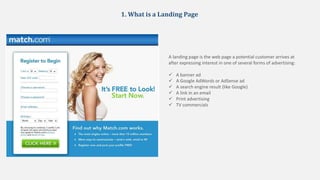
1. What is a Landing Page
A landing page is the web page a potential customer arrives at
after expressing interest in one of several forms of advertising:
 A banner ad
 A Google AdWords or AdSense ad
 A search engine result (like Google)
 A link in an email
 Print advertising
 TV commercials
2. Why should I Use a Landing Page
4. When should I Use a Landing Page
1. What is a Landing Page
5. Types of Landing Pages
7. The Anatomy of a Perfect Landing Page
10. Landing Page Optimization. What to Test on Landing Pages
9. A/B Testing. A/B Testing Tools
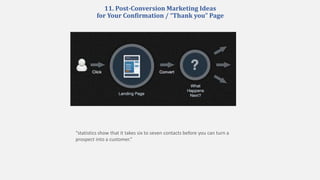
3. Landing Pages VS Homepages
13. Measuring Landing Page Performance
11. A/B Testing and SEO
12. Post conversion Marketing Strategies for a “Thank You” Page
Agenda
6. Click Trough & Lead Generation Landing Pages
8. Tips to Improve your User Experience
14. Useful Sources
2. Why Should I Use a Landing Page
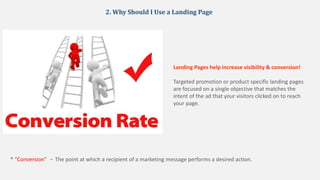
Landing Pages help increase visibility & conversion!
Targeted promotion or product specific landing pages
are focused on a single objective that matches the
intent of the ad that your visitors clicked on to reach
your page.
* “Conversion” - The point at which a recipient of a marketing message performs a desired action.
2. Why should I Use a Landing Page
4. When should I Use a Landing Page
1. What is a Landing Page
5. Types of Landing Pages
7. The Anatomy of a Perfect Landing Page
10. Landing Page Optimization. What to Test on Landing Pages
9. A/B Testing. A/B Testing Tools
3. Landing Pages VS Homepages
13. Measuring Landing Page Performance
11. A/B Testing and SEO
12. Post conversion Marketing Strategies for a “Thank You” Page
Agenda
6. Click Trough & Lead Generation Landing Pages
8. Tips to Improve your User Experience
14. Useful Sources
3. Landing Pages VS Homepages
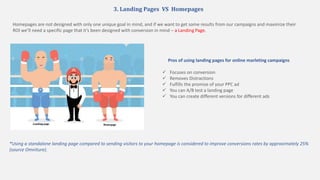
*Using a standalone landing page compared to sending visitors to your homepage is considered to improve conversions rates by approximately 25%
(source Omniture).
Pros of using landing pages for online marleting campaigns
 Focuses on conversion
 Removes Distractions
 Fulfills the promise of your PPC ad
 You can A/B test a landing page
 You can create different versions for different ads
Homepages are not designed with only one unique goal in mind, and if we want to get some results from our campaigns and maximize their
ROI we’ll need a specific page that it’s been designed with conversion in mind – a Landing Page.
2. Why should I Use a Landing Page
4. When should I Use a Landing Page
1. What is a Landing Page
5. Types of Landing Pages
7. The Anatomy of a Perfect Landing Page
10. Landing Page Optimization. What to Test on Landing Pages
9. A/B Testing. A/B Testing Tools
3. Landing Pages VS Homepages
13. Measuring Landing Page Performance
11. A/B Testing and SEO
12. Post conversion Marketing Strategies for a “Thank You” Page
Agenda
6. Click Trough & Lead Generation Landing Pages
8. Tips to Improve your User Experience
14. Useful Sources
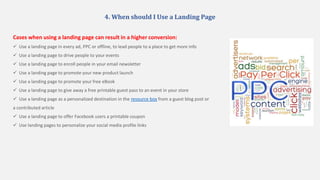
4. When should I Use a Landing Page
Cases when using a landing page can result in a higher conversion:
 Use a landing page in every ad, PPC or offline, to lead people to a place to get more info
 Use a landing page to drive people to your events
 Use a landing page to enroll people in your email newsletter
 Use a landing page to promote your new product launch
 Use a landing page to promote your free eBook
 Use a landing page to give away a free printable guest pass to an event in your store
 Use a landing page as a personalized destination in the resource box from a guest blog post or
a contributed article
 Use a landing page to offer Facebook users a printable coupon
 Use landing pages to personalize your social media profile links
2. Why should I Use a Landing Page
4. When should I Use a Landing Page
1. What is a Landing Page
5. Types of Landing Pages
7. The Anatomy of a Perfect Landing Page
10. Landing Page Optimization. What to Test on Landing Pages
9. A/B Testing. A/B Testing Tools
3. Landing Pages VS Homepages
13. Measuring Landing Page Performance
11. A/B Testing and SEO
12. Post conversion Marketing Strategies for a “Thank You” Page
Agenda
6. Click Trough & Lead Generation Landing Pages
8. Tips to Improve your User Experience
14. Useful Sources
5. Types of Landing Pages
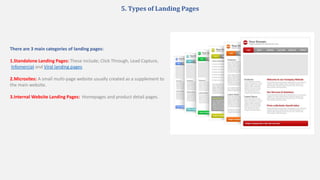
There are 3 main categories of landing pages:
1.Standalone Landing Pages: These include; Click Through, Lead Capture,
Infomercial and Viral landing pages.
2.Microsites: A small multi-page website usually created as a supplement to
the main website.
3.Internal Website Landing Pages: Homepages and product detail pages.
2. Why should I Use a Landing Page
4. When should I Use a Landing Page
1. What is a Landing Page
5. Types of Landing Pages
7. The Anatomy of a Perfect Landing Page
10. Landing Page Optimization. What to Test on Landing Pages
9. A/B Testing. A/B Testing Tools
3. Landing Pages VS Homepages
13. Measuring Landing Page Performance
11. A/B Testing and SEO
12. Post conversion Marketing Strategies for a “Thank You” Page
Agenda
6. Click Trough & Lead Generation Landing Pages
8. Tips to Improve your User Experience
14. Useful Sources
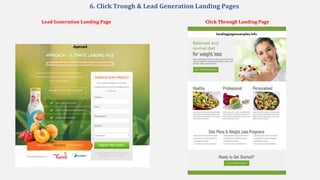
6. Click Trough & Lead Generation Landing Pages
Lead Generation Landing Page Click Through Landing Page
6. Click Trough & Lead Generation Landing Pages
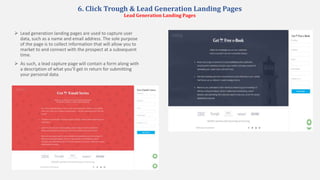
Lead Generation Landing Pages
 Lead generation landing pages are used to capture user
data, such as a name and email address. The sole purpose
of the page is to collect information that will allow you to
market to and connect with the prospect at a subsequent
time.
 As such, a lead capture page will contain a form along with
a description of what you’ll get in return for submitting
your personal data.
6. Click Trough & Lead Generation Landing Pages
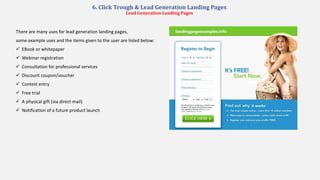
Lead Generation Landing Pages
There are many uses for lead generation landing pages,
some example uses and the items given to the user are listed below:
 EBook or whitepaper
 Webinar registration
 Consultation for professional services
 Discount coupon/voucher
 Contest entry
 Free trial
 A physical gift (via direct mail)
 Notification of a future product launch
6. Click Trough & Lead Generation Landing Pages
Click Through Landing Pages
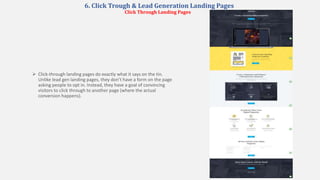
 Click-through landing pages do exactly what it says on the tin.
Unlike lead gen landing pages, they don’t have a form on the page
asking people to opt in. Instead, they have a goal of convincing
visitors to click through to another page (where the actual
conversion happens).
6. Click Trough & Lead Generation Landing Pages
Click Through Landing Pages
 Click trough landing pages are frequently used in ecommerce funnels
to describe a product in detail and “warm up” visitors for their
purchasing decision. They combat the cognitive dissonance that is
created when someone clicks on an ad for a specific product and they
wind up on a seemingly irrelevant generic product page.
2. Why should I Use a Landing Page
4. When should I Use a Landing Page
1. What is a Landing Page
5. Types of Landing Pages
7. The Anatomy of a Perfect Landing Page
10. Landing Page Optimization. What to Test on Landing Pages
9. A/B Testing. A/B Testing Tools
3. Landing Pages VS Homepages
13. Measuring Landing Page Performance
11. A/B Testing and SEO
12. Post conversion Marketing Strategies for a “Thank You” Page
Agenda
6. Click Trough & Lead Generation Landing Pages
8. Tips to Improve your User Experience
14. Useful Sources
7. The Anatomy of a Landing Page.
Landing Page Elements
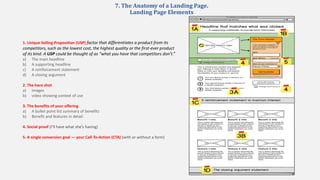
1. Unique Selling Proposition (USP) factor that differentiates a product from its
competitors, such as the lowest cost, the highest quality or the first-ever product
of its kind. A USP could be thought of as “what you have that competitors don't.”
a) The main headline
b) A supporting headline
c) A reinforcement statement
d) A closing argument
2. The hero shot
a) images
b) video showing context of use
3. The benefits of your offering
a) A bullet point list summary of benefits
b) Benefit and features in detail
4. Social proof (I’ll have what she’s having)
5. A single conversion goal — your Call-To-Action (CTA) (with or without a form)
2. Why should I Use a Landing Page
4. When should I Use a Landing Page
1. What is a Landing Page
5. Types of Landing Pages
7. The Anatomy of a Perfect Landing Page
10. Landing Page Optimization. What to Test on Landing Pages
9. A/B Testing. A/B Testing Tools
3. Landing Pages VS Homepages
13. Measuring Landing Page Performance
11. A/B Testing and SEO
12. Post conversion Marketing Strategies for a “Thank You” Page
Agenda
6. Click Trough & Lead Generation Landing Pages
8. Tips to Improve your User Experience
14. Useful Sources
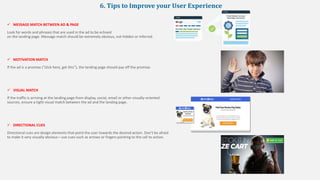
6. Tips to Improve your User Experience
 MESSAGE MATCH BETWEEN AD & PAGE
Look for words and phrases that are used in the ad to be echoed
on the landing page. Message match should be extremely obvious, not hidden or inferred.
 MOTIVATION MATCH
If the ad is a promise (“click here, get this”), the landing page should pay off the promise.
 VISUAL MATCH
If the traffic is arriving at the landing page from display, social, email or other visually-oriented
sources, ensure a tight visual match between the ad and the landing page.
 DIRECTIONAL CUES
Directional cues are design elements that point the user towards the desired action. Don’t be afraid
to make it very visually obvious—use cues such as arrows or fingers pointing to the call to action.
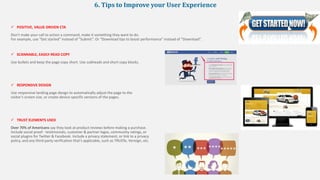
6. Tips to Improve your User Experience
 POSITIVE, VALUE-DRIVEN CTA
Don’t make your call to action a command, make it something they want to do.
For example, use “Get started” instead of “Submit”. Or “Download tips to boost performance” instead of “Download”.
 SCANNABLE, EASILY-READ COPY
Use bullets and keep the page copy short. Use subheads and short copy blocks.
 RESPONSIVE DESIGN
Use responsive landing page design to automatically adjust the page to the
visitor’s screen size, or create device-specific versions of the pages.
 TRUST ELEMENTS USED
Over 70% of Americans say they look at product reviews before making a purchase.
Include social proof - testimonials, customer & partner logos, community ratings, or
social plugins for Twitter & Facebook. Include a privacy statement, or link to a privacy
policy, and any third-party verification that’s applicable, such as TRUSTe, Verisign, etc.
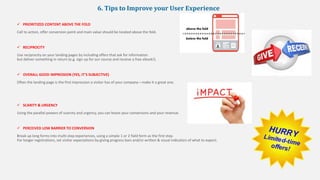
6. Tips to Improve your User Experience
 PRIORITIZED CONTENT ABOVE THE FOLD
Call to action, offer conversion point and main value should be located above the fold.
 RECIPROCITY
Use reciprocity on your landing pages by including offers that ask for information
but deliver something in return (e.g. sign up for our course and receive a free ebook!).
 OVERALL GOOD IMPRESSION (YES, IT’S SUBJECTIVE)
Often the landing page is the first impression a visitor has of your company—make it a great one.
 SCARITY & URGENCY
Using the parallel powers of scarcity and urgency, you can boost your conversions and your revenue.
 PERCEIVED LOW BARRIER TO CONVERSION
Break up long forms into multi-step experiences, using a simple 1 or 2 field form as the first step.
For longer registrations, set visitor expectations by giving progress bars and/or written & visual indicators of what to expect.
2. Why should I Use a Landing Page
4. When should I Use a Landing Page
1. What is a Landing Page
5. Types of Landing Pages
7. The Anatomy of a Perfect Landing Page
10. Landing Page Optimization. What to Test on Landing Pages
9. A/B Testing. A/B Testing Tools
3. Landing Pages VS Homepages
13. Measuring Landing Page Performance
11. A/B Testing and SEO
12. Post conversion Marketing Strategies for a “Thank You” Page
Agenda
6. Click Trough & Lead Generation Landing Pages
8. Tips to Improve your User Experience
14. Useful Sources
8. A/B testing
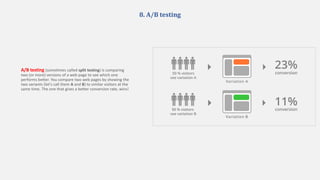
A/B testing (sometimes called split testing) is comparing
two (or more) versions of a web page to see which one
performs better. You compare two web pages by showing the
two variants (let's call them A and B) to similar visitors at the
same time. The one that gives a better conversion rate, wins!
8. A/B Testing Framework
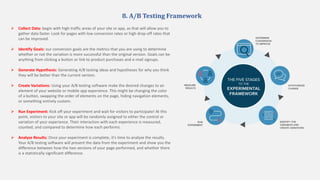
 Collect Data: begin with high traffic areas of your site or app, as that will allow you to
gather data faster. Look for pages with low conversion rates or high drop-off rates that
can be improved.
 Identify Goals: our conversion goals are the metrics that you are using to determine
whether or not the variation is more successful than the original version. Goals can be
anything from clicking a button or link to product purchases and e-mail signups.
 Generate Hypothesis: Generating A/B testing ideas and hypotheses for why you think
they will be better than the current version.
 Create Variations: Using your A/B testing software make the desired changes to an
element of your website or mobile app experience. This might be changing the color
of a button, swapping the order of elements on the page, hiding navigation elements,
or something entirely custom.
 Run Experiment: Kick off your experiment and wait for visitors to participate! At this
point, visitors to your site or app will be randomly assigned to either the control or
variation of your experience. Their interaction with each experience is measured,
counted, and compared to determine how each performs.
 Analyze Results: Once your experiment is complete, it's time to analyze the results.
Your A/B testing software will present the data from the experiment and show you the
difference between how the two versions of your page performed, and whether there
is a statistically significant difference.
8. A/B Testing Tools
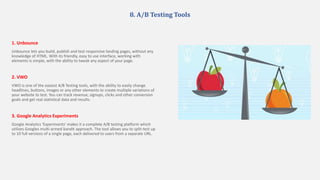
1. Unbounce
Unbounce lets you build, publish and test responsive landing pages, without any
knowledge of HTML. With its friendly, easy to use interface, working with
elements is simple, with the ability to tweak any aspect of your page.
2. VWO
VWO is one of the easiest A/B Testing tools, with the ability to easily change
headlines, buttons, images or any other elements to create multiple variations of
your website to test. You can track revenue, signups, clicks and other conversion
goals and get real statistical data and results.
3. Google Analytics Experiments
Google Analytics 'Experiments' makes it a complete A/B testing platform which
utilizes Googles multi-armed bandit approach. The tool allows you to split-test up
to 10 full versions of a single page, each delivered to users from a separate URL.
2. Why should I Use a Landing Page
4. When should I Use a Landing Page
1. What is a Landing Page
5. Types of Landing Pages
7. The Anatomy of a Perfect Landing Page
10. Landing Page Optimization. What to Test on Landing Pages
9. A/B Testing. A/B Testing Tools
3. Landing Pages VS Homepages
13. Measuring Landing Page Performance
11. A/B Testing and SEO
12. Post conversion Marketing Strategies for a “Thank You” Page
Agenda
6. Click Trough & Lead Generation Landing Pages
8. Tips to Improve your User Experience
14. Useful Sources
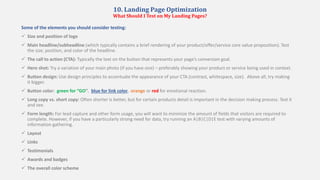
10. Landing Page Optimization
What Should I Test on My Landing Pages?
Some of the elements you should consider testing:
 Size and position of logo
 Main headline/subheadline (which typically contains a brief rendering of your product/offer/service core value proposition). Test
the size, position, and color of the headline.
 The call to action (CTA): Typically the text on the button that represents your page’s conversion goal.
 Hero shot: Try a variation of your main photo (if you have one) – preferably showing your product or service being used in context.
 Button design: Use design principles to accentuate the appearance of your CTA (contrast, whitespace, size). Above all, try making
it bigger.
 Button color: green for “GO”, blue for link color, orange or red for emotional reaction.
 Long copy vs. short copy: Often shorter is better, but for certain products detail is important in the decision making process. Test it
and see.
 Form length: For lead capture and other form usage, you will want to minimize the amount of fields that visitors are required to
complete. However, if you have a particularly strong need for data, try running an A|B|C|D|E test with varying amounts of
information gathering.
 Layout
 Links
 Testimonials
 Awards and badges
 The overall color scheme
2. Why should I Use a Landing Page
4. When should I Use a Landing Page
1. What is a Landing Page
5. Types of Landing Pages
7. The Anatomy of a Perfect Landing Page
10. Landing Page Optimization. What to Test on Landing Pages
9. A/B Testing. A/B Testing Tools
3. Landing Pages VS Homepages
13. Measuring Landing Page Performance
11. A/B Testing and SEO
12. Post conversion Marketing Strategies for a “Thank You” Page
Agenda
6. Click Trough & Lead Generation Landing Pages
8. Tips to Improve your User Experience
14. Useful Sources
9. A/B Testing and SEO
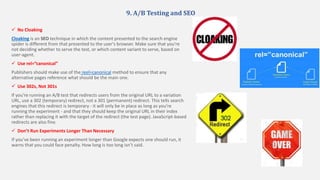
 No Cloaking
Cloaking is an SEO technique in which the content presented to the search engine
spider is different from that presented to the user's browser. Make sure that you're
not deciding whether to serve the test, or which content variant to serve, based on
user-agent.
 Use rel=”canonical”
Publishers should make use of the reel=canonical method to ensure that any
alternative pages reference what should be the main one.
 Use 302s, Not 301s
If you're running an A/B test that redirects users from the original URL to a variation
URL, use a 302 (temporary) redirect, not a 301 (permanent) redirect. This tells search
engines that this redirect is temporary - it will only be in place as long as you're
running the experiment - and that they should keep the original URL in their index
rather than replacing it with the target of the redirect (the test page). JavaScript-based
redirects are also fine.
 Don’t Run Experiments Longer Than Necessary
If you’ve been running an experiment longer than Google expects one should run, it
warns that you could face penalty. How long is too long isn’t said.
2. Why should I Use a Landing Page
4. When should I Use a Landing Page
1. What is a Landing Page
5. Types of Landing Pages
7. The Anatomy of a Perfect Landing Page
10. Landing Page Optimization. What to Test on Landing Pages
9. A/B Testing. A/B Testing Tools
3. Landing Pages VS Homepages
13. Measuring Landing Page Performance
11. A/B Testing and SEO
12. Post conversion Marketing Strategies for a “Thank You” Page
Agenda
6. Click Trough & Lead Generation Landing Pages
8. Tips to Improve your User Experience
14. Useful Sources
11. Post-Conversion Marketing Ideas
for Your Confirmation / “Thank you” Page
“statistics show that it takes six to seven contacts before you can turn a
prospect into a customer.”
11. Post-Conversion Marketing Ideas
for Your Confirmation / “Thank you” Page
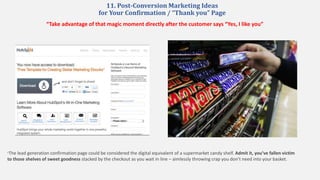
“Take advantage of that magic moment directly after the customer says “Yes, I like you”
*The lead generation confirmation page could be considered the digital equivalent of a supermarket candy shelf. Admit it, you’ve fallen victim
to those shelves of sweet goodness stacked by the checkout as you wait in line – aimlessly throwing crap you don’t need into your basket.
11. Post-Conversion Marketing Ideas
for Your Confirmation / “Thank you” Page
 Ask to follow you via social media (Twitter, Facebook) to learn about other opportunities
 Invite to a webinar
 Give a discount coupon (or code)
 Send to an important “What To Do Next” page
 Ask to subscribe to a drip campaign
 Offer a relevant product or service
 Ask to upgrade showing the advantages
2. Why should I Use a Landing Page
4. When should I Use a Landing Page
1. What is a Landing Page
5. Types of Landing Pages
7. The Anatomy of a Perfect Landing Page
10. Landing Page Optimization. What to Test on Landing Pages
9. A/B Testing. A/B Testing Tools
3. Landing Pages VS Homepages
13. Measuring Landing Page Performance
11. A/B Testing and SEO
12. Post conversion Marketing Strategies for a “Thank You” Page
Agenda
6. Click Trough & Lead Generation Landing Pages
8. Tips to Improve your User Experience
14. Useful Sources
12. Measuring Landing Page Performance
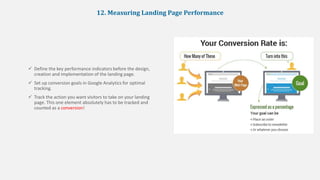
 Define the key performance indicators before the design,
creation and implementation of the landing page.
 Set up conversion goals in Google Analytics for optimal
tracking.
 Track the action you want visitors to take on your landing
page. This one element absolutely has to be tracked and
counted as a conversion!
12. Measuring Landing Page Performance
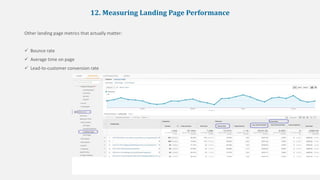
Other landing page metrics that actually matter:
 Bounce rate
 Average time on page
 Lead-to-customer conversion rate
2. Why should I Use a Landing Page
4. When should I Use a Landing Page
1. What is a Landing Page
5. Types of Landing Pages
7. The Anatomy of a Perfect Landing Page
10. Landing Page Optimization. What to Test on Landing Pages
9. A/B Testing. A/B Testing Tools
3. Landing Pages VS Homepages
13. Measuring Landing Page Performance
11. A/B Testing and SEO
12. Post conversion Marketing Strategies for a “Thank You” Page
Agenda
6. Click Trough & Lead Generation Landing Pages
8. Tips to Improve your User Experience
14. Useful Sources
Sources
http://unbounce.com/landing-pages/7-elements-of-a-winning-landing-page/
http://unbounce.com/landing-pages/7-types-of-landing-page/
https://support.kickofflabs.com/education/what-is-a-viral-landing-page
https://www.optimizely.com/optimization-glossary/statistical-significance/
https://landerapp.com/blog/5-reasons-to-use-a-landing-page-instead-of-your-homepage/
http://unbounce.com/landing-pages/7-types-of-landing-page/
https://www.impactbnd.com/blog/thank-you-page-examples
http://unbounce.com/conversion-rate-optimization/using-analytics-to-measure-your-landing-page-performance/https://www.semrush.com/blog/3-landing-
page-metrics-that-actually-matter/
http://tech.co/demystifying-conversion-rate-optimization-2015-10
http://unbounce.com/conversion-rate-optimization/using-analytics-to-measure-your-landing-page-performance/
http://unbounce.com/lead-generation/post-conversion-strategy-for-lead-gen-landing-pages/
https://ariadpartners.com/how-to-measure-landing-page-performance/
http://searchengineland.com/googles-seo-guide-on-ab-multivariate-testing-130093
https://vwo.com/ab-testing/
http://support.google.com/webmasters/bin/answer.py?hl=en&answer=139394
http://mashable.com/2015/01/30/ab-testing-tools/#3SYmoRdXwaqZ
https://www.optimizely.com/ab-testing/
2. Why should I Use a Landing Page
4. When should I Use a Landing Page
1. What is a Landing Page
5. Types of Landing Pages
7. The Anatomy of a Perfect Landing Page
10. Landing Page Optimization. What to Test on Landing Pages
9. A/B Testing. A/B Testing Tools
3. Landing Pages VS Homepages
13. Measuring Landing Page Performance
11. A/B Testing and SEO
12. Post conversion Marketing Strategies for a “Thank You” Page
Agenda
6. Click Trough & Lead Generation Landing Pages
8. Tips to Improve your User Experience
14. Useful Sources

Landing Pages Presentation

  • 1.
  • 2.
    2. Why shouldI Use a Landing Page 4. When should I Use a Landing Page 1. What is a Landing Page 5. Types of Landing Pages 7. The Anatomy of a Perfect Landing Page 10. Landing Page Optimization. What to Test on Landing Pages 9. A/B Testing. A/B Testing Tools 3. Landing Pages VS Homepages 13. Measuring Landing Page Performance 11. A/B Testing and SEO 12. Post conversion Marketing Strategies for a “Thank You” Page Agenda 6. Click Trough & Lead Generation Landing Pages 8. Tips to Improve your User Experience 14. Useful Sources
  • 3.
    1. What isa Landing Page A landing page is the web page a potential customer arrives at after expressing interest in one of several forms of advertising:  A banner ad  A Google AdWords or AdSense ad  A search engine result (like Google)  A link in an email  Print advertising  TV commercials
  • 4.
    2. Why shouldI Use a Landing Page 4. When should I Use a Landing Page 1. What is a Landing Page 5. Types of Landing Pages 7. The Anatomy of a Perfect Landing Page 10. Landing Page Optimization. What to Test on Landing Pages 9. A/B Testing. A/B Testing Tools 3. Landing Pages VS Homepages 13. Measuring Landing Page Performance 11. A/B Testing and SEO 12. Post conversion Marketing Strategies for a “Thank You” Page Agenda 6. Click Trough & Lead Generation Landing Pages 8. Tips to Improve your User Experience 14. Useful Sources
  • 5.
    2. Why ShouldI Use a Landing Page Landing Pages help increase visibility & conversion! Targeted promotion or product specific landing pages are focused on a single objective that matches the intent of the ad that your visitors clicked on to reach your page. * “Conversion” - The point at which a recipient of a marketing message performs a desired action.
  • 6.
    2. Why shouldI Use a Landing Page 4. When should I Use a Landing Page 1. What is a Landing Page 5. Types of Landing Pages 7. The Anatomy of a Perfect Landing Page 10. Landing Page Optimization. What to Test on Landing Pages 9. A/B Testing. A/B Testing Tools 3. Landing Pages VS Homepages 13. Measuring Landing Page Performance 11. A/B Testing and SEO 12. Post conversion Marketing Strategies for a “Thank You” Page Agenda 6. Click Trough & Lead Generation Landing Pages 8. Tips to Improve your User Experience 14. Useful Sources
  • 7.
    3. Landing PagesVS Homepages *Using a standalone landing page compared to sending visitors to your homepage is considered to improve conversions rates by approximately 25% (source Omniture). Pros of using landing pages for online marleting campaigns  Focuses on conversion  Removes Distractions  Fulfills the promise of your PPC ad  You can A/B test a landing page  You can create different versions for different ads Homepages are not designed with only one unique goal in mind, and if we want to get some results from our campaigns and maximize their ROI we’ll need a specific page that it’s been designed with conversion in mind – a Landing Page.
  • 8.
    2. Why shouldI Use a Landing Page 4. When should I Use a Landing Page 1. What is a Landing Page 5. Types of Landing Pages 7. The Anatomy of a Perfect Landing Page 10. Landing Page Optimization. What to Test on Landing Pages 9. A/B Testing. A/B Testing Tools 3. Landing Pages VS Homepages 13. Measuring Landing Page Performance 11. A/B Testing and SEO 12. Post conversion Marketing Strategies for a “Thank You” Page Agenda 6. Click Trough & Lead Generation Landing Pages 8. Tips to Improve your User Experience 14. Useful Sources
  • 9.
    4. When shouldI Use a Landing Page Cases when using a landing page can result in a higher conversion:  Use a landing page in every ad, PPC or offline, to lead people to a place to get more info  Use a landing page to drive people to your events  Use a landing page to enroll people in your email newsletter  Use a landing page to promote your new product launch  Use a landing page to promote your free eBook  Use a landing page to give away a free printable guest pass to an event in your store  Use a landing page as a personalized destination in the resource box from a guest blog post or a contributed article  Use a landing page to offer Facebook users a printable coupon  Use landing pages to personalize your social media profile links
  • 10.
    2. Why shouldI Use a Landing Page 4. When should I Use a Landing Page 1. What is a Landing Page 5. Types of Landing Pages 7. The Anatomy of a Perfect Landing Page 10. Landing Page Optimization. What to Test on Landing Pages 9. A/B Testing. A/B Testing Tools 3. Landing Pages VS Homepages 13. Measuring Landing Page Performance 11. A/B Testing and SEO 12. Post conversion Marketing Strategies for a “Thank You” Page Agenda 6. Click Trough & Lead Generation Landing Pages 8. Tips to Improve your User Experience 14. Useful Sources
  • 11.
    5. Types ofLanding Pages There are 3 main categories of landing pages: 1.Standalone Landing Pages: These include; Click Through, Lead Capture, Infomercial and Viral landing pages. 2.Microsites: A small multi-page website usually created as a supplement to the main website. 3.Internal Website Landing Pages: Homepages and product detail pages.
  • 12.
    2. Why shouldI Use a Landing Page 4. When should I Use a Landing Page 1. What is a Landing Page 5. Types of Landing Pages 7. The Anatomy of a Perfect Landing Page 10. Landing Page Optimization. What to Test on Landing Pages 9. A/B Testing. A/B Testing Tools 3. Landing Pages VS Homepages 13. Measuring Landing Page Performance 11. A/B Testing and SEO 12. Post conversion Marketing Strategies for a “Thank You” Page Agenda 6. Click Trough & Lead Generation Landing Pages 8. Tips to Improve your User Experience 14. Useful Sources
  • 13.
    6. Click Trough& Lead Generation Landing Pages Lead Generation Landing Page Click Through Landing Page
  • 14.
    6. Click Trough& Lead Generation Landing Pages Lead Generation Landing Pages  Lead generation landing pages are used to capture user data, such as a name and email address. The sole purpose of the page is to collect information that will allow you to market to and connect with the prospect at a subsequent time.  As such, a lead capture page will contain a form along with a description of what you’ll get in return for submitting your personal data.
  • 15.
    6. Click Trough& Lead Generation Landing Pages Lead Generation Landing Pages There are many uses for lead generation landing pages, some example uses and the items given to the user are listed below:  EBook or whitepaper  Webinar registration  Consultation for professional services  Discount coupon/voucher  Contest entry  Free trial  A physical gift (via direct mail)  Notification of a future product launch
  • 16.
    6. Click Trough& Lead Generation Landing Pages Click Through Landing Pages  Click-through landing pages do exactly what it says on the tin. Unlike lead gen landing pages, they don’t have a form on the page asking people to opt in. Instead, they have a goal of convincing visitors to click through to another page (where the actual conversion happens).
  • 17.
    6. Click Trough& Lead Generation Landing Pages Click Through Landing Pages  Click trough landing pages are frequently used in ecommerce funnels to describe a product in detail and “warm up” visitors for their purchasing decision. They combat the cognitive dissonance that is created when someone clicks on an ad for a specific product and they wind up on a seemingly irrelevant generic product page.
  • 18.
    2. Why shouldI Use a Landing Page 4. When should I Use a Landing Page 1. What is a Landing Page 5. Types of Landing Pages 7. The Anatomy of a Perfect Landing Page 10. Landing Page Optimization. What to Test on Landing Pages 9. A/B Testing. A/B Testing Tools 3. Landing Pages VS Homepages 13. Measuring Landing Page Performance 11. A/B Testing and SEO 12. Post conversion Marketing Strategies for a “Thank You” Page Agenda 6. Click Trough & Lead Generation Landing Pages 8. Tips to Improve your User Experience 14. Useful Sources
  • 19.
    7. The Anatomyof a Landing Page. Landing Page Elements 1. Unique Selling Proposition (USP) factor that differentiates a product from its competitors, such as the lowest cost, the highest quality or the first-ever product of its kind. A USP could be thought of as “what you have that competitors don't.” a) The main headline b) A supporting headline c) A reinforcement statement d) A closing argument 2. The hero shot a) images b) video showing context of use 3. The benefits of your offering a) A bullet point list summary of benefits b) Benefit and features in detail 4. Social proof (I’ll have what she’s having) 5. A single conversion goal — your Call-To-Action (CTA) (with or without a form)
  • 20.
    2. Why shouldI Use a Landing Page 4. When should I Use a Landing Page 1. What is a Landing Page 5. Types of Landing Pages 7. The Anatomy of a Perfect Landing Page 10. Landing Page Optimization. What to Test on Landing Pages 9. A/B Testing. A/B Testing Tools 3. Landing Pages VS Homepages 13. Measuring Landing Page Performance 11. A/B Testing and SEO 12. Post conversion Marketing Strategies for a “Thank You” Page Agenda 6. Click Trough & Lead Generation Landing Pages 8. Tips to Improve your User Experience 14. Useful Sources
  • 21.
    6. Tips toImprove your User Experience  MESSAGE MATCH BETWEEN AD & PAGE Look for words and phrases that are used in the ad to be echoed on the landing page. Message match should be extremely obvious, not hidden or inferred.  MOTIVATION MATCH If the ad is a promise (“click here, get this”), the landing page should pay off the promise.  VISUAL MATCH If the traffic is arriving at the landing page from display, social, email or other visually-oriented sources, ensure a tight visual match between the ad and the landing page.  DIRECTIONAL CUES Directional cues are design elements that point the user towards the desired action. Don’t be afraid to make it very visually obvious—use cues such as arrows or fingers pointing to the call to action.
  • 22.
    6. Tips toImprove your User Experience  POSITIVE, VALUE-DRIVEN CTA Don’t make your call to action a command, make it something they want to do. For example, use “Get started” instead of “Submit”. Or “Download tips to boost performance” instead of “Download”.  SCANNABLE, EASILY-READ COPY Use bullets and keep the page copy short. Use subheads and short copy blocks.  RESPONSIVE DESIGN Use responsive landing page design to automatically adjust the page to the visitor’s screen size, or create device-specific versions of the pages.  TRUST ELEMENTS USED Over 70% of Americans say they look at product reviews before making a purchase. Include social proof - testimonials, customer & partner logos, community ratings, or social plugins for Twitter & Facebook. Include a privacy statement, or link to a privacy policy, and any third-party verification that’s applicable, such as TRUSTe, Verisign, etc.
  • 23.
    6. Tips toImprove your User Experience  PRIORITIZED CONTENT ABOVE THE FOLD Call to action, offer conversion point and main value should be located above the fold.  RECIPROCITY Use reciprocity on your landing pages by including offers that ask for information but deliver something in return (e.g. sign up for our course and receive a free ebook!).  OVERALL GOOD IMPRESSION (YES, IT’S SUBJECTIVE) Often the landing page is the first impression a visitor has of your company—make it a great one.  SCARITY & URGENCY Using the parallel powers of scarcity and urgency, you can boost your conversions and your revenue.  PERCEIVED LOW BARRIER TO CONVERSION Break up long forms into multi-step experiences, using a simple 1 or 2 field form as the first step. For longer registrations, set visitor expectations by giving progress bars and/or written & visual indicators of what to expect.
  • 24.
    2. Why shouldI Use a Landing Page 4. When should I Use a Landing Page 1. What is a Landing Page 5. Types of Landing Pages 7. The Anatomy of a Perfect Landing Page 10. Landing Page Optimization. What to Test on Landing Pages 9. A/B Testing. A/B Testing Tools 3. Landing Pages VS Homepages 13. Measuring Landing Page Performance 11. A/B Testing and SEO 12. Post conversion Marketing Strategies for a “Thank You” Page Agenda 6. Click Trough & Lead Generation Landing Pages 8. Tips to Improve your User Experience 14. Useful Sources
  • 25.
    8. A/B testing A/Btesting (sometimes called split testing) is comparing two (or more) versions of a web page to see which one performs better. You compare two web pages by showing the two variants (let's call them A and B) to similar visitors at the same time. The one that gives a better conversion rate, wins!
  • 26.
    8. A/B TestingFramework  Collect Data: begin with high traffic areas of your site or app, as that will allow you to gather data faster. Look for pages with low conversion rates or high drop-off rates that can be improved.  Identify Goals: our conversion goals are the metrics that you are using to determine whether or not the variation is more successful than the original version. Goals can be anything from clicking a button or link to product purchases and e-mail signups.  Generate Hypothesis: Generating A/B testing ideas and hypotheses for why you think they will be better than the current version.  Create Variations: Using your A/B testing software make the desired changes to an element of your website or mobile app experience. This might be changing the color of a button, swapping the order of elements on the page, hiding navigation elements, or something entirely custom.  Run Experiment: Kick off your experiment and wait for visitors to participate! At this point, visitors to your site or app will be randomly assigned to either the control or variation of your experience. Their interaction with each experience is measured, counted, and compared to determine how each performs.  Analyze Results: Once your experiment is complete, it's time to analyze the results. Your A/B testing software will present the data from the experiment and show you the difference between how the two versions of your page performed, and whether there is a statistically significant difference.
  • 27.
    8. A/B TestingTools 1. Unbounce Unbounce lets you build, publish and test responsive landing pages, without any knowledge of HTML. With its friendly, easy to use interface, working with elements is simple, with the ability to tweak any aspect of your page. 2. VWO VWO is one of the easiest A/B Testing tools, with the ability to easily change headlines, buttons, images or any other elements to create multiple variations of your website to test. You can track revenue, signups, clicks and other conversion goals and get real statistical data and results. 3. Google Analytics Experiments Google Analytics 'Experiments' makes it a complete A/B testing platform which utilizes Googles multi-armed bandit approach. The tool allows you to split-test up to 10 full versions of a single page, each delivered to users from a separate URL.
  • 28.
    2. Why shouldI Use a Landing Page 4. When should I Use a Landing Page 1. What is a Landing Page 5. Types of Landing Pages 7. The Anatomy of a Perfect Landing Page 10. Landing Page Optimization. What to Test on Landing Pages 9. A/B Testing. A/B Testing Tools 3. Landing Pages VS Homepages 13. Measuring Landing Page Performance 11. A/B Testing and SEO 12. Post conversion Marketing Strategies for a “Thank You” Page Agenda 6. Click Trough & Lead Generation Landing Pages 8. Tips to Improve your User Experience 14. Useful Sources
  • 29.
    10. Landing PageOptimization What Should I Test on My Landing Pages? Some of the elements you should consider testing:  Size and position of logo  Main headline/subheadline (which typically contains a brief rendering of your product/offer/service core value proposition). Test the size, position, and color of the headline.  The call to action (CTA): Typically the text on the button that represents your page’s conversion goal.  Hero shot: Try a variation of your main photo (if you have one) – preferably showing your product or service being used in context.  Button design: Use design principles to accentuate the appearance of your CTA (contrast, whitespace, size). Above all, try making it bigger.  Button color: green for “GO”, blue for link color, orange or red for emotional reaction.  Long copy vs. short copy: Often shorter is better, but for certain products detail is important in the decision making process. Test it and see.  Form length: For lead capture and other form usage, you will want to minimize the amount of fields that visitors are required to complete. However, if you have a particularly strong need for data, try running an A|B|C|D|E test with varying amounts of information gathering.  Layout  Links  Testimonials  Awards and badges  The overall color scheme
  • 30.
    2. Why shouldI Use a Landing Page 4. When should I Use a Landing Page 1. What is a Landing Page 5. Types of Landing Pages 7. The Anatomy of a Perfect Landing Page 10. Landing Page Optimization. What to Test on Landing Pages 9. A/B Testing. A/B Testing Tools 3. Landing Pages VS Homepages 13. Measuring Landing Page Performance 11. A/B Testing and SEO 12. Post conversion Marketing Strategies for a “Thank You” Page Agenda 6. Click Trough & Lead Generation Landing Pages 8. Tips to Improve your User Experience 14. Useful Sources
  • 31.
    9. A/B Testingand SEO  No Cloaking Cloaking is an SEO technique in which the content presented to the search engine spider is different from that presented to the user's browser. Make sure that you're not deciding whether to serve the test, or which content variant to serve, based on user-agent.  Use rel=”canonical” Publishers should make use of the reel=canonical method to ensure that any alternative pages reference what should be the main one.  Use 302s, Not 301s If you're running an A/B test that redirects users from the original URL to a variation URL, use a 302 (temporary) redirect, not a 301 (permanent) redirect. This tells search engines that this redirect is temporary - it will only be in place as long as you're running the experiment - and that they should keep the original URL in their index rather than replacing it with the target of the redirect (the test page). JavaScript-based redirects are also fine.  Don’t Run Experiments Longer Than Necessary If you’ve been running an experiment longer than Google expects one should run, it warns that you could face penalty. How long is too long isn’t said.
  • 32.
    2. Why shouldI Use a Landing Page 4. When should I Use a Landing Page 1. What is a Landing Page 5. Types of Landing Pages 7. The Anatomy of a Perfect Landing Page 10. Landing Page Optimization. What to Test on Landing Pages 9. A/B Testing. A/B Testing Tools 3. Landing Pages VS Homepages 13. Measuring Landing Page Performance 11. A/B Testing and SEO 12. Post conversion Marketing Strategies for a “Thank You” Page Agenda 6. Click Trough & Lead Generation Landing Pages 8. Tips to Improve your User Experience 14. Useful Sources
  • 33.
    11. Post-Conversion MarketingIdeas for Your Confirmation / “Thank you” Page “statistics show that it takes six to seven contacts before you can turn a prospect into a customer.”
  • 34.
    11. Post-Conversion MarketingIdeas for Your Confirmation / “Thank you” Page “Take advantage of that magic moment directly after the customer says “Yes, I like you” *The lead generation confirmation page could be considered the digital equivalent of a supermarket candy shelf. Admit it, you’ve fallen victim to those shelves of sweet goodness stacked by the checkout as you wait in line – aimlessly throwing crap you don’t need into your basket.
  • 35.
    11. Post-Conversion MarketingIdeas for Your Confirmation / “Thank you” Page  Ask to follow you via social media (Twitter, Facebook) to learn about other opportunities  Invite to a webinar  Give a discount coupon (or code)  Send to an important “What To Do Next” page  Ask to subscribe to a drip campaign  Offer a relevant product or service  Ask to upgrade showing the advantages
  • 36.
    2. Why shouldI Use a Landing Page 4. When should I Use a Landing Page 1. What is a Landing Page 5. Types of Landing Pages 7. The Anatomy of a Perfect Landing Page 10. Landing Page Optimization. What to Test on Landing Pages 9. A/B Testing. A/B Testing Tools 3. Landing Pages VS Homepages 13. Measuring Landing Page Performance 11. A/B Testing and SEO 12. Post conversion Marketing Strategies for a “Thank You” Page Agenda 6. Click Trough & Lead Generation Landing Pages 8. Tips to Improve your User Experience 14. Useful Sources
  • 37.
    12. Measuring LandingPage Performance  Define the key performance indicators before the design, creation and implementation of the landing page.  Set up conversion goals in Google Analytics for optimal tracking.  Track the action you want visitors to take on your landing page. This one element absolutely has to be tracked and counted as a conversion!
  • 38.
    12. Measuring LandingPage Performance Other landing page metrics that actually matter:  Bounce rate  Average time on page  Lead-to-customer conversion rate
  • 39.
    2. Why shouldI Use a Landing Page 4. When should I Use a Landing Page 1. What is a Landing Page 5. Types of Landing Pages 7. The Anatomy of a Perfect Landing Page 10. Landing Page Optimization. What to Test on Landing Pages 9. A/B Testing. A/B Testing Tools 3. Landing Pages VS Homepages 13. Measuring Landing Page Performance 11. A/B Testing and SEO 12. Post conversion Marketing Strategies for a “Thank You” Page Agenda 6. Click Trough & Lead Generation Landing Pages 8. Tips to Improve your User Experience 14. Useful Sources
  • 40.
    Sources http://unbounce.com/landing-pages/7-elements-of-a-winning-landing-page/ http://unbounce.com/landing-pages/7-types-of-landing-page/ https://support.kickofflabs.com/education/what-is-a-viral-landing-page https://www.optimizely.com/optimization-glossary/statistical-significance/ https://landerapp.com/blog/5-reasons-to-use-a-landing-page-instead-of-your-homepage/ http://unbounce.com/landing-pages/7-types-of-landing-page/ https://www.impactbnd.com/blog/thank-you-page-examples http://unbounce.com/conversion-rate-optimization/using-analytics-to-measure-your-landing-page-performance/https://www.semrush.com/blog/3-landing- page-metrics-that-actually-matter/ http://tech.co/demystifying-conversion-rate-optimization-2015-10 http://unbounce.com/conversion-rate-optimization/using-analytics-to-measure-your-landing-page-performance/ http://unbounce.com/lead-generation/post-conversion-strategy-for-lead-gen-landing-pages/ https://ariadpartners.com/how-to-measure-landing-page-performance/ http://searchengineland.com/googles-seo-guide-on-ab-multivariate-testing-130093 https://vwo.com/ab-testing/ http://support.google.com/webmasters/bin/answer.py?hl=en&answer=139394 http://mashable.com/2015/01/30/ab-testing-tools/#3SYmoRdXwaqZ https://www.optimizely.com/ab-testing/
  • 41.
    2. Why shouldI Use a Landing Page 4. When should I Use a Landing Page 1. What is a Landing Page 5. Types of Landing Pages 7. The Anatomy of a Perfect Landing Page 10. Landing Page Optimization. What to Test on Landing Pages 9. A/B Testing. A/B Testing Tools 3. Landing Pages VS Homepages 13. Measuring Landing Page Performance 11. A/B Testing and SEO 12. Post conversion Marketing Strategies for a “Thank You” Page Agenda 6. Click Trough & Lead Generation Landing Pages 8. Tips to Improve your User Experience 14. Useful Sources