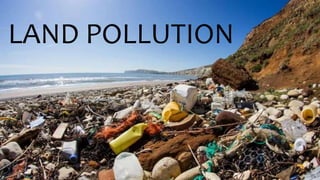
LAND POLLUTION
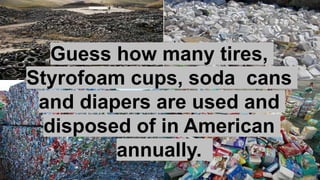
Guess how many tires,
Styrofoam cups, soda cans
and diapers are used and
disposed of in American
annually.
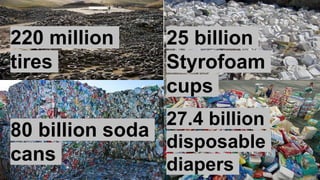
220 million
tires
25 billion
Styrofoam
cups
27.4 billion
disposable
diapers
80 billion soda
cans
LESSON OBJECTIVES
AT THE END OF THIS LESSON STUDENTS WILL BE ABLE TO ANSWER THE
FOLLOWING:
1. RECALL A DEFINITION FOR POLLUTION AND POLLUTANT
2. WRITE A DEFINITION FOR LAND POLLUTION
3. CLASSIFY THE MAIN LAND POLLUTANTS
4. CLEARLY DISTINGUISH BETWEEN BIODEGRADABLE AND NON- BIODEGRADABLE
5. SUGGEST METHODS OF CONTROLING THE MAIN LAND POLLUTANTS
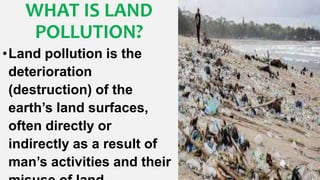
WHAT IS LAND
POLLUTION?
•Land pollution is the
deterioration
(destruction) of the
earth’s land surfaces,
often directly or
indirectly as a result of
man’s activities and their
NAME POLLUTANTS
• MAKE A LIST
PLACE THE LISTED MATERIAL INTO GROUPS
(CHEMICAL
SOLID WASTE
CONTAINERS
BIOMEDICAL WASTE )
• TOOLS
• GLASS
• GLOVES
• OIL
• STYROFOAM
• GOWNS
• GASOLINE
Batteries
Cars
Rubber
Needles
Fertilizers
Appliances
Plastic
Wound dressings
Pesticides
CLASSIFY THE POLLUTANTS
• PADLET
HOW DID YOU
GROUP YOUR
POLLUTANTS?
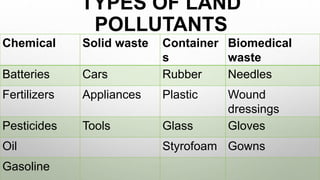
TYPES OF LAND
POLLUTANTS
Chemical Solid waste Container
s
Biomedical
waste
Batteries Cars Rubber Needles
Fertilizers Appliances Plastic Wound
dressings
Pesticides Tools Glass Gloves
Oil Styrofoam Gowns
Gasoline
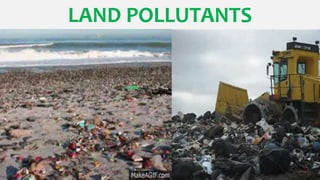
LAND POLLUTANTS
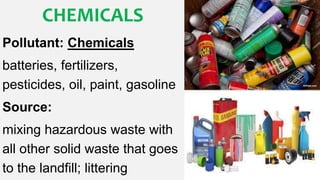
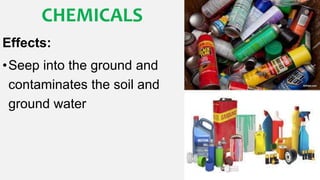
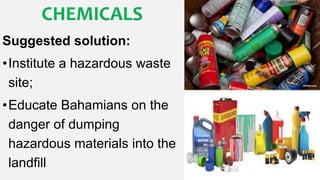
CHEMICALS
Pollutant: Chemicals
batteries, fertilizers,
pesticides, oil, paint, gasoline
Source:
mixing hazardous waste with
all other solid waste that goes
to the landfill; littering
CHEMICALS
Effects:
•Seep into the ground and
contaminates the soil and
ground water
CHEMICALS
Suggested solution:
•Institute a hazardous waste
site;
•Educate Bahamians on the
danger of dumping
hazardous materials into the
landfill
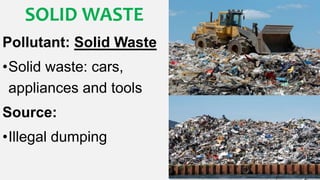
SOLID WASTE
Pollutant: Solid Waste
•Solid waste: cars,
appliances and tools
Source:
•Illegal dumping
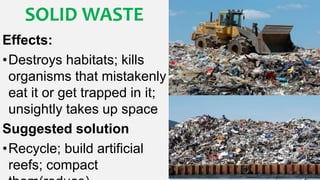
SOLID WASTE
Effects:
•Destroys habitats; kills
organisms that mistakenly
eat it or get trapped in it;
unsightly takes up space
Suggested solution
•Recycle; build artificial
reefs; compact
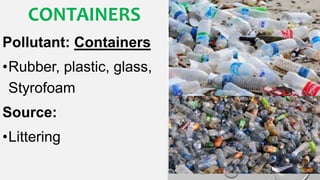
CONTAINERS
Pollutant: Containers
•Rubber, plastic, glass,
Styrofoam
Source:
•Littering
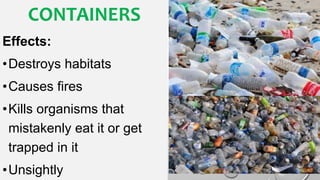
CONTAINERS
Effects:
•Destroys habitats
•Causes fires
•Kills organisms that
mistakenly eat it or get
trapped in it
•Unsightly
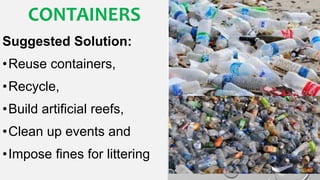
CONTAINERS
Suggested Solution:
•Reuse containers,
•Recycle,
•Build artificial reefs,
•Clean up events and
•Impose fines for littering
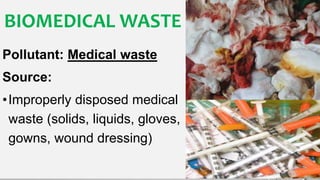
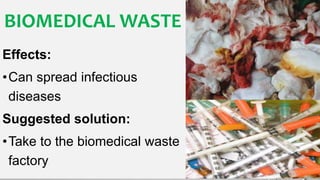
BIOMEDICAL WASTE
Pollutant: Medical waste
Source:
•Improperly disposed medical
waste (solids, liquids, gloves,
gowns, wound dressing)
BIOMEDICAL WASTE
Effects:
•Can spread infectious
diseases
Suggested solution:
•Take to the biomedical waste
factory
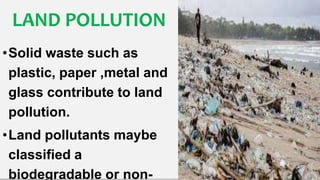
LAND POLLUTION
•Solid waste such as
plastic, paper ,metal and
glass contribute to land
pollution.
•Land pollutants maybe
classified a
biodegradable or non-
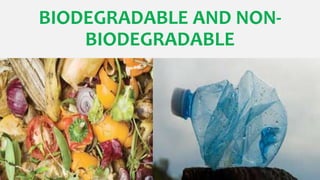
BIODEGRADABLE AND NON-
BIODEGRADABLE
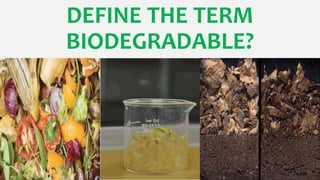
DEFINE THE TERM
BIODEGRADABLE?
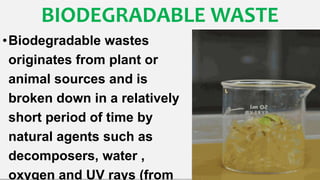
BIODEGRADABLE WASTE
•Biodegradable wastes
originates from plant or
animal sources and is
broken down in a relatively
short period of time by
natural agents such as
decomposers, water ,
oxygen and UV rays (from
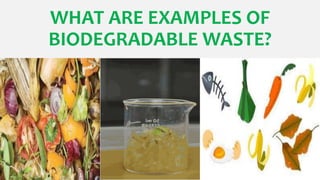
WHAT ARE EXAMPLES OF
BIODEGRADABLE WASTE?
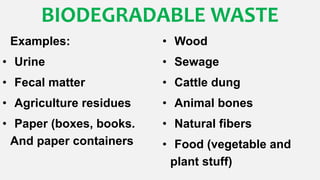
BIODEGRADABLE WASTE
Examples:
• Urine
• Fecal matter
• Agriculture residues
• Paper (boxes, books.
And paper containers
• Wood
• Sewage
• Cattle dung
• Animal bones
• Natural fibers
• Food (vegetable and
plant stuff)
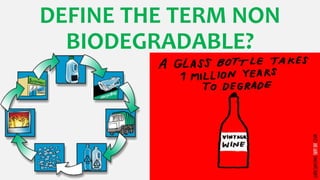
DEFINE THE TERM NON
BIODEGRADABLE?
NON-BIODEGRADABLE WASTE
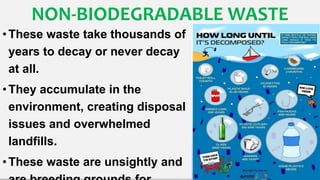
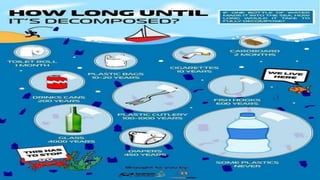
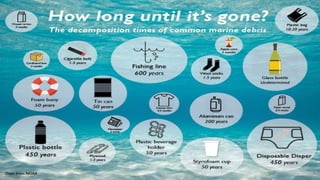
•These waste take thousands of
years to decay or never decay
at all.
•They accumulate in the
environment, creating disposal
issues and overwhelmed
landfills.
•These waste are unsightly and
WHAT ARE EXAMPLES OF NON-
BIODEGRADABLE WASTE?
NON-BIODEGRADABLE WASTE
Examples:
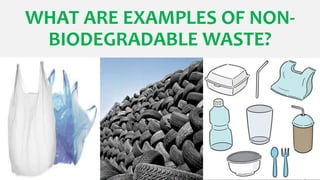
• Plastics Bags
• Insecticides
• Pesticides
• Mercury
• Lead
• Metal articles such
as aluminium cans,
synthetic fibres,
glass objects, iron
products
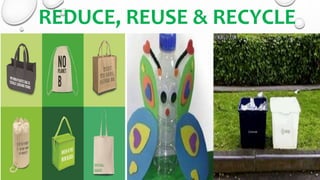
REDUCE, REUSE & RECYCLE
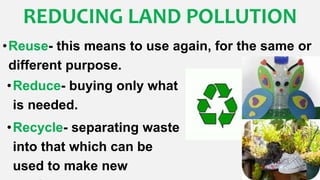
•Reuse- this means to use again, for the same or
different purpose.
REDUCING LAND POLLUTION
•Reduce- buying only what
is needed.
•Recycle- separating waste
into that which can be
used to make new
ASSIGNMENT
Plastic bottles are _________waste while rotting fruits and vegetables are
________________. *
2 points
A. bioegrdable,
B. non-biodegradable
non-biodegradable, biodegradable
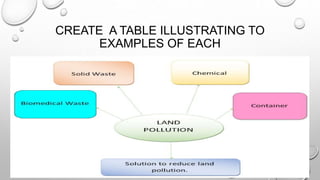
CREATE A TABLE ILLUSTRATING TO
EXAMPLES OF EACH
WRITE A SOLUTION FOR REDUCING LAND
POLLUTION IN THE BAHAMAS
• ______________________________________________________________________
______________________________________________________________________
______________________________________________________________________
______________________________________________________________________
___________________________________.
WRITE ONE EFFECT WHEN CONTAINERS OR
SOLID WASTE POLLUTE THE LAND.
• ______________________________________________________________________
______________________________________________________________________
______________________________________________________________________
______________________________________________________________________
______________________________________________________________________
________________________________________
ASSIGNMENT
1. WRITE A DEFINITION FOR POLLUTION AND POLLUTANT
2. WRITE A DEFINITION FOR LAND POLLUTION
3. CLASSIFY THE MAIN LAND POLLUTANTS
4. CLEARLY DISTINGUISH BETWEEN BIODEGRADABLE AND NON-
BIODEGRADABLE
5. SUGGEST METHODS OF CONTROLING THE MAIN LAND POLLUTANTS

LAND POLLUTION 2022 CJohnson.pptx

Editor's Notes

  • #14 Eventually affecting the health of living organisms in diverse ways depending on the chemical
  • #24 Which would break down first? Which is biodegradable ?
  • #25 Which would break down first? Which is biodegradable ?
  • #27 Which would break down first? Which is biodegradable ?
  • #29 Which would break down first? Which is biodegradable ?
  • #31 Which would break down first? Which is biodegradable ?
  • #32 Non- biodegradable waste such as most plastics, metal, rubbers and glasses are the main contributors to land pollution.
  • #35 Reuse- this means to use again, for the same or a different purpose. Example: Bottles can be returned to the manufacturers so that they can be cleaned and refilled. Reduce- buying only what is needed and avoiding unnecessary materials Recycle- separating waste into that which can be used to make new products. Example: Scrap metal can be collected and melted down for reuse
  • #36 Reuse- this means to use again, for the same or a different purpose. Example: Bottles can be returned to the manufacturers so that they can be cleaned and refilled. Reduce- buying only what is needed and avoiding unnecessary materials Recycle- separating waste into that which can be used to make new products. Example: Scrap metal can be collected and melted down for reuse