Land and Natural
Resources
Land
• Land was sometimes defined in classical and neoclassical economics as the "original
and indestructible powers of the soil.
• is used not merely in the sense of the soil or surface of the earth as is ordinarily
understood. It stands for all nature, living and lifeless. It includes all natural resources
that we can get free from air, water and land. It covers the land surface, whether level
or mountainous.
• “By land is meant not merely land in the strict sense of the word, but whole of the
materials and forces which nature gives freely for man’s aid in land, water, in air and
light and heat.” by Dr. Marshall
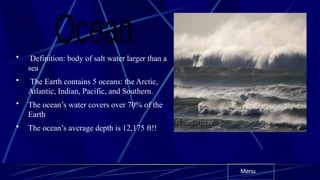
• Definition: body of salt water larger than a
sea
• The Earth contains 5 oceans: the Arctic,
Atlantic, Indian, Pacific, and Southern.
• The ocean’s water covers over 70% of the
Earth
• The ocean’s average depth is 12,175 ft!!
Menu
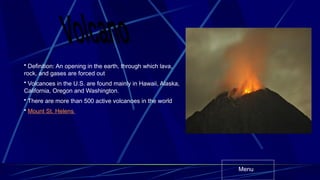
• Definition: An opening in the earth, through which lava,
rock, and gases are forced out
• Volcanoes in the U.S. are found mainly in Hawaii, Alaska,
California, Oregon and Washington.
• There are more than 500 active volcanoes in the world
• Mount St. Helens
Menu
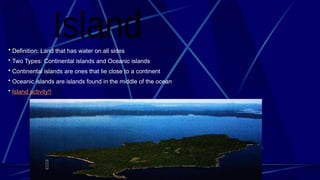
• Definition: Land that has water on all sides
• Two Types: Continental islands and Oceanic islands
• Continental islands are ones that lie close to a continent
• Oceanic islands are islands found in the middle of the ocean
• Island activity!!
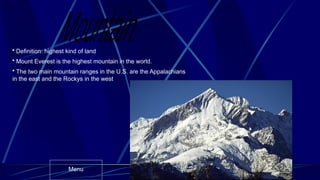
• Definition: highest kind of land
• Mount Everest is the highest mountain in the world.
• The two main mountain ranges in the U.S. are the Appalachians
in the east and the Rockys in the west
Menu
Menu
• Definition: Large stream of water that flows across the land
• The longest river is the Nile
• The largest river is the Amazon
• One important river in America is the Mississippi
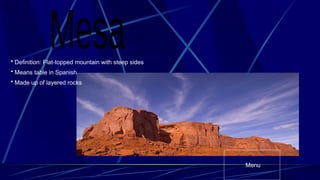
• Definition: Flat-topped mountain with steep sides
• Means table in Spanish
• Made up of layered rocks
Menu
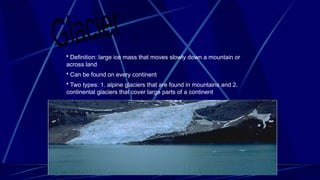
• Definition: large ice mass that moves slowly down a mountain or
across land
• Can be found on every continent
• Two types: 1. alpine glaciers that are found in mountains and 2.
continental glaciers that cover large parts of a continent
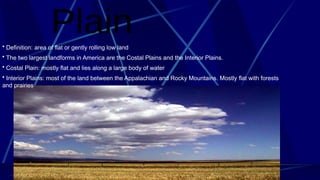
• Definition: area of flat or gently rolling low land
• The two largest landforms in America are the Costal Plains and the Interior Plains.
• Costal Plain: mostly flat and lies along a large body of water
• Interior Plains: most of the land between the Appalachian and Rocky Mountains. Mostly flat with forests
and prairies
Importance of Land
a store of wealth for individuals, groups, or a community
production of food, fibre, fuel or other biotic materials for human use
provision of biological habitats for plants, animals and micro-organisms
co-determinant in the global energy balance and the global hydrological
cycle, which provides both a source and a sink for greenhouse gases
regulation of the storage and flow of surface water and groundwater
storehouse of minerals and raw materials for human use
a buffer, filter or modifier for chemical pollutants
provision of physical space for settlements, industry and recreation
storage and protection of evidence from the historical or pre-historical
record (fossils, evidence of past climates, archaeological remains, etc.)
enabling or hampering movement of animals, plants and people
between one area and another
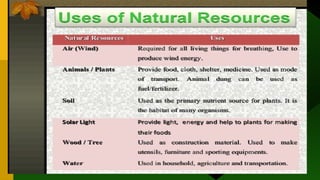
Natural Resources
• Natural resources are resources that exist without the actions
of humankind.
• Natural resources are materials and components (something
that can be used) that can be found within the environment.
• A natural resource may exist as a separate entity such as
fresh water, and air, as well as a living organism such as a fish,
or it may exist in an alternate form which must be processed to
obtain the resource such as metal ores, mineral oil, and most
forms of energy.
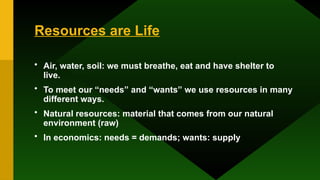
Resources are Life
• Air, water, soil: we must breathe, eat and have shelter to
live.
• To meet our “needs” and “wants” we use resources in many
different ways.
• Natural resources: material that comes from our natural
environment (raw)
• In economics: needs = demands; wants: supply
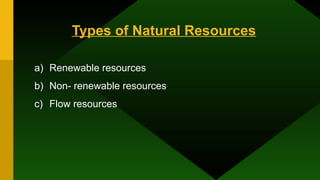
Types of Natural Resources
a) Renewable resources
b) Non- renewable resources
c) Flow resources
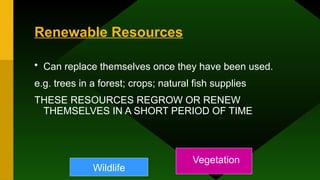
Renewable Resources
• Can replace themselves once they have been used.
e.g. trees in a forest; crops; natural fish supplies
THESE RESOURCES REGROW OR RENEW
THEMSELVES IN A SHORT PERIOD OF TIME
Wildlife
Vegetation
Non- renewable Resources
• Gone once they are used
e.g. minerals such as gold, iron, nickel; fossil fuels such as
coal and petroleum
CAN ONLY BE CREATED UNDER VERY SPECIFIC
CONDITIONS
Petroleum
Natural
Gas
Coal
Flow Resources
• Replaced by natural actions whether humans use them
or not
e.g. fresh water flowing through streams and rivers
because of precipitation; ocean currents
EXIST B/C OF NATURAL SYSTEMS AND NATURAL
PROCESSES
Solar
Energy
Fresh water
Waves,
Tides
Air
Wind
Land and Natural Resources (Landforms).pptx

Land and Natural Resources (Landforms).pptx

  • 1.
  • 2.
    Land • Land wassometimes defined in classical and neoclassical economics as the "original and indestructible powers of the soil. • is used not merely in the sense of the soil or surface of the earth as is ordinarily understood. It stands for all nature, living and lifeless. It includes all natural resources that we can get free from air, water and land. It covers the land surface, whether level or mountainous. • “By land is meant not merely land in the strict sense of the word, but whole of the materials and forces which nature gives freely for man’s aid in land, water, in air and light and heat.” by Dr. Marshall
  • 4.
    • Definition: bodyof salt water larger than a sea • The Earth contains 5 oceans: the Arctic, Atlantic, Indian, Pacific, and Southern. • The ocean’s water covers over 70% of the Earth • The ocean’s average depth is 12,175 ft!! Menu
  • 5.
    • Definition: Anopening in the earth, through which lava, rock, and gases are forced out • Volcanoes in the U.S. are found mainly in Hawaii, Alaska, California, Oregon and Washington. • There are more than 500 active volcanoes in the world • Mount St. Helens Menu
  • 6.
    • Definition: Landthat has water on all sides • Two Types: Continental islands and Oceanic islands • Continental islands are ones that lie close to a continent • Oceanic islands are islands found in the middle of the ocean • Island activity!!
  • 7.
    • Definition: highestkind of land • Mount Everest is the highest mountain in the world. • The two main mountain ranges in the U.S. are the Appalachians in the east and the Rockys in the west Menu
  • 8.
    Menu • Definition: Largestream of water that flows across the land • The longest river is the Nile • The largest river is the Amazon • One important river in America is the Mississippi
  • 9.
    • Definition: Flat-toppedmountain with steep sides • Means table in Spanish • Made up of layered rocks Menu
  • 10.
    • Definition: largeice mass that moves slowly down a mountain or across land • Can be found on every continent • Two types: 1. alpine glaciers that are found in mountains and 2. continental glaciers that cover large parts of a continent
  • 11.
    • Definition: areaof flat or gently rolling low land • The two largest landforms in America are the Costal Plains and the Interior Plains. • Costal Plain: mostly flat and lies along a large body of water • Interior Plains: most of the land between the Appalachian and Rocky Mountains. Mostly flat with forests and prairies
  • 12.
  • 13.
    a store ofwealth for individuals, groups, or a community production of food, fibre, fuel or other biotic materials for human use provision of biological habitats for plants, animals and micro-organisms co-determinant in the global energy balance and the global hydrological cycle, which provides both a source and a sink for greenhouse gases regulation of the storage and flow of surface water and groundwater storehouse of minerals and raw materials for human use a buffer, filter or modifier for chemical pollutants provision of physical space for settlements, industry and recreation storage and protection of evidence from the historical or pre-historical record (fossils, evidence of past climates, archaeological remains, etc.) enabling or hampering movement of animals, plants and people between one area and another
  • 14.
    Natural Resources • Naturalresources are resources that exist without the actions of humankind. • Natural resources are materials and components (something that can be used) that can be found within the environment. • A natural resource may exist as a separate entity such as fresh water, and air, as well as a living organism such as a fish, or it may exist in an alternate form which must be processed to obtain the resource such as metal ores, mineral oil, and most forms of energy.
  • 16.
    Resources are Life •Air, water, soil: we must breathe, eat and have shelter to live. • To meet our “needs” and “wants” we use resources in many different ways. • Natural resources: material that comes from our natural environment (raw) • In economics: needs = demands; wants: supply
  • 17.
    Types of NaturalResources a) Renewable resources b) Non- renewable resources c) Flow resources
  • 18.
    Renewable Resources • Canreplace themselves once they have been used. e.g. trees in a forest; crops; natural fish supplies THESE RESOURCES REGROW OR RENEW THEMSELVES IN A SHORT PERIOD OF TIME Wildlife Vegetation
  • 19.
    Non- renewable Resources •Gone once they are used e.g. minerals such as gold, iron, nickel; fossil fuels such as coal and petroleum CAN ONLY BE CREATED UNDER VERY SPECIFIC CONDITIONS Petroleum Natural Gas Coal
  • 20.
    Flow Resources • Replacedby natural actions whether humans use them or not e.g. fresh water flowing through streams and rivers because of precipitation; ocean currents EXIST B/C OF NATURAL SYSTEMS AND NATURAL PROCESSES Solar Energy Fresh water Waves, Tides Air Wind