Lamrack’s Hypothesis
Use and Disuse
Inheritance and Acquired characteristics
By
Bo No.22
Lita No.24
MEP 611
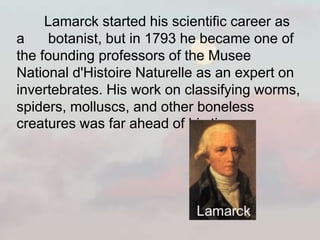
Lamarck started his scientific career as
a botanist, but in 1793 he became one of
the founding professors of the Musee
National d'Histoire Naturelle as an expert on
invertebrates. His work on classifying worms,
spiders, molluscs, and other boneless
creatures was far ahead of his time.
Use and Disuse
• He proposed that if an organ is used a lot it will
develop and strengthen
• If it is not used it will atrophy
• He called this the law of use and disuse
Inheritance and acquired
characteristics
• if an organism developed a characteristic feature
through adapting to a new way of life during its
lifetime, it would pass this on to its offspring
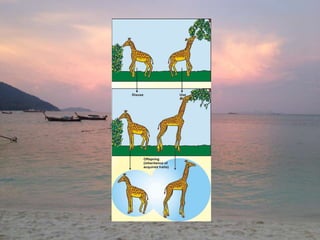
• The classic example given is that of the giraffe’s
neck
• As the giraffe’s ancestors searched for a richer
food supply they stretched to reach higher
branches in trees
• Thus their stretched bodies were passed onto
their offspring
THANK YOU

Lamracks hypothesis

  • 1.
    Lamrack’s Hypothesis Use andDisuse Inheritance and Acquired characteristics By Bo No.22 Lita No.24 MEP 611
  • 2.
    Lamarck started hisscientific career as a botanist, but in 1793 he became one of the founding professors of the Musee National d'Histoire Naturelle as an expert on invertebrates. His work on classifying worms, spiders, molluscs, and other boneless creatures was far ahead of his time.
  • 3.
    Use and Disuse •He proposed that if an organ is used a lot it will develop and strengthen • If it is not used it will atrophy • He called this the law of use and disuse
  • 5.
    Inheritance and acquired characteristics •if an organism developed a characteristic feature through adapting to a new way of life during its lifetime, it would pass this on to its offspring • The classic example given is that of the giraffe’s neck • As the giraffe’s ancestors searched for a richer food supply they stretched to reach higher branches in trees • Thus their stretched bodies were passed onto their offspring
  • 6.