Presented by Group 2
LAMARCKISM OR THEORY
OF INHERITANCE OF
ACQUIRED CHARACTERS
GENERAL BIOLOGY 2
PRESENTATION OUTLINE
Characteristics of the theory? What are the
basis?
Applications of the theory
Pros and Cons of the theory
INTRODUCTION
WHAT IS LAMARKISM?
A theory of evolution based on the
principle that physical changes in
organisms during their lifetime—such as
greater development of an organ or a part
through increased use—could be
transmitted to their offspring.
Lamarckism is an evolutionary
hypothesis based on the idea that
organisms undergo physical
changes throughout their lives.
This hypothesis is frequently
confused with Lamarckism, the
evolutionary theory of French
naturalist Jean-Baptiste Lamarck.
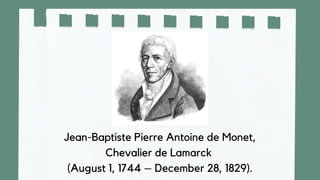
WHO IS JEAN-BAPTISTE
LAMARCK?
Jean-Baptiste Pierre Antoine de Monet,
Chevalier de Lamarck
(August 1, 1744 – December 28, 1829).
CHARACTERISTICS
OF LAMARCKISM
The notion of "soft inheritance," or the transmission of
acquired qualities, states that an organism that has
undergone such a change can pass on that character to
its progeny.
Acquired characteristics (or characters) are those
changes in the structure or function of an organism that
are the result of use, disuse, environmental influences,
disease, mutilation, and so forth, such as a muscle that is
enlarged through use or mice that have their tails cut off.
In his Philosophie Zoologique of 1809, Lamarck offered
the hypothesis that "necessary" qualities were gained (or
lost) throughout an organism's lifetime and subsequently
passed on to offspring. He saw this as leading to the
evolution of species in a chain of development leading to
higher forms.
Individuals lose characteristics they do not require (or
use) and develop characteristics that are useful.
Individuals inherit the traits of their ancestors.
Lamarck based his theory on two observations, in his day
considered to be generally true:
1.
2.
WITH THIS IN MIND, LAMARCK
DEVELOPED TWO LAWS:
Law of use and disuse.
Inheritance of acquired traits.
Giraffes stretching their necks to reach leaves high in
trees strengthen and gradually lengthen their necks.
These giraffes have offspring with slightly longer
necks (also known as "soft inheritance").
A blacksmith, through his work, strengthens the
muscles in his arms. His sons will have similar muscular
development when they mature.
Examples of Lamarckism would include:
APPLICATION OF LAMARCKISM
Acquired Characteristics those changes in the structure or
function of an organism that are the result of use, disuse,
environmental influences, disease, mutilation, and so forth,
such as a muscle that is enlarged through use or mice that
have their tails cut off.
According to Lamarck, new needs (besoins) arise in animals as a
result of a change in the environment. This leads to new types of
behaviour involving new uses of pre-existing organs.
CONCLUSION
Lamarckism is an such not wrong but it is
incomplete because Lamarck was unaware of
genetic factor is responsible for the inheritance
of acquired character. Genetics was developed
only after 1900AD, which was long after the
Lamarckism (1809-1811) AD . For example, simple
organisms are still detected in all varieties of
life, plus it is now known that mutations can
create variation such as neck length.
THANK YOU FOR LISTENING!
Don't hesitate to ask any questions!
REFERENCES
ACQUIRED CHARACTERISTICS - NEW WORLD
ENCYCLOPEDIA
JEAN-BAPTISTE LAMARCK - NEW WORLD
ENCYCLOPEDIA
THE WORK OF LAMARCK - EVOLUTION - AQA - GCSE
BIOLOGY (SINGLE SCIENCE) REVISION - AQA - BBC
BITESIZE
LAMARCKISM | FACTS, THEORY, & CONTRAST WITH
DARWINISM | BRITANNICA

Group 2 (Lamarckism).pdf

  • 1.
    Presented by Group2 LAMARCKISM OR THEORY OF INHERITANCE OF ACQUIRED CHARACTERS GENERAL BIOLOGY 2
  • 2.
    PRESENTATION OUTLINE Characteristics ofthe theory? What are the basis? Applications of the theory Pros and Cons of the theory
  • 3.
  • 4.
    WHAT IS LAMARKISM? Atheory of evolution based on the principle that physical changes in organisms during their lifetime—such as greater development of an organ or a part through increased use—could be transmitted to their offspring.
  • 5.
    Lamarckism is anevolutionary hypothesis based on the idea that organisms undergo physical changes throughout their lives. This hypothesis is frequently confused with Lamarckism, the evolutionary theory of French naturalist Jean-Baptiste Lamarck.
  • 6.
  • 7.
    Jean-Baptiste Pierre Antoinede Monet, Chevalier de Lamarck (August 1, 1744 – December 28, 1829).
  • 8.
  • 9.
    The notion of"soft inheritance," or the transmission of acquired qualities, states that an organism that has undergone such a change can pass on that character to its progeny. Acquired characteristics (or characters) are those changes in the structure or function of an organism that are the result of use, disuse, environmental influences, disease, mutilation, and so forth, such as a muscle that is enlarged through use or mice that have their tails cut off.
  • 10.
    In his PhilosophieZoologique of 1809, Lamarck offered the hypothesis that "necessary" qualities were gained (or lost) throughout an organism's lifetime and subsequently passed on to offspring. He saw this as leading to the evolution of species in a chain of development leading to higher forms. Individuals lose characteristics they do not require (or use) and develop characteristics that are useful. Individuals inherit the traits of their ancestors. Lamarck based his theory on two observations, in his day considered to be generally true: 1. 2.
  • 11.
    WITH THIS INMIND, LAMARCK DEVELOPED TWO LAWS: Law of use and disuse. Inheritance of acquired traits. Giraffes stretching their necks to reach leaves high in trees strengthen and gradually lengthen their necks. These giraffes have offspring with slightly longer necks (also known as "soft inheritance"). A blacksmith, through his work, strengthens the muscles in his arms. His sons will have similar muscular development when they mature. Examples of Lamarckism would include:
  • 12.
  • 13.
    Acquired Characteristics thosechanges in the structure or function of an organism that are the result of use, disuse, environmental influences, disease, mutilation, and so forth, such as a muscle that is enlarged through use or mice that have their tails cut off. According to Lamarck, new needs (besoins) arise in animals as a result of a change in the environment. This leads to new types of behaviour involving new uses of pre-existing organs.
  • 14.
    CONCLUSION Lamarckism is ansuch not wrong but it is incomplete because Lamarck was unaware of genetic factor is responsible for the inheritance of acquired character. Genetics was developed only after 1900AD, which was long after the Lamarckism (1809-1811) AD . For example, simple organisms are still detected in all varieties of life, plus it is now known that mutations can create variation such as neck length.
  • 15.
    THANK YOU FORLISTENING! Don't hesitate to ask any questions!
  • 16.
    REFERENCES ACQUIRED CHARACTERISTICS -NEW WORLD ENCYCLOPEDIA JEAN-BAPTISTE LAMARCK - NEW WORLD ENCYCLOPEDIA THE WORK OF LAMARCK - EVOLUTION - AQA - GCSE BIOLOGY (SINGLE SCIENCE) REVISION - AQA - BBC BITESIZE LAMARCKISM | FACTS, THEORY, & CONTRAST WITH DARWINISM | BRITANNICA