BARRIER-TO-BARRIER LAMINATING ADHESIVE
GAS
MOISTURE
FLAVOR
In gas barrier food packaging applications, printed OPA (or PET),
laminated to a barrier layer as metalized PET (or CPP), aluminum foil,
or PE-EVOH-PE, is the typical structure for barrier functions which can
significantly improve shelf-life. However, there is a specific issue
related with the double barrier web lamination. Unlike what happens
with permeable webs, the optical appearance of the laminate cannot
be improved after curing of the adhesive.
In order to better understand the situation inside the barrier-to-barrier
structure, let us firstly analyze permeable-to-permeable laminate.
With the growth of technology development and improving people’s life, higher quality
foods are further required. For the situation, barrier materials are widely used for
prolonging food shelf-life. Usually, barrier materials mainly for gas and moisture
resistance include OPA, PET, PE-EVOH-PE, metalized film, ALU, film with SiOx, etc..
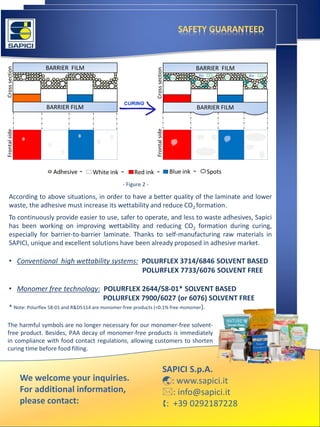
But for barrier-to-barrier laminate (shown in Figure 2), the trapped CO2 produced by
cross-linking reaction may enlarge the spots causing serious appearance problems. In
this case, even though adhesive has good wettability, the spots may be filled by CO2
instead of adhesive.
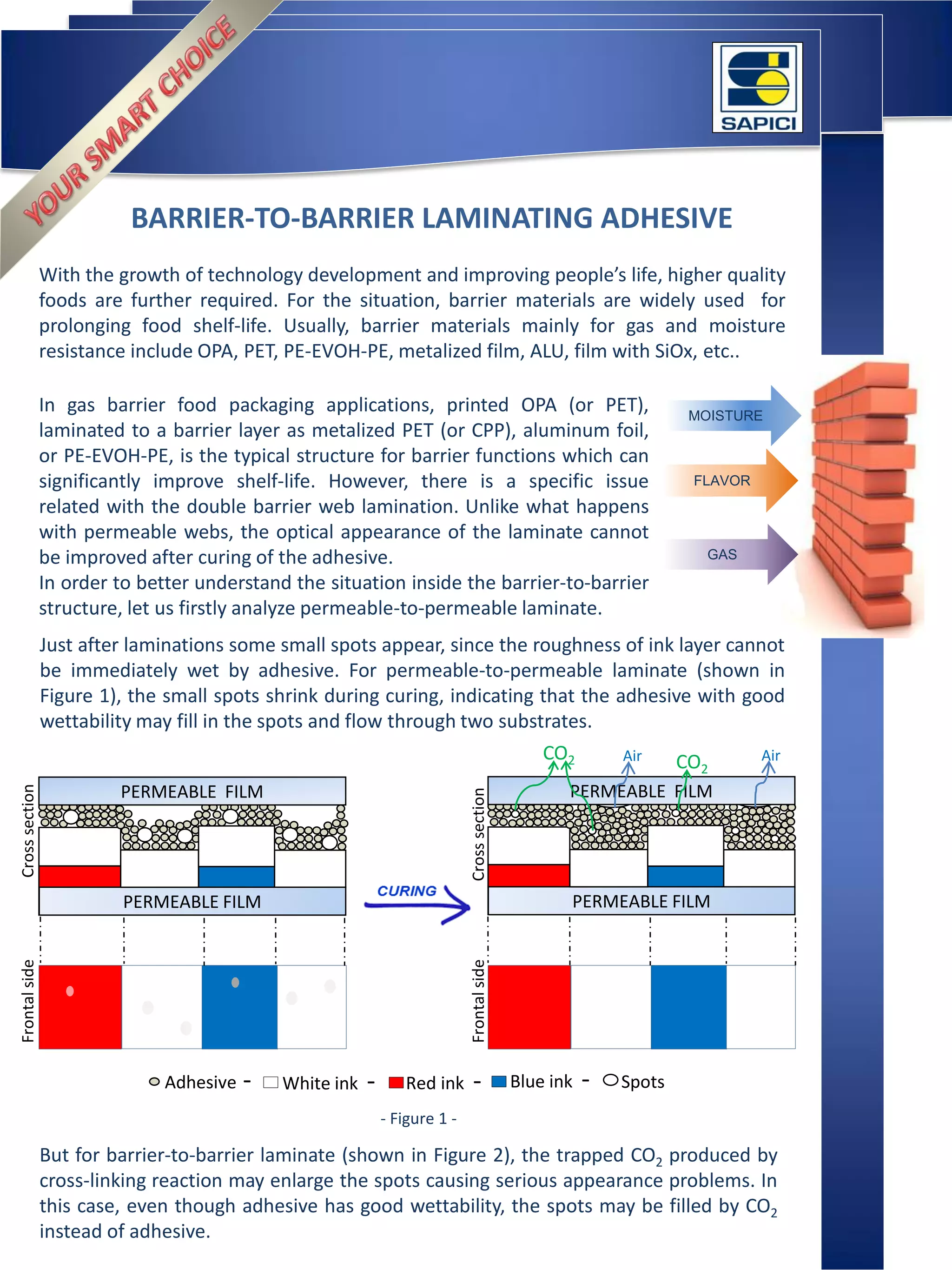
- Figure 1 -
CO2 AirAir
PERMEABLE FILM
PERMEABLE FILM
PERMEABLE FILM
PERMEABLE FILM
CO2
CrosssectionFrontalside
Adhesive - White ink - SpotsRed ink - Blue ink -
Just after laminations some small spots appear, since the roughness of ink layer cannot
be immediately wet by adhesive. For permeable-to-permeable laminate (shown in
Figure 1), the small spots shrink during curing, indicating that the adhesive with good
wettability may fill in the spots and flow through two substrates.
We welcome your inquiries.
For additional information,
please contact:
SAPICI S.p.A.
: www.sapici.it
: info@sapici.it
: +39 0292187228
CrosssectionFrontalside
BARRIER FILM
BARRIER FILM
CO2
Air
CrosssectionFrontalside
CO2
CO2
CO2
CO2
CO2 Air CO2
CO2
BARRIER FILM
BARRIER FILM
- Figure 2 -
According to above situations, in order to have a better quality of the laminate and lower
waste, the adhesive must increase its wettability and reduce CO2 formation.
To continuously provide easier to use, safer to operate, and less to waste adhesives, Sapici
has been working on improving wettability and reducing CO2 formation during curing,
especially for barrier-to-barrier laminate. Thanks to self-manufacturing raw materials in
SAPICI, unique and excellent solutions have been already proposed in adhesive market.
• Conventional high wettability systems: POLURFLEX 3714/6846 SOLVENT BASED
POLURFLEX 7733/6076 SOLVENT FREE
• Monomer free technology: POLURFLEX 2644/58-01* SOLVENT BASED
POLURFLEX 7900/6027 (or 6076) SOLVENT FREE
* Note: Polurflex 58-01 and R&D5114 are monomer-free products (<0.1% free monomer).
The harmful symbols are no longer necessary for our monomer-free solvent-
free product. Besides, PAA decay of monomer-free products is immediately
in compliance with food contact regulations, allowing customers to shorten
curing time before food filling.
Adhesive - White ink - SpotsRed ink - Blue ink -

Laminating adhesives - barrier material - flexible packaging

  • 1.
    BARRIER-TO-BARRIER LAMINATING ADHESIVE GAS MOISTURE FLAVOR Ingas barrier food packaging applications, printed OPA (or PET), laminated to a barrier layer as metalized PET (or CPP), aluminum foil, or PE-EVOH-PE, is the typical structure for barrier functions which can significantly improve shelf-life. However, there is a specific issue related with the double barrier web lamination. Unlike what happens with permeable webs, the optical appearance of the laminate cannot be improved after curing of the adhesive. In order to better understand the situation inside the barrier-to-barrier structure, let us firstly analyze permeable-to-permeable laminate. With the growth of technology development and improving people’s life, higher quality foods are further required. For the situation, barrier materials are widely used for prolonging food shelf-life. Usually, barrier materials mainly for gas and moisture resistance include OPA, PET, PE-EVOH-PE, metalized film, ALU, film with SiOx, etc.. But for barrier-to-barrier laminate (shown in Figure 2), the trapped CO2 produced by cross-linking reaction may enlarge the spots causing serious appearance problems. In this case, even though adhesive has good wettability, the spots may be filled by CO2 instead of adhesive. - Figure 1 - CO2 AirAir PERMEABLE FILM PERMEABLE FILM PERMEABLE FILM PERMEABLE FILM CO2 CrosssectionFrontalside CrosssectionFrontalside Adhesive - White ink - SpotsRed ink - Blue ink - Just after laminations some small spots appear, since the roughness of ink layer cannot be immediately wet by adhesive. For permeable-to-permeable laminate (shown in Figure 1), the small spots shrink during curing, indicating that the adhesive with good wettability may fill in the spots and flow through two substrates.
  • 2.
    We welcome yourinquiries. For additional information, please contact: SAPICI S.p.A. : www.sapici.it : info@sapici.it : +39 0292187228 CrosssectionFrontalside BARRIER FILM BARRIER FILM CO2 Air CrosssectionFrontalside CO2 CO2 CO2 CO2 CO2 Air CO2 CO2 BARRIER FILM BARRIER FILM - Figure 2 - According to above situations, in order to have a better quality of the laminate and lower waste, the adhesive must increase its wettability and reduce CO2 formation. To continuously provide easier to use, safer to operate, and less to waste adhesives, Sapici has been working on improving wettability and reducing CO2 formation during curing, especially for barrier-to-barrier laminate. Thanks to self-manufacturing raw materials in SAPICI, unique and excellent solutions have been already proposed in adhesive market. • Conventional high wettability systems: POLURFLEX 3714/6846 SOLVENT BASED POLURFLEX 7733/6076 SOLVENT FREE • Monomer free technology: POLURFLEX 2644/58-01* SOLVENT BASED POLURFLEX 7900/6027 (or 6076) SOLVENT FREE * Note: Polurflex 58-01 and R&D5114 are monomer-free products (<0.1% free monomer). The harmful symbols are no longer necessary for our monomer-free solvent- free product. Besides, PAA decay of monomer-free products is immediately in compliance with food contact regulations, allowing customers to shorten curing time before food filling. Adhesive - White ink - SpotsRed ink - Blue ink -