


Lambert’s Socio-Psychological Model (1972) Lambert (1973-1974) the main early figure in Second Language Research to resent a theory of SLA Emphasis upon Social and Psychological aspects in second language learning According to Lambert: This theory, in brief, holds that an individual successfully acquiring a second language gradually adopts various aspects of behavior, which characterize members of another linguistic-cultural group. The learner’s ethnocentric tendencies, his attitudes towards the other group, and his orientation regulate or control his motivation to learn and ultimately his success or failure in mastering the new language
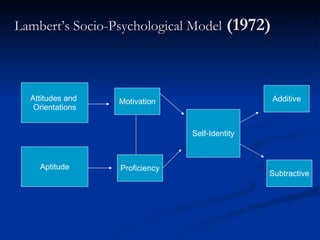
Lambert’s Socio-Psychological Model  (1972) Attitudes and  Orientations Aptitude Motivation Proficiency Self-Identity Subtractive Additive
Lambert’s model based on a theory of bilingual development and self-identity modification Linguistic Distinctiveness: a basic component of personal identity The development of second language proficiency has implications for the learner’s self-identity Linguistic Distinctiveness originates very early in the process of socialization Parents make contrasts between their own and other cultural communities to make the children understand of their social-identity Later on institutions reinforce the early perceptions
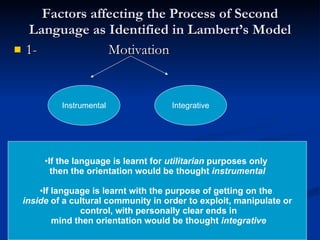
Factors affecting the Process of Second Language as Identified in Lambert’s Model 1-  Motivation Integrative Instrumental If the language is learnt for  utilitarian  purposes only  then the orientation would be thought  instrumental If language is learnt with the purpose of getting on the  inside  of a cultural community in order to exploit, manipulate or control, with personally clear ends in mind then orientation would be thought  integrative
2- Cognitive Variable of Aptitude General ability for language learning Aptitude is independent of attitudes and motivation A person without aptitude can learn the language well if the motivation and attitudes are strong A person with unfavorable attitudes and motivation can learn the language if his aptitude is strong Strong Aptitude + Proper Orientation = Better performance in acquiring a second language
Possible effects of learning a Second Language on Learner’s Identity The more a learner becomes proficient in a second language the more he may find himself an alien in his own community This situation is described by Lambert as “anomie”, which refers to  “ the feeling of social uncertainty or dissatisfaction which we believe characterize serious students of a second language and those who become bilingual”
Bilingual States   Additive Subtractive If learners are members of high-prestige ethno-linguistic  Groups, the resulting form would be additive  Seen as enriching experience Learners learns a language without doing any harm to  his native language A weakening Process that interferes the development of second Language L2 is acquired as a means of helping to promote cultural  Assimilation Often connected with members of ethnic minority groups

Lambert’S Socio Psychological Model

  • 1.
    Lambert’s Socio-Psychological Model(1972) Lambert (1973-1974) the main early figure in Second Language Research to resent a theory of SLA Emphasis upon Social and Psychological aspects in second language learning According to Lambert: This theory, in brief, holds that an individual successfully acquiring a second language gradually adopts various aspects of behavior, which characterize members of another linguistic-cultural group. The learner’s ethnocentric tendencies, his attitudes towards the other group, and his orientation regulate or control his motivation to learn and ultimately his success or failure in mastering the new language
  • 2.
    Lambert’s Socio-Psychological Model (1972) Attitudes and Orientations Aptitude Motivation Proficiency Self-Identity Subtractive Additive
  • 3.
    Lambert’s model basedon a theory of bilingual development and self-identity modification Linguistic Distinctiveness: a basic component of personal identity The development of second language proficiency has implications for the learner’s self-identity Linguistic Distinctiveness originates very early in the process of socialization Parents make contrasts between their own and other cultural communities to make the children understand of their social-identity Later on institutions reinforce the early perceptions
  • 4.
    Factors affecting theProcess of Second Language as Identified in Lambert’s Model 1- Motivation Integrative Instrumental If the language is learnt for utilitarian purposes only then the orientation would be thought instrumental If language is learnt with the purpose of getting on the inside of a cultural community in order to exploit, manipulate or control, with personally clear ends in mind then orientation would be thought integrative
  • 5.
    2- Cognitive Variableof Aptitude General ability for language learning Aptitude is independent of attitudes and motivation A person without aptitude can learn the language well if the motivation and attitudes are strong A person with unfavorable attitudes and motivation can learn the language if his aptitude is strong Strong Aptitude + Proper Orientation = Better performance in acquiring a second language
  • 6.
    Possible effects oflearning a Second Language on Learner’s Identity The more a learner becomes proficient in a second language the more he may find himself an alien in his own community This situation is described by Lambert as “anomie”, which refers to “ the feeling of social uncertainty or dissatisfaction which we believe characterize serious students of a second language and those who become bilingual”
  • 7.
    Bilingual States Additive Subtractive If learners are members of high-prestige ethno-linguistic Groups, the resulting form would be additive Seen as enriching experience Learners learns a language without doing any harm to his native language A weakening Process that interferes the development of second Language L2 is acquired as a means of helping to promote cultural Assimilation Often connected with members of ethnic minority groups