LACTOSE SYNTHASE
ENZYME TECHNOLOGY (BTY405)
CA – 2 PRESENTATION
SHARANYA CHAUDHURI
12108335
INTRODUCTION
Lactose synthase (E.C – 2.4.1.22)
 It is an oligomeric enzyme which generates lactose from UDP
galactose.
 It is isolated from milk.
 It is a member of the transferase family of enzymes.
 This enzyme is important for the synthesis of carbohydrate
components of glycoproteins.
 Reaction it catalyses for lactose synthesis –
UDP-galactose + glucose ⇌ UDP + lactose
Fig. – Reaction catalysed by Lactose Synthase
 Lactose synthase is a typical example of an enzyme in which a non functional subunit
modifies the behaviour of the functional subunit.
 The 2 subunits of Lactose synthase are –
a. N-acetyllactoseamine synthase (functional subunit)
b. Alpha-lactalbumin (non – functional subunit)
 The lactose synthase (LS) enzyme is a 1:1 complex of a catalytic component, beta1,4-
galactosyltransferse (beta4Gal-T1) and a regulatory component, alpha-lactalbumin
(LA), a mammary gland-specific protein.
Fig. - Crystal structure of a lactose
synthase complex
1. N-ACETYLLACTOSEAMINE SYNTHASE
 Better known as β-1,4-galactosyltransferase - 1.
 It contains the catalytic component.
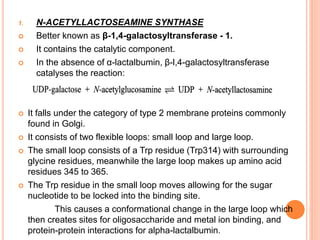
 In the absence of α-lactalbumin, β-l,4-galactosyltransferase
catalyses the reaction:
 It falls under the category of type 2 membrane proteins commonly
found in Golgi.
 It consists of two flexible loops: small loop and large loop.
 The small loop consists of a Trp residue (Trp314) with surrounding
glycine residues, meanwhile the large loop makes up amino acid
residues 345 to 365.
 The Trp residue in the small loop moves allowing for the sugar
nucleotide to be locked into the binding site.
This causes a conformational change in the large loop which
then creates sites for oligosaccharide and metal ion binding, and
protein-protein interactions for alpha-lactalbumin.
2. ALPHA-LACTALBUMIN
 Consists of the regulatory component of Lactose synthase.
 Alpha-lactalbumin is a Ca2+ binding protein specific to mammary
glands.
 Alpha-lactalbumin, which is expressed in response to prolactin,
increases the affinity of N-acetyllactosamine synthase for its
substrate, causing increased production of lactose during lactation.
 Without alpha-lactalbumin, the affinity of N-acetylglucosamine to
glucose is 1000-fold lower.
 Alpha-lactalbumin acts as the regulatory protein of lactose
synthase (EC 2.4.1.22), a role in which it modulates the affinity of the
catalytic component UDP-galactose β-N-acetylglucosaminide β1,4-
galactosyltransferase-1 (β4-galactosyltransferase-1; EC 2.4.1.38), for
acceptor substrates through a reversible protein–protein interaction.
MECHANISM
 N-acetyllactoseamine is produced and stored in the mammary gland
during pregnancy, when levels of α-lactalbumin are low.
 After the birth of the baby, reduced synthesis of the
hormone progesterone in the mother leads to increased synthesis of
the luteotrophic hormone (prolactin), stimulating the production of α-
lactalbumin in the mammary gland.
 This combines with the stored β-1,4-galcosyltransferase to form
lactose synthase, an enzyme which facilitates production of the
lactose component of the milk required for the new-born baby.
 Lactose synthase catalyses the reaction:
UDP-galactose + glucose ⇌ UDP + lactose.
 Thus it can be seen that the presence of the α-lactalbumin sub-unit
changes the specificity of the enzyme, causing it to
transfer galactose to glucose rather than to N- acetylgiucosamine.
The overall process involves conformational changes in the region
of the active site of the enzyme.
THANK YOU!

LACTOSE SYNTHASE.pptx

  • 1.
    LACTOSE SYNTHASE ENZYME TECHNOLOGY(BTY405) CA – 2 PRESENTATION SHARANYA CHAUDHURI 12108335
  • 2.
    INTRODUCTION Lactose synthase (E.C– 2.4.1.22)  It is an oligomeric enzyme which generates lactose from UDP galactose.  It is isolated from milk.  It is a member of the transferase family of enzymes.  This enzyme is important for the synthesis of carbohydrate components of glycoproteins.  Reaction it catalyses for lactose synthesis – UDP-galactose + glucose ⇌ UDP + lactose
  • 3.
    Fig. – Reactioncatalysed by Lactose Synthase
  • 4.
     Lactose synthaseis a typical example of an enzyme in which a non functional subunit modifies the behaviour of the functional subunit.  The 2 subunits of Lactose synthase are – a. N-acetyllactoseamine synthase (functional subunit) b. Alpha-lactalbumin (non – functional subunit)  The lactose synthase (LS) enzyme is a 1:1 complex of a catalytic component, beta1,4- galactosyltransferse (beta4Gal-T1) and a regulatory component, alpha-lactalbumin (LA), a mammary gland-specific protein. Fig. - Crystal structure of a lactose synthase complex
  • 5.
    1. N-ACETYLLACTOSEAMINE SYNTHASE Better known as β-1,4-galactosyltransferase - 1.  It contains the catalytic component.  In the absence of α-lactalbumin, β-l,4-galactosyltransferase catalyses the reaction:  It falls under the category of type 2 membrane proteins commonly found in Golgi.  It consists of two flexible loops: small loop and large loop.  The small loop consists of a Trp residue (Trp314) with surrounding glycine residues, meanwhile the large loop makes up amino acid residues 345 to 365.  The Trp residue in the small loop moves allowing for the sugar nucleotide to be locked into the binding site. This causes a conformational change in the large loop which then creates sites for oligosaccharide and metal ion binding, and protein-protein interactions for alpha-lactalbumin.
  • 6.
    2. ALPHA-LACTALBUMIN  Consistsof the regulatory component of Lactose synthase.  Alpha-lactalbumin is a Ca2+ binding protein specific to mammary glands.  Alpha-lactalbumin, which is expressed in response to prolactin, increases the affinity of N-acetyllactosamine synthase for its substrate, causing increased production of lactose during lactation.  Without alpha-lactalbumin, the affinity of N-acetylglucosamine to glucose is 1000-fold lower.  Alpha-lactalbumin acts as the regulatory protein of lactose synthase (EC 2.4.1.22), a role in which it modulates the affinity of the catalytic component UDP-galactose β-N-acetylglucosaminide β1,4- galactosyltransferase-1 (β4-galactosyltransferase-1; EC 2.4.1.38), for acceptor substrates through a reversible protein–protein interaction.
  • 7.
    MECHANISM  N-acetyllactoseamine isproduced and stored in the mammary gland during pregnancy, when levels of α-lactalbumin are low.  After the birth of the baby, reduced synthesis of the hormone progesterone in the mother leads to increased synthesis of the luteotrophic hormone (prolactin), stimulating the production of α- lactalbumin in the mammary gland.  This combines with the stored β-1,4-galcosyltransferase to form lactose synthase, an enzyme which facilitates production of the lactose component of the milk required for the new-born baby.  Lactose synthase catalyses the reaction: UDP-galactose + glucose ⇌ UDP + lactose.  Thus it can be seen that the presence of the α-lactalbumin sub-unit changes the specificity of the enzyme, causing it to transfer galactose to glucose rather than to N- acetylgiucosamine. The overall process involves conformational changes in the region of the active site of the enzyme.
  • 8.