LABOUR MARKET
DISCRIMINATION
 What is Labor Market?
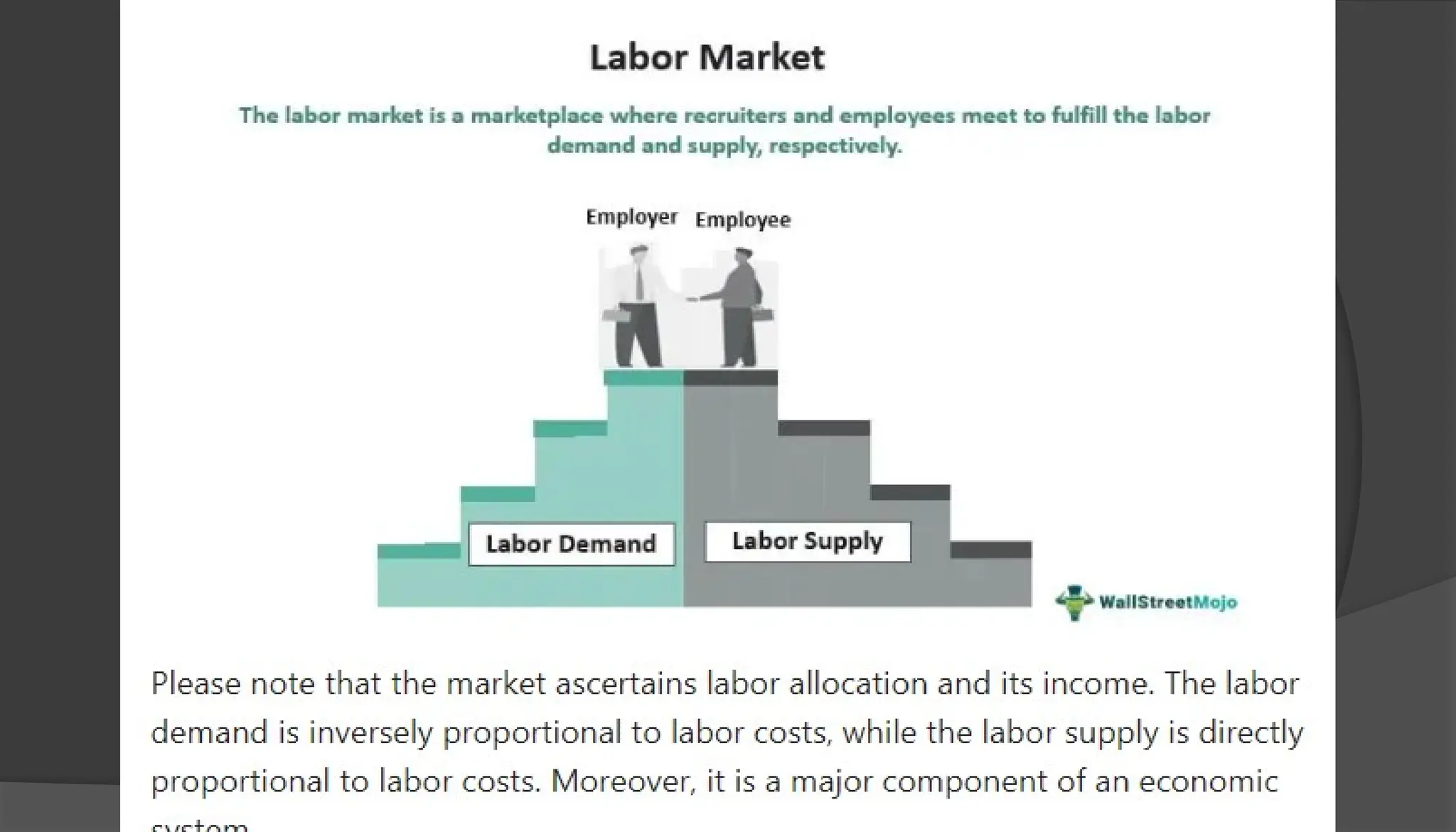
 The labor market or job market is a platform where the
demand for (by employers) and supply of (by workers)
employment meet. It assists in creating a skilled
workforce that flourishes with competition,
development, and economic expansion. Also, the labor
market graph is useful to comprehend its definition
and get information on tight or equilibrium job markets.
 The labor market definition connotes a marketplace entailing
the supply and demand of labor by employees and recruiters,
respectively.
 Its functioning is different from the microeconomic theories and
macroeconomic theories. Additionally, it achieves an
equilibrium position where labor price and volume are
balanced.
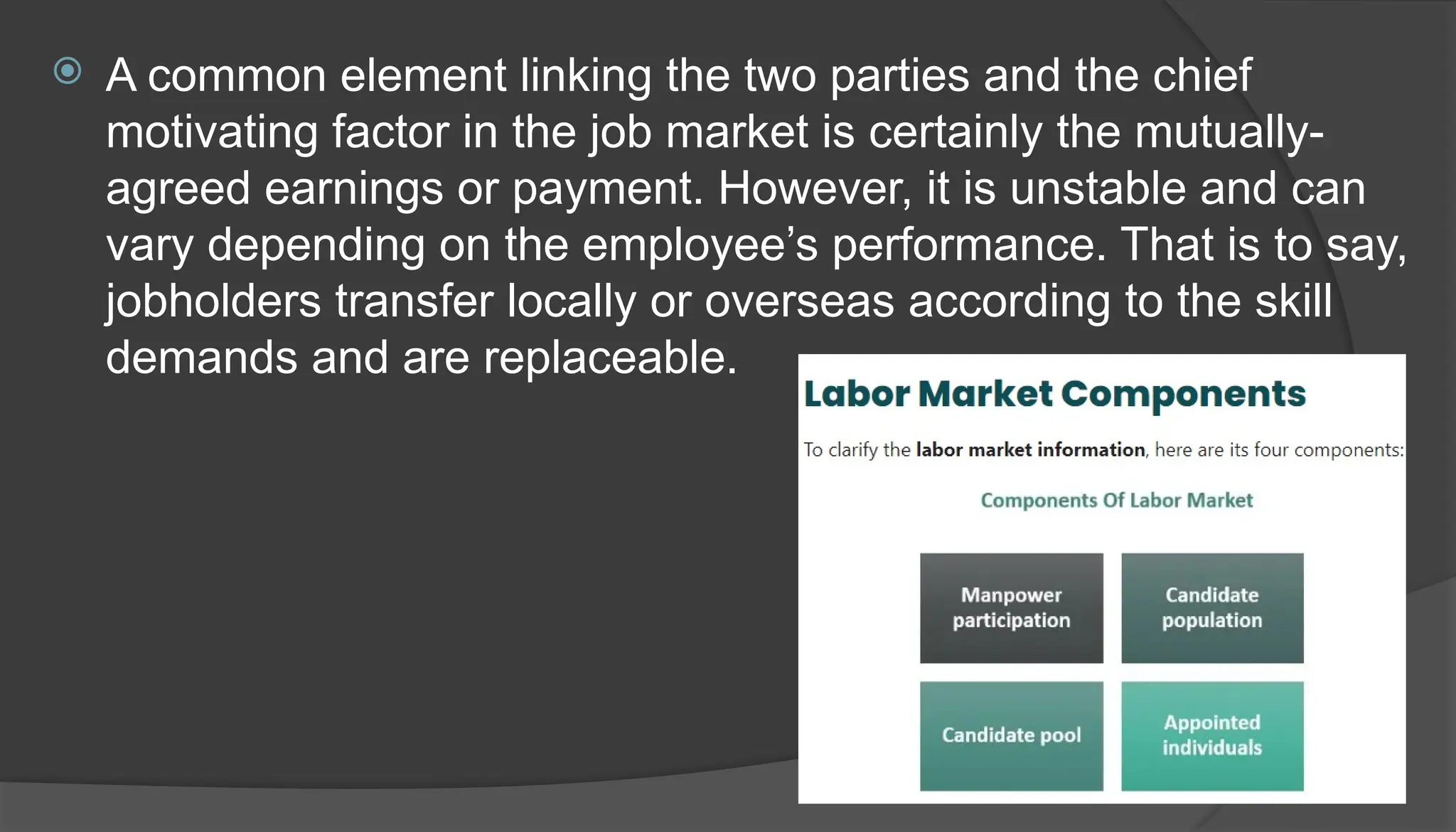
 It has four components: workforce participation, candidate
population, candidate pool, and recruited individuals.
 The job market assists employers in examining the quantity
and quality of the workforce to be recruited. Also, it authorizes
employees to demand a competitive remuneration package
 Labor Market Explained
 Labor market performance differs in the microeconomic and macroeconomic
theories. Please note that the microeconomics theory examines the labor demand
and supply at an independent employee and employer level. In contrast, the
macroeconomics theory reviews the connection between commodities, jobs, the
foreign exchange market, and cash.
 In macroeconomics, this indicates the shortage of wages upon labor
supply exceeding its demand. It also has four kinds
of unemployment: Frictional Unemployment, Structural
Unemployment, natural unemployment, and Cyclical
Unemployment.
 Comparatively, microeconomics specifies raised supply of labor upon
increased demand (subject to the product’s marginal
cost and marginal revenue). Above all, job market inspection is
pertinent to discover the most competent employees and offer them
competitive remuneration.
 Please note that the labor market graph exhibits an equilibrium
position where the labor quantity and cost are balanced and
unaffected, except in serious circumstances. Most importantly, the
employers are considered sellers while the workforce is conceived as
buyers.
 A common element linking the two parties and the chief
motivating factor in the job market is certainly the mutually-
agreed earnings or payment. However, it is unstable and can
vary depending on the employee’s performance. That is to say,
jobholders transfer locally or overseas according to the skill
demands and are replaceable.
 Labour market discrimination
 Discrimination
Labour market discrimination is defined as a situation where workers or
groups of workers are treated differently in terms of recruitment, pay, benefits
and promotion from other workers or groups due to their non-economic
characteristics, including gender, race, religion and age. This means that while
workers may be equally productive, they are not treated the same. Treatment
may be positive, where certain groups are favoured, or negative, where groups
are treated less favourably.
 Discrimination – effect on demand and supply
In terms of demand, negative discrimination will lead to employers
downgrading the expected value of employment of a particular group, and
hence reducing the expected MRP, and shifting the demand curve to the left.
The effect of this is to reduce the wage rate of the group discriminated against,
as well as reducing employment prospects.
 Also, some workers who fear they may be discriminated
against may not seek employment in those firms that they
perceive practice discrimination. Hence they do not supply
their labour to those types of firms. This shifts the
potential supply curve to the left, and raises the relative
wage rate of the favoured group.
Despite various Acts of Parliament, including the Equal Pay
Act (1970), Sex Discrimination Act (1975), and Employment
Protection Act (1975), considerable pay differences exist –
though not all can be attributed to discrimination.
There are several policies that could be used to help reduce
discrimination. A report by the OECD suggested the following:
1. Long-term investment in education and training to prepare
people better for the labour market.
2. Structural reforms to promote stronger and more sustainable
economic growth which can boost demand for workers,
creating a more competitive environment that forces managers
to drop discriminatory hiring and promotion practices.
3. Specific anti-discrimination legislation backed up by effective
enforcement.
4. Enforcement agencies should be empowered, even in the
absence of individual complaints, to investigate companies and
sanction employers when they find evidence of discrimination.
Dearness Allowance (DA)
Dearness Allowance can be understood as a component of
salary which is some fixed percentage of the basic salary,
aimed at hedging the impact of inflation. Since DA is directly
related to the cost of living, the DA component is different for
different employees based on their location. This means DA is
different for employees in the urban sector, semi-urban
sector, or the rural sector
What is Dearness Allowance?
Dearness Allowance is the cost-of-living adjustment allowance which the
government pays to the employees of the public sector as well as
pensioners of the same. DA component of the salary applies to both
employees in India and Bangladesh.
 Types of Dearness Allowance
 The Two separate categories to calculate Dearness Allowance are
Industrial and Variable Dearness Allowance.
1. Industrial Dearness Allowance
 Industrial dearness allowance or IDA is the allowance applicable to
employees of public sector enterprises.
1. Variable Dearness Allowance
 VAD or Variable dearness allowance is the allowance that comes as a
result of revision every six months for central government employees.
 Equal Remuneration Act, 1976
 For instance, consider that you are a woman working really hard
to earn well, but you find that there is some other person who
worked half as hard as you but earned double the amount just
because that person was a male. The basic concept underlying,
the very controversial subject, Feminism, is “equity”. Equity
refers to a treatment of equal with equals and Unequal with un
equals. The Equal Remuneration Act, 1976 (the Act) does
just that. It provides for Equal remuneration both men and
women, but also understanding the fact that it will not override
any special treatment provided to women in the country. There
was a time in India when women used to face heavy
discrimination in pay. But, after the advent of this Act, women
have been able to sue malpractices prevailing in their workplace
Act to have overriding effect
The Central Industrial Machinery (also, Chief Labour
Commissioner) has given effect to this Act and it states that it will
not affect the terms and conditions of any law which provides
special treatment to women. The statement in Section 3 itself
suggests that it will have effect under all circumstances.
The Equal Remuneration Act, 1976, helps in bridging the gap
between unequal remuneration faced by the women of our
country. By the successful implementation of the Act, India is
moving closer to being a country, which treats its men and women
equally.
Fair Employment Practices Committee (FEPC)
Committee established by U.S. Pres. Franklin D. Roosevelt in 1941 to
help prevent discrimination against African Americans in defense
and government jobs.
The Factories Act,1948
the Factories Act, 1948 consolidating and amending the law
relating to labour in factories, was passed by the Constituent
Assembly on August 28, 1948. The Act received the assent of
Governor General of India on 23 September 1948 and came into
force on April 1, 1949.

labour market discrimination short notes

  • 1.
  • 2.
     What isLabor Market?  The labor market or job market is a platform where the demand for (by employers) and supply of (by workers) employment meet. It assists in creating a skilled workforce that flourishes with competition, development, and economic expansion. Also, the labor market graph is useful to comprehend its definition and get information on tight or equilibrium job markets.
  • 4.
     The labormarket definition connotes a marketplace entailing the supply and demand of labor by employees and recruiters, respectively.  Its functioning is different from the microeconomic theories and macroeconomic theories. Additionally, it achieves an equilibrium position where labor price and volume are balanced.  It has four components: workforce participation, candidate population, candidate pool, and recruited individuals.  The job market assists employers in examining the quantity and quality of the workforce to be recruited. Also, it authorizes employees to demand a competitive remuneration package
  • 5.
     Labor MarketExplained  Labor market performance differs in the microeconomic and macroeconomic theories. Please note that the microeconomics theory examines the labor demand and supply at an independent employee and employer level. In contrast, the macroeconomics theory reviews the connection between commodities, jobs, the foreign exchange market, and cash.
  • 6.
     In macroeconomics,this indicates the shortage of wages upon labor supply exceeding its demand. It also has four kinds of unemployment: Frictional Unemployment, Structural Unemployment, natural unemployment, and Cyclical Unemployment.  Comparatively, microeconomics specifies raised supply of labor upon increased demand (subject to the product’s marginal cost and marginal revenue). Above all, job market inspection is pertinent to discover the most competent employees and offer them competitive remuneration.  Please note that the labor market graph exhibits an equilibrium position where the labor quantity and cost are balanced and unaffected, except in serious circumstances. Most importantly, the employers are considered sellers while the workforce is conceived as buyers.
  • 7.
     A commonelement linking the two parties and the chief motivating factor in the job market is certainly the mutually- agreed earnings or payment. However, it is unstable and can vary depending on the employee’s performance. That is to say, jobholders transfer locally or overseas according to the skill demands and are replaceable.
  • 8.
     Labour marketdiscrimination  Discrimination Labour market discrimination is defined as a situation where workers or groups of workers are treated differently in terms of recruitment, pay, benefits and promotion from other workers or groups due to their non-economic characteristics, including gender, race, religion and age. This means that while workers may be equally productive, they are not treated the same. Treatment may be positive, where certain groups are favoured, or negative, where groups are treated less favourably.  Discrimination – effect on demand and supply In terms of demand, negative discrimination will lead to employers downgrading the expected value of employment of a particular group, and hence reducing the expected MRP, and shifting the demand curve to the left. The effect of this is to reduce the wage rate of the group discriminated against, as well as reducing employment prospects.
  • 9.
     Also, someworkers who fear they may be discriminated against may not seek employment in those firms that they perceive practice discrimination. Hence they do not supply their labour to those types of firms. This shifts the potential supply curve to the left, and raises the relative wage rate of the favoured group. Despite various Acts of Parliament, including the Equal Pay Act (1970), Sex Discrimination Act (1975), and Employment Protection Act (1975), considerable pay differences exist – though not all can be attributed to discrimination.
  • 10.
    There are severalpolicies that could be used to help reduce discrimination. A report by the OECD suggested the following: 1. Long-term investment in education and training to prepare people better for the labour market. 2. Structural reforms to promote stronger and more sustainable economic growth which can boost demand for workers, creating a more competitive environment that forces managers to drop discriminatory hiring and promotion practices. 3. Specific anti-discrimination legislation backed up by effective enforcement. 4. Enforcement agencies should be empowered, even in the absence of individual complaints, to investigate companies and sanction employers when they find evidence of discrimination.
  • 11.
    Dearness Allowance (DA) DearnessAllowance can be understood as a component of salary which is some fixed percentage of the basic salary, aimed at hedging the impact of inflation. Since DA is directly related to the cost of living, the DA component is different for different employees based on their location. This means DA is different for employees in the urban sector, semi-urban sector, or the rural sector
  • 12.
    What is DearnessAllowance? Dearness Allowance is the cost-of-living adjustment allowance which the government pays to the employees of the public sector as well as pensioners of the same. DA component of the salary applies to both employees in India and Bangladesh.  Types of Dearness Allowance  The Two separate categories to calculate Dearness Allowance are Industrial and Variable Dearness Allowance. 1. Industrial Dearness Allowance  Industrial dearness allowance or IDA is the allowance applicable to employees of public sector enterprises. 1. Variable Dearness Allowance  VAD or Variable dearness allowance is the allowance that comes as a result of revision every six months for central government employees.
  • 13.
     Equal RemunerationAct, 1976  For instance, consider that you are a woman working really hard to earn well, but you find that there is some other person who worked half as hard as you but earned double the amount just because that person was a male. The basic concept underlying, the very controversial subject, Feminism, is “equity”. Equity refers to a treatment of equal with equals and Unequal with un equals. The Equal Remuneration Act, 1976 (the Act) does just that. It provides for Equal remuneration both men and women, but also understanding the fact that it will not override any special treatment provided to women in the country. There was a time in India when women used to face heavy discrimination in pay. But, after the advent of this Act, women have been able to sue malpractices prevailing in their workplace
  • 14.
    Act to haveoverriding effect The Central Industrial Machinery (also, Chief Labour Commissioner) has given effect to this Act and it states that it will not affect the terms and conditions of any law which provides special treatment to women. The statement in Section 3 itself suggests that it will have effect under all circumstances. The Equal Remuneration Act, 1976, helps in bridging the gap between unequal remuneration faced by the women of our country. By the successful implementation of the Act, India is moving closer to being a country, which treats its men and women equally.
  • 15.
    Fair Employment PracticesCommittee (FEPC) Committee established by U.S. Pres. Franklin D. Roosevelt in 1941 to help prevent discrimination against African Americans in defense and government jobs. The Factories Act,1948 the Factories Act, 1948 consolidating and amending the law relating to labour in factories, was passed by the Constituent Assembly on August 28, 1948. The Act received the assent of Governor General of India on 23 September 1948 and came into force on April 1, 1949.