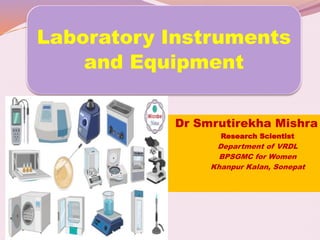
Laboratory Instruments
and Equipment
Dr Smrutirekha Mishra
Research Scientist
Department of VRDL
BPSGMC for Women
Khanpur Kalan, Sonepat
The instruments used in the microbiology labs include a bunch of
different kinds of instruments required for a lot of different processes conducted
within those laboratories.
INTRODUCTION
1. Pipettes
2. Glass syringes
3. Incubator
4. Hot air oven
5. Autoclave
6. Centrifuges
7. Water Bath
8. Vortex Mixture/ Vortexer
9. LaminarAir Flow/ LaminarHood
10.Microscope
11.Deep Freezer
12.Glasswares
List of Instruments used in Microbiology Lab
PIPETTES
 A pipette is a laboratory tool that is used to transfer very small
amounts of liquid from one container to another.
 It is commonly used in chemical and biological laboratories to
accurately measure and dispense small quantities of liquids.
 There are several different types of pipettes, including micropipettes,
which are used to measure and dispense very small volumes of
liquids, and volumetric pipettes, which are used to measure and
dispense specific volumes of liquids.
 Some pipettes are manual and require the user to draw the liquid up
into the pipette using a plunger, while others are electronic and
can be programmed to dispense specific volumes of liquid.
PIPETTES
Use of Pipettes
Pipettes are used to measure liquid volumes accurately. You'll need them
when making solutions, dissolving powders, mixing chemicals, and more.
Types Of Pipettes
 There are two main types of pipettes available:disposable and reusable.
 Disposables are inexpensive and easy to use, but they're not suitable for
high volume measurements.
 They also tend to break easily. Reusable pipettes are more expensive, but
they last longer and are better suited for large quantities of liquids.
Pipetting Techniques
Most commonly used dispensing techniques include forward pipetting, reverse
pipetting, dispensing, diluting, and sequential dispensing.
The selection of the dispensing technique depends on the experimental needs.
PIPETTES
Pipette Types
PIPETTES
Beral pipette
 The Beral pipette is also known as a disposable pipette.
 It is made of plastic and is used for the non-quantitative transfer of solutions.
Sometimes graduations are present on the stem of these pipettes.
Serological pipette
 Serological pipettes are graduated and are used for quantitative transfers.
 It requires a vacuum source for liquid dispensing typically a pipettor or a
pipette bulb attached to its blunt end.
 It is frequently used in the laboratory for transferring milliliter volumes,
from less than 1 ml to up to 50 ml.
 Serological pipettes are useful for mixing solutions and cell suspensions and
transferring liquids.
PIPETTES
Pasteur pipette
 Pasteur pipette is a thin glass transfer pipette like the Beral pipette.
 It requires a disposable rubber bulb to draw the sample and then dispense
it.
The thin stem allows for higher precision and more accuracy as compared
to the Beral pipette for small volume transfers.
Volumetric pipette
 Volumetric pipettes, also known as bulb pipettes, allow the user to precisely
transfer or measure the sample.
 These pipettes are equipped with a large bulb with a single graduation
mark as it is calibrated for a single volume. Usually, the markings
are for 10, 25, and 50 mL.
These types of pipettes are used to make laboratory solutions from a base
stock and prepare solutions for titration.
PIPETTES
Maintenance and Care of Pipettes
•Properly clean the pipette before and after every use.
•Rinse the contaminated parts of the pipette with distilled water or 70% ethanol and
air dry at 60°F to be used for aqueous solutions.
•Autoclave the lower part at 120°C for 20 minutes for infectious solutions.
•For proteins, rinse the pipette with a detergent and air dry. Do not use alcohol for
protein solutions as it will set the proteins.
•Periodically inspect the pipette for proper functioning and damages.
Strengths and Limitations
•Pipette is a powerful laboratory tool to transfer accurate volumes of liquid.
•Pipettes are equipped with an easily adjustable digital volumeter for optimal calibration to
draw specific volumes.
•The pipettes are easily cleaned and autoclaved that makes them useful for infectious
solutions too.
•Pipettes have made research more comfortable and accurate by allowing safe sample
transfer.
•They need proper maintenance and expertise to be handled.
 Syringes are commonly used in a lab setting for a variety of applications.
 Choosing your syringe carefully and handling it properly will ensure the longevity of the
syringe, and the safety of your personnel.
 Glass syringes intended to deliver drugs or biologics to a patient are a critical aspect of
patient care.
GLASS SYRINGES
 Syringes have a wide range of applications in a laboratory setting due to
their ability to accurately measure and dispense liquids. Common lab uses
include transferring precise volumes of liquid samples from one container to
another for dilution, mixing, reagent preparation, and sample extraction.
 Syringes are often used for precise dosing and delivery of reagents
during chemical reactions and synthesis processes, or in life science research
for aspirating media, adding growth factors or nutrients, and transferring cells.
 Researchers can use lab syringes to collect liquid samples, particularly
in environmental monitoring, water quality analysis, or biological sample
collection.
GLASS SYRINGES
Types of Syringes
 A variety of syringes are used in a laboratory setting.
The most used syringes in laboratories are general use syringes, which are
suitable for many applications.
They typically have a luer slip or luer lock tip and come in various sizes,
ranging from small microliter syringes to larger milliliter syringes.
Also common are disposable syringes that are designed for single-use and
are often made of plastic.
They are pre-sterilized and come individually wrapped, ensuring
cleanliness and convenience.
Reusable and sterilizable glass syringes are made of borosilicate glass,
which is resistant to heat and chemicals.
They are used in applications that require higher chemical compatibility,
such as handling samples that need to be heated.
GLASS SYRINGES
Using the Syringe
 Before drawing any liquid into the syringe, ensure there are no air bubbles
trapped inside. Hold the syringe vertically, tap gently to dislodge any
bubbles, and expel them by slowly pushing the plunger until a small amount
of liquid is released.
 Take measurements at eye level to avoid parallax errors. Slowly draw
the liquid into the syringe, allowing it to fill the barrel completely
and ensuring that the meniscus is aligned with the desired
measurement mark.
 When dispensing the liquid, apply slow, steady pressure to the plunger
to avoid sudden spurts or spills.
 If precise dispensing is required, use the graduations on the syringe
barrel for reference. For precision dispensing of liquids, a micropump
like WPI’s UMP3 can accurately and consistently inject down to the
sub-microliter range.
GLASS SYRINGES
After Using a Syringe
When you change the aqueous substance being handled, always use a new,
clean syringe to prevent cross-contamination.
If you are reusing a syringe for the same substance, thoroughly clean and
rinse it between uses to eliminate any residue.
Also use a clean syringe for every subject you inject in or withdraw from.
Dispose of used syringes in accordance with appropriate safety protocols in
place for your institution, following local regulations and guidelines
for the disposal of medical waste or sharps.
Always prioritize safety and accuracy when using laboratory syringes and
consult with experienced personnel or supervisors for any specific
protocols or procedures in place for your laboratory setting.
INCUBATOR
An incubator is a device that is used in laboratories for the growth and
maintenance of microorganisms and cultures. Incubator provides an optimal
temperature, pressure, moisture, among other things required for the growth of
microorganisms.
 An incubator, in microbiology, is an insulated and enclosed device that
provides an optimal condition of temperature, humidity, and other
environmental conditions required for the growth of organisms.
An incubator is a piece of vital laboratory equipment necessary for cultivating
microorganisms under artificial conditions.
An incubator can be used to cultivate both unicellular and multicellular organisms.
INCUBATOR
 All incubators are based on the concept that when organisms are provided with
the optimal condition of temperature, humidity, oxygen, and carbon dioxide
levels, they grow and divide to form more organisms.
A microbial incubator is made up of various units, some of which are:
Cabinet
Door
Control Panel
Thermostat
Perforated shelves
Asbestos door gasket
L-shaped thermometer
HEPA filters
Humidity and gas control
INCUBATOR
Cabinet
•The cabinet is the main body of the incubator consisting of a double-
walled cuboidal enclosure with a capacity ranging from 20 to 800L.
Door
•A door is present in all incubators to close the insulated cabinet.
Control Panel
•On the outer wall of the incubator is a control panel with all the switches and
indicators that allows the parameters of the incubator to be controlled.
Thermostat
•A thermostat is used to set the desired temperature of the incubator.
Perforated shelves
•The perforations on the shelves allow the movement of hot air throughout the inside of the
incubator.
Asbestos door gasket
•The asbestos door gasket provides an almost airtight seal between the door and the
cabinet.
L-shaped thermometer
•A thermometer is placed on the top part of the outer wall of the incubator.
HEPA filters
•Some advanced incubators are also provided with HEPA filters to lower the possible
contamination created due to airflow.
INCUBATOR
Uses of Incubator
Incubators have a wide range of applications in various areas including cell
culture, pharmaceutical studies, hematological studies, and biochemical studies.
Some of the uses of incubators are given below:
•Incubators are used to grow microbial culture or cell cultures.
•Incubators can also be used to maintain the culture of organisms to be
used later.
•Some incubators are used to increase the growth rate of organisms,
having a prolonged growth rate in the natural environment.
•Specific incubators are used for the reproduction of microbial colonies
and subsequent determination of biochemical oxygen demand.
•These are also used for breeding of insects and hatching of eggs in
zoology.
•Incubators also provide a controlled condition for sample storage before
they can be processed in the laboratories.
HOT AIR OVEN
A hot air oven is an essential laboratory equipment that uses to dry heat
(hot air) to sterilize laboratory objects and samples. This type of
sterilization is also known as dry heat sterilization.
•This mechanism of heat treatment was introduced by French scientist Louis
Pasteur
A hot air oven is an electrical device that is used for sterilization of
medical equipment or samples using dry heat.
Some of the applications of hot air ovens are:
•It is used for sterilization of laboratory equipment such as glassware
(flasks, pipettes, Petri-plates, and test tubes), culture media, metal items
(forceps, spatula, scalpel, scissors), non-volatile compounds (zinc and
starch powder, sulfonamide), and other materials that contain oils.
HOT AIR OVEN-
HOT AIR OVEN-
•A hot air oven is generally used for samples that are heat resistant and do
not melt, change the form or catch fire on exposure to high
temperatures.
• It generally kills microorganisms and bacterial spores at extremely high
temperatures over several hours and sterilizes items.
•Effective sterilization can only be achieved when the appropriate
temperature and holding time are selected depending on the type
of microorganism being targeted and the type of material being
sterilized.
•The most commonly used temperature and time to sterilize items are 170
degrees Celsius for 30 minutes, 160 degrees for 60 minutes, and 150
degrees for 150 minutes.
Working Principle
HOT AIR OVEN-
Advantages of Hot Air Oven
•It does not require water for sterilization purposes like an autoclave.
•It is economical and easy to operate.
•It can function at higher temperature and faster than autoclave.
•The small size of the oven requires less space and has an easier installation process.
•The dry heat does not corrode or rust metals or other sharp articles.
•It is smaller in size and is convenient to work on.
•Less pressure built in it ensures safety during operation.
•It is non-toxic. No harmful chemical residues will be discarded.
•The dry heat can penetrate deeply into thick objects such that it helps to achieve an
in-depth sterilization effect.
Limitations of Hot Air Oven
•It is not suitable to sterilize items such as rubber, plastics, surgical dressing, etc., due
to their low melting point.
•It may not destroy the heat-resistant endospores and prions because they utilize
dry heat instead of moist heat.
•It is time-consuming relative to steam, flaming, chemical sterilization, or radiation.
AUTOCLAVE
An autoclave is a pressurized chamber used for the process of sterilization and
disinfection by combining three factors: time, pressure, and steam
Steam sterilisation is used to disinfect instruments, solid, hollow, or liquid,
from all types of backgrounds and settings.
Two most commonly used instruments used in plant tissue culture labs for the
sterilization of equipment and materials are autoclave and microwave. They both
work on two different principle of moist heat sterilization (Autoclave) and dry heat
sterilization (microwave).
Today, different types of autoclaves are present according
to your needs. It includes:
•Pressure cooker type/ Laboratory bench autoclaves (N-type): It’s a domestic
pressure cooker that is a perfect fit for tissue culture enthusiasts or
hobbyists.
•Gravity displacement type autoclave: It’s the most common type of autoclave
used in research laboratories. In this autoclave, steam displaces air in the
chamber by gravity through a drain port.
•Positive pressure displacement type (B-type): This is an advanced autoclave,
in which steam is generated in a separate steam generator, which is
then passed into the autoclave for sterilization of equipment.
•Negative pressure displacement type (S-type): This is the most expensive
type of autoclave. It comes with a vacuum generator and steam generator
that works efficiently to achieve complete sterilization of equipment.
TYPES OF AUTOCLAVE AUTOCLAVE
AUTOCLAVE
Uses
 Autoclaves are mostly used for the sterilization of medical or laboratory
equipment with the capacity of sterilizing a large number of
materials at once.
 They are commonly used for the preparation of culture media during
laboratory applications.
 Autoclaves are capable of sterilising solids, liquids, hollows, and other
instruments that come in varying shapes and sizes. Some examples
of this may include surgical equipment, pharmaceutical objects,
laboratory instruments, and many others.
 Other examples of what autoclaves can sterilise include culture media,
autoclavable plastic materials, solutions and water, selective
glassware, pipette tips, plastic tubes, and biohazardous waste.
CENTRIFUGES
 A centrifuge is a device that allows the rotation of an object about a single
axis, where an outward force is applied perpendicularly to the axis.
 A laboratory centrifuge is motor-based and allows the rotation of a liquid
sample resulting in the separation of the components of the mixture.
Principle of Centrifuges
•Classifications and Types of Centrifuges
•Applications and Benefits of Centrifuges
•And Much More..
It is used to separate a mixture containing two
dissimilar miscible liquids. Centrifugation takes
advantage of the different densities of the two
liquids and thus achieving the separation.
CENTRIFUGES
Working Principle
 A centrifuge works on the principle of sedimentation, where the high speed of
the rotation causes the denser particles to move away from the center while
smaller, less dense particles are forced towards the center.
Thus, the denser particles settle at the bottom while the lighter particles are
collected at the top.
In a laboratory tabletop centrifuge, the sample tubes are aligned at an angle so
that the particles have to travel a shorter distance before they hit the bottom.
CENTRIFUGES
 centrifuges are very important devices that help us in our day to day lives
as they can be used in various walks of life.
Ranging from laboratories, pharmaceuticals, biology and chemical technology
experiments, mining, and industrial processes.
There are also many different types of centrifuges with different
capabilities.
These centrifuges, though important, do come in with a notable number of
drawbacks that need to be considered.
They have a wide range of specifications that need to be considered before
acquiring one.
Uses
The primary application of a centrifuge is the separation of particles suspended in
a suspension. It can be used for the separation of cell organelles, nucleic acid, blood
components, and separation of isotopes.
WATERBATH
Water Bath is a conventional device that is
used for chemical reactions that required a
controlled environment at a constant
temperature.
Again,a water bath is a piece
of scientific equipment used to maintain a
steady temperature for a prolonged time
when incubating samples.
 It can be used for reagent warming, substrate melting, or cell culture incubation.
 The water bath is the preferred heat source for heating flammable
compounds because it allows some chemical processes to occur at high
temperatures.
 It improves the solubility of poorly soluble compounds.
WATERBATH
Uses
 Water baths are primarily used for heating samples under a controlled
temperature.
These are suitable for heating chemicals that might be flammable under
direct ignition.
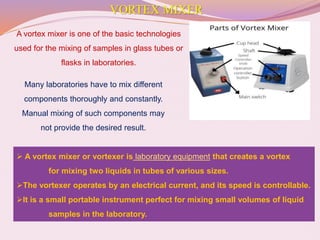
VORTEX MIXER
A vortex mixer is one of the basic technologies
used for the mixing of samples in glass tubes or
flasks in laboratories.
Many laboratories have to mix different
components thoroughly and constantly.
Manual mixing of such components may
not provide the desired result.
 A vortex mixer or vortexer is laboratory equipment that creates a vortex
for mixing two liquids in tubes of various sizes.
The vortexer operates by an electrical current, and its speed is controllable.
It is a small portable instrument perfect for mixing small volumes of liquid
samples in the laboratory.
Uses
 Vortex mixer is mostly used for the mixing of various sample fluids
in the sample tubes and also allows for the homogenization of
cells and cell organelles.
 Mixing chemicals: Vortexing helps in most laboratories’
homogenous mixing of chemicals. The mixing time is quicker
than that of other methods of mixing.
 DNA extraction: The vortexer is used for homogenous sample
mixing with extraction buffer. This method also helps in cell
disruption.
 In the analysis of proteins and enzymes: Proper mixing of samples
with reagents and buffer is a critical step in studying proteins
and enzymes. So, a vortex mixer helps in homogenized mixing
during analysis.
VORTEX MIXER
LAMINAR AIR FLOW/ LAMINAR HOOD
 Laminar Hood is a closed device primarily for processes or instruments
sensitive to microbial contamination.
Working Principle
This device creates a sterile environment with the flow of sterile air through a
High-Efficiency Particulate Air (HEPA) filter and shortwave ultraviolet germicidal lamp
that sterilizes the workstation.
Laminar Air Flow has to turn on 15 minutes before to ensure complete
sterilization and the workstation should be cleaned with ethanol before and after use.
Uses
Laminar Hood is commonly used to conduct processes that are sensitive to
contamination.
It is used for experiments related to plant tissue culture and for the experiments
of genetic transformation.
Microscopes are devices that allow the observer to have an exceedingly
close view of minute particles.
Working Principle
There are many different types of microscopes, each of which works on its
respective principles.
The basic principle in a microscope is magnification. Based on the relative
position of the object from the lens or electromagnets, different positions,
nature, and magnification of the image can be achieved.
Different types of microscopes are developed to cater to the specific needs of
the observation. However, the common theme is magnification.
Uses
 Based on the type of microscope , different microscopes are used for different
purposes.
 They are primarily used for the observation of minute particles which cannot be
observed with naked eyes.
Microscope
Working Principle
 Deep freezers are based on the principle that under extremely low
temperatures, there is minimum microbial growth which allows for the
protection and preservation of different substances.
 Based on this principle, we can even preserve cultures over a long
period of time without any change in the concentration of the
microorganisms.
Uses
 A deep freeze can be used for the preservation of different things
used in the laboratories for a very long period of time.
 Deep freezers are used in laboratories to store and preserve
medical equipment, food items, blood samples, medicines, and
injections, etc. for a more extended period of time.
Deep Freezer
lab_instruments.pptx

lab_instruments.pptx

  • 1.
    Laboratory Instruments and Equipment DrSmrutirekha Mishra Research Scientist Department of VRDL BPSGMC for Women Khanpur Kalan, Sonepat
  • 2.
    The instruments usedin the microbiology labs include a bunch of different kinds of instruments required for a lot of different processes conducted within those laboratories. INTRODUCTION 1. Pipettes 2. Glass syringes 3. Incubator 4. Hot air oven 5. Autoclave 6. Centrifuges 7. Water Bath 8. Vortex Mixture/ Vortexer 9. LaminarAir Flow/ LaminarHood 10.Microscope 11.Deep Freezer 12.Glasswares List of Instruments used in Microbiology Lab
  • 3.
    PIPETTES  A pipetteis a laboratory tool that is used to transfer very small amounts of liquid from one container to another.  It is commonly used in chemical and biological laboratories to accurately measure and dispense small quantities of liquids.  There are several different types of pipettes, including micropipettes, which are used to measure and dispense very small volumes of liquids, and volumetric pipettes, which are used to measure and dispense specific volumes of liquids.  Some pipettes are manual and require the user to draw the liquid up into the pipette using a plunger, while others are electronic and can be programmed to dispense specific volumes of liquid.
  • 4.
    PIPETTES Use of Pipettes Pipettesare used to measure liquid volumes accurately. You'll need them when making solutions, dissolving powders, mixing chemicals, and more. Types Of Pipettes  There are two main types of pipettes available:disposable and reusable.  Disposables are inexpensive and easy to use, but they're not suitable for high volume measurements.  They also tend to break easily. Reusable pipettes are more expensive, but they last longer and are better suited for large quantities of liquids. Pipetting Techniques Most commonly used dispensing techniques include forward pipetting, reverse pipetting, dispensing, diluting, and sequential dispensing. The selection of the dispensing technique depends on the experimental needs.
  • 5.
  • 6.
    PIPETTES Beral pipette  TheBeral pipette is also known as a disposable pipette.  It is made of plastic and is used for the non-quantitative transfer of solutions. Sometimes graduations are present on the stem of these pipettes. Serological pipette  Serological pipettes are graduated and are used for quantitative transfers.  It requires a vacuum source for liquid dispensing typically a pipettor or a pipette bulb attached to its blunt end.  It is frequently used in the laboratory for transferring milliliter volumes, from less than 1 ml to up to 50 ml.  Serological pipettes are useful for mixing solutions and cell suspensions and transferring liquids.
  • 7.
    PIPETTES Pasteur pipette  Pasteurpipette is a thin glass transfer pipette like the Beral pipette.  It requires a disposable rubber bulb to draw the sample and then dispense it. The thin stem allows for higher precision and more accuracy as compared to the Beral pipette for small volume transfers. Volumetric pipette  Volumetric pipettes, also known as bulb pipettes, allow the user to precisely transfer or measure the sample.  These pipettes are equipped with a large bulb with a single graduation mark as it is calibrated for a single volume. Usually, the markings are for 10, 25, and 50 mL. These types of pipettes are used to make laboratory solutions from a base stock and prepare solutions for titration.
  • 8.
    PIPETTES Maintenance and Careof Pipettes •Properly clean the pipette before and after every use. •Rinse the contaminated parts of the pipette with distilled water or 70% ethanol and air dry at 60°F to be used for aqueous solutions. •Autoclave the lower part at 120°C for 20 minutes for infectious solutions. •For proteins, rinse the pipette with a detergent and air dry. Do not use alcohol for protein solutions as it will set the proteins. •Periodically inspect the pipette for proper functioning and damages. Strengths and Limitations •Pipette is a powerful laboratory tool to transfer accurate volumes of liquid. •Pipettes are equipped with an easily adjustable digital volumeter for optimal calibration to draw specific volumes. •The pipettes are easily cleaned and autoclaved that makes them useful for infectious solutions too. •Pipettes have made research more comfortable and accurate by allowing safe sample transfer. •They need proper maintenance and expertise to be handled.
  • 9.
     Syringes arecommonly used in a lab setting for a variety of applications.  Choosing your syringe carefully and handling it properly will ensure the longevity of the syringe, and the safety of your personnel.  Glass syringes intended to deliver drugs or biologics to a patient are a critical aspect of patient care. GLASS SYRINGES  Syringes have a wide range of applications in a laboratory setting due to their ability to accurately measure and dispense liquids. Common lab uses include transferring precise volumes of liquid samples from one container to another for dilution, mixing, reagent preparation, and sample extraction.  Syringes are often used for precise dosing and delivery of reagents during chemical reactions and synthesis processes, or in life science research for aspirating media, adding growth factors or nutrients, and transferring cells.  Researchers can use lab syringes to collect liquid samples, particularly in environmental monitoring, water quality analysis, or biological sample collection.
  • 10.
    GLASS SYRINGES Types ofSyringes  A variety of syringes are used in a laboratory setting. The most used syringes in laboratories are general use syringes, which are suitable for many applications. They typically have a luer slip or luer lock tip and come in various sizes, ranging from small microliter syringes to larger milliliter syringes. Also common are disposable syringes that are designed for single-use and are often made of plastic. They are pre-sterilized and come individually wrapped, ensuring cleanliness and convenience. Reusable and sterilizable glass syringes are made of borosilicate glass, which is resistant to heat and chemicals. They are used in applications that require higher chemical compatibility, such as handling samples that need to be heated.
  • 11.
    GLASS SYRINGES Using theSyringe  Before drawing any liquid into the syringe, ensure there are no air bubbles trapped inside. Hold the syringe vertically, tap gently to dislodge any bubbles, and expel them by slowly pushing the plunger until a small amount of liquid is released.  Take measurements at eye level to avoid parallax errors. Slowly draw the liquid into the syringe, allowing it to fill the barrel completely and ensuring that the meniscus is aligned with the desired measurement mark.  When dispensing the liquid, apply slow, steady pressure to the plunger to avoid sudden spurts or spills.  If precise dispensing is required, use the graduations on the syringe barrel for reference. For precision dispensing of liquids, a micropump like WPI’s UMP3 can accurately and consistently inject down to the sub-microliter range.
  • 12.
    GLASS SYRINGES After Usinga Syringe When you change the aqueous substance being handled, always use a new, clean syringe to prevent cross-contamination. If you are reusing a syringe for the same substance, thoroughly clean and rinse it between uses to eliminate any residue. Also use a clean syringe for every subject you inject in or withdraw from. Dispose of used syringes in accordance with appropriate safety protocols in place for your institution, following local regulations and guidelines for the disposal of medical waste or sharps. Always prioritize safety and accuracy when using laboratory syringes and consult with experienced personnel or supervisors for any specific protocols or procedures in place for your laboratory setting.
  • 13.
    INCUBATOR An incubator isa device that is used in laboratories for the growth and maintenance of microorganisms and cultures. Incubator provides an optimal temperature, pressure, moisture, among other things required for the growth of microorganisms.  An incubator, in microbiology, is an insulated and enclosed device that provides an optimal condition of temperature, humidity, and other environmental conditions required for the growth of organisms. An incubator is a piece of vital laboratory equipment necessary for cultivating microorganisms under artificial conditions. An incubator can be used to cultivate both unicellular and multicellular organisms.
  • 14.
    INCUBATOR  All incubatorsare based on the concept that when organisms are provided with the optimal condition of temperature, humidity, oxygen, and carbon dioxide levels, they grow and divide to form more organisms. A microbial incubator is made up of various units, some of which are: Cabinet Door Control Panel Thermostat Perforated shelves Asbestos door gasket L-shaped thermometer HEPA filters Humidity and gas control
  • 15.
    INCUBATOR Cabinet •The cabinet isthe main body of the incubator consisting of a double- walled cuboidal enclosure with a capacity ranging from 20 to 800L. Door •A door is present in all incubators to close the insulated cabinet. Control Panel •On the outer wall of the incubator is a control panel with all the switches and indicators that allows the parameters of the incubator to be controlled. Thermostat •A thermostat is used to set the desired temperature of the incubator. Perforated shelves •The perforations on the shelves allow the movement of hot air throughout the inside of the incubator. Asbestos door gasket •The asbestos door gasket provides an almost airtight seal between the door and the cabinet. L-shaped thermometer •A thermometer is placed on the top part of the outer wall of the incubator. HEPA filters •Some advanced incubators are also provided with HEPA filters to lower the possible contamination created due to airflow.
  • 16.
    INCUBATOR Uses of Incubator Incubatorshave a wide range of applications in various areas including cell culture, pharmaceutical studies, hematological studies, and biochemical studies. Some of the uses of incubators are given below: •Incubators are used to grow microbial culture or cell cultures. •Incubators can also be used to maintain the culture of organisms to be used later. •Some incubators are used to increase the growth rate of organisms, having a prolonged growth rate in the natural environment. •Specific incubators are used for the reproduction of microbial colonies and subsequent determination of biochemical oxygen demand. •These are also used for breeding of insects and hatching of eggs in zoology. •Incubators also provide a controlled condition for sample storage before they can be processed in the laboratories.
  • 17.
    HOT AIR OVEN Ahot air oven is an essential laboratory equipment that uses to dry heat (hot air) to sterilize laboratory objects and samples. This type of sterilization is also known as dry heat sterilization. •This mechanism of heat treatment was introduced by French scientist Louis Pasteur A hot air oven is an electrical device that is used for sterilization of medical equipment or samples using dry heat. Some of the applications of hot air ovens are: •It is used for sterilization of laboratory equipment such as glassware (flasks, pipettes, Petri-plates, and test tubes), culture media, metal items (forceps, spatula, scalpel, scissors), non-volatile compounds (zinc and starch powder, sulfonamide), and other materials that contain oils.
  • 18.
  • 19.
    HOT AIR OVEN- •Ahot air oven is generally used for samples that are heat resistant and do not melt, change the form or catch fire on exposure to high temperatures. • It generally kills microorganisms and bacterial spores at extremely high temperatures over several hours and sterilizes items. •Effective sterilization can only be achieved when the appropriate temperature and holding time are selected depending on the type of microorganism being targeted and the type of material being sterilized. •The most commonly used temperature and time to sterilize items are 170 degrees Celsius for 30 minutes, 160 degrees for 60 minutes, and 150 degrees for 150 minutes. Working Principle
  • 20.
    HOT AIR OVEN- Advantagesof Hot Air Oven •It does not require water for sterilization purposes like an autoclave. •It is economical and easy to operate. •It can function at higher temperature and faster than autoclave. •The small size of the oven requires less space and has an easier installation process. •The dry heat does not corrode or rust metals or other sharp articles. •It is smaller in size and is convenient to work on. •Less pressure built in it ensures safety during operation. •It is non-toxic. No harmful chemical residues will be discarded. •The dry heat can penetrate deeply into thick objects such that it helps to achieve an in-depth sterilization effect. Limitations of Hot Air Oven •It is not suitable to sterilize items such as rubber, plastics, surgical dressing, etc., due to their low melting point. •It may not destroy the heat-resistant endospores and prions because they utilize dry heat instead of moist heat. •It is time-consuming relative to steam, flaming, chemical sterilization, or radiation.
  • 21.
    AUTOCLAVE An autoclave isa pressurized chamber used for the process of sterilization and disinfection by combining three factors: time, pressure, and steam Steam sterilisation is used to disinfect instruments, solid, hollow, or liquid, from all types of backgrounds and settings. Two most commonly used instruments used in plant tissue culture labs for the sterilization of equipment and materials are autoclave and microwave. They both work on two different principle of moist heat sterilization (Autoclave) and dry heat sterilization (microwave).
  • 22.
    Today, different typesof autoclaves are present according to your needs. It includes: •Pressure cooker type/ Laboratory bench autoclaves (N-type): It’s a domestic pressure cooker that is a perfect fit for tissue culture enthusiasts or hobbyists. •Gravity displacement type autoclave: It’s the most common type of autoclave used in research laboratories. In this autoclave, steam displaces air in the chamber by gravity through a drain port. •Positive pressure displacement type (B-type): This is an advanced autoclave, in which steam is generated in a separate steam generator, which is then passed into the autoclave for sterilization of equipment. •Negative pressure displacement type (S-type): This is the most expensive type of autoclave. It comes with a vacuum generator and steam generator that works efficiently to achieve complete sterilization of equipment. TYPES OF AUTOCLAVE AUTOCLAVE
  • 23.
    AUTOCLAVE Uses  Autoclaves aremostly used for the sterilization of medical or laboratory equipment with the capacity of sterilizing a large number of materials at once.  They are commonly used for the preparation of culture media during laboratory applications.  Autoclaves are capable of sterilising solids, liquids, hollows, and other instruments that come in varying shapes and sizes. Some examples of this may include surgical equipment, pharmaceutical objects, laboratory instruments, and many others.  Other examples of what autoclaves can sterilise include culture media, autoclavable plastic materials, solutions and water, selective glassware, pipette tips, plastic tubes, and biohazardous waste.
  • 24.
    CENTRIFUGES  A centrifugeis a device that allows the rotation of an object about a single axis, where an outward force is applied perpendicularly to the axis.  A laboratory centrifuge is motor-based and allows the rotation of a liquid sample resulting in the separation of the components of the mixture. Principle of Centrifuges •Classifications and Types of Centrifuges •Applications and Benefits of Centrifuges •And Much More.. It is used to separate a mixture containing two dissimilar miscible liquids. Centrifugation takes advantage of the different densities of the two liquids and thus achieving the separation.
  • 25.
    CENTRIFUGES Working Principle  Acentrifuge works on the principle of sedimentation, where the high speed of the rotation causes the denser particles to move away from the center while smaller, less dense particles are forced towards the center. Thus, the denser particles settle at the bottom while the lighter particles are collected at the top. In a laboratory tabletop centrifuge, the sample tubes are aligned at an angle so that the particles have to travel a shorter distance before they hit the bottom.
  • 26.
    CENTRIFUGES  centrifuges arevery important devices that help us in our day to day lives as they can be used in various walks of life. Ranging from laboratories, pharmaceuticals, biology and chemical technology experiments, mining, and industrial processes. There are also many different types of centrifuges with different capabilities. These centrifuges, though important, do come in with a notable number of drawbacks that need to be considered. They have a wide range of specifications that need to be considered before acquiring one. Uses The primary application of a centrifuge is the separation of particles suspended in a suspension. It can be used for the separation of cell organelles, nucleic acid, blood components, and separation of isotopes.
  • 27.
    WATERBATH Water Bath isa conventional device that is used for chemical reactions that required a controlled environment at a constant temperature. Again,a water bath is a piece of scientific equipment used to maintain a steady temperature for a prolonged time when incubating samples.
  • 28.
     It canbe used for reagent warming, substrate melting, or cell culture incubation.  The water bath is the preferred heat source for heating flammable compounds because it allows some chemical processes to occur at high temperatures.  It improves the solubility of poorly soluble compounds. WATERBATH Uses  Water baths are primarily used for heating samples under a controlled temperature. These are suitable for heating chemicals that might be flammable under direct ignition.
  • 29.
    VORTEX MIXER A vortexmixer is one of the basic technologies used for the mixing of samples in glass tubes or flasks in laboratories. Many laboratories have to mix different components thoroughly and constantly. Manual mixing of such components may not provide the desired result.  A vortex mixer or vortexer is laboratory equipment that creates a vortex for mixing two liquids in tubes of various sizes. The vortexer operates by an electrical current, and its speed is controllable. It is a small portable instrument perfect for mixing small volumes of liquid samples in the laboratory.
  • 30.
    Uses  Vortex mixeris mostly used for the mixing of various sample fluids in the sample tubes and also allows for the homogenization of cells and cell organelles.  Mixing chemicals: Vortexing helps in most laboratories’ homogenous mixing of chemicals. The mixing time is quicker than that of other methods of mixing.  DNA extraction: The vortexer is used for homogenous sample mixing with extraction buffer. This method also helps in cell disruption.  In the analysis of proteins and enzymes: Proper mixing of samples with reagents and buffer is a critical step in studying proteins and enzymes. So, a vortex mixer helps in homogenized mixing during analysis. VORTEX MIXER
  • 31.
    LAMINAR AIR FLOW/LAMINAR HOOD  Laminar Hood is a closed device primarily for processes or instruments sensitive to microbial contamination. Working Principle This device creates a sterile environment with the flow of sterile air through a High-Efficiency Particulate Air (HEPA) filter and shortwave ultraviolet germicidal lamp that sterilizes the workstation. Laminar Air Flow has to turn on 15 minutes before to ensure complete sterilization and the workstation should be cleaned with ethanol before and after use. Uses Laminar Hood is commonly used to conduct processes that are sensitive to contamination. It is used for experiments related to plant tissue culture and for the experiments of genetic transformation.
  • 32.
    Microscopes are devicesthat allow the observer to have an exceedingly close view of minute particles. Working Principle There are many different types of microscopes, each of which works on its respective principles. The basic principle in a microscope is magnification. Based on the relative position of the object from the lens or electromagnets, different positions, nature, and magnification of the image can be achieved. Different types of microscopes are developed to cater to the specific needs of the observation. However, the common theme is magnification. Uses  Based on the type of microscope , different microscopes are used for different purposes.  They are primarily used for the observation of minute particles which cannot be observed with naked eyes. Microscope
  • 33.
    Working Principle  Deepfreezers are based on the principle that under extremely low temperatures, there is minimum microbial growth which allows for the protection and preservation of different substances.  Based on this principle, we can even preserve cultures over a long period of time without any change in the concentration of the microorganisms. Uses  A deep freeze can be used for the preservation of different things used in the laboratories for a very long period of time.  Deep freezers are used in laboratories to store and preserve medical equipment, food items, blood samples, medicines, and injections, etc. for a more extended period of time. Deep Freezer