Branding, Packaging and
Labeling
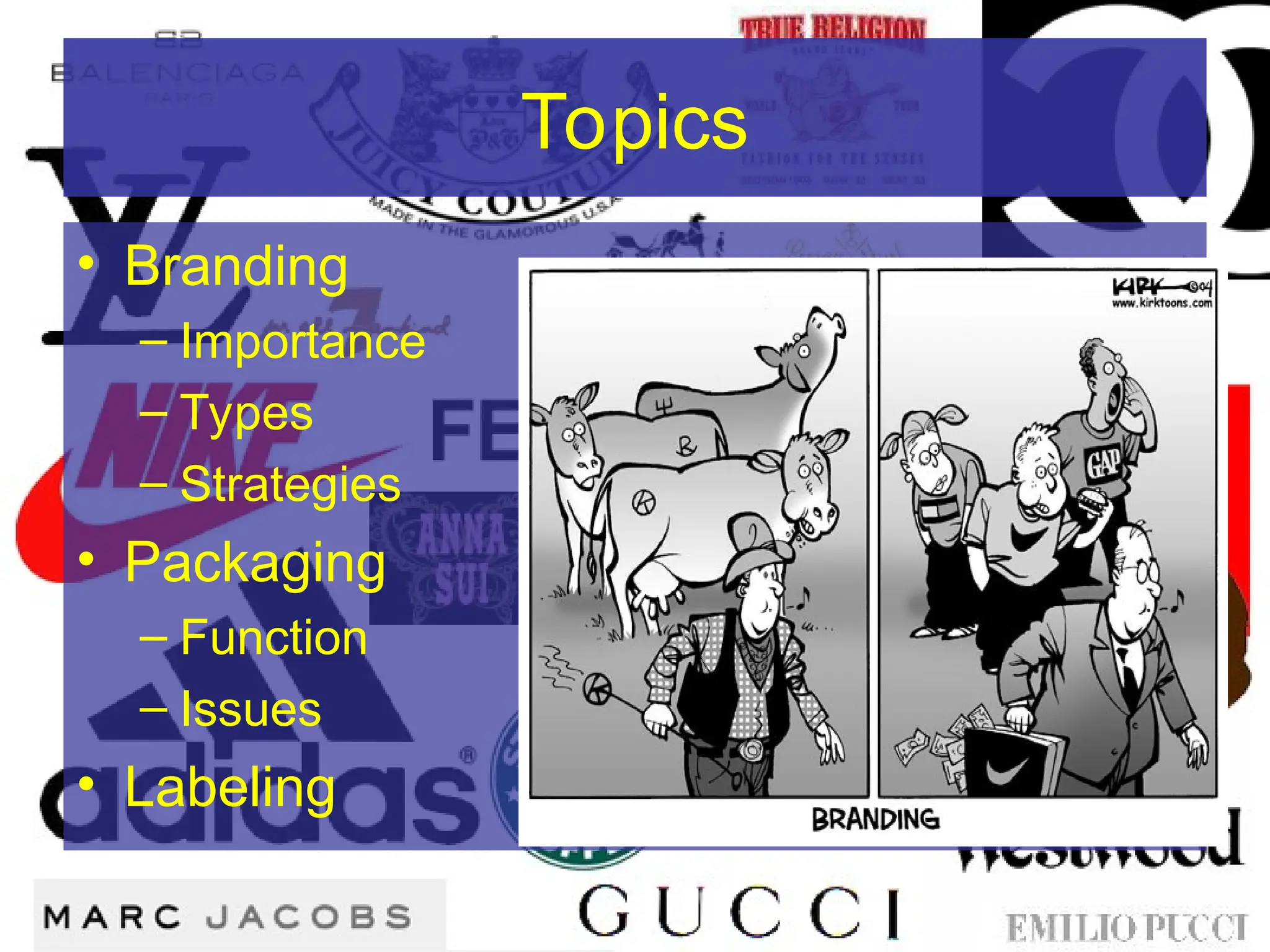
Topics
• Branding
– Importance
– Types
– Strategies
• Packaging
– Function
– Issues
• Labeling
Branding
• Brand
– Name, term, design, or symbol that identifies a
business and its products
• Corporate brands
– Identify the business and reflect image across all
products
– Coca-Cola, Daimler-Chrysler
• Product brands
– Among most important assets and powerful selling
elements
– Coke, Dodge
Brands
• Brand Name
– Words, letter numbers the represent brand
– Corvette, Airwalk, FedEx
• Brand Mark
– Logo or symbol
• Trade Name
– Legal name a company uses to conduct
business
– Dell, Xerox
Brands
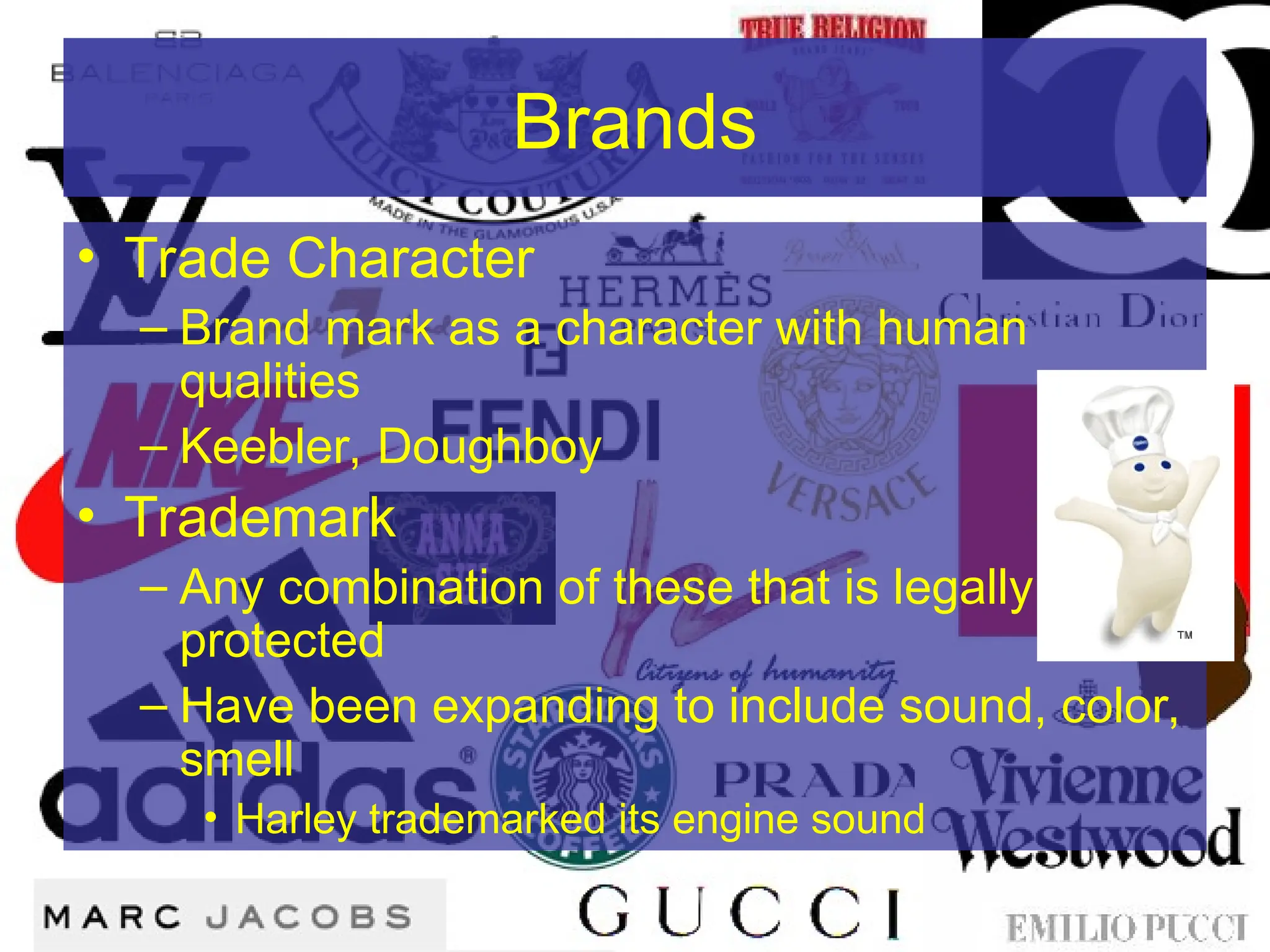
• Trade Character
– Brand mark as a character with human
qualities
– Keebler, Doughboy
• Trademark
– Any combination of these that is legally
protected
– Have been expanding to include sound, color,
smell
• Harley trademarked its engine sound
Importance of Branding
• Builds customer loyalty
– Customers pay more for recognized names
• Assures customer of quality & reduces risk
of dissatisfaction
• Assists in extending lines
– Customers more willing to try familiar names
Generating Brands
• Estimated that 75% of companies
introduce a new product brand annually
• In 1999, 79,000 trademarks were
registered
• Global brands often consolidate names
– Confusion can result from multiple names for
the same product
• In UK, 3 Musketeers is known as Mars Bar
Types of Brands
• Manufacturer Brands
– Producer brands, owned by manufacturer
– Gives impression of standard quality,
performance & status
– Most brands are manufacturer brands
• 65% of appliances
• 70% of food
• 80% of gas
• 100% of cars
Types of Brands
• Private distributor brands
– Store or dealer brands, owned by retail stores
– Item is purchased to be sold exclusively at
certain stores, i.e. Radio Shack brand
– Manufacturer name is not displayed
– Higher returns for store
– Builds retailer loyalty
• Craftsman, Kenmore sold only at Sears
Types of Brands
• Generic Brands
– Carry no company name, just product
description
– Sold much cheaper, 30 – 50% lower than
manufacturer brands, and 10 – 15% lower
than store brands
– Jewel supermarkets in Chicago were the first
to offer
Branding Strategies
• Brand extension
– Uses existing brand name to promote new
products
– Dilution may become a problem
• Brand Licensing
– Allow other companies to use trademarks for
a fee, plus royalties on sales
– Enhances image & helps sales of core
products
Branding Strategies
• Mixed branding
– Offer combination of manufacturer, store &
generic brands
– Manufacturer will sell under a national brand,
then sell extra to a store to be repackaged
under a store brand, then make a generic
– Maximizes profit by appealing to all segments
Branding Strategies
• Co-Branding
– Uses two or more brands to increase loyalty
and sales for individual brands
– Builds recognition for each, work best if
product complement each other
• Starbucks in Barnes & Nobles
• Smuckers jelly in Pop-Tarts
Packaging
• Physical container or wrapping
– Approximately 10% of retail price is spent on
package
– In some cases, package is most expensive
part of production
Function of Packaging
• Key selling tool
• Promoting & selling
– Reaction to packaging is important to overall
success or failure
– New designs may not replace old, but
complement it
• Pump soap containers
• Defining product identity
– Invoke prestige, convenience, status, etc.
Function of Packaging
• Provide information
– Directions on how to use, warnings,
ingredients
• Meet customer needs
– Various sizes for different market segments
– Must adapt to meet changing lifestyles
Function of Packaging
• Ensure safe use
– Tamper resistance, child proofing
– Blisterpacks, molded plastic with foil or
cardboard backing
• Gums and some medicine
• Protection
– Shipping, storage, display
– Prevent shoplifting, breakage & spills
Contemporary Issues
• Changing social and political atmosphere
leads to changes in product & package
– Environmental packaging
• Surveys indicate consumers will pay more for
these packages
– Cause packaging
• Promoting unrelated issues on package, usually
socially or politically motivated
– Ben & Jerry’s, Body Shop
Labeling
• Informational tag, wrapper, seal or
imprinted message
• Main function is to inform about contents
and give directions
• Protects company from liability & lawsuits
Labels
• Brand label
– Gives name, logo & trademark
• Descriptive label
– Gives information about use, construction,
care, performance, etc.
• Does not contain all the information that a
consumer might want
• Grade label
– Give product quality
Labels
• Food labels must contain weight, dating
and storage information, UPC, etc.
– Net weight is entire product minus the weight
of package and packing materials
– Dating options are
• Date packed
• Sell by date – last day it should be sold
• Best if – last day for best quality
• Expiration – should not be used after
Labeling Laws
• Public outcry has lead to regulations on
what needs to be incorporated on labels
• Fair Packaging & Labeling Act (FPLA)
gives the FDA and FTC authority over
labeling
• Not all countries have the same label laws
– Coke was pulled off Italian shelves because
they would not list the “secret ingredient”
Labeling Laws
• FDA
– Enacted a law to require labels to give
information on how the product fits into a daily
diet
– Developed definitions for light, free, low,
reduced and good source
– Warning labels on cigarettes and alcohol
– Developing regulations for genetically
modified foods
Labeling Laws
• FTC
– Responsible for ensuring labels are not
deceptive
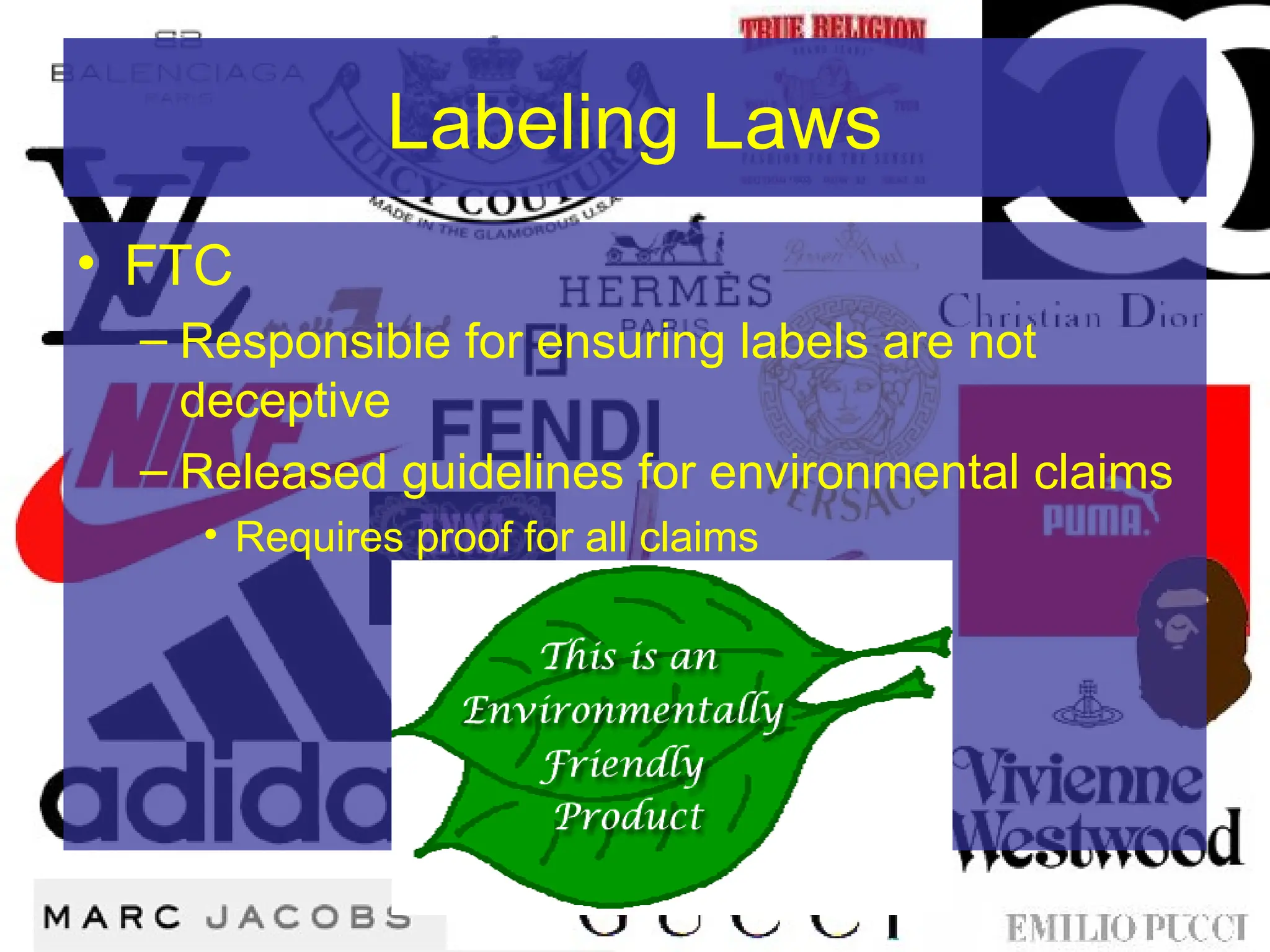
– Released guidelines for environmental claims
• Requires proof for all claims

labeling marketing management in business management.ppt

  • 1.
  • 2.
    Topics • Branding – Importance –Types – Strategies • Packaging – Function – Issues • Labeling
  • 3.
    Branding • Brand – Name,term, design, or symbol that identifies a business and its products • Corporate brands – Identify the business and reflect image across all products – Coca-Cola, Daimler-Chrysler • Product brands – Among most important assets and powerful selling elements – Coke, Dodge
  • 4.
    Brands • Brand Name –Words, letter numbers the represent brand – Corvette, Airwalk, FedEx • Brand Mark – Logo or symbol • Trade Name – Legal name a company uses to conduct business – Dell, Xerox
  • 5.
    Brands • Trade Character –Brand mark as a character with human qualities – Keebler, Doughboy • Trademark – Any combination of these that is legally protected – Have been expanding to include sound, color, smell • Harley trademarked its engine sound
  • 6.
    Importance of Branding •Builds customer loyalty – Customers pay more for recognized names • Assures customer of quality & reduces risk of dissatisfaction • Assists in extending lines – Customers more willing to try familiar names
  • 7.
    Generating Brands • Estimatedthat 75% of companies introduce a new product brand annually • In 1999, 79,000 trademarks were registered • Global brands often consolidate names – Confusion can result from multiple names for the same product • In UK, 3 Musketeers is known as Mars Bar
  • 8.
    Types of Brands •Manufacturer Brands – Producer brands, owned by manufacturer – Gives impression of standard quality, performance & status – Most brands are manufacturer brands • 65% of appliances • 70% of food • 80% of gas • 100% of cars
  • 9.
    Types of Brands •Private distributor brands – Store or dealer brands, owned by retail stores – Item is purchased to be sold exclusively at certain stores, i.e. Radio Shack brand – Manufacturer name is not displayed – Higher returns for store – Builds retailer loyalty • Craftsman, Kenmore sold only at Sears
  • 10.
    Types of Brands •Generic Brands – Carry no company name, just product description – Sold much cheaper, 30 – 50% lower than manufacturer brands, and 10 – 15% lower than store brands – Jewel supermarkets in Chicago were the first to offer
  • 11.
    Branding Strategies • Brandextension – Uses existing brand name to promote new products – Dilution may become a problem • Brand Licensing – Allow other companies to use trademarks for a fee, plus royalties on sales – Enhances image & helps sales of core products
  • 12.
    Branding Strategies • Mixedbranding – Offer combination of manufacturer, store & generic brands – Manufacturer will sell under a national brand, then sell extra to a store to be repackaged under a store brand, then make a generic – Maximizes profit by appealing to all segments
  • 13.
    Branding Strategies • Co-Branding –Uses two or more brands to increase loyalty and sales for individual brands – Builds recognition for each, work best if product complement each other • Starbucks in Barnes & Nobles • Smuckers jelly in Pop-Tarts
  • 14.
    Packaging • Physical containeror wrapping – Approximately 10% of retail price is spent on package – In some cases, package is most expensive part of production
  • 15.
    Function of Packaging •Key selling tool • Promoting & selling – Reaction to packaging is important to overall success or failure – New designs may not replace old, but complement it • Pump soap containers • Defining product identity – Invoke prestige, convenience, status, etc.
  • 16.
    Function of Packaging •Provide information – Directions on how to use, warnings, ingredients • Meet customer needs – Various sizes for different market segments – Must adapt to meet changing lifestyles
  • 17.
    Function of Packaging •Ensure safe use – Tamper resistance, child proofing – Blisterpacks, molded plastic with foil or cardboard backing • Gums and some medicine • Protection – Shipping, storage, display – Prevent shoplifting, breakage & spills
  • 18.
    Contemporary Issues • Changingsocial and political atmosphere leads to changes in product & package – Environmental packaging • Surveys indicate consumers will pay more for these packages – Cause packaging • Promoting unrelated issues on package, usually socially or politically motivated – Ben & Jerry’s, Body Shop
  • 19.
    Labeling • Informational tag,wrapper, seal or imprinted message • Main function is to inform about contents and give directions • Protects company from liability & lawsuits
  • 20.
    Labels • Brand label –Gives name, logo & trademark • Descriptive label – Gives information about use, construction, care, performance, etc. • Does not contain all the information that a consumer might want • Grade label – Give product quality
  • 21.
    Labels • Food labelsmust contain weight, dating and storage information, UPC, etc. – Net weight is entire product minus the weight of package and packing materials – Dating options are • Date packed • Sell by date – last day it should be sold • Best if – last day for best quality • Expiration – should not be used after
  • 22.
    Labeling Laws • Publicoutcry has lead to regulations on what needs to be incorporated on labels • Fair Packaging & Labeling Act (FPLA) gives the FDA and FTC authority over labeling • Not all countries have the same label laws – Coke was pulled off Italian shelves because they would not list the “secret ingredient”
  • 23.
    Labeling Laws • FDA –Enacted a law to require labels to give information on how the product fits into a daily diet – Developed definitions for light, free, low, reduced and good source – Warning labels on cigarettes and alcohol – Developing regulations for genetically modified foods
  • 24.
    Labeling Laws • FTC –Responsible for ensuring labels are not deceptive – Released guidelines for environmental claims • Requires proof for all claims