*COMPANY MANAGEMENT -UNIT IV
*QUALIFICATION OF DIRECTORS
*DISQUALIFICATION OF DIRECTORS
*LIMITS ON NUMBER OF DIRECTORSHIPS
*DIRECTOR IDENTIFICATION NUMBER (DIN)
*DOCUMENTS FOR OBTAINING DIN
*APPOINTMENT OF DIRECTORS
*DUTIES OF A DIRECTOR
*RESIGNATION OF DIRECTOR
*REMOVAL OF A DIRECTOR
*VACATION OF OFFICE OF DIRECTOR
*ANNUAL ROTATION OF DIRECTOR
*DISCLOSURE OF INTEREST BY DIRECTOR
* COMPANY MANAGEMENT - UNIT IV
 Qualification & Disqualification Of Directors
 The Act provides for a dedicated provision, which is
Section 162 that underlines the explanations that an
individual might not appoint as a director. there’s no
such provision regarding the qualification under the
Act.
However, requirements are listed as below:
 1.The said person should have completed 18 years age
or above.
 2. Nationality are often that of Indian or otherwise.
* COMPANY MANAGEMENT -UNIT IV
 3. The person must be in receipt of his own Digital
Signature Certificate (DSC) and the same be used for
obtaining Director’s identification number (DIN).
 4. The person shall also furnish a written declaration
providing his consent to act as the Director and he’s not
someone who falls under the category of disqualified
members.
 5. there’s no academic qualification that has to be held
by the one who is desirous of obtaining the directorship
of a corporation.
*COMPANY MANAGEMENT -UNIT
IV
Section 164(1) provides grounds on which someone
becomes disqualified to act as a director.
someone shall not be eligible to become a director
of a corporation if any of the following conditions
are not fulfilled
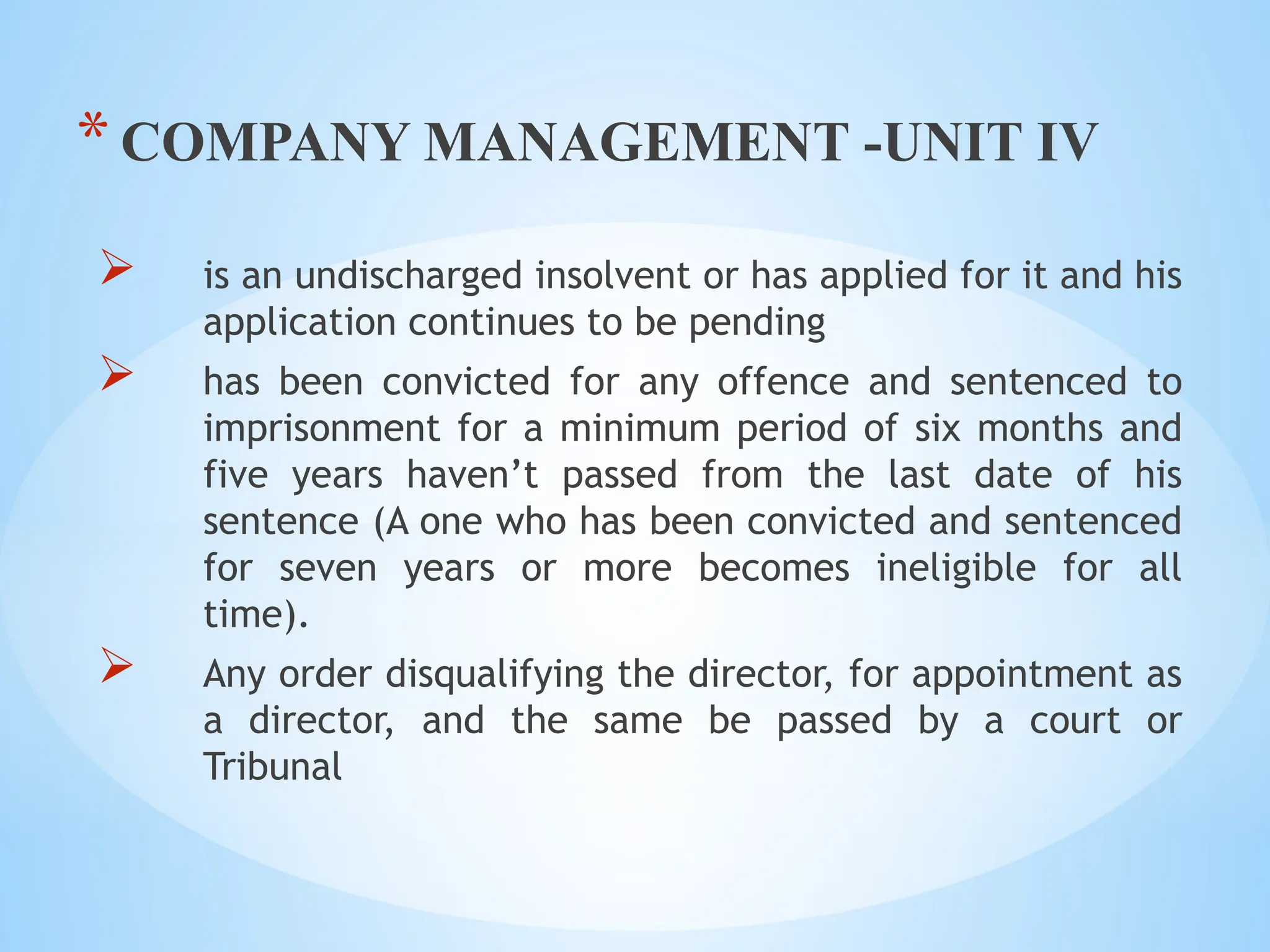
*COMPANY MANAGEMENT -UNIT IV
 is an undischarged insolvent or has applied for it and his
application continues to be pending
 has been convicted for any offence and sentenced to
imprisonment for a minimum period of six months and
five years haven’t passed from the last date of his
sentence (A one who has been convicted and sentenced
for seven years or more becomes ineligible for all
time).
 Any order disqualifying the director, for appointment as
a director, and the same be passed by a court or
Tribunal
*COMPANY MANAGEMENT -UNIT IV
 has not paid any calls in respect of any shares of the
corporate held by him and 6 months have elapsed from
the date of payment
 has been convicted in respect of an offence addressing
related party transactions as per section 188 during the
preceding five years
 has not been allotted a Director identification number
(discussed later within the text)
 accepts directorships exceeding the most number of
directorships provided in section 165, which brings us to
our next topic, which is about the bounds imposed on
the quantity of directorships that someone can hold at
only once.
LIMITS ON NUMBER OF DIRECTORSHIPS
* A person is allowed to hold directorship in maximum of 20
companies at one point of time (including alternate
directorship but excluding dormant companies).
* This limit doesn’t apply to Section 8 companies.
* However, in case of public companies (including their
private holding or subsidiary companies) the said limit has
been reduced to only ten.
*DIRECTOR IDENTIFICATION NUMBER
(DIN)
* A person is disqualified from acting as a company’s director
if he has not obtained a legitimate DIN.
* DIN could be a unique identification number that may be
obtained by somebody who intends to be a director or is
already acting as a director during a company but has not
obtained a DIN.
* One director is allowed to hold only one DIN at a time.
Just in case if a director has wrongly obtained two DINs,
then he’s required to surrender his latest DIN.
APPOINTMENT OF DIRECTORS
The appointment of a director is often made by
Subscribing to the memorandum (First Director)
•Passing a resolution during a General Meeting (Director/
Regularization/  Reappointment)
• Board of Directors (Alternate/ Casual/ Additional Director)
• Small Shareholders (Small shareholders director)
• Tribunal
DUTIES OF A DIRECTOR
Section 166 talks about the duties which a director has got to
perform in a company. Their duty is
To act in good faith
• To act as per the articles of the corporate
• To exercise care and diligence
• To avoid any sought of conflict of interest and hence do not
make any undue gain
• Not to assign his office to the other person
RESIGNATION OF A DIRECTOR
A director is required to administer notice to the corporate
intimating his resignation. The date of resignation shall be
the date of receiving the data by the corporate or any date
which is mentioned by the director within the notice
(whichever is later).
* After taking note of this, the corporate shall inform the
registrar about this within 30 days of his resignation.
* If the corporate fails or refuses to file the director’s
resignation, then the director can even intimate about his
resignation within the prescribed form.
REMOVAL OF A DIRECTOR
* A company or its shareholders may remove its director by
passing a standard resolution (but not the director
appointed by the tribunal).
* An independent director (appointed on his second term
within the company) can only be removed after passing a
special resolution by the shareholders.
* The tribunal may also remove a director if it’s received any
application of oppression and mismanagement within the
company and if it deems acceptable remove the director.
*VACATION OF OFFICE OF DIRECTOR
The director shall vacate the office where,
* Becomes disqualified to act as a director (if the director
has did not file financial statements and annual returns of
an organization for 3 years continuously, then he shall
vacate his office altogether the businesses but not the
corporate during which he has defaulted.
* Fails to attend any board meeting for a continuous period
of twelve months.
* Contravenes the provisions associated with contracts
within which the director was interested.
*VACATION OF OFFICE OF DIRECTOR
* Any court’s order, restricting the director from appointing
in any company.
* Is removed in line with the provisions of the Act
* Was appointed due to his holding office in another
company and has ceased to carry office in this company.
* Ceases to be a tiny low shareholder or fails to fulfill the
factors of independence (in case of small shareholders
director)
*DISCLOSURE OF INTEREST BY
DIRECTOR
* All the administrators are required to disclose their
interests in any company if any.
* This disclosure shall be made at his first meeting and also
the first meetings within the subsequent financial years.
* If there’s any change in his interests, then also he’s
required to disclose it.
*DISCLOSURE OF INTEREST BY
DIRECTOR
Corporate Social Responsibility
* “A company’s corporate social responsibility (CSR) should
be concerned to the management of the business
operations to produce a positive impact on society”
Corporate Social Responsibility
*
INTRODUCTION
Definition
Corporate Social Responsibility is the continuing commitment of
businesses to behave ethically in contributing to social and economic
development in improving the quality of life of the workforce and their
families as well as of the local community and society at large.
Meaning of CSR
The responsibility of a business towards the society
Corporate Social Responsibility
CSR is a process by which an organization involves itself in
various programmes for the upliftment of society. CSR is
also known as “Corporate Citizenship”.
Corporate Social Responsibility
* “A corporate social responsibility is a responsibility which
the companies imposes on itself, for the betterment of the
society which will include various aspects of the society
such as environment, competition-ethics, legal, moral,
economic and well-being of employees and the
responsibilities so imposed by the companies on itself are
in accordance with their financial capacity and other
resources useful for carrying out activities of corporate
social responsibility”.
EVOLUTION OF CORPORATE SOCIAL
RESPONSIBILITY
* The evolution of corporate social responsibility (CSR) one can
trace it back from the Mauryan period in the form of charity to
the poor.
* The first phase is of philanthropists and charity which drove
the basics of corporate social responsibility (CSR) in this phase.
It was till 1850s that the CSR was influenced by cultural and
hereditary values along with industrialisation.
* Then came the second phase of pre-independence period, of
setting up of industries and the industrialist were at that time
supposed to show their dedication towards the benefit of the
society.
* Then in the third phase the time of globalisation came it was
the time of 1990s when great businessmen like Tata, Birla,
Godrej, Bajaj, etc. encouraged the concept of charities via
establishing educational and healthcare institutions, trusts for
development of various communities.
Do all Companies have to do CSR ?
A Company having a net worth of Rs. 500 crore or turnover of
Rs.1000 crore or net profit of 5 crore has to constitute a
“CSR Committee", according to the clause 135 of the
Companies Act of 2013.
Corporate Social Responsibility-Who are eligible?
* In section 135 it is provided that only those companies are
eligible to perform activities of corporate social
responsibility (CSR) which:-
* Have the net worth of RS. 500 crore or more,
* Have the turnover of RS. 1000 crore or more,
* Have the net profit of RS. 5 crore or more, and
* Every company who is eligible according to above
mentioned conditions to perform CSR activities is required
to spend at least 2% of its average net profit, immediately
preceding three financial years.
* Eligible companies will also constitute a corporate social
responsibility committee, consisting of three or more
directors of the company, which shall allow certain CSR
activities to be done.
EVOLUTION OF CORPORATE SOCIAL
RESPONSIBILITY
* The last phase or say the current scenario is that India not only
developed this concept but also gave this concept a specific
term i.e. Corporate Social Responsibility (CSR) by incorporating
it in Companies Act, 2013.
* India is the first country in whole wide world to give the
concept of corporate social responsibility a statutory
significance.
* It was officially notified by the Ministry of Corporate Affairs and
not only they introduce the concept of CSR in India but also
provided some rules regarding the same under the title of
Companies (Corporate Social Responsibility Policy) Rules, 2014
and they came into force on 1st April, 2014.
ACTIVITIES CONSTITUTING CORPORATE
SOCIAL RESPONSIBILITY
* The companies can set up trusts or charitable foundations.
* They promote education by setting up educational institutions.
* By creating or connecting with different NGO’s they promote gender
equality and women empowerment.
* They can establish healthcare institutions for enhancing the health
standards in the society.
* They can also contribute in government raised funds such as Prime
Minister’s Relief Fund.
* They are also allowed to establish old age homes, orphanage etc.
* They ensure environmental sustainability by enhancing the quality of
environment or by performing their functions within the permissible
limits prescribed by various environmental legislations.
* For the welfare of the minority or backward classes raise funds and
various other activities constituting corporate social responsibility (CSR)
as prescribed by the company can be performed.
*CSR ALSO KNOWN AS
 Corporate Citizenship
 Economic Policy
 Corporate Responsibility
 Responsible Business
 Sustainable Responsible Business
 Corporate Social Performance.
CSR OBJECTIVES
 The basic Objective of CSR now a days is to maximize the
companies’ overall impact on the society and its shareholders.
 To give back to the community in the best possible way in
return for the resources received.
 To maintain success of the business in the long run and to
achieve customer loyalty.
 To create awareness about the company and to build its
public profile.
Where such CSR Initiatives have to be mentioned ?
The Bill has proposed that the disclosure of the
financial statements contain “the details about the
policy developed and implemented by the company
on corporate social responsibility initiatives taken
during the year”
*SCOPE OF CSR
 Promotion of Education.
 Eradicating Hunger and Poverty.
 Social Empowerment.
 Ensuring Environmental Sustainability.
 Promotion of Sports activities.
 Combating the human immunodeficiency virus, AIDS,
Malaria and other diseases.
*CSR Initiatives
Guiding Principles for CSR
Projects
• CSR is about corporate citizenship.
• It is about giving back to the society.
• It is about business sustainability.
• It is about thriving in a competitive
business environment.
*PROS and CONS OF
CSR
*PROS of CSR
PROs
 Increase societal development.
 Enhanced Brand Image and Reputation.
 Change from profitability to wealth creation
and sustainable development.
 Increased ability to attract and retain
employees.
 Increase in the number of educational
institutions.
*CONS of CSR
CONS
 Reduced Company profits.
 Adding 1 more committee will increase the
burden on companies.
 The Government is trying to “outsource” its
responsibility towards company.
 Shareholders get less benefits.
 Manipulation of accounts.
CSR COURSES IN INDIA
a) Indian Institute of Corporate Affairs (IICA).
b) Tata Institute of Social Sciences (TISS)
c) Karve Institute Social Service, Pune
d) IIM Bangalore
e) IIM Calcutta
f) Indian School of Business (ISB)
g) IIM Indore
* SIX REASONS COMPANIES SHOULD ADOPT
CSR
 Innovation
 Cost savings
 Brand differentiation
 Long-term thinking
 Customer engagement
 Employee engagement.
*CSR ACTIVITIES BY TOP
BRANDS
Tata Consultancy Services Limited. ...
Reliance Industries Limited. ...
HDFC Bank Limited. ...
ICICI Bank Limited. ...
Infosys Limited. ...
Hindustan Unilever Limited. ...
State Bank of India. ...
Housing Development Finance Corporation Limited.
*Top CSR companies
*Cadbury’s & Society
Cadbury India has a tradition of caring for the environment and
enriching the quality of lives of the communities we live and
work in, through a variety of result oriented programs:
 Our commitment to the Environment
 Growing community value
* Commitment to the Environment
 To increase water conservation, Bangalore factory
constructed a check dam to store the rainwater
 It acts as a major ground water replenishing source for
the bore wells in the factories and surrounding
community and also as a stopover location for some of
the migratory birds
 Worked with the Kerala Agriculture University to
undertake cocoa research which increased cocoa
productivity and touched the lives of thousands of
farmers.
Commitment to the Environment
 Installed 28 solar powered
streetlights to reduce annual carbon
dioxide emissions by 10 tones, playing
a part in the effort to reduce global
warming.
 Karnataka State Pollution Control
Board has honored the Bangalore
factory with the Parisara Premi
(Preserver of the Environment) Award
for the second year in a row.
* Commitment to the Environment
Cadbury in tie-up with Bharti-Walmart
to support education needs of
underprivileged children
Cadbury spreads smiles at Vastly
- Partnered with vatsalya Foundation, an NGO
working with underprivileged street children in
Mumbai to give the child a supportive
environment to live and study in and gain skills so
that they become contributing members of
society
*Novartis’s CSR
“ We do everything we can to operate in a manner that is
Sustainable: economically, socially, and environmentally – in
the best interest of long-term success for our enterprise.”
*Tuberculosis and Malaria
 JEET – Joint efforts to eradicate Tuberculosis
 Distribution of free Drugs to 5,00,000 TB
patients
 Working with “Global TB Alliance for TB drug
development.
 Novartis institute for tropical diseases
 Distribution of Anti Malarial drug Coartem
*Arogya Parivar
Program
 A Rural Health initiative originated in 2006
 Disease area(s) – Multiple diseases
 Partner(s) – Rural connect, NGO,Volunteers
 Program type(s): Access – Pricing, Education
 Current Status: Serving 25 million villagers across seven
states
 Objective: To be fully operational in the country
 Award won: “Best long-term rural marketing initiative” from
RMAI
*Community Partnership
Day
 Worldwide initiative
 Novartis India – a step further by “celebrating” a week
 Hundreds of associates contribute
 Employee is given the chance to spend one day a year
volunteering for a local community project
 Decorating buildings to organizing children’s art and
craft workshops, providing health checks, cleaning
streets, delivering food to shelters, visiting hospitals and
working with older people and people with physical and
mental disabilities
CONCLUSION
 CSR is the heart and soul of modern corporations and is an
important standard for corporate governance.
 CSR is an indispensible mechanism for both increased corporate
accountability, profitability and environmental sustainability.
CSR is the pole star for modern corporations in order to maintain
the integrity of moral fabrics both inside and outside the
corporations while conducting socially responsible business.
Company management  and importance .pptx

Company management and importance .pptx

  • 1.
    *COMPANY MANAGEMENT -UNITIV *QUALIFICATION OF DIRECTORS *DISQUALIFICATION OF DIRECTORS *LIMITS ON NUMBER OF DIRECTORSHIPS *DIRECTOR IDENTIFICATION NUMBER (DIN) *DOCUMENTS FOR OBTAINING DIN *APPOINTMENT OF DIRECTORS *DUTIES OF A DIRECTOR *RESIGNATION OF DIRECTOR *REMOVAL OF A DIRECTOR *VACATION OF OFFICE OF DIRECTOR *ANNUAL ROTATION OF DIRECTOR *DISCLOSURE OF INTEREST BY DIRECTOR
  • 2.
    * COMPANY MANAGEMENT- UNIT IV  Qualification & Disqualification Of Directors  The Act provides for a dedicated provision, which is Section 162 that underlines the explanations that an individual might not appoint as a director. there’s no such provision regarding the qualification under the Act. However, requirements are listed as below:  1.The said person should have completed 18 years age or above.  2. Nationality are often that of Indian or otherwise.
  • 3.
    * COMPANY MANAGEMENT-UNIT IV  3. The person must be in receipt of his own Digital Signature Certificate (DSC) and the same be used for obtaining Director’s identification number (DIN).  4. The person shall also furnish a written declaration providing his consent to act as the Director and he’s not someone who falls under the category of disqualified members.  5. there’s no academic qualification that has to be held by the one who is desirous of obtaining the directorship of a corporation.
  • 4.
  • 5.
    Section 164(1) providesgrounds on which someone becomes disqualified to act as a director. someone shall not be eligible to become a director of a corporation if any of the following conditions are not fulfilled
  • 6.
    *COMPANY MANAGEMENT -UNITIV  is an undischarged insolvent or has applied for it and his application continues to be pending  has been convicted for any offence and sentenced to imprisonment for a minimum period of six months and five years haven’t passed from the last date of his sentence (A one who has been convicted and sentenced for seven years or more becomes ineligible for all time).  Any order disqualifying the director, for appointment as a director, and the same be passed by a court or Tribunal
  • 7.
    *COMPANY MANAGEMENT -UNITIV  has not paid any calls in respect of any shares of the corporate held by him and 6 months have elapsed from the date of payment  has been convicted in respect of an offence addressing related party transactions as per section 188 during the preceding five years  has not been allotted a Director identification number (discussed later within the text)  accepts directorships exceeding the most number of directorships provided in section 165, which brings us to our next topic, which is about the bounds imposed on the quantity of directorships that someone can hold at only once.
  • 8.
    LIMITS ON NUMBEROF DIRECTORSHIPS * A person is allowed to hold directorship in maximum of 20 companies at one point of time (including alternate directorship but excluding dormant companies). * This limit doesn’t apply to Section 8 companies. * However, in case of public companies (including their private holding or subsidiary companies) the said limit has been reduced to only ten.
  • 9.
    *DIRECTOR IDENTIFICATION NUMBER (DIN) *A person is disqualified from acting as a company’s director if he has not obtained a legitimate DIN. * DIN could be a unique identification number that may be obtained by somebody who intends to be a director or is already acting as a director during a company but has not obtained a DIN. * One director is allowed to hold only one DIN at a time. Just in case if a director has wrongly obtained two DINs, then he’s required to surrender his latest DIN.
  • 10.
    APPOINTMENT OF DIRECTORS Theappointment of a director is often made by Subscribing to the memorandum (First Director) •Passing a resolution during a General Meeting (Director/ Regularization/ Reappointment) • Board of Directors (Alternate/ Casual/ Additional Director) • Small Shareholders (Small shareholders director) • Tribunal
  • 11.
    DUTIES OF ADIRECTOR Section 166 talks about the duties which a director has got to perform in a company. Their duty is To act in good faith • To act as per the articles of the corporate • To exercise care and diligence • To avoid any sought of conflict of interest and hence do not make any undue gain • Not to assign his office to the other person
  • 12.
    RESIGNATION OF ADIRECTOR A director is required to administer notice to the corporate intimating his resignation. The date of resignation shall be the date of receiving the data by the corporate or any date which is mentioned by the director within the notice (whichever is later). * After taking note of this, the corporate shall inform the registrar about this within 30 days of his resignation. * If the corporate fails or refuses to file the director’s resignation, then the director can even intimate about his resignation within the prescribed form.
  • 13.
    REMOVAL OF ADIRECTOR * A company or its shareholders may remove its director by passing a standard resolution (but not the director appointed by the tribunal). * An independent director (appointed on his second term within the company) can only be removed after passing a special resolution by the shareholders. * The tribunal may also remove a director if it’s received any application of oppression and mismanagement within the company and if it deems acceptable remove the director.
  • 14.
    *VACATION OF OFFICEOF DIRECTOR The director shall vacate the office where, * Becomes disqualified to act as a director (if the director has did not file financial statements and annual returns of an organization for 3 years continuously, then he shall vacate his office altogether the businesses but not the corporate during which he has defaulted. * Fails to attend any board meeting for a continuous period of twelve months. * Contravenes the provisions associated with contracts within which the director was interested.
  • 15.
    *VACATION OF OFFICEOF DIRECTOR * Any court’s order, restricting the director from appointing in any company. * Is removed in line with the provisions of the Act * Was appointed due to his holding office in another company and has ceased to carry office in this company. * Ceases to be a tiny low shareholder or fails to fulfill the factors of independence (in case of small shareholders director)
  • 16.
    *DISCLOSURE OF INTERESTBY DIRECTOR * All the administrators are required to disclose their interests in any company if any. * This disclosure shall be made at his first meeting and also the first meetings within the subsequent financial years. * If there’s any change in his interests, then also he’s required to disclose it.
  • 17.
  • 18.
    Corporate Social Responsibility *“A company’s corporate social responsibility (CSR) should be concerned to the management of the business operations to produce a positive impact on society”
  • 19.
  • 20.
    * INTRODUCTION Definition Corporate Social Responsibilityis the continuing commitment of businesses to behave ethically in contributing to social and economic development in improving the quality of life of the workforce and their families as well as of the local community and society at large.
  • 21.
    Meaning of CSR Theresponsibility of a business towards the society Corporate Social Responsibility CSR is a process by which an organization involves itself in various programmes for the upliftment of society. CSR is also known as “Corporate Citizenship”.
  • 22.
    Corporate Social Responsibility *“A corporate social responsibility is a responsibility which the companies imposes on itself, for the betterment of the society which will include various aspects of the society such as environment, competition-ethics, legal, moral, economic and well-being of employees and the responsibilities so imposed by the companies on itself are in accordance with their financial capacity and other resources useful for carrying out activities of corporate social responsibility”.
  • 23.
    EVOLUTION OF CORPORATESOCIAL RESPONSIBILITY * The evolution of corporate social responsibility (CSR) one can trace it back from the Mauryan period in the form of charity to the poor. * The first phase is of philanthropists and charity which drove the basics of corporate social responsibility (CSR) in this phase. It was till 1850s that the CSR was influenced by cultural and hereditary values along with industrialisation. * Then came the second phase of pre-independence period, of setting up of industries and the industrialist were at that time supposed to show their dedication towards the benefit of the society. * Then in the third phase the time of globalisation came it was the time of 1990s when great businessmen like Tata, Birla, Godrej, Bajaj, etc. encouraged the concept of charities via establishing educational and healthcare institutions, trusts for development of various communities.
  • 24.
    Do all Companieshave to do CSR ? A Company having a net worth of Rs. 500 crore or turnover of Rs.1000 crore or net profit of 5 crore has to constitute a “CSR Committee", according to the clause 135 of the Companies Act of 2013.
  • 25.
    Corporate Social Responsibility-Whoare eligible? * In section 135 it is provided that only those companies are eligible to perform activities of corporate social responsibility (CSR) which:- * Have the net worth of RS. 500 crore or more, * Have the turnover of RS. 1000 crore or more, * Have the net profit of RS. 5 crore or more, and * Every company who is eligible according to above mentioned conditions to perform CSR activities is required to spend at least 2% of its average net profit, immediately preceding three financial years. * Eligible companies will also constitute a corporate social responsibility committee, consisting of three or more directors of the company, which shall allow certain CSR activities to be done.
  • 26.
    EVOLUTION OF CORPORATESOCIAL RESPONSIBILITY * The last phase or say the current scenario is that India not only developed this concept but also gave this concept a specific term i.e. Corporate Social Responsibility (CSR) by incorporating it in Companies Act, 2013. * India is the first country in whole wide world to give the concept of corporate social responsibility a statutory significance. * It was officially notified by the Ministry of Corporate Affairs and not only they introduce the concept of CSR in India but also provided some rules regarding the same under the title of Companies (Corporate Social Responsibility Policy) Rules, 2014 and they came into force on 1st April, 2014.
  • 27.
    ACTIVITIES CONSTITUTING CORPORATE SOCIALRESPONSIBILITY * The companies can set up trusts or charitable foundations. * They promote education by setting up educational institutions. * By creating or connecting with different NGO’s they promote gender equality and women empowerment. * They can establish healthcare institutions for enhancing the health standards in the society. * They can also contribute in government raised funds such as Prime Minister’s Relief Fund. * They are also allowed to establish old age homes, orphanage etc. * They ensure environmental sustainability by enhancing the quality of environment or by performing their functions within the permissible limits prescribed by various environmental legislations. * For the welfare of the minority or backward classes raise funds and various other activities constituting corporate social responsibility (CSR) as prescribed by the company can be performed.
  • 28.
    *CSR ALSO KNOWNAS  Corporate Citizenship  Economic Policy  Corporate Responsibility  Responsible Business  Sustainable Responsible Business  Corporate Social Performance.
  • 29.
    CSR OBJECTIVES  Thebasic Objective of CSR now a days is to maximize the companies’ overall impact on the society and its shareholders.  To give back to the community in the best possible way in return for the resources received.  To maintain success of the business in the long run and to achieve customer loyalty.  To create awareness about the company and to build its public profile.
  • 30.
    Where such CSRInitiatives have to be mentioned ? The Bill has proposed that the disclosure of the financial statements contain “the details about the policy developed and implemented by the company on corporate social responsibility initiatives taken during the year”
  • 31.
    *SCOPE OF CSR Promotion of Education.  Eradicating Hunger and Poverty.  Social Empowerment.  Ensuring Environmental Sustainability.  Promotion of Sports activities.  Combating the human immunodeficiency virus, AIDS, Malaria and other diseases.
  • 32.
    *CSR Initiatives Guiding Principlesfor CSR Projects • CSR is about corporate citizenship. • It is about giving back to the society. • It is about business sustainability. • It is about thriving in a competitive business environment.
  • 33.
  • 34.
    *PROS of CSR PROs Increase societal development.  Enhanced Brand Image and Reputation.  Change from profitability to wealth creation and sustainable development.  Increased ability to attract and retain employees.  Increase in the number of educational institutions.
  • 35.
    *CONS of CSR CONS Reduced Company profits.  Adding 1 more committee will increase the burden on companies.  The Government is trying to “outsource” its responsibility towards company.  Shareholders get less benefits.  Manipulation of accounts.
  • 36.
    CSR COURSES ININDIA a) Indian Institute of Corporate Affairs (IICA). b) Tata Institute of Social Sciences (TISS) c) Karve Institute Social Service, Pune d) IIM Bangalore e) IIM Calcutta f) Indian School of Business (ISB) g) IIM Indore
  • 37.
    * SIX REASONSCOMPANIES SHOULD ADOPT CSR  Innovation  Cost savings  Brand differentiation  Long-term thinking  Customer engagement  Employee engagement.
  • 38.
  • 41.
    Tata Consultancy ServicesLimited. ... Reliance Industries Limited. ... HDFC Bank Limited. ... ICICI Bank Limited. ... Infosys Limited. ... Hindustan Unilever Limited. ... State Bank of India. ... Housing Development Finance Corporation Limited. *Top CSR companies
  • 42.
    *Cadbury’s & Society CadburyIndia has a tradition of caring for the environment and enriching the quality of lives of the communities we live and work in, through a variety of result oriented programs:  Our commitment to the Environment  Growing community value
  • 43.
    * Commitment tothe Environment  To increase water conservation, Bangalore factory constructed a check dam to store the rainwater  It acts as a major ground water replenishing source for the bore wells in the factories and surrounding community and also as a stopover location for some of the migratory birds  Worked with the Kerala Agriculture University to undertake cocoa research which increased cocoa productivity and touched the lives of thousands of farmers.
  • 44.
    Commitment to theEnvironment  Installed 28 solar powered streetlights to reduce annual carbon dioxide emissions by 10 tones, playing a part in the effort to reduce global warming.  Karnataka State Pollution Control Board has honored the Bangalore factory with the Parisara Premi (Preserver of the Environment) Award for the second year in a row.
  • 45.
    * Commitment tothe Environment Cadbury in tie-up with Bharti-Walmart to support education needs of underprivileged children Cadbury spreads smiles at Vastly - Partnered with vatsalya Foundation, an NGO working with underprivileged street children in Mumbai to give the child a supportive environment to live and study in and gain skills so that they become contributing members of society
  • 46.
    *Novartis’s CSR “ Wedo everything we can to operate in a manner that is Sustainable: economically, socially, and environmentally – in the best interest of long-term success for our enterprise.”
  • 47.
    *Tuberculosis and Malaria JEET – Joint efforts to eradicate Tuberculosis  Distribution of free Drugs to 5,00,000 TB patients  Working with “Global TB Alliance for TB drug development.  Novartis institute for tropical diseases  Distribution of Anti Malarial drug Coartem
  • 48.
    *Arogya Parivar Program  ARural Health initiative originated in 2006  Disease area(s) – Multiple diseases  Partner(s) – Rural connect, NGO,Volunteers  Program type(s): Access – Pricing, Education  Current Status: Serving 25 million villagers across seven states  Objective: To be fully operational in the country  Award won: “Best long-term rural marketing initiative” from RMAI
  • 49.
    *Community Partnership Day  Worldwideinitiative  Novartis India – a step further by “celebrating” a week  Hundreds of associates contribute  Employee is given the chance to spend one day a year volunteering for a local community project  Decorating buildings to organizing children’s art and craft workshops, providing health checks, cleaning streets, delivering food to shelters, visiting hospitals and working with older people and people with physical and mental disabilities
  • 50.
    CONCLUSION  CSR isthe heart and soul of modern corporations and is an important standard for corporate governance.  CSR is an indispensible mechanism for both increased corporate accountability, profitability and environmental sustainability. CSR is the pole star for modern corporations in order to maintain the integrity of moral fabrics both inside and outside the corporations while conducting socially responsible business.