Programming in Java
Lecture 7: Inheritance
Contents
• Inheritance
• Method Overloading
• Method Overriding
• Dynamic Method Dispatch
Introduction
• Object-oriented programming allows classes to inherit commonly
used state and behavior from other classes.
• In the Java programming language, each class is allowed to have one
direct super-class, and each super-class has the potential for an
unlimited number of subclasses.
• Inheritance is a fundamental object-oriented design technique used to
create and organize reusable classes.
Inheritance
• Inheritance defines an is-a relationship between a super-
class and its subclasses. It means that the subclass (child) is a
more specific version of the super-class (parent).
• An object of a subclass can be used wherever an object of the
super-class can be used.
• Inheritance is used to build new classes from existing classes.
• The inheritance relationship is transitive: if class y extends
class x, and a class z extends class y, then z will also inherit
from class x.
Inheritance
 Using inheritance, we can create a general class that defines traits(state
and behaviors) common to a set of related items.
 This class can then be inherited by other, more specific classes, each
adding those things that are unique to it.
 In Java, a class that is inherited is called a super-class.
 The class that does the inheriting is called a subclass.
 A Subclass inherits all of the instance variables and methods defined by
the super-class and adds its own, unique elements.
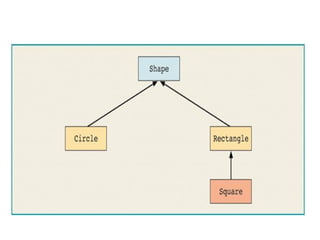
Inheritance Example
class Shape {
int area(){…}
}
class Rectangle extends Shape{
int area() { area = length * width;}
int length; int width;
}
class Square extends Rectangle {
int area() {…}
int length; int width = length;
Key Points
• Private members of the super-class are inherited but they can not be
accessed by the subclass directly.
• Members that have default accessibility in the super-class are also not
inherited by subclasses in other packages.
• Constructors and initializer blocks are not inherited by a subclass.
• A subclass can extend only one super-class.
Types of Inheritance
The following kinds of inheritance are there in java.
 Simple Inheritance
 Multilevel Inheritance
 Simple Inheritance: A subclass is derived simply from it's parent
class.
 There is only a sub class and it's parent class. It is also called single
inheritance or one level inheritance.
 Multi-level Inheritance: A subclass is derived from a derived class.
Multiple Inheritance
• The mechanism of inheriting the features of more than one base class
into a single class is known as multiple inheritance.
• Java does not support multiple inheritance but the multiple
inheritance can be achieved by using the interface.
• In Java Multiple Inheritance can be achieved through use of
Interfaces by implementing more than one interfaces in a class.
Method Overloading
 Method overloading means having two or more methods with the
same name but different signatures in the same scope.
 These two methods may exist in the same class or one in base class
and another in derived class.
 It allows creating several methods with the same name which differ
from each other in the type of the input and the output of the method.
 It is simply defined as the ability of one method to perform different
tasks.
Example
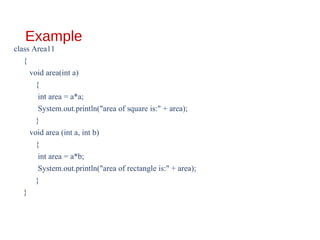
class Area11
{
void area(int a)
{
int area = a*a;
System.out.println("area of square is:" + area);
}
void area (int a, int b)
{
int area = a*b;
System.out.println("area of rectangle is:" + area);
}
}
class OverloadDemo
{
public static void main (String arr[])
{
Area11 ar= new Area11();
ar.area(10);
ar.area(10,5);
}
}
Method Overriding
• Method overriding means having a different
implementation of the same method in the inherited class.
• These two methods would have the same signature, but
different implementation.
• One of these would exist in the base class and another in the
derived class. These cannot exist in the same class.
•The version of a method that is executed will be
determined by the object that is used to invoke it.
•If an object of a parent class is used to invoke the
method, then the version in the parent class will be
executed.
•If an object of the subclass is used to invoke the
method, then the version in the child class will be
executed.
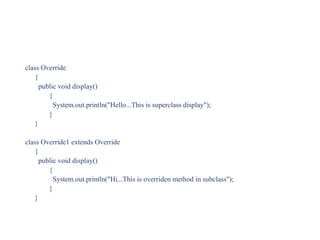
class Override
{
public void display()
{
System.out.println("Hello...This is superclass display");
}
}
class Override1 extends Override
{
public void display()
{
System.out.println("Hi...This is overriden method in subclass");
}
}
class OverrideDemo
{
public static void main(String arr[])
{
Override o = new Override();
o.display();
Override1 o1 = new Override1();
o1.display();
}
}
Dynamic Method Dispatch
• Dynamic method dispatch is the mechanism by which a call to an
overridden method is resolved at run time, rather than compile time.
• Dynamic method dispatch is important because this is how Java
implements run-time polymorphism.
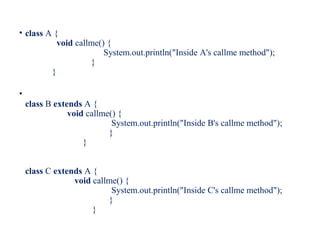
• class A {
void callme() {
System.out.println("Inside A's callme method");
}
}
•
class B extends A {
void callme() {
System.out.println("Inside B's callme method");
}
}
class C extends A {
void callme() {
System.out.println("Inside C's callme method");
}
}
class Dispatch {
public static void main(String args[]) {
A a = new A(); // object of type A
B b = new B(); // object of type B
C c = new C(); // object of type C
A r; // obtain a reference of type A
r = a; // r refers to an A object
r.callme(); // calls A's version of callme
r = b; // r refers to a B object
r.callme(); // calls B's version of callme
r = c; // r refers to a C object
r.callme(); // calls C's version of callme
}
}
L7 inheritance

L7 inheritance

  • 1.
  • 2.
    Contents • Inheritance • MethodOverloading • Method Overriding • Dynamic Method Dispatch
  • 3.
    Introduction • Object-oriented programmingallows classes to inherit commonly used state and behavior from other classes. • In the Java programming language, each class is allowed to have one direct super-class, and each super-class has the potential for an unlimited number of subclasses. • Inheritance is a fundamental object-oriented design technique used to create and organize reusable classes.
  • 4.
    Inheritance • Inheritance definesan is-a relationship between a super- class and its subclasses. It means that the subclass (child) is a more specific version of the super-class (parent). • An object of a subclass can be used wherever an object of the super-class can be used. • Inheritance is used to build new classes from existing classes. • The inheritance relationship is transitive: if class y extends class x, and a class z extends class y, then z will also inherit from class x.
  • 5.
    Inheritance  Using inheritance,we can create a general class that defines traits(state and behaviors) common to a set of related items.  This class can then be inherited by other, more specific classes, each adding those things that are unique to it.  In Java, a class that is inherited is called a super-class.  The class that does the inheriting is called a subclass.  A Subclass inherits all of the instance variables and methods defined by the super-class and adds its own, unique elements.
  • 7.
    Inheritance Example class Shape{ int area(){…} } class Rectangle extends Shape{ int area() { area = length * width;} int length; int width; } class Square extends Rectangle { int area() {…} int length; int width = length;
  • 8.
    Key Points • Privatemembers of the super-class are inherited but they can not be accessed by the subclass directly. • Members that have default accessibility in the super-class are also not inherited by subclasses in other packages. • Constructors and initializer blocks are not inherited by a subclass. • A subclass can extend only one super-class.
  • 9.
    Types of Inheritance Thefollowing kinds of inheritance are there in java.  Simple Inheritance  Multilevel Inheritance  Simple Inheritance: A subclass is derived simply from it's parent class.  There is only a sub class and it's parent class. It is also called single inheritance or one level inheritance.  Multi-level Inheritance: A subclass is derived from a derived class.
  • 10.
    Multiple Inheritance • Themechanism of inheriting the features of more than one base class into a single class is known as multiple inheritance. • Java does not support multiple inheritance but the multiple inheritance can be achieved by using the interface. • In Java Multiple Inheritance can be achieved through use of Interfaces by implementing more than one interfaces in a class.
  • 11.
    Method Overloading  Methodoverloading means having two or more methods with the same name but different signatures in the same scope.  These two methods may exist in the same class or one in base class and another in derived class.  It allows creating several methods with the same name which differ from each other in the type of the input and the output of the method.  It is simply defined as the ability of one method to perform different tasks.
  • 12.
    Example class Area11 { void area(inta) { int area = a*a; System.out.println("area of square is:" + area); } void area (int a, int b) { int area = a*b; System.out.println("area of rectangle is:" + area); } }
  • 13.
    class OverloadDemo { public staticvoid main (String arr[]) { Area11 ar= new Area11(); ar.area(10); ar.area(10,5); } }
  • 14.
    Method Overriding • Methodoverriding means having a different implementation of the same method in the inherited class. • These two methods would have the same signature, but different implementation. • One of these would exist in the base class and another in the derived class. These cannot exist in the same class.
  • 15.
    •The version ofa method that is executed will be determined by the object that is used to invoke it. •If an object of a parent class is used to invoke the method, then the version in the parent class will be executed. •If an object of the subclass is used to invoke the method, then the version in the child class will be executed.
  • 16.
    class Override { public voiddisplay() { System.out.println("Hello...This is superclass display"); } } class Override1 extends Override { public void display() { System.out.println("Hi...This is overriden method in subclass"); } }
  • 17.
    class OverrideDemo { public staticvoid main(String arr[]) { Override o = new Override(); o.display(); Override1 o1 = new Override1(); o1.display(); } }
  • 18.
    Dynamic Method Dispatch •Dynamic method dispatch is the mechanism by which a call to an overridden method is resolved at run time, rather than compile time. • Dynamic method dispatch is important because this is how Java implements run-time polymorphism.
  • 19.
    • class A { void callme(){ System.out.println("Inside A's callme method"); } } • class B extends A { void callme() { System.out.println("Inside B's callme method"); } } class C extends A { void callme() { System.out.println("Inside C's callme method"); } }
  • 20.
    class Dispatch { publicstatic void main(String args[]) { A a = new A(); // object of type A B b = new B(); // object of type B C c = new C(); // object of type C A r; // obtain a reference of type A r = a; // r refers to an A object r.callme(); // calls A's version of callme r = b; // r refers to a B object r.callme(); // calls B's version of callme r = c; // r refers to a C object r.callme(); // calls C's version of callme } }