Programming in Java
Lecture 7: Inheritance
By
Ravi Kant Sahu
Asst. Professor, LPU
Contents
 Inheritance
 Method Overloading
 Method Overriding
 Dynamic Method Dispatch
Ravi Kant Sahu, Asst. Professor @ Lovely Professional University, Punjab (India)
Introduction
 Object-oriented programming allows classes to inherit
commonly used state and behavior from other classes.
 In the Java programming language, each class is allowed
to have one direct super-class, and each super-class has the
potential for an unlimited number of subclasses.
 Inheritance is a fundamental object-oriented design
technique used to create and organize reusable classes.
Ravi Kant Sahu, Asst. Professor @ Lovely Professional University, Punjab (India)
Inheritance
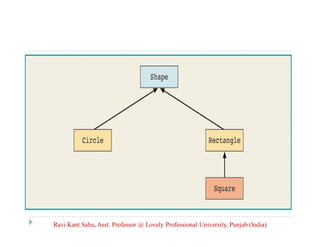
 Inheritance defines an is-a relationship between a super-class
and its subclasses. It means that the subclass (child) is a more
specific version of the super-class (parent).
 An object of a subclass can be used wherever an object of the
super-class can be used.
 Inheritance is used to build new classes from existing classes.
 The inheritance relationship is transitive: if class y extends
class x, and a class z extends class y, then z will also inherit
from class x.
Ravi Kant Sahu, Asst. Professor @ Lovely Professional University, Punjab (India)
Inheritance
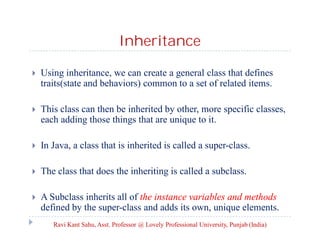
 Using inheritance, we can create a general class that defines
traits(state and behaviors) common to a set of related items.
 This class can then be inherited by other, more specific classes,
each adding those things that are unique to it.
 In Java, a class that is inherited is called a super-class.
 The class that does the inheriting is called a subclass.
 A Subclass inherits all of the instance variables and methods
defined by the super-class and adds its own, unique elements.
Ravi Kant Sahu, Asst. Professor @ Lovely Professional University, Punjab (India)
Inheritance Example
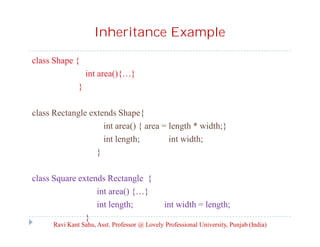
class Shape {
int area(){…}
}
class Rectangle extends Shape{
int area() { area = length * width;}
int length; int width;
}
class Square extends Rectangle {
int area() {…}
int length; int width = length;
}
Ravi Kant Sahu, Asst. Professor @ Lovely Professional University, Punjab (India)
Key Points
 Private members of the super-class are inherited but they
can not be accessed by the subclass directly.
 Members that have default accessibility in the super-class
are also not inherited by subclasses in other packages.
 Constructors and initializer blocks are not inherited by a
subclass.
 A subclass can extend only one super-class.
Ravi Kant Sahu, Asst. Professor @ Lovely Professional University, Punjab (India)
Types of Inheritance
The following kinds of inheritance are there in java.
 Simple Inheritance
 Multilevel Inheritance
 Simple Inheritance: A subclass is derived simply from it's
parent class.
 There is only a sub class and it's parent class. It is also
called single inheritance or one level inheritance.
 Multi-level Inheritance: A subclass is derived from a
derived class.
Ravi Kant Sahu, Asst. Professor @ Lovely Professional University, Punjab (India)
Multiple Inheritance
 The mechanism of inheriting the features of more than one
base class into a single class is known as multiple
inheritance.
 Java does not support multiple inheritance but the
multiple inheritance can be achieved by using the
interface.
 In Java Multiple Inheritance can be achieved through use
of Interfaces by implementing more than one interfaces in
a class.
Ravi Kant Sahu, Asst. Professor @ Lovely Professional University, Punjab (India)
Method Overloading
 Method overloading means having two or more methods with
the same name but different signatures in the same scope.
 These two methods may exist in the same class or one in base
class and another in derived class.
 It allows creating several methods with the same name which
differ from each other in the type of the input and the output of
the method.
 It is simply defined as the ability of one method to perform
different tasks.
Ravi Kant Sahu, Asst. Professor @ Lovely Professional University, Punjab (India)
Example
class Area11
{
void area(int a)
{
int area = a*a;
System.out.println("area of square is:" + area);
}
void area (int a, int b)
{
int area = a*b;
System.out.println("area of rectangle is:" + area);
}
}
Ravi Kant Sahu, Asst. Professor @ Lovely Professional University, Punjab (India)
class OverloadDemo
{
public static void main (String arr[])
{
Area11 ar= new Area11();
ar.area(10);
ar.area(10,5);
}
}
Ravi Kant Sahu, Asst. Professor @ Lovely Professional University, Punjab (India)
Method Overriding
 Method overriding means having a different implementation
of the same method in the inherited class.
 These two methods would have the same signature, but
different implementation.
 One of these would exist in the base class and another in the
derived class. These cannot exist in the same class.
Ravi Kant Sahu, Asst. Professor @ Lovely Professional University, Punjab (India)
 The version of a method that is executed will be
determined by the object that is used to invoke it.
 If an object of a parent class is used to invoke the
method, then the version in the parent class will be
executed.
 If an object of the subclass is used to invoke the
method, then the version in the child class will be
executed.
Ravi Kant Sahu, Asst. Professor @ Lovely Professional University, Punjab (India)
class Override
{
public void display()
{
System.out.println("Hello...This is superclass display");
}
}
class Override1 extends Override
{
public void display()
{
System.out.println("Hi...This is overriden method in subclass");
}
}
Ravi Kant Sahu, Asst. Professor @ Lovely Professional University, Punjab (India)
class OverrideDemo
{
public static void main(String arr[])
{
Override o = new Override();
o.display();
Override1 o1 = new Override1();
o1.display();
}
}
Ravi Kant Sahu, Asst. Professor @ Lovely Professional University, Punjab (India)
Dynamic Method Dispatch
 Dynamic method dispatch is the mechanism by which a
call to an overridden method is resolved at run time, rather
than compile time.
 Dynamic method dispatch is important because this is
how Java implements run-time polymorphism.
Ravi Kant Sahu, Asst. Professor @ Lovely Professional University, Punjab (India)
 class A {
void callme() {
System.out.println("Inside A's callme method");
}
}

class B extends A {
void callme() {
System.out.println("Inside B's callme method");
}
}
class C extends A {
void callme() {
System.out.println("Inside C's callme method");
}
}Ravi Kant Sahu, Asst. Professor @ Lovely Professional University, Punjab (India)
class Dispatch {
public static void main(String args[]) {
A a = new A(); // object of type A
B b = new B(); // object of type B
C c = new C(); // object of type C
A r; // obtain a reference of type A
r = a; // r refers to an A object
r.callme(); // calls A's version of callme
r = b; // r refers to a B object
r.callme(); // calls B's version of callme
r = c; // r refers to a C object
r.callme(); // calls C's version of callme
}
}
Ravi Kant Sahu, Asst. Professor @ Lovely Professional University, Punjab (India)
Inheritance

Inheritance

  • 1.
    Programming in Java Lecture7: Inheritance By Ravi Kant Sahu Asst. Professor, LPU
  • 2.
    Contents  Inheritance  MethodOverloading  Method Overriding  Dynamic Method Dispatch Ravi Kant Sahu, Asst. Professor @ Lovely Professional University, Punjab (India)
  • 3.
    Introduction  Object-oriented programmingallows classes to inherit commonly used state and behavior from other classes.  In the Java programming language, each class is allowed to have one direct super-class, and each super-class has the potential for an unlimited number of subclasses.  Inheritance is a fundamental object-oriented design technique used to create and organize reusable classes. Ravi Kant Sahu, Asst. Professor @ Lovely Professional University, Punjab (India)
  • 4.
    Inheritance  Inheritance definesan is-a relationship between a super-class and its subclasses. It means that the subclass (child) is a more specific version of the super-class (parent).  An object of a subclass can be used wherever an object of the super-class can be used.  Inheritance is used to build new classes from existing classes.  The inheritance relationship is transitive: if class y extends class x, and a class z extends class y, then z will also inherit from class x. Ravi Kant Sahu, Asst. Professor @ Lovely Professional University, Punjab (India)
  • 5.
    Inheritance  Using inheritance,we can create a general class that defines traits(state and behaviors) common to a set of related items.  This class can then be inherited by other, more specific classes, each adding those things that are unique to it.  In Java, a class that is inherited is called a super-class.  The class that does the inheriting is called a subclass.  A Subclass inherits all of the instance variables and methods defined by the super-class and adds its own, unique elements. Ravi Kant Sahu, Asst. Professor @ Lovely Professional University, Punjab (India)
  • 6.
    Ravi Kant Sahu,Asst. Professor @ Lovely Professional University, Punjab (India)
  • 7.
    Inheritance Example class Shape{ int area(){…} } class Rectangle extends Shape{ int area() { area = length * width;} int length; int width; } class Square extends Rectangle { int area() {…} int length; int width = length; } Ravi Kant Sahu, Asst. Professor @ Lovely Professional University, Punjab (India)
  • 8.
    Key Points  Privatemembers of the super-class are inherited but they can not be accessed by the subclass directly.  Members that have default accessibility in the super-class are also not inherited by subclasses in other packages.  Constructors and initializer blocks are not inherited by a subclass.  A subclass can extend only one super-class. Ravi Kant Sahu, Asst. Professor @ Lovely Professional University, Punjab (India)
  • 9.
    Types of Inheritance Thefollowing kinds of inheritance are there in java.  Simple Inheritance  Multilevel Inheritance  Simple Inheritance: A subclass is derived simply from it's parent class.  There is only a sub class and it's parent class. It is also called single inheritance or one level inheritance.  Multi-level Inheritance: A subclass is derived from a derived class. Ravi Kant Sahu, Asst. Professor @ Lovely Professional University, Punjab (India)
  • 10.
    Multiple Inheritance  Themechanism of inheriting the features of more than one base class into a single class is known as multiple inheritance.  Java does not support multiple inheritance but the multiple inheritance can be achieved by using the interface.  In Java Multiple Inheritance can be achieved through use of Interfaces by implementing more than one interfaces in a class. Ravi Kant Sahu, Asst. Professor @ Lovely Professional University, Punjab (India)
  • 11.
    Method Overloading  Methodoverloading means having two or more methods with the same name but different signatures in the same scope.  These two methods may exist in the same class or one in base class and another in derived class.  It allows creating several methods with the same name which differ from each other in the type of the input and the output of the method.  It is simply defined as the ability of one method to perform different tasks. Ravi Kant Sahu, Asst. Professor @ Lovely Professional University, Punjab (India)
  • 12.
    Example class Area11 { void area(inta) { int area = a*a; System.out.println("area of square is:" + area); } void area (int a, int b) { int area = a*b; System.out.println("area of rectangle is:" + area); } } Ravi Kant Sahu, Asst. Professor @ Lovely Professional University, Punjab (India)
  • 13.
    class OverloadDemo { public staticvoid main (String arr[]) { Area11 ar= new Area11(); ar.area(10); ar.area(10,5); } } Ravi Kant Sahu, Asst. Professor @ Lovely Professional University, Punjab (India)
  • 14.
    Method Overriding  Methodoverriding means having a different implementation of the same method in the inherited class.  These two methods would have the same signature, but different implementation.  One of these would exist in the base class and another in the derived class. These cannot exist in the same class. Ravi Kant Sahu, Asst. Professor @ Lovely Professional University, Punjab (India)
  • 15.
     The versionof a method that is executed will be determined by the object that is used to invoke it.  If an object of a parent class is used to invoke the method, then the version in the parent class will be executed.  If an object of the subclass is used to invoke the method, then the version in the child class will be executed. Ravi Kant Sahu, Asst. Professor @ Lovely Professional University, Punjab (India)
  • 16.
    class Override { public voiddisplay() { System.out.println("Hello...This is superclass display"); } } class Override1 extends Override { public void display() { System.out.println("Hi...This is overriden method in subclass"); } } Ravi Kant Sahu, Asst. Professor @ Lovely Professional University, Punjab (India)
  • 17.
    class OverrideDemo { public staticvoid main(String arr[]) { Override o = new Override(); o.display(); Override1 o1 = new Override1(); o1.display(); } } Ravi Kant Sahu, Asst. Professor @ Lovely Professional University, Punjab (India)
  • 18.
    Dynamic Method Dispatch Dynamic method dispatch is the mechanism by which a call to an overridden method is resolved at run time, rather than compile time.  Dynamic method dispatch is important because this is how Java implements run-time polymorphism. Ravi Kant Sahu, Asst. Professor @ Lovely Professional University, Punjab (India)
  • 19.
     class A{ void callme() { System.out.println("Inside A's callme method"); } }  class B extends A { void callme() { System.out.println("Inside B's callme method"); } } class C extends A { void callme() { System.out.println("Inside C's callme method"); } }Ravi Kant Sahu, Asst. Professor @ Lovely Professional University, Punjab (India)
  • 20.
    class Dispatch { publicstatic void main(String args[]) { A a = new A(); // object of type A B b = new B(); // object of type B C c = new C(); // object of type C A r; // obtain a reference of type A r = a; // r refers to an A object r.callme(); // calls A's version of callme r = b; // r refers to a B object r.callme(); // calls B's version of callme r = c; // r refers to a C object r.callme(); // calls C's version of callme } } Ravi Kant Sahu, Asst. Professor @ Lovely Professional University, Punjab (India)