Space Travel Through the DecadesBy Marilyn Krause
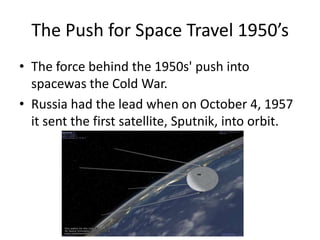
The Push for Space Travel 1950’sThe force behind the 1950s' push into spacewas the Cold War.Russia had the lead when on October 4, 1957 it sent the first satellite, Sputnik, into orbit.
America Joins the RaceThe successful launch of Explorer 1 on January 31, 1958. Meant that the U.S. had joined the "space race.”America suffered a series of embarrassing failures but on March in1959 Pioneer 4 was launched it was able to achieve lunar distance, missing the moon by 37,500 miles
Orbiting  Earth 1960’sOn April 12, 1961, the Soviets launch Yuri Gagarin on the world's first piloted space mission. He orbited the Earth once.The first American orbited Earth on February 12, 1962. He circled the globe three times.America was still overshadowed by the Soviet’s flights.
1970’s1971, two years before the Soviet launched the world's first space station. With three cosmonauts who spent 21 days aboard the stationAmerica came up with a  re-usable space shuttle that would ferry astronauts to and from Earth. The shuttle would launch satellites, and serve as an orbiting research platform.
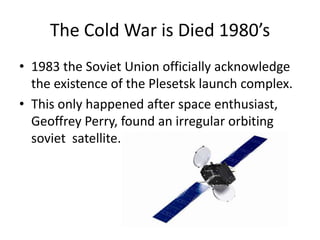
The Cold War is Died 1980’s1983 the Soviet Union officially acknowledge the existence of the Plesetsk launch complex.This only happened after space enthusiast, Geoffrey Perry, found an irregular orbiting soviet  satellite.
Nanotechnology 2000NASA has embraced nanotechnology. They think it is the future of space travel and space living.Nanotechnology holds the key to the true revolution of the way we live and travel on Earth and in space.
Web site listhttp://www.space.com/news/spacehistory/greatest_space_events_1950s-1.htmlhttp://www.space.com/news/spacehistory/greatest_space_events_1960s.htmlhttp://www.space.com/news/spacehistory/greatest_70s_991230.html

L3

  • 1.
    Space Travel Throughthe DecadesBy Marilyn Krause
  • 2.
    The Push forSpace Travel 1950’sThe force behind the 1950s' push into spacewas the Cold War.Russia had the lead when on October 4, 1957 it sent the first satellite, Sputnik, into orbit.
  • 3.
    America Joins theRaceThe successful launch of Explorer 1 on January 31, 1958. Meant that the U.S. had joined the "space race.”America suffered a series of embarrassing failures but on March in1959 Pioneer 4 was launched it was able to achieve lunar distance, missing the moon by 37,500 miles
  • 4.
    Orbiting Earth1960’sOn April 12, 1961, the Soviets launch Yuri Gagarin on the world's first piloted space mission. He orbited the Earth once.The first American orbited Earth on February 12, 1962. He circled the globe three times.America was still overshadowed by the Soviet’s flights.
  • 5.
    1970’s1971, two yearsbefore the Soviet launched the world's first space station. With three cosmonauts who spent 21 days aboard the stationAmerica came up with a re-usable space shuttle that would ferry astronauts to and from Earth. The shuttle would launch satellites, and serve as an orbiting research platform.
  • 6.
    The Cold Waris Died 1980’s1983 the Soviet Union officially acknowledge the existence of the Plesetsk launch complex.This only happened after space enthusiast, Geoffrey Perry, found an irregular orbiting soviet satellite.
  • 7.
    Nanotechnology 2000NASA hasembraced nanotechnology. They think it is the future of space travel and space living.Nanotechnology holds the key to the true revolution of the way we live and travel on Earth and in space.
  • 8.