Conservation and Human Societies preservation of biological diversity is often in conflict with actual and perceived human needs what is  sustainable development ?  - economic development to satisfy present and future needs while  minimizing impacts on biodiversity the concept is often misused by   corporations, governments etc.
The Ultimate Source of the Biodiversity Crisis if current predictions of  human population  growth prove accurate  science and technology may not be able to prevent irreversible degradation  of the natural environment... ...dealing successfully with environmental problems will require the achievement of  zero population growth... 30 billion people present
present human population 6 billion people 95% of the earth’s surface is occupied by  human settlements or ecosystems managed for food  and materials production natural ecosystems are under increasing pressure - fragmentation, species extinction, loss of global genetic diversity cannot feed  the projected human population by simply increasing the area used for food production the enormity of the crisis has stimulated efforts to conserve biodiversity and use resources sustainably
Conserving Agricultural Genetic Diversity Potato:  1830’s European ‘potato famine” was caused by susceptibility to fungal disease potato varieties grown came from a limited genetic source diverse localized populations in South America provided disease resistance
occurred because 70% of USA corn was developed using a  single genetic source  susceptible to the pathogen ( ie. lack of genetic variability) genetic uniformity  is recognized as “dangerous” because of inability to respond to biotic and abiotic environmental pressures Corn: 1970 failure of corn crops from “corn leaf blight”
agricultural genetic diversity in pre-industrialized societies is  high eg. indigenous cultivars of maize from Mexico vary in  time  to maturity from 60 days to 16 months height  from 40 to 700cm ear lengths  range from 4 to 40cm teosinte -maize wild relative- in Mexico loss of diversity is associated with “modern” agricultural methods
variation in fruit form in  tomato  ( Lycopersicon esculentum ) variation in  cabbage  leaf type in  Brassica oleracea acephala striking  morphological  examples of genetic diversity
genetic conservation  of important agricultural crops began early in the 20th century loss of primitive varieties of crop species --  “landraces”  -- meant loss of genetic variation essential for sustained crop improvement  systematic collection of  seeds  of indigenous crop varieties understanding of  geographic distribution  of genetic variation in crops varieties of wheat primitive wheat varieties (landraces)
germplasm (= the DNA = mostly seeds) in these collections represent over 3,600,000  genetically distinct  samples from about  100 crop species  and their wild relatives seed in these  “seed-banks”  held at -88C and periodically propagated to preserve viability these  ex situ  collections are essentially the only genetic resource used for crop improvements Primack 1998 Ch 14 Australian National Botanic Gardens seed bank
Pest-Resistant Crops and Genetic Diversity maintaining  agricultural productivity  to meet  world food  needs depends on continued development of pest resistance developing  host plant resistance  (HPR) to insects and pathogens is a primary focus of food plant development HPR  and  resistance to pathogens  is most frequently found in “unimproved” or  wild landraces eg. resistance of current varieties to 12 diseases of tomato originates in wild tomato varieties
in situ  Conservation of Agricultural Biodiversity 1. preserved habitats containing wild populations of crop species 2. regions where cultivation of  indigenous landraces  is continued by  “custodian” farmers  in exchange for subsidies indigenous rice variety grown in Vietnam - note no water!
less expensive than  ex situ variation is maintained by natural or  indigenous cultural practices selecting rice seeds and varieties  in Vietnam
in situ  (on farm) agricultural conservation aims to 1. conserve  processes  of evolution and adaptation of crops (dependent on farmers)  2. conserve  diversity  at ecosystem, species and intra-specific level 3.  integrate farmers  into the global genetic resources system 4. conserve  ecosystem services 5.  improve the livelihood  of resource-poor farmers 6.  maintain  or increase farmers’  access to crop genetic resources http://www.ipgri.cgiar.org
crop species show high genetic diversity in certain areas of the world
locations of in situ crop diversity and wild crop relatives conservation projects
Morocco alfalfa, bean & barley farming system farmer with a turnip landrace Morocco contains a vast diversity of agro-ecosystems high Atlas Mountains oasis area Rif Mountains
priority crops barley  Hordeum vulgare durum wheat  Triticum turgidum faba bean  Vicia faba alfalfa  Medicago sativa bread wheat  Triticum aestivum crops chosen on economic importance farmer knowledge of landraces - varieties for straw, food, abiotic stress scientific data indicating high genetic diversity extent of threats posed by new cultivars
Burkina Faso seed storage women farmers group target crops sorghum  Sorgum bicolor cowpea  Vigna unguiculata pearl millet  Pennisetum glaucum okra  Abelmoschus spp . African potato  Solenostomum sorghum landrace
Nepal single households may maintain >20 varieties of the  same crop rice  Oryza sativa maize  Zea mays finger millet  Eleusine spp . beans taro  Colocasia esculenta   mustard  Brassica campestris conserve, diversify, empower
Hungary project to  re-introduce  local varieties into farming systems quantify effects of  restoring agrobiodiversity  on agro-ecosystem functions, genetic diversity and  economic development farmer varieties of vegetables Hungarian farmer with a maize landrace
crop wild relatives are  found naturally  in agro-ecosystems near farms, but increasingly threatened many are found in centres of plant diversity  and crop diversity in  developing countries these farmers and countries lack resources to invest in the necessary conservation strategies global strategies  to link these countries to International conservation agencies eg. UN FAO, IUCN current project involves countries like Armenia, Bolivia, Madagascar, Sri Lanka and Uzbekistan - all centres of crop diversity
Local Conservation in  Developed  Countries local, regional and state laws  aim to regulate activities which directly  impacts on species and ecosystems regulation  of hunting & fishing - season, size catch etc. harvesting plants  - certification of a permit eg. tree ferns, grass trees laws controlling  land use  can protect biodiversity - access, pollution levels, lighting fires etc. zoning laws  - prevent development in sensitive areas;  environmental impact statements
passage and enforcement of conservation-related laws at a local level can be highly emotional public must be made to look  beyond the immediate benefits  of development eg. protection of water supplies may mean no development -no grazing, logging or housing -  in water catchments  the arguments of conservation may be  misused  by people to prevent development near them -  “not in my backyard” this misuse damages true conservation efforts  “by association”
one of the most powerful means to protect biological diversity is to set aside intact biological communities as nature reserves, National Parks etc. - a means of  in situ  conservation Park Managers throughout the world cite  conflicts with local people  as their most serious problem in the developing world local people typically  obtain many or all their resources  from their immediate environment common to  disregard the traditional rights of local people  in establishing new conservation areas -  ecocolonialism
Traditional Societies  &  Biological Diversity many traditional societies have a strong conservation ethic not stated in Western terms based on sustainable resource use traditional land use and farming practices are frequently responsible for the patterns of biological diversity we now observe needs of local people and conservation need to be reconciled
Tukano people of Brazil diet of root crops and river fish strong cultural prohibitions against cutting the forest along the Upper Rio Negro  recognized as critical for maintaining fish populations extensive refuges for fish; fishing is permitted along less than 40% of the river margin Primack 1998 Fig 20.8
Biological Diversity and Cultural Diversity strong association between cultural diversity and the occurrence of high biological diversity the  development of landraces is often a response to human selection for desired traits they are adapted to local soils, climates and tastes eg. the Nuba mountains of Sudan host  62 distinct human language groups , and grow  dozens of landraces of sesame  which are identified with particular tribes and places
protection of traditional cultures within their traditional areas provides a dual opportunity for  cultural as well as biological diversity conservation
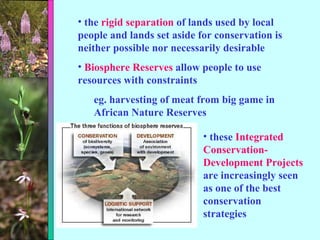
the  rigid separation  of lands used by local people and lands set aside for conservation is neither possible nor necessarily desirable Biosphere Reserves  allow people to use resources with constraints eg. harvesting of meat from big game in African Nature Reserves these  Integrated Conservation-Development Projects  are increasingly seen as one of the best conservation strategies

L25 human societies

  • 1.
    Conservation and HumanSocieties preservation of biological diversity is often in conflict with actual and perceived human needs what is sustainable development ? - economic development to satisfy present and future needs while minimizing impacts on biodiversity the concept is often misused by corporations, governments etc.
  • 2.
    The Ultimate Sourceof the Biodiversity Crisis if current predictions of human population growth prove accurate science and technology may not be able to prevent irreversible degradation of the natural environment... ...dealing successfully with environmental problems will require the achievement of zero population growth... 30 billion people present
  • 3.
    present human population6 billion people 95% of the earth’s surface is occupied by human settlements or ecosystems managed for food and materials production natural ecosystems are under increasing pressure - fragmentation, species extinction, loss of global genetic diversity cannot feed the projected human population by simply increasing the area used for food production the enormity of the crisis has stimulated efforts to conserve biodiversity and use resources sustainably
  • 4.
    Conserving Agricultural GeneticDiversity Potato: 1830’s European ‘potato famine” was caused by susceptibility to fungal disease potato varieties grown came from a limited genetic source diverse localized populations in South America provided disease resistance
  • 5.
    occurred because 70%of USA corn was developed using a single genetic source susceptible to the pathogen ( ie. lack of genetic variability) genetic uniformity is recognized as “dangerous” because of inability to respond to biotic and abiotic environmental pressures Corn: 1970 failure of corn crops from “corn leaf blight”
  • 6.
    agricultural genetic diversityin pre-industrialized societies is high eg. indigenous cultivars of maize from Mexico vary in time to maturity from 60 days to 16 months height from 40 to 700cm ear lengths range from 4 to 40cm teosinte -maize wild relative- in Mexico loss of diversity is associated with “modern” agricultural methods
  • 7.
    variation in fruitform in tomato ( Lycopersicon esculentum ) variation in cabbage leaf type in Brassica oleracea acephala striking morphological examples of genetic diversity
  • 8.
    genetic conservation of important agricultural crops began early in the 20th century loss of primitive varieties of crop species -- “landraces” -- meant loss of genetic variation essential for sustained crop improvement systematic collection of seeds of indigenous crop varieties understanding of geographic distribution of genetic variation in crops varieties of wheat primitive wheat varieties (landraces)
  • 9.
    germplasm (= theDNA = mostly seeds) in these collections represent over 3,600,000 genetically distinct samples from about 100 crop species and their wild relatives seed in these “seed-banks” held at -88C and periodically propagated to preserve viability these ex situ collections are essentially the only genetic resource used for crop improvements Primack 1998 Ch 14 Australian National Botanic Gardens seed bank
  • 10.
    Pest-Resistant Crops andGenetic Diversity maintaining agricultural productivity to meet world food needs depends on continued development of pest resistance developing host plant resistance (HPR) to insects and pathogens is a primary focus of food plant development HPR and resistance to pathogens is most frequently found in “unimproved” or wild landraces eg. resistance of current varieties to 12 diseases of tomato originates in wild tomato varieties
  • 11.
    in situ Conservation of Agricultural Biodiversity 1. preserved habitats containing wild populations of crop species 2. regions where cultivation of indigenous landraces is continued by “custodian” farmers in exchange for subsidies indigenous rice variety grown in Vietnam - note no water!
  • 12.
    less expensive than ex situ variation is maintained by natural or indigenous cultural practices selecting rice seeds and varieties in Vietnam
  • 13.
    in situ (on farm) agricultural conservation aims to 1. conserve processes of evolution and adaptation of crops (dependent on farmers) 2. conserve diversity at ecosystem, species and intra-specific level 3. integrate farmers into the global genetic resources system 4. conserve ecosystem services 5. improve the livelihood of resource-poor farmers 6. maintain or increase farmers’ access to crop genetic resources http://www.ipgri.cgiar.org
  • 14.
    crop species showhigh genetic diversity in certain areas of the world
  • 15.
    locations of insitu crop diversity and wild crop relatives conservation projects
  • 16.
    Morocco alfalfa, bean& barley farming system farmer with a turnip landrace Morocco contains a vast diversity of agro-ecosystems high Atlas Mountains oasis area Rif Mountains
  • 17.
    priority crops barley Hordeum vulgare durum wheat Triticum turgidum faba bean Vicia faba alfalfa Medicago sativa bread wheat Triticum aestivum crops chosen on economic importance farmer knowledge of landraces - varieties for straw, food, abiotic stress scientific data indicating high genetic diversity extent of threats posed by new cultivars
  • 18.
    Burkina Faso seedstorage women farmers group target crops sorghum Sorgum bicolor cowpea Vigna unguiculata pearl millet Pennisetum glaucum okra Abelmoschus spp . African potato Solenostomum sorghum landrace
  • 19.
    Nepal single householdsmay maintain >20 varieties of the same crop rice Oryza sativa maize Zea mays finger millet Eleusine spp . beans taro Colocasia esculenta mustard Brassica campestris conserve, diversify, empower
  • 20.
    Hungary project to re-introduce local varieties into farming systems quantify effects of restoring agrobiodiversity on agro-ecosystem functions, genetic diversity and economic development farmer varieties of vegetables Hungarian farmer with a maize landrace
  • 21.
    crop wild relativesare found naturally in agro-ecosystems near farms, but increasingly threatened many are found in centres of plant diversity and crop diversity in developing countries these farmers and countries lack resources to invest in the necessary conservation strategies global strategies to link these countries to International conservation agencies eg. UN FAO, IUCN current project involves countries like Armenia, Bolivia, Madagascar, Sri Lanka and Uzbekistan - all centres of crop diversity
  • 22.
    Local Conservation in Developed Countries local, regional and state laws aim to regulate activities which directly impacts on species and ecosystems regulation of hunting & fishing - season, size catch etc. harvesting plants - certification of a permit eg. tree ferns, grass trees laws controlling land use can protect biodiversity - access, pollution levels, lighting fires etc. zoning laws - prevent development in sensitive areas; environmental impact statements
  • 23.
    passage and enforcementof conservation-related laws at a local level can be highly emotional public must be made to look beyond the immediate benefits of development eg. protection of water supplies may mean no development -no grazing, logging or housing - in water catchments the arguments of conservation may be misused by people to prevent development near them - “not in my backyard” this misuse damages true conservation efforts “by association”
  • 24.
    one of themost powerful means to protect biological diversity is to set aside intact biological communities as nature reserves, National Parks etc. - a means of in situ conservation Park Managers throughout the world cite conflicts with local people as their most serious problem in the developing world local people typically obtain many or all their resources from their immediate environment common to disregard the traditional rights of local people in establishing new conservation areas - ecocolonialism
  • 25.
    Traditional Societies & Biological Diversity many traditional societies have a strong conservation ethic not stated in Western terms based on sustainable resource use traditional land use and farming practices are frequently responsible for the patterns of biological diversity we now observe needs of local people and conservation need to be reconciled
  • 26.
    Tukano people ofBrazil diet of root crops and river fish strong cultural prohibitions against cutting the forest along the Upper Rio Negro recognized as critical for maintaining fish populations extensive refuges for fish; fishing is permitted along less than 40% of the river margin Primack 1998 Fig 20.8
  • 27.
    Biological Diversity andCultural Diversity strong association between cultural diversity and the occurrence of high biological diversity the development of landraces is often a response to human selection for desired traits they are adapted to local soils, climates and tastes eg. the Nuba mountains of Sudan host 62 distinct human language groups , and grow dozens of landraces of sesame which are identified with particular tribes and places
  • 28.
    protection of traditionalcultures within their traditional areas provides a dual opportunity for cultural as well as biological diversity conservation
  • 29.
    the rigidseparation of lands used by local people and lands set aside for conservation is neither possible nor necessarily desirable Biosphere Reserves allow people to use resources with constraints eg. harvesting of meat from big game in African Nature Reserves these Integrated Conservation-Development Projects are increasingly seen as one of the best conservation strategies