Lecture 1: Introduction
1
Introduction to Artificial Intelligence
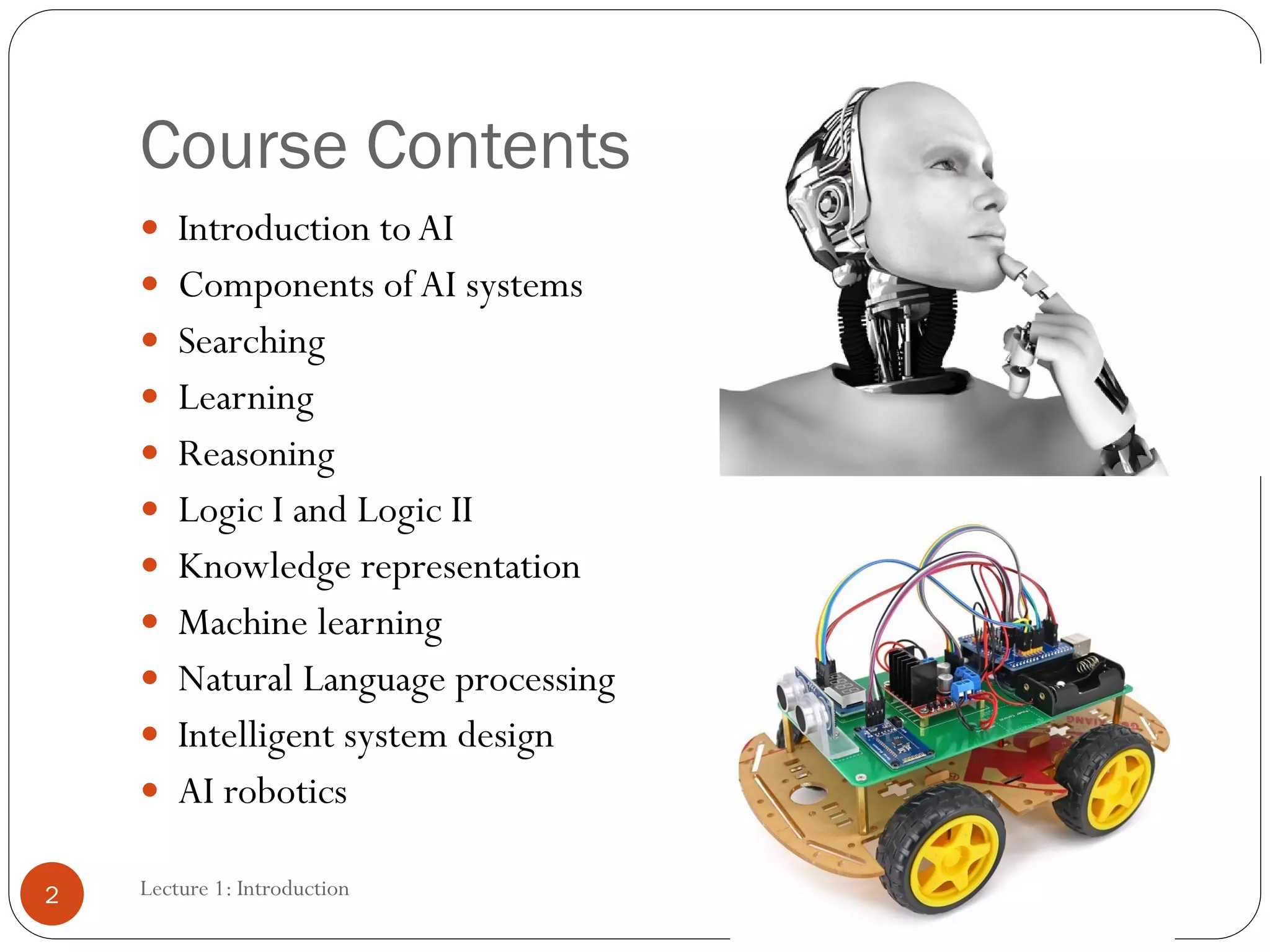
Course Contents
 Introduction toAI
 Components ofAI systems
 Searching
 Learning
 Reasoning
 Logic I and Logic II
 Knowledge representation
 Machine learning
 Natural Language processing
 Intelligent system design
 AI robotics
2 Lecture 1: Introduction
Course Assessment
 Quiz 10%
 Project 20%
 Lab 20%
 Assignment 10%
 Midterm 20%
 Final term 20%
3 Lecture 1: Introduction
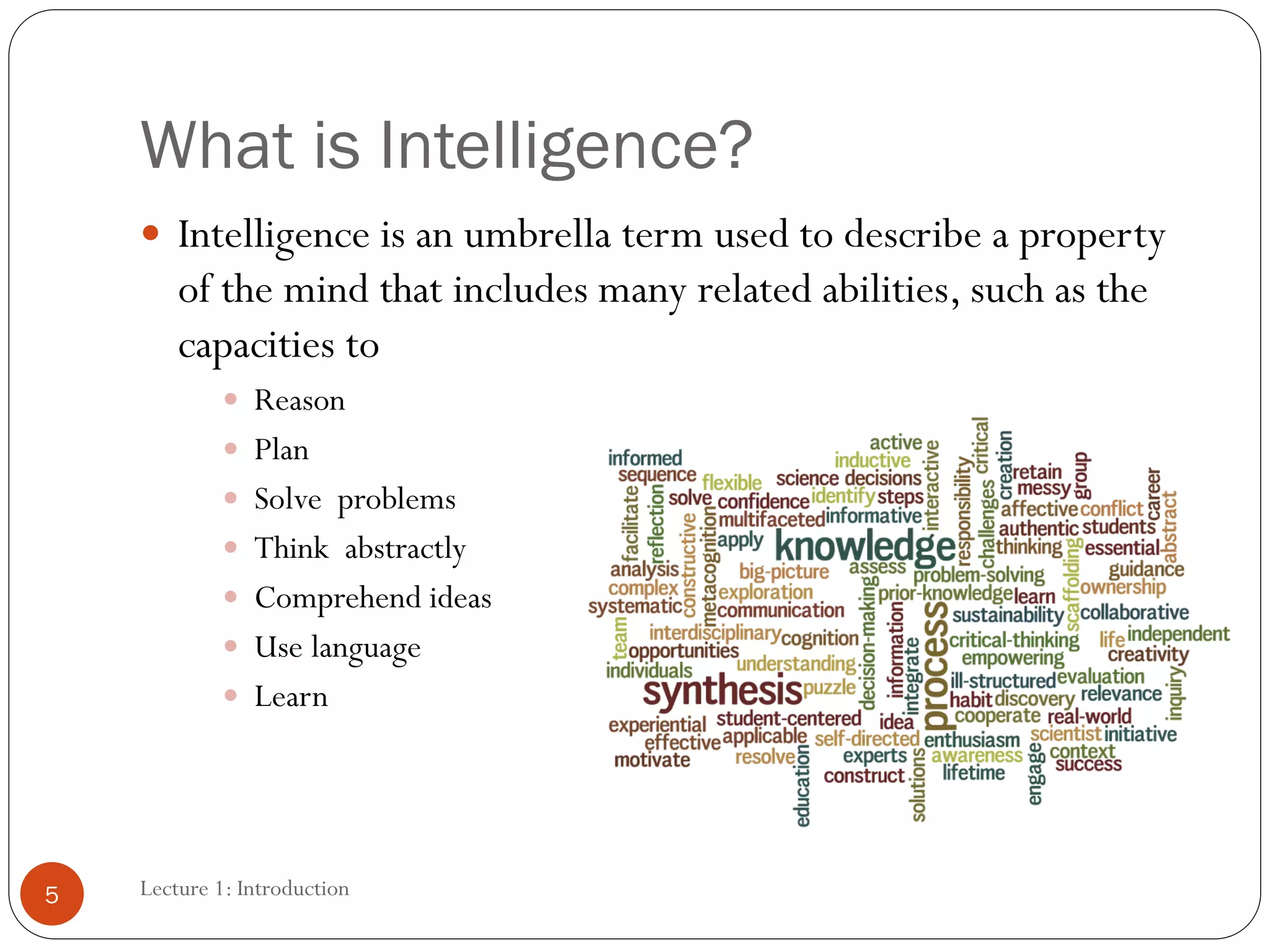
What is Intelligence?
 Intelligence is an umbrella term used to describe a property
of the mind that includes many related abilities, such as the
capacities to
 Reason
 Plan
 Solve problems
 Think abstractly
 Comprehend ideas
 Use language
 Learn
5 Lecture 1: Introduction
What is Artificial Intelligence?
 Artificial Intelligence is a way of making a machine
(Computer, robot software) to think and behave intelligently
like a intelligent human
 AI study and design a computing systems that can perceives
its environment and takes actions like human beings
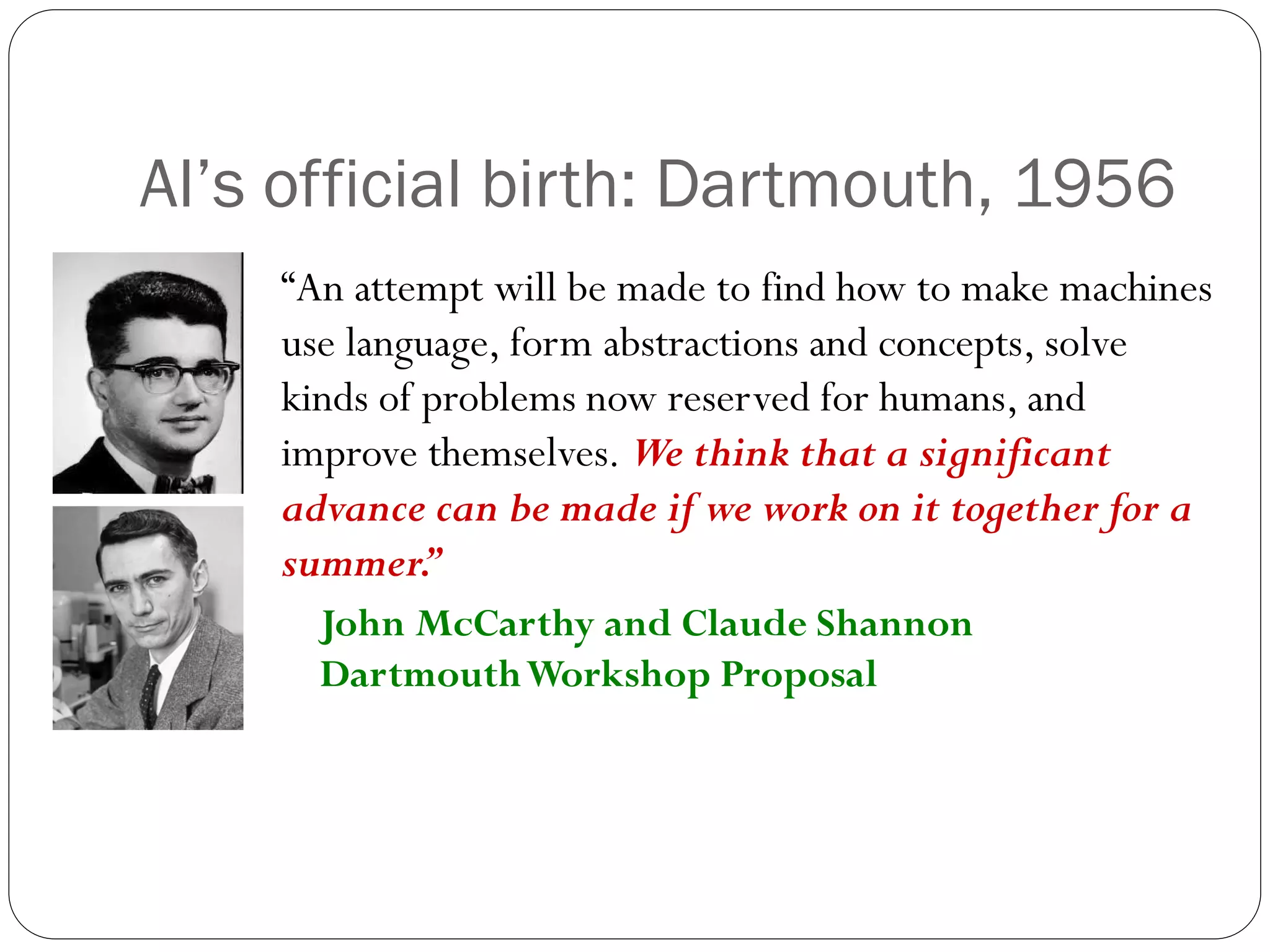
 AI term was introduced by John McCarthy in 1956
 AI is defined as a system that possesses at least one of the
abilities mentioned in the previous slide
 AI studies theories and technologies for obtaining systems
that are partially or fully intelligent
7 Lecture 1: Introduction
What is Artificial Intelligence?
 Four definations ofAI
 Think humanly – cognition – cognitive science – cognitive
neuro science data driven
 Act humanly
 Think Rationally
 Act Rationally
8 Lecture 1: Introduction
Lecture 1: Introduction
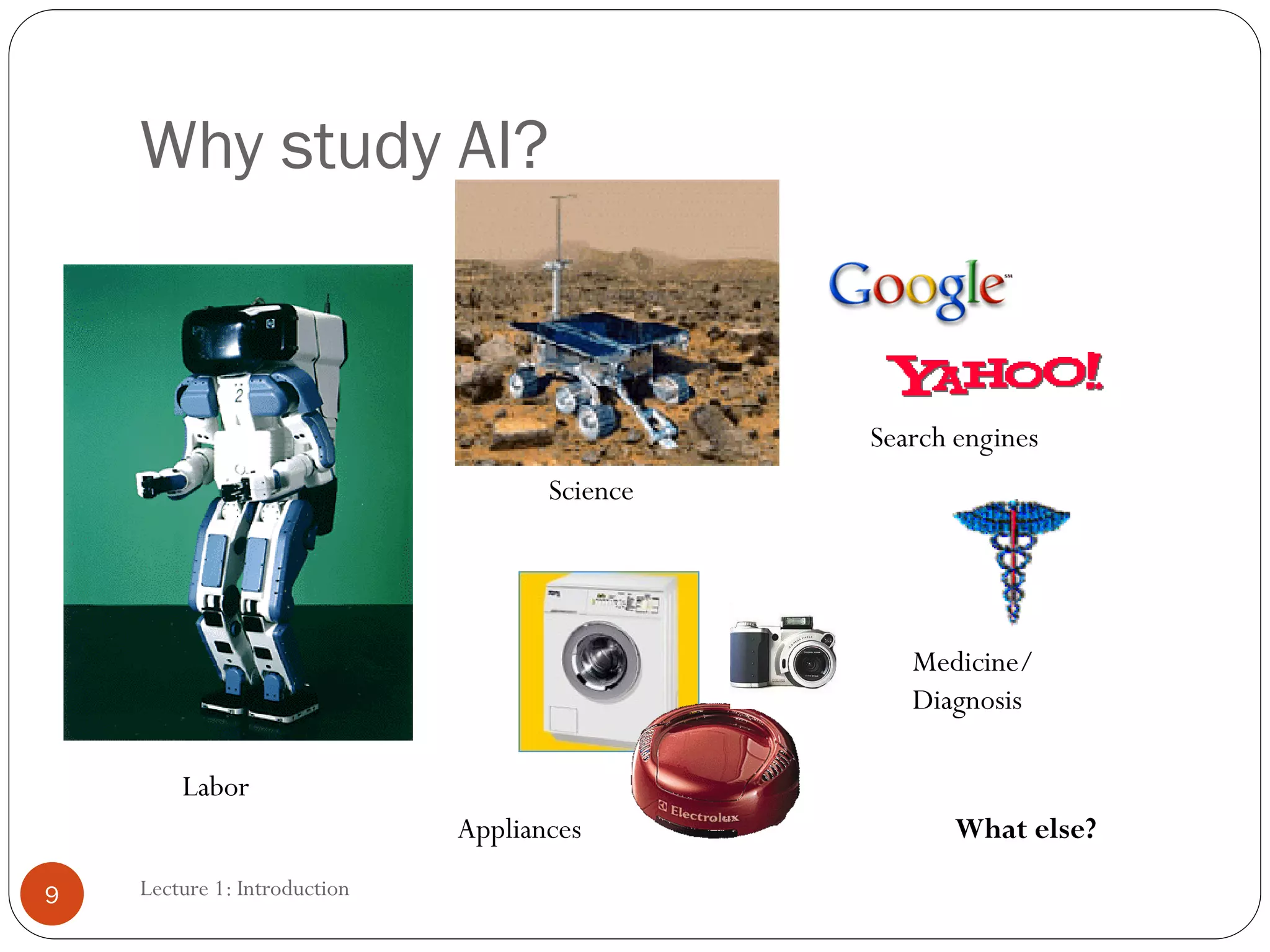
Why study AI?
Search engines
Labor
Science
Medicine/
Diagnosis
Appliances What else?
9
Lecture 1: Introduction
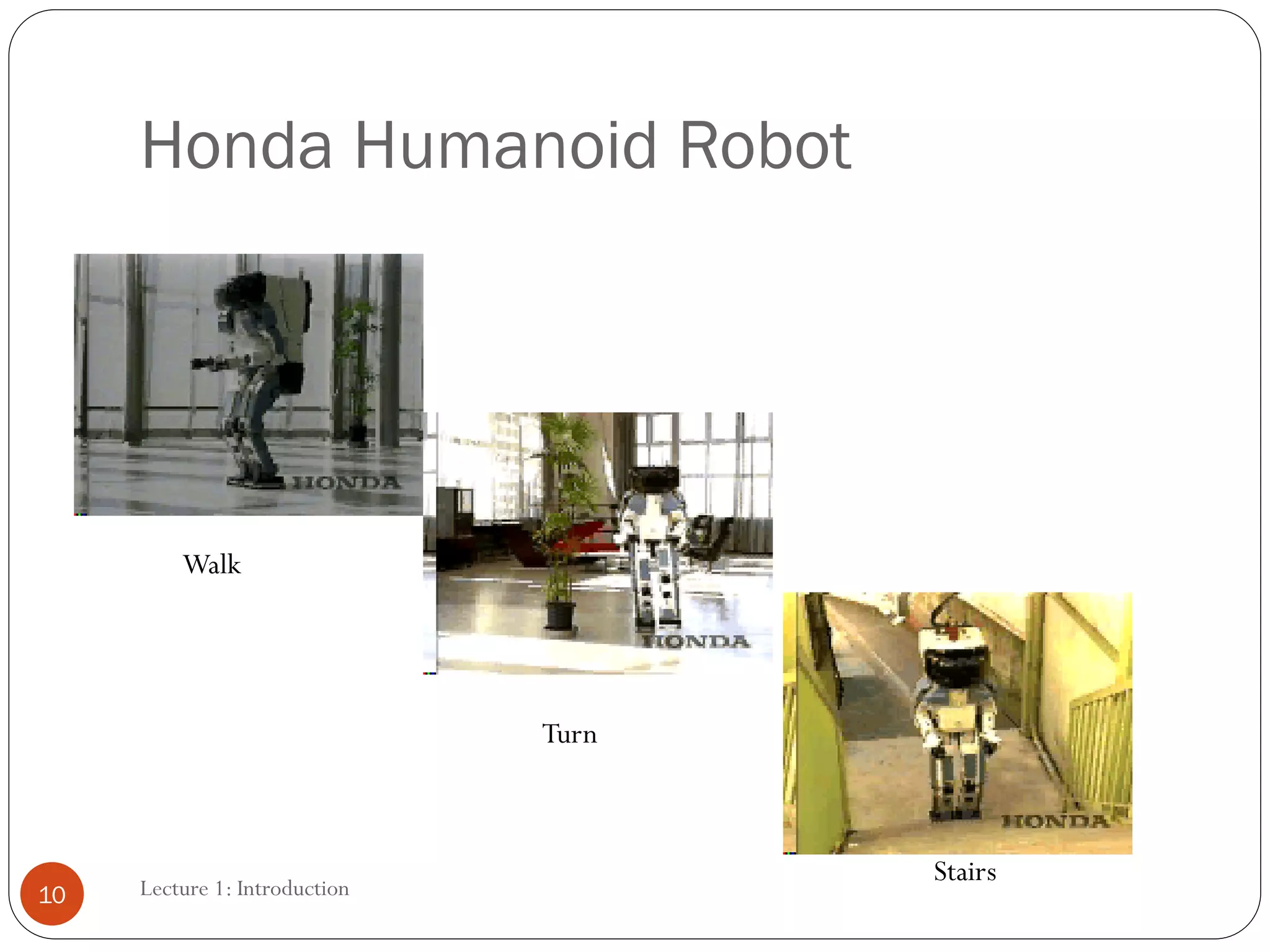
Honda Humanoid Robot
Walk
Turn
Stairs
10
Lecture 1: Introduction
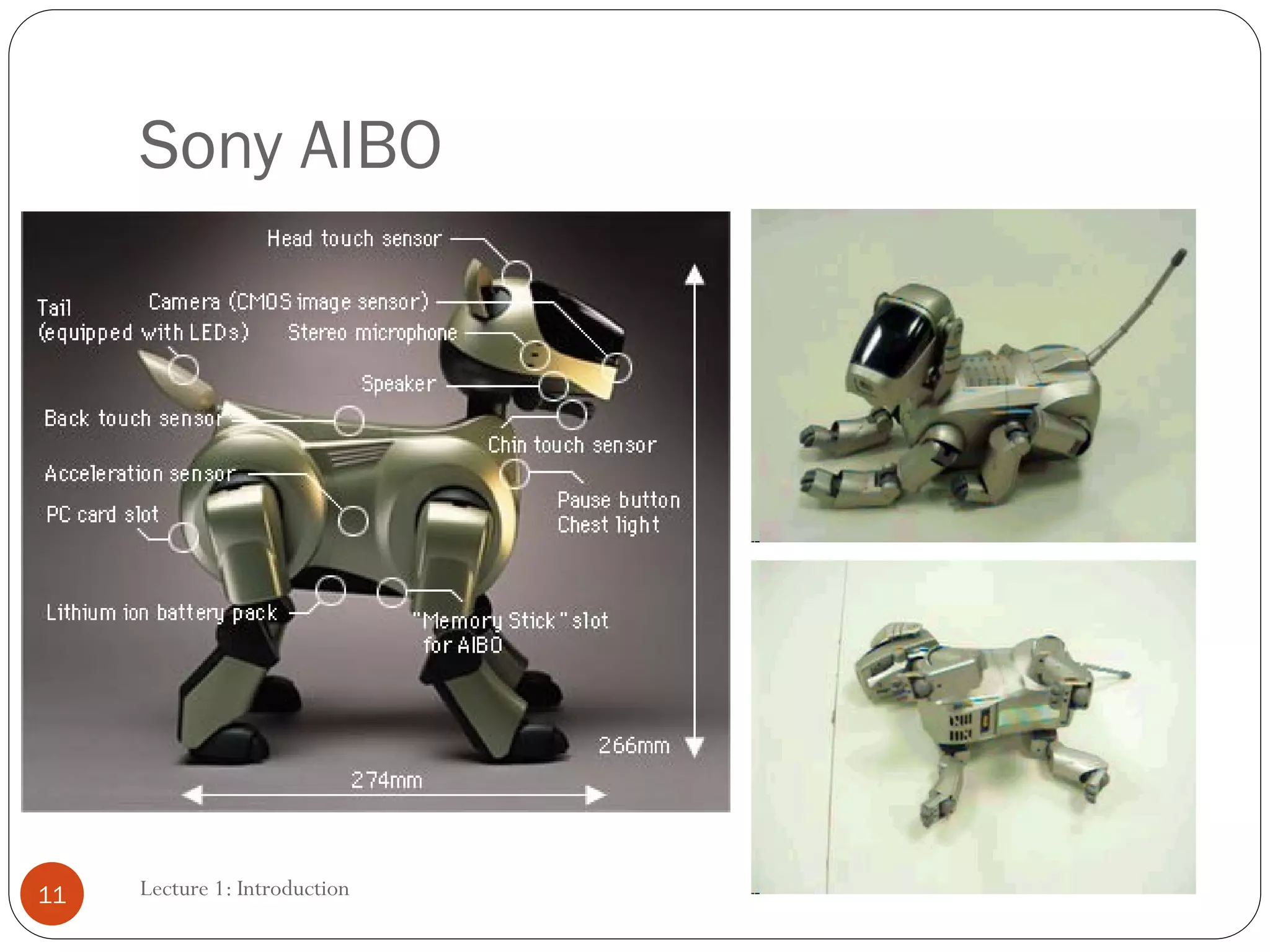
Sony AIBO
11
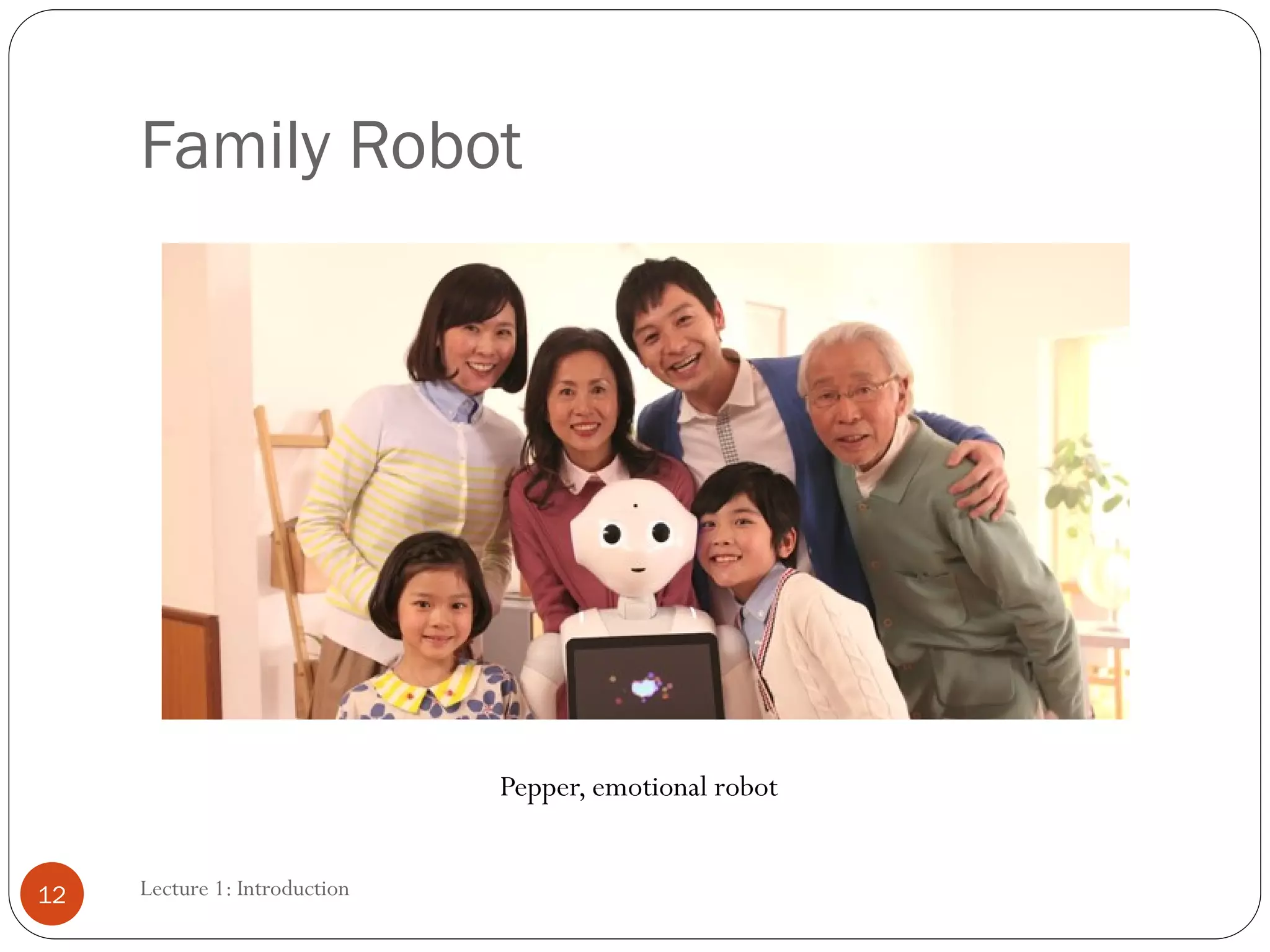
Family Robot
Lecture 1: Introduction
12
Pepper, emotional robot
Lecture 1: Introduction
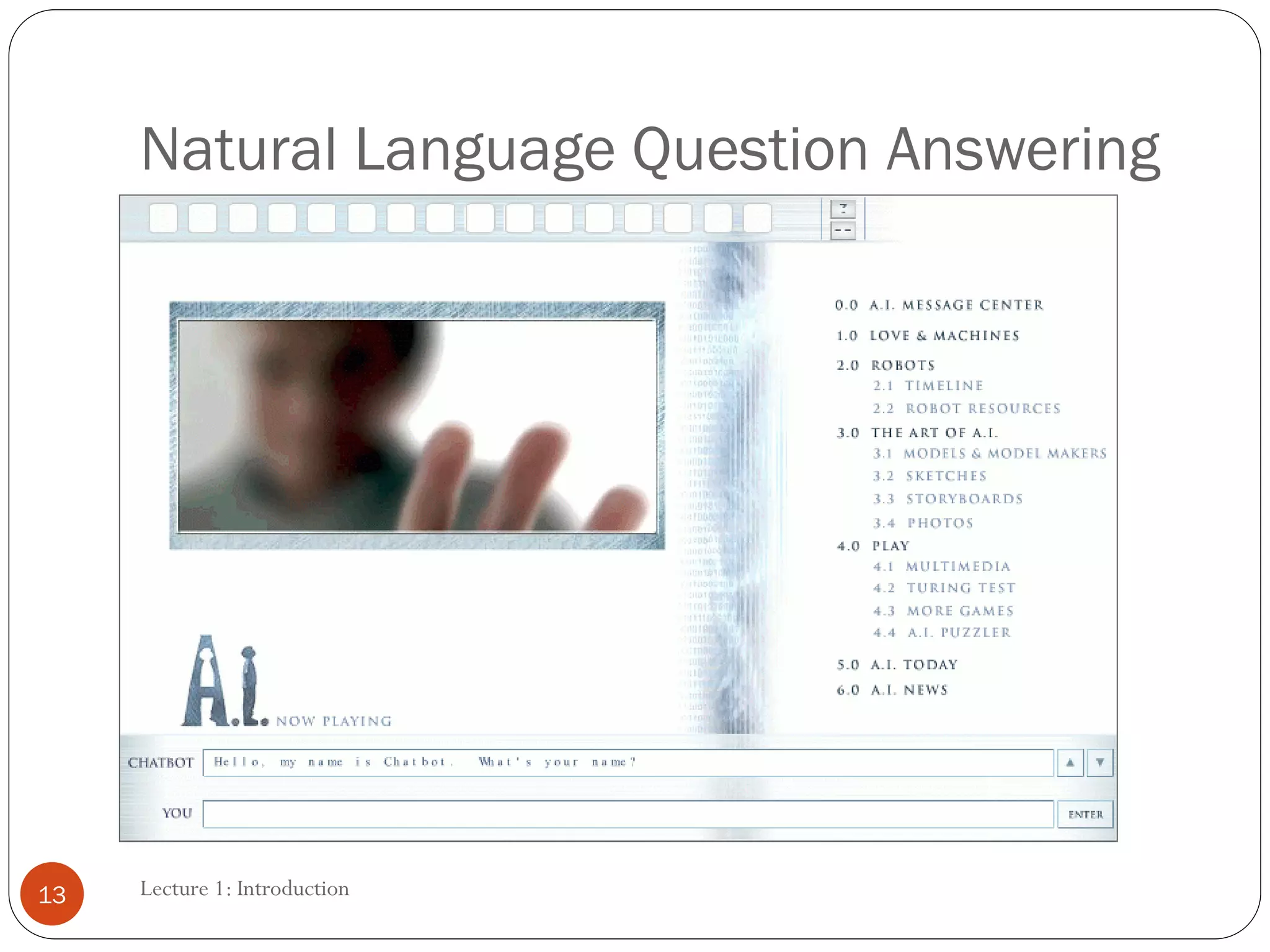
Natural Language Question Answering
13
Lecture 1: Introduction
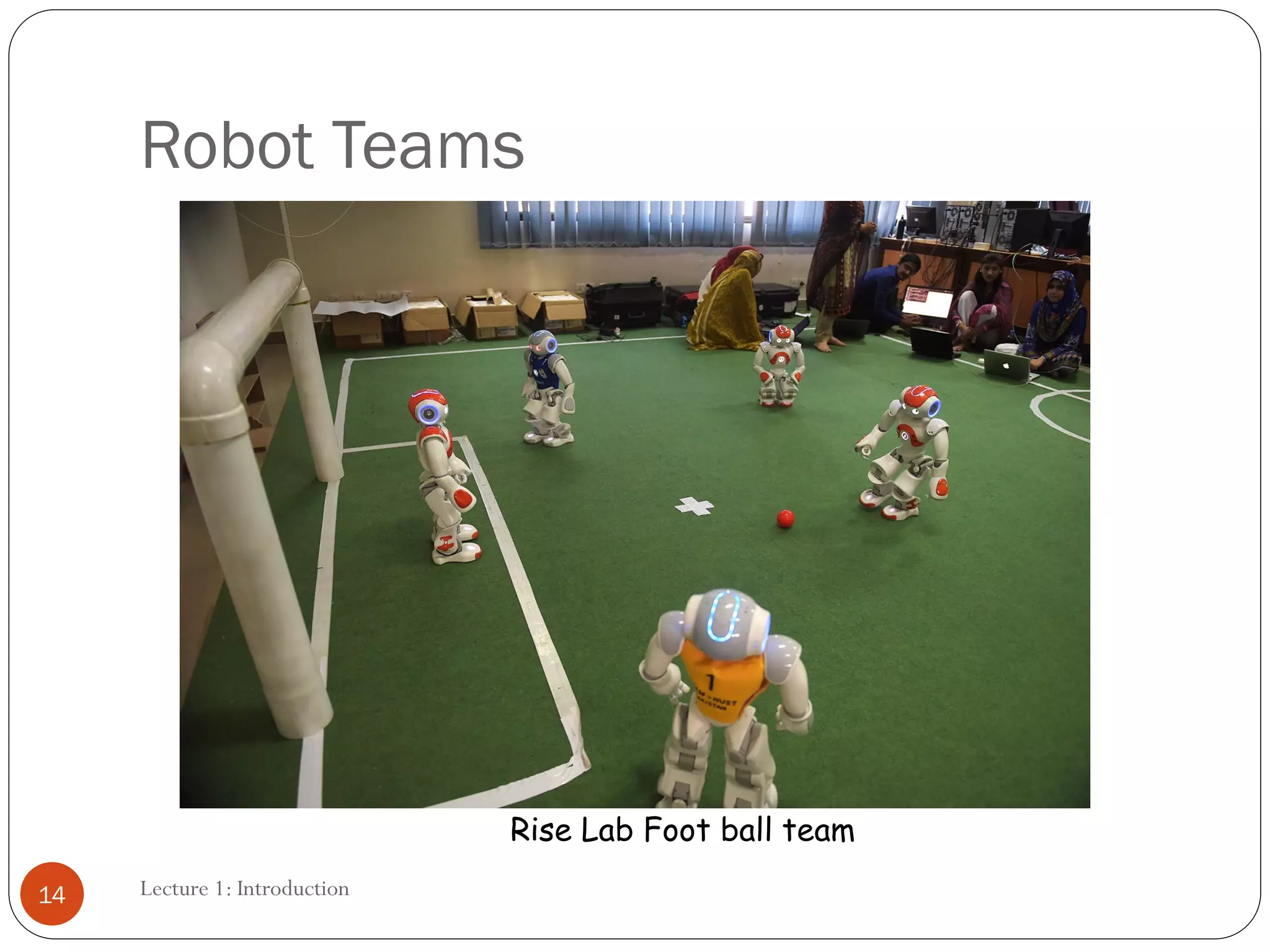
Robot Teams
Rise Lab Foot ball team
14
A Brief History of AI
 1943: McCulloch and Pitts propose a model of artificial
neurons
 1956 Minsky and Edmonds build first neural network
computer, the SNARC
15 Lecture 1: Introduction
The Dartmouth Conference (1956)
 John McCarthy organizes a two-month workshop for
researchers interested in neural networks and the study of
intelligence
 Agreement to adopt a new name for this field of study:
Artificial Intelligence
16 Lecture 1: Introduction
“An attempt will be made to find how to make machines
use language, form abstractions and concepts, solve
kinds of problems now reserved for humans, and
improve themselves. We think that a significant

advance can be made if we work on it together for a
summer.
”
John McCarthy and Claude Shannon
DartmouthWorkshop Proposal
AI’s official birth: Dartmouth, 1956
1952-1969 Enthusiasm
 Checkers player
 Lots of work on neural networks
18 Lecture 1: Introduction
1966-1974 Reality
 AI problems appear to be too big and complex
 Computers are very slow, very expensive, and have very little
memory (compared to today)
19 Lecture 1: Introduction
1969-1979 Knowledge-based systems
 Birth of expert systems
 Idea is to give AI systems lots of information to start with
20 Lecture 1: Introduction
1980-1988 AI in industry:
 First successful commercial expert system
 Some interesting phone company systems for diagnosing
failures of telephone service
21 Lecture 1: Introduction
1990s to the present:
 Increases in computational power (computers are cheaper,
faster, and have tons more memory than they used to)
 An example of the coolness of speed: Computer Chess
22 Lecture 1: Introduction
Lecture 1: Introduction
AI State of the art
 Have the following been achieved byAI?
 World-class chess playing
 Playing table tennis
 Cross-country driving
 Solving mathematical problems
 Discover and prove mathematical theories
 Engage in a meaningful conversation
 Understand spoken language
 Observe and understand human emotions
 Express emotions
23
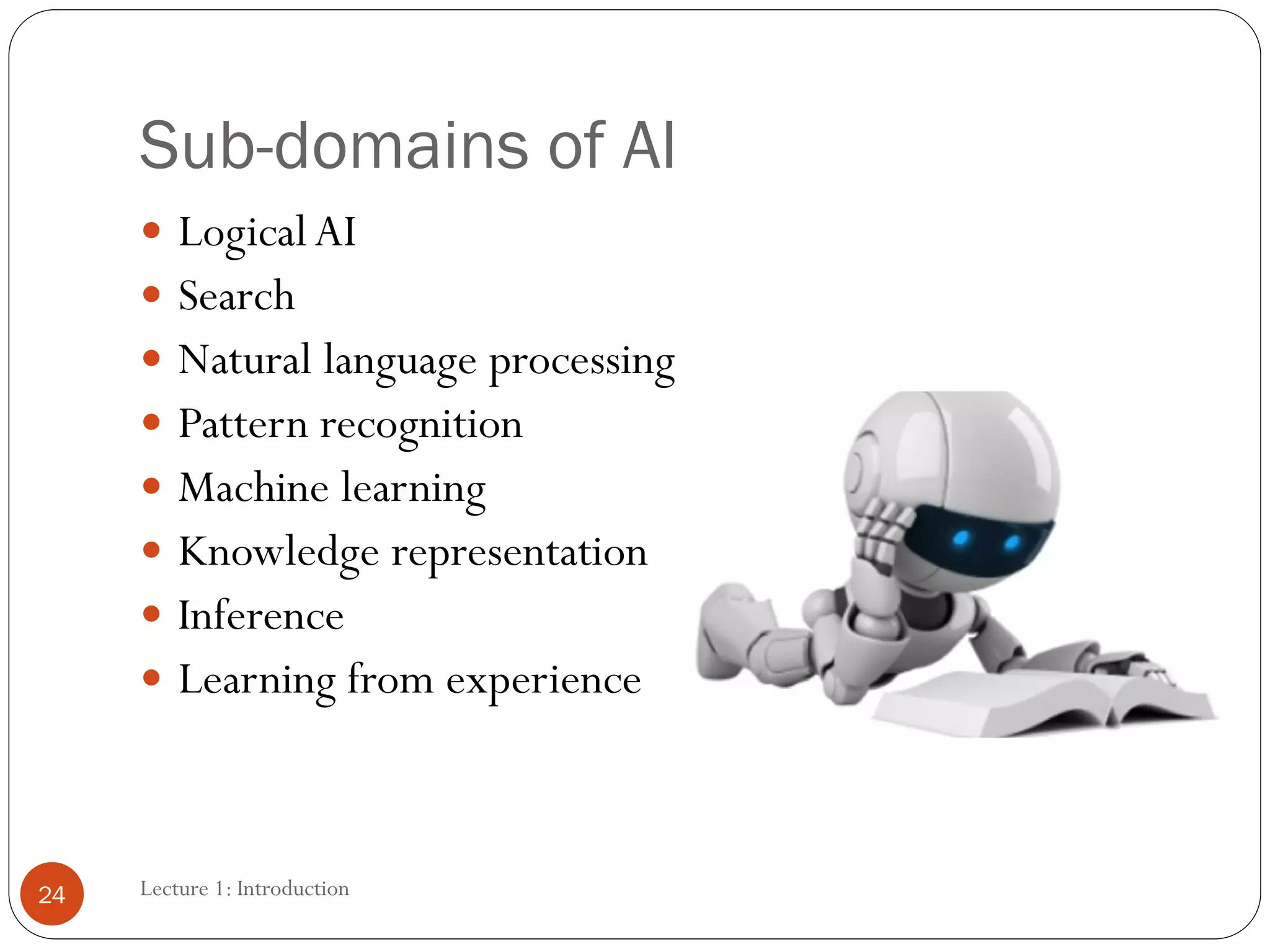
Sub-domains of AI
 LogicalAI
 Search
 Natural language processing
 Pattern recognition
 Machine learning
 Knowledge representation
 Inference
 Learning from experience
24 Lecture 1: Introduction
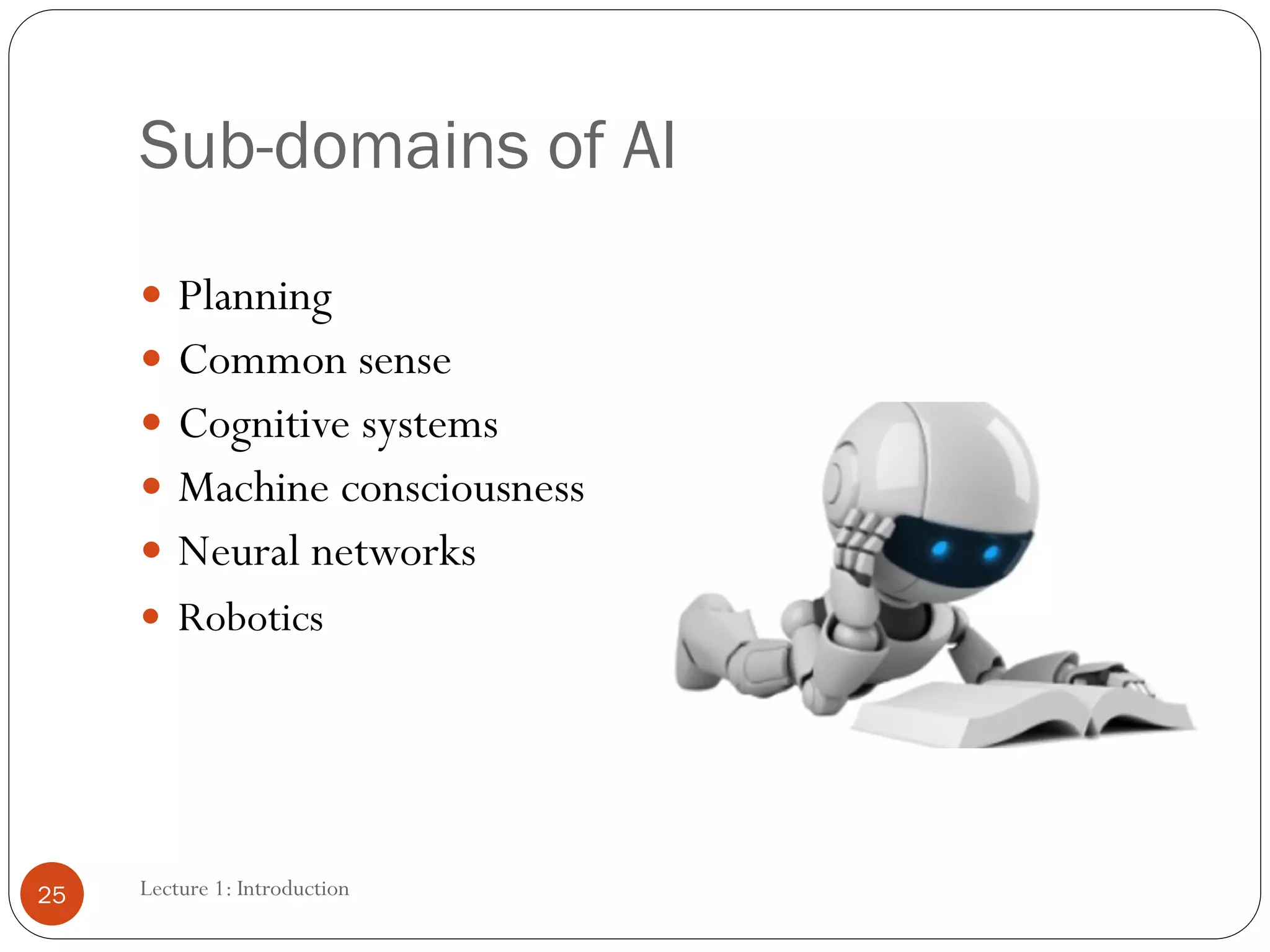
Sub-domains of AI
 Planning
 Common sense
 Cognitive systems
 Machine consciousness
 Neural networks
 Robotics
25 Lecture 1: Introduction
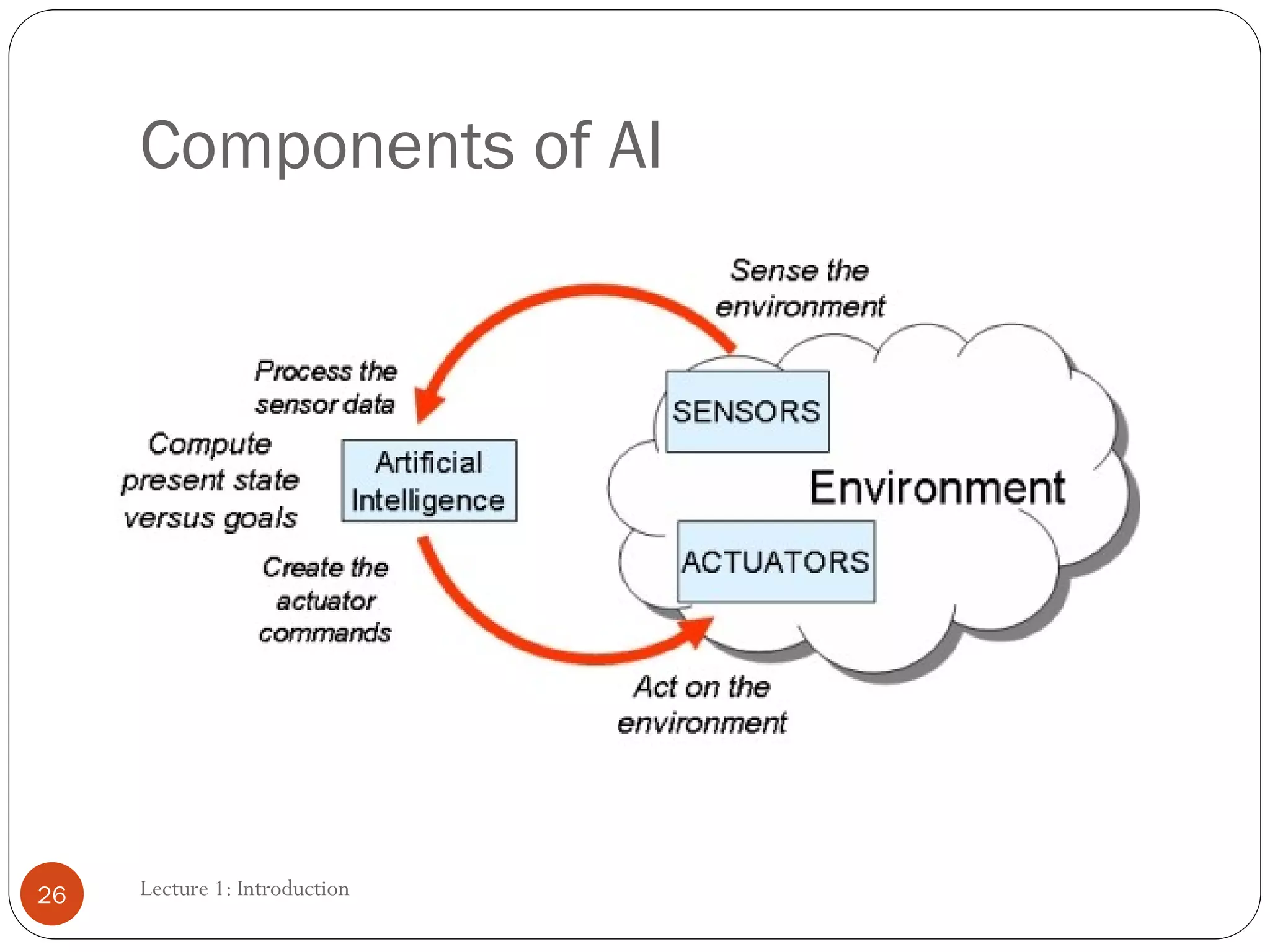
Components of AI
26 Lecture 1: Introduction
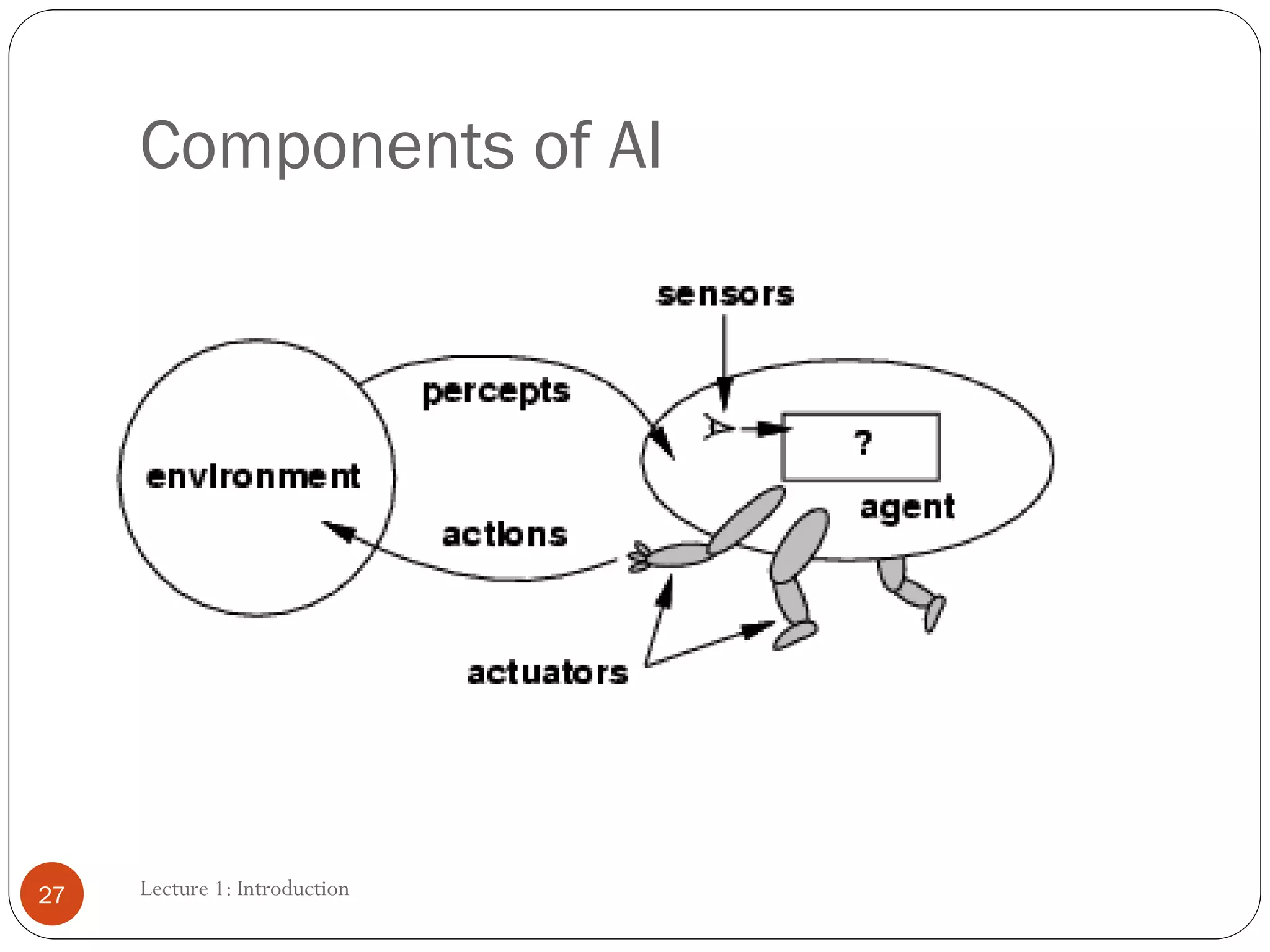
Components of AI
Lecture 1: Introduction
27
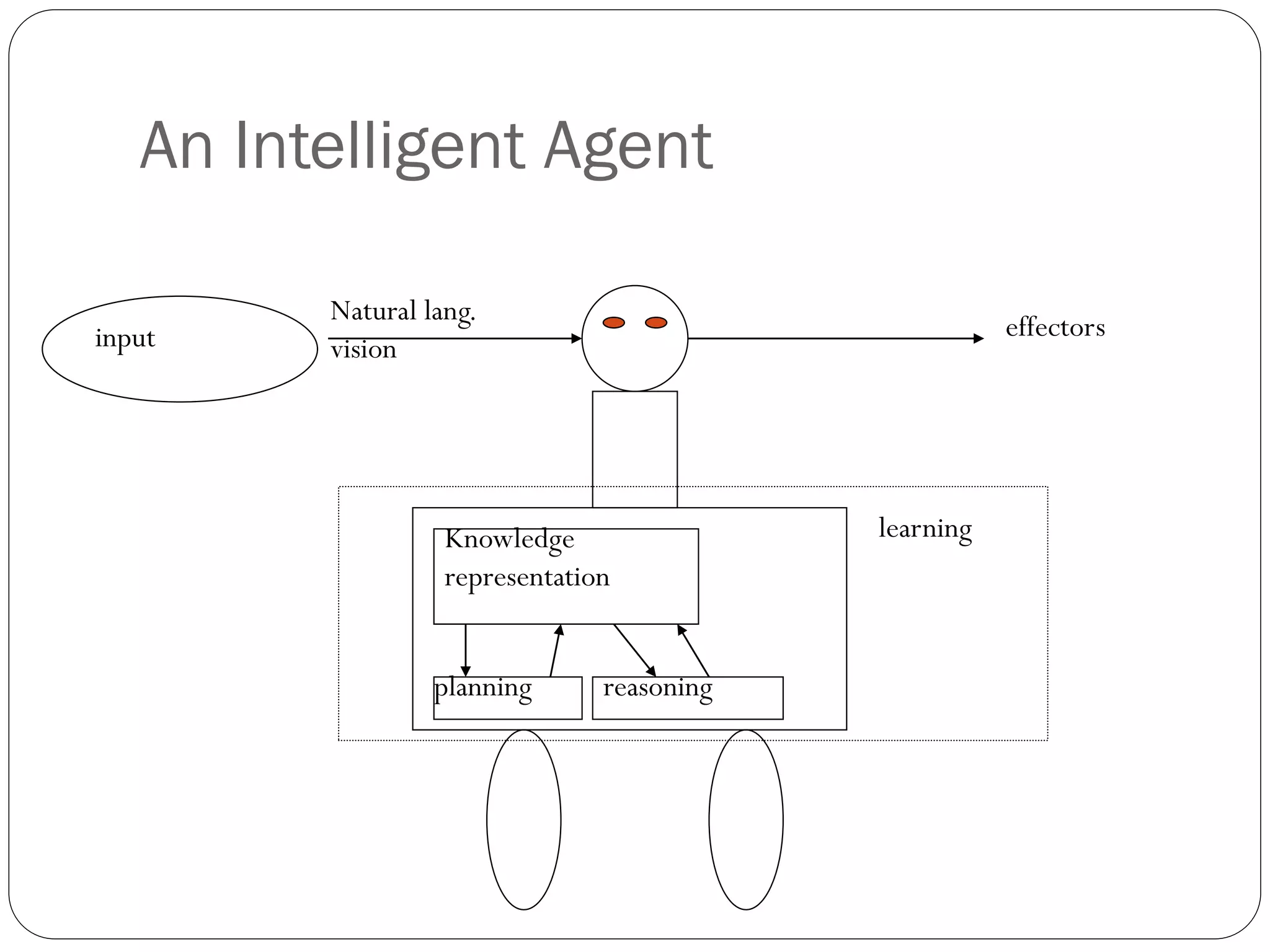
Agent
 An agent is anything that can perceive its environment
through sensors and acts upon that environment through effectors
and actuators
 Agent includes human, robot, softbot, thermostat, etc.
 A human agent has sensory organs such as eyes, ears, nose, tongue
and skin parallel to the sensors, and organs as actuators such as
hands, legs, mouth, for effectors
 A robotic agent replaces cameras and infrared range finders for the
sensors, and various motors and actuators for effectors
 A software agent has encoded bit strings as its programs and
actions
28 Lecture 1: Introduction
An Intelligent Agent
Knowledge
representation
reasoning
planning
learning
input
Natural lang.
vision
effectors
Lecture 1: Introduction
Acting Humanly: The Full Turing
Test
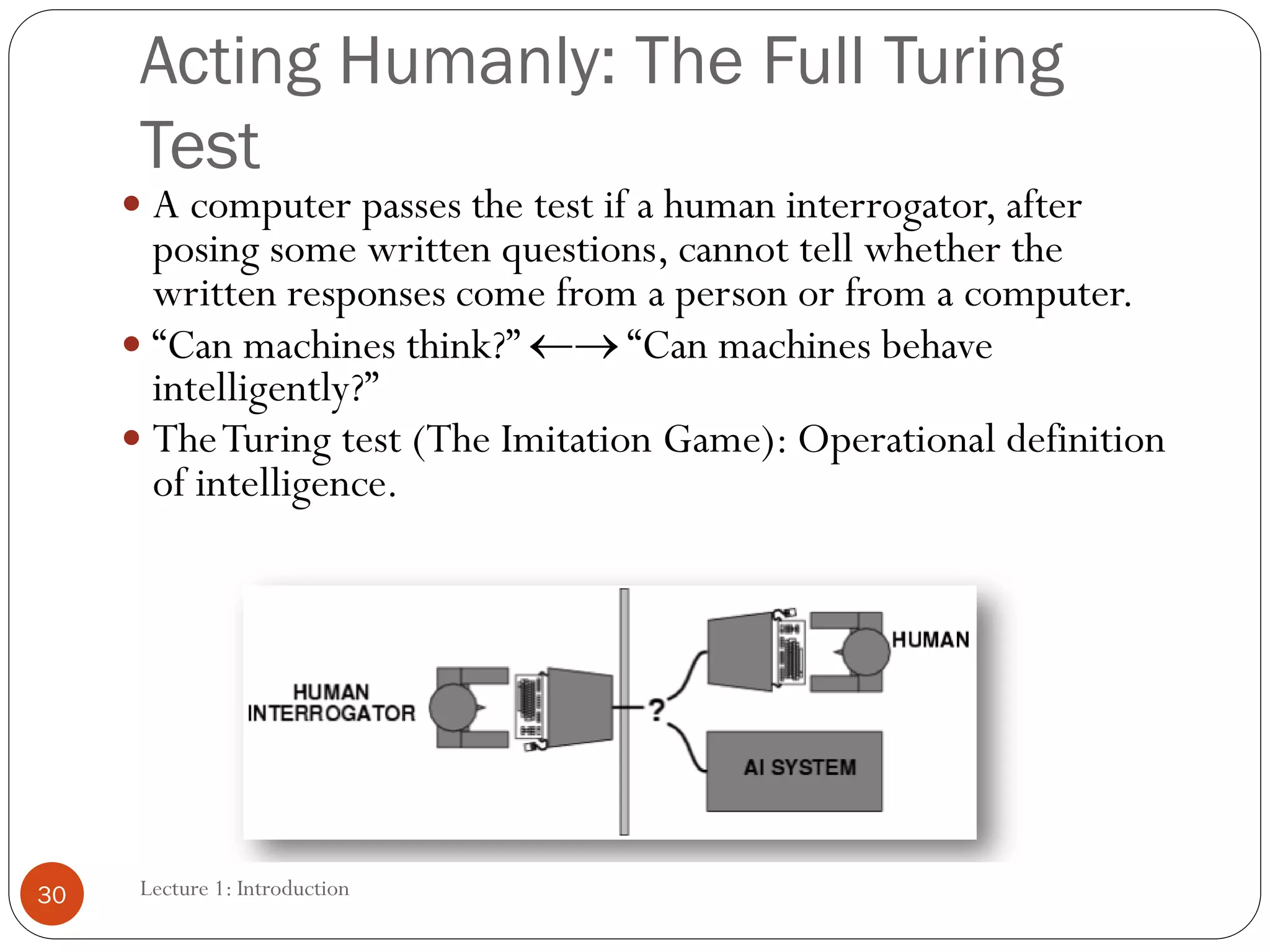
 A computer passes the test if a human interrogator, after
posing some written questions, cannot tell whether the
written responses come from a person or from a computer.
 “Can machines think?” → “Can machines behave
intelligently?”
 TheTuring test (The Imitation Game): Operational definition
of intelligence.
30
Lecture 1: Introduction
Acting Humanly: The Full Turing Test
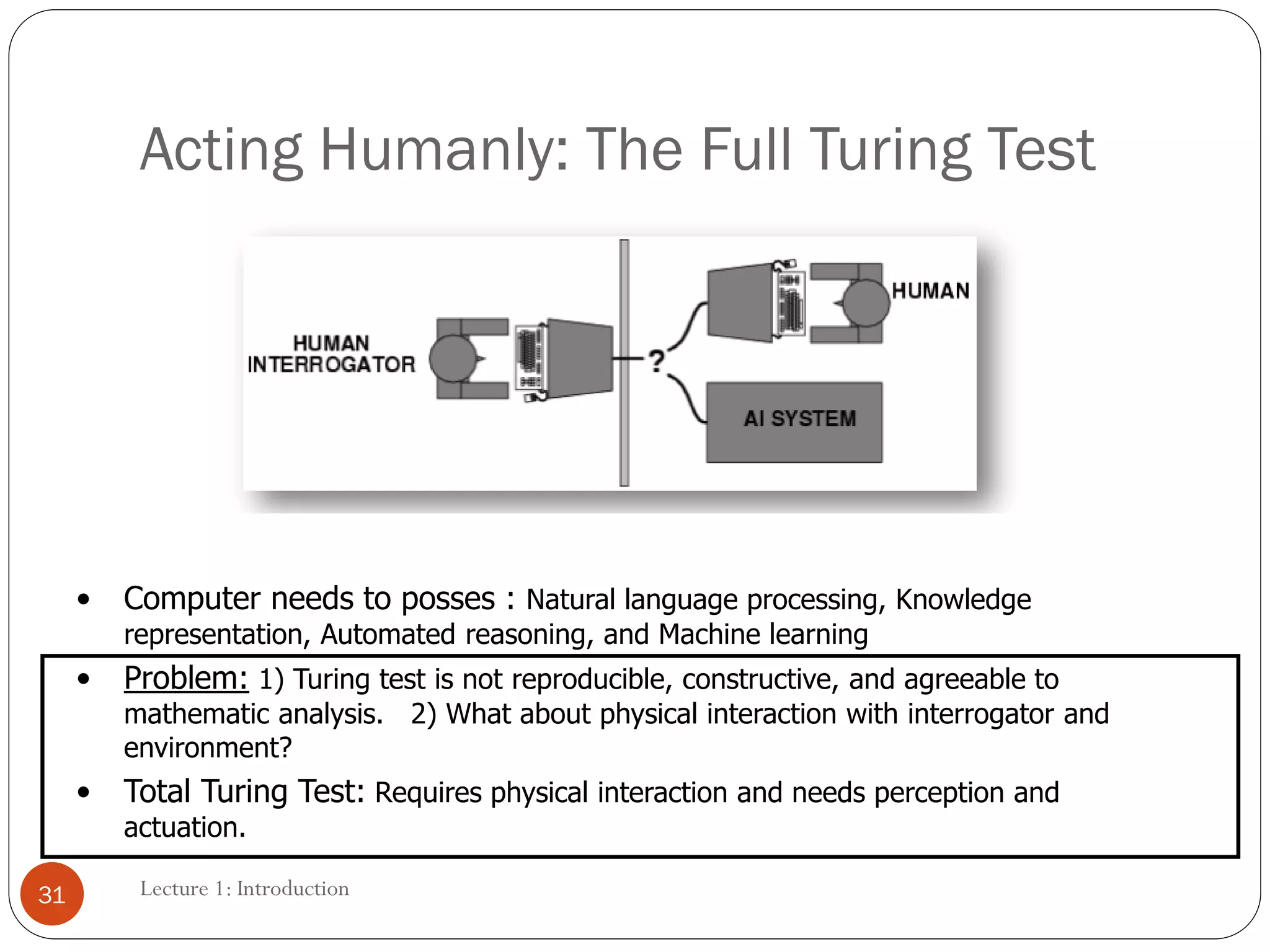
• Computer needs to posses : Natural language processing, Knowledge
representation, Automated reasoning, and Machine learning
• Problem: 1) Turing test is not reproducible, constructive, and agreeable to
mathematic analysis. 2) What about physical interaction with interrogator and
environment?
• Total Turing Test: Requires physical interaction and needs perception and
actuation.
31
Lets Think…….!
Lecture 1: Introduction
32
 Concepts
 Facts
 Reasoning
 learning
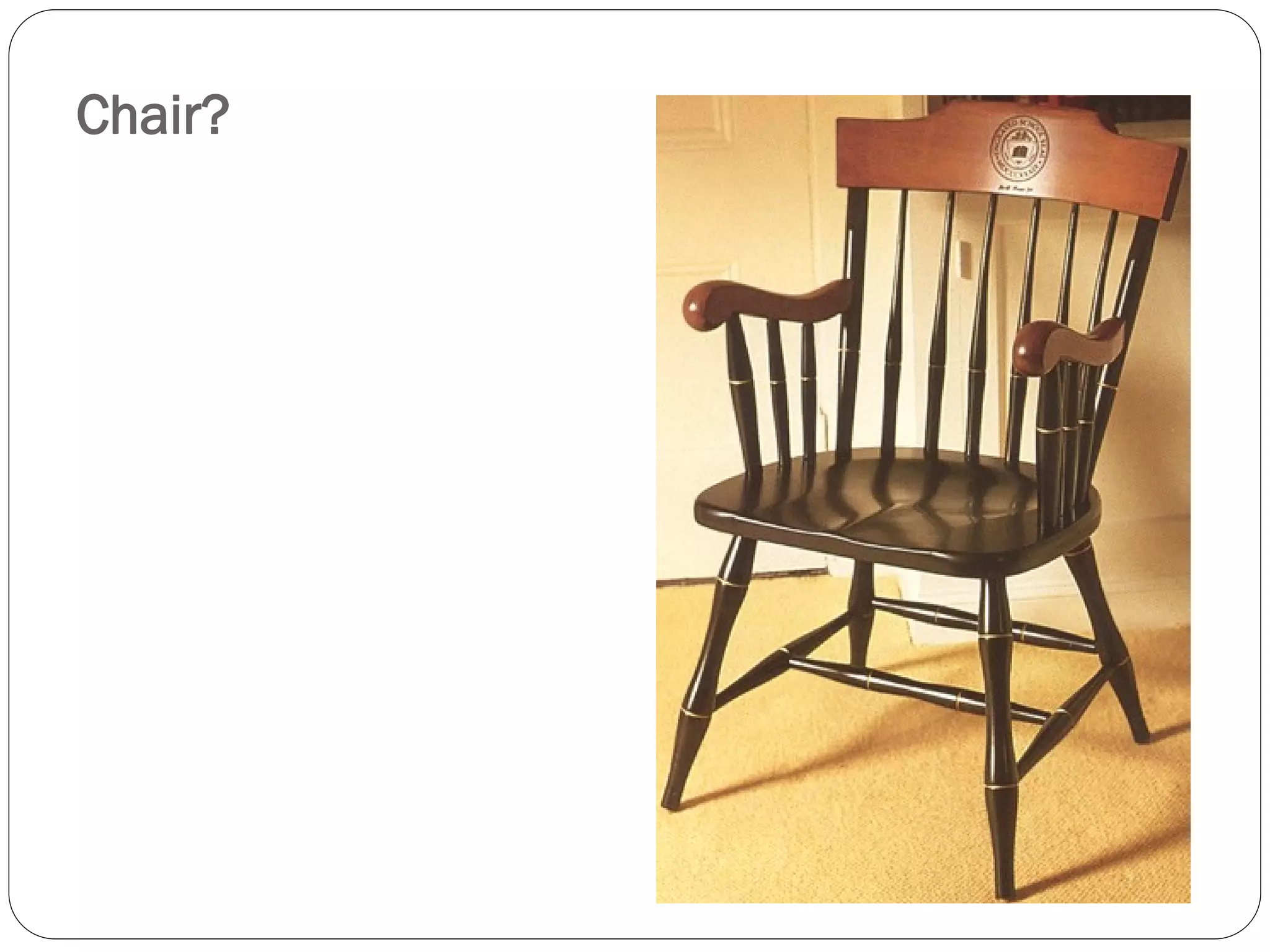
Chair?
Chair?
Chair?
Chair?
Chair?
Chair?
Questions…..?
Lecture 1: Introduction
39
 How system can identify these images?
 How classification of these images occurred?
 How intelligent system can learn and reason?
 What knowledge base we need for learning and reasoning?
Cool things AI is doing now
 Speech recognition
 Face recognition
 Automated reasoning
 Machine learning
 Expert systems
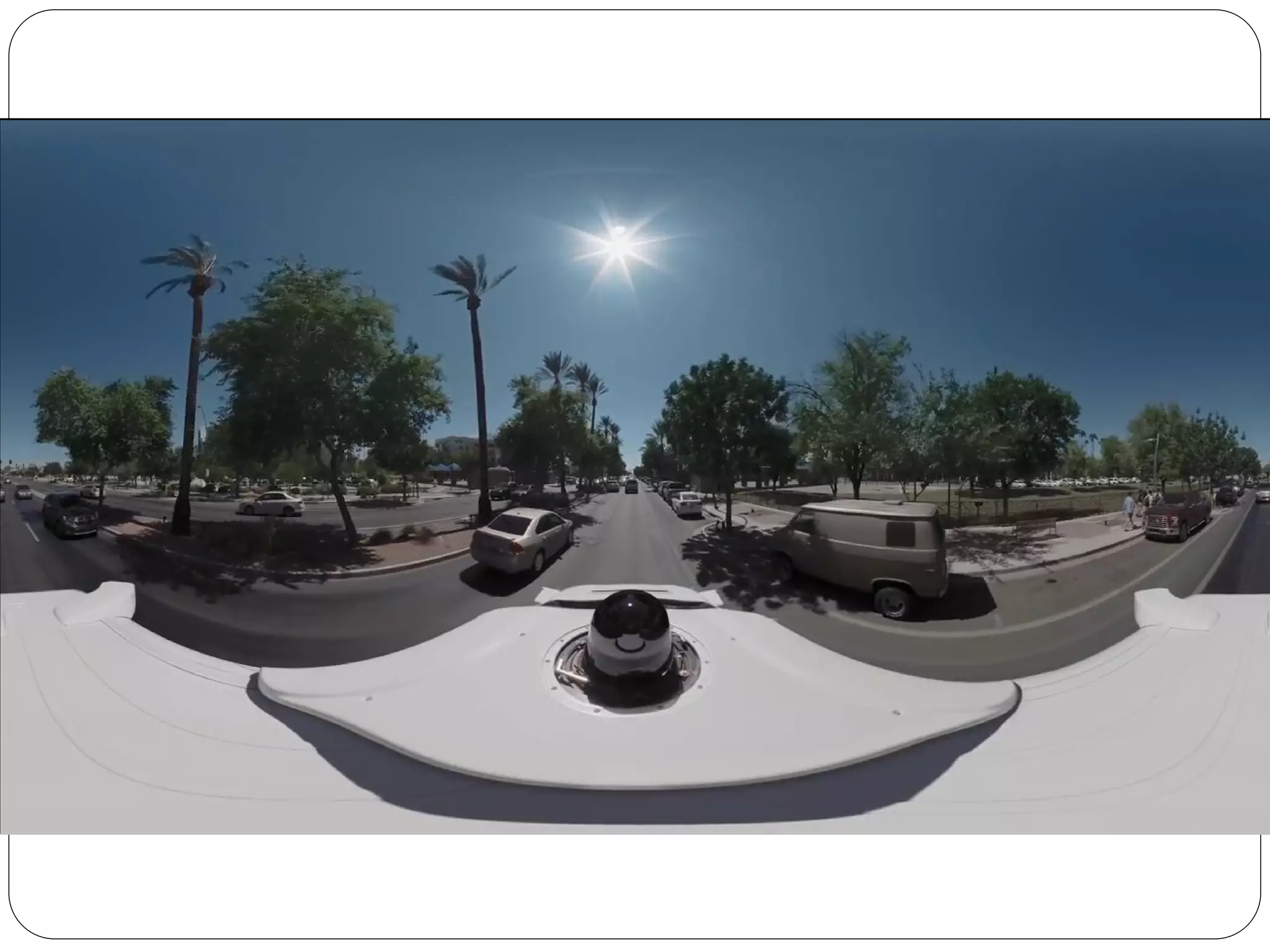
 Intelligent cars
 Voice recognition
 Health monitoring
 Companion robots
 Many more
40 Lecture 1: Introduction
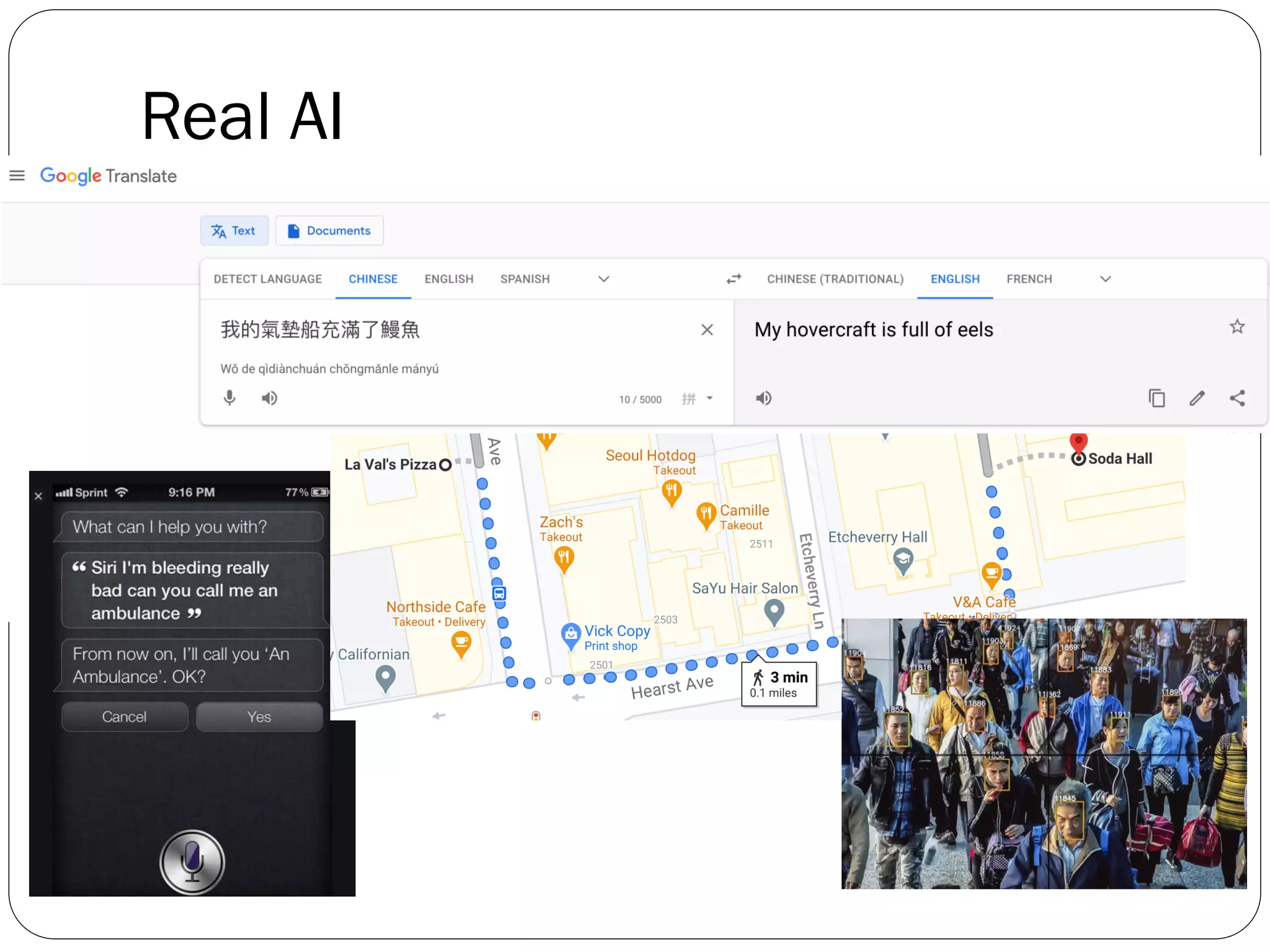
Real AI
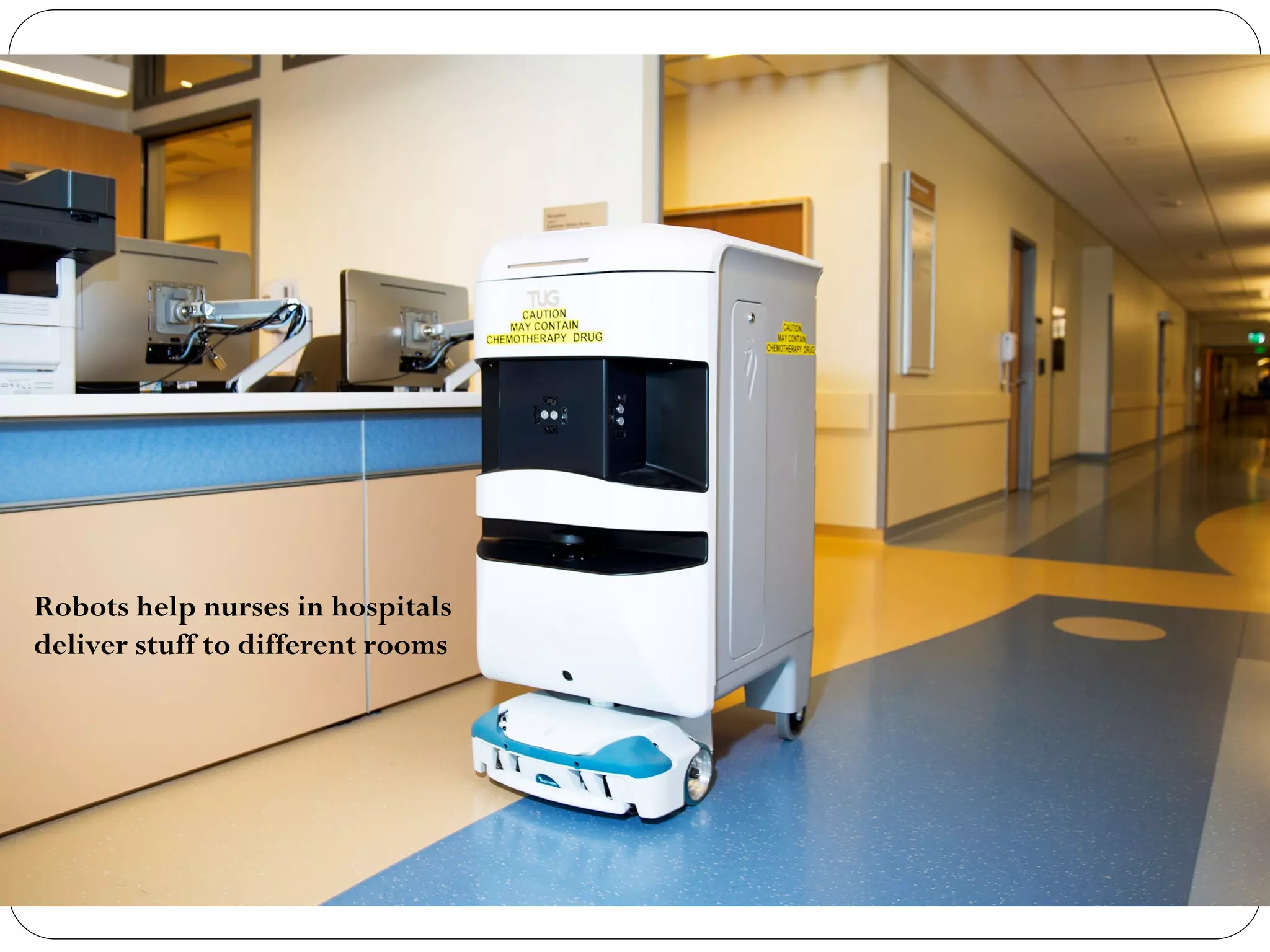
Robots help nurses in hospitals
deliver stuff to different rooms
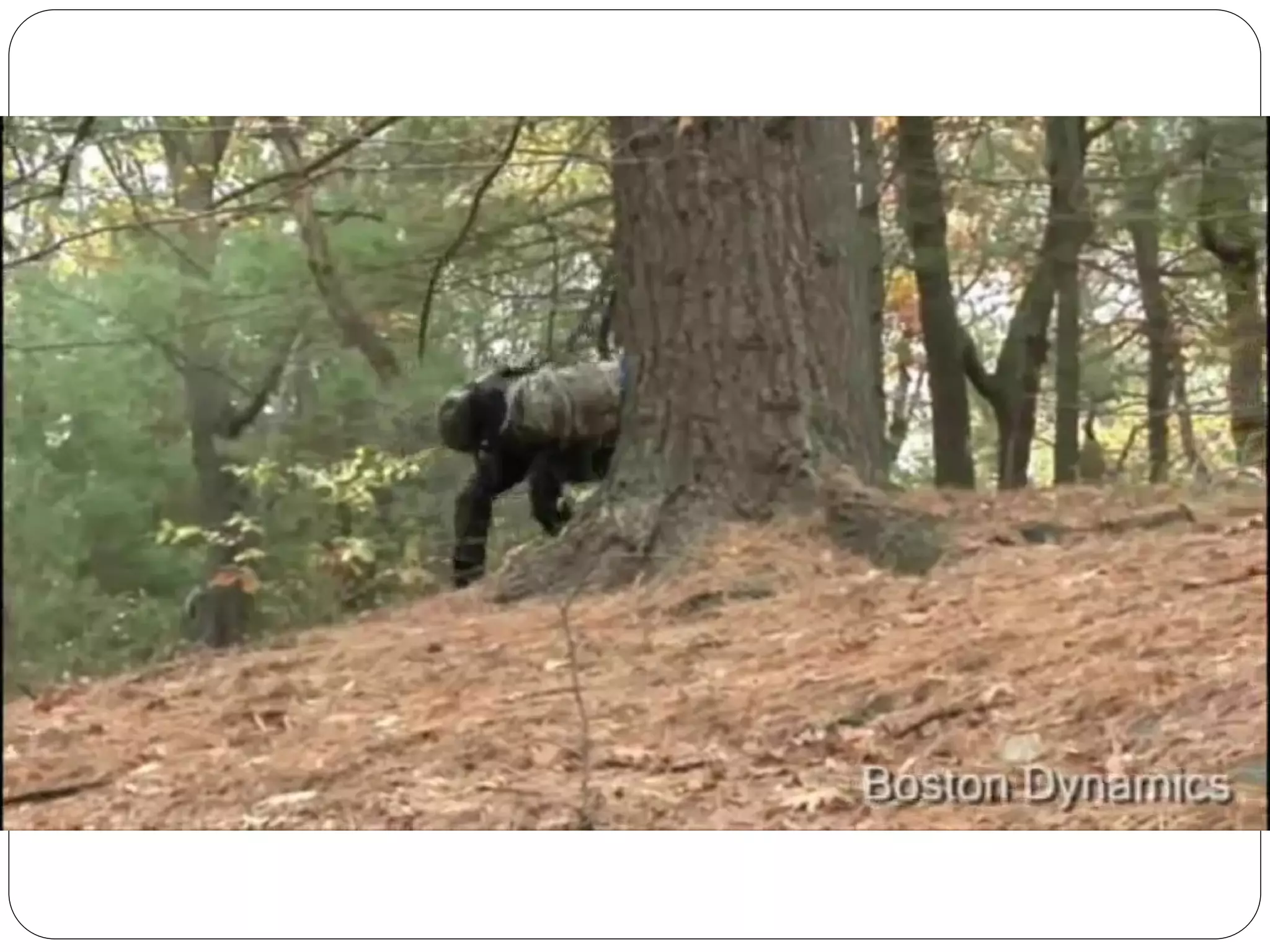
Task 1
Lecture 1: Introduction
45
 Sensors?
 Actuators?
 Schemas?
 Functionalities
 How can improve?
Q&A
Lecture 1: Introduction
46

L1-Introduction to Artificial Intelligence.pdf

  • 1.
    Lecture 1: Introduction 1 Introductionto Artificial Intelligence
  • 2.
    Course Contents  IntroductiontoAI  Components ofAI systems  Searching  Learning  Reasoning  Logic I and Logic II  Knowledge representation  Machine learning  Natural Language processing  Intelligent system design  AI robotics 2 Lecture 1: Introduction
  • 3.
    Course Assessment  Quiz10%  Project 20%  Lab 20%  Assignment 10%  Midterm 20%  Final term 20% 3 Lecture 1: Introduction
  • 4.
  • 5.
    What is Intelligence? Intelligence is an umbrella term used to describe a property of the mind that includes many related abilities, such as the capacities to  Reason  Plan  Solve problems  Think abstractly  Comprehend ideas  Use language  Learn 5 Lecture 1: Introduction
  • 6.
    What is ArtificialIntelligence?
  • 7.
    What is ArtificialIntelligence?  Artificial Intelligence is a way of making a machine (Computer, robot software) to think and behave intelligently like a intelligent human  AI study and design a computing systems that can perceives its environment and takes actions like human beings  AI term was introduced by John McCarthy in 1956  AI is defined as a system that possesses at least one of the abilities mentioned in the previous slide  AI studies theories and technologies for obtaining systems that are partially or fully intelligent 7 Lecture 1: Introduction
  • 8.
    What is ArtificialIntelligence?  Four definations ofAI  Think humanly – cognition – cognitive science – cognitive neuro science data driven  Act humanly  Think Rationally  Act Rationally 8 Lecture 1: Introduction
  • 9.
    Lecture 1: Introduction Whystudy AI? Search engines Labor Science Medicine/ Diagnosis Appliances What else? 9
  • 10.
    Lecture 1: Introduction HondaHumanoid Robot Walk Turn Stairs 10
  • 11.
  • 12.
    Family Robot Lecture 1:Introduction 12 Pepper, emotional robot
  • 13.
    Lecture 1: Introduction NaturalLanguage Question Answering 13
  • 14.
    Lecture 1: Introduction RobotTeams Rise Lab Foot ball team 14
  • 15.
    A Brief Historyof AI  1943: McCulloch and Pitts propose a model of artificial neurons  1956 Minsky and Edmonds build first neural network computer, the SNARC 15 Lecture 1: Introduction
  • 16.
    The Dartmouth Conference(1956)  John McCarthy organizes a two-month workshop for researchers interested in neural networks and the study of intelligence  Agreement to adopt a new name for this field of study: Artificial Intelligence 16 Lecture 1: Introduction
  • 17.
    “An attempt willbe made to find how to make machines use language, form abstractions and concepts, solve kinds of problems now reserved for humans, and improve themselves. We think that a significant advance can be made if we work on it together for a summer. ” John McCarthy and Claude Shannon DartmouthWorkshop Proposal AI’s official birth: Dartmouth, 1956
  • 18.
    1952-1969 Enthusiasm  Checkersplayer  Lots of work on neural networks 18 Lecture 1: Introduction
  • 19.
    1966-1974 Reality  AIproblems appear to be too big and complex  Computers are very slow, very expensive, and have very little memory (compared to today) 19 Lecture 1: Introduction
  • 20.
    1969-1979 Knowledge-based systems Birth of expert systems  Idea is to give AI systems lots of information to start with 20 Lecture 1: Introduction
  • 21.
    1980-1988 AI inindustry:  First successful commercial expert system  Some interesting phone company systems for diagnosing failures of telephone service 21 Lecture 1: Introduction
  • 22.
    1990s to thepresent:  Increases in computational power (computers are cheaper, faster, and have tons more memory than they used to)  An example of the coolness of speed: Computer Chess 22 Lecture 1: Introduction
  • 23.
    Lecture 1: Introduction AIState of the art  Have the following been achieved byAI?  World-class chess playing  Playing table tennis  Cross-country driving  Solving mathematical problems  Discover and prove mathematical theories  Engage in a meaningful conversation  Understand spoken language  Observe and understand human emotions  Express emotions 23
  • 24.
    Sub-domains of AI LogicalAI  Search  Natural language processing  Pattern recognition  Machine learning  Knowledge representation  Inference  Learning from experience 24 Lecture 1: Introduction
  • 25.
    Sub-domains of AI Planning  Common sense  Cognitive systems  Machine consciousness  Neural networks  Robotics 25 Lecture 1: Introduction
  • 26.
    Components of AI 26Lecture 1: Introduction
  • 27.
    Components of AI Lecture1: Introduction 27
  • 28.
    Agent  An agentis anything that can perceive its environment through sensors and acts upon that environment through effectors and actuators  Agent includes human, robot, softbot, thermostat, etc.  A human agent has sensory organs such as eyes, ears, nose, tongue and skin parallel to the sensors, and organs as actuators such as hands, legs, mouth, for effectors  A robotic agent replaces cameras and infrared range finders for the sensors, and various motors and actuators for effectors  A software agent has encoded bit strings as its programs and actions 28 Lecture 1: Introduction
  • 29.
  • 30.
    Lecture 1: Introduction ActingHumanly: The Full Turing Test  A computer passes the test if a human interrogator, after posing some written questions, cannot tell whether the written responses come from a person or from a computer.  “Can machines think?” → “Can machines behave intelligently?”  TheTuring test (The Imitation Game): Operational definition of intelligence. 30
  • 31.
    Lecture 1: Introduction ActingHumanly: The Full Turing Test • Computer needs to posses : Natural language processing, Knowledge representation, Automated reasoning, and Machine learning • Problem: 1) Turing test is not reproducible, constructive, and agreeable to mathematic analysis. 2) What about physical interaction with interrogator and environment? • Total Turing Test: Requires physical interaction and needs perception and actuation. 31
  • 32.
    Lets Think…….! Lecture 1:Introduction 32  Concepts  Facts  Reasoning  learning
  • 33.
  • 34.
  • 35.
  • 36.
  • 37.
  • 38.
  • 39.
    Questions…..? Lecture 1: Introduction 39 How system can identify these images?  How classification of these images occurred?  How intelligent system can learn and reason?  What knowledge base we need for learning and reasoning?
  • 40.
    Cool things AIis doing now  Speech recognition  Face recognition  Automated reasoning  Machine learning  Expert systems  Intelligent cars  Voice recognition  Health monitoring  Companion robots  Many more 40 Lecture 1: Introduction
  • 41.
  • 42.
    Robots help nursesin hospitals deliver stuff to different rooms
  • 45.
    Task 1 Lecture 1:Introduction 45  Sensors?  Actuators?  Schemas?  Functionalities  How can improve?
  • 46.