Software Engineering
CS20006
Lecture 2
Requirement Specification
Lecture #2
• System Requirement Specification (SRS)
• SRS Document Template
Software Engineering (CS20006)
Spring 2020 @DSamanta
2
System Requirement Specification
• Objectives:
– Understanding the precise requirement of the
customers
• Avoids bitter developer-customer disputes
• Legal battle, timely payment
– Requirements documentation
• Several contractors can bid for the contract, offering,
perhaps, different ways of meeting the customer’s need
• To avoid number of iterative changes during the
development life cycle
Software Engineering (CS20006)
Spring 2020 @DSamanta
3
Requirement Engineering
• Requirements for a system are the description
of the services provided by the system and its
operational constraints
• The process of finding out, analyzing,
documenting and checking these services and
constraints is called Requirements Engineering
Software Engineering (CS20006)
Spring 2020 @DSamanta
4
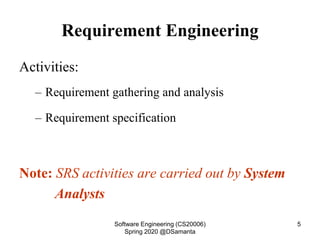
Requirement Engineering
Activities:
– Requirement gathering and analysis
– Requirement specification
Note: SRS activities are carried out by System
Analysts
Software Engineering (CS20006)
Spring 2020 @DSamanta
5
Requirement Gathering and Analysis
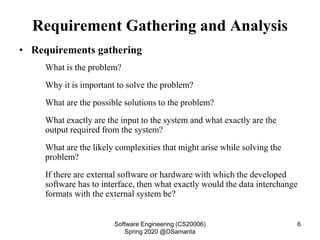
• Requirements gathering
What is the problem?
Why it is important to solve the problem?
What are the possible solutions to the problem?
What exactly are the input to the system and what exactly are the
output required from the system?
What are the likely complexities that might arise while solving the
problem?
If there are external software or hardware with which the developed
software has to interface, then what exactly would the data interchange
formats with the external system be?
Software Engineering (CS20006)
Spring 2020 @DSamanta
6
Requirement Gathering and Analysis
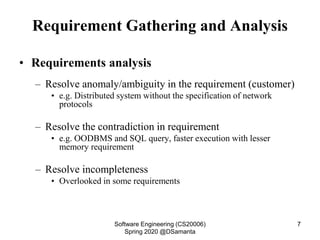
• Requirements analysis
– Resolve anomaly/ambiguity in the requirement (customer)
• e.g. Distributed system without the specification of network
protocols
– Resolve the contradiction in requirement
• e.g. OODBMS and SQL query, faster execution with lesser
memory requirement
– Resolve incompleteness
• Overlooked in some requirements
Software Engineering (CS20006)
Spring 2020 @DSamanta
7
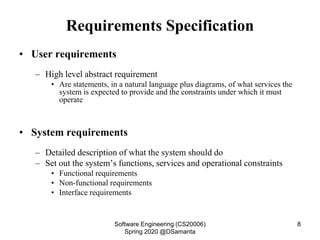
Requirements Specification
• User requirements
– High level abstract requirement
• Are statements, in a natural language plus diagrams, of what services the
system is expected to provide and the constraints under which it must
operate
• System requirements
– Detailed description of what the system should do
– Set out the system’s functions, services and operational constraints
• Functional requirements
• Non-functional requirements
• Interface requirements
Software Engineering (CS20006)
Spring 2020 @DSamanta
8
Functional Requirements
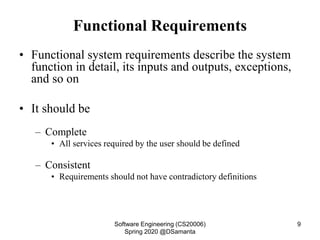
• Functional system requirements describe the system
function in detail, its inputs and outputs, exceptions,
and so on
• It should be
– Complete
• All services required by the user should be defined
– Consistent
• Requirements should not have contradictory definitions
Software Engineering (CS20006)
Spring 2020 @DSamanta
9
An Example: ATM
• Case Study: Automated Teller Machine
Software Engineering (CS20006)
Spring 2020 @DSamanta
10
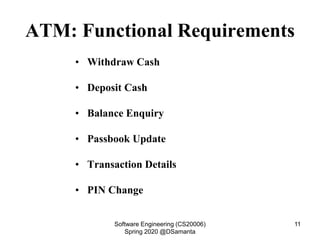
ATM: Functional Requirements
• Withdraw Cash
• Deposit Cash
• Balance Enquiry
• Passbook Update
• Transaction Details
• PIN Change
Software Engineering (CS20006)
Spring 2020 @DSamanta
11
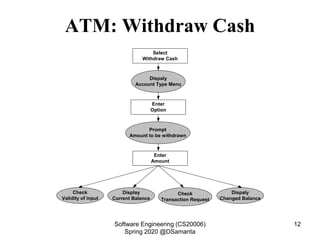
ATM: Withdraw Cash
Select
Withdraw Cash
Dispaly
Account Type Menu
Enter
Option
Prompt
Amount to be withdrawn
Enter
Amount
Check
Validity of input
Display
Current Balance
Check
Transaction Request
Dispaly
Changed Balance
Software Engineering (CS20006)
Spring 2020 @DSamanta
12
ATM: Withdraw Cash
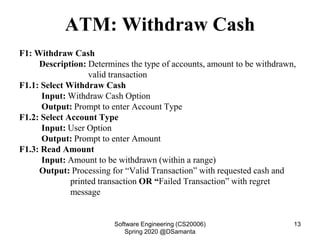
F1: Withdraw Cash
Description: Determines the type of accounts, amount to be withdrawn,
valid transaction
F1.1: Select Withdraw Cash
Input: Withdraw Cash Option
Output: Prompt to enter Account Type
F1.2: Select Account Type
Input: User Option
Output: Prompt to enter Amount
F1.3: Read Amount
Input: Amount to be withdrawn (within a range)
Output: Processing for “Valid Transaction” with requested cash and
printed transaction OR “Failed Transaction” with regret
message
Software Engineering (CS20006)
Spring 2020 @DSamanta
13
Non-Functional Requirements
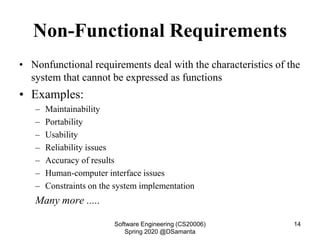
• Nonfunctional requirements deal with the characteristics of the
system that cannot be expressed as functions
• Examples:
– Maintainability
– Portability
– Usability
– Reliability issues
– Accuracy of results
– Human-computer interface issues
– Constraints on the system implementation
Many more .....
Software Engineering (CS20006)
Spring 2020 @DSamanta
14
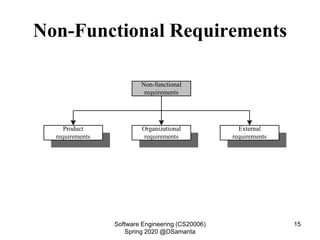
Non-Functional Requirements
Non-functional
requirements
Product
requirements
Organizational
requirements
External
requirements
Software Engineering (CS20006)
Spring 2020 @DSamanta
15
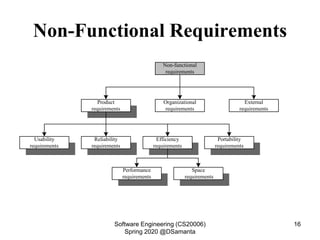
Non-Functional Requirements
Non-functional
requirements
Product
requirements
Organizational
requirements
External
requirements
Efficiency
requirements
Reliability
requirements
Portability
requirements
Usability
requirements
Performance
requirements
Space
requirements
Software Engineering (CS20006)
Spring 2020 @DSamanta
16
Non-Functional Requirements
Non-functional
requirements
Product
requirements
Organizational
requirements
External
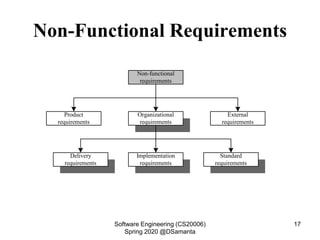
requirements
Implementation
requirements
Delivery
requirements
Standard
requirements
Software Engineering (CS20006)
Spring 2020 @DSamanta
17
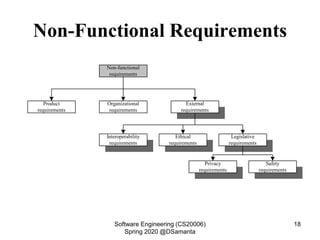
Non-Functional Requirements
Non-functional
requirements
Product
requirements
Organizational
requirements
External
requirements
Ethical
requirements
Interoperability
requirements
Legislative
requirements
Privacy
requirements
Safety
requirements
Software Engineering (CS20006)
Spring 2020 @DSamanta
18
Interface Requirements
• Different interface for different functionality in
the system
– Specified with user’s level of understanding
– GUI or Command based
– With HCI perspective
Software Engineering (CS20006)
Spring 2020 @DSamanta
19
SRS Document Template
Software Engineering (CS20006)
Spring 2020 @DSamanta
20
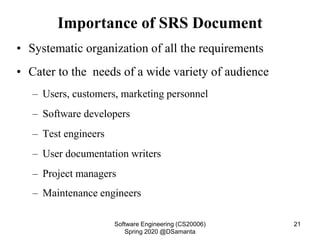
Importance of SRS Document
• Systematic organization of all the requirements
• Cater to the needs of a wide variety of audience
– Users, customers, marketing personnel
– Software developers
– Test engineers
– User documentation writers
– Project managers
– Maintenance engineers
Software Engineering (CS20006)
Spring 2020 @DSamanta
21
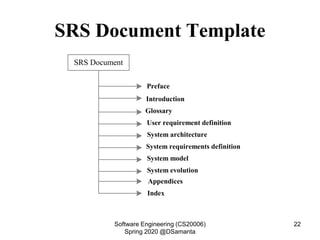
SRS Document Template
SRS Document
Preface
System evolution
System model
System architecture
User requirement definition
Glossary
Introduction
System requirements definition
Appendices
Index
Software Engineering (CS20006)
Spring 2020 @DSamanta
22
SRS Document Template
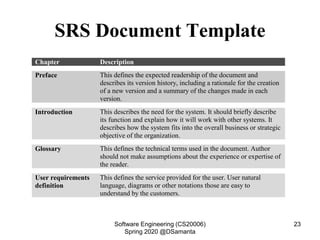
Chapter Description
Preface This defines the expected readership of the document and
describes its version history, including a rationale for the creation
of a new version and a summary of the changes made in each
version.
Introduction This describes the need for the system. It should briefly describe
its function and explain how it will work with other systems. It
describes how the system fits into the overall business or strategic
objective of the organization.
Glossary This defines the technical terms used in the document. Author
should not make assumptions about the experience or expertise of
the reader.
User requirements
definition
This defines the service provided for the user. User natural
language, diagrams or other notations those are easy to
understand by the customers.
Software Engineering (CS20006)
Spring 2020 @DSamanta
23
SRS Document Template (Cont’d)
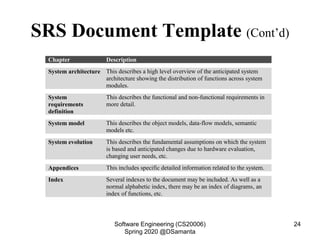
Chapter Description
System architecture This describes a high level overview of the anticipated system
architecture showing the distribution of functions across system
modules.
System
requirements
definition
This describes the functional and non-functional requirements in
more detail.
System model This describes the object models, data-flow models, semantic
models etc.
System evolution This describes the fundamental assumptions on which the system
is based and anticipated changes due to hardware evaluation,
changing user needs, etc.
Appendices This includes specific detailed information related to the system.
Index Several indexes to the document may be included. As well as a
normal alphabetic index, there may be an index of diagrams, an
index of functions, etc.
Software Engineering (CS20006)
Spring 2020 @DSamanta
24
IEEE Standard of SRS Document
For the IEEE Standard (1998) of SRS Document
preparation, see the link below:
http://www.facweb.iitkgp.ernet.in/~dsamanta
Software Engineering (CS20006)
Spring 2020 @DSamanta
25
Problems to Ponder
• Why SRS document is often touted as a “Black
Box” document?
• “SRS document should be a flexible
document” - Agree or disagree the comment
• SRS can be taken as a legal document for the
customer as well as the developer - Justify
Software Engineering (CS20006)
Spring 2020 @DSamanta
26
Problems to Ponder
• How Requirement Engineering is related to
process development models?
• How Requirement Engineering is related to
software quality?
• How RE takes place in Agile software
development environment?
Software Engineering (CS20006)
Spring 2020 @DSamanta
27

L02_RequirementEngineering.ppsx

  • 1.
  • 2.
    Lecture #2 • SystemRequirement Specification (SRS) • SRS Document Template Software Engineering (CS20006) Spring 2020 @DSamanta 2
  • 3.
    System Requirement Specification •Objectives: – Understanding the precise requirement of the customers • Avoids bitter developer-customer disputes • Legal battle, timely payment – Requirements documentation • Several contractors can bid for the contract, offering, perhaps, different ways of meeting the customer’s need • To avoid number of iterative changes during the development life cycle Software Engineering (CS20006) Spring 2020 @DSamanta 3
  • 4.
    Requirement Engineering • Requirementsfor a system are the description of the services provided by the system and its operational constraints • The process of finding out, analyzing, documenting and checking these services and constraints is called Requirements Engineering Software Engineering (CS20006) Spring 2020 @DSamanta 4
  • 5.
    Requirement Engineering Activities: – Requirementgathering and analysis – Requirement specification Note: SRS activities are carried out by System Analysts Software Engineering (CS20006) Spring 2020 @DSamanta 5
  • 6.
    Requirement Gathering andAnalysis • Requirements gathering What is the problem? Why it is important to solve the problem? What are the possible solutions to the problem? What exactly are the input to the system and what exactly are the output required from the system? What are the likely complexities that might arise while solving the problem? If there are external software or hardware with which the developed software has to interface, then what exactly would the data interchange formats with the external system be? Software Engineering (CS20006) Spring 2020 @DSamanta 6
  • 7.
    Requirement Gathering andAnalysis • Requirements analysis – Resolve anomaly/ambiguity in the requirement (customer) • e.g. Distributed system without the specification of network protocols – Resolve the contradiction in requirement • e.g. OODBMS and SQL query, faster execution with lesser memory requirement – Resolve incompleteness • Overlooked in some requirements Software Engineering (CS20006) Spring 2020 @DSamanta 7
  • 8.
    Requirements Specification • Userrequirements – High level abstract requirement • Are statements, in a natural language plus diagrams, of what services the system is expected to provide and the constraints under which it must operate • System requirements – Detailed description of what the system should do – Set out the system’s functions, services and operational constraints • Functional requirements • Non-functional requirements • Interface requirements Software Engineering (CS20006) Spring 2020 @DSamanta 8
  • 9.
    Functional Requirements • Functionalsystem requirements describe the system function in detail, its inputs and outputs, exceptions, and so on • It should be – Complete • All services required by the user should be defined – Consistent • Requirements should not have contradictory definitions Software Engineering (CS20006) Spring 2020 @DSamanta 9
  • 10.
    An Example: ATM •Case Study: Automated Teller Machine Software Engineering (CS20006) Spring 2020 @DSamanta 10
  • 11.
    ATM: Functional Requirements •Withdraw Cash • Deposit Cash • Balance Enquiry • Passbook Update • Transaction Details • PIN Change Software Engineering (CS20006) Spring 2020 @DSamanta 11
  • 12.
    ATM: Withdraw Cash Select WithdrawCash Dispaly Account Type Menu Enter Option Prompt Amount to be withdrawn Enter Amount Check Validity of input Display Current Balance Check Transaction Request Dispaly Changed Balance Software Engineering (CS20006) Spring 2020 @DSamanta 12
  • 13.
    ATM: Withdraw Cash F1:Withdraw Cash Description: Determines the type of accounts, amount to be withdrawn, valid transaction F1.1: Select Withdraw Cash Input: Withdraw Cash Option Output: Prompt to enter Account Type F1.2: Select Account Type Input: User Option Output: Prompt to enter Amount F1.3: Read Amount Input: Amount to be withdrawn (within a range) Output: Processing for “Valid Transaction” with requested cash and printed transaction OR “Failed Transaction” with regret message Software Engineering (CS20006) Spring 2020 @DSamanta 13
  • 14.
    Non-Functional Requirements • Nonfunctionalrequirements deal with the characteristics of the system that cannot be expressed as functions • Examples: – Maintainability – Portability – Usability – Reliability issues – Accuracy of results – Human-computer interface issues – Constraints on the system implementation Many more ..... Software Engineering (CS20006) Spring 2020 @DSamanta 14
  • 15.
  • 16.
  • 17.
  • 18.
  • 19.
    Interface Requirements • Differentinterface for different functionality in the system – Specified with user’s level of understanding – GUI or Command based – With HCI perspective Software Engineering (CS20006) Spring 2020 @DSamanta 19
  • 20.
    SRS Document Template SoftwareEngineering (CS20006) Spring 2020 @DSamanta 20
  • 21.
    Importance of SRSDocument • Systematic organization of all the requirements • Cater to the needs of a wide variety of audience – Users, customers, marketing personnel – Software developers – Test engineers – User documentation writers – Project managers – Maintenance engineers Software Engineering (CS20006) Spring 2020 @DSamanta 21
  • 22.
    SRS Document Template SRSDocument Preface System evolution System model System architecture User requirement definition Glossary Introduction System requirements definition Appendices Index Software Engineering (CS20006) Spring 2020 @DSamanta 22
  • 23.
    SRS Document Template ChapterDescription Preface This defines the expected readership of the document and describes its version history, including a rationale for the creation of a new version and a summary of the changes made in each version. Introduction This describes the need for the system. It should briefly describe its function and explain how it will work with other systems. It describes how the system fits into the overall business or strategic objective of the organization. Glossary This defines the technical terms used in the document. Author should not make assumptions about the experience or expertise of the reader. User requirements definition This defines the service provided for the user. User natural language, diagrams or other notations those are easy to understand by the customers. Software Engineering (CS20006) Spring 2020 @DSamanta 23
  • 24.
    SRS Document Template(Cont’d) Chapter Description System architecture This describes a high level overview of the anticipated system architecture showing the distribution of functions across system modules. System requirements definition This describes the functional and non-functional requirements in more detail. System model This describes the object models, data-flow models, semantic models etc. System evolution This describes the fundamental assumptions on which the system is based and anticipated changes due to hardware evaluation, changing user needs, etc. Appendices This includes specific detailed information related to the system. Index Several indexes to the document may be included. As well as a normal alphabetic index, there may be an index of diagrams, an index of functions, etc. Software Engineering (CS20006) Spring 2020 @DSamanta 24
  • 25.
    IEEE Standard ofSRS Document For the IEEE Standard (1998) of SRS Document preparation, see the link below: http://www.facweb.iitkgp.ernet.in/~dsamanta Software Engineering (CS20006) Spring 2020 @DSamanta 25
  • 26.
    Problems to Ponder •Why SRS document is often touted as a “Black Box” document? • “SRS document should be a flexible document” - Agree or disagree the comment • SRS can be taken as a legal document for the customer as well as the developer - Justify Software Engineering (CS20006) Spring 2020 @DSamanta 26
  • 27.
    Problems to Ponder •How Requirement Engineering is related to process development models? • How Requirement Engineering is related to software quality? • How RE takes place in Agile software development environment? Software Engineering (CS20006) Spring 2020 @DSamanta 27

Editor's Notes