One health approach to trichinellosis risk in borderland highlanders of
                         northern Thailand
   Chalisa Kallayanamitra1 Chalermpol Samranpong4 Bruce A. Wilcox2 Parichat Saenna2 Veerasak Punyapornwithaya3 KhwanchaiKreausukon3 Pisit Leeahtam1 Manoj Potapohn1
1 Faculty of Economics, Chiang Mai University, 2Global Health Asia, Faculty of Public Health, Mahidol University, 3Faculty of Veterinary Medicine, Chiang Mai University,
4Center for Agricultural Resource System Research, Faculty of Agriculture, Chiang Mai University


                                                                 Project Background                                                                                                                                                                          Preliminary Results
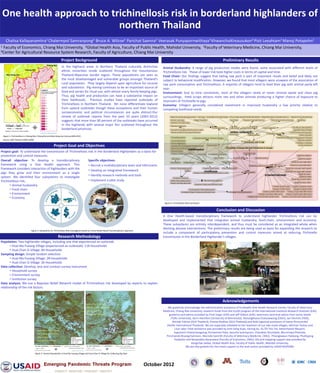
                                                                 In the highland areas in Northern Thailand culturally distinctive                        Animal Husbandry: A range of pig production modes were found, some associated with different levels of
                                                                 ethnic minorities reside scattered throughout the mountainous                            Trichinellosis risk. Those of lower risk bore higher costs in terms of capital and time.
                                                                 Thailand-Myanmar border region. These populations are seen as                            Food Chain: Our findings suggest that eating raw pork is part of important rituals and belief and likely not
                                                                 the most disadvantaged and vulnerable groups amongst Thailand’s                          subject to behavioral modification. However, we found that most villagers were unaware of the association of
                                                                 rural population. They largely depend upon agriculture for income                        raw pork consumption and Trichinellosis. A majority of villagers tend to feed their pig with animal parts left
                                                                 and subsistence. Pig rearing continues to be an important source of                      over.
                                                                 food and serves for ritual use, with almost every family keeping pigs.                   Environment: Due to time constraints, most of the villagers rarely or never remove waste and clean pig
                                                                 Thus, pig health and production can have a substantial impact on                         surroundings. Feed scraps attracts more rats and other animals producing a higher chance of exposure to
                                                                 their livelihoods. Previous studies have reported outbreaks of                           reservoirs of Trichinella to pigs.
                                                                 Trichinellosis in Northern Thailand. Yet none differentiate lowland                      Economy: Villagers generally considered investment in improved husbandry a low priority relative to
                                                                 from upland outbreaks though these ecosystems and their human                            competing livelihood needs.
                                                                 socioeconomic and political circumstances are quite distinct.Our
                                                                 review of outbreak reports from the past 10 years (2003-2012)                                   Reason for choosing pig housing system           Type of pig    Accessibility of rat in feed storage     Do you usually clean left over feed after feeding?   Responsible person for pig health check up         Reasons for not using deworming

                                                                 suggests that more than 90 percent of the outbreaks have occurred                                Ethnicity of pig raiser
                                                                                                                                                                 Awareness of housing system
                                                                                                                                                                                                            Religion of pig raiser                                        Type of feed          Frequency of pig health check up               What will you do with your sick pig           Deworming


                                                                 in the highlands with several major foci scattered throughout the                                Objectives of raising pig
                                                                                                                                                                                                                                                                                                                                                                                    How often you clean pig place?
                                                                 borderland provinces.                                                                            Time spent for pig raising:Total time spent on career
                                                                                                                                                                                                                                            Pig housing system            Feed handling       Animal health practices            Waste management
                                                                                                                                                                                                                                                                                                                                                                                      Recognition about rat danger
                                                                                                                                                                  Revenue received from pig raising:Total revenue                                                         ANIMAL HUSBANDRY                                                                                      Formal education level of pig raiser
                                                                                                                                                                                                                                                                         Source of pig                                                  Knowledge of pig raiser
                                                                                                                                                                                                                                                                                                         Rearing practices                                                                      Gender of pig raiser
 Figure 1: Trichinellosis in Chiang Mai, Chiang Rai and Mae Hong Son During 2003-2012
                                                                                                                                                                  Wet garbage handling                   Environment suitability for Trichinosis circulation                                                                                             Understanding relationship of pig housing and Trichinosis
 Source: BOE Thailand (2003-2009)                                                                                                                                 Solid garbage handling                                                                                                                                                                                                     Trichinosis recognition
                                                                                                                                                                                                                                                                                                 Trichinosis risk in pig                                                                   Experience in raising pig
                                                                                                                                                                  Place to slaughter pig

                                                         Project Goal and Objectives                                                                              Carcasses left over handling after slaughtering a pig
                                                                                                                                                                  Dead animal (cat,dog,rat,etc.) handling
                                                                                                                                                                                                                                     Source of meat
                                                                                                                                                                                                                                                                      Possibility of being infected Trichinosis in human
                                                                                                                                                                                                                                                                                                                                                                                               Source of information


                                                                                                                                                                                                  ENVIRONMENT
Project goal: To understand the transmission of Trichinellosis risk in the Borderland Highlanders as a basis for                                                  Dead pig handling
                                                                                                                                                                  Frequency of cleaning surrounding                                                                                              Food Safety Level
                                                                                                                                                                                                                  Income level            Investment in pig raising
prevention and control measures.                                                                                                                                                                                                                                                                                                                                                            Benefit from headman

                                                                                                                                                                    Rat control                                                                Source of fund                       Family welfare                   Convenient products                                                      Benefit from teacher
Overall objective: To develop a transdisciplinary              Specific objectives:                                                                               Rat abundance         Wildlife presence        Environment cleanliness                     Risk of Eating Outside                                                                                                Benefit from pulic health officer

framework using a One Health approach. This                    • Recruit a multidisciplinary team and informants                                                                                                                                                                                          Benefit from private sector's and public sector services               Benefit from animal health officer

framework considers interaction of highlanders with the        • Develop an integrative framework
                                                                                                                                                                 Ethnicity of food preparing person                        Frequency eating outside         Place of eating outside                                                                                       Benefit from local public health volunteer
                                                                                                                                                                                            Religion
                                                                                                                                                                                                                             FOOD CHAIN                                                                                                                                  Benefit from local animal health volunteer
pigs they grow and their environment as a single                                                                                                                                                         Frequency of having meat (Carnivore/omnivore) in a year                                 Meat Preparation


system. We identified four subsystems to investigate           • Identify research methods and tools                                                                                                                                                                                                                                ECONOMY/WELFARE
                                                                                                                                                                                                                                                                                                                                                                                               Benefit from police
                                                                                                                                                                                                                                                                                                                                                                                                Benefit from Heifer
                                                                                                                                                                      Occasions for killing pig

Trichinellosis risk;                                           • Implement a pilot study                                                                          Gender of food preparing person                           Raw/undercooked preference
                                                                                                                                                                                                                                                                                                                                                                                   Benefit from sub-district officer

                                                                                                                                                                                                                                                                                                                                                                                        Benefit from district officer
                                                                                                                                                                  Reasons describing eating habit
       • Animal husbandry                                                                                                                                                                                   Awareness of eating raw/undercooked meat
                                                                                                                                                                                                                                                                                                                                                  Frequency of police service       Frequency of headman service

       • Food chain                                                                                                                                                                               Formal education of food preparing person                                                                                                       Frequency of Heifer service
                                                                                                                                                                                                                                                                                                                                 Frequency of district officer service
                                                                                                                                                                                                                                                                                                                                                                                      Frequency of teacher service
                                                                                                                                                                                                                                                                                                                                                                            Frequency of pulic health officer service
       • Environment
                                                                                                                                                                                    Knowledge of danger of having raw/undercooked meat                                   Knowledge of food preparing person
                                                                                                                                                                                                                                                                                                                          Frequency of sub-district officer service      Frequency of animal health officer service

       • Economy                                                                                                                                                                                                                                                                                        Frequency of local animal health volunteer service        Frequency of local pulic health volunteer service


                                                                                                                                                           Figure 4: Trichinellosis Risk Framework


                                                                                                                                                                                                                                                  Conclusion and Discussion
                                                                                                                                                          A One Health-based transdisciplinary framework to understand highlander Trichinellosis risk can be
                                                                                                                                                          developed and implemented that integrates animal husbandry, food-chain, environment and economy.
                                                                                                                                                          These subsystems are entirely interdependent, and thus must be considered as an integrated whole when
                                                                                                                                                          devising disease interventions. The preliminary results are being used as basis for expanding the research to
                               Figure 2: Subsystems for Trichinellosis Risk Investigation Based on a One Health-Based Transdisciplinary Approach
                                                                                                                                                          include a component of participatory prevention and control measures aimed at reducing Trichinella
                                                             Research Methodology                                                                         transmission in the Borderland Highlander’s villages.
Population: Two highlander villages, including one that experienced an outbreak.
       • Huai Ma Fueang Village (experienced an outbreak): 118 Households
       • Huai Chan Si Village: 84 Households
Sampling design: Simple random selection
       • Huai Ma Fueang Village: 28 Households
       • Huai Chan Si Village: 26 Households
Data collection: Develop, test and conduct survey instrument
       • Household survey
       • Environment survey
       • Institution survey
Data analysis: We use a Bayesian Belief Network model of Trichinellosis risk developed by experts to explain
relationship of the risk factors.


                                                                                                                                                                                                                                                             Acknowledgements
                                                                                                                                                             We gratefully acknowledge the administrative assistance of Ecohealth-One Health Research Center, Faculty of Veterinary
                                                                                                                                                          Medicine, Chiang Mai University; research funds from the EcoZD program of the International Livestock Research Institute (ILRI);
                                                                                                                                                              guidance and advice provided by Fred Unger (ILRI) and Jeff Gilbert (ILRI); veterinary technical advice from Jenny Steele
                                                                                                                                                               (Tufts University), Karin Hamilton (University of Minnesota), Warangkhana Chaisowwong (CMU), Jan Hinrichs (FAO),
                                                                                                                                                                 Wichak Tidchai (DLD Thailand), Pranee Rodtian (DLD Thailand);and field logistical assistance of Isaree Khreusirikul
                                                                                                                                                            (Heifer International Thailand). We are especially indebted to the headmen of our two study villages, Abhinan Taotao and
                                                                                                                                                                  Lisor Jalor. Field assistance was provided by Sinh Dang Xuan, Farong Xu, Vu Thi Thu Tra, Hataichanok Wasasiri,
                                                                                                                                                                  Suputsorn Chatsiriyingyong, Pornwimon Pata, Sarocha Sukrinprom, Chanakan Khumpilai, Bhurichaya Pholsote,
                                                                                                                                                            Pimchanok Muangchaimoon, Warinda Somrith (Faculty of Veterinary Medicine, CMU), Phiangkwaun Padeang, Phuttipong
                                                                                                                                                                  Pookjohn and Nonprabha Buranawut (Faculty of Economics, CMU); GIS and mapping support was provided by
                                                                                                                                                                                  Kongchak Jaidee, Global Health Asia, Faculty of Public Health, Mahidol University.
                                                                                                                                                                            We are also grateful for the travel support to the lead author provided by USAID RESPOND.

                                    Figure 3: Visited Households in Huai Ma Fueang Village and Huai Chan Si Village for Collecting Pig Data


                                                                                                                                                   October 2012

One health approach to trichinellosis risk in borderland highlanders of northern Thailand

  • 1.
    One health approachto trichinellosis risk in borderland highlanders of northern Thailand Chalisa Kallayanamitra1 Chalermpol Samranpong4 Bruce A. Wilcox2 Parichat Saenna2 Veerasak Punyapornwithaya3 KhwanchaiKreausukon3 Pisit Leeahtam1 Manoj Potapohn1 1 Faculty of Economics, Chiang Mai University, 2Global Health Asia, Faculty of Public Health, Mahidol University, 3Faculty of Veterinary Medicine, Chiang Mai University, 4Center for Agricultural Resource System Research, Faculty of Agriculture, Chiang Mai University Project Background Preliminary Results In the highland areas in Northern Thailand culturally distinctive Animal Husbandry: A range of pig production modes were found, some associated with different levels of ethnic minorities reside scattered throughout the mountainous Trichinellosis risk. Those of lower risk bore higher costs in terms of capital and time. Thailand-Myanmar border region. These populations are seen as Food Chain: Our findings suggest that eating raw pork is part of important rituals and belief and likely not the most disadvantaged and vulnerable groups amongst Thailand’s subject to behavioral modification. However, we found that most villagers were unaware of the association of rural population. They largely depend upon agriculture for income raw pork consumption and Trichinellosis. A majority of villagers tend to feed their pig with animal parts left and subsistence. Pig rearing continues to be an important source of over. food and serves for ritual use, with almost every family keeping pigs. Environment: Due to time constraints, most of the villagers rarely or never remove waste and clean pig Thus, pig health and production can have a substantial impact on surroundings. Feed scraps attracts more rats and other animals producing a higher chance of exposure to their livelihoods. Previous studies have reported outbreaks of reservoirs of Trichinella to pigs. Trichinellosis in Northern Thailand. Yet none differentiate lowland Economy: Villagers generally considered investment in improved husbandry a low priority relative to from upland outbreaks though these ecosystems and their human competing livelihood needs. socioeconomic and political circumstances are quite distinct.Our review of outbreak reports from the past 10 years (2003-2012) Reason for choosing pig housing system Type of pig Accessibility of rat in feed storage Do you usually clean left over feed after feeding? Responsible person for pig health check up Reasons for not using deworming suggests that more than 90 percent of the outbreaks have occurred Ethnicity of pig raiser Awareness of housing system Religion of pig raiser Type of feed Frequency of pig health check up What will you do with your sick pig Deworming in the highlands with several major foci scattered throughout the Objectives of raising pig How often you clean pig place? borderland provinces. Time spent for pig raising:Total time spent on career Pig housing system Feed handling Animal health practices Waste management Recognition about rat danger Revenue received from pig raising:Total revenue ANIMAL HUSBANDRY Formal education level of pig raiser Source of pig Knowledge of pig raiser Rearing practices Gender of pig raiser Figure 1: Trichinellosis in Chiang Mai, Chiang Rai and Mae Hong Son During 2003-2012 Wet garbage handling Environment suitability for Trichinosis circulation Understanding relationship of pig housing and Trichinosis Source: BOE Thailand (2003-2009) Solid garbage handling Trichinosis recognition Trichinosis risk in pig Experience in raising pig Place to slaughter pig Project Goal and Objectives Carcasses left over handling after slaughtering a pig Dead animal (cat,dog,rat,etc.) handling Source of meat Possibility of being infected Trichinosis in human Source of information ENVIRONMENT Project goal: To understand the transmission of Trichinellosis risk in the Borderland Highlanders as a basis for Dead pig handling Frequency of cleaning surrounding Food Safety Level Income level Investment in pig raising prevention and control measures. Benefit from headman Rat control Source of fund Family welfare Convenient products Benefit from teacher Overall objective: To develop a transdisciplinary Specific objectives: Rat abundance Wildlife presence Environment cleanliness Risk of Eating Outside Benefit from pulic health officer framework using a One Health approach. This • Recruit a multidisciplinary team and informants Benefit from private sector's and public sector services Benefit from animal health officer framework considers interaction of highlanders with the • Develop an integrative framework Ethnicity of food preparing person Frequency eating outside Place of eating outside Benefit from local public health volunteer Religion FOOD CHAIN Benefit from local animal health volunteer pigs they grow and their environment as a single Frequency of having meat (Carnivore/omnivore) in a year Meat Preparation system. We identified four subsystems to investigate • Identify research methods and tools ECONOMY/WELFARE Benefit from police Benefit from Heifer Occasions for killing pig Trichinellosis risk; • Implement a pilot study Gender of food preparing person Raw/undercooked preference Benefit from sub-district officer Benefit from district officer Reasons describing eating habit • Animal husbandry Awareness of eating raw/undercooked meat Frequency of police service Frequency of headman service • Food chain Formal education of food preparing person Frequency of Heifer service Frequency of district officer service Frequency of teacher service Frequency of pulic health officer service • Environment Knowledge of danger of having raw/undercooked meat Knowledge of food preparing person Frequency of sub-district officer service Frequency of animal health officer service • Economy Frequency of local animal health volunteer service Frequency of local pulic health volunteer service Figure 4: Trichinellosis Risk Framework Conclusion and Discussion A One Health-based transdisciplinary framework to understand highlander Trichinellosis risk can be developed and implemented that integrates animal husbandry, food-chain, environment and economy. These subsystems are entirely interdependent, and thus must be considered as an integrated whole when devising disease interventions. The preliminary results are being used as basis for expanding the research to Figure 2: Subsystems for Trichinellosis Risk Investigation Based on a One Health-Based Transdisciplinary Approach include a component of participatory prevention and control measures aimed at reducing Trichinella Research Methodology transmission in the Borderland Highlander’s villages. Population: Two highlander villages, including one that experienced an outbreak. • Huai Ma Fueang Village (experienced an outbreak): 118 Households • Huai Chan Si Village: 84 Households Sampling design: Simple random selection • Huai Ma Fueang Village: 28 Households • Huai Chan Si Village: 26 Households Data collection: Develop, test and conduct survey instrument • Household survey • Environment survey • Institution survey Data analysis: We use a Bayesian Belief Network model of Trichinellosis risk developed by experts to explain relationship of the risk factors. Acknowledgements We gratefully acknowledge the administrative assistance of Ecohealth-One Health Research Center, Faculty of Veterinary Medicine, Chiang Mai University; research funds from the EcoZD program of the International Livestock Research Institute (ILRI); guidance and advice provided by Fred Unger (ILRI) and Jeff Gilbert (ILRI); veterinary technical advice from Jenny Steele (Tufts University), Karin Hamilton (University of Minnesota), Warangkhana Chaisowwong (CMU), Jan Hinrichs (FAO), Wichak Tidchai (DLD Thailand), Pranee Rodtian (DLD Thailand);and field logistical assistance of Isaree Khreusirikul (Heifer International Thailand). We are especially indebted to the headmen of our two study villages, Abhinan Taotao and Lisor Jalor. Field assistance was provided by Sinh Dang Xuan, Farong Xu, Vu Thi Thu Tra, Hataichanok Wasasiri, Suputsorn Chatsiriyingyong, Pornwimon Pata, Sarocha Sukrinprom, Chanakan Khumpilai, Bhurichaya Pholsote, Pimchanok Muangchaimoon, Warinda Somrith (Faculty of Veterinary Medicine, CMU), Phiangkwaun Padeang, Phuttipong Pookjohn and Nonprabha Buranawut (Faculty of Economics, CMU); GIS and mapping support was provided by Kongchak Jaidee, Global Health Asia, Faculty of Public Health, Mahidol University. We are also grateful for the travel support to the lead author provided by USAID RESPOND. Figure 3: Visited Households in Huai Ma Fueang Village and Huai Chan Si Village for Collecting Pig Data October 2012