A Combined Radar/Radiometer Retrieval for Precipitation  IGARSS – Session 1.1 Vancouver, Canada 26 July, 2011 Christian Kummerow 1 , S. Joseph Munchak 1,2 1  Dept. of Atmospheric Science Colorado State University 2 NASA/Goddard Space Flight Center
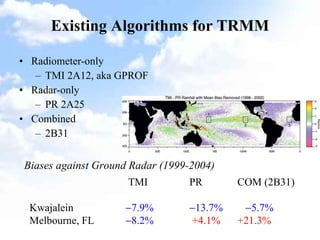
Existing Algorithms for TRMM Radiometer-only  TMI 2A12, aka GPROF Radar-only  PR 2A25 Combined  2B31   TMI PR COM (2B31)‏ Kwajalein  7.9%  13.7%    5.7% Melbourne, FL  8.2%  +4.1% +21.3% Biases against Ground Radar (1999-2004)‏
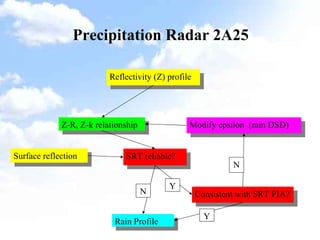
Precipitation Radar 2A25 Reflectivity (Z) profile Z-R, Z-k relationship Consistent with SRT PIA?  Modify epsilon  (rain DSD)‏ SRT reliable? Rain Profile N N Y Y Surface reflection
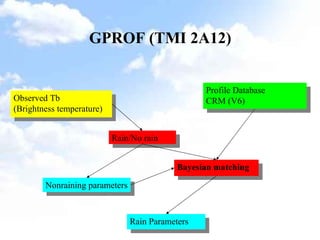
GPROF (TMI 2A12) Observed Tb  (Brightness temperature)‏ Profile Database CRM (V6) Bayesian matching Rain/No rain Nonraining parameters Rain Parameters
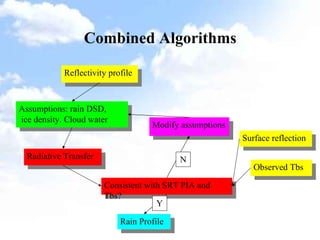
Combined Algorithms Reflectivity profile Assumptions: rain DSD, ice density. Cloud water Consistent with SRT PIA and Tbs? Modify assumptions Radiative Transfer Rain Profile N Y Surface reflection Observed Tbs
Algorithm Philosophy Build on existing single-sensor methods Core is a radar profiling algorithm similar to 2A25 Use internally consistent, interchangeable modules for scattering physics and radiative transfer Improve upon previous combined algorithms Identify key assumptions needed for microwave RT and use these as variable inputs to radar profiling algorithm Minimize errors over large scenes to overcome beam filling and field-of-view overlap problems Use all channels to maximize resolution and sensitivity to rain
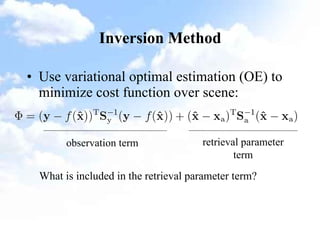
Inversion Method Use variational optimal estimation (OE) to minimize cost function over scene: observation term retrieval parameter term What is included in the retrieval parameter term?
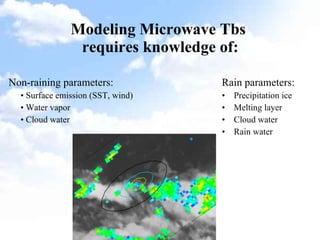
Modeling Microwave Tbs  requires knowledge of: Non-raining parameters: •  Surface emission (SST, wind)  •  Water vapor •  Cloud water Rain parameters: Precipitation ice Melting layer Cloud water Rain water
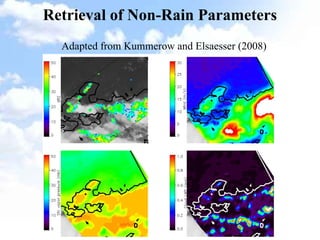
Retrieval of Non-Rain Parameters Adapted from Kummerow and Elsaesser (2008)‏
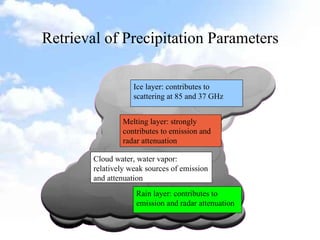
Retrieval of Precipitation Parameters Ice layer: contributes to scattering at 85 and 37 GHz Melting layer: strongly contributes to emission and radar attenuation Rain layer: contributes to emission and radar attenuation Cloud water, water vapor: relatively weak sources of emission and attenuation
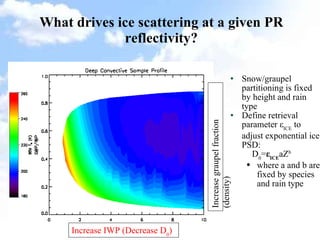
What drives ice scattering at a given PR reflectivity? Increase IWP (Decrease D 0 )  Increase graupel fraction (density)‏ Snow/graupel partitioning is fixed by height and rain type Define retrieval parameter  ε ICE  to adjust exponential ice PSD:  D 0 = ε ICE aZ b where a and b are fixed by species and rain type
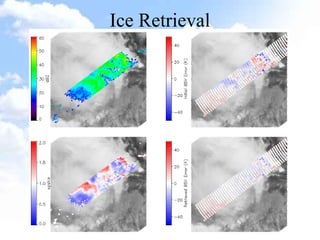
Ice Retrieval
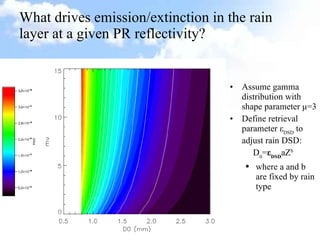
What drives emission/extinction in the rain layer at a given PR reflectivity? Assume gamma distribution with shape parameter  μ=3 Define retrieval parameter  ε DSD  to adjust rain DSD:    D 0 = ε DSD aZ b where a and b are fixed by rain type
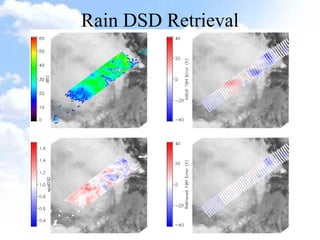
Rain DSD Retrieval
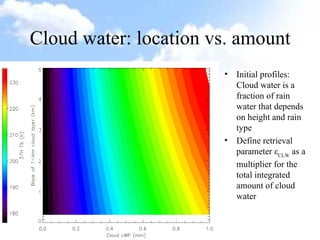
Cloud water: location vs. amount Initial profiles: Cloud water is a fraction of rain water that depends on height and rain type Define retrieval parameter  ε CLW  as a multiplier for the total integrated amount of cloud water
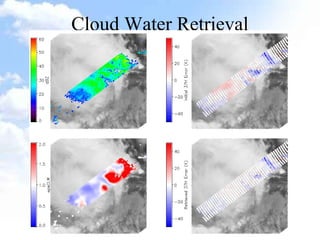
Cloud Water Retrieval
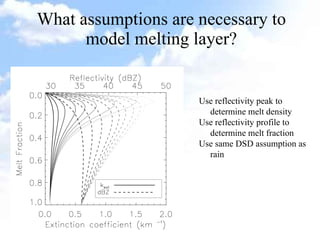
What assumptions are necessary to model melting layer? Use reflectivity peak to determine melt density Use reflectivity profile to determine melt fraction Use same DSD assumption as rain
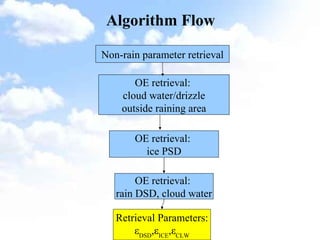
Algorithm Flow Non-rain parameter retrieval OE retrieval:  cloud water/drizzle outside raining area OE retrieval:  ice PSD OE retrieval:  rain DSD, cloud water Retrieval Parameters: ε DSD ,ε ICE ,ε CLW
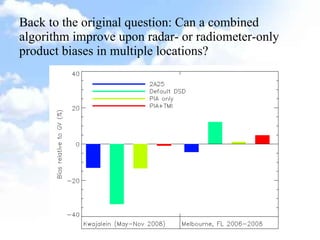
Back to the original question: Can a combined algorithm improve upon radar- or radiometer-only product biases in multiple locations?

Kummerow.1.1B.ppt

  • 1.
    A Combined Radar/RadiometerRetrieval for Precipitation IGARSS – Session 1.1 Vancouver, Canada 26 July, 2011 Christian Kummerow 1 , S. Joseph Munchak 1,2 1 Dept. of Atmospheric Science Colorado State University 2 NASA/Goddard Space Flight Center
  • 2.
    Existing Algorithms forTRMM Radiometer-only TMI 2A12, aka GPROF Radar-only PR 2A25 Combined 2B31 TMI PR COM (2B31)‏ Kwajalein  7.9%  13.7%  5.7% Melbourne, FL  8.2% +4.1% +21.3% Biases against Ground Radar (1999-2004)‏
  • 3.
    Precipitation Radar 2A25Reflectivity (Z) profile Z-R, Z-k relationship Consistent with SRT PIA? Modify epsilon (rain DSD)‏ SRT reliable? Rain Profile N N Y Y Surface reflection
  • 4.
    GPROF (TMI 2A12)Observed Tb (Brightness temperature)‏ Profile Database CRM (V6) Bayesian matching Rain/No rain Nonraining parameters Rain Parameters
  • 5.
    Combined Algorithms Reflectivityprofile Assumptions: rain DSD, ice density. Cloud water Consistent with SRT PIA and Tbs? Modify assumptions Radiative Transfer Rain Profile N Y Surface reflection Observed Tbs
  • 6.
    Algorithm Philosophy Buildon existing single-sensor methods Core is a radar profiling algorithm similar to 2A25 Use internally consistent, interchangeable modules for scattering physics and radiative transfer Improve upon previous combined algorithms Identify key assumptions needed for microwave RT and use these as variable inputs to radar profiling algorithm Minimize errors over large scenes to overcome beam filling and field-of-view overlap problems Use all channels to maximize resolution and sensitivity to rain
  • 7.
    Inversion Method Usevariational optimal estimation (OE) to minimize cost function over scene: observation term retrieval parameter term What is included in the retrieval parameter term?
  • 8.
    Modeling Microwave Tbs requires knowledge of: Non-raining parameters: • Surface emission (SST, wind) • Water vapor • Cloud water Rain parameters: Precipitation ice Melting layer Cloud water Rain water
  • 9.
    Retrieval of Non-RainParameters Adapted from Kummerow and Elsaesser (2008)‏
  • 10.
    Retrieval of PrecipitationParameters Ice layer: contributes to scattering at 85 and 37 GHz Melting layer: strongly contributes to emission and radar attenuation Rain layer: contributes to emission and radar attenuation Cloud water, water vapor: relatively weak sources of emission and attenuation
  • 11.
    What drives icescattering at a given PR reflectivity? Increase IWP (Decrease D 0 ) Increase graupel fraction (density)‏ Snow/graupel partitioning is fixed by height and rain type Define retrieval parameter ε ICE to adjust exponential ice PSD: D 0 = ε ICE aZ b where a and b are fixed by species and rain type
  • 12.
  • 13.
    What drives emission/extinctionin the rain layer at a given PR reflectivity? Assume gamma distribution with shape parameter μ=3 Define retrieval parameter ε DSD to adjust rain DSD: D 0 = ε DSD aZ b where a and b are fixed by rain type
  • 14.
  • 15.
    Cloud water: locationvs. amount Initial profiles: Cloud water is a fraction of rain water that depends on height and rain type Define retrieval parameter ε CLW as a multiplier for the total integrated amount of cloud water
  • 16.
  • 17.
    What assumptions arenecessary to model melting layer? Use reflectivity peak to determine melt density Use reflectivity profile to determine melt fraction Use same DSD assumption as rain
  • 18.
    Algorithm Flow Non-rainparameter retrieval OE retrieval: cloud water/drizzle outside raining area OE retrieval: ice PSD OE retrieval: rain DSD, cloud water Retrieval Parameters: ε DSD ,ε ICE ,ε CLW
  • 19.
    Back to theoriginal question: Can a combined algorithm improve upon radar- or radiometer-only product biases in multiple locations?

Editor's Notes

  • #9 Rephrase as problem, “what affects Tbs” and show (with TMI footprint) how non-rain and rain parameters both contribute
  • #12 Simplify header, why is this important
  • #14 header
  • #19 Take out text (add slide after example retrieval), remove “OE”
  • #20 Shorten question