By
Smt.Sowmya.K
PRINCIPAL
SBRR Mahajana Law College
Mysore
CONCEPT OF GOODS AND SERVICE TAX[GST]
Meaning
“GST is a tax on goods and services with value addition at each stage
having comprehensive and continuous chain of set of benefits from the
producer’s or service provider’s point up to the retailers level where only the
final consumer should bear the tax.”
It is a comprehensive indirect tax on manufacture, sale and consumption
of goods and services at national level.
The GST is expected to replace all the indirect taxes in India. At the
centre's level, GST will replace central excise duty, service tax and customs
duties. At the state level, the GST will replace State VAT.
France was the first country to introduce this value added tax system in
1954 .
Definitions
Article 366 (12A) of the Indian Constitution defined Goods and Services
Tax (GST) to mean “any tax on supply of goods or services or both except taxes
on the supply of alcoholic liquor for human consumption.”
Article 366(26A) defines “service” to mean “anything other than goods.”
Article 366(12) defines “goods to include all materials, commodities, and
articles.”
Smt.Sowmya.K 3
HISTORY OF GST
 When we look in to the history of tax structure in the world, it
is found that several countries have already established the Goods
and Services Tax. GST was implemented in New Zealand in 1986. A
hidden Manufacturer’s Sales Tax was replaced by GST in Canada, in
the year 1991. In Singapore, GST was implemented in 1994. In
Australia, the system was introduced in 2000 to replace the Federal
Wholesale Tax.GST is a value-added tax in Malaysia that came into
effect in 2015. The implementation of the Goods and Services Tax
(GST) in India was a historical move, as it marked a significant
indirect tax reform in the country.
 The idea of adopting Goods and Service Tax in India was first
suggested by the Central Government in the leadership of Sri Atal
Bihari Bajpayee in 2000. The state finance ministers formed an
Empowered Committee to create a road map and structure for GST
on the basis of their experience in designing State Value Added Tax.
The representatives from the centre and states were requested to
examine various aspects of the GST proposals and create report on
the thresholds, exemptions, taxations of inter-state supplies and
taxation of services. The committee was chaired by Mr Asim Das
Gupta of West Bengal.
Smt.Sowmya.K 4
 The Kelkar Committee (Headed by Vijay Kelkar) indicated in 2004 that
the existing tax structure had many issues that would be mitigated by the
proposed GST system.
 In 2005, the Finance Minister of Central Government Mr P.
Chidambaram, during the discussion on budget, declared that the medium to
long term goal of the government was to implement a uniform GST
structure across the country, covering the whole production, distribution
chain.
 In February 2006, the Finance Minister of India set 1 April,2010 as the GST
introduction date.
 In July 2009, the new central finance minster Mr Pranab Mukharjee
announced the basic structure of the GST system. In November, the
Empowered Committee put forth the first Discussion Paper describing the
proposed GST regime with the expectation to start the debate and generate
inputs from various stakeholders.
 The central government introduced the mission-mode project with a
budgetary outlay of Rs 1133 crore, to computerize commercial taxes in
states. This project laid the foundation for GST in India.
 In March 2011, the government put forth the Constitution
Amenment (115th) Bill for the introduction of GST and the bill was sent to
standing committee for detailed examination. The standing committee starts
discussions on the bill in June 2012 and the deadline was set as 31st
December,2012 for the resolution of issues. Congress led central
government could not implement GST during her tenure.
Smt.Sowmya.K 5
 In May 2014, Mr Narendra Modi came into the power at centre. Arun
Jately, the Finance Minister of India, submits the Constitution Amendment
(122nd) Bill, 2014 in the Parliament. Government indicated that she is
looking to implement the GST by 1st April, 2016. In May, 2015 Lok Sabha
passes the bill but Rajya Sabha could not. In June 2016, government
releases the draft model law on GST to the public expecting suggestions and
views. In August 2016, the bill was passed in the Rajya Sabha. After
consent of Honourable President of India, the bill became an Act. Four bills
related to GST namely- Central GST Bill, Integrated GST Bill, Union
Territory GST Bill and GST (Compensation to States) Bill also became Act.
The GST Council also finalised on the GST rates and GST rules. The
Government declares that the GST Bill will be applicable from 1 July 2017,
following a short delay that is attributed to legal issues.
A Goods and Services Tax Council (GSTC) was created in Sep, 2016
by the union finance minister, revenue minister, and ministers of states to
take decisions on GST rates, thresholds, taxes to be subsumed, exemptions,
and other features of the taxation system. The state finance ministers
mentioned that the EC would be a platform for states where there would be
discussions of their regional issues. The GST Council is a separate entity
that would oversee the implementation of the GST system.
Smt.Sowmya.K 6
OBJECTIVES OF GOODS AND SERVICE TAX
a) One Country – One Tax
b) Consumption based tax instead of Manufacturing
c) Uniform GST Registration, payment and Input tax
Credit
d) Subsume all indirect taxes at Centre and State Level
under
e) Reduce tax evasion and corruption
f) Increase productivity
g) Increase Tax to GDP Ratio and revenue surplus
h) Increase Compliance
i) Reducing economic distortions
Smt.Sowmya.K 7
CONSTITUTIONAL PROVISIONS ON GST
Article-246A. Special provision with respect to goods and services tax.
Article-269A. Levy and collection of goods and services tax in course of
inter-State trade or commerce.
Article-279A. Goods and Services Tax CounciL
Article -366 of the Constitution,—
‘(12A) “goods and services tax”
‘(26A) “Services”
(26B) “State”
Smt.Sowmya.K 8
"246A. Special provision with respect to goods and services tax.
(1) Notwithstanding anything contained in articles 246 and 254, Parliament, and, subject to clause (2),
the Legislature of every State, have power to make laws with respect to goods and services tax
imposed by the Union or by such State.
(2) Parliament has exclusive power to make laws with respect to goods and services tax where the
supply of goods, or of services, or both takes place in the course of inter-State trade or commerce.
Explanation.—The provisions of this article, shall, in respect of goods and services tax referred to in
clause (5) of article 279A, take effect from the date recommended by the Goods and Services Tax
Council.’’.
‘‘269A. Levy and collection of goods and services tax in course of inter-State trade or
commerce.
Goods and services tax on supplies in the course of inter-State trade or commerce shall be
levied and collected by the Government of India and such tax shall be apportioned between the
Union and the States in the manner as may be provided by Parliament by law on the
recommendations of the Goods and Services Tax Council.
Explanation.—For the purposes of this clause, supply of goods, or of services, or both in the course of
import into the territory of India shall be deemed to be supply of goods, or of services, or both in
the course of inter-State trade or commerce.
(2) The amount apportioned to a State under clause (1) shall not form part of the Consolidated Fund
of India.
(3) Where an amount collected as tax levied under clause (1) has been used for payment of the tax
levied by a State under article 246A, such amount shall not form part of the Consolidated Fund of
India.
(4) Where an amount collected as tax levied by a State under article 246A has been used for payment
of the tax levied under clause (1), such amount shall not form part of the Consolidated Fund of the
State.
(5) Parliament may, by law, formulate the principles for determining the place of supply, and when a
supply of goods, or of services, or both takes place in the course of inter-State trade or
commerce.’’. Smt.Sowmya.K 9
‘‘279A. Goods and Services Tax CounciL
(1) The President shall, within sixty days from the date of commencement of the
Constitution (One Hundred and First Amendment) Act, 2016, by order, constitute a
Council to be called the Goods and Services Tax Council.
(2) The Goods and Services Tax Council shall consist of the following members,
namely:—
(a) the Union Finance Minister........................ Chairperson;
(b) the Union Minister of State in charge of Revenue or Finance................. Member;
(c) the Minister in charge of Finance or Taxation or any other Minister nominated by
each State Government....................Members.
(3) The Members of the Goods and Services Tax Council referred to in sub-clause (c)
of clause (2) shall, as soon as may be, choose one amongst themselves to be the
Vice-Chairperson of the Council for such period as they may decide.
(4) The Goods and Services Tax Council shall make recommendations to the Union
and the States on—
(a) the taxes, cesses and surcharges levied by the Union, the States and the local
bodies which may be subsumed in the goods and services tax;
(b) the goods and services that may be subjected to, or exempted from the goods and
services tax; (c) model Goods and Services Tax Laws, principles of levy,
apportionment of Goods and Services Tax levied on supplies in the course of inter-
State trade or commerce under article 269A and the principles that govern the place
of supply;
Smt.Sowmya.K 10
(d) the threshold limit of turnover below which goods and services may be exempted from
goods and services tax;
(e) the rates including floor rates with bands of goods and services tax;
(f) any special rate or rates for a specified period, to raise additional resources during any
natural calamity or disaster;
(g) special provision with respect to the States of Arunachal Pradesh, Assam, Jammu and
Kashmir, Manipur, Meghalaya, Mizoram, Nagaland, Sikkim, Tripura, Himachal Pradesh
and Uttarakhand; and (h) any other matter relating to the goods and services tax, as the
Council may decide.
(5) The Goods and Services Tax Council shall recommend the date on which the goods and
services tax be levied on petroleum crude, high speed diesel, motor spirit (commonly
known as petrol), natural gas and aviation turbine fuel.
(6) While discharging the functions conferred by this article, the Goods and Services Tax
Council shall be guided by the need for a harmonised structure of goods and services tax
and for the development of a harmonised national market for goods and services.
(7) One-half of the total number of Members of the Goods and Services Tax Council shall
constitute the quorum at its meetings.
(8) The Goods and Services Tax Council shall determine the procedure in the performance
of its functions.
(9) Every decision of the Goods and Services Tax Council shall be taken at a meeting, by a
majority of not less than three-fourths of the weighted votes of the members present and
voting, in accordance with the following principles, namely:—
(a) the vote of the Central Government shall have a weightage of onethird of the total votes
cast, and
(b) the votes of all the State Governments taken together shall have a weightage of two-
thirds of the total votes cast, in that meeting.
Smt.Sowmya.K 11
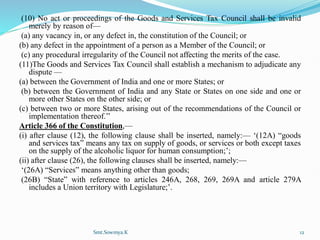
(10) No act or proceedings of the Goods and Services Tax Council shall be invalid
merely by reason of—
(a) any vacancy in, or any defect in, the constitution of the Council; or
(b) any defect in the appointment of a person as a Member of the Council; or
(c) any procedural irregularity of the Council not affecting the merits of the case.
(11)The Goods and Services Tax Council shall establish a mechanism to adjudicate any
dispute —
(a) between the Government of India and one or more States; or
(b) between the Government of India and any State or States on one side and one or
more other States on the other side; or
(c) between two or more States, arising out of the recommendations of the Council or
implementation thereof.’’
Article 366 of the Constitution,—
(i) after clause (12), the following clause shall be inserted, namely:— ‘(12A) “goods
and services tax” means any tax on supply of goods, or services or both except taxes
on the supply of the alcoholic liquor for human consumption;’;
(ii) after clause (26), the following clauses shall be inserted, namely:—
‘(26A) “Services” means anything other than goods;
(26B) “State” with reference to articles 246A, 268, 269, 269A and article 279A
includes a Union territory with Legislature;’.
Smt.Sowmya.K 12
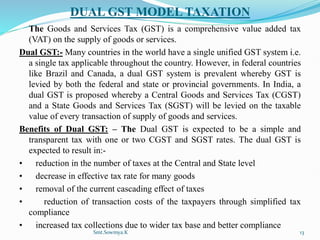
DUAL GST MODEL TAXATION
The Goods and Services Tax (GST) is a comprehensive value added tax
(VAT) on the supply of goods or services.
Dual GST:- Many countries in the world have a single unified GST system i.e.
a single tax applicable throughout the country. However, in federal countries
like Brazil and Canada, a dual GST system is prevalent whereby GST is
levied by both the federal and state or provincial governments. In India, a
dual GST is proposed whereby a Central Goods and Services Tax (CGST)
and a State Goods and Services Tax (SGST) will be levied on the taxable
value of every transaction of supply of goods and services.
Benefits of Dual GST: – The Dual GST is expected to be a simple and
transparent tax with one or two CGST and SGST rates. The dual GST is
expected to result in:-
• reduction in the number of taxes at the Central and State level
• decrease in effective tax rate for many goods
• removal of the current cascading effect of taxes
• reduction of transaction costs of the taxpayers through simplified tax
compliance
• increased tax collections due to wider tax base and better compliance
Smt.Sowmya.K 13
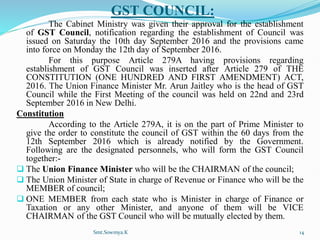
GST COUNCIL:
The Cabinet Ministry was given their approval for the establishment
of GST Council, notification regarding the establishment of Council was
issued on Saturday the 10th day September 2016 and the provisions came
into force on Monday the 12th day of September 2016.
For this purpose Article 279A having provisions regarding
establishment of GST Council was inserted after Article 279 of THE
CONSTITUTION (ONE HUNDRED AND FIRST AMENDMENT) ACT,
2016. The Union Finance Minister Mr. Arun Jaitley who is the head of GST
Council while the First Meeting of the council was held on 22nd and 23rd
September 2016 in New Delhi.
Constitution
According to the Article 279A, it is on the part of Prime Minister to
give the order to constitute the council of GST within the 60 days from the
12th September 2016 which is already notified by the Government.
Following are the designated personnels, who will form the GST Council
together:-
 The Union Finance Minister who will be the CHAIRMAN of the council;
 The Union Minister of State in charge of Revenue or Finance who will be the
MEMBER of council;
 ONE MEMBER from each state who is Minister in charge of Finance or
Taxation or any other Minister, and anyone of them will be VICE
CHAIRMAN of the GST Council who will be mutually elected by them.
Smt.Sowmya.K 14
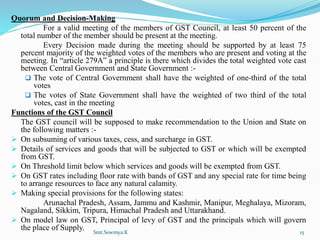
Quorum and Decision-Making
For a valid meeting of the members of GST Council, at least 50 percent of the
total number of the member should be present at the meeting.
Every Decision made during the meeting should be supported by at least 75
percent majority of the weighted votes of the members who are present and voting at the
meeting. In “article 279A” a principle is there which divides the total weighted vote cast
between Central Government and State Government :-
 The vote of Central Government shall have the weighted of one-third of the total
votes
 The votes of State Government shall have the weighted of two third of the total
votes, cast in the meeting
Functions of the GST Council
The GST council will be supposed to make recommendation to the Union and State on
the following matters :-
 On subsuming of various taxes, cess, and surcharge in GST.
 Details of services and goods that will be subjected to GST or which will be exempted
from GST.
 On Threshold limit below which services and goods will be exempted from GST.
 On GST rates including floor rate with bands of GST and any special rate for time being
to arrange resources to face any natural calamity.
 Making special provisions for the following states:
Arunachal Pradesh, Assam, Jammu and Kashmir, Manipur, Meghalaya, Mizoram,
Nagaland, Sikkim, Tripura, Himachal Pradesh and Uttarakhand.
 On model law on GST, Principal of levy of GST and the principals which will govern
the place of Supply. Smt.Sowmya.K 15
GST Impact on Gross Domestic Product (GDP) in India
The biggest tax reform is on its way and very soon Goods and Services Tax will be the part
of Indian Economy. A new and unified tax structure will be followed for indirect taxation on the
place of various existing tax laws like Excise duty, Service Tax, VAT, CST etc. and for sure the
new tax regime will eliminate the cascading effect of tax on transaction of products and services,
and it will result in availability of product and services to consumers at lower price. It is expected
that it will be helpful in increasing production and the purchasing power of the buyer which may
increase the GDP by 1% to 3%. Recently, India accounted 7.1 percent growth for the financial year
of 2016-17 while for the march quarter, it was behind the china at 6.1 percent in front of 6.9
percent of china’s statistics.
GST Positive Impact of GDP
There will be one tax rate for all which will create a unified market in terms of tax
implementation and the transaction of goods and services will be seamless across the states.
The same will reduce the cost of transaction. In a survey, it was found that 10-11 types of
taxes levied on the road transport businesses. So the GST will be helpful to reduce transportation
cost by eliminating other taxes.
After GST implementation the export of goods and services will become competitive
because of nil effect of cascading effect of taxes on goods and products. In a research done by
NCAER it was suggested that GST would be the key revolution in Indian Economy and it could
increase the GDP by 0.9 to 1.7 percent. As speculated earlier, the tax experts can now assume that
the growth will be around 1 to 2 percent after the implementation of the GST.
GST will be more transparent in comparison to the existing law provision so it will
generate more revenue to the Government and will be more effective in reducing corruption at the
same time. Overall GST will improve the tax Compliances.
In a report issued by the Finance Ministry, it was mentioned that Make In India
programme will be more benefited by the GST structure due to the availability of input tax credit
on capital goods.
As the GST will subsume all other taxes, the exemption available for manufacturers in
regards of excise duty will be taken off which will be an addition to Government revenue and it
could result in an increase in GDP.
Smt.Sowmya.K 16
The GST regime has although a very powerful impact on many things including the
GDP also. The Gross Domestic Product has the tendency to loom on the shoulders of
revenue generated by the economy in a year. Still, a worthwhile point includes that the
GST has the capability to extended the GDP by a total of 2 percent in order to complete
the ultimate goal of increasing the per-capita income of every individual. Also, the GST
scheme will certainly improve the indirect revenues to the government as the tax
compliance will be further enhanced and rigid, extending the tax paying base which will
add to the revenue. The increased income of the government will redirected towards the
developmental projects and urban financing creating an overall implied scenario.
GST Negative Impact on GDP
As the GST rates are 5%, 12%, 18% and 28% and if the GST rate on service will
be finalized at 5% or 12% then cost of services will get reduced while in else case if the
rate will be 18% or 28% on services then services will become costlier and it will lead to
inflation for a short period.
In a report, DBS bank noted that initially GST will lead to rise in inflation rate
which will remain for a year but after that GST will affect positively on the economy.
As we know Real Estate also plays an important role in Indian economy but some
expert thinks that GST will impact the Real Estate business negatively as it will add up the
additional 8 to 10 percent to the cost and reduce the demand about 12 percent.
GST will applicable in the form of IGST, CGST AND SGST on the Center and
State Government, but some economists say that there is nothing new in the form of GST
although these are the new names of Central Excise, VAT, CST and Service Tax etc.
As every coin has two faces in the same way we tried here to familiarize the things
related to GST with both perspective i.e. positively and negatively in this article. Despite
having some factor which is being expected to affect the Economy adversely there are so
many other things which are expected with a positive impact on GDP.
Smt.Sowmya.K 17
Goods and Services Tax Network (GSTN)
Launch of GST needs mega infrastructural support including IT
facilities. So far, the Centre and State indirect tax administrations worked
under different laws, regulations, procedures and formats and consequently
they have independent IT systems. Integrating them for GST
implementation and bringing them under an entirely new indirect tax system
and administration need fresh institutional arrangement. For this task, the
government has created Goods and Services Tax Network (GSTN).
Meaning
The Goods and Services Tax Network (GSTN) is a non-government
non-profit private limited company created for providing the front end and
back end IT and infrastructural support for the working of GST. It is
registered as a non – profit Company under the New Companies Act in
March 2013.
Shareholding
Given its non-government nature, the shareholding is important.
Here, the Governments –centre, states plus UTs hold 49% of GSTN. Central
government holds 24.5% while the remaining governmental share of 24.5%
is held by states and UTs. It has an authorized capital of Rs.10 crore to
establish and operate the IT backbone of GST.
Smt.Sowmya.K 18
The remaining 51% share is divided among five financial institutions—
LIC Housing Finance with 11% stake and ICICI Bank, HDFC, HDFC Bank and
NSE Strategic Investment Corporation Ltd with 10% stake each.
Management
Though the shareholding looks non-government, governments have more
say in the management of GSTN. The Central and the state governments
together have seven members in the 14-member GSTN board, including the
Chairman. Private share-holders have only three members. The remaining three
are independent members and a board-appointed chief executive officer. This
means that the strategic control of the company lies with government.
Functions of GSTN
Following are the main functions of GSTN:
(i) facilitating registration;
(ii) filing and forwarding the returns to Central and State tax authorities;
(iii) computation and settlement of IGST;
(iv) matching of tax payment details with banking network;
(v) providing various Management Information System reports to Governments.
(vi) analysis of tax payers’ profile; and
(vii) running the matching engine for input tax credit.
GST Suvidha Providers or GSP
GSP or GST Suvidha Providers are third party IT vendors who develop the web or
mobile base interfaces for taxpayers to interact with the GST network.
Smt.Sowmya.K 19
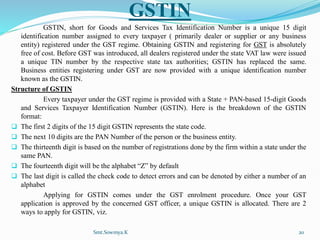
GSTIN
GSTIN, short for Goods and Services Tax Identification Number is a unique 15 digit
identification number assigned to every taxpayer ( primarily dealer or supplier or any business
entity) registered under the GST regime. Obtaining GSTIN and registering for GST is absolutely
free of cost. Before GST was introduced, all dealers registered under the state VAT law were issued
a unique TIN number by the respective state tax authorities; GSTIN has replaced the same.
Business entities registering under GST are now provided with a unique identification number
known as the GSTIN.
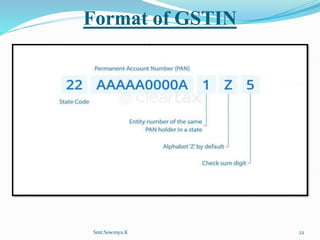
Structure of GSTIN
Every taxpayer under the GST regime is provided with a State + PAN-based 15-digit Goods
and Services Taxpayer Identification Number (GSTIN). Here is the breakdown of the GSTIN
format:
 The first 2 digits of the 15 digit GSTIN represents the state code.
 The next 10 digits are the PAN Number of the person or the business entity.
 The thirteenth digit is based on the number of registrations done by the firm within a state under the
same PAN.
 The fourteenth digit will be the alphabet “Z” by default
 The last digit is called the check code to detect errors and can be denoted by either a number of an
alphabet
Applying for GSTIN comes under the GST enrolment procedure. Once your GST
application is approved by the concerned GST officer, a unique GSTIN is allocated. There are 2
ways to apply for GSTIN, viz.
Smt.Sowmya.K 20
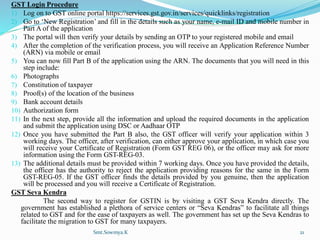
GST Login Procedure
1) Log on to GST online portal https://services.gst.gov.in/services/quicklinks/registration
2) Go to ‘New Registration’ and fill in the details such as your name, e-mail ID and mobile number in
Part A of the application
3) The portal will then verify your details by sending an OTP to your registered mobile and email
4) After the completion of the verification process, you will receive an Application Reference Number
(ARN) via mobile or email
5) You can now fill Part B of the application using the ARN. The documents that you will need in this
step include:
6) Photographs
7) Constitution of taxpayer
8) Proof(s) of the location of the business
9) Bank account details
10) Authorization form
11) In the next step, provide all the information and upload the required documents in the application
and submit the application using DSC or Aadhaar OTP
12) Once you have submitted the Part B also, the GST officer will verify your application within 3
working days. The officer, after verification, can either approve your application, in which case you
will receive your Certificate of Registration (Form GST REG 06), or the officer may ask for more
information using the Form GST-REG-03.
13) The additional details must be provided within 7 working days. Once you have provided the details,
the officer has the authority to reject the application providing reasons for the same in the Form
GST-REG-05. If the GST officer finds the details provided by you genuine, then the application
will be processed and you will receive a Certificate of Registration.
GST Seva Kendra
The second way to register for GSTIN is by visiting a GST Seva Kendra directly. The
government has established a plethora of service centers or “Seva Kendras” to facilitate all things
related to GST and for the ease of taxpayers as well. The government has set up the Seva Kendras to
facilitate the migration to GST for many taxpayers.
Smt.Sowmya.K 21
Format of GSTIN
Smt.Sowmya.K 22
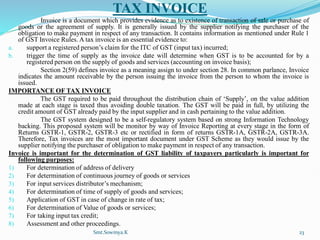
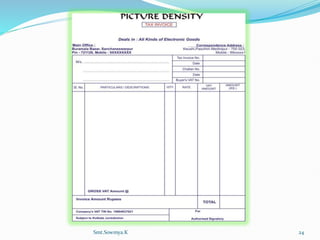
TAX INVOICE
Invoice is a document which provides evidence as to existence of transaction of sale or purchase of
goods or the agreement of supply. It is generally issued by the supplier notifying the purchaser of the
obligation to make payment in respect of any transaction. It contains information as mentioned under Rule 1
of GST Invoice Rules. A tax invoice is an essential evidence to:
a. support a registered person’s claim for the ITC of GST (input tax) incurred;
b. trigger the time of supply as the invoice date will determine when GST is to be accounted for by a
registered person on the supply of goods and services (accounting on invoice basis);
Section 2(59) defines invoice as a meaning assign to under section 28. In common parlance, Invoice
indicates the amount receivable by the person issuing the invoice from the person to whom the invoice is
issued.
IMPORTANCE OF TAX INVOICE
The GST required to be paid throughout the distribution chain of ‘Supply’, on the value addition
made at each stage is taxed thus avoiding double taxation. The GST will be paid in full, by utilizing the
credit amount of GST already paid by the input supplier and in cash pertaining to the value addition.
The GST system designed to be a self-regulatory system based on strong Information Technology
backing. This proposed system will be monitor by way of Invoice Reporting at every stage in the form of
Returns GSTR-1, GSTR-2, GSTR-3 etc or rectified in form of returns GSTR-1A, GSTR-2A, GSTR-3A.
Therefore, Tax invoices are the most important document under GST Scheme as they would issue by the
supplier notifying the purchaser of obligation to make payment in respect of any transaction.
Invoice is important for the determination of GST liability of taxpayers particularly is important for
following purposes:
1) For determination of address of delivery
2) For determination of continuous journey of goods or services
3) For input services distributor’s mechanism;
4) For determination of time of supply of goods and services;
5) Application of GST in case of change in rate of tax;
6) For determination of Value of goods or services;
7) For taking input tax credit;
8) Assessment and other proceedings.
Smt.Sowmya.K 23
Smt.Sowmya.K 24
CENTRAL GOODS AND SERVICES TAX ACT, 2017
The Central Goods and Services Tax Act, 2017 has been enacted
to make a provision for levy and collection of tax on intra-state supply of
goods or services or both by the Central Government and the matters
connected therewith or incidental thereto. This series of Articles shall
analyze the provisions of Central Goods and Services Tax Act, 2017,
which has been enacted on 12 April, 2017.
Objects of CGST Law
Presently, the Central Government levies tax on, manufacture of
certain goods in the form of Central Excise duty, provision of certain
services in the form of service tax, inter-State sale of goods in the form of
Central Sales tax. Similarly, the State Governments levy tax on and on
retail sales in the form of value added tax, entry of goods in the State in
the form of entry tax, luxury tax and purchase tax, etc. Accordingly, there
is multiplicity of taxes which are being levied on the same supply chain.
Taxonomy of CGST Act
The CGST Act, 2017 comprises of 174 Sections in 21 Chapters and
three Schedules on supplies without consideration, treatment of activities
as to goods or services and activities which shall be considered as neither
goods or services.
Smt.Sowmya.K 25
Salient Features of CGST Act
The Central Goods and Services Tax Act, 2017, inter alia,
will provide for the following, namely:—
a) to levy tax on all intra-State supplies of goods or services or both
except supply of alcoholic liquor for human consumption at a
rate to be notified, not exceeding twenty per cent. as
recommended by the Goods and Services Tax Council (the
Council);
b) to broad base the input tax credit by making it available in
respect of taxes paid on any supply of goods or services or both
used or intended to be used in the course or furtherance of
business;
c) to impose obligation on electronic commerce operators to collect
tax at source, at such rate not exceeding one per cent. of net
value of taxable supplies, out of payments to suppliers supplying
goods or services through their portals;
d) to provide for self-assessment of the taxes payable by the
registered person;
Smt.Sowmya.K 26
e) to provide for conduct of audit of registered persons in order to
verify compliance with the provisions of the Act;
f) to provide for recovery of arrears of tax using various modes
including detaining and sale of goods, movable and immovable
property of defaulting taxable person;
g) to provide for powers of inspection, search, seizure and arrest
to the officers;
h) to establish the Goods and Services Tax Appellate Tribunal by
the Central Government for hearing appeals against the orders
passed by the Appellate Authority or the Revisional Authority;
i) to make provision for penalties for contravention of the
provisions of the proposed Legislation;
j) to provide for an anti-profiteering clause in order to ensure that
business passes on the benefit of reduced tax incidence on
goods or services or both to the consumers; and
k) to provide for elaborate transitional provisions for smooth
transition of existing taxpayers to goods and services tax
regime.

Law of Taxation unit- 3.pdf by Smt.Sowmya.K

  • 1.
  • 3.
    CONCEPT OF GOODSAND SERVICE TAX[GST] Meaning “GST is a tax on goods and services with value addition at each stage having comprehensive and continuous chain of set of benefits from the producer’s or service provider’s point up to the retailers level where only the final consumer should bear the tax.” It is a comprehensive indirect tax on manufacture, sale and consumption of goods and services at national level. The GST is expected to replace all the indirect taxes in India. At the centre's level, GST will replace central excise duty, service tax and customs duties. At the state level, the GST will replace State VAT. France was the first country to introduce this value added tax system in 1954 . Definitions Article 366 (12A) of the Indian Constitution defined Goods and Services Tax (GST) to mean “any tax on supply of goods or services or both except taxes on the supply of alcoholic liquor for human consumption.” Article 366(26A) defines “service” to mean “anything other than goods.” Article 366(12) defines “goods to include all materials, commodities, and articles.” Smt.Sowmya.K 3
  • 4.
    HISTORY OF GST When we look in to the history of tax structure in the world, it is found that several countries have already established the Goods and Services Tax. GST was implemented in New Zealand in 1986. A hidden Manufacturer’s Sales Tax was replaced by GST in Canada, in the year 1991. In Singapore, GST was implemented in 1994. In Australia, the system was introduced in 2000 to replace the Federal Wholesale Tax.GST is a value-added tax in Malaysia that came into effect in 2015. The implementation of the Goods and Services Tax (GST) in India was a historical move, as it marked a significant indirect tax reform in the country.  The idea of adopting Goods and Service Tax in India was first suggested by the Central Government in the leadership of Sri Atal Bihari Bajpayee in 2000. The state finance ministers formed an Empowered Committee to create a road map and structure for GST on the basis of their experience in designing State Value Added Tax. The representatives from the centre and states were requested to examine various aspects of the GST proposals and create report on the thresholds, exemptions, taxations of inter-state supplies and taxation of services. The committee was chaired by Mr Asim Das Gupta of West Bengal. Smt.Sowmya.K 4
  • 5.
     The KelkarCommittee (Headed by Vijay Kelkar) indicated in 2004 that the existing tax structure had many issues that would be mitigated by the proposed GST system.  In 2005, the Finance Minister of Central Government Mr P. Chidambaram, during the discussion on budget, declared that the medium to long term goal of the government was to implement a uniform GST structure across the country, covering the whole production, distribution chain.  In February 2006, the Finance Minister of India set 1 April,2010 as the GST introduction date.  In July 2009, the new central finance minster Mr Pranab Mukharjee announced the basic structure of the GST system. In November, the Empowered Committee put forth the first Discussion Paper describing the proposed GST regime with the expectation to start the debate and generate inputs from various stakeholders.  The central government introduced the mission-mode project with a budgetary outlay of Rs 1133 crore, to computerize commercial taxes in states. This project laid the foundation for GST in India.  In March 2011, the government put forth the Constitution Amenment (115th) Bill for the introduction of GST and the bill was sent to standing committee for detailed examination. The standing committee starts discussions on the bill in June 2012 and the deadline was set as 31st December,2012 for the resolution of issues. Congress led central government could not implement GST during her tenure. Smt.Sowmya.K 5
  • 6.
     In May2014, Mr Narendra Modi came into the power at centre. Arun Jately, the Finance Minister of India, submits the Constitution Amendment (122nd) Bill, 2014 in the Parliament. Government indicated that she is looking to implement the GST by 1st April, 2016. In May, 2015 Lok Sabha passes the bill but Rajya Sabha could not. In June 2016, government releases the draft model law on GST to the public expecting suggestions and views. In August 2016, the bill was passed in the Rajya Sabha. After consent of Honourable President of India, the bill became an Act. Four bills related to GST namely- Central GST Bill, Integrated GST Bill, Union Territory GST Bill and GST (Compensation to States) Bill also became Act. The GST Council also finalised on the GST rates and GST rules. The Government declares that the GST Bill will be applicable from 1 July 2017, following a short delay that is attributed to legal issues. A Goods and Services Tax Council (GSTC) was created in Sep, 2016 by the union finance minister, revenue minister, and ministers of states to take decisions on GST rates, thresholds, taxes to be subsumed, exemptions, and other features of the taxation system. The state finance ministers mentioned that the EC would be a platform for states where there would be discussions of their regional issues. The GST Council is a separate entity that would oversee the implementation of the GST system. Smt.Sowmya.K 6
  • 7.
    OBJECTIVES OF GOODSAND SERVICE TAX a) One Country – One Tax b) Consumption based tax instead of Manufacturing c) Uniform GST Registration, payment and Input tax Credit d) Subsume all indirect taxes at Centre and State Level under e) Reduce tax evasion and corruption f) Increase productivity g) Increase Tax to GDP Ratio and revenue surplus h) Increase Compliance i) Reducing economic distortions Smt.Sowmya.K 7
  • 8.
    CONSTITUTIONAL PROVISIONS ONGST Article-246A. Special provision with respect to goods and services tax. Article-269A. Levy and collection of goods and services tax in course of inter-State trade or commerce. Article-279A. Goods and Services Tax CounciL Article -366 of the Constitution,— ‘(12A) “goods and services tax” ‘(26A) “Services” (26B) “State” Smt.Sowmya.K 8
  • 9.
    "246A. Special provisionwith respect to goods and services tax. (1) Notwithstanding anything contained in articles 246 and 254, Parliament, and, subject to clause (2), the Legislature of every State, have power to make laws with respect to goods and services tax imposed by the Union or by such State. (2) Parliament has exclusive power to make laws with respect to goods and services tax where the supply of goods, or of services, or both takes place in the course of inter-State trade or commerce. Explanation.—The provisions of this article, shall, in respect of goods and services tax referred to in clause (5) of article 279A, take effect from the date recommended by the Goods and Services Tax Council.’’. ‘‘269A. Levy and collection of goods and services tax in course of inter-State trade or commerce. Goods and services tax on supplies in the course of inter-State trade or commerce shall be levied and collected by the Government of India and such tax shall be apportioned between the Union and the States in the manner as may be provided by Parliament by law on the recommendations of the Goods and Services Tax Council. Explanation.—For the purposes of this clause, supply of goods, or of services, or both in the course of import into the territory of India shall be deemed to be supply of goods, or of services, or both in the course of inter-State trade or commerce. (2) The amount apportioned to a State under clause (1) shall not form part of the Consolidated Fund of India. (3) Where an amount collected as tax levied under clause (1) has been used for payment of the tax levied by a State under article 246A, such amount shall not form part of the Consolidated Fund of India. (4) Where an amount collected as tax levied by a State under article 246A has been used for payment of the tax levied under clause (1), such amount shall not form part of the Consolidated Fund of the State. (5) Parliament may, by law, formulate the principles for determining the place of supply, and when a supply of goods, or of services, or both takes place in the course of inter-State trade or commerce.’’. Smt.Sowmya.K 9
  • 10.
    ‘‘279A. Goods andServices Tax CounciL (1) The President shall, within sixty days from the date of commencement of the Constitution (One Hundred and First Amendment) Act, 2016, by order, constitute a Council to be called the Goods and Services Tax Council. (2) The Goods and Services Tax Council shall consist of the following members, namely:— (a) the Union Finance Minister........................ Chairperson; (b) the Union Minister of State in charge of Revenue or Finance................. Member; (c) the Minister in charge of Finance or Taxation or any other Minister nominated by each State Government....................Members. (3) The Members of the Goods and Services Tax Council referred to in sub-clause (c) of clause (2) shall, as soon as may be, choose one amongst themselves to be the Vice-Chairperson of the Council for such period as they may decide. (4) The Goods and Services Tax Council shall make recommendations to the Union and the States on— (a) the taxes, cesses and surcharges levied by the Union, the States and the local bodies which may be subsumed in the goods and services tax; (b) the goods and services that may be subjected to, or exempted from the goods and services tax; (c) model Goods and Services Tax Laws, principles of levy, apportionment of Goods and Services Tax levied on supplies in the course of inter- State trade or commerce under article 269A and the principles that govern the place of supply; Smt.Sowmya.K 10
  • 11.
    (d) the thresholdlimit of turnover below which goods and services may be exempted from goods and services tax; (e) the rates including floor rates with bands of goods and services tax; (f) any special rate or rates for a specified period, to raise additional resources during any natural calamity or disaster; (g) special provision with respect to the States of Arunachal Pradesh, Assam, Jammu and Kashmir, Manipur, Meghalaya, Mizoram, Nagaland, Sikkim, Tripura, Himachal Pradesh and Uttarakhand; and (h) any other matter relating to the goods and services tax, as the Council may decide. (5) The Goods and Services Tax Council shall recommend the date on which the goods and services tax be levied on petroleum crude, high speed diesel, motor spirit (commonly known as petrol), natural gas and aviation turbine fuel. (6) While discharging the functions conferred by this article, the Goods and Services Tax Council shall be guided by the need for a harmonised structure of goods and services tax and for the development of a harmonised national market for goods and services. (7) One-half of the total number of Members of the Goods and Services Tax Council shall constitute the quorum at its meetings. (8) The Goods and Services Tax Council shall determine the procedure in the performance of its functions. (9) Every decision of the Goods and Services Tax Council shall be taken at a meeting, by a majority of not less than three-fourths of the weighted votes of the members present and voting, in accordance with the following principles, namely:— (a) the vote of the Central Government shall have a weightage of onethird of the total votes cast, and (b) the votes of all the State Governments taken together shall have a weightage of two- thirds of the total votes cast, in that meeting. Smt.Sowmya.K 11
  • 12.
    (10) No actor proceedings of the Goods and Services Tax Council shall be invalid merely by reason of— (a) any vacancy in, or any defect in, the constitution of the Council; or (b) any defect in the appointment of a person as a Member of the Council; or (c) any procedural irregularity of the Council not affecting the merits of the case. (11)The Goods and Services Tax Council shall establish a mechanism to adjudicate any dispute — (a) between the Government of India and one or more States; or (b) between the Government of India and any State or States on one side and one or more other States on the other side; or (c) between two or more States, arising out of the recommendations of the Council or implementation thereof.’’ Article 366 of the Constitution,— (i) after clause (12), the following clause shall be inserted, namely:— ‘(12A) “goods and services tax” means any tax on supply of goods, or services or both except taxes on the supply of the alcoholic liquor for human consumption;’; (ii) after clause (26), the following clauses shall be inserted, namely:— ‘(26A) “Services” means anything other than goods; (26B) “State” with reference to articles 246A, 268, 269, 269A and article 279A includes a Union territory with Legislature;’. Smt.Sowmya.K 12
  • 13.
    DUAL GST MODELTAXATION The Goods and Services Tax (GST) is a comprehensive value added tax (VAT) on the supply of goods or services. Dual GST:- Many countries in the world have a single unified GST system i.e. a single tax applicable throughout the country. However, in federal countries like Brazil and Canada, a dual GST system is prevalent whereby GST is levied by both the federal and state or provincial governments. In India, a dual GST is proposed whereby a Central Goods and Services Tax (CGST) and a State Goods and Services Tax (SGST) will be levied on the taxable value of every transaction of supply of goods and services. Benefits of Dual GST: – The Dual GST is expected to be a simple and transparent tax with one or two CGST and SGST rates. The dual GST is expected to result in:- • reduction in the number of taxes at the Central and State level • decrease in effective tax rate for many goods • removal of the current cascading effect of taxes • reduction of transaction costs of the taxpayers through simplified tax compliance • increased tax collections due to wider tax base and better compliance Smt.Sowmya.K 13
  • 14.
    GST COUNCIL: The CabinetMinistry was given their approval for the establishment of GST Council, notification regarding the establishment of Council was issued on Saturday the 10th day September 2016 and the provisions came into force on Monday the 12th day of September 2016. For this purpose Article 279A having provisions regarding establishment of GST Council was inserted after Article 279 of THE CONSTITUTION (ONE HUNDRED AND FIRST AMENDMENT) ACT, 2016. The Union Finance Minister Mr. Arun Jaitley who is the head of GST Council while the First Meeting of the council was held on 22nd and 23rd September 2016 in New Delhi. Constitution According to the Article 279A, it is on the part of Prime Minister to give the order to constitute the council of GST within the 60 days from the 12th September 2016 which is already notified by the Government. Following are the designated personnels, who will form the GST Council together:-  The Union Finance Minister who will be the CHAIRMAN of the council;  The Union Minister of State in charge of Revenue or Finance who will be the MEMBER of council;  ONE MEMBER from each state who is Minister in charge of Finance or Taxation or any other Minister, and anyone of them will be VICE CHAIRMAN of the GST Council who will be mutually elected by them. Smt.Sowmya.K 14
  • 15.
    Quorum and Decision-Making Fora valid meeting of the members of GST Council, at least 50 percent of the total number of the member should be present at the meeting. Every Decision made during the meeting should be supported by at least 75 percent majority of the weighted votes of the members who are present and voting at the meeting. In “article 279A” a principle is there which divides the total weighted vote cast between Central Government and State Government :-  The vote of Central Government shall have the weighted of one-third of the total votes  The votes of State Government shall have the weighted of two third of the total votes, cast in the meeting Functions of the GST Council The GST council will be supposed to make recommendation to the Union and State on the following matters :-  On subsuming of various taxes, cess, and surcharge in GST.  Details of services and goods that will be subjected to GST or which will be exempted from GST.  On Threshold limit below which services and goods will be exempted from GST.  On GST rates including floor rate with bands of GST and any special rate for time being to arrange resources to face any natural calamity.  Making special provisions for the following states: Arunachal Pradesh, Assam, Jammu and Kashmir, Manipur, Meghalaya, Mizoram, Nagaland, Sikkim, Tripura, Himachal Pradesh and Uttarakhand.  On model law on GST, Principal of levy of GST and the principals which will govern the place of Supply. Smt.Sowmya.K 15
  • 16.
    GST Impact onGross Domestic Product (GDP) in India The biggest tax reform is on its way and very soon Goods and Services Tax will be the part of Indian Economy. A new and unified tax structure will be followed for indirect taxation on the place of various existing tax laws like Excise duty, Service Tax, VAT, CST etc. and for sure the new tax regime will eliminate the cascading effect of tax on transaction of products and services, and it will result in availability of product and services to consumers at lower price. It is expected that it will be helpful in increasing production and the purchasing power of the buyer which may increase the GDP by 1% to 3%. Recently, India accounted 7.1 percent growth for the financial year of 2016-17 while for the march quarter, it was behind the china at 6.1 percent in front of 6.9 percent of china’s statistics. GST Positive Impact of GDP There will be one tax rate for all which will create a unified market in terms of tax implementation and the transaction of goods and services will be seamless across the states. The same will reduce the cost of transaction. In a survey, it was found that 10-11 types of taxes levied on the road transport businesses. So the GST will be helpful to reduce transportation cost by eliminating other taxes. After GST implementation the export of goods and services will become competitive because of nil effect of cascading effect of taxes on goods and products. In a research done by NCAER it was suggested that GST would be the key revolution in Indian Economy and it could increase the GDP by 0.9 to 1.7 percent. As speculated earlier, the tax experts can now assume that the growth will be around 1 to 2 percent after the implementation of the GST. GST will be more transparent in comparison to the existing law provision so it will generate more revenue to the Government and will be more effective in reducing corruption at the same time. Overall GST will improve the tax Compliances. In a report issued by the Finance Ministry, it was mentioned that Make In India programme will be more benefited by the GST structure due to the availability of input tax credit on capital goods. As the GST will subsume all other taxes, the exemption available for manufacturers in regards of excise duty will be taken off which will be an addition to Government revenue and it could result in an increase in GDP. Smt.Sowmya.K 16
  • 17.
    The GST regimehas although a very powerful impact on many things including the GDP also. The Gross Domestic Product has the tendency to loom on the shoulders of revenue generated by the economy in a year. Still, a worthwhile point includes that the GST has the capability to extended the GDP by a total of 2 percent in order to complete the ultimate goal of increasing the per-capita income of every individual. Also, the GST scheme will certainly improve the indirect revenues to the government as the tax compliance will be further enhanced and rigid, extending the tax paying base which will add to the revenue. The increased income of the government will redirected towards the developmental projects and urban financing creating an overall implied scenario. GST Negative Impact on GDP As the GST rates are 5%, 12%, 18% and 28% and if the GST rate on service will be finalized at 5% or 12% then cost of services will get reduced while in else case if the rate will be 18% or 28% on services then services will become costlier and it will lead to inflation for a short period. In a report, DBS bank noted that initially GST will lead to rise in inflation rate which will remain for a year but after that GST will affect positively on the economy. As we know Real Estate also plays an important role in Indian economy but some expert thinks that GST will impact the Real Estate business negatively as it will add up the additional 8 to 10 percent to the cost and reduce the demand about 12 percent. GST will applicable in the form of IGST, CGST AND SGST on the Center and State Government, but some economists say that there is nothing new in the form of GST although these are the new names of Central Excise, VAT, CST and Service Tax etc. As every coin has two faces in the same way we tried here to familiarize the things related to GST with both perspective i.e. positively and negatively in this article. Despite having some factor which is being expected to affect the Economy adversely there are so many other things which are expected with a positive impact on GDP. Smt.Sowmya.K 17
  • 18.
    Goods and ServicesTax Network (GSTN) Launch of GST needs mega infrastructural support including IT facilities. So far, the Centre and State indirect tax administrations worked under different laws, regulations, procedures and formats and consequently they have independent IT systems. Integrating them for GST implementation and bringing them under an entirely new indirect tax system and administration need fresh institutional arrangement. For this task, the government has created Goods and Services Tax Network (GSTN). Meaning The Goods and Services Tax Network (GSTN) is a non-government non-profit private limited company created for providing the front end and back end IT and infrastructural support for the working of GST. It is registered as a non – profit Company under the New Companies Act in March 2013. Shareholding Given its non-government nature, the shareholding is important. Here, the Governments –centre, states plus UTs hold 49% of GSTN. Central government holds 24.5% while the remaining governmental share of 24.5% is held by states and UTs. It has an authorized capital of Rs.10 crore to establish and operate the IT backbone of GST. Smt.Sowmya.K 18
  • 19.
    The remaining 51%share is divided among five financial institutions— LIC Housing Finance with 11% stake and ICICI Bank, HDFC, HDFC Bank and NSE Strategic Investment Corporation Ltd with 10% stake each. Management Though the shareholding looks non-government, governments have more say in the management of GSTN. The Central and the state governments together have seven members in the 14-member GSTN board, including the Chairman. Private share-holders have only three members. The remaining three are independent members and a board-appointed chief executive officer. This means that the strategic control of the company lies with government. Functions of GSTN Following are the main functions of GSTN: (i) facilitating registration; (ii) filing and forwarding the returns to Central and State tax authorities; (iii) computation and settlement of IGST; (iv) matching of tax payment details with banking network; (v) providing various Management Information System reports to Governments. (vi) analysis of tax payers’ profile; and (vii) running the matching engine for input tax credit. GST Suvidha Providers or GSP GSP or GST Suvidha Providers are third party IT vendors who develop the web or mobile base interfaces for taxpayers to interact with the GST network. Smt.Sowmya.K 19
  • 20.
    GSTIN GSTIN, short forGoods and Services Tax Identification Number is a unique 15 digit identification number assigned to every taxpayer ( primarily dealer or supplier or any business entity) registered under the GST regime. Obtaining GSTIN and registering for GST is absolutely free of cost. Before GST was introduced, all dealers registered under the state VAT law were issued a unique TIN number by the respective state tax authorities; GSTIN has replaced the same. Business entities registering under GST are now provided with a unique identification number known as the GSTIN. Structure of GSTIN Every taxpayer under the GST regime is provided with a State + PAN-based 15-digit Goods and Services Taxpayer Identification Number (GSTIN). Here is the breakdown of the GSTIN format:  The first 2 digits of the 15 digit GSTIN represents the state code.  The next 10 digits are the PAN Number of the person or the business entity.  The thirteenth digit is based on the number of registrations done by the firm within a state under the same PAN.  The fourteenth digit will be the alphabet “Z” by default  The last digit is called the check code to detect errors and can be denoted by either a number of an alphabet Applying for GSTIN comes under the GST enrolment procedure. Once your GST application is approved by the concerned GST officer, a unique GSTIN is allocated. There are 2 ways to apply for GSTIN, viz. Smt.Sowmya.K 20
  • 21.
    GST Login Procedure 1)Log on to GST online portal https://services.gst.gov.in/services/quicklinks/registration 2) Go to ‘New Registration’ and fill in the details such as your name, e-mail ID and mobile number in Part A of the application 3) The portal will then verify your details by sending an OTP to your registered mobile and email 4) After the completion of the verification process, you will receive an Application Reference Number (ARN) via mobile or email 5) You can now fill Part B of the application using the ARN. The documents that you will need in this step include: 6) Photographs 7) Constitution of taxpayer 8) Proof(s) of the location of the business 9) Bank account details 10) Authorization form 11) In the next step, provide all the information and upload the required documents in the application and submit the application using DSC or Aadhaar OTP 12) Once you have submitted the Part B also, the GST officer will verify your application within 3 working days. The officer, after verification, can either approve your application, in which case you will receive your Certificate of Registration (Form GST REG 06), or the officer may ask for more information using the Form GST-REG-03. 13) The additional details must be provided within 7 working days. Once you have provided the details, the officer has the authority to reject the application providing reasons for the same in the Form GST-REG-05. If the GST officer finds the details provided by you genuine, then the application will be processed and you will receive a Certificate of Registration. GST Seva Kendra The second way to register for GSTIN is by visiting a GST Seva Kendra directly. The government has established a plethora of service centers or “Seva Kendras” to facilitate all things related to GST and for the ease of taxpayers as well. The government has set up the Seva Kendras to facilitate the migration to GST for many taxpayers. Smt.Sowmya.K 21
  • 22.
  • 23.
    TAX INVOICE Invoice isa document which provides evidence as to existence of transaction of sale or purchase of goods or the agreement of supply. It is generally issued by the supplier notifying the purchaser of the obligation to make payment in respect of any transaction. It contains information as mentioned under Rule 1 of GST Invoice Rules. A tax invoice is an essential evidence to: a. support a registered person’s claim for the ITC of GST (input tax) incurred; b. trigger the time of supply as the invoice date will determine when GST is to be accounted for by a registered person on the supply of goods and services (accounting on invoice basis); Section 2(59) defines invoice as a meaning assign to under section 28. In common parlance, Invoice indicates the amount receivable by the person issuing the invoice from the person to whom the invoice is issued. IMPORTANCE OF TAX INVOICE The GST required to be paid throughout the distribution chain of ‘Supply’, on the value addition made at each stage is taxed thus avoiding double taxation. The GST will be paid in full, by utilizing the credit amount of GST already paid by the input supplier and in cash pertaining to the value addition. The GST system designed to be a self-regulatory system based on strong Information Technology backing. This proposed system will be monitor by way of Invoice Reporting at every stage in the form of Returns GSTR-1, GSTR-2, GSTR-3 etc or rectified in form of returns GSTR-1A, GSTR-2A, GSTR-3A. Therefore, Tax invoices are the most important document under GST Scheme as they would issue by the supplier notifying the purchaser of obligation to make payment in respect of any transaction. Invoice is important for the determination of GST liability of taxpayers particularly is important for following purposes: 1) For determination of address of delivery 2) For determination of continuous journey of goods or services 3) For input services distributor’s mechanism; 4) For determination of time of supply of goods and services; 5) Application of GST in case of change in rate of tax; 6) For determination of Value of goods or services; 7) For taking input tax credit; 8) Assessment and other proceedings. Smt.Sowmya.K 23
  • 24.
  • 25.
    CENTRAL GOODS ANDSERVICES TAX ACT, 2017 The Central Goods and Services Tax Act, 2017 has been enacted to make a provision for levy and collection of tax on intra-state supply of goods or services or both by the Central Government and the matters connected therewith or incidental thereto. This series of Articles shall analyze the provisions of Central Goods and Services Tax Act, 2017, which has been enacted on 12 April, 2017. Objects of CGST Law Presently, the Central Government levies tax on, manufacture of certain goods in the form of Central Excise duty, provision of certain services in the form of service tax, inter-State sale of goods in the form of Central Sales tax. Similarly, the State Governments levy tax on and on retail sales in the form of value added tax, entry of goods in the State in the form of entry tax, luxury tax and purchase tax, etc. Accordingly, there is multiplicity of taxes which are being levied on the same supply chain. Taxonomy of CGST Act The CGST Act, 2017 comprises of 174 Sections in 21 Chapters and three Schedules on supplies without consideration, treatment of activities as to goods or services and activities which shall be considered as neither goods or services. Smt.Sowmya.K 25
  • 26.
    Salient Features ofCGST Act The Central Goods and Services Tax Act, 2017, inter alia, will provide for the following, namely:— a) to levy tax on all intra-State supplies of goods or services or both except supply of alcoholic liquor for human consumption at a rate to be notified, not exceeding twenty per cent. as recommended by the Goods and Services Tax Council (the Council); b) to broad base the input tax credit by making it available in respect of taxes paid on any supply of goods or services or both used or intended to be used in the course or furtherance of business; c) to impose obligation on electronic commerce operators to collect tax at source, at such rate not exceeding one per cent. of net value of taxable supplies, out of payments to suppliers supplying goods or services through their portals; d) to provide for self-assessment of the taxes payable by the registered person; Smt.Sowmya.K 26
  • 27.
    e) to providefor conduct of audit of registered persons in order to verify compliance with the provisions of the Act; f) to provide for recovery of arrears of tax using various modes including detaining and sale of goods, movable and immovable property of defaulting taxable person; g) to provide for powers of inspection, search, seizure and arrest to the officers; h) to establish the Goods and Services Tax Appellate Tribunal by the Central Government for hearing appeals against the orders passed by the Appellate Authority or the Revisional Authority; i) to make provision for penalties for contravention of the provisions of the proposed Legislation; j) to provide for an anti-profiteering clause in order to ensure that business passes on the benefit of reduced tax incidence on goods or services or both to the consumers; and k) to provide for elaborate transitional provisions for smooth transition of existing taxpayers to goods and services tax regime.