1
GOODS AND SERVICES TAX (GST)
2
2
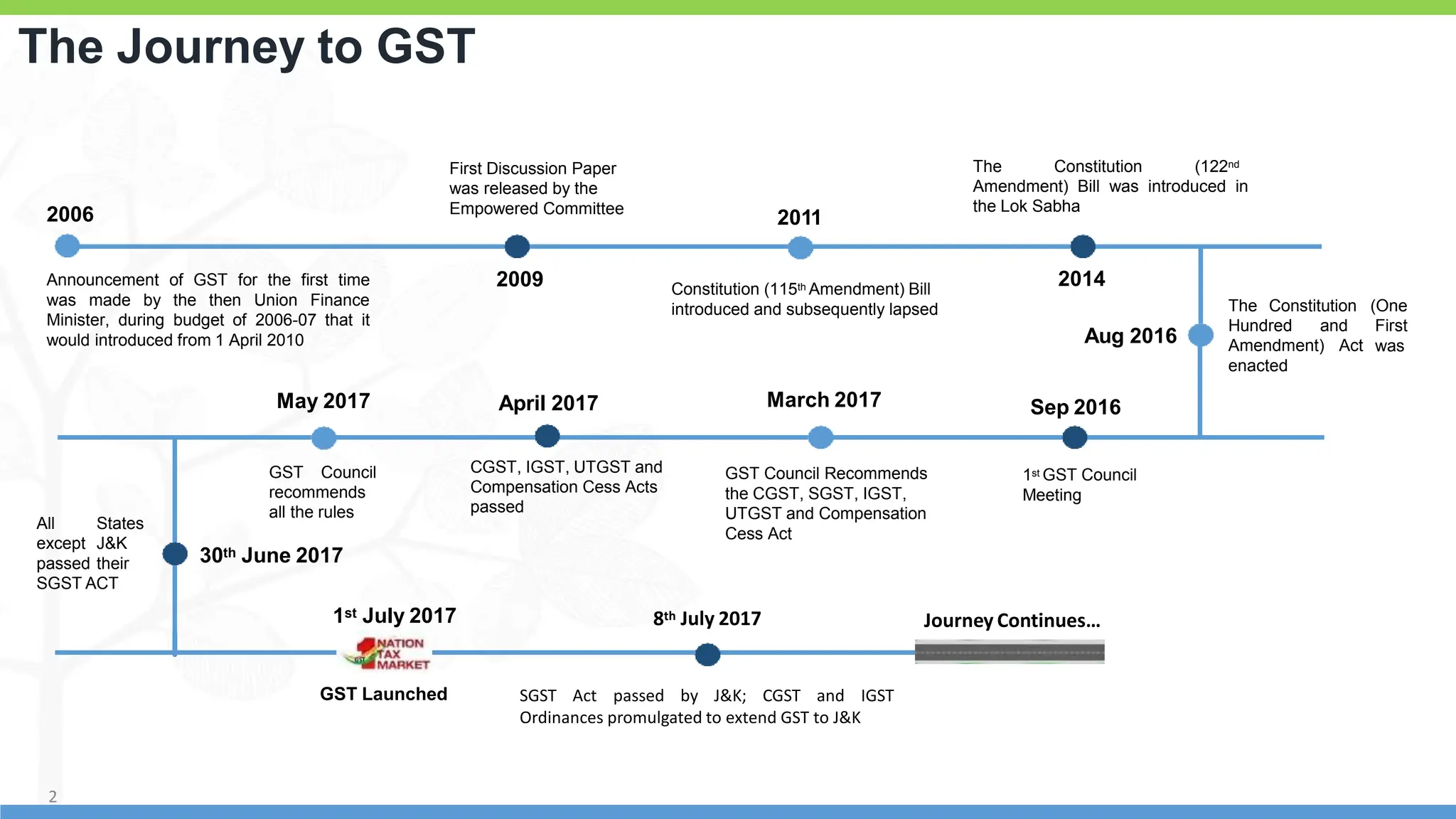
The Journey to GST
Announcement of GST for the first time
was made by the then Union Finance
Minister, during budget of 2006-07 that it
would introduced from 1 April 2010
2006
First Discussion Paper
was released by the
Empowered Committee
2009 Constitution (115th Amendment) Bill
introduced and subsequently lapsed
2011
The Constitution (122nd
Amendment) Bill was introduced in
the Lok Sabha
2014
Aug 2016
The Constitution (One
First
was
Hundred and
Amendment) Act
enacted
March 2017
GST Council Recommends
the CGST, SGST, IGST,
UTGST and Compensation
Cess Act
April 2017
CGST, IGST, UTGST and
Compensation Cess Acts
passed
All
except
passed
States
J&K
their
SGST ACT
May 2017
GST Launched
1st July 2017
1st GST Council
Meeting
Sep 2016
30th June 2017
2
GST Council
recommends
all the rules
SGST Act passed by J&K; CGST and IGST
Ordinances promulgated to extend GST to J&K
8th July 2017 Journey Continues…
3
3
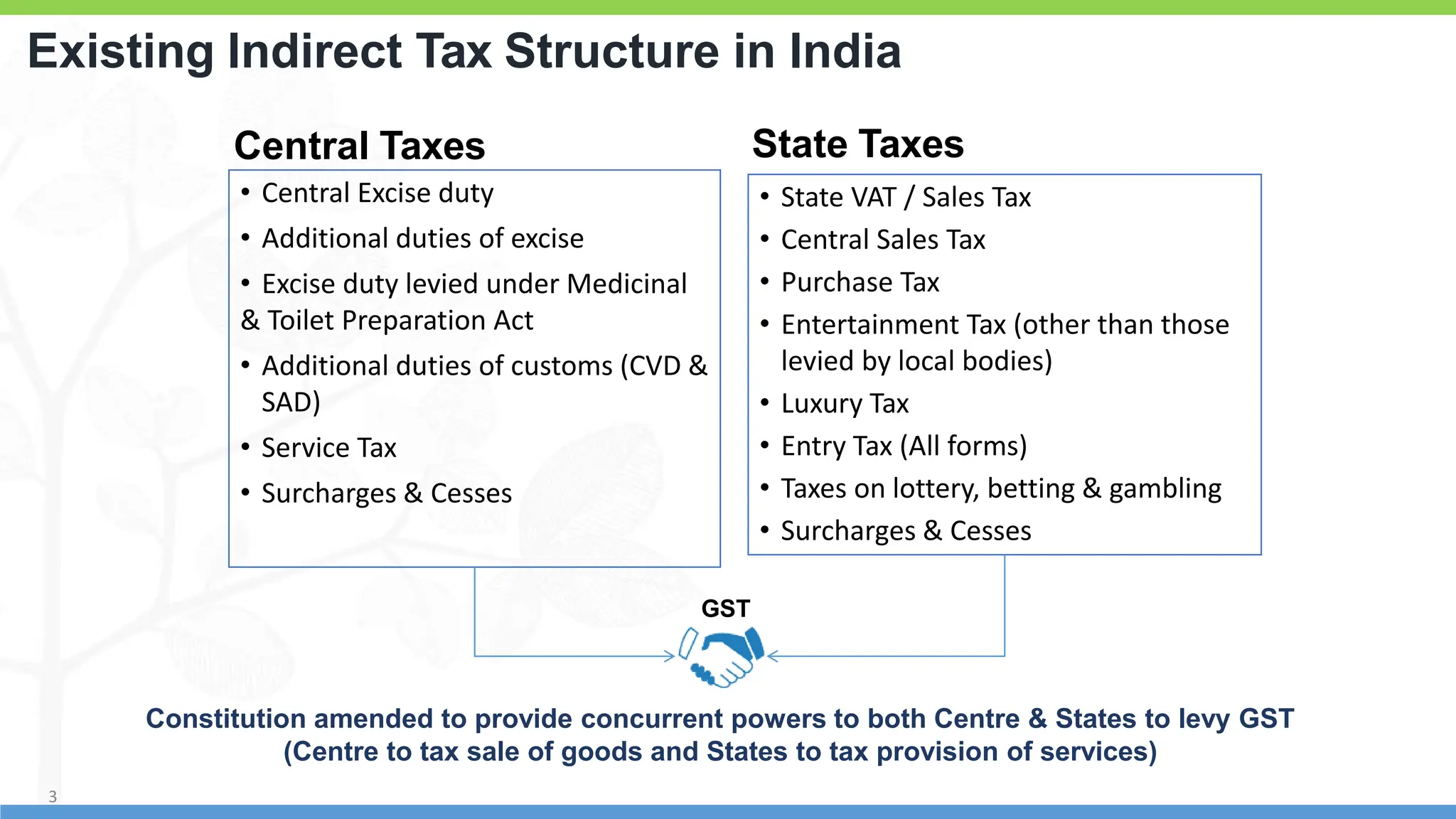
Existing Indirect Tax Structure in India
Constitution amended to provide concurrent powers to both Centre & States to levy GST
(Centre to tax sale of goods and States to tax provision of services)
• Central Excise duty
• Additional duties of excise
• Excise duty levied under Medicinal
& Toilet Preparation Act
• Additional duties of customs (CVD &
SAD)
• Service Tax
• Surcharges & Cesses
• State VAT / Sales Tax
• Central Sales Tax
• Purchase Tax
• Entertainment Tax (other than those
levied by local bodies)
• Luxury Tax
• Entry Tax (All forms)
• Taxes on lottery, betting & gambling
• Surcharges & Cesses
Central Taxes State Taxes
GST
3
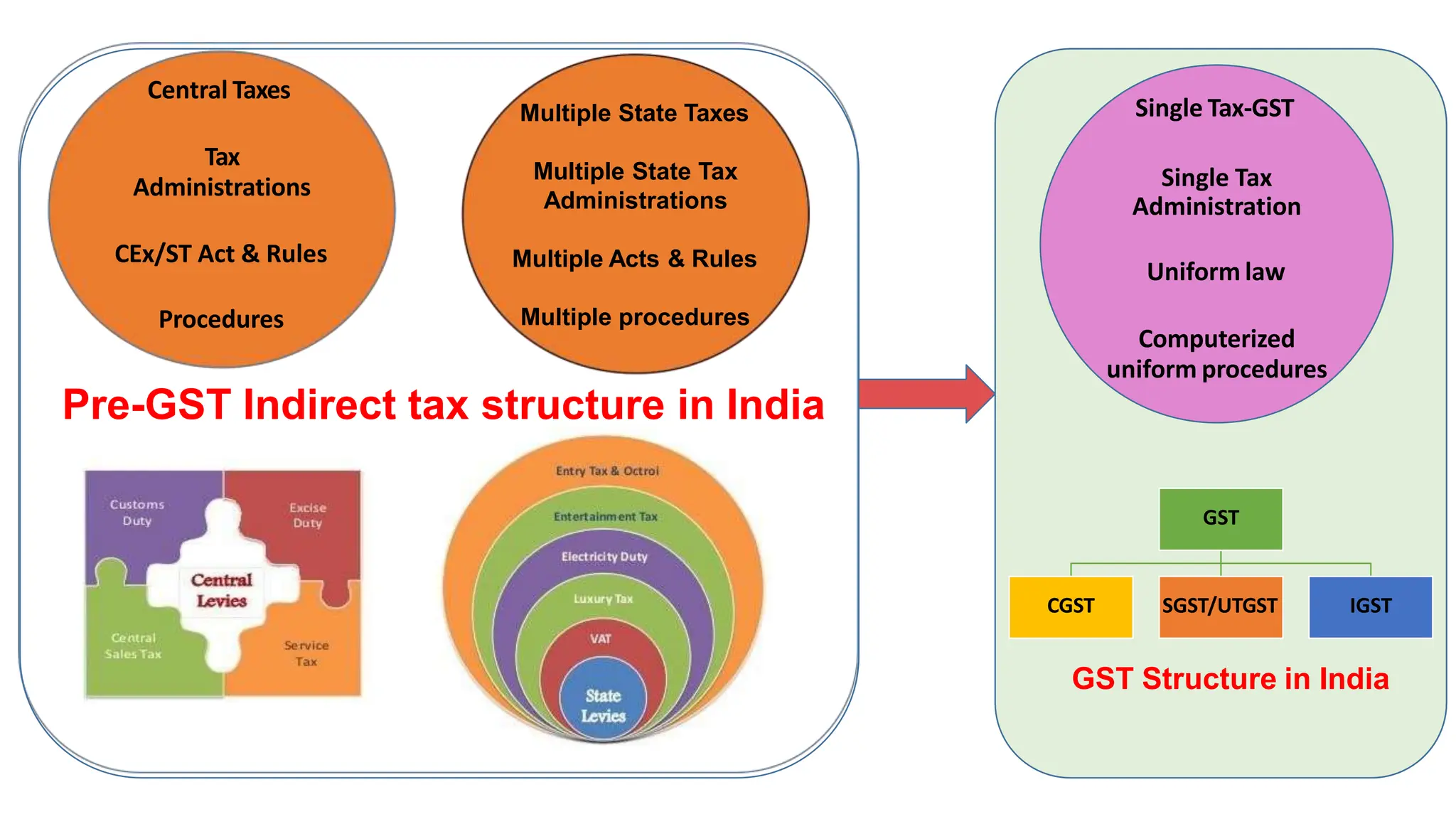
GST
CGST SGST/UTGST IGST
Pre-GST Indirect tax structure in India
Central Taxes
Tax
Administrations
CEx/ST Act & Rules
Procedures
GST
CGST SGST/UTGST IGST
Single Tax-GST
Single Tax
Administration
Uniform law
Computerized
uniform procedures
GST Structure in India
Multiple State Taxes
Multiple State Tax
Administrations
Multiple Acts & Rules
Multiple procedures
5
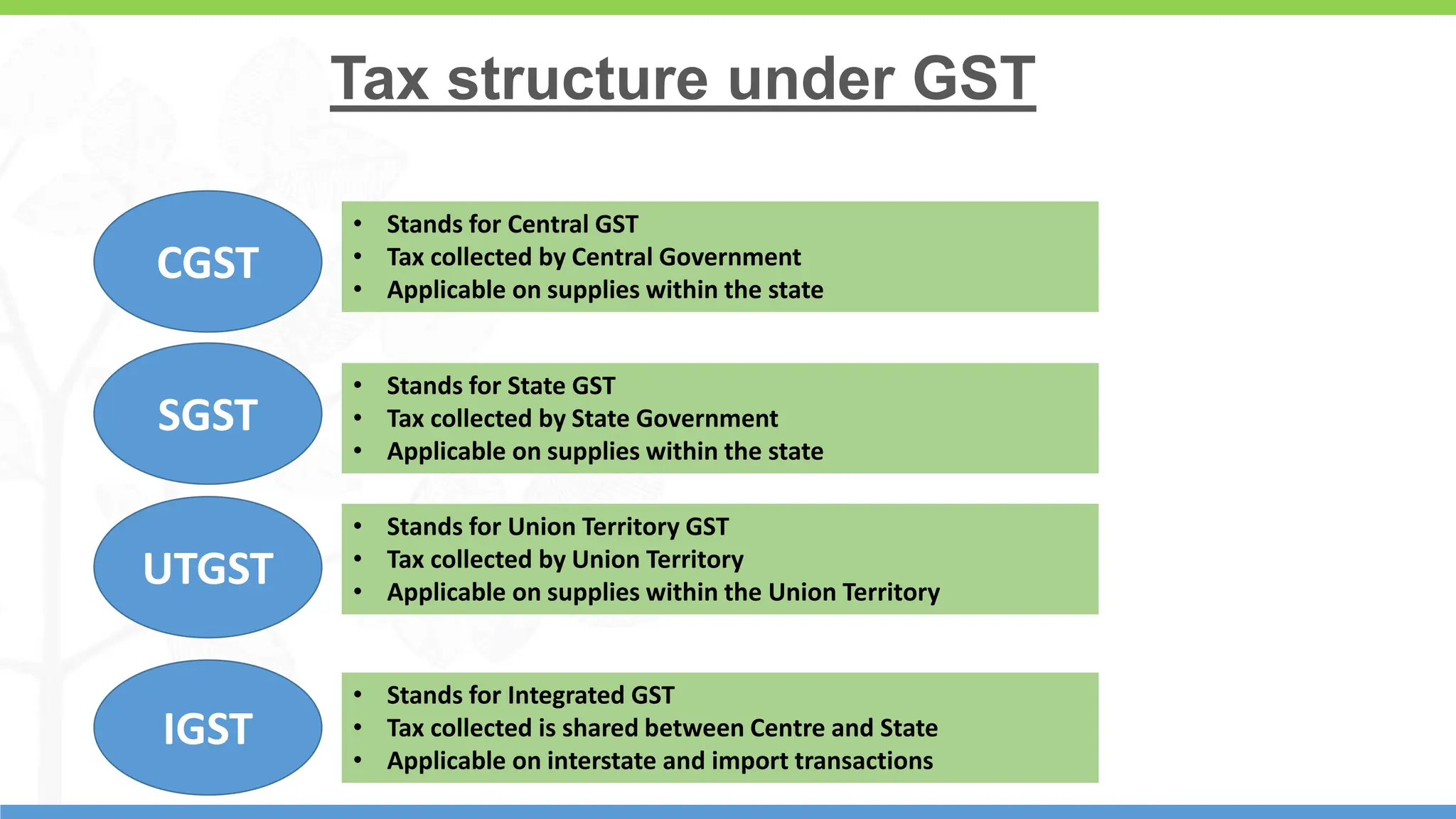
Tax structure under GST
SGST
IGST
• Stands for Central GST
• Tax collected by Central Government
• Applicable on supplies within the state
• Stands for State GST
• Tax collected by State Government
• Applicable on supplies within the state
• Stands for Integrated GST
• Tax collected is shared between Centre and State
• Applicable on interstate and import transactions
UTGST
• Stands for Union Territory GST
• Tax collected by Union Territory
• Applicable on supplies within the Union Territory
CGST
6
6
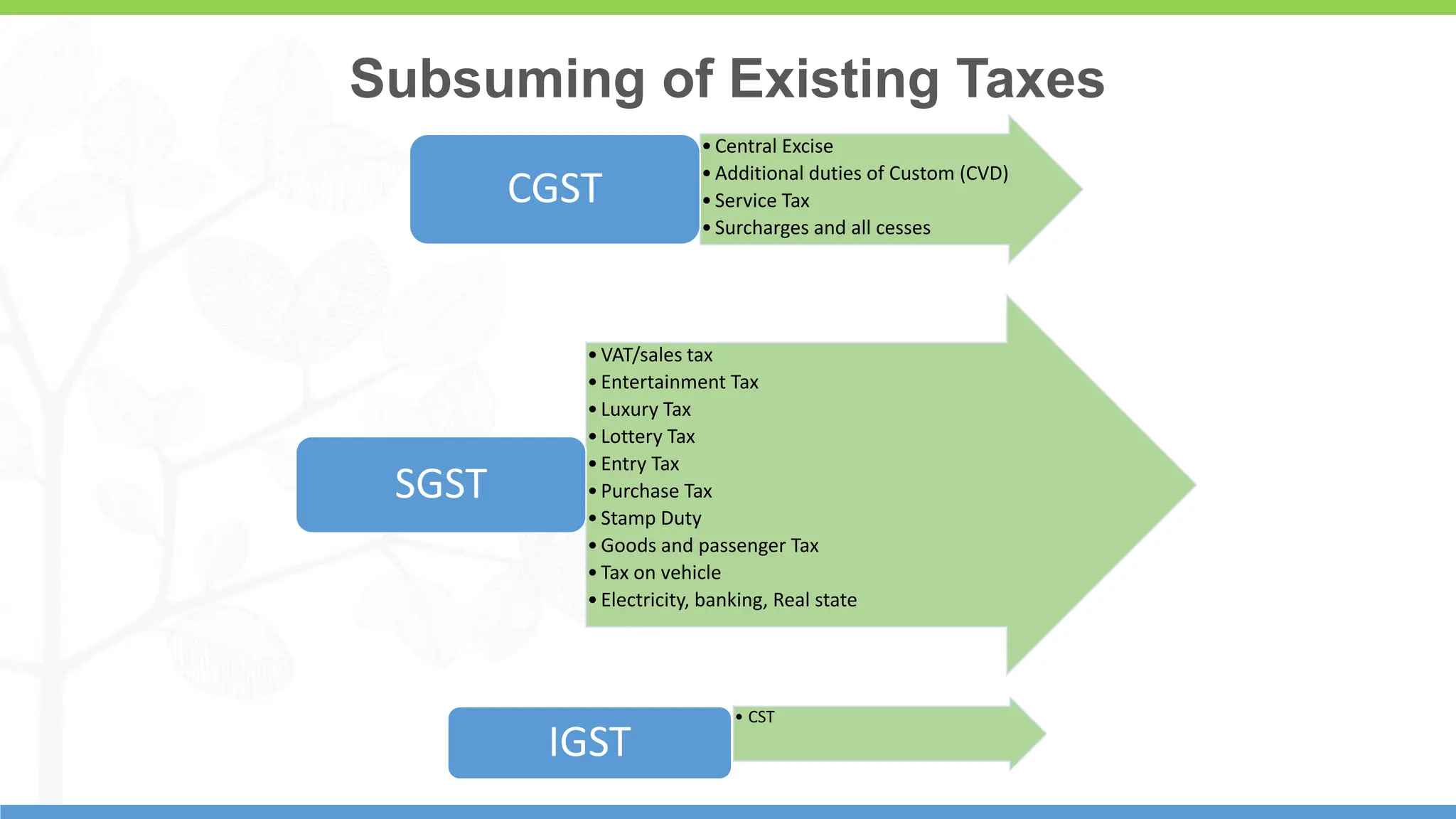
•Central Excise
•Additional duties of Custom (CVD)
•Service Tax
•Surcharges and all cesses
CGST
•VAT/sales tax
•Entertainment Tax
•Luxury Tax
•Lottery Tax
•Entry Tax
•Purchase Tax
•Stamp Duty
•Goods and passenger Tax
•Tax on vehicle
•Electricity, banking, Real state
SGST
• CST
IGST
Subsuming of Existing Taxes
7
7
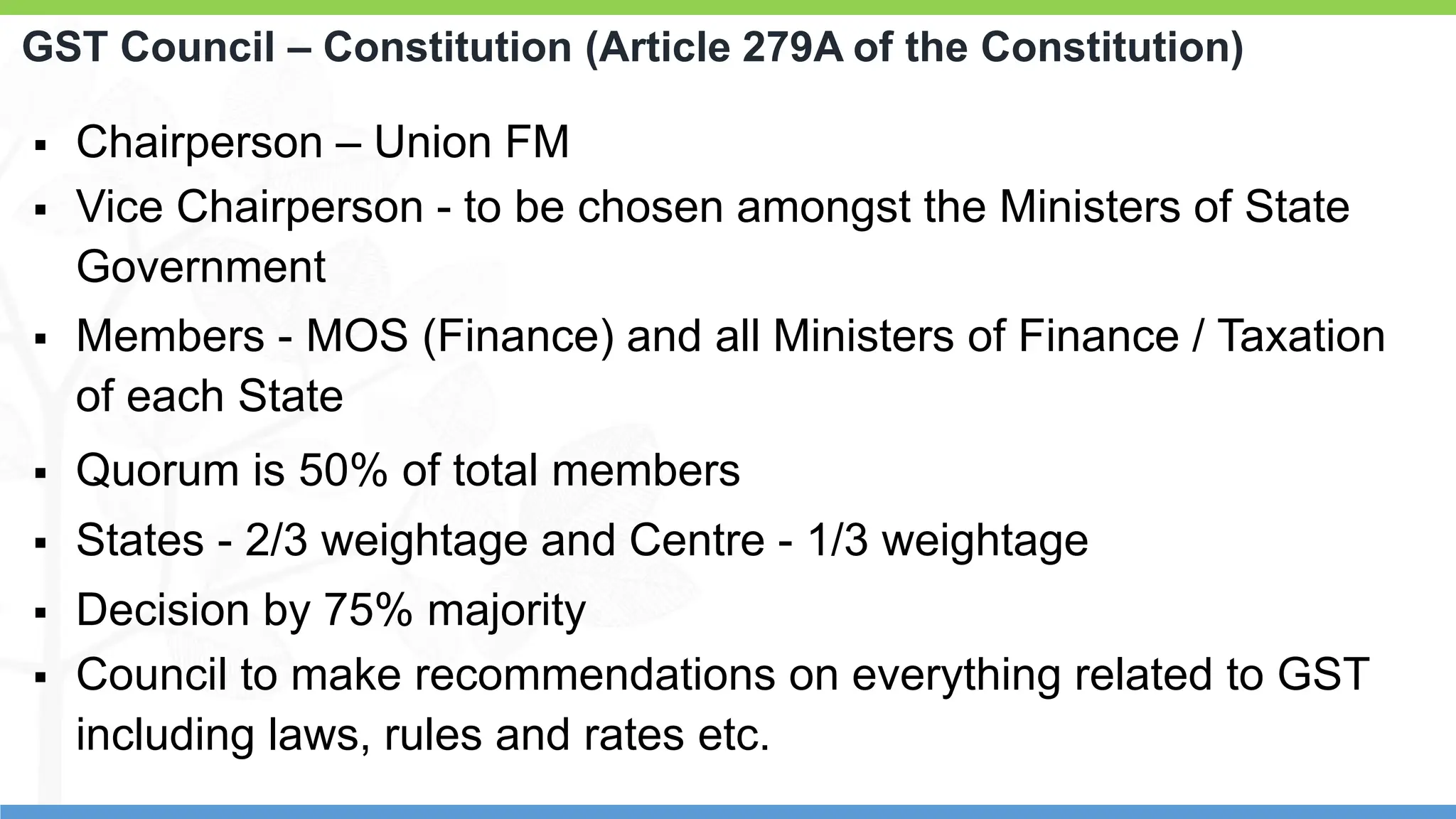
GST Council – Constitution (Article 279A of the Constitution)
 Chairperson – Union FM
 Vice Chairperson - to be chosen amongst the Ministers of State
Government
 Members - MOS (Finance) and all Ministers of Finance / Taxation
of each State
 Quorum is 50% of total members
 States - 2/3 weightage and Centre - 1/3 weightage
 Decision by 75% majority
 Council to make recommendations on everything related to GST
including laws, rules and rates etc.
8
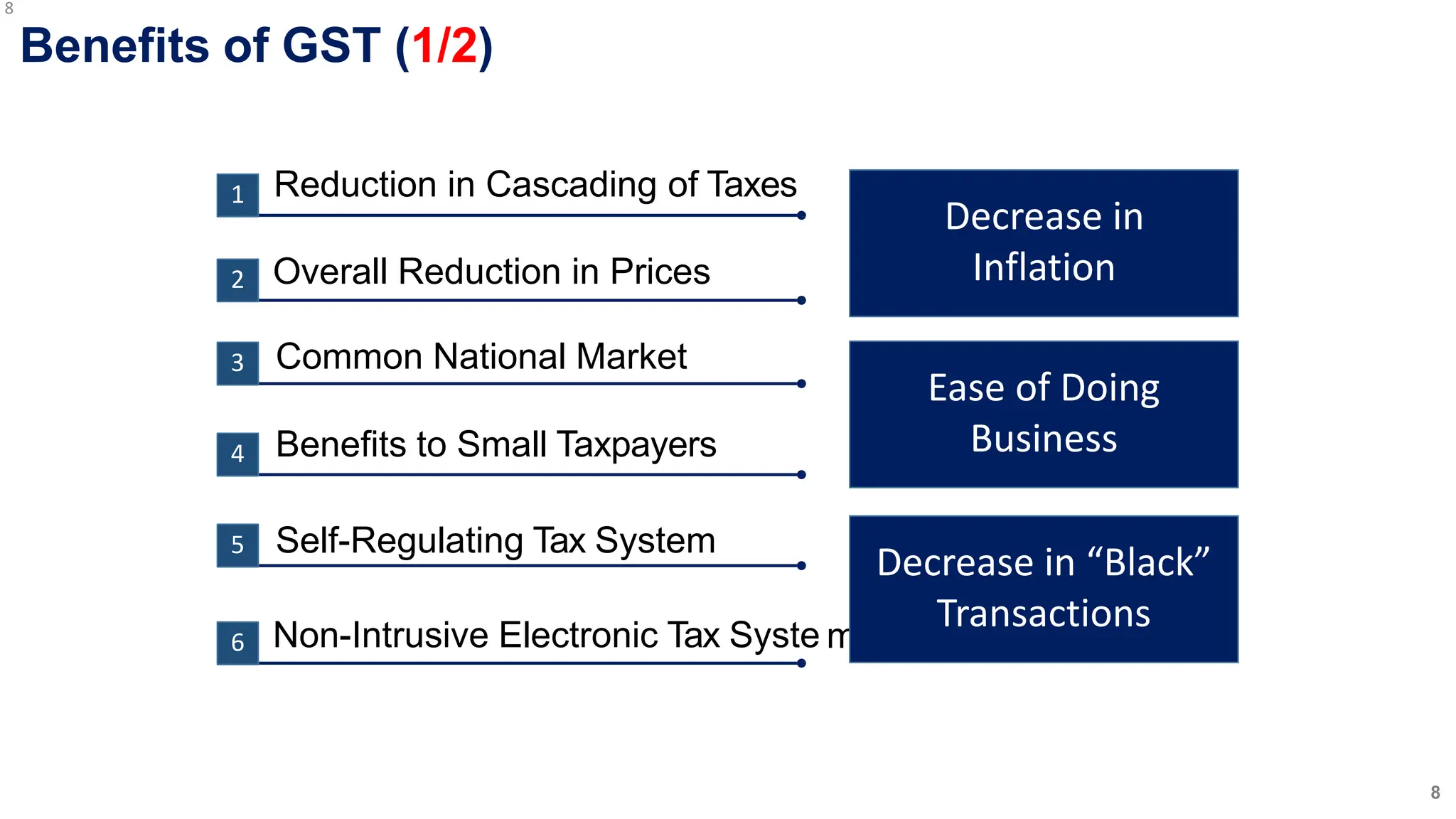
Benefits of GST (1/2)
1
2
3
4
5
Overall Reduction in Prices
Reduction in Cascading of Taxes
Common National Market
Benefits to Small Taxpayers
Self-Regulating Tax System
6
8
Non-Intrusive Electronic Tax Syste m
Decrease in
Inflation
Ease of Doing
Business
Decrease in “Black”
Transactions
9
9
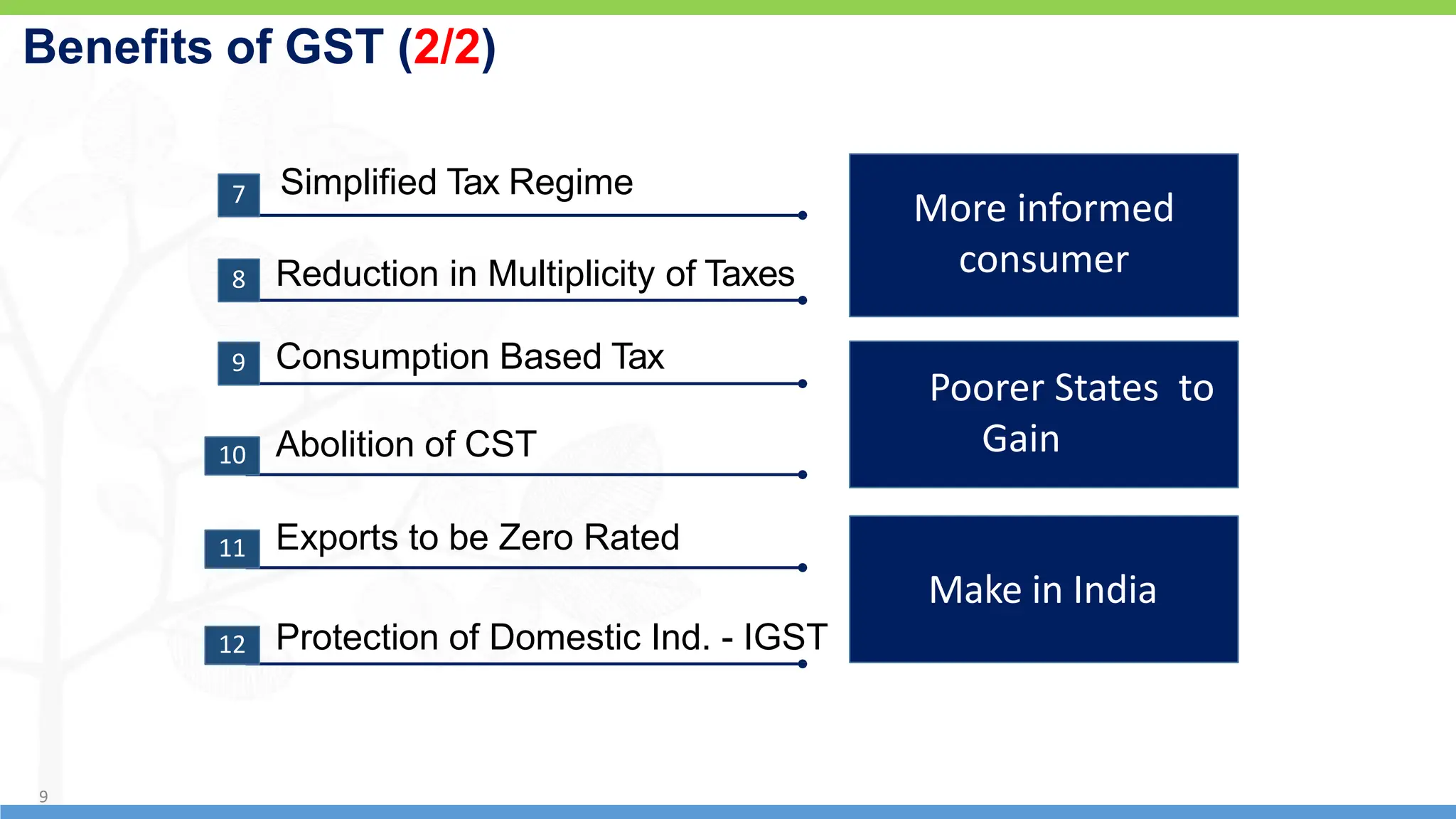
Benefits of GST (2/2)
7
8
9
10
Simplified Tax Regime
Reduction in Multiplicity of Taxes
Consumption Based Tax
Abolition of CST
More informed
consumer
Poorer States to
Gain
Make in India
11 Exports to be Zero Rated
12
9
Protection of Domestic Ind. - IGST
10
10
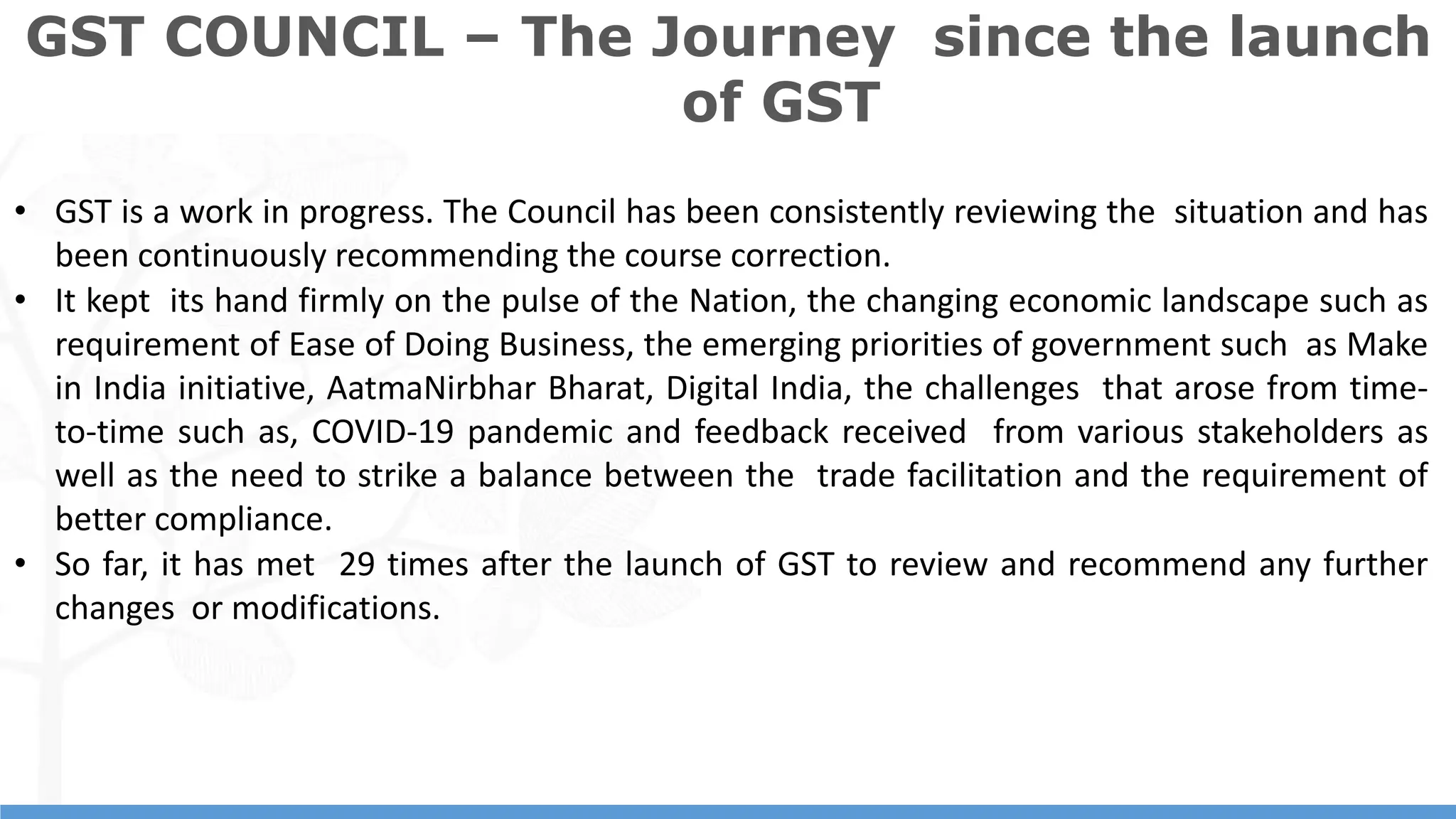
• GST is a work in progress. The Council has been consistently reviewing the situation and has
been continuously recommending the course correction.
• It kept its hand firmly on the pulse of the Nation, the changing economic landscape such as
requirement of Ease of Doing Business, the emerging priorities of government such as Make
in India initiative, AatmaNirbhar Bharat, Digital India, the challenges that arose from time-
to-time such as, COVID-19 pandemic and feedback received from various stakeholders as
well as the need to strike a balance between the trade facilitation and the requirement of
better compliance.
• So far, it has met 29 times after the launch of GST to review and recommend any further
changes or modifications.
GST COUNCIL – The Journey since the launch
of GST
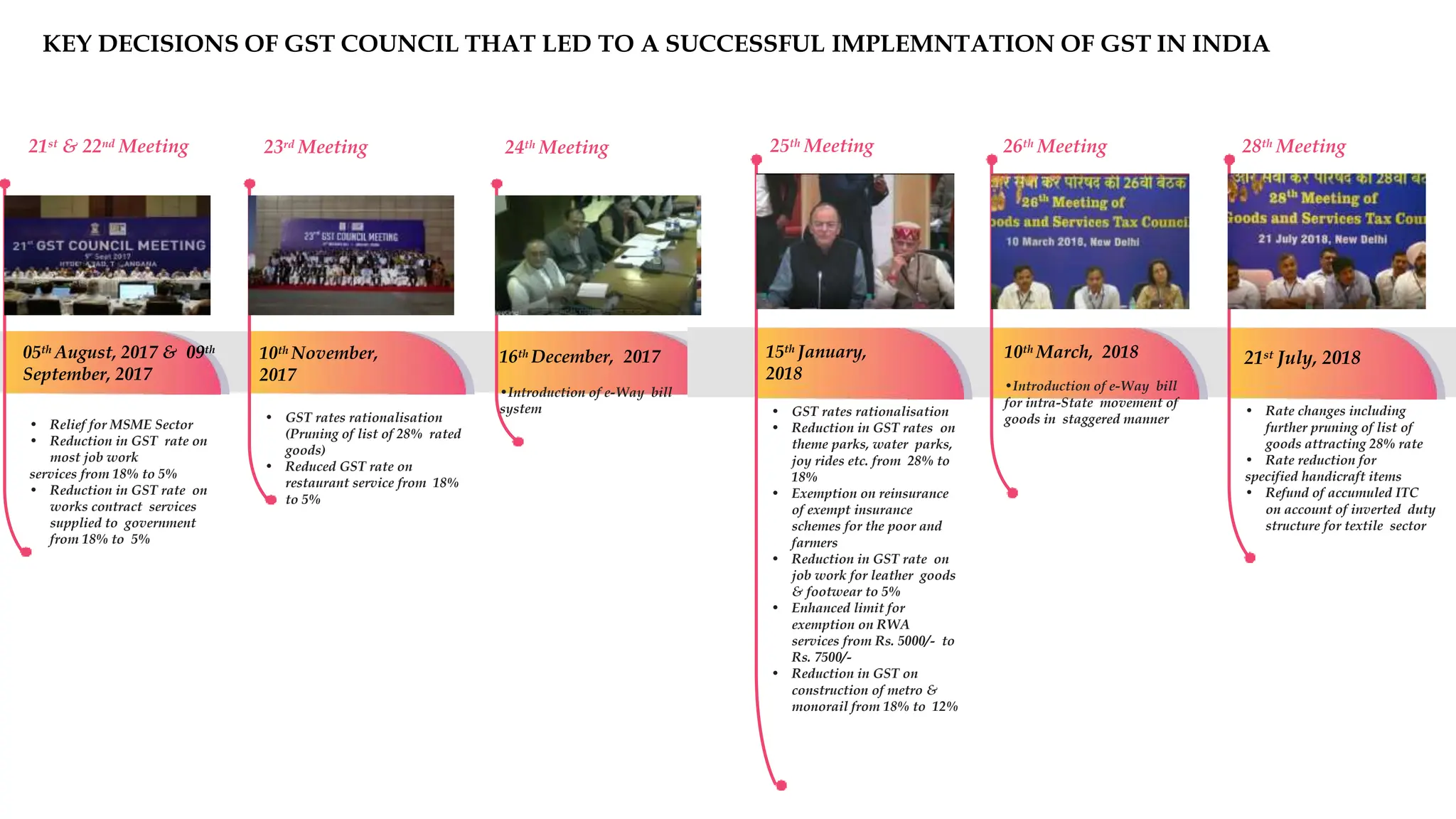
• GST rates rationalisation
(Pruning of list of 28% rated
goods)
• Reduced GST rate on
restaurant service from 18%
to 5%
• Relief for MSME Sector
• Reduction in GST rate on
most job work
services from 18% to 5%
• Reduction in GST rate on
works contract services
supplied to government
from 18% to 5%
21st & 22nd Meeting 23rd Meeting 24th Meeting
05th August, 2017 & 09th
September, 2017
10th November,
2017
16th December, 2017
•Introduction of e-Way bill
system • Rate changes including
further pruning of list of
goods attracting 28% rate
• Rate reduction for
specified handicraft items
• Refund of accumuled ITC
on account of inverted duty
structure for textile sector
• GST rates rationalisation
• Reduction in GST rates on
theme parks, water parks,
joy rides etc. from 28% to
18%
• Exemption on reinsurance
of exempt insurance
schemes for the poor and
farmers
• Reduction in GST rate on
job work for leather goods
& footwear to 5%
• Enhanced limit for
exemption on RWA
services from Rs. 5000/- to
Rs. 7500/-
• Reduction in GST on
construction of metro &
monorail from 18% to 12%
25th Meeting 26th Meeting 28th Meeting
15th January,
2018
10th March, 2018
•Introduction of e-Way bill
for intra-State movement of
goods in staggered manner
21st July, 2018
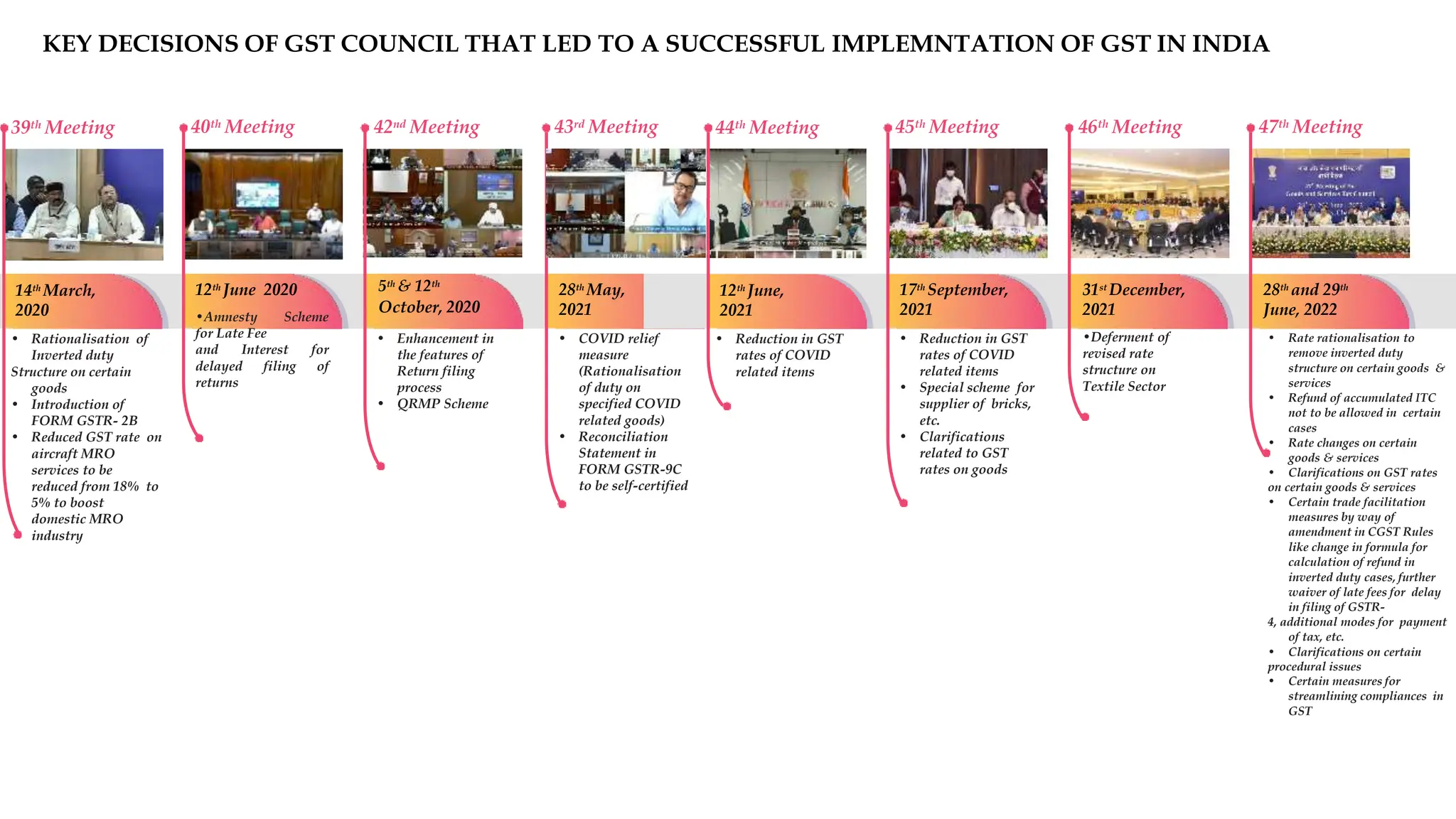
KEY DECISIONS OF GST COUNCIL THAT LED TO A SUCCESSFUL IMPLEMNTATION OF GST IN INDIA
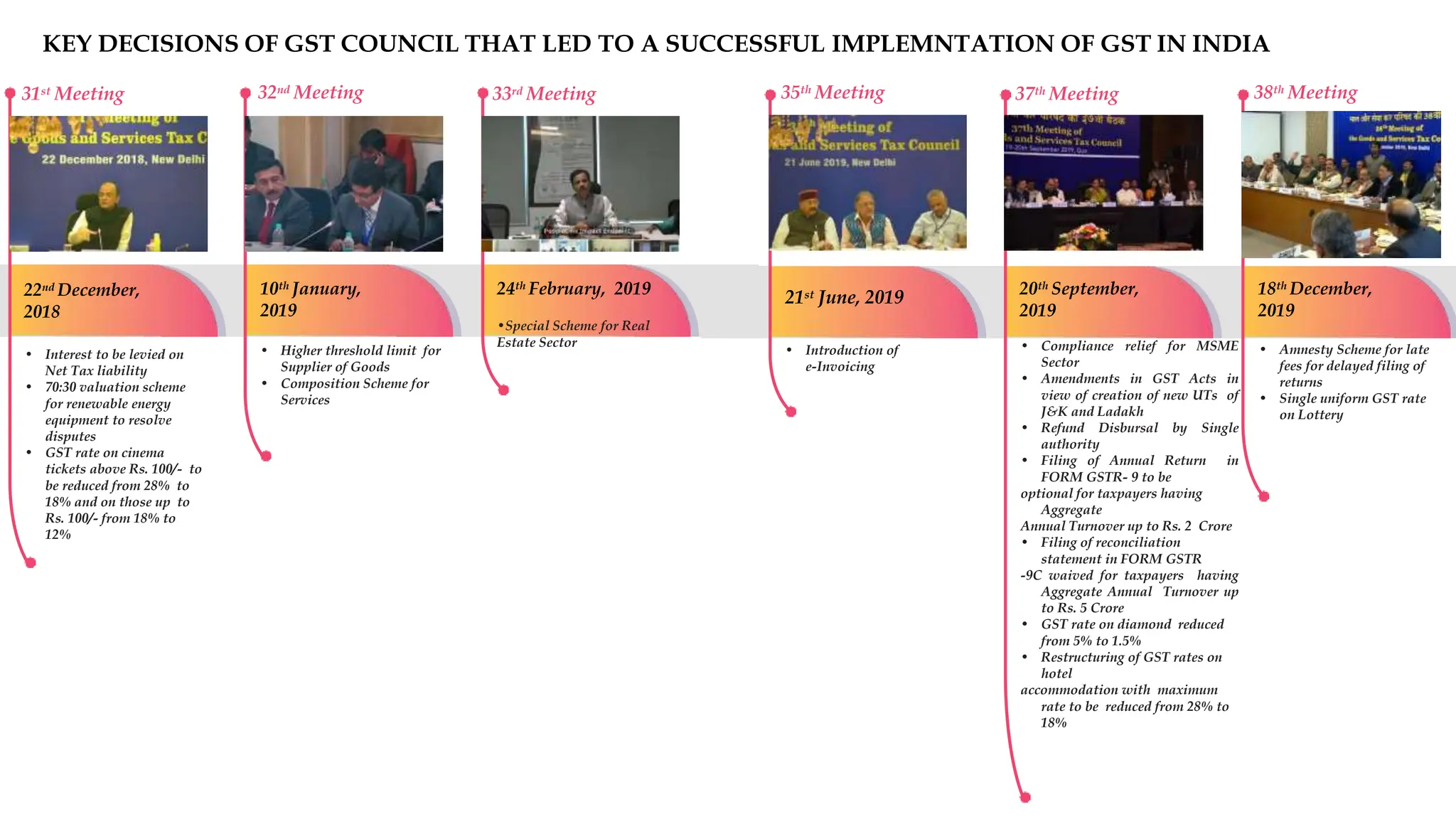
• Higher threshold limit for
Supplier of Goods
• Composition Scheme for
Services
• Interest to be levied on
Net Tax liability
• 70:30 valuation scheme
for renewable energy
equipment to resolve
disputes
• GST rate on cinema
tickets above Rs. 100/- to
be reduced from 28% to
18% and on those up to
Rs. 100/- from 18% to
12%
31st Meeting 32nd Meeting 33rd Meeting
22nd December,
2018
10th January,
2019
24th February, 2019
•Special Scheme for Real
Estate Sector • Compliance relief for MSME
Sector
• Amendments in GST Acts in
view of creation of new UTs of
J&K and Ladakh
• Refund Disbursal by Single
authority
• Filing of Annual Return in
FORM GSTR- 9 to be
optional for taxpayers having
Aggregate
Annual Turnover up to Rs. 2 Crore
• Filing of reconciliation
statement in FORM GSTR
-9C waived for taxpayers having
Aggregate Annual Turnover up
to Rs. 5 Crore
• GST rate on diamond reduced
from 5% to 1.5%
• Restructuring of GST rates on
hotel
accommodation with maximum
rate to be reduced from 28% to
18%
• Amnesty Scheme for late
fees for delayed filing of
returns
• Single uniform GST rate
on Lottery
• Introduction of
e-Invoicing
35th Meeting 37th Meeting 38th Meeting
21st June, 2019 20th September,
2019
18th December,
2019
KEY DECISIONS OF GST COUNCIL THAT LED TO A SUCCESSFUL IMPLEMNTATION OF GST IN INDIA
• Enhancement in
the features of
Return filing
process
• QRMP Scheme
• COVID relief
measure
(Rationalisation
of duty on
specified COVID
related goods)
• Reconciliation
Statement in
FORM GSTR-9C
to be self-certified
• Rationalisation of
Inverted duty
Structure on certain
goods
• Introduction of
FORM GSTR- 2B
• Reduced GST rate on
aircraft MRO
services to be
reduced from 18% to
5% to boost
domestic MRO
industry
39th Meeting 40th Meeting 42nd Meeting 43rd Meeting
14th
March,
2020
12th
June 2020
•Amnesty Scheme
for Late Fee
and Interest for
delayed filing of
returns
5th & 12th
October, 2020
28th
May,
2021
• Reduction in GST
rates of COVID
related items
• Special scheme for
supplier of bricks,
etc.
• Clarifications
related to GST
rates on goods
• Rate rationalisation to
remove inverted duty
structure on certain goods &
services
• Refund of accumulated ITC
not to be allowed in certain
cases
• Rate changes on certain
goods & services
• Clarifications on GST rates
on certain goods & services
• Certain trade facilitation
measures by way of
amendment in CGST Rules
like change in formula for
calculation of refund in
inverted duty cases, further
waiver of late fees for delay
in filing of GSTR-
4, additional modes for payment
of tax, etc.
• Clarifications on certain
procedural issues
• Certain measures for
streamlining compliances in
GST
• Reduction in GST
rates of COVID
related items
44th Meeting 45th Meeting 46th Meeting 47th Meeting
12th
June,
2021
17th
September,
2021
31st
December,
2021
•Deferment of
revised rate
structure on
Textile Sector
28th
and 29th
June, 2022
KEY DECISIONS OF GST COUNCIL THAT LED TO A SUCCESSFUL IMPLEMNTATION OF GST IN INDIA
14
14
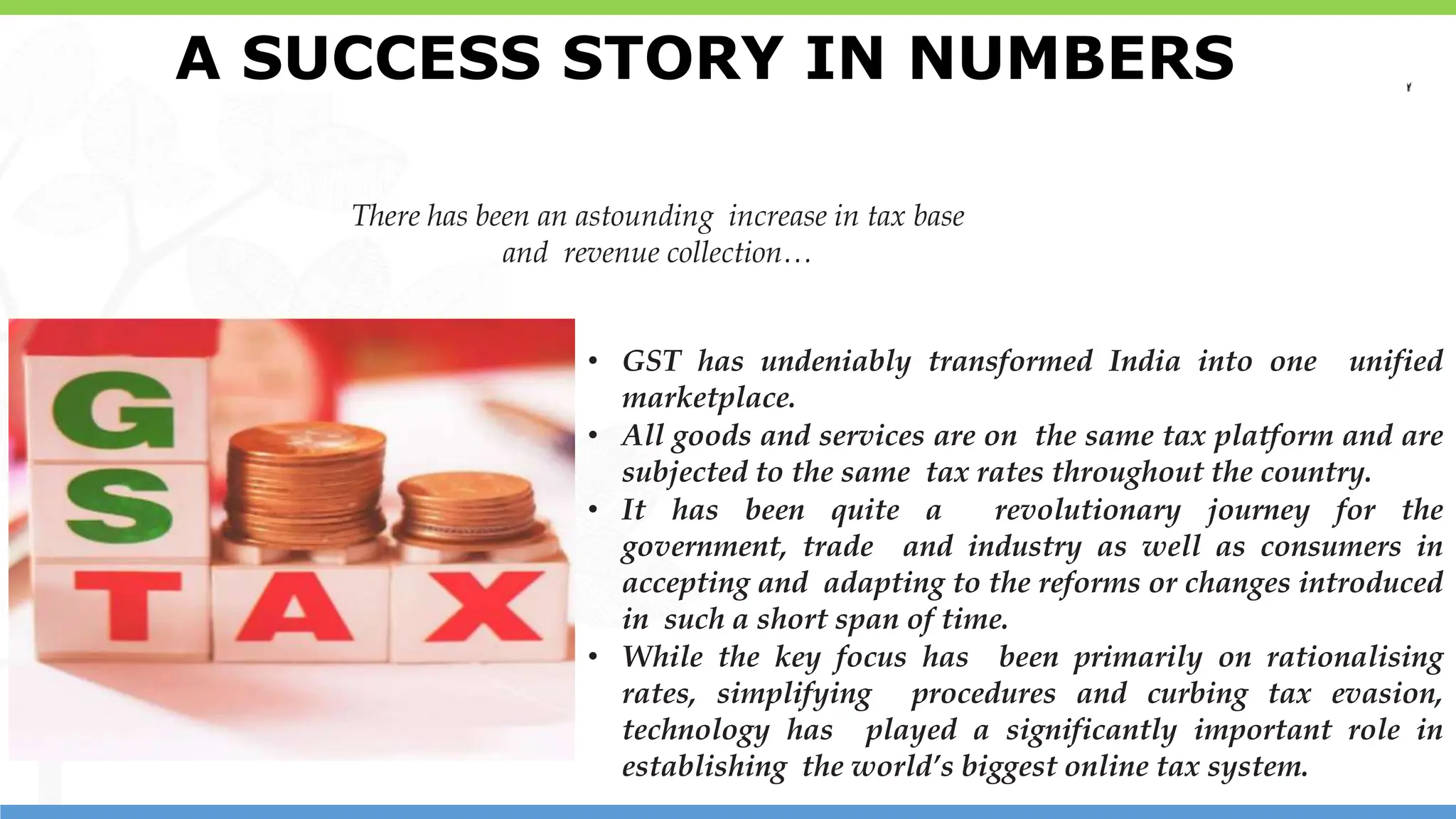
There has been an astounding increase in tax base
and revenue collection…
• GST has undeniably transformed India into one unified
marketplace.
• All goods and services are on the same tax platform and are
subjected to the same tax rates throughout the country.
• It has been quite a revolutionary journey for the
government, trade and industry as well as consumers in
accepting and adapting to the reforms or changes introduced
in such a short span of time.
• While the key focus has been primarily on rationalising
rates, simplifying procedures and curbing tax evasion,
technology has played a significantly important role in
establishing the world’s biggest online tax system.
A SUCCESS STORY IN NUMBERS
15
15
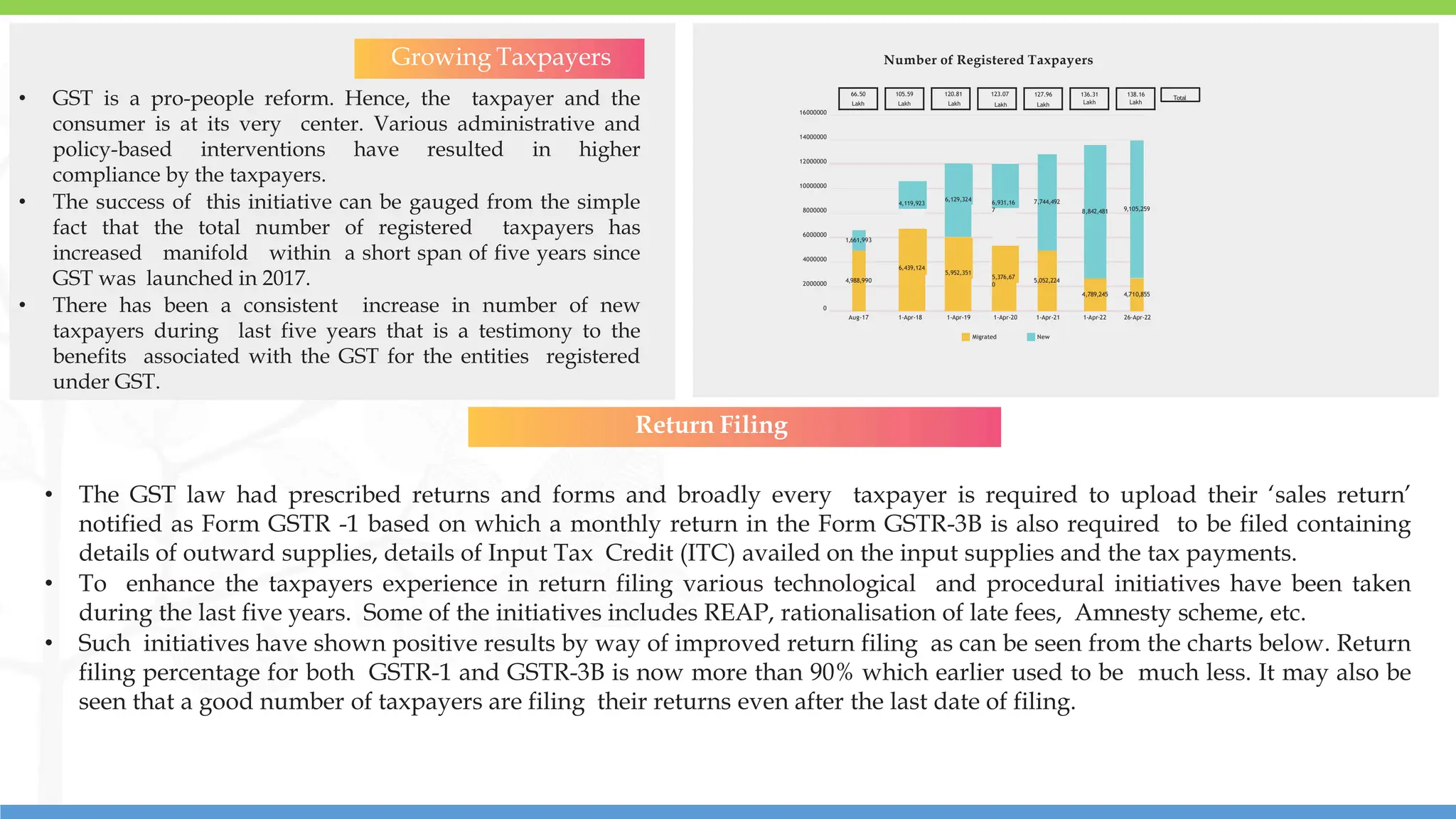
• GST is a pro-people reform. Hence, the taxpayer and the
consumer is at its very center. Various administrative and
policy-based interventions have resulted in higher
compliance by the taxpayers.
• The success of this initiative can be gauged from the simple
fact that the total number of registered taxpayers has
increased manifold within a short span of five years since
GST was launched in 2017.
• There has been a consistent increase in number of new
taxpayers during last five years that is a testimony to the
benefits associated with the GST for the entities registered
under GST.
• The GST law had prescribed returns and forms and broadly every taxpayer is required to upload their ‘sales return’
notified as Form GSTR -1 based on which a monthly return in the Form GSTR-3B is also required to be filed containing
details of outward supplies, details of Input Tax Credit (ITC) availed on the input supplies and the tax payments.
• To enhance the taxpayers experience in return filing various technological and procedural initiatives have been taken
during the last five years. Some of the initiatives includes REAP, rationalisation of late fees, Amnesty scheme, etc.
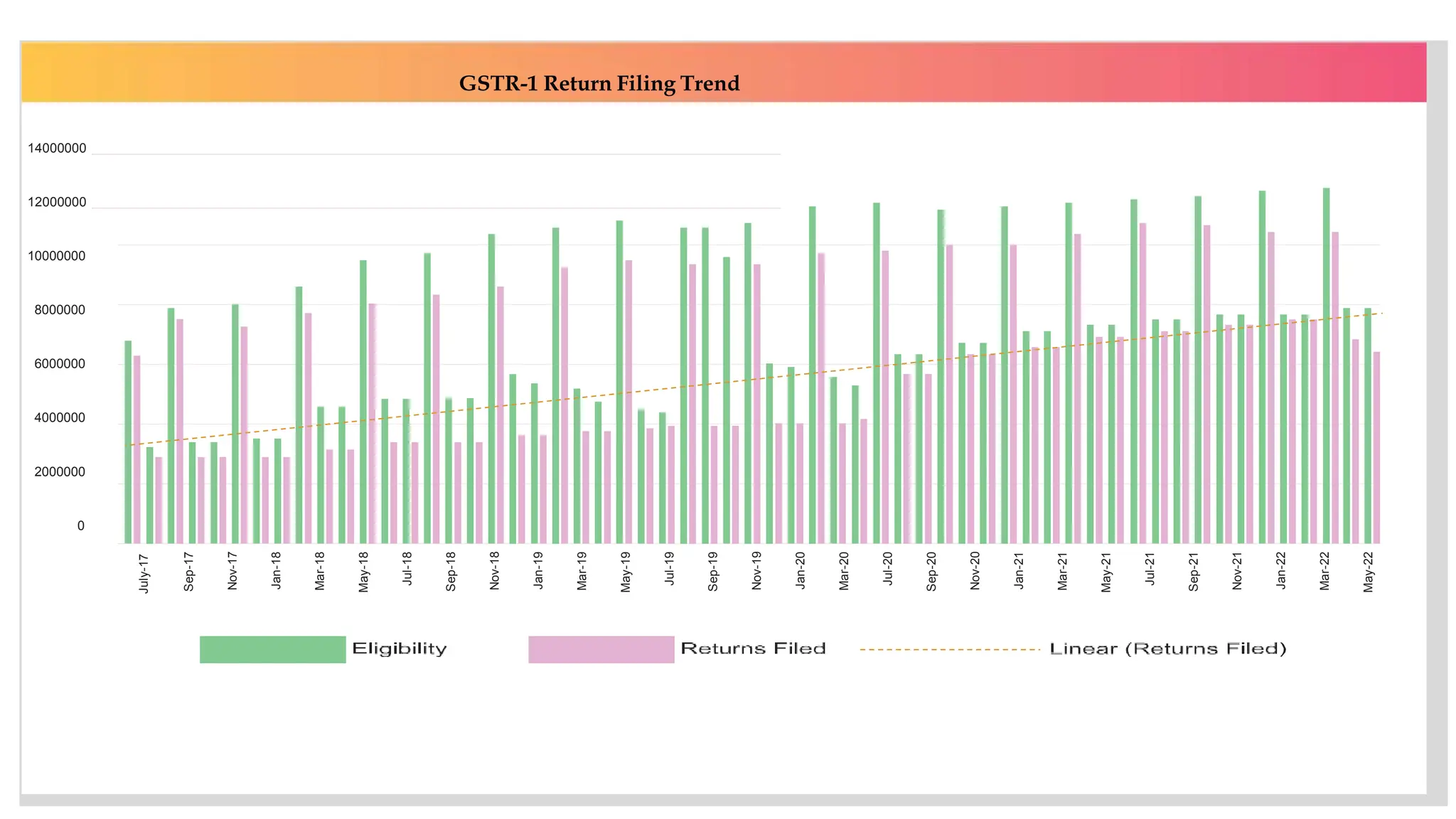
• Such initiatives have shown positive results by way of improved return filing as can be seen from the charts below. Return
filing percentage for both GSTR-1 and GSTR-3B is now more than 90% which earlier used to be much less. It may also be
seen that a good number of taxpayers are filing their returns even after the last date of filing.
Growing Taxpayers
Return Filing
16000000
14000000
12000000
10000000
8000000
6000000
4000000
2000000
0
1,661,993
4,988,990
6,439,124
4,119,923
5,952,351
6,129,324
6,931,16
7
5,376,67
0
5,052,224
7,744,492
8,842,481
4,789,245 4,710,855
9,105,259
Aug-17 1-Apr-18 1-Apr-19 1-Apr-20 1-Apr-21 1-Apr-22 26-Apr-22
Migrated New
66.50 105.59 120.81 123.07 127.96 136.31 138.16
Lakh Lakh Lakh Lakh Lakh Lakh Lakh
Total
Number of Registered Taxpayers
GSTR-1 Return Filing Trend
14000000
12000000
10000000
8000000
6000000
4000000
2000000
0
July-17
Sep-17
Nov-17
Jan-18
Mar-18
May-18
Jul-18
Sep-18
Nov-18
Jan-19
Mar-19
May-19
Jul-19
Sep-19
Nov-19
Jan-20
Mar-20
Jul-20
Sep-20
Nov-20
Jan-21
Mar-21
May-21
Jul-21
Sep-21
Nov-21
Jan-22
Mar-22
May-22
17
17
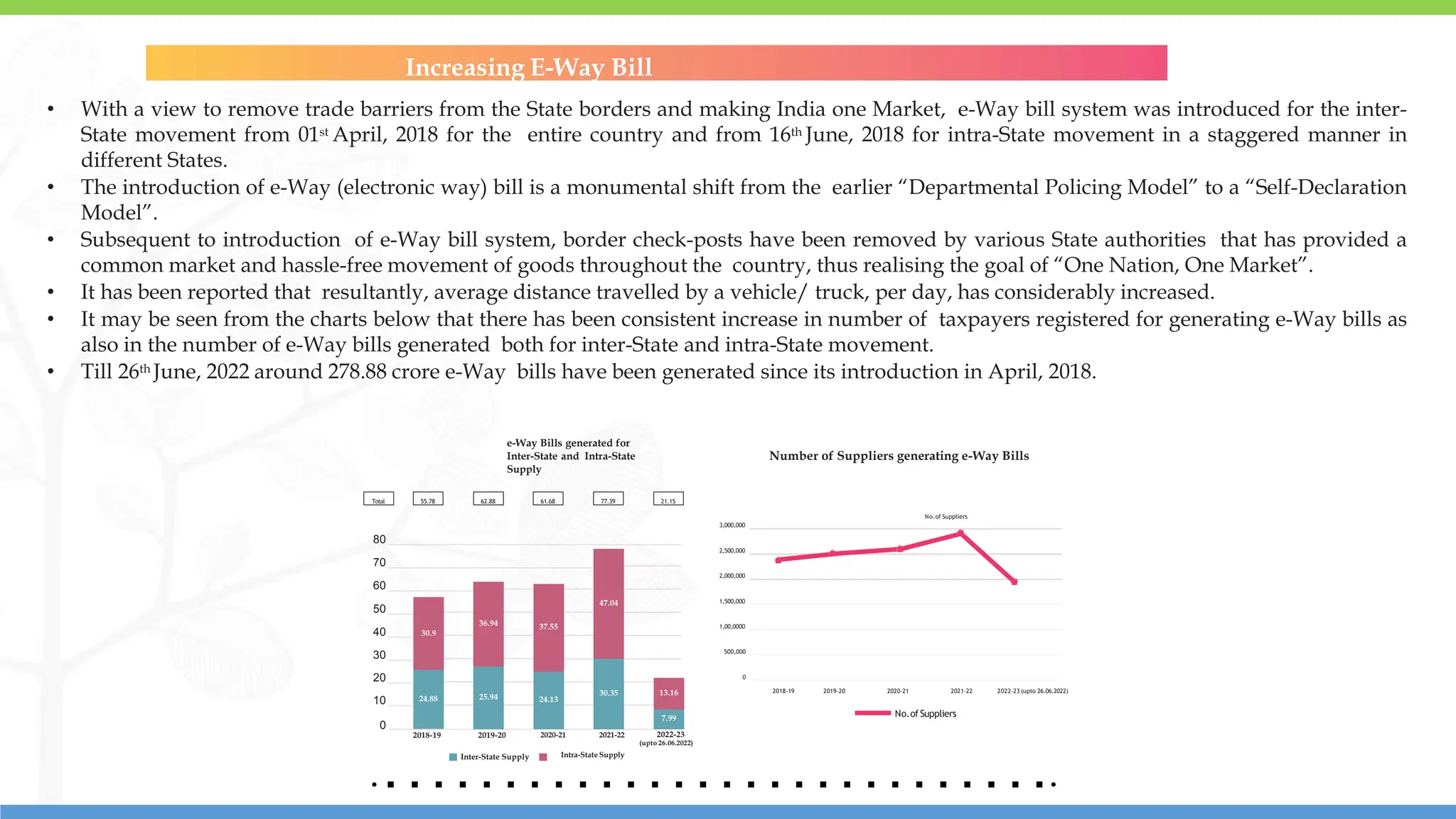
• With a view to remove trade barriers from the State borders and making India one Market, e-Way bill system was introduced for the inter-
State movement from 01st April, 2018 for the entire country and from 16th June, 2018 for intra-State movement in a staggered manner in
different States.
• The introduction of e-Way (electronic way) bill is a monumental shift from the earlier “Departmental Policing Model” to a “Self-Declaration
Model”.
• Subsequent to introduction of e-Way bill system, border check-posts have been removed by various State authorities that has provided a
common market and hassle-free movement of goods throughout the country, thus realising the goal of “One Nation, One Market”.
• It has been reported that resultantly, average distance travelled by a vehicle/ truck, per day, has considerably increased.
• It may be seen from the charts below that there has been consistent increase in number of taxpayers registered for generating e-Way bills as
also in the number of e-Way bills generated both for inter-State and intra-State movement.
• Till 26th June, 2022 around 278.88 crore e-Way bills have been generated since its introduction in April, 2018.
Increasing E-Way Bill
e-Way Bills generated for
Inter-State and Intra-State
Supply
Number of Suppliers generating e-Way Bills
3,000,000
2,500,000
2,000,000
1,500,000
1,00,0000
500,000
No.of Suppliers
0
2018-19 2019-20 2020-21 2021-22 2022-23 (upto 26.06.2022)
No.of Suppliers
80
70
60
50
30
20
10
2018-19 2019-20
40 30.9
24.88
36.94
25.94
37.55
24.13
47.04
30.35 13.16
7.99
2020-21 2021-22
Intra-State Supply
2022-23
(upto 26.06.2022)
Inter-State Supply
0
55.78
Total 62.88 61.68 77.39 21.15
18
18
• e-Invoicing was introduced for taxpayers with aggregate annual
turnover of more than Rs. 500 crore from October, 2020 for B2B
transactions and for export invoices,
• The said turnover limit has been reduced over a period of time
and presently the taxpayers having aggregate annual turnover of
more than Rs. 20 crore are required to generate e-Invoice w.e.f. 01st
April, 2022. e-Invoicing is a rapidly expanding technology which
helps taxpayers in backward integration and automation of tax
relevant processes.
• It also helps tax authorities in combating the menace of tax
evasion.
• This help in seamless flow of credit and invoice matching as
envisaged in the GST regime.
• Further, it helps in real-time updation of data on the GSTN system
and thereby, drastically reducing the time taken in filing the
returns.
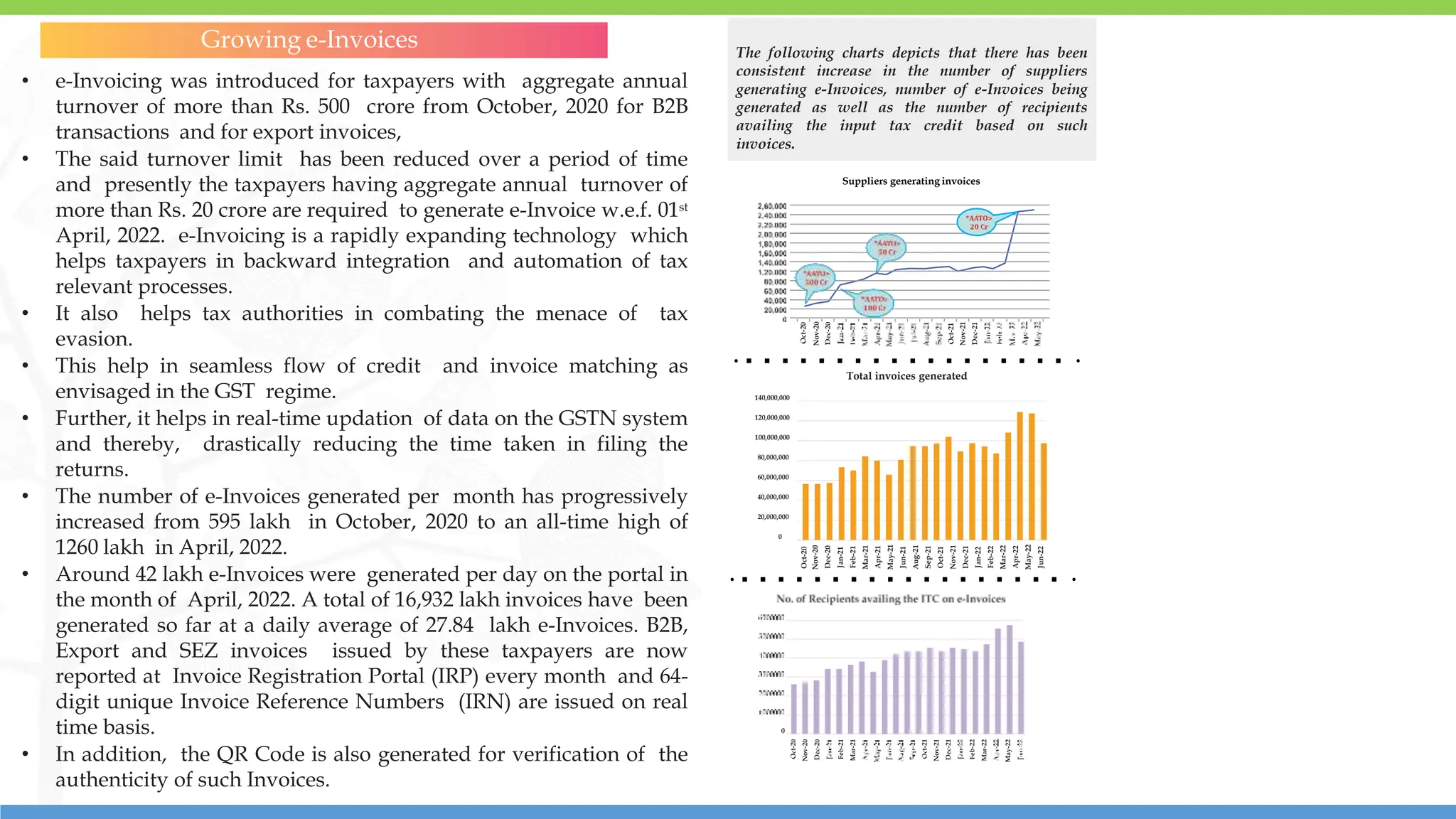
• The number of e-Invoices generated per month has progressively
increased from 595 lakh in October, 2020 to an all-time high of
1260 lakh in April, 2022.
• Around 42 lakh e-Invoices were generated per day on the portal in
the month of April, 2022. A total of 16,932 lakh invoices have been
generated so far at a daily average of 27.84 lakh e-Invoices. B2B,
Export and SEZ invoices issued by these taxpayers are now
reported at Invoice Registration Portal (IRP) every month and 64-
digit unique Invoice Reference Numbers (IRN) are issued on real
time basis.
• In addition, the QR Code is also generated for verification of the
authenticity of such Invoices.
Growing e-Invoices The following charts depicts that there has been
consistent increase in the number of suppliers
generating e-Invoices, number of e-Invoices being
generated as well as the number of recipients
availing the input tax credit based on such
invoices.
69
Suppliers generating invoices
140,000,000
120,000,000
100,000,000
80,000,000
60,000,000
40,000,000
20,000,000
0
Oct-20
Nov-20
Dec-20
Jan-21
Feb-21
Mar-21
Apr-21
May-21
Jun-21
Aug-21
Sep-21
Oct-21
Nov-21
Dec-21
Jan-22
Feb-22
Mar-22
Apr-22
May-22
Jun-22
Total invoices generated
19
19
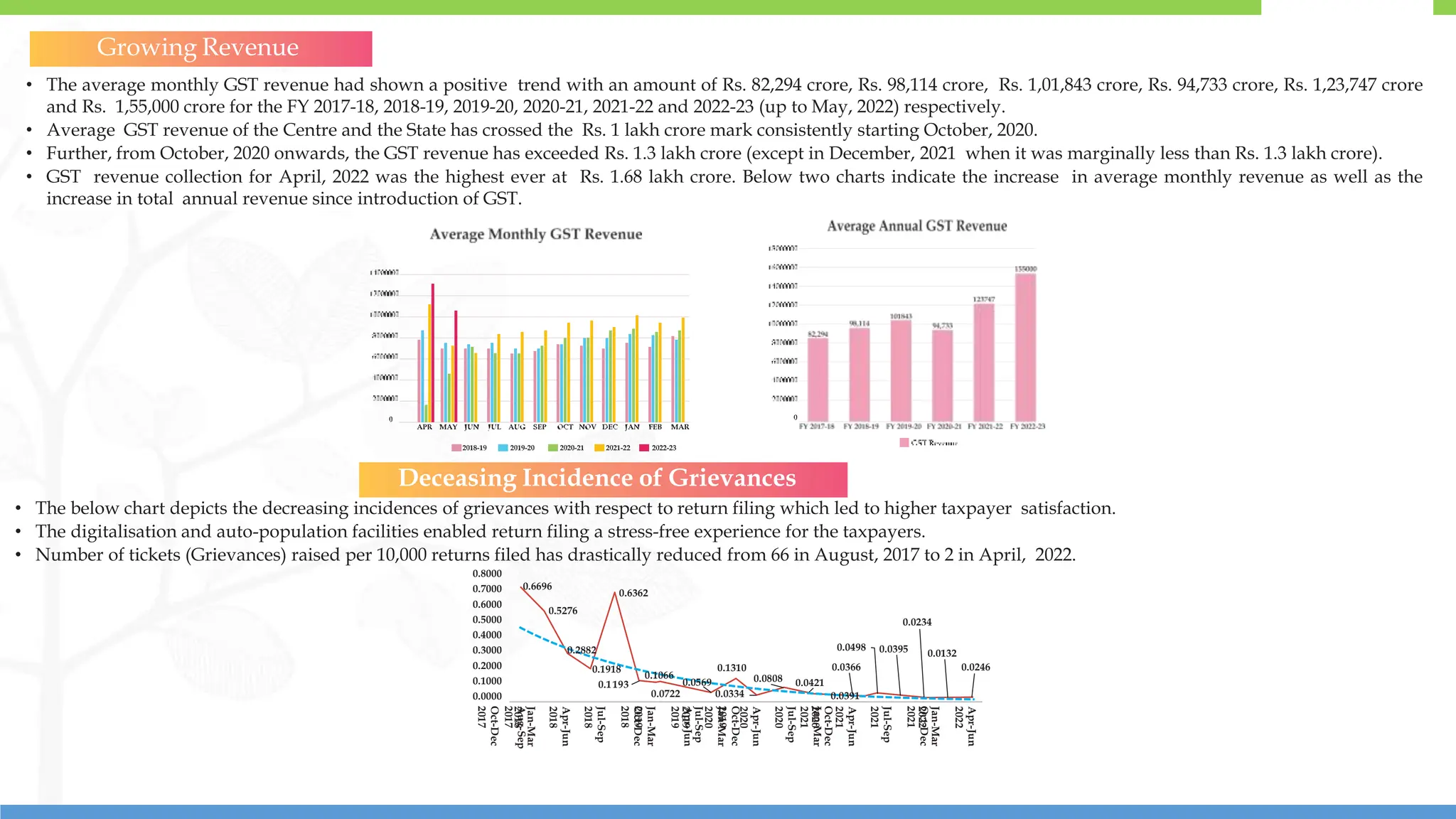
• The average monthly GST revenue had shown a positive trend with an amount of Rs. 82,294 crore, Rs. 98,114 crore, Rs. 1,01,843 crore, Rs. 94,733 crore, Rs. 1,23,747 crore
and Rs. 1,55,000 crore for the FY 2017-18, 2018-19, 2019-20, 2020-21, 2021-22 and 2022-23 (up to May, 2022) respectively.
• Average GST revenue of the Centre and the State has crossed the Rs. 1 lakh crore mark consistently starting October, 2020.
• Further, from October, 2020 onwards, the GST revenue has exceeded Rs. 1.3 lakh crore (except in December, 2021 when it was marginally less than Rs. 1.3 lakh crore).
• GST revenue collection for April, 2022 was the highest ever at Rs. 1.68 lakh crore. Below two charts indicate the increase in average monthly revenue as well as the
increase in total annual revenue since introduction of GST.
Growing Revenue
• The below chart depicts the decreasing incidences of grievances with respect to return filing which led to higher taxpayer satisfaction.
• The digitalisation and auto-population facilities enabled return filing a stress-free experience for the taxpayers.
• Number of tickets (Grievances) raised per 10,000 returns filed has drastically reduced from 66 in August, 2017 to 2 in April, 2022.
Deceasing Incidence of Grievances
0.8000
0.7000
0.6000
0.5000
0.4000
0.3000
0.2000
0.1000
0.0000
0.6696
0.5276
0.6362
0.1310
0.0808
0.0334
0.0421
0.0498
0.0366
0.0395 0.0132
0.0234
0.0246
Aug-Sep
2017
Oct-Dec
2018
Jul-Sep
2018
Apr-Jun
2018
Jan-Mar
2018
Oct-Dec
2017
Apr-Jun
2019
Jan-Mar
2019
Oct-Dec
2019
Jul-Sep
2019
Oct-Dec
2020
Jul-Sep
2020
Apr-Jun
2020
Jan-Mar
2020
Oct-Dec
2021
Jul-Sep
2021
Apr-Jun
2021
Jan-Mar
2021
Apr-Jun
2022
Jan-Mar
2022
0.2882
0.0391
0.0569
0.1066
0.0722
0.1918
0.1193
20
20
20
• Indian Goods and Services Tax (GST) completes five year on 30 June 2022.
• GST subsumes many taxes from the Union as well as State tax bases.
• Revenue assessment of the GST with reference to revenue that is subsumed into GST is important to assess the success
of the GST in terms of revenue protection for the Union as well as state governments.
• Revenue uncertainty associated with any tax reform is a major concern for all participating governments and therefore
the assurance of revenue protection given by the Union government to states helped to achieve broad consensus in
favor of GST.
• Sustaining the revenue stream at least at the level prevalent prior to GST reform is important to meet the expenditure
demands of respective governments. Unlike state governments, the Union government does not enjoy revenue
protection in the GST regime.
• However, the Union government enjoys taxation power to levy taxes to protect revenue.
Conclusions
21
21
21
• Goods and services tax is currently going under tremendous pressure to go through some of the burnings and solution-seeking
problems of the year-old implemented indirect tax regime. The finance ministry, as well as the GST council, needs to take care
of the GST return filing issues and forms related consequences that have to be faced by the taxpayers alike.
• Let us discuss and find those priority topics of GST on which the GST council and the finance ministry must work
immediately:
• September Return Due Dates
• It might be wrong to the taxpayers as they cannot claim the ITC before matching the invoice, for the date being shortened
to October 20th. Also, the credit of ITC claimed or unclaimed is to be claimed or reversed according to the filing dates, so
the dates must be extended.
• Credit Reversal
• The credit claimed on the purchases in which the payment has not been given to the suppliers within the 180 days must
be reversed. And to keep a note of these things may indulge an extra burden on the organization.
Technical GST Issues for Indian Taxpayers
22
22
22
• Some Pertinent Issues for Small Traders
• GST implies additional operational costs for Small businesses. In a developing country like ours, not all SMEs will be able
to afford the cost of computers and accountants required to implement GST (make bills and file tax returns). 28% GST rate
on some products like plywood, automobile parts, and electronic items forces potential buyers to opt for unregistered
dealers.
• It is too difficult to assign MRP to handmade products like local shoes, Banarasi Sarees, etc. Most small artisans are
illiterate and therefore unable to write MRP on their products and/or do any paperwork. Dealers are confused about how to
rate such products.
• Small businesses that have a small turnover and need not pay GST face trust issues. Buyers demand bills from even those
sellers who are exempted from GST. Without proof of a certificate of GST exemption, small shop owners find themselves
stranded and immobile.
• Issues for E-commerce Companies
• E-commerce giants like Flipkart, Amazon also have not escaped the aftereffects of GST rollout. TCS has to be collected by
the e-commerce companies from the sellers at the time of payment.
• The capital blockage will hamper day to day operational costs due to TCS provisions. The GST council has fixed the 1 per
cent TCS over the deduction made while payment to the sellers.
23
23
23
• GST and Fiscal Fractures
• The GST revenue shortfall promises large dents in the Centre and states’ fiscal applecart. The Center and State budgets
will be pegged down by the gap in Tax revenue. The common man will find himself on the receiving end if such a gap in
revenue continues. To bring states on the same wavelength and approve GST, the government had offered state
compensations to the tune of Rs 60,000 crore for July to March in FY18. In order to stay true to its pre-GST promises, it is
estimated the Central Government will have to make payment to the tune of Rs 90,000 crore further in FY19.
• Understandably, the Budget 2018 unleashed record taxation of over Rs 90,000 crore in the form of capital gains tax,
increase in customs duty, cess and surcharge. The fall in revenue has further made states apprehensive about bringing
petroleum products and real estate under the GST ambit.
• Adapting to The IT Ecosystem is Hard
• Indian economy is majorly driven by small business units i.e SMEs. It will be unfair to expect small-scale business firms
to make the transition to an online IT platform and expect no errors in return filing. It is an uphill task for the majority of
our working population which has little hands-on experience with IT solutions. The cost of SRP deployment is a major
concern for micro-small-medium scale enterprises.
24
24
24
• The real challenge posed by GST arises from the adverse impact on the very large unorganised sector. The second challenge is
the presence of a large black economy in the organised sector and the resultant low direct tax-to-GDP ratio, forcing the
government to try to collect more and more from indirect taxes like GST.
• The direction for reform is clear. GST is a last-point tax – collected at the point of final sale. So, why not levy it on the MRP of
the final product and collect it at the last point rather than at each stage of production and distribution. This would bring about
simplicity, eliminate problems due to input credit, e-way bills, reverse charge, filing of hundreds of forms, inverted duty
structure, etc. The disadvantage the unorganised sector faces and demand shifting away from it would be eliminated, leading to
higher growth and buoyant employment.
• The proponents of the present structurally flawed GST would argue that black income generation would increase if ITC, the
many forms that are filled and e-way bills are eliminated. To the contrary, a simplified structure would reduce inspector raj,
enable easier detection of fraud and therefore reduction in black income generation. Since 95% of the GST is collected from
5% of the units that would be much easier to monitor and check black income generation.
• The argument that India absolutely must have a GST regime, just because it exists in so many other countries is fallacious. The
Indian economy is unlike other large economies and has its own issues which the present partial form of GST is aggravating
rather than resolving. One cannot turn the clock back, but with five years of dealing with GST, it is clear that it needs a
structural revamp.
Revamp required

Understanding GST in India: A Comprehensive Guide

  • 1.
  • 2.
    2 2 The Journey toGST Announcement of GST for the first time was made by the then Union Finance Minister, during budget of 2006-07 that it would introduced from 1 April 2010 2006 First Discussion Paper was released by the Empowered Committee 2009 Constitution (115th Amendment) Bill introduced and subsequently lapsed 2011 The Constitution (122nd Amendment) Bill was introduced in the Lok Sabha 2014 Aug 2016 The Constitution (One First was Hundred and Amendment) Act enacted March 2017 GST Council Recommends the CGST, SGST, IGST, UTGST and Compensation Cess Act April 2017 CGST, IGST, UTGST and Compensation Cess Acts passed All except passed States J&K their SGST ACT May 2017 GST Launched 1st July 2017 1st GST Council Meeting Sep 2016 30th June 2017 2 GST Council recommends all the rules SGST Act passed by J&K; CGST and IGST Ordinances promulgated to extend GST to J&K 8th July 2017 Journey Continues…
  • 3.
    3 3 Existing Indirect TaxStructure in India Constitution amended to provide concurrent powers to both Centre & States to levy GST (Centre to tax sale of goods and States to tax provision of services) • Central Excise duty • Additional duties of excise • Excise duty levied under Medicinal & Toilet Preparation Act • Additional duties of customs (CVD & SAD) • Service Tax • Surcharges & Cesses • State VAT / Sales Tax • Central Sales Tax • Purchase Tax • Entertainment Tax (other than those levied by local bodies) • Luxury Tax • Entry Tax (All forms) • Taxes on lottery, betting & gambling • Surcharges & Cesses Central Taxes State Taxes GST 3
  • 4.
    GST CGST SGST/UTGST IGST Pre-GSTIndirect tax structure in India Central Taxes Tax Administrations CEx/ST Act & Rules Procedures GST CGST SGST/UTGST IGST Single Tax-GST Single Tax Administration Uniform law Computerized uniform procedures GST Structure in India Multiple State Taxes Multiple State Tax Administrations Multiple Acts & Rules Multiple procedures
  • 5.
    5 Tax structure underGST SGST IGST • Stands for Central GST • Tax collected by Central Government • Applicable on supplies within the state • Stands for State GST • Tax collected by State Government • Applicable on supplies within the state • Stands for Integrated GST • Tax collected is shared between Centre and State • Applicable on interstate and import transactions UTGST • Stands for Union Territory GST • Tax collected by Union Territory • Applicable on supplies within the Union Territory CGST
  • 6.
    6 6 •Central Excise •Additional dutiesof Custom (CVD) •Service Tax •Surcharges and all cesses CGST •VAT/sales tax •Entertainment Tax •Luxury Tax •Lottery Tax •Entry Tax •Purchase Tax •Stamp Duty •Goods and passenger Tax •Tax on vehicle •Electricity, banking, Real state SGST • CST IGST Subsuming of Existing Taxes
  • 7.
    7 7 GST Council –Constitution (Article 279A of the Constitution)  Chairperson – Union FM  Vice Chairperson - to be chosen amongst the Ministers of State Government  Members - MOS (Finance) and all Ministers of Finance / Taxation of each State  Quorum is 50% of total members  States - 2/3 weightage and Centre - 1/3 weightage  Decision by 75% majority  Council to make recommendations on everything related to GST including laws, rules and rates etc.
  • 8.
    8 Benefits of GST(1/2) 1 2 3 4 5 Overall Reduction in Prices Reduction in Cascading of Taxes Common National Market Benefits to Small Taxpayers Self-Regulating Tax System 6 8 Non-Intrusive Electronic Tax Syste m Decrease in Inflation Ease of Doing Business Decrease in “Black” Transactions
  • 9.
    9 9 Benefits of GST(2/2) 7 8 9 10 Simplified Tax Regime Reduction in Multiplicity of Taxes Consumption Based Tax Abolition of CST More informed consumer Poorer States to Gain Make in India 11 Exports to be Zero Rated 12 9 Protection of Domestic Ind. - IGST
  • 10.
    10 10 • GST isa work in progress. The Council has been consistently reviewing the situation and has been continuously recommending the course correction. • It kept its hand firmly on the pulse of the Nation, the changing economic landscape such as requirement of Ease of Doing Business, the emerging priorities of government such as Make in India initiative, AatmaNirbhar Bharat, Digital India, the challenges that arose from time- to-time such as, COVID-19 pandemic and feedback received from various stakeholders as well as the need to strike a balance between the trade facilitation and the requirement of better compliance. • So far, it has met 29 times after the launch of GST to review and recommend any further changes or modifications. GST COUNCIL – The Journey since the launch of GST
  • 11.
    • GST ratesrationalisation (Pruning of list of 28% rated goods) • Reduced GST rate on restaurant service from 18% to 5% • Relief for MSME Sector • Reduction in GST rate on most job work services from 18% to 5% • Reduction in GST rate on works contract services supplied to government from 18% to 5% 21st & 22nd Meeting 23rd Meeting 24th Meeting 05th August, 2017 & 09th September, 2017 10th November, 2017 16th December, 2017 •Introduction of e-Way bill system • Rate changes including further pruning of list of goods attracting 28% rate • Rate reduction for specified handicraft items • Refund of accumuled ITC on account of inverted duty structure for textile sector • GST rates rationalisation • Reduction in GST rates on theme parks, water parks, joy rides etc. from 28% to 18% • Exemption on reinsurance of exempt insurance schemes for the poor and farmers • Reduction in GST rate on job work for leather goods & footwear to 5% • Enhanced limit for exemption on RWA services from Rs. 5000/- to Rs. 7500/- • Reduction in GST on construction of metro & monorail from 18% to 12% 25th Meeting 26th Meeting 28th Meeting 15th January, 2018 10th March, 2018 •Introduction of e-Way bill for intra-State movement of goods in staggered manner 21st July, 2018 KEY DECISIONS OF GST COUNCIL THAT LED TO A SUCCESSFUL IMPLEMNTATION OF GST IN INDIA
  • 12.
    • Higher thresholdlimit for Supplier of Goods • Composition Scheme for Services • Interest to be levied on Net Tax liability • 70:30 valuation scheme for renewable energy equipment to resolve disputes • GST rate on cinema tickets above Rs. 100/- to be reduced from 28% to 18% and on those up to Rs. 100/- from 18% to 12% 31st Meeting 32nd Meeting 33rd Meeting 22nd December, 2018 10th January, 2019 24th February, 2019 •Special Scheme for Real Estate Sector • Compliance relief for MSME Sector • Amendments in GST Acts in view of creation of new UTs of J&K and Ladakh • Refund Disbursal by Single authority • Filing of Annual Return in FORM GSTR- 9 to be optional for taxpayers having Aggregate Annual Turnover up to Rs. 2 Crore • Filing of reconciliation statement in FORM GSTR -9C waived for taxpayers having Aggregate Annual Turnover up to Rs. 5 Crore • GST rate on diamond reduced from 5% to 1.5% • Restructuring of GST rates on hotel accommodation with maximum rate to be reduced from 28% to 18% • Amnesty Scheme for late fees for delayed filing of returns • Single uniform GST rate on Lottery • Introduction of e-Invoicing 35th Meeting 37th Meeting 38th Meeting 21st June, 2019 20th September, 2019 18th December, 2019 KEY DECISIONS OF GST COUNCIL THAT LED TO A SUCCESSFUL IMPLEMNTATION OF GST IN INDIA
  • 13.
    • Enhancement in thefeatures of Return filing process • QRMP Scheme • COVID relief measure (Rationalisation of duty on specified COVID related goods) • Reconciliation Statement in FORM GSTR-9C to be self-certified • Rationalisation of Inverted duty Structure on certain goods • Introduction of FORM GSTR- 2B • Reduced GST rate on aircraft MRO services to be reduced from 18% to 5% to boost domestic MRO industry 39th Meeting 40th Meeting 42nd Meeting 43rd Meeting 14th March, 2020 12th June 2020 •Amnesty Scheme for Late Fee and Interest for delayed filing of returns 5th & 12th October, 2020 28th May, 2021 • Reduction in GST rates of COVID related items • Special scheme for supplier of bricks, etc. • Clarifications related to GST rates on goods • Rate rationalisation to remove inverted duty structure on certain goods & services • Refund of accumulated ITC not to be allowed in certain cases • Rate changes on certain goods & services • Clarifications on GST rates on certain goods & services • Certain trade facilitation measures by way of amendment in CGST Rules like change in formula for calculation of refund in inverted duty cases, further waiver of late fees for delay in filing of GSTR- 4, additional modes for payment of tax, etc. • Clarifications on certain procedural issues • Certain measures for streamlining compliances in GST • Reduction in GST rates of COVID related items 44th Meeting 45th Meeting 46th Meeting 47th Meeting 12th June, 2021 17th September, 2021 31st December, 2021 •Deferment of revised rate structure on Textile Sector 28th and 29th June, 2022 KEY DECISIONS OF GST COUNCIL THAT LED TO A SUCCESSFUL IMPLEMNTATION OF GST IN INDIA
  • 14.
    14 14 There has beenan astounding increase in tax base and revenue collection… • GST has undeniably transformed India into one unified marketplace. • All goods and services are on the same tax platform and are subjected to the same tax rates throughout the country. • It has been quite a revolutionary journey for the government, trade and industry as well as consumers in accepting and adapting to the reforms or changes introduced in such a short span of time. • While the key focus has been primarily on rationalising rates, simplifying procedures and curbing tax evasion, technology has played a significantly important role in establishing the world’s biggest online tax system. A SUCCESS STORY IN NUMBERS
  • 15.
    15 15 • GST isa pro-people reform. Hence, the taxpayer and the consumer is at its very center. Various administrative and policy-based interventions have resulted in higher compliance by the taxpayers. • The success of this initiative can be gauged from the simple fact that the total number of registered taxpayers has increased manifold within a short span of five years since GST was launched in 2017. • There has been a consistent increase in number of new taxpayers during last five years that is a testimony to the benefits associated with the GST for the entities registered under GST. • The GST law had prescribed returns and forms and broadly every taxpayer is required to upload their ‘sales return’ notified as Form GSTR -1 based on which a monthly return in the Form GSTR-3B is also required to be filed containing details of outward supplies, details of Input Tax Credit (ITC) availed on the input supplies and the tax payments. • To enhance the taxpayers experience in return filing various technological and procedural initiatives have been taken during the last five years. Some of the initiatives includes REAP, rationalisation of late fees, Amnesty scheme, etc. • Such initiatives have shown positive results by way of improved return filing as can be seen from the charts below. Return filing percentage for both GSTR-1 and GSTR-3B is now more than 90% which earlier used to be much less. It may also be seen that a good number of taxpayers are filing their returns even after the last date of filing. Growing Taxpayers Return Filing 16000000 14000000 12000000 10000000 8000000 6000000 4000000 2000000 0 1,661,993 4,988,990 6,439,124 4,119,923 5,952,351 6,129,324 6,931,16 7 5,376,67 0 5,052,224 7,744,492 8,842,481 4,789,245 4,710,855 9,105,259 Aug-17 1-Apr-18 1-Apr-19 1-Apr-20 1-Apr-21 1-Apr-22 26-Apr-22 Migrated New 66.50 105.59 120.81 123.07 127.96 136.31 138.16 Lakh Lakh Lakh Lakh Lakh Lakh Lakh Total Number of Registered Taxpayers
  • 16.
    GSTR-1 Return FilingTrend 14000000 12000000 10000000 8000000 6000000 4000000 2000000 0 July-17 Sep-17 Nov-17 Jan-18 Mar-18 May-18 Jul-18 Sep-18 Nov-18 Jan-19 Mar-19 May-19 Jul-19 Sep-19 Nov-19 Jan-20 Mar-20 Jul-20 Sep-20 Nov-20 Jan-21 Mar-21 May-21 Jul-21 Sep-21 Nov-21 Jan-22 Mar-22 May-22
  • 17.
    17 17 • With aview to remove trade barriers from the State borders and making India one Market, e-Way bill system was introduced for the inter- State movement from 01st April, 2018 for the entire country and from 16th June, 2018 for intra-State movement in a staggered manner in different States. • The introduction of e-Way (electronic way) bill is a monumental shift from the earlier “Departmental Policing Model” to a “Self-Declaration Model”. • Subsequent to introduction of e-Way bill system, border check-posts have been removed by various State authorities that has provided a common market and hassle-free movement of goods throughout the country, thus realising the goal of “One Nation, One Market”. • It has been reported that resultantly, average distance travelled by a vehicle/ truck, per day, has considerably increased. • It may be seen from the charts below that there has been consistent increase in number of taxpayers registered for generating e-Way bills as also in the number of e-Way bills generated both for inter-State and intra-State movement. • Till 26th June, 2022 around 278.88 crore e-Way bills have been generated since its introduction in April, 2018. Increasing E-Way Bill e-Way Bills generated for Inter-State and Intra-State Supply Number of Suppliers generating e-Way Bills 3,000,000 2,500,000 2,000,000 1,500,000 1,00,0000 500,000 No.of Suppliers 0 2018-19 2019-20 2020-21 2021-22 2022-23 (upto 26.06.2022) No.of Suppliers 80 70 60 50 30 20 10 2018-19 2019-20 40 30.9 24.88 36.94 25.94 37.55 24.13 47.04 30.35 13.16 7.99 2020-21 2021-22 Intra-State Supply 2022-23 (upto 26.06.2022) Inter-State Supply 0 55.78 Total 62.88 61.68 77.39 21.15
  • 18.
    18 18 • e-Invoicing wasintroduced for taxpayers with aggregate annual turnover of more than Rs. 500 crore from October, 2020 for B2B transactions and for export invoices, • The said turnover limit has been reduced over a period of time and presently the taxpayers having aggregate annual turnover of more than Rs. 20 crore are required to generate e-Invoice w.e.f. 01st April, 2022. e-Invoicing is a rapidly expanding technology which helps taxpayers in backward integration and automation of tax relevant processes. • It also helps tax authorities in combating the menace of tax evasion. • This help in seamless flow of credit and invoice matching as envisaged in the GST regime. • Further, it helps in real-time updation of data on the GSTN system and thereby, drastically reducing the time taken in filing the returns. • The number of e-Invoices generated per month has progressively increased from 595 lakh in October, 2020 to an all-time high of 1260 lakh in April, 2022. • Around 42 lakh e-Invoices were generated per day on the portal in the month of April, 2022. A total of 16,932 lakh invoices have been generated so far at a daily average of 27.84 lakh e-Invoices. B2B, Export and SEZ invoices issued by these taxpayers are now reported at Invoice Registration Portal (IRP) every month and 64- digit unique Invoice Reference Numbers (IRN) are issued on real time basis. • In addition, the QR Code is also generated for verification of the authenticity of such Invoices. Growing e-Invoices The following charts depicts that there has been consistent increase in the number of suppliers generating e-Invoices, number of e-Invoices being generated as well as the number of recipients availing the input tax credit based on such invoices. 69 Suppliers generating invoices 140,000,000 120,000,000 100,000,000 80,000,000 60,000,000 40,000,000 20,000,000 0 Oct-20 Nov-20 Dec-20 Jan-21 Feb-21 Mar-21 Apr-21 May-21 Jun-21 Aug-21 Sep-21 Oct-21 Nov-21 Dec-21 Jan-22 Feb-22 Mar-22 Apr-22 May-22 Jun-22 Total invoices generated
  • 19.
    19 19 • The averagemonthly GST revenue had shown a positive trend with an amount of Rs. 82,294 crore, Rs. 98,114 crore, Rs. 1,01,843 crore, Rs. 94,733 crore, Rs. 1,23,747 crore and Rs. 1,55,000 crore for the FY 2017-18, 2018-19, 2019-20, 2020-21, 2021-22 and 2022-23 (up to May, 2022) respectively. • Average GST revenue of the Centre and the State has crossed the Rs. 1 lakh crore mark consistently starting October, 2020. • Further, from October, 2020 onwards, the GST revenue has exceeded Rs. 1.3 lakh crore (except in December, 2021 when it was marginally less than Rs. 1.3 lakh crore). • GST revenue collection for April, 2022 was the highest ever at Rs. 1.68 lakh crore. Below two charts indicate the increase in average monthly revenue as well as the increase in total annual revenue since introduction of GST. Growing Revenue • The below chart depicts the decreasing incidences of grievances with respect to return filing which led to higher taxpayer satisfaction. • The digitalisation and auto-population facilities enabled return filing a stress-free experience for the taxpayers. • Number of tickets (Grievances) raised per 10,000 returns filed has drastically reduced from 66 in August, 2017 to 2 in April, 2022. Deceasing Incidence of Grievances 0.8000 0.7000 0.6000 0.5000 0.4000 0.3000 0.2000 0.1000 0.0000 0.6696 0.5276 0.6362 0.1310 0.0808 0.0334 0.0421 0.0498 0.0366 0.0395 0.0132 0.0234 0.0246 Aug-Sep 2017 Oct-Dec 2018 Jul-Sep 2018 Apr-Jun 2018 Jan-Mar 2018 Oct-Dec 2017 Apr-Jun 2019 Jan-Mar 2019 Oct-Dec 2019 Jul-Sep 2019 Oct-Dec 2020 Jul-Sep 2020 Apr-Jun 2020 Jan-Mar 2020 Oct-Dec 2021 Jul-Sep 2021 Apr-Jun 2021 Jan-Mar 2021 Apr-Jun 2022 Jan-Mar 2022 0.2882 0.0391 0.0569 0.1066 0.0722 0.1918 0.1193
  • 20.
    20 20 20 • Indian Goodsand Services Tax (GST) completes five year on 30 June 2022. • GST subsumes many taxes from the Union as well as State tax bases. • Revenue assessment of the GST with reference to revenue that is subsumed into GST is important to assess the success of the GST in terms of revenue protection for the Union as well as state governments. • Revenue uncertainty associated with any tax reform is a major concern for all participating governments and therefore the assurance of revenue protection given by the Union government to states helped to achieve broad consensus in favor of GST. • Sustaining the revenue stream at least at the level prevalent prior to GST reform is important to meet the expenditure demands of respective governments. Unlike state governments, the Union government does not enjoy revenue protection in the GST regime. • However, the Union government enjoys taxation power to levy taxes to protect revenue. Conclusions
  • 21.
    21 21 21 • Goods andservices tax is currently going under tremendous pressure to go through some of the burnings and solution-seeking problems of the year-old implemented indirect tax regime. The finance ministry, as well as the GST council, needs to take care of the GST return filing issues and forms related consequences that have to be faced by the taxpayers alike. • Let us discuss and find those priority topics of GST on which the GST council and the finance ministry must work immediately: • September Return Due Dates • It might be wrong to the taxpayers as they cannot claim the ITC before matching the invoice, for the date being shortened to October 20th. Also, the credit of ITC claimed or unclaimed is to be claimed or reversed according to the filing dates, so the dates must be extended. • Credit Reversal • The credit claimed on the purchases in which the payment has not been given to the suppliers within the 180 days must be reversed. And to keep a note of these things may indulge an extra burden on the organization. Technical GST Issues for Indian Taxpayers
  • 22.
    22 22 22 • Some PertinentIssues for Small Traders • GST implies additional operational costs for Small businesses. In a developing country like ours, not all SMEs will be able to afford the cost of computers and accountants required to implement GST (make bills and file tax returns). 28% GST rate on some products like plywood, automobile parts, and electronic items forces potential buyers to opt for unregistered dealers. • It is too difficult to assign MRP to handmade products like local shoes, Banarasi Sarees, etc. Most small artisans are illiterate and therefore unable to write MRP on their products and/or do any paperwork. Dealers are confused about how to rate such products. • Small businesses that have a small turnover and need not pay GST face trust issues. Buyers demand bills from even those sellers who are exempted from GST. Without proof of a certificate of GST exemption, small shop owners find themselves stranded and immobile. • Issues for E-commerce Companies • E-commerce giants like Flipkart, Amazon also have not escaped the aftereffects of GST rollout. TCS has to be collected by the e-commerce companies from the sellers at the time of payment. • The capital blockage will hamper day to day operational costs due to TCS provisions. The GST council has fixed the 1 per cent TCS over the deduction made while payment to the sellers.
  • 23.
    23 23 23 • GST andFiscal Fractures • The GST revenue shortfall promises large dents in the Centre and states’ fiscal applecart. The Center and State budgets will be pegged down by the gap in Tax revenue. The common man will find himself on the receiving end if such a gap in revenue continues. To bring states on the same wavelength and approve GST, the government had offered state compensations to the tune of Rs 60,000 crore for July to March in FY18. In order to stay true to its pre-GST promises, it is estimated the Central Government will have to make payment to the tune of Rs 90,000 crore further in FY19. • Understandably, the Budget 2018 unleashed record taxation of over Rs 90,000 crore in the form of capital gains tax, increase in customs duty, cess and surcharge. The fall in revenue has further made states apprehensive about bringing petroleum products and real estate under the GST ambit. • Adapting to The IT Ecosystem is Hard • Indian economy is majorly driven by small business units i.e SMEs. It will be unfair to expect small-scale business firms to make the transition to an online IT platform and expect no errors in return filing. It is an uphill task for the majority of our working population which has little hands-on experience with IT solutions. The cost of SRP deployment is a major concern for micro-small-medium scale enterprises.
  • 24.
    24 24 24 • The realchallenge posed by GST arises from the adverse impact on the very large unorganised sector. The second challenge is the presence of a large black economy in the organised sector and the resultant low direct tax-to-GDP ratio, forcing the government to try to collect more and more from indirect taxes like GST. • The direction for reform is clear. GST is a last-point tax – collected at the point of final sale. So, why not levy it on the MRP of the final product and collect it at the last point rather than at each stage of production and distribution. This would bring about simplicity, eliminate problems due to input credit, e-way bills, reverse charge, filing of hundreds of forms, inverted duty structure, etc. The disadvantage the unorganised sector faces and demand shifting away from it would be eliminated, leading to higher growth and buoyant employment. • The proponents of the present structurally flawed GST would argue that black income generation would increase if ITC, the many forms that are filled and e-way bills are eliminated. To the contrary, a simplified structure would reduce inspector raj, enable easier detection of fraud and therefore reduction in black income generation. Since 95% of the GST is collected from 5% of the units that would be much easier to monitor and check black income generation. • The argument that India absolutely must have a GST regime, just because it exists in so many other countries is fallacious. The Indian economy is unlike other large economies and has its own issues which the present partial form of GST is aggravating rather than resolving. One cannot turn the clock back, but with five years of dealing with GST, it is clear that it needs a structural revamp. Revamp required