THE ROLES AND FUNCTIONS OF
EDUCATIONAL TECHNOLOGY:
Both teachers and the students are convinced about the
important contributions educational technology can
offer. If properly selected and used, instructional
materials can do the following:
1.) Arouse and sustain the interest and attention of the
pupils/students to learn.
2.) Concretize abstract concepts/ideas to promote meaningful
learning.
3.) Makes learning more permanent because of the rich
experiences that they provide.
4.) Provide self-activities for independent learning.
5.) Increase vocabulary by eliminating verbalism.
6.) Develop continuity of thought.
7.) Increase the quality of learning while decreasing
the time spent.
8.) Check pupils preparedness.
9.) Make learning more interactive, hence learning
is improved.
Important functions
of educational
technology are
briefly explained
here:
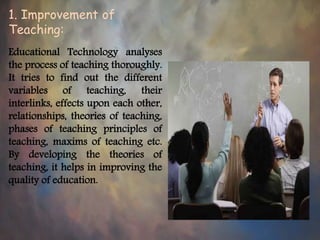
1. Improvement of
Teaching:
Educational Technology analyses
the process of teaching thoroughly.
It tries to find out the different
variables of teaching, their
interlinks, effects upon each other,
relationships, theories of teaching,
phases of teaching principles of
teaching, maxims of teaching etc.
By developing the theories of
teaching, it helps in improving the
quality of education.
2. Analysis of the
Teaching-Learning
Process:
Educational Technology aims at analysing the process of
teaching-learning thoroughly. It tries to find out the different
variables of teaching their interlinks effects upon each other,
relationship etc.
It is also concerned with various phases of teaching. The
principles of teaching and the maxims of teaching are also
analysed by it. Over all, it tries to establish better and better
relationship between teaching and learning.
3. Improvement of Learning:
Educational Technology analyses the process
of learning and the related theories. It
facilitates more and more of learning in less
time. It takes the help of various empirically
established generalisations from psychology,
sociology, physical sciences, engineering etc
4. Fixing up Goals of Education:
The objectives of education are being reviewed and
revised with the passage of time. Educational
technology helps in finding out the right objectives.
Everything in this universe is undergoing tremendous
changes and with a very fast speed.
The needs and requirements of the people and hence
education need be revised from moment to moment.
Educational Technology helps in fixing up the right
objectives in the light of the changed circumstances
and changed environment.
5. Training to Teachers:
The changed type of environment with new curriculum and new
materials is to be handled by the teachers. The teachers equipped
with old strategies and methodologies of teaching will remain
misfits.
Right type of training to the teachers is the need of the hour.
Educational Technology can render its valuable help in the
training of teachers also. The use of video tapes and close circuit
T.V. will help the teachers to remodel and reshape their teaching
behaviours suitably.
6. Development of Curriculum:
Keeping in view the objectives of education which have
been finalized by education technology thereafter comes
the question of developing right type of curriculum. Only a
suitable type of curriculum will help in the attainment of
goals.
Curriculum is the total teaching-learning environment
which has to be modified and remodeled in the light of
latest thoughts. Only educational technology can do this
job of developing a suitable curriculum appropriately.
7. Development of Teaching-Learning Materials:
Teaching- learning materials are also as important as
anything else in the teaching-learning process. They have
to be in accordance with the environment of the learners.
In this age of science and technology, the materials of
teaching cannot be unscientific.
Everything of the society including values of life need be
reflected in the materials. Only right type of materials will
able to modify the behaviour of the learner suitably making
him a fit person for the society. Only educational
technology can develop the required and the desired type
of teaching-learning materials.
8. Teaching-Learning Strategies:
A strategy plays an important role in the hands of a
teacher in every teaching-learning situation.
The strategy has to be the right one which should
be according to the materials and is able to bring
about effective teaching-learning. The different
strategies are being evolved by educational
technology. The knowledge of those strategies is a
must for every teacher. Then only the teachers will
be able to do justice to their jobs.
9. Development of Audio-Visual Aids:
Audio-Visual aids have always played an important role in the
teaching-learning process. They need be used according to the times.
The software aids, the hardware aids, the computer and other such
appliances, equipment etc., have “to be used in the present type of
teaching-learning environment.
Computer assisted instructions will help the learner as well as the
teacher to achieve the goals of education more conveniently. There is
need of deriving maximum benefits out of educational technology.
10. Help in Overall
Improvement:
Educational technology helps in locating the problems
in the different areas of education. It also helps in
remedying the draw-backs.
Evaluation of the teaching- learning process is also
made better because through feedback, things are
improved thoroughly and there is better control over
the process of education. Thus, educational technology
can revolutionize the whole process of teaching-
learning.
11. Identification of Needs of the Community:
Educational Technology identifies the needs of the
community. It helps in providing equal education
opportunities to backward people, disadvantaged students
and deprived sections of the society. It helps education to
reach the remotest corner of the country.
The needs and requirements of the community are fast
changing. Educational Technology aims at identifying the
needs of the community from time to time. Then it tries to
improve the community in every possible way.
12. Identification of the Needs
of Class-Room Behaviors.
Educational Technology identifies the needs of class-
room behaviour. As the mass education has reduced the
standard of education, the use of educational technology
can maintain and improve the standard by the use of
teaching aids and programmed instruction material.
Educational Technology can inspire the students in the
class-rooms for self-learning.
Students demand it.
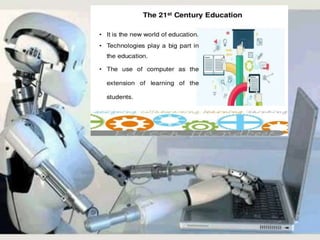
Students are engaging with technology constantly outside of the classroom. Kids like
to be interactive, and learning through technology has now become a part of their
lifestyle.
New teachers are demanding it.
The technology movement has been implemented in post-secondary education as
well as other professional jobs. For new teachers, technology is considered a
necessity for the learning environment.
Kids are the digital native.
Kids know technology better than most adults. It has become the easiest way they
learn, because it is such an integral part of their life. Engaging with technology in the
classroom has not only helped them learn better, but they also acquire multi-tasking
skills. At this day in age, they hardly know how to learn without it. This knowledge is
important, because they would be way behind in the real world without it.
Kids can learn at their own pace.
We know from years of experience that kids learn at their own pace, but
sometimes the traditional classroom makes it difficult to do so. With the
integration of technology in education, children have the ability to slow down
and go back over lessons and concepts, and more advanced kids can go ahead. It
also frees up the teacher to help kids on a more one-on-one level.
With technology, there are no limitations.
Having access to other information outside of the book gives students many
different ways to learn a concept. Teachers can come up with creative ways to
teach their students that keeps them engaged. Technology has changed the
learning environment so that learning is more hands-on. Schools throughout
the nation are diverse in income, and often kids don’t always get the resources
they need. The implementation of technology in schools helps close that gap.
Technology has the ability to enhance relationships between
teachers and students.
When teachers effectively integrate technology into subject areas, teachers grow
into roles of adviser, content expert, and coach. Technology helps make
teaching and learning more meaningful and fun. Students are also able to
collaborate with their own classmates through technological applications.
Testing has gone online
One protocol that schools don’t have control over, but must adapt to, is online testing. Testing
online is the way of the future, but it has a lot of advantages. Assessing students’ performance
can be done instantly with technology. Beyond seeing test scores in real-time, teachers can
better track and understand students’ grasp of the subject.
Multitude of resources
Computers, tablets, and other forms of technology bring multiple resources for the teacher
that’s not in the book. They not only keep students engaged with exciting new features and
apps, but also have other ways to teach students material. Every kid learns differently, and
technology helps with this gap as well.
Technology keeps kids engaged.
The students of this generation are considered technological learners. They learn best being
more interactive, and technology is what helps them do that. Children often struggle to stay on
task or interested, and with resources to help the teacher, they can better stay focused and learn
faster.
Technology is necessary to succeed outside of primary and secondary education
Whether we like it or not, technology is an essential concept to learn. Because it changes so
quickly, children are better off learning about it sooner. It is a primary part of every industry,
and there is no way around it. These days, technology means more than just learning basic
computing skills. Technology has made itself part of every aspect of our lives today, and the
students who understand it are the ones who succeed in the business world.
which has been designed to be used
with slides.
Slides are small transparencies mounted
in sturdy frames which are ideally
suited to magnification and projection,
since they have a very high resolution
and a resultantly high image quality.
The use of slide projectors is in
decline,
as other projection methods
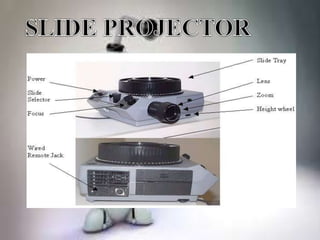
A slide projector is an opto-mechanical
device for showing photographic slides.
35 mm slide projectors, direct
descendants of the larger-format magic
lantern, first came into widespread use
during the 1950s as a form of occasional
home entertainment; family members and
friends would gather to view slide shows,
which typically consisted of slides snapped
during vacations and at family events. Slide
projectors were also widely used in
educational and other institutional
settings.
Photographic film slides and projectors
have mostly been replaced by image files
on digital storage media shown on a
projection screen by using a video
projector or simply displayed on a large-
screen video monitor.
Become Familiar with the
Machine
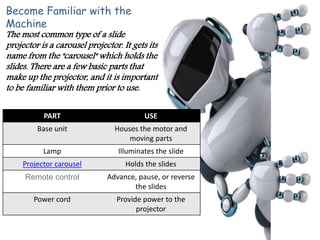
The most common type of a slide
projector is a carousel projector. It gets its
name from the "carousel" which holds the
slides. There are a few basic parts that
make up the projector, and it is important
to be familiar with them prior to use.
PART USE
Base unit Houses the motor and
moving parts
Lamp Illuminates the slide
Projector carousel Holds the slides
Remote control Advance, pause, or reverse
the slides
Power cord Provide power to the
projector
Make sure all the pieces are accounted for and
in working order prior to setting up for a
slideshow. It is a good idea to keep an extra
lamp on hand just in case the current one
gives out in the middle of viewing slides. If
there are a large number of slides to view, an
extra carousel comes in handy as well.
Set Up the Viewing Area
The first and most important thing one needs when
viewing slides is a screen. There are professional
projector screens, which are very convenient and
easy to set up. Another option is a plain white sheet
hung on the wall. The easiest way to go is to show
the slides on a blank wall. Be sure the wall is white
or the colors in the slides will not be true. Choose a
place for the viewing area, which all guests can
easily see. Place comfortable chairs or floor cushions
for seating. Keep in mind that nobody likes their
view blocked by other guests. Consider placing the
screen above eye level, which alleviates that
problem.
Gather the Slides
It may seem like a daunting task to gather all of the slides together,
especially if there is a large number of them. Set aside a block of time to
go through them and order as desired. Some choose to show the slides
in chronological order while others may group them by topic such as
summer vacations or holidays.
The carousel for the projector has numbered slots. Put one slide into
each slot and make a notation on a sheet of paper what the slide is. This
will help when viewing slides, in case there are questions as to the
occasion, year, or people in the picture.
Prepare the Machine
Be sure to use a sturdy table on which to place the projector. As the
carousel moves, it may jostle the table if it is not secure. This may result
in blurry pictures. Be sure the table is close to an outlet for the power
cord. If necessary, use an extension cord. Use duct tape to secure the
cord to the floor to ensure guests will not trip over it.
Place the machine on the table, attach the carousel, and turn on the
power switch. Run a few test slides to check for focus. It may be
necessary to move the lens of the machine in or out slightly to bring the
pictures into focus. Turn off the machine until it is time for the show to
ensure it does not overheat.
The Advantages
of Using a
Projector in the
Classroom
Easier Note Taking
Projectors enable teachers to create bulleted PowerPoint
presentations or other highly organized notes for the
class. With the use of projectors in the classroom, students
can take better notes with the ability to discern what
information the teacher displays is most useful to them.
Additionally, students can ask the teacher to repeat a slide
if they missed information, or even ask that the teacher to
email the presentation for further review
Greater Teaching Versatility
Projectors release teachers from being bound to chalk
and dry-erase boards to present information to their
students. With the use of projectors, teachers can now
use films, slides, and images to teach students about a
variety of subjects. Teachers will also find that the
Internet is more useful since projectors can display web
content to an entire class, rather than each student
accessing information on individual computers, if they
are available.
Better Use of Class Time
Prior to the use of projectors in the classroom, teachers had to spend
time writing notes on the board, as well as erasing information as the
board filled up. Projectors require a simple click of a button or mouse,
thus, freeing valuable class time. By using projectors, teachers can
more easily prepare all notes prior to class for easy presentation.
Teachers may also find that they spend less time repeating or
rewriting information that is now accessible with a simple click.
Better Student Presentations
Students will appreciate the use of projectors as they prepare class
projects that they can now create in PowerPoint or other electronic
mediums. Consequently, students will find that presentation creation
will go faster with each person using their own computer to create
their section of the presentation. Presentations on a projector,
additionally, reduce the need to make copies of materials to pass out to
classmates during presentations that can now be displayed for the
entire class to view at once.

Kristine bongcaras

  • 2.
    THE ROLES ANDFUNCTIONS OF EDUCATIONAL TECHNOLOGY: Both teachers and the students are convinced about the important contributions educational technology can offer. If properly selected and used, instructional materials can do the following: 1.) Arouse and sustain the interest and attention of the pupils/students to learn. 2.) Concretize abstract concepts/ideas to promote meaningful learning. 3.) Makes learning more permanent because of the rich experiences that they provide.
  • 3.
    4.) Provide self-activitiesfor independent learning. 5.) Increase vocabulary by eliminating verbalism. 6.) Develop continuity of thought. 7.) Increase the quality of learning while decreasing the time spent. 8.) Check pupils preparedness. 9.) Make learning more interactive, hence learning is improved.
  • 4.
  • 5.
    1. Improvement of Teaching: EducationalTechnology analyses the process of teaching thoroughly. It tries to find out the different variables of teaching, their interlinks, effects upon each other, relationships, theories of teaching, phases of teaching principles of teaching, maxims of teaching etc. By developing the theories of teaching, it helps in improving the quality of education.
  • 6.
    2. Analysis ofthe Teaching-Learning Process: Educational Technology aims at analysing the process of teaching-learning thoroughly. It tries to find out the different variables of teaching their interlinks effects upon each other, relationship etc. It is also concerned with various phases of teaching. The principles of teaching and the maxims of teaching are also analysed by it. Over all, it tries to establish better and better relationship between teaching and learning.
  • 7.
    3. Improvement ofLearning: Educational Technology analyses the process of learning and the related theories. It facilitates more and more of learning in less time. It takes the help of various empirically established generalisations from psychology, sociology, physical sciences, engineering etc
  • 8.
    4. Fixing upGoals of Education: The objectives of education are being reviewed and revised with the passage of time. Educational technology helps in finding out the right objectives. Everything in this universe is undergoing tremendous changes and with a very fast speed. The needs and requirements of the people and hence education need be revised from moment to moment. Educational Technology helps in fixing up the right objectives in the light of the changed circumstances and changed environment.
  • 9.
    5. Training toTeachers: The changed type of environment with new curriculum and new materials is to be handled by the teachers. The teachers equipped with old strategies and methodologies of teaching will remain misfits. Right type of training to the teachers is the need of the hour. Educational Technology can render its valuable help in the training of teachers also. The use of video tapes and close circuit T.V. will help the teachers to remodel and reshape their teaching behaviours suitably.
  • 10.
    6. Development ofCurriculum: Keeping in view the objectives of education which have been finalized by education technology thereafter comes the question of developing right type of curriculum. Only a suitable type of curriculum will help in the attainment of goals. Curriculum is the total teaching-learning environment which has to be modified and remodeled in the light of latest thoughts. Only educational technology can do this job of developing a suitable curriculum appropriately.
  • 11.
    7. Development ofTeaching-Learning Materials: Teaching- learning materials are also as important as anything else in the teaching-learning process. They have to be in accordance with the environment of the learners. In this age of science and technology, the materials of teaching cannot be unscientific. Everything of the society including values of life need be reflected in the materials. Only right type of materials will able to modify the behaviour of the learner suitably making him a fit person for the society. Only educational technology can develop the required and the desired type of teaching-learning materials.
  • 12.
    8. Teaching-Learning Strategies: Astrategy plays an important role in the hands of a teacher in every teaching-learning situation. The strategy has to be the right one which should be according to the materials and is able to bring about effective teaching-learning. The different strategies are being evolved by educational technology. The knowledge of those strategies is a must for every teacher. Then only the teachers will be able to do justice to their jobs.
  • 13.
    9. Development ofAudio-Visual Aids: Audio-Visual aids have always played an important role in the teaching-learning process. They need be used according to the times. The software aids, the hardware aids, the computer and other such appliances, equipment etc., have “to be used in the present type of teaching-learning environment. Computer assisted instructions will help the learner as well as the teacher to achieve the goals of education more conveniently. There is need of deriving maximum benefits out of educational technology.
  • 14.
    10. Help inOverall Improvement: Educational technology helps in locating the problems in the different areas of education. It also helps in remedying the draw-backs. Evaluation of the teaching- learning process is also made better because through feedback, things are improved thoroughly and there is better control over the process of education. Thus, educational technology can revolutionize the whole process of teaching- learning.
  • 15.
    11. Identification ofNeeds of the Community: Educational Technology identifies the needs of the community. It helps in providing equal education opportunities to backward people, disadvantaged students and deprived sections of the society. It helps education to reach the remotest corner of the country. The needs and requirements of the community are fast changing. Educational Technology aims at identifying the needs of the community from time to time. Then it tries to improve the community in every possible way.
  • 16.
    12. Identification ofthe Needs of Class-Room Behaviors. Educational Technology identifies the needs of class- room behaviour. As the mass education has reduced the standard of education, the use of educational technology can maintain and improve the standard by the use of teaching aids and programmed instruction material. Educational Technology can inspire the students in the class-rooms for self-learning.
  • 20.
    Students demand it. Studentsare engaging with technology constantly outside of the classroom. Kids like to be interactive, and learning through technology has now become a part of their lifestyle. New teachers are demanding it. The technology movement has been implemented in post-secondary education as well as other professional jobs. For new teachers, technology is considered a necessity for the learning environment. Kids are the digital native. Kids know technology better than most adults. It has become the easiest way they learn, because it is such an integral part of their life. Engaging with technology in the classroom has not only helped them learn better, but they also acquire multi-tasking skills. At this day in age, they hardly know how to learn without it. This knowledge is important, because they would be way behind in the real world without it.
  • 21.
    Kids can learnat their own pace. We know from years of experience that kids learn at their own pace, but sometimes the traditional classroom makes it difficult to do so. With the integration of technology in education, children have the ability to slow down and go back over lessons and concepts, and more advanced kids can go ahead. It also frees up the teacher to help kids on a more one-on-one level. With technology, there are no limitations. Having access to other information outside of the book gives students many different ways to learn a concept. Teachers can come up with creative ways to teach their students that keeps them engaged. Technology has changed the learning environment so that learning is more hands-on. Schools throughout the nation are diverse in income, and often kids don’t always get the resources they need. The implementation of technology in schools helps close that gap. Technology has the ability to enhance relationships between teachers and students. When teachers effectively integrate technology into subject areas, teachers grow into roles of adviser, content expert, and coach. Technology helps make teaching and learning more meaningful and fun. Students are also able to collaborate with their own classmates through technological applications.
  • 22.
    Testing has goneonline One protocol that schools don’t have control over, but must adapt to, is online testing. Testing online is the way of the future, but it has a lot of advantages. Assessing students’ performance can be done instantly with technology. Beyond seeing test scores in real-time, teachers can better track and understand students’ grasp of the subject. Multitude of resources Computers, tablets, and other forms of technology bring multiple resources for the teacher that’s not in the book. They not only keep students engaged with exciting new features and apps, but also have other ways to teach students material. Every kid learns differently, and technology helps with this gap as well. Technology keeps kids engaged. The students of this generation are considered technological learners. They learn best being more interactive, and technology is what helps them do that. Children often struggle to stay on task or interested, and with resources to help the teacher, they can better stay focused and learn faster. Technology is necessary to succeed outside of primary and secondary education Whether we like it or not, technology is an essential concept to learn. Because it changes so quickly, children are better off learning about it sooner. It is a primary part of every industry, and there is no way around it. These days, technology means more than just learning basic computing skills. Technology has made itself part of every aspect of our lives today, and the students who understand it are the ones who succeed in the business world.
  • 25.
    which has beendesigned to be used with slides. Slides are small transparencies mounted in sturdy frames which are ideally suited to magnification and projection, since they have a very high resolution and a resultantly high image quality. The use of slide projectors is in decline, as other projection methods
  • 26.
    A slide projectoris an opto-mechanical device for showing photographic slides. 35 mm slide projectors, direct descendants of the larger-format magic lantern, first came into widespread use during the 1950s as a form of occasional home entertainment; family members and friends would gather to view slide shows, which typically consisted of slides snapped during vacations and at family events. Slide projectors were also widely used in educational and other institutional settings. Photographic film slides and projectors have mostly been replaced by image files on digital storage media shown on a projection screen by using a video projector or simply displayed on a large- screen video monitor.
  • 28.
    Become Familiar withthe Machine The most common type of a slide projector is a carousel projector. It gets its name from the "carousel" which holds the slides. There are a few basic parts that make up the projector, and it is important to be familiar with them prior to use. PART USE Base unit Houses the motor and moving parts Lamp Illuminates the slide Projector carousel Holds the slides Remote control Advance, pause, or reverse the slides Power cord Provide power to the projector
  • 29.
    Make sure allthe pieces are accounted for and in working order prior to setting up for a slideshow. It is a good idea to keep an extra lamp on hand just in case the current one gives out in the middle of viewing slides. If there are a large number of slides to view, an extra carousel comes in handy as well. Set Up the Viewing Area The first and most important thing one needs when viewing slides is a screen. There are professional projector screens, which are very convenient and easy to set up. Another option is a plain white sheet hung on the wall. The easiest way to go is to show the slides on a blank wall. Be sure the wall is white or the colors in the slides will not be true. Choose a place for the viewing area, which all guests can easily see. Place comfortable chairs or floor cushions for seating. Keep in mind that nobody likes their view blocked by other guests. Consider placing the screen above eye level, which alleviates that problem.
  • 30.
    Gather the Slides Itmay seem like a daunting task to gather all of the slides together, especially if there is a large number of them. Set aside a block of time to go through them and order as desired. Some choose to show the slides in chronological order while others may group them by topic such as summer vacations or holidays. The carousel for the projector has numbered slots. Put one slide into each slot and make a notation on a sheet of paper what the slide is. This will help when viewing slides, in case there are questions as to the occasion, year, or people in the picture. Prepare the Machine Be sure to use a sturdy table on which to place the projector. As the carousel moves, it may jostle the table if it is not secure. This may result in blurry pictures. Be sure the table is close to an outlet for the power cord. If necessary, use an extension cord. Use duct tape to secure the cord to the floor to ensure guests will not trip over it. Place the machine on the table, attach the carousel, and turn on the power switch. Run a few test slides to check for focus. It may be necessary to move the lens of the machine in or out slightly to bring the pictures into focus. Turn off the machine until it is time for the show to ensure it does not overheat.
  • 31.
    The Advantages of Usinga Projector in the Classroom
  • 32.
    Easier Note Taking Projectorsenable teachers to create bulleted PowerPoint presentations or other highly organized notes for the class. With the use of projectors in the classroom, students can take better notes with the ability to discern what information the teacher displays is most useful to them. Additionally, students can ask the teacher to repeat a slide if they missed information, or even ask that the teacher to email the presentation for further review Greater Teaching Versatility Projectors release teachers from being bound to chalk and dry-erase boards to present information to their students. With the use of projectors, teachers can now use films, slides, and images to teach students about a variety of subjects. Teachers will also find that the Internet is more useful since projectors can display web content to an entire class, rather than each student accessing information on individual computers, if they are available.
  • 33.
    Better Use ofClass Time Prior to the use of projectors in the classroom, teachers had to spend time writing notes on the board, as well as erasing information as the board filled up. Projectors require a simple click of a button or mouse, thus, freeing valuable class time. By using projectors, teachers can more easily prepare all notes prior to class for easy presentation. Teachers may also find that they spend less time repeating or rewriting information that is now accessible with a simple click. Better Student Presentations Students will appreciate the use of projectors as they prepare class projects that they can now create in PowerPoint or other electronic mediums. Consequently, students will find that presentation creation will go faster with each person using their own computer to create their section of the presentation. Presentations on a projector, additionally, reduce the need to make copies of materials to pass out to classmates during presentations that can now be displayed for the entire class to view at once.