Farm Level Indicators for NewTopics in
policy evaluation
Krijn Poppe and HansVrolijk,
Wageningen Economic Research,The Netherlands
Meeting Global Club of Directors, Rome, October 2016
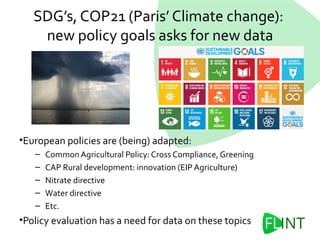
SDG’s, COP21 (Paris’ Climate change):
new policy goals asks for new data
•European policies are (being) adapted:
– Common Agricultural Policy: Cross Compliance, Greening
– CAP Rural development: innovation (EIP Agriculture)
– Nitrate directive
– Water directive
– Etc.
•Policy evaluation has a need for data on these topics
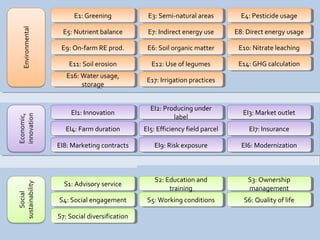
E3: Semi-natural areasE3: Semi-natural areas
E6: Soil organic matterE6: Soil organic matter E10: Nitrate leachingE10: Nitrate leaching
E11: Soil erosionE11: Soil erosion E12: Use of legumesE12: Use of legumes
E4: Pesticide usageE4: Pesticide usage
E5: Nutrient balanceE5: Nutrient balance E7: Indirect energy useE7: Indirect energy use E8: Direct energy usageE8: Direct energy usage
E9: On-farm RE prod.E9: On-farm RE prod.
E1: GreeningE1: Greening
EI1: InnovationEI1: Innovation
EI2: Producing under
label
EI2: Producing under
label
EI3: Market outletEI3: Market outlet
EI4: Farm durationEI4: Farm duration EI5: Efficiency field parcelEI5: Efficiency field parcel EI7: InsuranceEI7: Insurance
EI8: Marketing contractsEI8: Marketing contracts EI9: Risk exposureEI9: Risk exposure
S1: Advisory serviceS1: Advisory service
S2: Education and
training
S2: Education and
training
S3: Ownership
management
S3: Ownership
management
S4: Social engagementS4: Social engagement S5: Working conditionsS5: Working conditions S6: Quality of lifeS6: Quality of life
S7: Social diversificationS7: Social diversification
E16: Water usage,
storage
E16: Water usage,
storage
E17: Irrigation practicesE17: Irrigation practices
E14: GHG calculationE14: GHG calculation
EI6: ModernizationEI6: Modernization
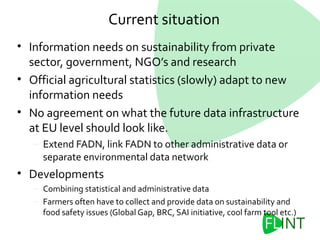
Current situation
• Information needs on sustainability from private
sector, government, NGO’s and research
• Official agricultural statistics (slowly) adapt to new
information needs
• No agreement on what the future data infrastructure
at EU level should look like.
– Extend FADN, link FADN to other administrative data or
separate environmental data network
• Developments
– Combining statistical and administrative data
– Farmers often have to collect and provide data on sustainability and
food safety issues (Global Gap, BRC, SAI initiative, cool farm tool etc.)
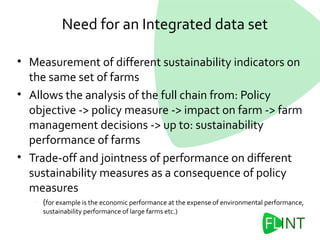
Need for an Integrated data set
• Measurement of different sustainability indicators on
the same set of farms
• Allows the analysis of the full chain from: Policy
objective -> policy measure -> impact on farm -> farm
management decisions -> up to: sustainability
performance of farms
• Trade-off and jointness of performance on different
sustainability measures as a consequence of policy
measures
– (for example is the economic performance at the expense of environmental performance,
sustainability performance of large farms etc.)
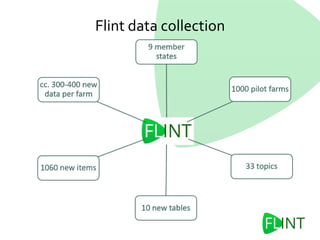
Flint data collection
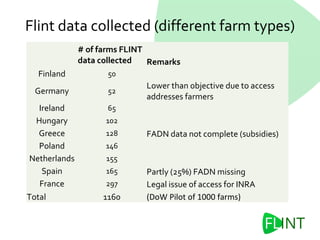
Flint data collected (different farm types)
# of farms FLINT
data collected Remarks
Finland 50
Germany 52
Lower than objective due to access
addresses farmers
Ireland 65
Hungary 102
Greece 128 FADN data not complete (subsidies)
Poland 146
Netherlands 155
Spain 165 Partly (25%) FADN missing
France 297 Legal issue of access for INRA
Total 1160 (DoW Pilot of 1000 farms)
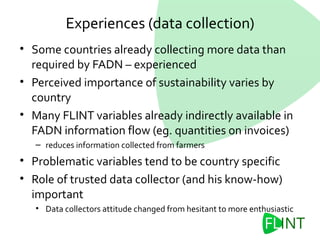
Experiences (data collection)
• Some countries already collecting more data than
required by FADN – experienced
• Perceived importance of sustainability varies by
country
• Many FLINT variables already indirectly available in
FADN information flow (eg. quantities on invoices)
– reduces information collected from farmers
• Problematic variables tend to be country specific
• Role of trusted data collector (and his know-how)
important
• Data collectors attitude changed from hesitant to more enthusiastic
Experiences (overall)
• Collection of new data always causes some initial
problems and need for adaptation –
– Despite reviews and prior testing, still some issues need to
explained more clearly
• However, first year collection of sustainability data
seems far less complicated than first year FADN data
collection
• Collection in scope of FADN provides advantages in
terms of farmer participation and quality assurance
• Time needed: 0.5 up to max. 4 hours per farm
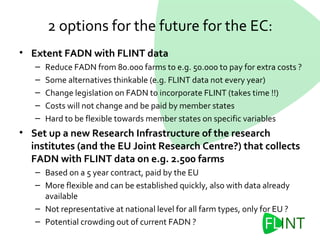
• Extent FADN with FLINT data
– Reduce FADN from 80.000 farms to e.g. 50.000 to pay for extra costs ?
– Some alternatives thinkable (e.g. FLINT data not every year)
– Change legislation on FADN to incorporate FLINT (takes time !!)
– Costs will not change and be paid by member states
– Hard to be flexible towards member states on specific variables
• Set up a new Research Infrastructure of the research
institutes (and the EU Joint Research Centre?) that collects
FADN with FLINT data on e.g. 2.500 farms
– Based on a 5 year contract, paid by the EU
– More flexible and can be established quickly, also with data already
available
– Not representative at national level for all farm types, only for EU ?
– Potential crowding out of current FADN ?
2 options for the future for the EC:
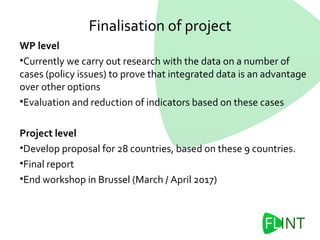
WP level
•Currently we carry out research with the data on a number of
cases (policy issues) to prove that integrated data is an advantage
over other options
•Evaluation and reduction of indicators based on these cases
Project level
•Develop proposal for 28 countries, based on these 9 countries.
•Final report
•End workshop in Brussel (March / April 2017)
Finalisation of project
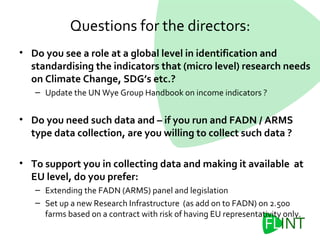
• Do you see a role at a global level in identification and
standardising the indicators that (micro level) research needs
on Climate Change, SDG’s etc.?
– Update the UN Wye Group Handbook on income indicators ?
• Do you need such data and – if you run and FADN / ARMS
type data collection, are you willing to collect such data ?
• To support you in collecting data and making it available at
EU level, do you prefer:
– Extending the FADN (ARMS) panel and legislation
– Set up a new Research Infrastructure (as add on to FADN) on 2.500
farms based on a contract with risk of having EU representativity only.
Questions for the directors:
Contact us:
HansVrolijk: hans.vrolijk@wur.nl
Krijn Poppe: krijn.poppe@wur.nl
more information:
www.flint-fp7.eu

Flint for global club directors

  • 1.
    Farm Level Indicatorsfor NewTopics in policy evaluation Krijn Poppe and HansVrolijk, Wageningen Economic Research,The Netherlands Meeting Global Club of Directors, Rome, October 2016
  • 2.
    SDG’s, COP21 (Paris’Climate change): new policy goals asks for new data •European policies are (being) adapted: – Common Agricultural Policy: Cross Compliance, Greening – CAP Rural development: innovation (EIP Agriculture) – Nitrate directive – Water directive – Etc. •Policy evaluation has a need for data on these topics
  • 3.
    E3: Semi-natural areasE3:Semi-natural areas E6: Soil organic matterE6: Soil organic matter E10: Nitrate leachingE10: Nitrate leaching E11: Soil erosionE11: Soil erosion E12: Use of legumesE12: Use of legumes E4: Pesticide usageE4: Pesticide usage E5: Nutrient balanceE5: Nutrient balance E7: Indirect energy useE7: Indirect energy use E8: Direct energy usageE8: Direct energy usage E9: On-farm RE prod.E9: On-farm RE prod. E1: GreeningE1: Greening EI1: InnovationEI1: Innovation EI2: Producing under label EI2: Producing under label EI3: Market outletEI3: Market outlet EI4: Farm durationEI4: Farm duration EI5: Efficiency field parcelEI5: Efficiency field parcel EI7: InsuranceEI7: Insurance EI8: Marketing contractsEI8: Marketing contracts EI9: Risk exposureEI9: Risk exposure S1: Advisory serviceS1: Advisory service S2: Education and training S2: Education and training S3: Ownership management S3: Ownership management S4: Social engagementS4: Social engagement S5: Working conditionsS5: Working conditions S6: Quality of lifeS6: Quality of life S7: Social diversificationS7: Social diversification E16: Water usage, storage E16: Water usage, storage E17: Irrigation practicesE17: Irrigation practices E14: GHG calculationE14: GHG calculation EI6: ModernizationEI6: Modernization
  • 4.
    Current situation • Informationneeds on sustainability from private sector, government, NGO’s and research • Official agricultural statistics (slowly) adapt to new information needs • No agreement on what the future data infrastructure at EU level should look like. – Extend FADN, link FADN to other administrative data or separate environmental data network • Developments – Combining statistical and administrative data – Farmers often have to collect and provide data on sustainability and food safety issues (Global Gap, BRC, SAI initiative, cool farm tool etc.)
  • 5.
    Need for anIntegrated data set • Measurement of different sustainability indicators on the same set of farms • Allows the analysis of the full chain from: Policy objective -> policy measure -> impact on farm -> farm management decisions -> up to: sustainability performance of farms • Trade-off and jointness of performance on different sustainability measures as a consequence of policy measures – (for example is the economic performance at the expense of environmental performance, sustainability performance of large farms etc.)
  • 6.
  • 7.
    Flint data collected(different farm types) # of farms FLINT data collected Remarks Finland 50 Germany 52 Lower than objective due to access addresses farmers Ireland 65 Hungary 102 Greece 128 FADN data not complete (subsidies) Poland 146 Netherlands 155 Spain 165 Partly (25%) FADN missing France 297 Legal issue of access for INRA Total 1160 (DoW Pilot of 1000 farms)
  • 8.
    Experiences (data collection) •Some countries already collecting more data than required by FADN – experienced • Perceived importance of sustainability varies by country • Many FLINT variables already indirectly available in FADN information flow (eg. quantities on invoices) – reduces information collected from farmers • Problematic variables tend to be country specific • Role of trusted data collector (and his know-how) important • Data collectors attitude changed from hesitant to more enthusiastic
  • 9.
    Experiences (overall) • Collectionof new data always causes some initial problems and need for adaptation – – Despite reviews and prior testing, still some issues need to explained more clearly • However, first year collection of sustainability data seems far less complicated than first year FADN data collection • Collection in scope of FADN provides advantages in terms of farmer participation and quality assurance • Time needed: 0.5 up to max. 4 hours per farm
  • 10.
    • Extent FADNwith FLINT data – Reduce FADN from 80.000 farms to e.g. 50.000 to pay for extra costs ? – Some alternatives thinkable (e.g. FLINT data not every year) – Change legislation on FADN to incorporate FLINT (takes time !!) – Costs will not change and be paid by member states – Hard to be flexible towards member states on specific variables • Set up a new Research Infrastructure of the research institutes (and the EU Joint Research Centre?) that collects FADN with FLINT data on e.g. 2.500 farms – Based on a 5 year contract, paid by the EU – More flexible and can be established quickly, also with data already available – Not representative at national level for all farm types, only for EU ? – Potential crowding out of current FADN ? 2 options for the future for the EC:
  • 11.
    WP level •Currently wecarry out research with the data on a number of cases (policy issues) to prove that integrated data is an advantage over other options •Evaluation and reduction of indicators based on these cases Project level •Develop proposal for 28 countries, based on these 9 countries. •Final report •End workshop in Brussel (March / April 2017) Finalisation of project
  • 12.
    • Do yousee a role at a global level in identification and standardising the indicators that (micro level) research needs on Climate Change, SDG’s etc.? – Update the UN Wye Group Handbook on income indicators ? • Do you need such data and – if you run and FADN / ARMS type data collection, are you willing to collect such data ? • To support you in collecting data and making it available at EU level, do you prefer: – Extending the FADN (ARMS) panel and legislation – Set up a new Research Infrastructure (as add on to FADN) on 2.500 farms based on a contract with risk of having EU representativity only. Questions for the directors:
  • 13.
    Contact us: HansVrolijk: hans.vrolijk@wur.nl KrijnPoppe: krijn.poppe@wur.nl more information: www.flint-fp7.eu

Editor's Notes

  • #8 Finland 50 Germany 95 Ireland 65 Hungary 100 Greece 110 Poland 140 NL 150 Spain 165 France 150
  • #9 Water Wel of niet flexibiliteit in de eind oplossing, hoe gaat de wetgeving daar mee om