knowledge sharing in the
       sciences
                  kaitlin thaney
     program manager, science commons
     costa rica - aCCCeso - 11 nov 2009


  This presentation is licensed under the CreativeCommons-Attribution-3.0 Unported license.
xi.
 open science,
knowledge sharing,
and the commons
make sharing easy, legal and scalable

        integrated approach

building part of the infrastructure for
          knowledge sharing
knowledge sharing is at the root of
     scholarship and science

  the system of print publishing is a
    system of sharing knowledge

 then came the move to digital ...
knowledge sharing

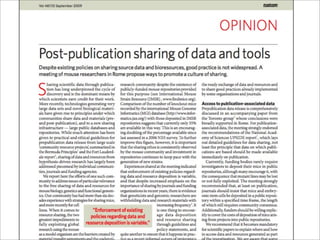
    journal articles
          data
       ontologies
      annotations
plasmids and cell lines
knowledge sharing

  journal articles
         data
      ontologies
     annotations
plasmids and cell lines
access is step one

content needs to be legally and
    technically accessible
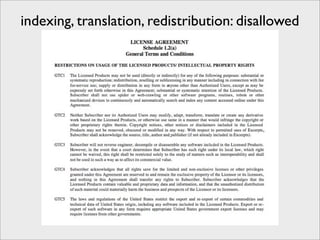
indexing, translation, redistribution: disallowed
“ By open access to the literature, we mean its
      free availability on the public internet,
     permitting users to read, download, copy,
distribute, print, search, or link to the full texts of
 the articles, crawl them for indexing, pass them as
data to software, or use them for any other lawful
     purpose, without financial, legal or technical
barriers other than those inseparable from gaining
             access to the internet itself.”

          Image from the Public Library of Science, licensed to the public, under
                                       CC-BY-3.0
“The only constraint on reproduction and
distribution, and the only role for copyright in this
domain, should be to give authors control over the
    integrity of their work and the right to be
     properly acknowledged and cited.”
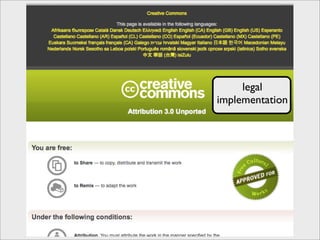
legal
implementation
knowledge sharing

    journal articles
          data
       ontologies
      annotations
plasmids and cell lines
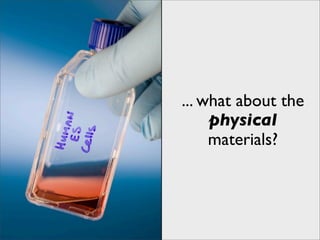
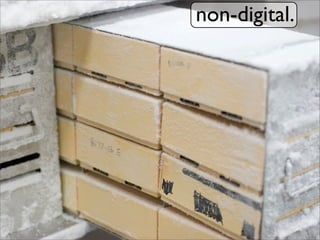
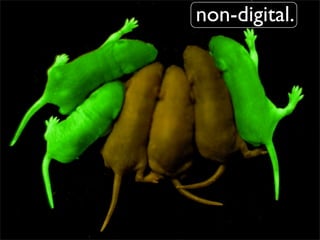
... what about the
     physical
     materials?
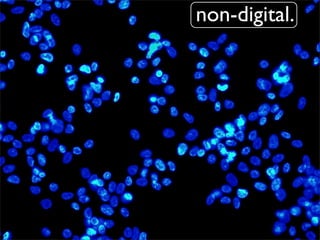
non-digital.
non-digital.
non-digital.
ideally ...

 contact author, obtain material,
      recreate experiment

build on the existing work, publish

          and repeat ...
the reality ...
  materials difficult to find, fulfill, lack
               resources

reagents and assays often re-invented
       or reverse engineered

    locked in contracts, bureaucracy,
deliberate withholding, “club mentality”
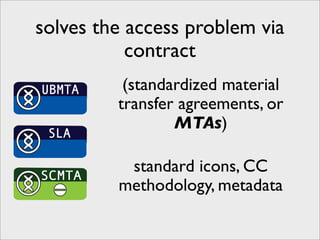
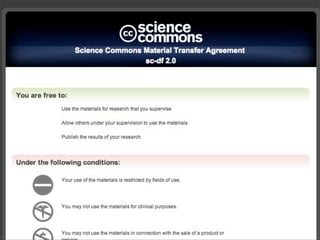
solves the access problem via
           contract
UBMTA     (standardized material
         transfer agreements, or
                 MTAs)
 SLA


SCMTA
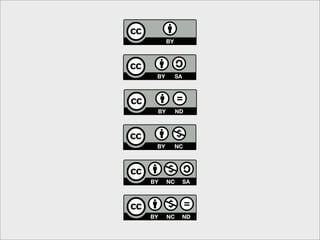
          standard icons, CC
         methodology, metadata
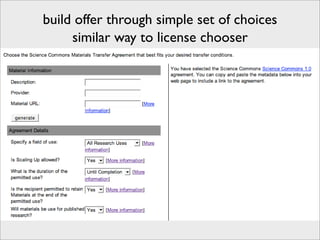
build offer through simple set of choices
     similar way to license chooser
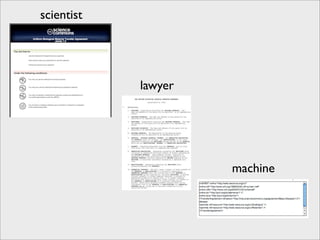
scientist


            lawyer


                     machine
knowledge sharing

             journal articles
                 data
               ontologies
              annotations
         plasmids and cell lines

... how to treat? like content? software?
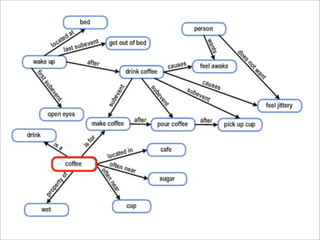
the data web
as a means to achieve Open Access
      but what about data?
1.
three layers of resistance:
 technical, semantic, legal
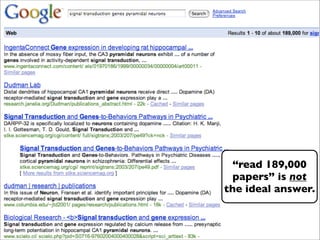
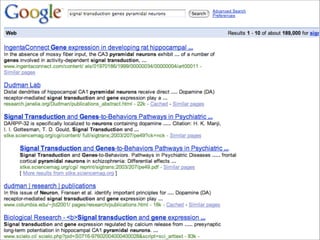
“read 189,000
  papers” is not
the ideal answer.
social and semantics
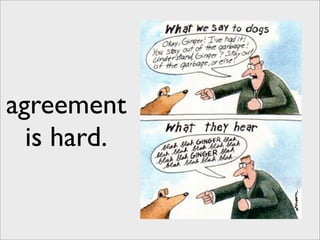
agreement
  is hard.
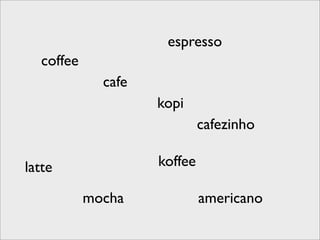
espresso
  coffee
             cafe
                    kopi
                             cafezinho

latte               koffee

           mocha             americano
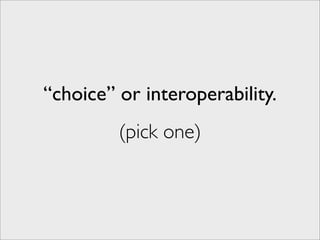
“choice” or interoperability.
         (pick one)
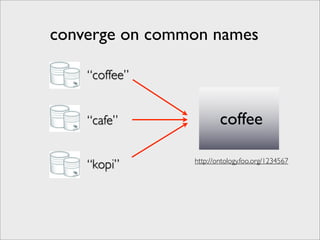
converge on common names

    “coffee”


    “cafe”              coffee

    “kopi”      http://ontology.foo.org/1234567
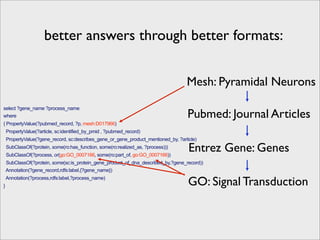
better answers through better formats:


                                                                                    Mesh: Pyramidal Neurons
select ?gene_name ?process_name
where                                                                               Pubmed: Journal Articles
{ PropertyValue(?pubmed_record, ?p, mesh:D017966)
    PropertyValue(?article, sc:identified_by_pmid , ?pubmed_record)
    PropertyValue(?gene_record, sc:describes_gene_or_gene_product_mentioned_by, ?article)
    SubClassOf(?protein, some(ro:has_function, some(ro:realized_as, ?process)))
    SubClassOf(?process, or(go:GO_0007166, some(ro:part_of, go:GO_0007166))
                                                                                     Entrez Gene: Genes
    SubClassOf(?protein, some(sc:is_protein_gene_product_of_dna_described_by,?gene_record))
    Annotation(?gene_record,rdfs:label,{?gene_name})


}
    Annotation(?process,rdfs:label,?process_name)
                                                                                     GO: Signal Transduction
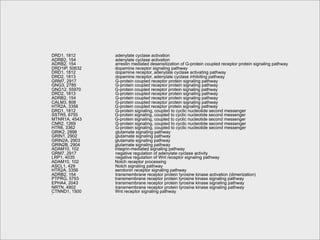
DRD1, 1812      adenylate cyclase activation
ADRB2, 154      adenylate cyclase activation
ADRB2, 154      arrestin mediated desensitization of G-protein coupled receptor protein signaling pathway
DRD1IP, 50632   dopamine receptor signaling pathway
DRD1, 1812      dopamine receptor, adenylate cyclase activating pathway
DRD2, 1813      dopamine receptor, adenylate cyclase inhibiting pathway
GRM7, 2917      G-protein coupled receptor protein signaling pathway
GNG3, 2785      G-protein coupled receptor protein signaling pathway
GNG12, 55970    G-protein coupled receptor protein signaling pathway
DRD2, 1813      G-protein coupled receptor protein signaling pathway
ADRB2, 154      G-protein coupled receptor protein signaling pathway
CALM3, 808      G-protein coupled receptor protein signaling pathway
HTR2A, 3356     G-protein coupled receptor protein signaling pathway
DRD1, 1812      G-protein signaling, coupled to cyclic nucleotide second messenger
SSTR5, 6755     G-protein signaling, coupled to cyclic nucleotide second messenger
MTNR1A, 4543    G-protein signaling, coupled to cyclic nucleotide second messenger
CNR2, 1269      G-protein signaling, coupled to cyclic nucleotide second messenger
HTR6, 3362      G-protein signaling, coupled to cyclic nucleotide second messenger
GRIK2, 2898     glutamate signaling pathway
GRIN1, 2902     glutamate signaling pathway
GRIN2A, 2903    glutamate signaling pathway
GRIN2B, 2904    glutamate signaling pathway
ADAM10, 102     integrin-mediated signaling pathway
GRM7, 2917      negative regulation of adenylate cyclase activity
LRP1, 4035      negative regulation of Wnt receptor signaling pathway
ADAM10, 102     Notch receptor processing
ASCL1, 429      Notch signaling pathway
HTR2A, 3356     serotonin receptor signaling pathway
ADRB2, 154      transmembrane receptor protein tyrosine kinase activation (dimerization)
PTPRG, 5793     transmembrane receptor protein tyrosine kinase signaling pathway
EPHA4, 2043     transmembrane receptor protein tyrosine kinase signaling pathway
NRTN, 4902      transmembrane receptor protein tyrosine kinase signaling pathway
CTNND1, 1500    Wnt receptor signaling pathway
`
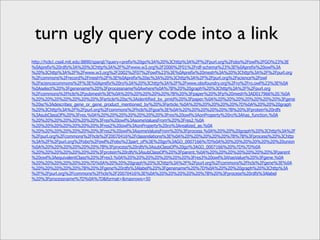
turn ugly query code into a link
http://hcls1.csail.mit.edu:8890/sparql/?query=prefix%20go%3A%20%3Chttp%3A%2F%2Fpurl.org%2Fobo%2Fowl%2FGO%23%3E
%0Aprefix%20rdfs%3A%20%3Chttp%3A%2F%2Fwww.w3.org%2F2000%2F01%2Frdf-schema%23%3E%0Aprefix%20owl%3A
%20%3Chttp%3A%2F%2Fwww.w3.org%2F2002%2F07%2Fowl%23%3E%0Aprefix%20mesh%3A%20%3Chttp%3A%2F%2Fpurl.org
%2Fcommons%2Frecord%2Fmesh%2F%3E%0Aprefix%20sc%3A%20%3Chttp%3A%2F%2Fpurl.org%2Fscience%2Fowl
%2Fsciencecommons%2F%3E%0Aprefix%20ro%3A%20%3Chttp%3A%2F%2Fwww.obofoundry.org%2Fro%2Fro.owl%23%3E%0A
%0Aselect%20%3Fgenename%20%3Fprocessname%0Awhere%0A%7B%20%20graph%20%3Chttp%3A%2F%2Fpurl.org
%2Fcommons%2Fhcls%2Fpubmesh%3E%0A%20%20%20%20%20%7B%20%3Fpaper%20%3Fp%20mesh%3AD017966%20.%0A
%20%20%20%20%20%20%20%3Farticle%20sc%3Aidentified_by_pmid%20%3Fpaper.%0A%20%20%20%20%20%20%20%3Fgene
%20sc%3Adescribes_gene_or_gene_product_mentioned_by%20%3Farticle.%0A%20%20%20%20%20%7D%0A%20%20%20graph
%20%3Chttp%3A%2F%2Fpurl.org%2Fcommons%2Fhcls%2Fgoa%3E%0A%20%20%20%20%20%7B%20%3Fprotein%20rdfs
%3AsubClassOf%20%3Fres.%0A%20%20%20%20%20%20%20%3Fres%20owl%3AonProperty%20ro%3Ahas_function.%0A
%20%20%20%20%20%20%20%3Fres%20owl%3AsomeValuesFrom%20%3Fres2.%0A
%20%20%20%20%20%20%20%3Fres2%20owl%3AonProperty%20ro%3Arealized_as.%0A
%20%20%20%20%20%20%20%3Fres2%20owl%3AsomeValuesFrom%20%3Fprocess.%0A%20%20%20graph%20%3Chttp%3A%2F
%2Fpurl.org%2Fcommons%2Fhcls%2F20070416%2Fclassrelations%3E%0A%20%20%20%20%20%7B%7B%3Fprocess%20%3Chttp
%3A%2F%2Fpurl.org%2Fobo%2Fowl%2Fobo%23part_of%3E%20go%3AGO_0007166%7D%0A%20%20%20%20%20%20%20union
%0A%20%20%20%20%20%20%7B%3Fprocess%20rdfs%3AsubClassOf%20go%3AGO_0007166%20%7D%7D%0A
%20%20%20%20%20%20%20%3Fprotein%20rdfs%3AsubClassOf%20%3Fparent.%0A%20%20%20%20%20%20%20%3Fparent
%20owl%3AequivalentClass%20%3Fres3.%0A%20%20%20%20%20%20%20%3Fres3%20owl%3AhasValue%20%3Fgene.%0A
%20%20%20%20%20%20%7D%0A%20%20%20graph%20%3Chttp%3A%2F%2Fpurl.org%2Fcommons%2Fhcls%2Fgene%3E%0A
%20%20%20%20%20%7B%20%3Fgene%20rdfs%3Alabel%20%3Fgenename%20%7D%0A%20%20%20graph%20%3Chttp%3A
%2F%2Fpurl.org%2Fcommons%2Fhcls%2F20070416%3E%0A%20%20%20%20%20%7B%20%3Fprocess%20rdfs%3Alabel
%20%3Fprocessname%7D%0A%7D&format=&maxrows=50
social barriers:
protection instinct / culture of control

  quality control, integrity concerns

  “my data”, interpretation issues

     fear, uncertainty, doubt (FUD)
the data “rights” conundrum...

implications of FLOSS toggles
©
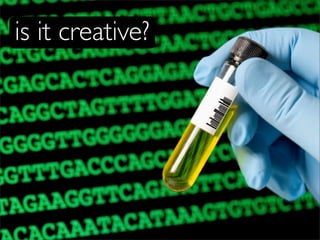
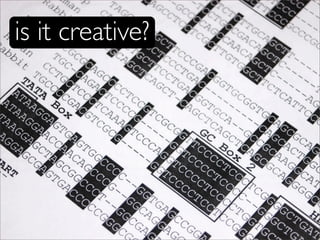
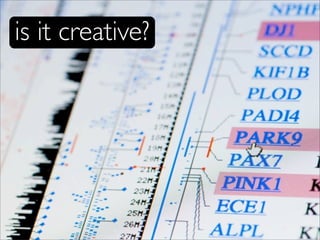
“creative expression”
is it creative?
is it creative?
is it creative?
category errors
the problem of...
   Non-Commercial


   for data
Non-Commercial


what’s a commercial use
   of the data web?
the problem of...
  Share Alike


   for data
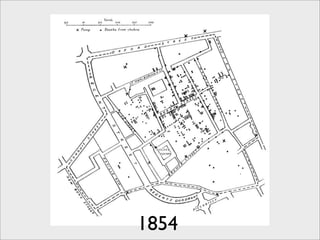
1854
issue of license proliferation

   whatever you do to the least of the
databases, you do to the integrated system

       (the most restrictive wins)

    risk for unintended consequences
the problem of...
   Attribution


   for data
the problem of...
  any license

   for data
national law / jurisdiction-based
            hurdles

             sui generis,
        “sweat of the brow”
          Crown copyright
           “level of skill”

how internat’l data sharing efforts
          are affected?
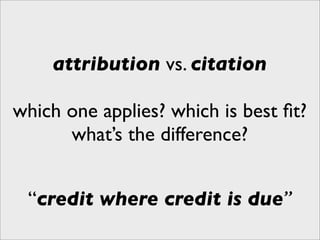
attribution vs. citation

which one applies? which is best fit?
      what’s the difference?


 “credit where credit is due”
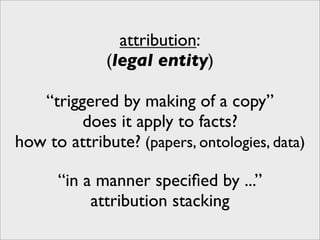
attribution:
             (legal entity)

   “triggered by making of a copy”
         does it apply to facts?
how to attribute? (papers, ontologies, data)

      “in a manner specified by ...”
           attribution stacking
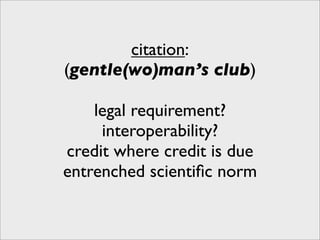
citation:
(gentle(wo)man’s club)

    legal requirement?
     interoperability?
credit where credit is due
entrenched scientific norm
we shouldn’t use the law to make it
   hard to do the wrong thing ...
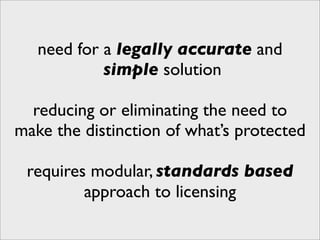
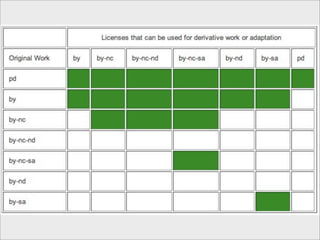
need for a legally accurate and
            simple solution

  reducing or eliminating the need to
make the distinction of what’s protected

 requires modular, standards based
         approach to licensing
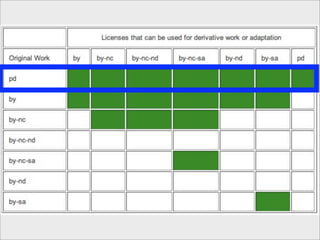
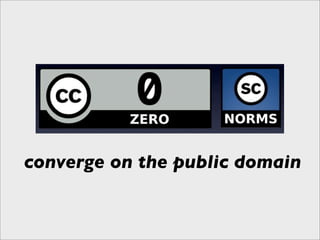
converge on the public domain
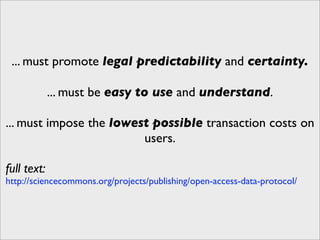
... must promote legal predictability and certainty.

             ... must be easy to use and understand.

... must impose the lowest possible transaction costs on
                         users.

full text:
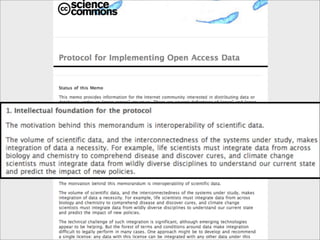
http://sciencecommons.org/projects/publishing/open-access-data-protocol/
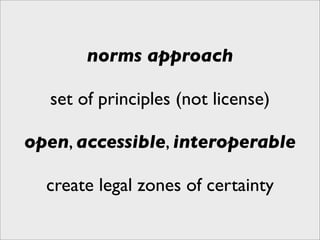
norms approach

  set of principles (not license)

open, accessible, interoperable

  create legal zones of certainty
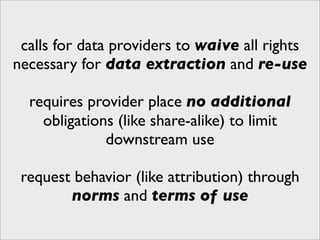
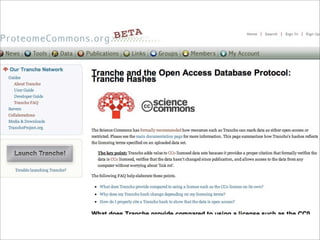
calls for data providers to waive all rights
necessary for data extraction and re-use

  requires provider place no additional
    obligations (like share-alike) to limit
              downstream use

 request behavior (like attribution) through
        norms and terms of use
at best, we’re partially right.
at worst, we’re really wrong.
infrastructure for a data web

 the digital commons

law + content + technology +
         community
resist the temptation to treat
              as property

embrace the potential to treat instead
      as a network resource
early days of WWW

no licenses (even free)
  debate over code
   CERN’s decision
   view/edit source
   network effects
the right to fix our mistakes.
thank you.

kaitlin@creativecommons.org
      sciencecommons.org
     creativecommons.org
   slideshare.net/kaythaney

Knowledge Sharing - aCCCeso

  • 1.
    knowledge sharing inthe sciences kaitlin thaney program manager, science commons costa rica - aCCCeso - 11 nov 2009 This presentation is licensed under the CreativeCommons-Attribution-3.0 Unported license.
  • 2.
    xi. open science, knowledgesharing, and the commons
  • 3.
    make sharing easy,legal and scalable integrated approach building part of the infrastructure for knowledge sharing
  • 4.
    knowledge sharing isat the root of scholarship and science the system of print publishing is a system of sharing knowledge then came the move to digital ...
  • 5.
    knowledge sharing journal articles data ontologies annotations plasmids and cell lines
  • 6.
    knowledge sharing journal articles data ontologies annotations plasmids and cell lines
  • 7.
    access is stepone content needs to be legally and technically accessible
  • 8.
  • 9.
    “ By openaccess to the literature, we mean its free availability on the public internet, permitting users to read, download, copy, distribute, print, search, or link to the full texts of the articles, crawl them for indexing, pass them as data to software, or use them for any other lawful purpose, without financial, legal or technical barriers other than those inseparable from gaining access to the internet itself.” Image from the Public Library of Science, licensed to the public, under CC-BY-3.0
  • 10.
    “The only constrainton reproduction and distribution, and the only role for copyright in this domain, should be to give authors control over the integrity of their work and the right to be properly acknowledged and cited.”
  • 12.
  • 13.
    knowledge sharing journal articles data ontologies annotations plasmids and cell lines
  • 14.
    ... what aboutthe physical materials?
  • 15.
  • 16.
  • 17.
  • 18.
    ideally ... contactauthor, obtain material, recreate experiment build on the existing work, publish and repeat ...
  • 19.
    the reality ... materials difficult to find, fulfill, lack resources reagents and assays often re-invented or reverse engineered locked in contracts, bureaucracy, deliberate withholding, “club mentality”
  • 21.
    solves the accessproblem via contract UBMTA (standardized material transfer agreements, or MTAs) SLA SCMTA standard icons, CC methodology, metadata
  • 23.
    build offer throughsimple set of choices similar way to license chooser
  • 24.
    scientist lawyer machine
  • 25.
    knowledge sharing journal articles data ontologies annotations plasmids and cell lines ... how to treat? like content? software?
  • 26.
  • 27.
    as a meansto achieve Open Access but what about data?
  • 28.
    1. three layers ofresistance: technical, semantic, legal
  • 29.
    “read 189,000 papers” is not the ideal answer.
  • 30.
  • 31.
  • 34.
    espresso coffee cafe kopi cafezinho latte koffee mocha americano
  • 35.
  • 36.
    converge on commonnames “coffee” “cafe” coffee “kopi” http://ontology.foo.org/1234567
  • 40.
    better answers throughbetter formats: Mesh: Pyramidal Neurons select ?gene_name ?process_name where Pubmed: Journal Articles { PropertyValue(?pubmed_record, ?p, mesh:D017966) PropertyValue(?article, sc:identified_by_pmid , ?pubmed_record) PropertyValue(?gene_record, sc:describes_gene_or_gene_product_mentioned_by, ?article) SubClassOf(?protein, some(ro:has_function, some(ro:realized_as, ?process))) SubClassOf(?process, or(go:GO_0007166, some(ro:part_of, go:GO_0007166)) Entrez Gene: Genes SubClassOf(?protein, some(sc:is_protein_gene_product_of_dna_described_by,?gene_record)) Annotation(?gene_record,rdfs:label,{?gene_name}) } Annotation(?process,rdfs:label,?process_name) GO: Signal Transduction
  • 41.
    DRD1, 1812 adenylate cyclase activation ADRB2, 154 adenylate cyclase activation ADRB2, 154 arrestin mediated desensitization of G-protein coupled receptor protein signaling pathway DRD1IP, 50632 dopamine receptor signaling pathway DRD1, 1812 dopamine receptor, adenylate cyclase activating pathway DRD2, 1813 dopamine receptor, adenylate cyclase inhibiting pathway GRM7, 2917 G-protein coupled receptor protein signaling pathway GNG3, 2785 G-protein coupled receptor protein signaling pathway GNG12, 55970 G-protein coupled receptor protein signaling pathway DRD2, 1813 G-protein coupled receptor protein signaling pathway ADRB2, 154 G-protein coupled receptor protein signaling pathway CALM3, 808 G-protein coupled receptor protein signaling pathway HTR2A, 3356 G-protein coupled receptor protein signaling pathway DRD1, 1812 G-protein signaling, coupled to cyclic nucleotide second messenger SSTR5, 6755 G-protein signaling, coupled to cyclic nucleotide second messenger MTNR1A, 4543 G-protein signaling, coupled to cyclic nucleotide second messenger CNR2, 1269 G-protein signaling, coupled to cyclic nucleotide second messenger HTR6, 3362 G-protein signaling, coupled to cyclic nucleotide second messenger GRIK2, 2898 glutamate signaling pathway GRIN1, 2902 glutamate signaling pathway GRIN2A, 2903 glutamate signaling pathway GRIN2B, 2904 glutamate signaling pathway ADAM10, 102 integrin-mediated signaling pathway GRM7, 2917 negative regulation of adenylate cyclase activity LRP1, 4035 negative regulation of Wnt receptor signaling pathway ADAM10, 102 Notch receptor processing ASCL1, 429 Notch signaling pathway HTR2A, 3356 serotonin receptor signaling pathway ADRB2, 154 transmembrane receptor protein tyrosine kinase activation (dimerization) PTPRG, 5793 transmembrane receptor protein tyrosine kinase signaling pathway EPHA4, 2043 transmembrane receptor protein tyrosine kinase signaling pathway NRTN, 4902 transmembrane receptor protein tyrosine kinase signaling pathway CTNND1, 1500 Wnt receptor signaling pathway `
  • 42.
    turn ugly querycode into a link http://hcls1.csail.mit.edu:8890/sparql/?query=prefix%20go%3A%20%3Chttp%3A%2F%2Fpurl.org%2Fobo%2Fowl%2FGO%23%3E %0Aprefix%20rdfs%3A%20%3Chttp%3A%2F%2Fwww.w3.org%2F2000%2F01%2Frdf-schema%23%3E%0Aprefix%20owl%3A %20%3Chttp%3A%2F%2Fwww.w3.org%2F2002%2F07%2Fowl%23%3E%0Aprefix%20mesh%3A%20%3Chttp%3A%2F%2Fpurl.org %2Fcommons%2Frecord%2Fmesh%2F%3E%0Aprefix%20sc%3A%20%3Chttp%3A%2F%2Fpurl.org%2Fscience%2Fowl %2Fsciencecommons%2F%3E%0Aprefix%20ro%3A%20%3Chttp%3A%2F%2Fwww.obofoundry.org%2Fro%2Fro.owl%23%3E%0A %0Aselect%20%3Fgenename%20%3Fprocessname%0Awhere%0A%7B%20%20graph%20%3Chttp%3A%2F%2Fpurl.org %2Fcommons%2Fhcls%2Fpubmesh%3E%0A%20%20%20%20%20%7B%20%3Fpaper%20%3Fp%20mesh%3AD017966%20.%0A %20%20%20%20%20%20%20%3Farticle%20sc%3Aidentified_by_pmid%20%3Fpaper.%0A%20%20%20%20%20%20%20%3Fgene %20sc%3Adescribes_gene_or_gene_product_mentioned_by%20%3Farticle.%0A%20%20%20%20%20%7D%0A%20%20%20graph %20%3Chttp%3A%2F%2Fpurl.org%2Fcommons%2Fhcls%2Fgoa%3E%0A%20%20%20%20%20%7B%20%3Fprotein%20rdfs %3AsubClassOf%20%3Fres.%0A%20%20%20%20%20%20%20%3Fres%20owl%3AonProperty%20ro%3Ahas_function.%0A %20%20%20%20%20%20%20%3Fres%20owl%3AsomeValuesFrom%20%3Fres2.%0A %20%20%20%20%20%20%20%3Fres2%20owl%3AonProperty%20ro%3Arealized_as.%0A %20%20%20%20%20%20%20%3Fres2%20owl%3AsomeValuesFrom%20%3Fprocess.%0A%20%20%20graph%20%3Chttp%3A%2F %2Fpurl.org%2Fcommons%2Fhcls%2F20070416%2Fclassrelations%3E%0A%20%20%20%20%20%7B%7B%3Fprocess%20%3Chttp %3A%2F%2Fpurl.org%2Fobo%2Fowl%2Fobo%23part_of%3E%20go%3AGO_0007166%7D%0A%20%20%20%20%20%20%20union %0A%20%20%20%20%20%20%7B%3Fprocess%20rdfs%3AsubClassOf%20go%3AGO_0007166%20%7D%7D%0A %20%20%20%20%20%20%20%3Fprotein%20rdfs%3AsubClassOf%20%3Fparent.%0A%20%20%20%20%20%20%20%3Fparent %20owl%3AequivalentClass%20%3Fres3.%0A%20%20%20%20%20%20%20%3Fres3%20owl%3AhasValue%20%3Fgene.%0A %20%20%20%20%20%20%7D%0A%20%20%20graph%20%3Chttp%3A%2F%2Fpurl.org%2Fcommons%2Fhcls%2Fgene%3E%0A %20%20%20%20%20%7B%20%3Fgene%20rdfs%3Alabel%20%3Fgenename%20%7D%0A%20%20%20graph%20%3Chttp%3A %2F%2Fpurl.org%2Fcommons%2Fhcls%2F20070416%3E%0A%20%20%20%20%20%7B%20%3Fprocess%20rdfs%3Alabel %20%3Fprocessname%7D%0A%7D&format=&maxrows=50
  • 44.
    social barriers: protection instinct/ culture of control quality control, integrity concerns “my data”, interpretation issues fear, uncertainty, doubt (FUD)
  • 45.
    the data “rights”conundrum... implications of FLOSS toggles
  • 46.
  • 47.
  • 48.
  • 49.
  • 50.
  • 51.
    the problem of... Non-Commercial for data
  • 52.
  • 53.
    the problem of... Share Alike for data
  • 54.
  • 55.
    issue of licenseproliferation whatever you do to the least of the databases, you do to the integrated system (the most restrictive wins) risk for unintended consequences
  • 56.
    the problem of... Attribution for data
  • 59.
    the problem of... any license for data
  • 60.
    national law /jurisdiction-based hurdles sui generis, “sweat of the brow” Crown copyright “level of skill” how internat’l data sharing efforts are affected?
  • 61.
    attribution vs. citation whichone applies? which is best fit? what’s the difference? “credit where credit is due”
  • 62.
    attribution: (legal entity) “triggered by making of a copy” does it apply to facts? how to attribute? (papers, ontologies, data) “in a manner specified by ...” attribution stacking
  • 63.
    citation: (gentle(wo)man’s club) legal requirement? interoperability? credit where credit is due entrenched scientific norm
  • 64.
    we shouldn’t usethe law to make it hard to do the wrong thing ...
  • 65.
    need for alegally accurate and simple solution reducing or eliminating the need to make the distinction of what’s protected requires modular, standards based approach to licensing
  • 68.
    converge on thepublic domain
  • 70.
    ... must promotelegal predictability and certainty. ... must be easy to use and understand. ... must impose the lowest possible transaction costs on users. full text: http://sciencecommons.org/projects/publishing/open-access-data-protocol/
  • 71.
    norms approach set of principles (not license) open, accessible, interoperable create legal zones of certainty
  • 72.
    calls for dataproviders to waive all rights necessary for data extraction and re-use requires provider place no additional obligations (like share-alike) to limit downstream use request behavior (like attribution) through norms and terms of use
  • 78.
    at best, we’repartially right. at worst, we’re really wrong.
  • 79.
    infrastructure for adata web the digital commons law + content + technology + community
  • 80.
    resist the temptationto treat as property embrace the potential to treat instead as a network resource
  • 81.
    early days ofWWW no licenses (even free) debate over code CERN’s decision view/edit source network effects
  • 82.
    the right tofix our mistakes.
  • 83.
    thank you. kaitlin@creativecommons.org sciencecommons.org creativecommons.org slideshare.net/kaythaney