


Supported by


Prominent international speakers from


             h"p://workshop.eisbm.eu1
SBGN comprehensive disease maps at the LCSB


              Antonio del Sol


             Lyon

             June 14th, 2012
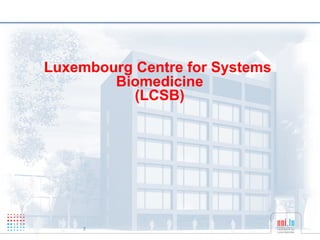
Luxembourg Centre for Systems
              Biomedicine
                 (LCSB)


18/06/12   2
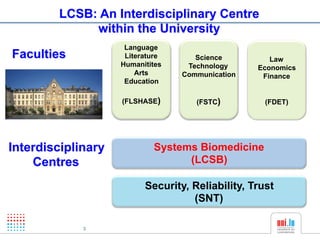
LCSB: An Interdisciplinary Centre
             within the University
                     Language
Faculties            Literature      Science         Law
                    Humanitites    Technology     Economics
                        Arts      Communication    Finance
                     Education

                    (FLSHASE)        (FSTC)         (FDET)


Interdisciplinary           Systems Biomedicine
    Centres                       (LCSB)

                          Security, Reliability, Trust
                                    (SNT)

             3
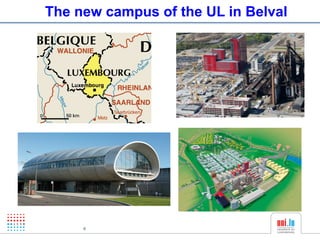
The new campus of the UL in Belval


     4
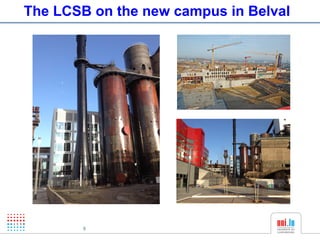
The LCSB on the new campus in Belval


        5
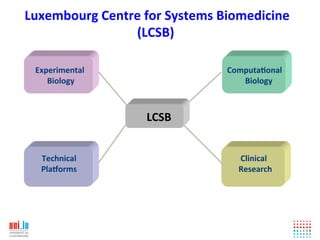
Luxembourg!Centre!for!Systems!Biomedicine!
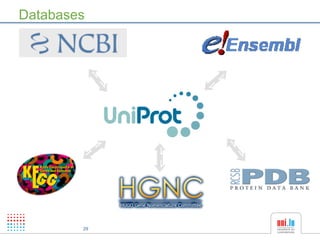
!!!!!!!!!!!!!!!!!!!!!!!!!!!!!!!!!!!(LCSB)!

!!!!Experimental!!                   Computa2onal!!
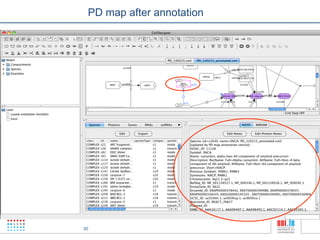
!!!!!!!!!Biology!                    !!!!!!!!!Biology!


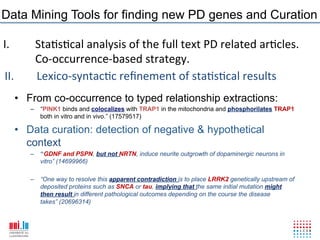
                       !!!!!!LCSB!


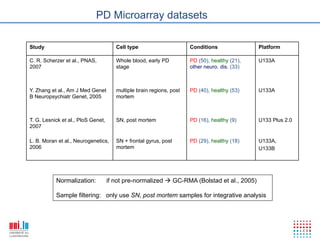
!!!!!!!!!Technical!!                 !!!!!!!!!!Clinical!!
!!!!!!Pla8orms!                      !!!!!!Research!
!                                    !!!!!!!!
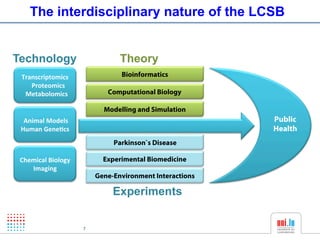
The interdisciplinary nature of the LCSB


Technology                      Theory
 Transcriptomics!               Bioinformatics
   !!!!Proteomics!
 !!Metabolomics!            Computational Biology

                           Modelling and Simulation
 !Animal!Models!                                                   Public
 Human!Gene2cs!                       !!!!!!!!!!!!!!!!!!!!!!!!!!
                                                               !   Health
                              Parkinson`s Disease

 Chemical!Biology!         Experimental Biomedicine
    Imaging!!!!
                         Gene-Environment Interactions

                              Experiments


 18/06/12            7
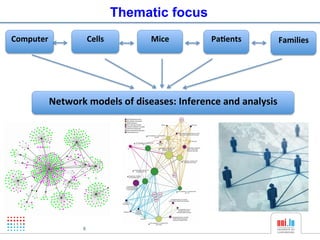
Thematic focus
Computer!          Cells!        Mice!       Pa2ents!     Families!
   !                 !


        Network!models!of!diseases:!Inference!and!analysis!


               8
Computa(onal+Biology+Group!
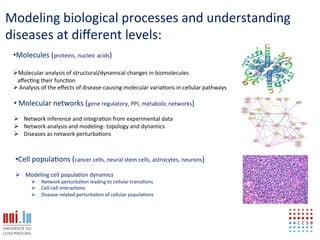
Modeling!biological!processes!and!understanding!
diseases!at!different!levels:!
! • Molecules!(      proteins,!nucleic!acids)!
  !
  ! Molecular!analysis!of!structural/dynamical!changes!in!biomolecules!!
  !!!affec6ng!their!func6on!
  ! Analysis!of!the!effects!of!disease?causing!molecular!varia6ons!in!cellular!pathways!

  !• !Molecular!networks!(gene!regulatory,!PPI,!metabolic!networks)!!
  !!
   !  Network!inference!and!integra6on!from!experimental!data!
   !  Network!analysis!and!modeling?!topology!and!dynamics!
   !  Diseases!as!network!perturba6ons!
   !


      • Cell!popula6ons!(cancer!cells,!neural!stem!cells,!astrocytes,!neurons)!
      !
      !  Modeling!cell!popula6on!dynamics!
            !  Network!perturba6on!leading!to!cellular!transi6ons!
            !  Cell?cell!interac6ons!
            !  Disease?related!perturba6on!of!cellular!popula6ons!

      !
      !
                                                                                          10
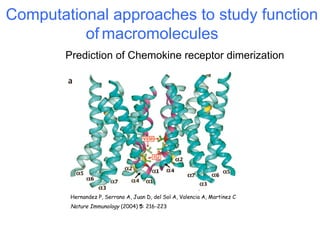
Computational approaches to study function
          of macromolecules
        Prediction of Chemokine receptor dimerization


         Hernandez P, Serrano A, Juan D, del Sol A, Valencia A, Martinez C
         Nature Immunology (2004) 5: 216-223
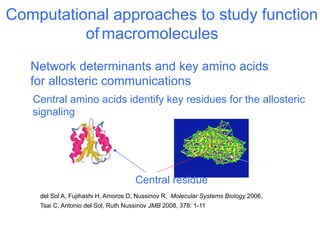
Computational approaches to study function
          of macromolecules
   Network determinants and key amino acids
   for allosteric communications
   Central amino acids identify key residues for the allosteric
   signaling


                                     Central residue
    del Sol A, Fujihashi H, Amoros D, Nussinov R, Molecular Systems Biology 2006,
    Tsai C, Antonio del Sol, Ruth Nussinov JMB 2008, 378: 1-11
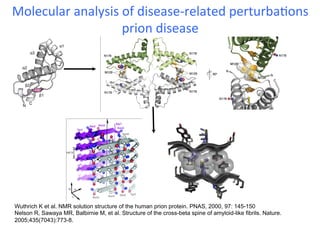
Molecular!analysis!of!disease?related!perturba6ons
                                                 !
                   prion!disease!
                                                        !


Wuthrich K et al. NMR solution structure of the human prion protein. PNAS, 2000, 97: 145-150
Nelson R, Sawaya MR, Balbirnie M, et al. Structure of the cross-beta spine of amyloid-like fibrils. Nature.
2005;435(7043):773-8.
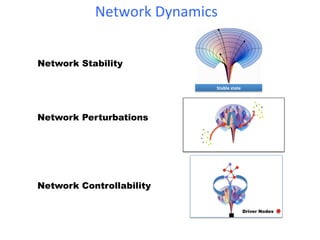
Network!Dynamics!!
                          !


Network Stability

                              Stable!state!


Network Perturbations


Network Controllability

                                              Driver Nodes
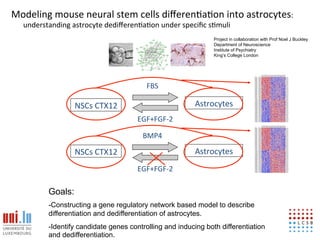
Modeling!mouse!neural!stem!cells!differen6a6on!into!astrocytes:!
  understanding!astrocyte!dedifferen6a6on!under!specific!s6muli!
                                                               Project in collaboration with Prof Noel J Buckley
                                                               Department of Neuroscience
                                                               Institute of Psychiatry
                                                               King’s College London


                                         FBS!

                  NSCs!CTX12!                            Astrocytes!
                                      EGF+FGF?2!

                                       BMP4!

                  NSCs!CTX12!                            Astrocytes!
                                      EGF+FGF?2!

         Goals:
         -Constructing a gene regulatory network based model to describe
         differentiation and dedifferentiation of astrocytes.
         -Identify candidate genes controlling and inducing both differentiation                        15
         and dedifferentiation.
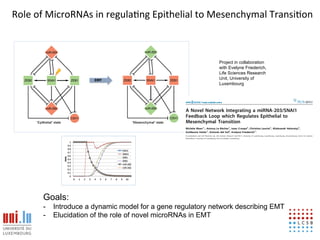
Role!of!MicroRNAs!in!regula6ng!Epithelial!to!Mesenchymal!Transi6on!


                                                           Project in collaboration
                                                           with Evelyne Friederich,
                                                           Life Sciences Research
                                                           Unit, University of
                                                           Luxembourg


      Goals:
      -  Introduce a dynamic model for a gene regulatory network describing EMT
      -  Elucidation of the role of novel microRNAs in EMT
                                                                                      16
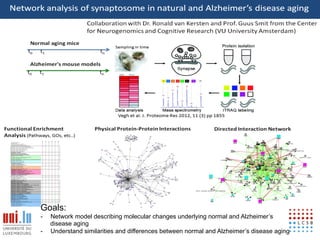
Goals:
-    Network model describing molecular changes underlying normal and Alzheimer’s
     disease aging                                                                        17
-    Understand similarities and differences between normal and Alzheimer’s disease aging
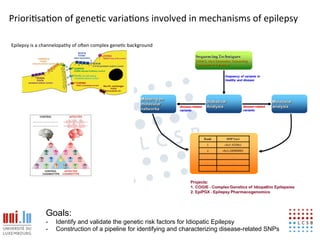
Priori6sa6on!of!gene6c!varia6ons!involved!in!mechanisms!of!epilepsy!

Epilepsy!is!a!channelopathy!of!oUen!complex!gene6c!background!


               Goals:
               -    Identify and validate the genetic risk factors for Idiopatic Epilepsy                18
               -    Construction of a pipeline for identifying and characterizing disease-related SNPs
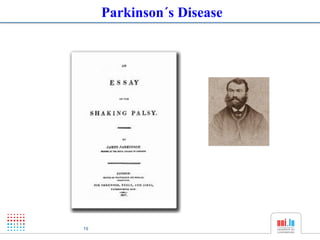
Parkinson´s Disease


                      J. Parkinson

                           1817


19
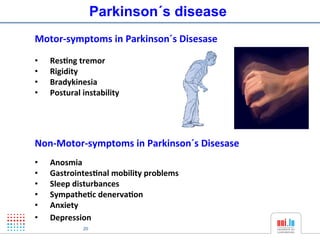
Parkinson´s disease
!
MotorLsymptoms!in!Parkinson´s!Disesase!
!
•    R
     ! es2ng!tremor!
•    R
     ! igidity!
•    B
     ! radykinesia!
•    P
     ! ostural!instability!
!
!
!
NonLMotorLsymptoms!in!Parkinson´s!Disesase!
!
•    A
     ! nosmia!
•    G
     ! astrointes2nal!mobility!problems!
•    S
     ! leep!disturbances!
•    S
     ! ympathe2c!denerva2on!
•    A
     ! nxiety!
•    ! epression!
     D
!              20
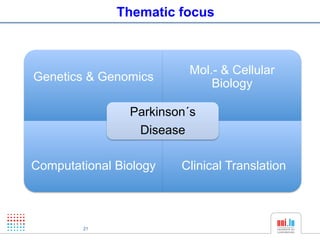
Thematic focus


                         Mol.- & Cellular
Genetics & Genomics
                             Biology

                Parkinson´s
                 Disease

Computational Biology   Clinical Translation


        21
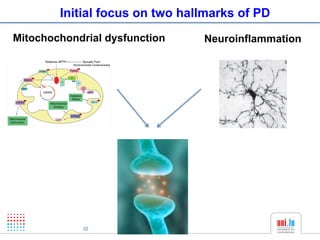
Initial focus on two hallmarks of PD
Mitochochondrial dysfunction    Neuroinflammation


            22
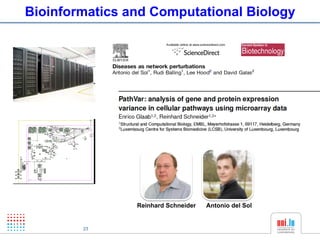
Bioinformatics and Computational Biology


                Reinhard Schneider   Antonio del Sol


        23
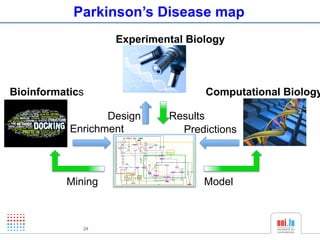
Parkinson’s Disease map
                   Experimental Biology


Bioinformatics                     Computational Biology

                  Design    Results
           Enrichment         Predictions


          Mining                   Model


             24
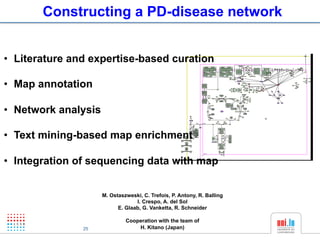
Constructing a PD-disease network


•  Literature and expertise-based curation

•  Map annotation

•  Network analysis

•  Text mining-based map enrichment

•  Integration of sequencing data with map


                      M. Ostaszweski, C. Trefois, P. Antony, R. Balling
                                   I. Crespo, A. del Sol
                            E. Glaab, G. Vanketta, R. Schneider

                               Cooperation with the team of
               25                  H. Kitano (Japan)
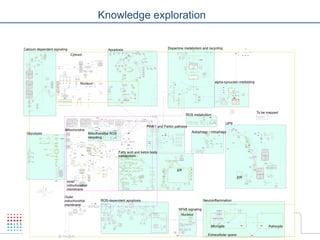
Knowledge exploration


26
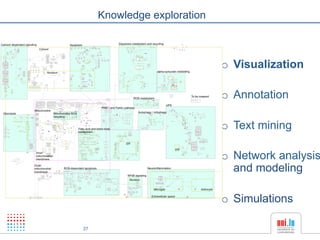
Knowledge exploration


                             o  Visualization

                             o  Annotation

                             o  Text mining

                             o  Network analysis
                                and modeling

                             o  Simulations

27
PD map annotation


Motivation
Enrichment of PD map with annotations
from biological databases


         28
Databases


             1
             1


        29
PD map after annotation


30
     30
Data Mining Tools for finding new PD genes and Curation

I.    !Sta6s6cal!analysis!of!the!full!text!PD!related!ar6cles.!!
      !Co?occurrence?based!strategy.!
II. ! !Lexico?syntac6c!refinement!of!sta6s6cal!results!
     •  From co-occurrence to typed relationship extractions:
        –  “PINK1 binds and colocalizes with TRAP1 in the mitochondria and phosphorilates TRAP1
           both in vitro and in vivo.” (17579517)

     •  Data curation: detection of negative & hypothetical
        context
        –  “GDNF and PSPN, but not NRTN, induce neurite outgrowth of dopaminergic neurons in
           vitro” (14699966)

        –  “One way to resolve this apparent contradiction is to place LRRK2 genetically upstream of
           deposited proteins such as SNCA or tau, implying that the same initial mutation might
           then result in different pathological outcomes depending on the course the disease
           takes” (20696314)


          Monday, March 12, 2012                 31
PD Microarray datasets

Study                                  Cell type                      Conditions               Platform

C. R. Scherzer et al., PNAS,           Whole blood, early PD          PD (50), healthy (21),   U133A
2007                                   stage                          other neuro. dis. (33)


Y. Zhang et al., Am J Med Genet        multiple brain regions, post   PD (40), healthy (53)    U133A
B Neuropsychiatr Genet, 2005           mortem


T. G. Lesnick et al., PloS Genet,      SN, post mortem                PD (16), healthy (9)     U133 Plus 2.0
2007

L. B. Moran et al., Neurogenetics,     SN + frontal gyrus, post       PD (29), healthy (18)    U133A,
2006                                   mortem                                                  U133B


           Normalization:           if not pre-normalized " GC-RMA (Bolstad et al., 2005)

           Sample filtering: only use SN, post mortem samples for integrative analysis


   Monday, March 12, 2012                            32
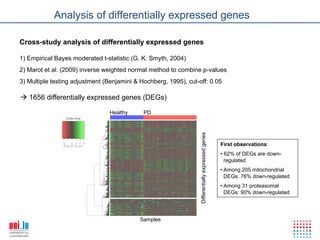
Analysis of differentially expressed genes

Cross-study analysis of differentially expressed genes

1) Empirical Bayes moderated t-statistic (G. K. Smyth, 2004)
2) Marot et al. (2009) inverse weighted normal method to combine p-values
3) Multiple testing adjustment (Benjamini & Hochberg, 1995), cut-off: 0.05

" 1656 differentially expressed genes (DEGs)

                                Healthy      PD


                                                                  Differentially expressed genes
                                                                                                   First observations:
                                                                                                   •  62% of DEGs are down-
                                                                                                     regulated
                                                                                                   •  Among 205 mitochondrial
                                                                                                      DEGs: 76% down-regulated
                                                                                                   •  Among 31 proteasomal
                                                                                                      DEGs: 90% down-regulated


                                            Samples

      Monday, March 12, 2012                   33
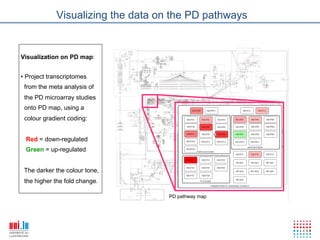
Visualizing the data on the PD pathways


Visualization on PD map:


•  Project transcriptomes
 from the meta analysis of
 the PD microarray studies
 onto PD map, using a
 colour gradient coding:


 Red = down-regulated
 Green = up-regulated


 The darker the colour tone,
 the higher the fold change.

                                      PD pathway map


      Monday, March 12, 2012     34
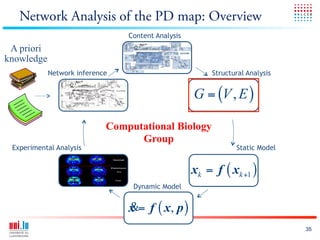
Network Analysis of the PD map: Overview
                                Content Analysis
 A priori
knowledge
            Network inference                           Structural Analysis


                                                   G = (V , E )

                            Computational Biology
                                  Group
 Experimental Analysis                                         Static Model


                                                   xk = f ( xk +1 )
                                 Dynamic Model


                                &
                                x = f ( x, p )
                                                                              35
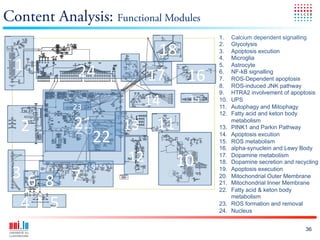
Content Analysis: Functional Modules
                                         1.     Calcium dependent signalling

                             18!
                                         2.     Glycolysis
                                         3.     Apoptosis excution

  1!
                                         4.     Microglia

             24!      19!                5.     Astrocyte

                            17! 16!      6. 
                                         7. 
                                         8. 
                                                NF-kB signalling
                                                ROS-Dependent apoptosis
                                                ROS-induced JNK pathway
                                         9.     HTRA2 involvement of apoptosis

             !
            23
                            14!    15!   10. 
                                         11. 
                                                UPS
                                                Autophagy and Mitophagy
                                         12.    Fatty acid and keton body

   2!       21!
            20! 13! 11!                  13. 
                                                metabolism
                                                PINK1 and Parkin Pathway

               22!                       14. 
                                         15. 
                                         16. 
                                                Apoptosis excution
                                                ROS metabolism
                                                alpha-synuclein and Lewy Body

                      12!         10!    17. 
                                         18. 
                                                Dopamine metabolism
                                                Dopamine secretion and recycling

 3! 6 8! 7!      9                       19. 
                                         20. 
                                         21. 
                                                Apoptosis execution
                                                Mitochondrial Outer Membrane
                                                Mitochondrial Inner Membrane
                                         22.    Fatty acid & keton body

  4! 5!
                                                metabolism
                                         23.    ROS formation and removal
                                         24.    Nucleus


                                                                           36
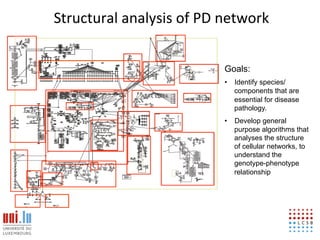
Structural!analysis!of!PD!network!


                          Goals:
                          •  Identify species/
                             components that are
                             essential for disease
                             pathology.
                          •  Develop general
                             purpose algorithms that
                             analyses the structure
                             of cellular networks, to
                             understand the
                             genotype-phenotype
                             relationship
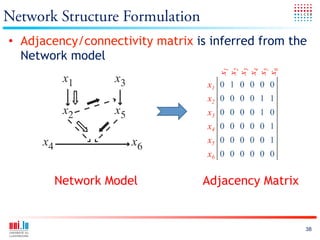
Network Structure Formulation
•  Adjacency/connectivity matrix is inferred from the
   Network model


                                     x1
                                     x2
                                     x3
                                     x4
                                     x5
                                     x6
                                   x1 0 1 0 0 0 0
                                   x2 0 0 0 0 1 1
                                   x3 0 0 0 0 1 0
                                   x4 0 0 0 0 0 1
                                   x5 0 0 0 0 0 1
                                   x6 0 0 0 0 0 0


        Network Model             Adjacency Matrix


                                                     38
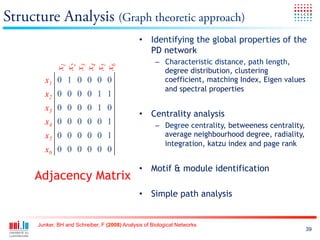
Structure Analysis (Graph theoretic approach)
                                                •  Identifying the global properties of the
                                                   PD network
             x1                                       –  Characteristic distance, path length,
             x2
             x3
             x4
             x5
             x6
                                                         degree distribution, clustering
        x1 0 1 0 0 0 0                                   coefficient, matching Index, Eigen values
                                                         and spectral properties
        x2 0 0 0 0 1 1
        x3 0 0 0 0 1 0
                                                •  Centrality analysis
        x4 0 0 0 0 0 1                                –  Degree centrality, betweeness centrality,
        x5 0 0 0 0 0 1                                   average neighbourhood degree, radiality,
                                                         integration, katzu index and page rank
        x6 0 0 0 0 0 0

                                                •  Motif & module identification
     Adjacency Matrix
                                                •  Simple path analysis


      Junker, BH and Schreiber, F (2008) Analysis of Biological Networks
                                                                                                     39
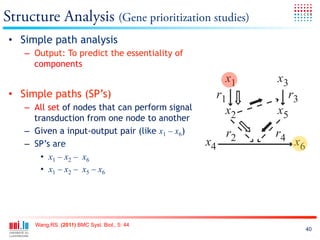
Structure Analysis (Gene prioritization studies)
 •  Simple path analysis
    –  Output: To predict the essentiality of
       components


 •  Simple paths (SP’s)
    –  All set of nodes that can perform signal
       transduction from one node to another
    –  Given a input-output pair (like x1 – x6)
    –  SP’s are
         •  x1 – x2 – x6
         •  x1 – x2 – x5 – x6


      Wang,RS. (2011) BMC Syst. Biol., 5: 44
                                                   40
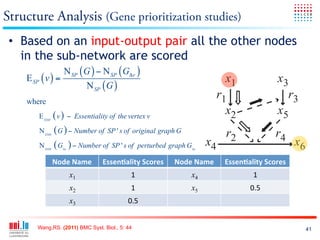
Structure Analysis (Gene prioritization studies)
 •  Based on an input-output pair all the other nodes
    in the sub-network are scored
                  N SP ( G ) − N SP ( GΔv )
     E SP ( v ) =
                         N SP ( G )
    where
       E ESM ( v ) − Essentiality of the vertex v

       N ESM ( G ) − Number of SP ' s of original graph G

       N ESM ( GΔv ) − Number of SP ' s of perturbed graph GΔv

            Node!Name!          Essen2ality!Scores!   Node!Name!   Essen2ality!Scores!
                  x1                       1!               x4!            1!
                  x2!                      1!               x5!           0.5!
                  x3!                     0.5!


      Wang,RS. (2011) BMC Syst. Biol., 5: 44                                             41
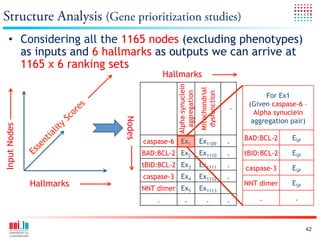
Structure Analysis (Gene prioritization studies)
   •  Considering all the 1165 nodes (excluding phenotypes)
      as inputs and 6 hallmarks as outputs we can arrive at
      1165 x 6 ranking sets
                                          Hallmarks


                                             Alpha-synuclein


                                                               Mitochondrial
                                               aggregation


                                                                dysfunction
                                                                                          For Ex1
                                                                                    (Given caspase-6 –


                                                                               .
                                                                                      Alpha synuclein
                          Nodes                                                      aggregation pair)
Input Nodes


                                  caspase-6 Ex1                Ex1109          .   BAD:BCL-2     ESP

                                  BAD:BCL-2 Ex2                Ex1110          .   tBID:BCL-2    ESP
                                  tBID:BCL-2 Ex3               Ex1111          .   caspase-3     ESP
                                  caspase-3 Ex4                Ex1112          .
              Hallmarks           NNT dimer Ex5                Ex1113          .
                                                                                   NNT dimer     ESP

                                      .            .                .          .       .          .


                                                                                                       42
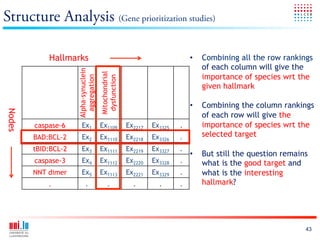
Structure Analysis (Gene prioritization studies)

            Hallmarks                                                        •    Combining all the row rankings
                                                                                  of each column will give the
                     Alpha-synuclein


                                       Mitochondrial
                                                                                  importance of species wrt the
                       aggregation


                                        dysfunction
                                                                                  given hallmark

                                                                             •    Combining the column rankings
Nodes


                                                                                  of each row will give the
        caspase-6      Ex1             Ex1109          Ex2217   Ex3325   .        importance of species wrt the
        BAD:BCL-2      Ex2             Ex1110          Ex2218   Ex3326   .        selected target
        tBID:BCL-2     Ex3             Ex1111          Ex2219   Ex3327   .
                                                                             •    But still the question remains
        caspase-3      Ex4             Ex1112          Ex2220   Ex3328   .        what is the good target and
        NNT dimer      Ex5             Ex1113          Ex2221   Ex3329   .        what is the interesting
            .              .                .            .        .      .        hallmark?


                                                                                                               43
Centrality analysis and Simple path analysis
•  Simple path analysis:
   –  Top 10% includes metabolites of citric acid cycle and glycolysis pathway
   –  Next group forms proteins and complexes involved in apoptosis


•  Centrality analysis:
   –  VDAC1 and apoptosome to be the key components that are highly
      ranked
   –  AMPA receptors involved in long-term potentiation mechanism of
      synaptic plasticity and transcription factors like CREB1.


•  Both analysis:
   –  Highlights many small molecules such as reactive oxygen species (e.g.
      hydrogen peroxide)


                                                                              44
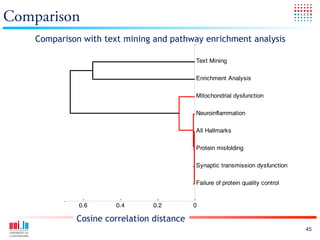
Comparison
    Comparison with text mining and pathway enrichment analysis

                                           Text Mining

                                           Enrichment Analysis

                                           Mitochondrial dysfunction

                                           Neuroinflammation

                                           All Hallmarks

                                           Protein misfolding

                                           Synaptic transmission dysfunction

                                           Failure of protein quality control


              0.6      0.4      0.2        0

             Cosine correlation distance
                                                                                45
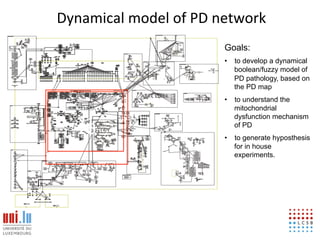
Dynamical!model!of!PD!network!
                       Goals:
                       •  to develop a dynamical
                          boolean/fuzzy model of
                          PD pathology, based on
                          the PD map
                       •  to understand the
                          mitochondrial

  21!
                          dysfunction mechanism

  20!                     of PD
                       •  to generate hyposthesis
                          for in house
                          experiments.
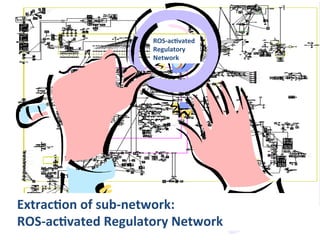
ROSLac2vated!
                     Regulatory!
                     Network!!


Extrac2on!of!subLnetwork:!!
ROSLac2vated!Regulatory!Network!!
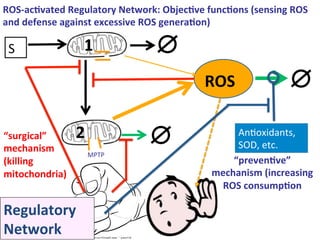
ROSLac2vated!Regulatory!Network:!Objec2ve!func2ons!(sensing!ROS!
and!defense!against!excessive!ROS!genera2on)!!

 S!               1!

                                          ROS!

“surgical”!      2!                             An6oxidants,!
mechanism!                                      SOD,!etc.!
                  MPTP!
(killing!                                      “preven2ve”!
mitochondria)!                             mechanism!(increasing!
                                            ROS!consump2on!

Regulatory!
Network!
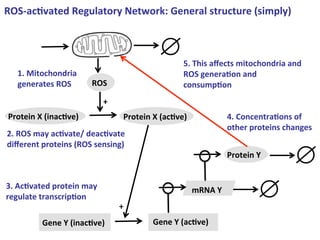
ROSLac2vated!Regulatory!Network:!General!structure!(simply)!!


                                                 5.!This!affects!mitochondria!and!
  1.!Mitochondria!                               ROS!genera2on!and!
  generates!ROS!       ROS!                      consump2on!
                           +!
Protein!X!(inac2ve)!             Protein!X!(ac2ve)!             4.!Concentra2ons!of!
                                                                other!proteins!changes!
2.!ROS!may!ac2vate/!deac2vate!
different!proteins!(ROS!sensing)!
                                                                Protein!Y!


3.!Ac2vated!protein!may!                              mRNA!Y!
regulate!transcrip2on!
                                +!
         Gene!Y!(inac2ve)!               Gene!Y!(ac2ve)!
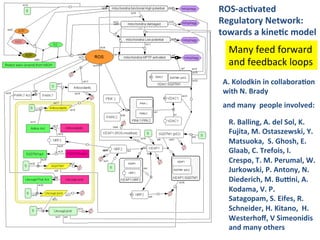
ROSLac2vated!
Regulatory!Network:!
towards!a!kine2c!model!!
  Many!feed!forward!
  and!feedback!loops!
A.!Kolodkin!in!collabora2on!
with!N.!Brady!!
and!many!!people!involved:!

  R.!Balling,!A.!del!Sol,!K.!
  Fujita,!M.!Ostaszewski,!Y.!
  Matsuoka,!!S.!Ghosh,!E.!
  Glaab,!C.!Trefois,!I.!
  Crespo,!T.!M.!Perumal,!W.!
  Jurkowski,!P.!Antony,!N.!
  Diederich,!M.!Budni,!A.!
  Kodama,!V.!P.!
  Satagopam,!S.!Eifes,!R.!
  Schneider,!H.!Kitano,!!H.!
  Westerhoff,!V!Simeonidis!
  and!many!others!!
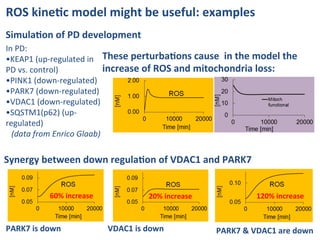
ROS!kine2c!model!might!be!useful:!examples!
Simula2on!of!PD!development!
In!PD:!!
•KEAP1!(up?regulated!in! These!perturba2ons!cause!!in!the!model!the!
PD!vs.!control)!           increase!of!ROS!and!mitochondria!loss:!
•PINK1!(down?regulated)!
•PARK7!(down?regulated)!
•VDAC1!(down?regulated)!
•SQSTM1(p62)!(up?
regulated)!
  (data+from+Enrico+Glaab)+

Synergy!between!down!regula2on!of!VDAC1!and!PARK7!


          60%!increase!            20%!increase!            120%!increase!


PARK7!is!down!            VDAC1!is!down!           PARK7!&!VDAC1!are!down!
LCSB                               SBI
Computational Biology Group          Hiroaki Kitano (Group Leader)
 Antonio del Sol (Group leader)
                                     Kazuhiro Fujita
                                     Ghosh Samik
 Wiktor Jurkowski
                                     Yukiko Matsuoka
 Thanneer Malai Perumal
 Isaac Crespo


 Bioinformatics core
 Reinhard Schneider (Group Leader)   ISB Fellow
 Venkata Satagopam                   Alexey Kolodkin
 Maria Briyukov
 Enrico Glaab
 Serge Eifes

Experimental Biology Group
 Rudi Balling (Group leader)
 Christophe Trefois
 Paul Antony
 Manuel Buttini
Thanks for your
  attention!

SBGN comprehensive disease maps at LCSB.

  • 1.
    Supported by Prominent internationalspeakers from h"p://workshop.eisbm.eu1
  • 2.
    SBGN comprehensive diseasemaps at the LCSB Antonio del Sol Lyon June 14th, 2012
  • 3.
    Luxembourg Centre forSystems Biomedicine (LCSB) 18/06/12 2
  • 4.
    LCSB: An InterdisciplinaryCentre within the University Language Faculties Literature Science Law Humanitites Technology Economics Arts Communication Finance Education (FLSHASE) (FSTC) (FDET) Interdisciplinary Systems Biomedicine Centres (LCSB) Security, Reliability, Trust (SNT) 3
  • 5.
    The new campusof the UL in Belval 4
  • 6.
    The LCSB onthe new campus in Belval 5
  • 7.
    Luxembourg!Centre!for!Systems!Biomedicine! !!!!!!!!!!!!!!!!!!!!!!!!!!!!!!!!!!!(LCSB)! !!!!Experimental!! Computa2onal!! !!!!!!!!!Biology! !!!!!!!!!Biology! !!!!!!LCSB! !!!!!!!!!Technical!! !!!!!!!!!!Clinical!! !!!!!!Pla8orms! !!!!!!Research! ! !!!!!!!!
  • 8.
    The interdisciplinary natureof the LCSB Technology Theory Transcriptomics! Bioinformatics !!!!Proteomics! !!Metabolomics! Computational Biology Modelling and Simulation !Animal!Models! Public Human!Gene2cs! !!!!!!!!!!!!!!!!!!!!!!!!!! ! Health Parkinson`s Disease Chemical!Biology! Experimental Biomedicine Imaging!!!! Gene-Environment Interactions Experiments 18/06/12 7
  • 9.
    Thematic focus Computer! Cells! Mice! Pa2ents! Families! ! ! Network!models!of!diseases:!Inference!and!analysis! 8
  • 10.
  • 11.
    Modeling!biological!processes!and!understanding! diseases!at!different!levels:! ! • Molecules!( proteins,!nucleic!acids)! ! ! Molecular!analysis!of!structural/dynamical!changes!in!biomolecules!! !!!affec6ng!their!func6on! ! Analysis!of!the!effects!of!disease?causing!molecular!varia6ons!in!cellular!pathways! !• !Molecular!networks!(gene!regulatory,!PPI,!metabolic!networks)!! !! !  Network!inference!and!integra6on!from!experimental!data! !  Network!analysis!and!modeling?!topology!and!dynamics! !  Diseases!as!network!perturba6ons! ! • Cell!popula6ons!(cancer!cells,!neural!stem!cells,!astrocytes,!neurons)! ! !  Modeling!cell!popula6on!dynamics! !  Network!perturba6on!leading!to!cellular!transi6ons! !  Cell?cell!interac6ons! !  Disease?related!perturba6on!of!cellular!popula6ons! ! ! 10
  • 12.
    Computational approaches tostudy function of macromolecules Prediction of Chemokine receptor dimerization Hernandez P, Serrano A, Juan D, del Sol A, Valencia A, Martinez C Nature Immunology (2004) 5: 216-223
  • 13.
    Computational approaches tostudy function of macromolecules Network determinants and key amino acids for allosteric communications Central amino acids identify key residues for the allosteric signaling Central residue del Sol A, Fujihashi H, Amoros D, Nussinov R, Molecular Systems Biology 2006, Tsai C, Antonio del Sol, Ruth Nussinov JMB 2008, 378: 1-11
  • 14.
    Molecular!analysis!of!disease?related!perturba6ons ! prion!disease! ! Wuthrich K et al. NMR solution structure of the human prion protein. PNAS, 2000, 97: 145-150 Nelson R, Sawaya MR, Balbirnie M, et al. Structure of the cross-beta spine of amyloid-like fibrils. Nature. 2005;435(7043):773-8.
  • 15.
    Network!Dynamics!! ! Network Stability Stable!state! Network Perturbations Network Controllability Driver Nodes
  • 16.
    Modeling!mouse!neural!stem!cells!differen6a6on!into!astrocytes:! understanding!astrocyte!dedifferen6a6on!under!specific!s6muli! Project in collaboration with Prof Noel J Buckley Department of Neuroscience Institute of Psychiatry King’s College London FBS! NSCs!CTX12! Astrocytes! EGF+FGF?2! BMP4! NSCs!CTX12! Astrocytes! EGF+FGF?2! Goals: -Constructing a gene regulatory network based model to describe differentiation and dedifferentiation of astrocytes. -Identify candidate genes controlling and inducing both differentiation 15 and dedifferentiation.
  • 17.
    Role!of!MicroRNAs!in!regula6ng!Epithelial!to!Mesenchymal!Transi6on! Project in collaboration with Evelyne Friederich, Life Sciences Research Unit, University of Luxembourg Goals: -  Introduce a dynamic model for a gene regulatory network describing EMT -  Elucidation of the role of novel microRNAs in EMT 16
  • 18.
    Goals: -  Network model describing molecular changes underlying normal and Alzheimer’s disease aging 17 -  Understand similarities and differences between normal and Alzheimer’s disease aging
  • 19.
    Priori6sa6on!of!gene6c!varia6ons!involved!in!mechanisms!of!epilepsy! Epilepsy!is!a!channelopathy!of!oUen!complex!gene6c!background! Goals: -  Identify and validate the genetic risk factors for Idiopatic Epilepsy 18 -  Construction of a pipeline for identifying and characterizing disease-related SNPs
  • 20.
    Parkinson´s Disease J. Parkinson 1817 19
  • 21.
    Parkinson´s disease ! MotorLsymptoms!in!Parkinson´s!Disesase! ! •  R ! es2ng!tremor! •  R ! igidity! •  B ! radykinesia! •  P ! ostural!instability! ! ! ! NonLMotorLsymptoms!in!Parkinson´s!Disesase! ! •  A ! nosmia! •  G ! astrointes2nal!mobility!problems! •  S ! leep!disturbances! •  S ! ympathe2c!denerva2on! •  A ! nxiety! •  ! epression! D ! 20
  • 22.
    Thematic focus Mol.- & Cellular Genetics & Genomics Biology Parkinson´s Disease Computational Biology Clinical Translation 21
  • 23.
    Initial focus ontwo hallmarks of PD Mitochochondrial dysfunction Neuroinflammation 22
  • 24.
    Bioinformatics and ComputationalBiology Reinhard Schneider Antonio del Sol 23
  • 25.
    Parkinson’s Disease map Experimental Biology Bioinformatics Computational Biology Design Results Enrichment Predictions Mining Model 24
  • 26.
    Constructing a PD-diseasenetwork •  Literature and expertise-based curation •  Map annotation •  Network analysis •  Text mining-based map enrichment •  Integration of sequencing data with map M. Ostaszweski, C. Trefois, P. Antony, R. Balling I. Crespo, A. del Sol E. Glaab, G. Vanketta, R. Schneider Cooperation with the team of 25 H. Kitano (Japan)
  • 27.
  • 28.
    Knowledge exploration o  Visualization o  Annotation o  Text mining o  Network analysis and modeling o  Simulations 27
  • 29.
    PD map annotation Motivation Enrichmentof PD map with annotations from biological databases 28
  • 30.
    Databases 1 1 29
  • 31.
    PD map afterannotation 30 30
  • 32.
    Data Mining Toolsfor finding new PD genes and Curation I. !Sta6s6cal!analysis!of!the!full!text!PD!related!ar6cles.!! !Co?occurrence?based!strategy.! II. ! !Lexico?syntac6c!refinement!of!sta6s6cal!results! •  From co-occurrence to typed relationship extractions: –  “PINK1 binds and colocalizes with TRAP1 in the mitochondria and phosphorilates TRAP1 both in vitro and in vivo.” (17579517) •  Data curation: detection of negative & hypothetical context –  “GDNF and PSPN, but not NRTN, induce neurite outgrowth of dopaminergic neurons in vitro” (14699966) –  “One way to resolve this apparent contradiction is to place LRRK2 genetically upstream of deposited proteins such as SNCA or tau, implying that the same initial mutation might then result in different pathological outcomes depending on the course the disease takes” (20696314) Monday, March 12, 2012 31
  • 33.
    PD Microarray datasets Study Cell type Conditions Platform C. R. Scherzer et al., PNAS, Whole blood, early PD PD (50), healthy (21), U133A 2007 stage other neuro. dis. (33) Y. Zhang et al., Am J Med Genet multiple brain regions, post PD (40), healthy (53) U133A B Neuropsychiatr Genet, 2005 mortem T. G. Lesnick et al., PloS Genet, SN, post mortem PD (16), healthy (9) U133 Plus 2.0 2007 L. B. Moran et al., Neurogenetics, SN + frontal gyrus, post PD (29), healthy (18) U133A, 2006 mortem U133B Normalization: if not pre-normalized " GC-RMA (Bolstad et al., 2005) Sample filtering: only use SN, post mortem samples for integrative analysis Monday, March 12, 2012 32
  • 34.
    Analysis of differentiallyexpressed genes Cross-study analysis of differentially expressed genes 1) Empirical Bayes moderated t-statistic (G. K. Smyth, 2004) 2) Marot et al. (2009) inverse weighted normal method to combine p-values 3) Multiple testing adjustment (Benjamini & Hochberg, 1995), cut-off: 0.05 " 1656 differentially expressed genes (DEGs) Healthy PD Differentially expressed genes First observations: •  62% of DEGs are down- regulated •  Among 205 mitochondrial DEGs: 76% down-regulated •  Among 31 proteasomal DEGs: 90% down-regulated Samples Monday, March 12, 2012 33
  • 35.
    Visualizing the dataon the PD pathways Visualization on PD map: •  Project transcriptomes from the meta analysis of the PD microarray studies onto PD map, using a colour gradient coding: Red = down-regulated Green = up-regulated The darker the colour tone, the higher the fold change. PD pathway map Monday, March 12, 2012 34
  • 36.
    Network Analysis ofthe PD map: Overview Content Analysis A priori knowledge Network inference Structural Analysis G = (V , E ) Computational Biology Group Experimental Analysis Static Model xk = f ( xk +1 ) Dynamic Model & x = f ( x, p ) 35
  • 37.
    Content Analysis: FunctionalModules 1.  Calcium dependent signalling 18! 2.  Glycolysis 3.  Apoptosis excution 1! 4.  Microglia 24! 19! 5.  Astrocyte 17! 16! 6.  7.  8.  NF-kB signalling ROS-Dependent apoptosis ROS-induced JNK pathway 9.  HTRA2 involvement of apoptosis ! 23 14! 15! 10.  11.  UPS Autophagy and Mitophagy 12.  Fatty acid and keton body 2! 21! 20! 13! 11! 13.  metabolism PINK1 and Parkin Pathway 22! 14.  15.  16.  Apoptosis excution ROS metabolism alpha-synuclein and Lewy Body 12! 10! 17.  18.  Dopamine metabolism Dopamine secretion and recycling 3! 6 8! 7! 9 19.  20.  21.  Apoptosis execution Mitochondrial Outer Membrane Mitochondrial Inner Membrane 22.  Fatty acid & keton body 4! 5! metabolism 23.  ROS formation and removal 24.  Nucleus 36
  • 38.
    Structural!analysis!of!PD!network! Goals: •  Identify species/ components that are essential for disease pathology. •  Develop general purpose algorithms that analyses the structure of cellular networks, to understand the genotype-phenotype relationship
  • 39.
    Network Structure Formulation • Adjacency/connectivity matrix is inferred from the Network model x1 x2 x3 x4 x5 x6 x1 0 1 0 0 0 0 x2 0 0 0 0 1 1 x3 0 0 0 0 1 0 x4 0 0 0 0 0 1 x5 0 0 0 0 0 1 x6 0 0 0 0 0 0 Network Model Adjacency Matrix 38
  • 40.
    Structure Analysis (Graphtheoretic approach) •  Identifying the global properties of the PD network x1 –  Characteristic distance, path length, x2 x3 x4 x5 x6 degree distribution, clustering x1 0 1 0 0 0 0 coefficient, matching Index, Eigen values and spectral properties x2 0 0 0 0 1 1 x3 0 0 0 0 1 0 •  Centrality analysis x4 0 0 0 0 0 1 –  Degree centrality, betweeness centrality, x5 0 0 0 0 0 1 average neighbourhood degree, radiality, integration, katzu index and page rank x6 0 0 0 0 0 0 •  Motif & module identification Adjacency Matrix •  Simple path analysis Junker, BH and Schreiber, F (2008) Analysis of Biological Networks 39
  • 41.
    Structure Analysis (Geneprioritization studies) •  Simple path analysis –  Output: To predict the essentiality of components •  Simple paths (SP’s) –  All set of nodes that can perform signal transduction from one node to another –  Given a input-output pair (like x1 – x6) –  SP’s are •  x1 – x2 – x6 •  x1 – x2 – x5 – x6 Wang,RS. (2011) BMC Syst. Biol., 5: 44 40
  • 42.
    Structure Analysis (Geneprioritization studies) •  Based on an input-output pair all the other nodes in the sub-network are scored N SP ( G ) − N SP ( GΔv ) E SP ( v ) = N SP ( G ) where E ESM ( v ) − Essentiality of the vertex v N ESM ( G ) − Number of SP ' s of original graph G N ESM ( GΔv ) − Number of SP ' s of perturbed graph GΔv Node!Name! Essen2ality!Scores! Node!Name! Essen2ality!Scores! x1 1! x4! 1! x2! 1! x5! 0.5! x3! 0.5! Wang,RS. (2011) BMC Syst. Biol., 5: 44 41
  • 43.
    Structure Analysis (Geneprioritization studies) •  Considering all the 1165 nodes (excluding phenotypes) as inputs and 6 hallmarks as outputs we can arrive at 1165 x 6 ranking sets Hallmarks Alpha-synuclein Mitochondrial aggregation dysfunction For Ex1 (Given caspase-6 – . Alpha synuclein Nodes aggregation pair) Input Nodes caspase-6 Ex1 Ex1109 . BAD:BCL-2 ESP BAD:BCL-2 Ex2 Ex1110 . tBID:BCL-2 ESP tBID:BCL-2 Ex3 Ex1111 . caspase-3 ESP caspase-3 Ex4 Ex1112 . Hallmarks NNT dimer Ex5 Ex1113 . NNT dimer ESP . . . . . . 42
  • 44.
    Structure Analysis (Geneprioritization studies) Hallmarks •  Combining all the row rankings of each column will give the Alpha-synuclein Mitochondrial importance of species wrt the aggregation dysfunction given hallmark •  Combining the column rankings Nodes of each row will give the caspase-6 Ex1 Ex1109 Ex2217 Ex3325 . importance of species wrt the BAD:BCL-2 Ex2 Ex1110 Ex2218 Ex3326 . selected target tBID:BCL-2 Ex3 Ex1111 Ex2219 Ex3327 . •  But still the question remains caspase-3 Ex4 Ex1112 Ex2220 Ex3328 . what is the good target and NNT dimer Ex5 Ex1113 Ex2221 Ex3329 . what is the interesting . . . . . . hallmark? 43
  • 45.
    Centrality analysis andSimple path analysis •  Simple path analysis: –  Top 10% includes metabolites of citric acid cycle and glycolysis pathway –  Next group forms proteins and complexes involved in apoptosis •  Centrality analysis: –  VDAC1 and apoptosome to be the key components that are highly ranked –  AMPA receptors involved in long-term potentiation mechanism of synaptic plasticity and transcription factors like CREB1. •  Both analysis: –  Highlights many small molecules such as reactive oxygen species (e.g. hydrogen peroxide) 44
  • 46.
    Comparison Comparison with text mining and pathway enrichment analysis Text Mining Enrichment Analysis Mitochondrial dysfunction Neuroinflammation All Hallmarks Protein misfolding Synaptic transmission dysfunction Failure of protein quality control 0.6 0.4 0.2 0 Cosine correlation distance 45
  • 47.
    Dynamical!model!of!PD!network! Goals: •  to develop a dynamical boolean/fuzzy model of PD pathology, based on the PD map •  to understand the mitochondrial 21! dysfunction mechanism 20! of PD •  to generate hyposthesis for in house experiments.
  • 48.
    ROSLac2vated! Regulatory! Network!! Extrac2on!of!subLnetwork:!! ROSLac2vated!Regulatory!Network!!
  • 49.
    ROSLac2vated!Regulatory!Network:!Objec2ve!func2ons!(sensing!ROS! and!defense!against!excessive!ROS!genera2on)!! S! 1! ROS! “surgical”! 2! An6oxidants,! mechanism! SOD,!etc.! MPTP! (killing! “preven2ve”! mitochondria)! mechanism!(increasing! ROS!consump2on! Regulatory! Network!
  • 50.
    ROSLac2vated!Regulatory!Network:!General!structure!(simply)!! 5.!This!affects!mitochondria!and! 1.!Mitochondria! ROS!genera2on!and! generates!ROS! ROS! consump2on! +! Protein!X!(inac2ve)! Protein!X!(ac2ve)! 4.!Concentra2ons!of! other!proteins!changes! 2.!ROS!may!ac2vate/!deac2vate! different!proteins!(ROS!sensing)! Protein!Y! 3.!Ac2vated!protein!may! mRNA!Y! regulate!transcrip2on! +! Gene!Y!(inac2ve)! Gene!Y!(ac2ve)!
  • 51.
    ROSLac2vated! Regulatory!Network:! towards!a!kine2c!model!! Many!feed!forward! and!feedback!loops! A.!Kolodkin!in!collabora2on! with!N.!Brady!! and!many!!people!involved:! R.!Balling,!A.!del!Sol,!K.! Fujita,!M.!Ostaszewski,!Y.! Matsuoka,!!S.!Ghosh,!E.! Glaab,!C.!Trefois,!I.! Crespo,!T.!M.!Perumal,!W.! Jurkowski,!P.!Antony,!N.! Diederich,!M.!Budni,!A.! Kodama,!V.!P.! Satagopam,!S.!Eifes,!R.! Schneider,!H.!Kitano,!!H.! Westerhoff,!V!Simeonidis! and!many!others!!
  • 52.
    ROS!kine2c!model!might!be!useful:!examples! Simula2on!of!PD!development! In!PD:!! •KEAP1!(up?regulated!in! These!perturba2ons!cause!!in!the!model!the! PD!vs.!control)! increase!of!ROS!and!mitochondria!loss:! •PINK1!(down?regulated)! •PARK7!(down?regulated)! •VDAC1!(down?regulated)! •SQSTM1(p62)!(up? regulated)! (data+from+Enrico+Glaab)+ Synergy!between!down!regula2on!of!VDAC1!and!PARK7! 60%!increase! 20%!increase! 120%!increase! PARK7!is!down! VDAC1!is!down! PARK7!&!VDAC1!are!down!
  • 53.
    LCSB SBI Computational Biology Group Hiroaki Kitano (Group Leader) Antonio del Sol (Group leader) Kazuhiro Fujita Ghosh Samik Wiktor Jurkowski Yukiko Matsuoka Thanneer Malai Perumal Isaac Crespo Bioinformatics core Reinhard Schneider (Group Leader) ISB Fellow Venkata Satagopam Alexey Kolodkin Maria Briyukov Enrico Glaab Serge Eifes Experimental Biology Group Rudi Balling (Group leader) Christophe Trefois Paul Antony Manuel Buttini
  • 54.
    Thanks for your attention!