Knowledge Progression
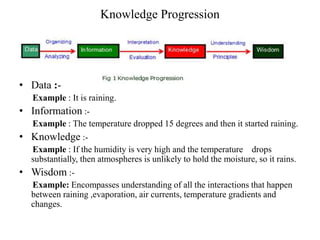
• Data :-
Example : It is raining.
• Information :-
Example : The temperature dropped 15 degrees and then it started raining.
• Knowledge :-
Example : If the humidity is very high and the temperature drops
substantially, then atmospheres is unlikely to hold the moisture, so it rains.
• Wisdom :-
Example: Encompasses understanding of all the interactions that happen
between raining ,evaporation, air currents, temperature gradients and
changes.
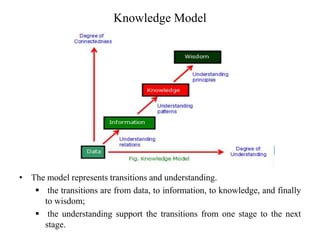
Knowledge Model
• The model represents transitions and understanding.
 the transitions are from data, to information, to knowledge, and finally
to wisdom;
 the understanding support the transitions from one stage to the next
stage.
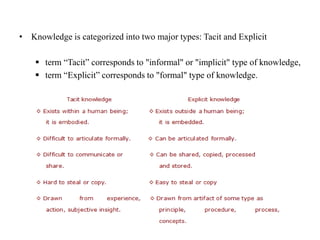
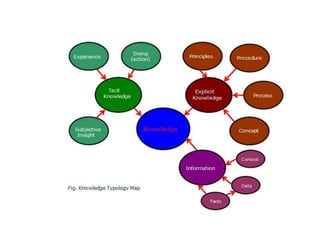
• Knowledge is categorized into two major types: Tacit and Explicit
 term “Tacit” corresponds to "informal" or "implicit" type of knowledge,
 term “Explicit” corresponds to "formal" type of knowledge.
• Facts
• Concepts
• Processes
• Procedures
• Principles
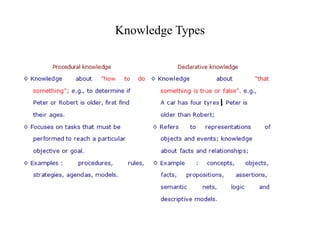
Knowledge Types
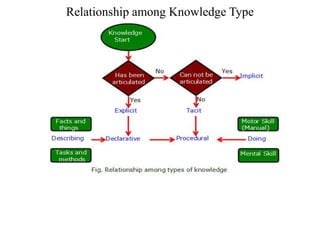
Relationship among Knowledge Type
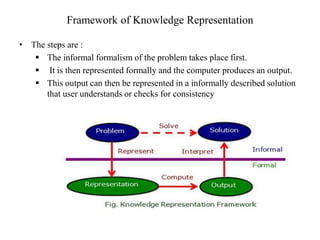
Framework of Knowledge Representation
• The steps are :
 The informal formalism of the problem takes place first.
 It is then represented formally and the computer produces an output.
 This output can then be represented in a informally described solution
that user understands or checks for consistency
• The steps are :
 The informal formalism of the problem takes place first.
 It is then represented formally and the computer produces an output.
 This output can then be represented in a informally described solution that
user understands or checks for consistency
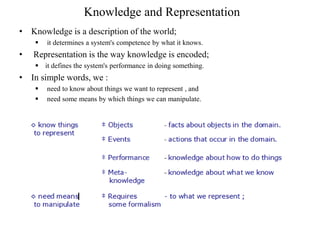
Knowledge and Representation
• Knowledge is a description of the world;
 it determines a system's competence by what it knows.
• Representation is the way knowledge is encoded;
 it defines the system's performance in doing something.
• In simple words, we :
 need to know about things we want to represent , and
 need some means by which things we can manipulate.
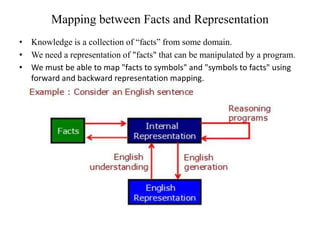
Mapping between Facts and Representation
• Knowledge is a collection of “facts” from some domain.
• We need a representation of "facts" that can be manipulated by a program.
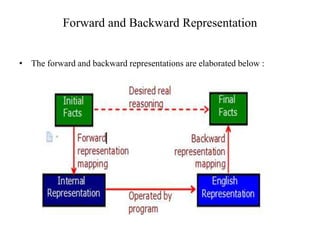
• We must be able to map "facts to symbols" and "symbols to facts" using
forward and backward representation mapping.
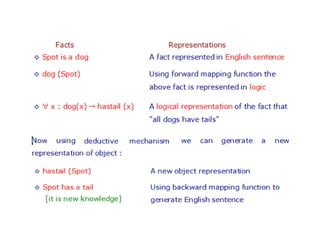
Forward and Backward Representation
• The forward and backward representations are elaborated below :
KR System Requirements
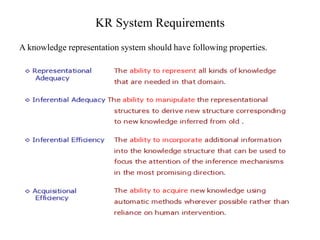
A knowledge representation system should have following properties.
Knowledge Representation Schemes
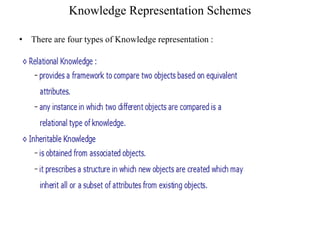
• There are four types of Knowledge representation :
Relational Knowledge
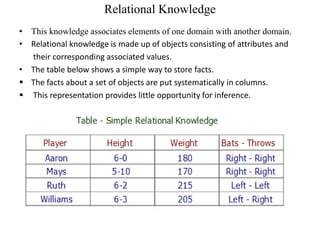
• This knowledge associates elements of one domain with another domain.
• Relational knowledge is made up of objects consisting of attributes and
their corresponding associated values.
• The table below shows a simple way to store facts.
 The facts about a set of objects are put systematically in columns.
 This representation provides little opportunity for inference.
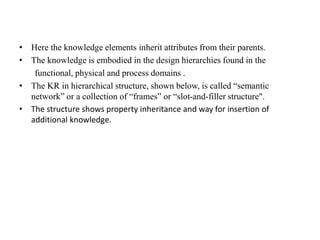
• Here the knowledge elements inherit attributes from their parents.
• The knowledge is embodied in the design hierarchies found in the
functional, physical and process domains .
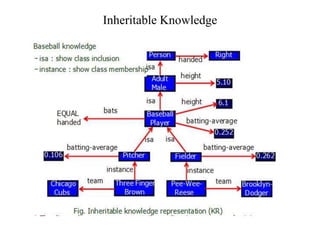
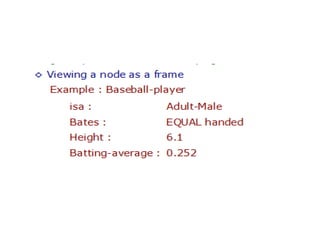
• The KR in hierarchical structure, shown below, is called “semantic
network” or a collection of “frames” or “slot-and-filler structure".
• The structure shows property inheritance and way for insertion of
additional knowledge.
Inheritable Knowledge
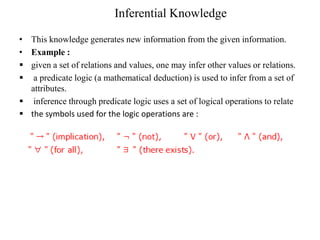
Inferential Knowledge
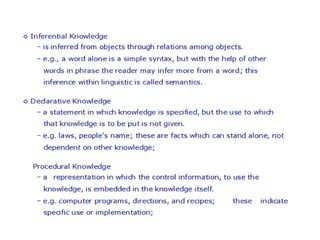
• This knowledge generates new information from the given information.
• Example :
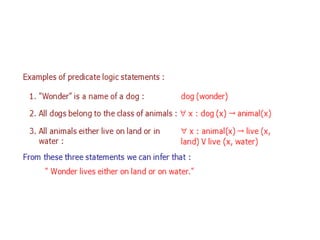
 given a set of relations and values, one may infer other values or relations.
 a predicate logic (a mathematical deduction) is used to infer from a set of
attributes.
 inference through predicate logic uses a set of logical operations to relate
 the symbols used for the logic operations are :
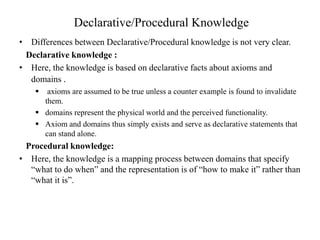
Declarative/Procedural Knowledge
• Differences between Declarative/Procedural knowledge is not very clear.
Declarative knowledge :
• Here, the knowledge is based on declarative facts about axioms and
domains .
 axioms are assumed to be true unless a counter example is found to invalidate
them.
 domains represent the physical world and the perceived functionality.
 Axiom and domains thus simply exists and serve as declarative statements that
can stand alone.
Procedural knowledge:
• Here, the knowledge is a mapping process between domains that specify
“what to do when” and the representation is of “how to make it” rather than
“what it is”.
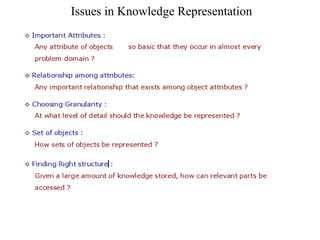
Issues in Knowledge Representation

Knowledge Representation.ppt

  • 1.
    Knowledge Progression • Data:- Example : It is raining. • Information :- Example : The temperature dropped 15 degrees and then it started raining. • Knowledge :- Example : If the humidity is very high and the temperature drops substantially, then atmospheres is unlikely to hold the moisture, so it rains. • Wisdom :- Example: Encompasses understanding of all the interactions that happen between raining ,evaporation, air currents, temperature gradients and changes.
  • 2.
    Knowledge Model • Themodel represents transitions and understanding.  the transitions are from data, to information, to knowledge, and finally to wisdom;  the understanding support the transitions from one stage to the next stage.
  • 3.
    • Knowledge iscategorized into two major types: Tacit and Explicit  term “Tacit” corresponds to "informal" or "implicit" type of knowledge,  term “Explicit” corresponds to "formal" type of knowledge.
  • 5.
    • Facts • Concepts •Processes • Procedures • Principles
  • 6.
  • 7.
  • 8.
    Framework of KnowledgeRepresentation • The steps are :  The informal formalism of the problem takes place first.  It is then represented formally and the computer produces an output.  This output can then be represented in a informally described solution that user understands or checks for consistency
  • 9.
    • The stepsare :  The informal formalism of the problem takes place first.  It is then represented formally and the computer produces an output.  This output can then be represented in a informally described solution that user understands or checks for consistency
  • 10.
    Knowledge and Representation •Knowledge is a description of the world;  it determines a system's competence by what it knows. • Representation is the way knowledge is encoded;  it defines the system's performance in doing something. • In simple words, we :  need to know about things we want to represent , and  need some means by which things we can manipulate.
  • 11.
    Mapping between Factsand Representation • Knowledge is a collection of “facts” from some domain. • We need a representation of "facts" that can be manipulated by a program. • We must be able to map "facts to symbols" and "symbols to facts" using forward and backward representation mapping.
  • 13.
    Forward and BackwardRepresentation • The forward and backward representations are elaborated below :
  • 14.
    KR System Requirements Aknowledge representation system should have following properties.
  • 15.
    Knowledge Representation Schemes •There are four types of Knowledge representation :
  • 17.
    Relational Knowledge • Thisknowledge associates elements of one domain with another domain. • Relational knowledge is made up of objects consisting of attributes and their corresponding associated values. • The table below shows a simple way to store facts.  The facts about a set of objects are put systematically in columns.  This representation provides little opportunity for inference.
  • 18.
    • Here theknowledge elements inherit attributes from their parents. • The knowledge is embodied in the design hierarchies found in the functional, physical and process domains . • The KR in hierarchical structure, shown below, is called “semantic network” or a collection of “frames” or “slot-and-filler structure". • The structure shows property inheritance and way for insertion of additional knowledge.
  • 19.
  • 21.
    Inferential Knowledge • Thisknowledge generates new information from the given information. • Example :  given a set of relations and values, one may infer other values or relations.  a predicate logic (a mathematical deduction) is used to infer from a set of attributes.  inference through predicate logic uses a set of logical operations to relate  the symbols used for the logic operations are :
  • 23.
    Declarative/Procedural Knowledge • Differencesbetween Declarative/Procedural knowledge is not very clear. Declarative knowledge : • Here, the knowledge is based on declarative facts about axioms and domains .  axioms are assumed to be true unless a counter example is found to invalidate them.  domains represent the physical world and the perceived functionality.  Axiom and domains thus simply exists and serve as declarative statements that can stand alone. Procedural knowledge: • Here, the knowledge is a mapping process between domains that specify “what to do when” and the representation is of “how to make it” rather than “what it is”.
  • 24.
    Issues in KnowledgeRepresentation