Program : B.C.A
Knowledge Management
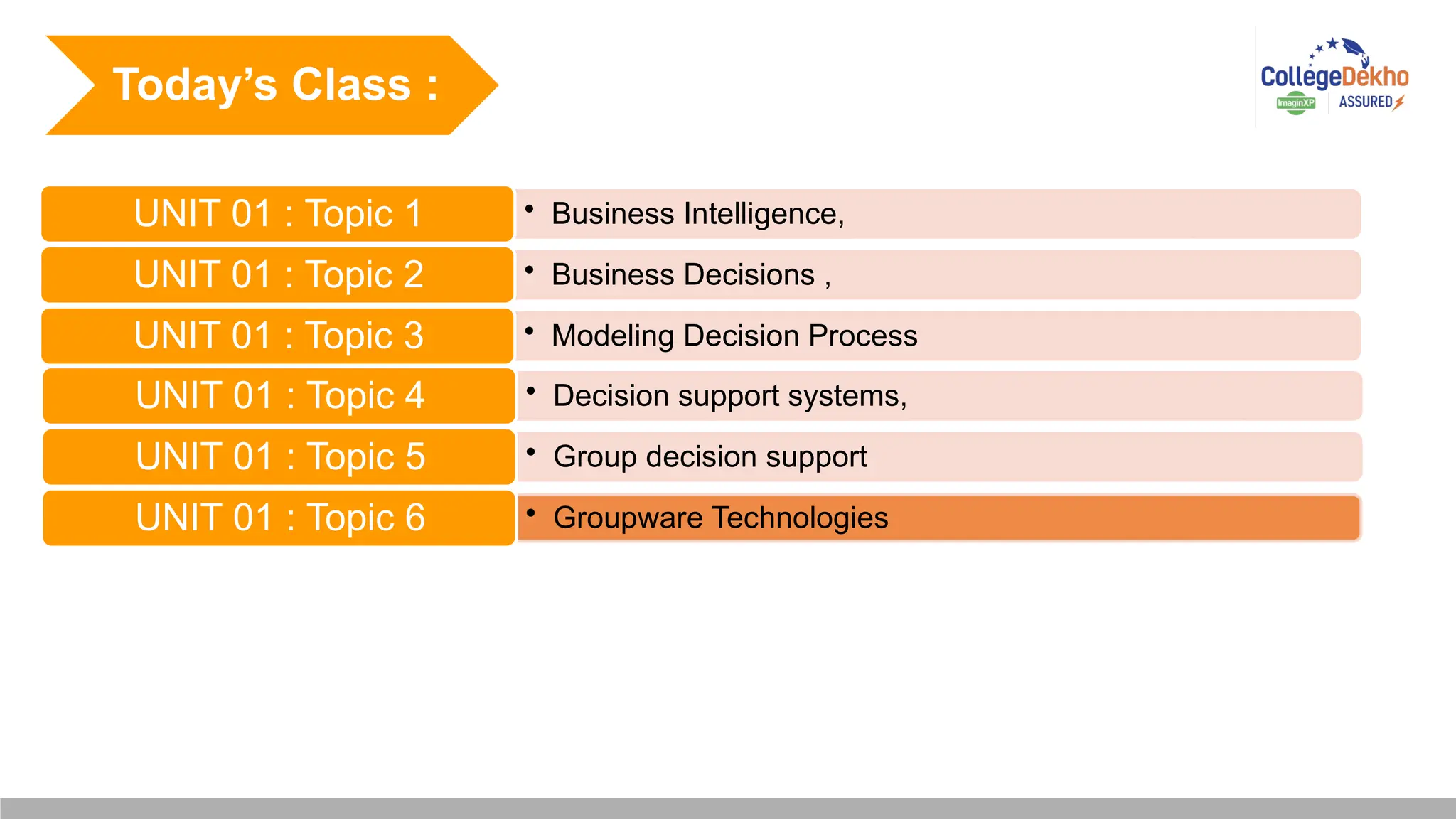
• Decision support systems,
UNIT 01 : Topic 4
• Group decision support
UNIT 01 : Topic 5
• Groupware Technologies
UNIT 01 : Topic 6
Today’s Class :
• Business Intelligence,
UNIT 01 : Topic 1
• Business Decisions ,
UNIT 01 : Topic 2
• Modeling Decision Process
UNIT 01 : Topic 3
•Groupware Technologies
UNIT 01 :
Topic 6
Groupware Technology
With the help of groupware, multiple users can exchange emails, documents, shared database access,
organized online meeting in between various users and they able to see each other as well as view
information to other users, collective writing, calendaring, task management, scheduling, and more
activities.
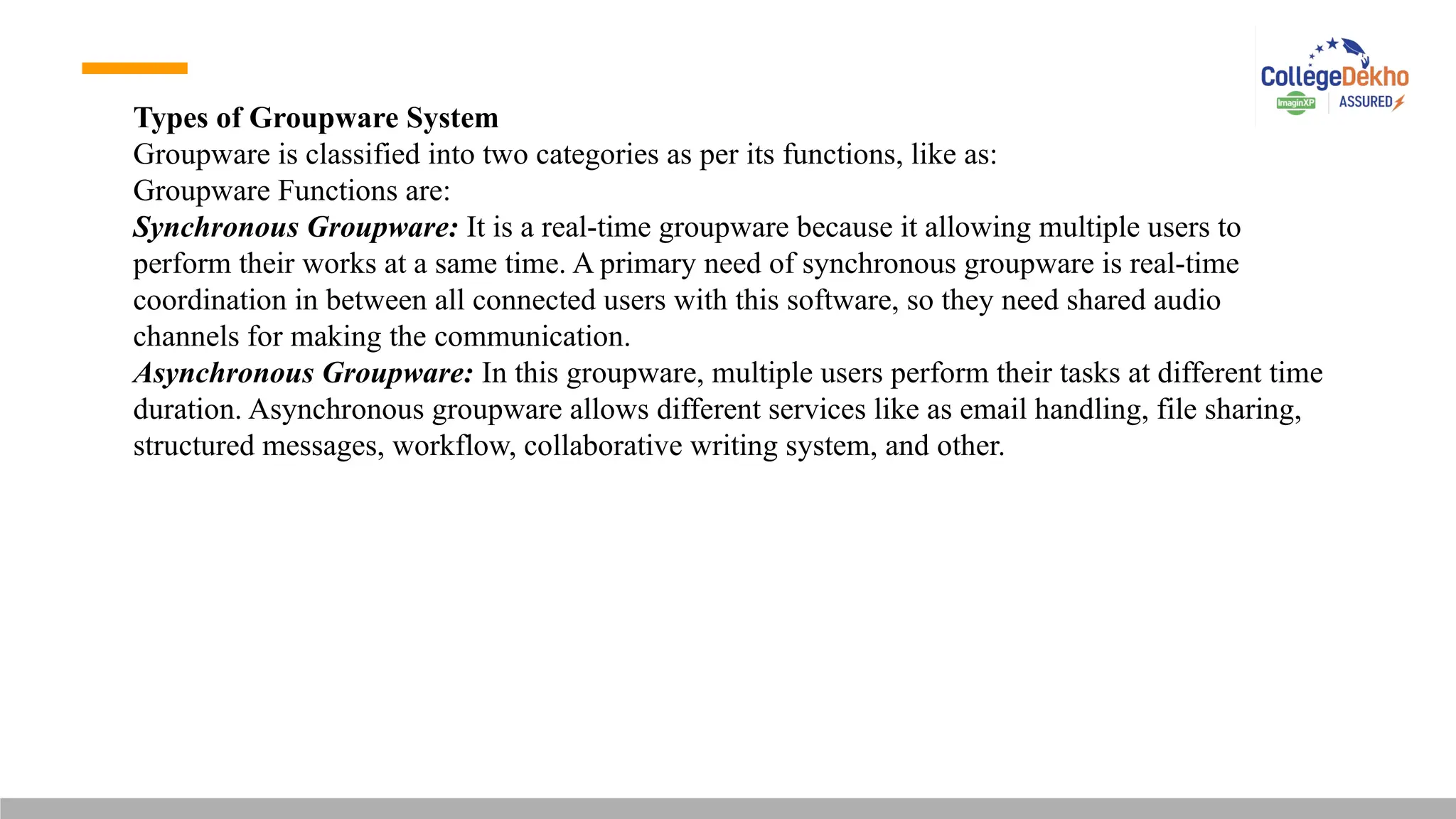
Types of Groupware System
Groupware is classified into two categories as per its functions, like as:
Groupware Functions are:
Synchronous Groupware: It is a real-time groupware because it allowing multiple users to
perform their works at a same time. A primary need of synchronous groupware is real-time
coordination in between all connected users with this software, so they need shared audio
channels for making the communication.
Asynchronous Groupware: In this groupware, multiple users perform their tasks at different time
duration. Asynchronous groupware allows different services like as email handling, file sharing,
structured messages, workflow, collaborative writing system, and other.
Quiz Time ???
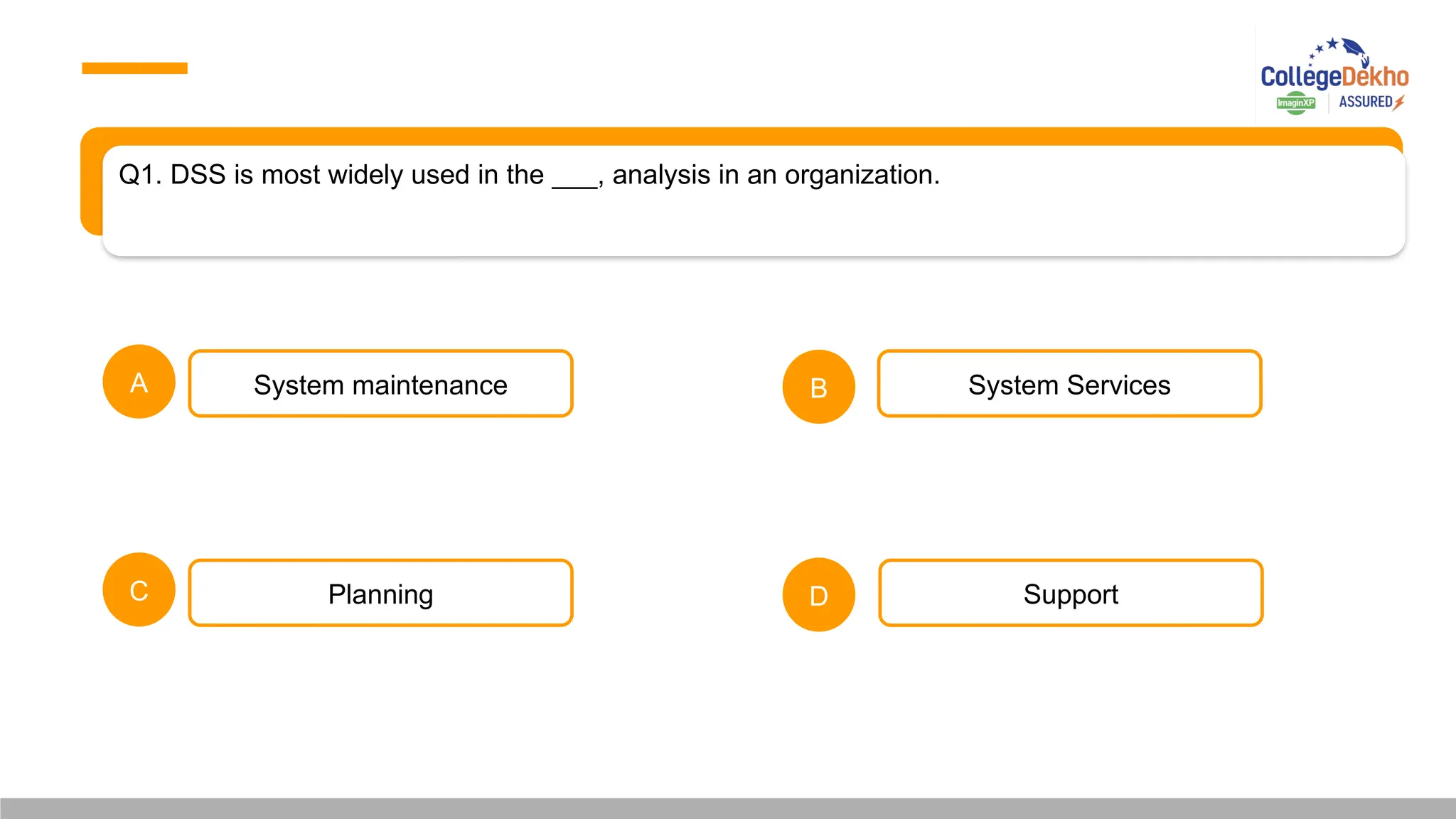
Q1. DSS is most widely used in the ___, analysis in an organization.
A B
C D
System maintenance
Planning
System Services
Support
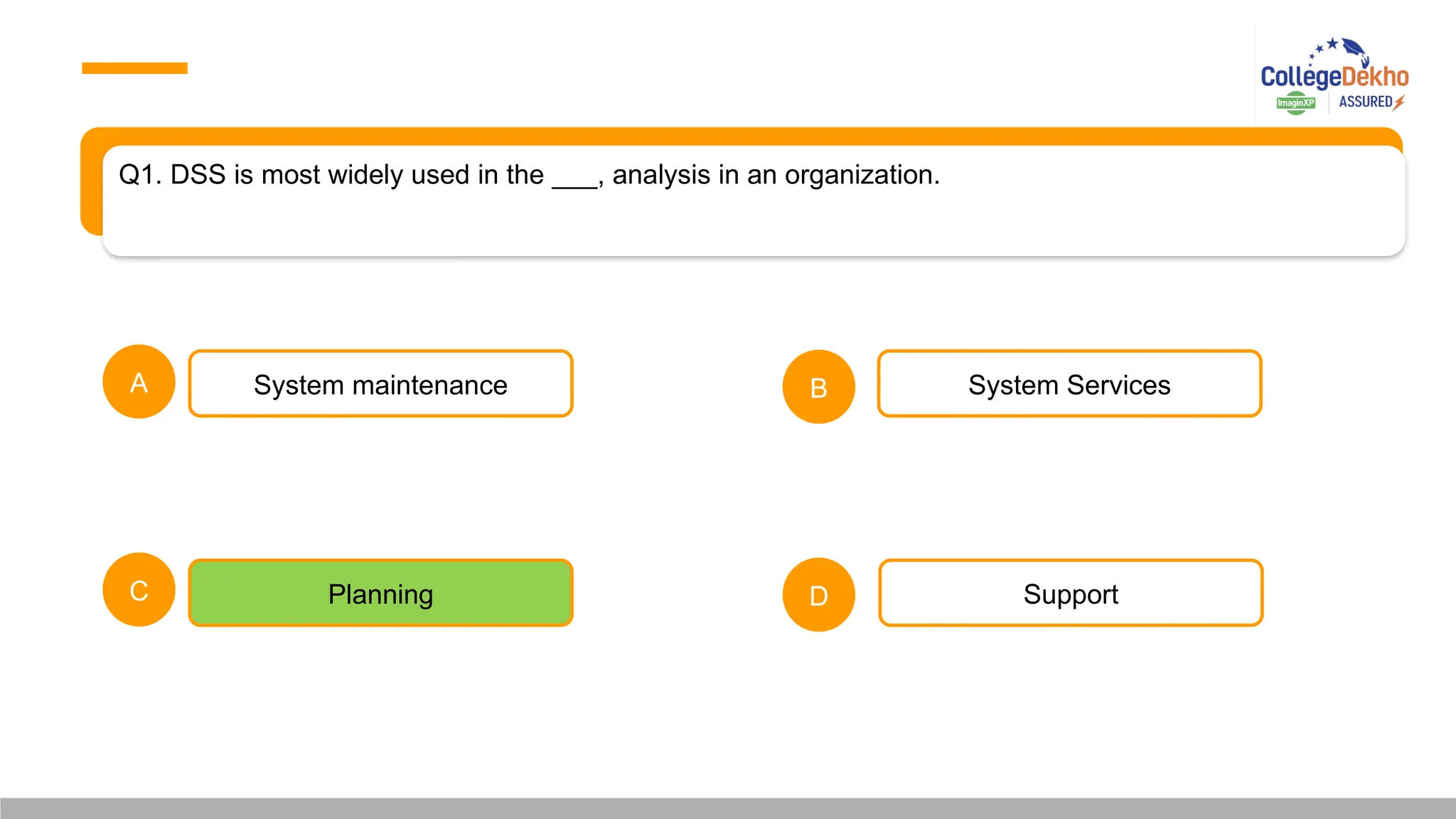
Q1. DSS is most widely used in the ___, analysis in an organization.
A B
C D
System maintenance
Planning
System Services
Support
Q1. What are Decision Support Systems, and how do they enhance business decision-making?
Sol. Decision Support Systems (DSS) are computer-based systems designed to assist business or organizational
decision-making activities. They enhance decision-making in several ways:
Data Management:
Role: DSS store and manage large volumes of data from various sources, making it easily accessible for analysis. This centralization of data
ensures that decision-makers have access to comprehensive and up-to-date information.
Model Management:
Role: DSS provide models for analyzing data and simulating various scenarios. These models help in understanding the potential outcomes of
different decisions, enabling decision-makers to evaluate options systematically.
User Interface:
Role: DSS offer intuitive interfaces that allow users to interact with data and models easily. These interfaces often include dashboards,
visualization tools, and interactive reports, making complex data more understandable and actionable.
Knowledge Management:
Role: DSS incorporate knowledge-based components that provide specialized expertise. This can include rules, procedures, and best practices
that guide decision-makers in solving specific problems.
.
Q1. How does a Model-Driven DSS differ from a Data-Driven DSS?
Sol. A Model-Driven DSS emphasizes access to and manipulation of statistical, financial, optimization, or
simulation models, rather than just large data sets.
Summary!
Summary :
Understanding these concepts provides on overall, BI, DSS, GDSS, and groupware technologies aim to
enhance decision-making processes by providing comprehensive tools and frameworks that leverage data,
models, and collaboration to arrive at informed and effective decisions.
Knowledge Management with data mining detail-Unit-1-L6.pptx

Knowledge Management with data mining detail-Unit-1-L6.pptx

  • 1.
  • 2.
    • Decision supportsystems, UNIT 01 : Topic 4 • Group decision support UNIT 01 : Topic 5 • Groupware Technologies UNIT 01 : Topic 6 Today’s Class : • Business Intelligence, UNIT 01 : Topic 1 • Business Decisions , UNIT 01 : Topic 2 • Modeling Decision Process UNIT 01 : Topic 3
  • 3.
  • 4.
  • 5.
    With the helpof groupware, multiple users can exchange emails, documents, shared database access, organized online meeting in between various users and they able to see each other as well as view information to other users, collective writing, calendaring, task management, scheduling, and more activities.
  • 6.
    Types of GroupwareSystem Groupware is classified into two categories as per its functions, like as: Groupware Functions are: Synchronous Groupware: It is a real-time groupware because it allowing multiple users to perform their works at a same time. A primary need of synchronous groupware is real-time coordination in between all connected users with this software, so they need shared audio channels for making the communication. Asynchronous Groupware: In this groupware, multiple users perform their tasks at different time duration. Asynchronous groupware allows different services like as email handling, file sharing, structured messages, workflow, collaborative writing system, and other.
  • 7.
  • 8.
    Q1. DSS ismost widely used in the ___, analysis in an organization. A B C D System maintenance Planning System Services Support
  • 9.
    Q1. DSS ismost widely used in the ___, analysis in an organization. A B C D System maintenance Planning System Services Support
  • 10.
    Q1. What areDecision Support Systems, and how do they enhance business decision-making? Sol. Decision Support Systems (DSS) are computer-based systems designed to assist business or organizational decision-making activities. They enhance decision-making in several ways: Data Management: Role: DSS store and manage large volumes of data from various sources, making it easily accessible for analysis. This centralization of data ensures that decision-makers have access to comprehensive and up-to-date information. Model Management: Role: DSS provide models for analyzing data and simulating various scenarios. These models help in understanding the potential outcomes of different decisions, enabling decision-makers to evaluate options systematically. User Interface: Role: DSS offer intuitive interfaces that allow users to interact with data and models easily. These interfaces often include dashboards, visualization tools, and interactive reports, making complex data more understandable and actionable. Knowledge Management: Role: DSS incorporate knowledge-based components that provide specialized expertise. This can include rules, procedures, and best practices that guide decision-makers in solving specific problems. .
  • 11.
    Q1. How doesa Model-Driven DSS differ from a Data-Driven DSS?
  • 12.
    Q1. How doesa Model-Driven DSS differ from a Data-Driven DSS? Sol. A Model-Driven DSS emphasizes access to and manipulation of statistical, financial, optimization, or simulation models, rather than just large data sets.
  • 13.
  • 14.
    Summary : Understanding theseconcepts provides on overall, BI, DSS, GDSS, and groupware technologies aim to enhance decision-making processes by providing comprehensive tools and frameworks that leverage data, models, and collaboration to arrive at informed and effective decisions.