




Why College Should Be  In YOUR Future: Education After High School Dr. Rebecca Joseph, California State University, Los Angeles
Acknowledgments This information came from several places, including: The Institute for Higher Education Policy www.ihep.org Mapping Your Future www.mapping-your-future.org The National Association of Student Financial Aid Administrators www.NASFAA.org Northwest Education Loan Association www.nela.net
THINKING and PLANNING First we’re going to THINK about the possibility of college. Then we’re going to talk about how to PLAN for college. Let’s go!
You might be THINKING now about whether to go to college Have you talked about it with your family? Ask around, read, listen: there’s a lot of information out there. Don’t fall back on everyone else’s thinking. Check with the person who has the most riding on your decision: YOU.
Bad Reasons NOT to Go I don’t know what I want to do with my life. I was never a very good student. Nobody in my family went to college. College is way too expensive. I want to get a job right away! School stinks, and so will college.
Myth: You can’t go to college unless you KNOW what you want to do FACT: Most students decide what they want to do during or after college. College is a great place to explore new interests and discover what you like. Lots of students start out studying one subject and change their minds while they’re in college.
Myth: You can’t go to college if YOUR PARENTS didn’t go Fact: Forty percent of all undergraduate students have parents who didn’t go to college. There’s no rule that says your parents had to go or you can’t. Some colleges give extra financial aid to students whose parents didn’t go to college.
Myth: You can’t go to college if you don’t have the MONEY FACT: Colleges come in all price ranges. Financial aid is available . . . almost half of all college students receive financial aid. In 2004-05 nearly $130 billion in financial aid was distributed. Imagine! College is an investment in your future. Even though the cost of college is going up, it is still the best step you can take for a good future.
You Can Get MONEY to Go to College Because You . . . Need it (this is the biggest reason students get money) Earn good grades or take hard courses Have talent in music, art, sports, etc. Have a certain background or characteristic Belong to a certain organization (or your parents do) Have a special need or a disability (There are lots of other ways to get money for college, too.)
Good Reasons to GO to College It gives you more  choices. It gives you better  quality of life  through  social benefits (more in a minute). It gives you a better  quality of life  through  economic benefits (more in a minute).
More CHOICES Choose from more careers. Choose higher paying jobs, if you want. Choose jobs you really like to do. Choose where you want to live.
Quality of Life: Social Benefits Like your job. Live healthier and longer. Be a better problem solver and make better decisions. Make a better life for you and your family. Increase your social status. Have more hobbies and leisure activities.
Quality of Life: Economic Benefits Last time we checked, high school graduates earned about $25,000 a year while college graduates with a bachelor’s degree earned about $48,000. Over 30 years of work, that’s a $700,000 difference The difference may be $1 million+.
How Much is a MILLION? One million is the difference between the single CD you listened to while doing your homework last night and 10,000 iPOD Nano systems!
Economic Benefits, continued Lower unemployment. Higher savings. Better working conditions. Get ahead personally and professionally.
Think OUTSIDE the Box It’s important to get your education. It doesn’t matter as much  where . “College” means trade or technical schools and community colleges, not just four-year schools. Don’t feel like you can only get jobs related to your education. Your degree may not match your career later on.
Now I’m interested, What Can I DO? First, understand that you live in the best state to go to college... There are public—state funded colleges that are relatively low cost.  There are also private four year colleges—they are more expensive but provide full scholarships to many first generation and/or minority students. There are also great colleges across the country who are desperate for high achieving kids, minority students like you.
How do I Find out About Colleges? Go to your College and Career Center. There are many books there as well as great websites about college. Start with the College Board. They have many great online resources, including timelines and college search plans http://collegesearch.collegeboard.com/search/index.jsp
Other Resources. The Fiske Guide-describes lots of colleges CSU Mentor is a great place to learn about the Cal State System and all kinds of financial aid and planning information  http://www.csumentor.edu/ California Career Zone helps you learn about different careers http://www.cacareerzone.org/index.html;jsessionid=56683AAFFE0E2D4C6BA1E2BF0D7BCDD9
Four Year Colleges Lots of kids go directly from high school to four year colleges. Four years colleges offer you all kinds of choices and social opportunities.  You can live on campus or commute. In California, you need to do several things to get ready for these colleges…
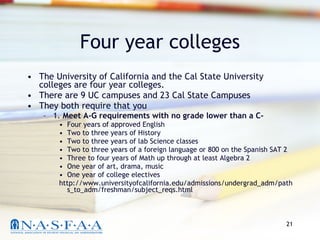
Four year colleges The University of California and the Cal State University colleges are four year colleges. There are 9 UC campuses and 23 Cal State Campuses They both require that you 1.  Meet A-G requirements with no grade lower than a C- Four years of approved English Two to three years of History Two to three years of lab Science classes Two to three years of a foreign language or 800 on the Spanish SAT 2 Three to four years of Math up through at least Algebra 2 One year of art, drama, music One year of college electives http://www.universityofcalifornia.edu/admissions/undergrad_adm/paths_to_adm/freshman/subject_reqs.html
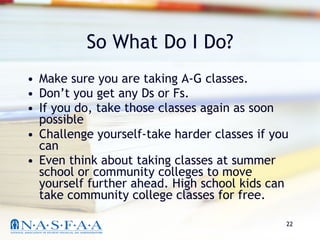
So What Do I Do? Make sure you are taking A-G classes. Don’t you get any Ds or Fs. If you do, take those classes again as soon possible Challenge yourself-take harder classes if you can Even think about taking classes at summer school or community colleges to move yourself further ahead. High school kids can take community college classes for free.
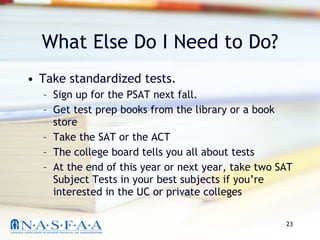
What Else Do I Need to Do? Take standardized tests.  Sign up for the PSAT next fall.  Get test prep books from the library or a book store Take the SAT or the ACT The college board tells you all about tests At the end of this year or next year, take two SAT Subject Tests in your best subjects if you’re interested in the UC or private colleges
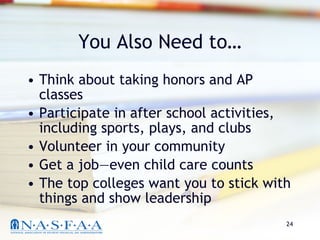
You Also Need to… Think about taking honors and AP classes Participate in after school activities, including sports, plays, and clubs Volunteer in your community Get a job—even child care counts The top colleges want you to stick with things and show leadership
What if I’m Not Ready for a Four Year College? You’re lucky… We have many community colleges-two year schools. They are very inexpensive You start there and take two years of courses.  Once you complete all your required courses, you can apply to transfer to a four year school Make sure you immediately find the transfer office if you go to community colleges
IS It Going to Be Too Expensive? It’s true. It costs money. But there is money for you… Scholarships Loans Grants Jobs Each college will let you know about financial aid…when you’re ready…go to your College and Career Center for information. The CSU Mentor and College Board sites also provide information.
What Now? Colleges want first generation college goers. You make colleges better places. You grow in so many ways by going to college. You can have so many more choices if you go to college.
When you’re ready… Begin to keep all your report cards. Save all your best writing assignments and tests. Develop a list of all your activities and awards. Think of stories that colleges will want to know about you in essays. Ask questions…. Email me anytime at rjoseph@calstatela.edu
Other Planning Resources Adventures in Education www.adventuresineducation.org Includes information in Spanish. Mapping Your Future www.mapping-your-future.org Includes information in Spanish. The College Board www.collegeboard.com
Remember the BIG Picture!!! Any amount of college or training after high school is better than none It can bring you . . . More choices in life Better quality of life More money! More money! More money! It’s all up to you, so you decide!
So, Do You Want to Go to College? Naturally, we think so. But it’s all up to YOU! Do get started on your checklist TODAY. Good luck and happy planning! The End!

College Awareness Morningside

  • 1.
    Why College ShouldBe In YOUR Future: Education After High School Dr. Rebecca Joseph, California State University, Los Angeles
  • 2.
    Acknowledgments This informationcame from several places, including: The Institute for Higher Education Policy www.ihep.org Mapping Your Future www.mapping-your-future.org The National Association of Student Financial Aid Administrators www.NASFAA.org Northwest Education Loan Association www.nela.net
  • 3.
    THINKING and PLANNINGFirst we’re going to THINK about the possibility of college. Then we’re going to talk about how to PLAN for college. Let’s go!
  • 4.
    You might beTHINKING now about whether to go to college Have you talked about it with your family? Ask around, read, listen: there’s a lot of information out there. Don’t fall back on everyone else’s thinking. Check with the person who has the most riding on your decision: YOU.
  • 5.
    Bad Reasons NOTto Go I don’t know what I want to do with my life. I was never a very good student. Nobody in my family went to college. College is way too expensive. I want to get a job right away! School stinks, and so will college.
  • 6.
    Myth: You can’tgo to college unless you KNOW what you want to do FACT: Most students decide what they want to do during or after college. College is a great place to explore new interests and discover what you like. Lots of students start out studying one subject and change their minds while they’re in college.
  • 7.
    Myth: You can’tgo to college if YOUR PARENTS didn’t go Fact: Forty percent of all undergraduate students have parents who didn’t go to college. There’s no rule that says your parents had to go or you can’t. Some colleges give extra financial aid to students whose parents didn’t go to college.
  • 8.
    Myth: You can’tgo to college if you don’t have the MONEY FACT: Colleges come in all price ranges. Financial aid is available . . . almost half of all college students receive financial aid. In 2004-05 nearly $130 billion in financial aid was distributed. Imagine! College is an investment in your future. Even though the cost of college is going up, it is still the best step you can take for a good future.
  • 9.
    You Can GetMONEY to Go to College Because You . . . Need it (this is the biggest reason students get money) Earn good grades or take hard courses Have talent in music, art, sports, etc. Have a certain background or characteristic Belong to a certain organization (or your parents do) Have a special need or a disability (There are lots of other ways to get money for college, too.)
  • 10.
    Good Reasons toGO to College It gives you more choices. It gives you better quality of life through social benefits (more in a minute). It gives you a better quality of life through economic benefits (more in a minute).
  • 11.
    More CHOICES Choosefrom more careers. Choose higher paying jobs, if you want. Choose jobs you really like to do. Choose where you want to live.
  • 12.
    Quality of Life:Social Benefits Like your job. Live healthier and longer. Be a better problem solver and make better decisions. Make a better life for you and your family. Increase your social status. Have more hobbies and leisure activities.
  • 13.
    Quality of Life:Economic Benefits Last time we checked, high school graduates earned about $25,000 a year while college graduates with a bachelor’s degree earned about $48,000. Over 30 years of work, that’s a $700,000 difference The difference may be $1 million+.
  • 14.
    How Much isa MILLION? One million is the difference between the single CD you listened to while doing your homework last night and 10,000 iPOD Nano systems!
  • 15.
    Economic Benefits, continuedLower unemployment. Higher savings. Better working conditions. Get ahead personally and professionally.
  • 16.
    Think OUTSIDE theBox It’s important to get your education. It doesn’t matter as much where . “College” means trade or technical schools and community colleges, not just four-year schools. Don’t feel like you can only get jobs related to your education. Your degree may not match your career later on.
  • 17.
    Now I’m interested,What Can I DO? First, understand that you live in the best state to go to college... There are public—state funded colleges that are relatively low cost. There are also private four year colleges—they are more expensive but provide full scholarships to many first generation and/or minority students. There are also great colleges across the country who are desperate for high achieving kids, minority students like you.
  • 18.
    How do IFind out About Colleges? Go to your College and Career Center. There are many books there as well as great websites about college. Start with the College Board. They have many great online resources, including timelines and college search plans http://collegesearch.collegeboard.com/search/index.jsp
  • 19.
    Other Resources. TheFiske Guide-describes lots of colleges CSU Mentor is a great place to learn about the Cal State System and all kinds of financial aid and planning information http://www.csumentor.edu/ California Career Zone helps you learn about different careers http://www.cacareerzone.org/index.html;jsessionid=56683AAFFE0E2D4C6BA1E2BF0D7BCDD9
  • 20.
    Four Year CollegesLots of kids go directly from high school to four year colleges. Four years colleges offer you all kinds of choices and social opportunities. You can live on campus or commute. In California, you need to do several things to get ready for these colleges…
  • 21.
    Four year collegesThe University of California and the Cal State University colleges are four year colleges. There are 9 UC campuses and 23 Cal State Campuses They both require that you 1. Meet A-G requirements with no grade lower than a C- Four years of approved English Two to three years of History Two to three years of lab Science classes Two to three years of a foreign language or 800 on the Spanish SAT 2 Three to four years of Math up through at least Algebra 2 One year of art, drama, music One year of college electives http://www.universityofcalifornia.edu/admissions/undergrad_adm/paths_to_adm/freshman/subject_reqs.html
  • 22.
    So What DoI Do? Make sure you are taking A-G classes. Don’t you get any Ds or Fs. If you do, take those classes again as soon possible Challenge yourself-take harder classes if you can Even think about taking classes at summer school or community colleges to move yourself further ahead. High school kids can take community college classes for free.
  • 23.
    What Else DoI Need to Do? Take standardized tests. Sign up for the PSAT next fall. Get test prep books from the library or a book store Take the SAT or the ACT The college board tells you all about tests At the end of this year or next year, take two SAT Subject Tests in your best subjects if you’re interested in the UC or private colleges
  • 24.
    You Also Needto… Think about taking honors and AP classes Participate in after school activities, including sports, plays, and clubs Volunteer in your community Get a job—even child care counts The top colleges want you to stick with things and show leadership
  • 25.
    What if I’mNot Ready for a Four Year College? You’re lucky… We have many community colleges-two year schools. They are very inexpensive You start there and take two years of courses. Once you complete all your required courses, you can apply to transfer to a four year school Make sure you immediately find the transfer office if you go to community colleges
  • 26.
    IS It Goingto Be Too Expensive? It’s true. It costs money. But there is money for you… Scholarships Loans Grants Jobs Each college will let you know about financial aid…when you’re ready…go to your College and Career Center for information. The CSU Mentor and College Board sites also provide information.
  • 27.
    What Now? Collegeswant first generation college goers. You make colleges better places. You grow in so many ways by going to college. You can have so many more choices if you go to college.
  • 28.
    When you’re ready…Begin to keep all your report cards. Save all your best writing assignments and tests. Develop a list of all your activities and awards. Think of stories that colleges will want to know about you in essays. Ask questions…. Email me anytime at rjoseph@calstatela.edu
  • 29.
    Other Planning ResourcesAdventures in Education www.adventuresineducation.org Includes information in Spanish. Mapping Your Future www.mapping-your-future.org Includes information in Spanish. The College Board www.collegeboard.com
  • 30.
    Remember the BIGPicture!!! Any amount of college or training after high school is better than none It can bring you . . . More choices in life Better quality of life More money! More money! More money! It’s all up to you, so you decide!
  • 31.
    So, Do YouWant to Go to College? Naturally, we think so. But it’s all up to YOU! Do get started on your checklist TODAY. Good luck and happy planning! The End!