1© 2004, Cisco Systems, Inc. All rights reserved.
Module 9
TCP/IP Protocol Suite and IP
Addressing
222© 2004, Cisco Systems, Inc. All rights reserved.
www.pnj.ac.id
Objectives
333© 2004, Cisco Systems, Inc. All rights reserved.
www.pnj.ac.id
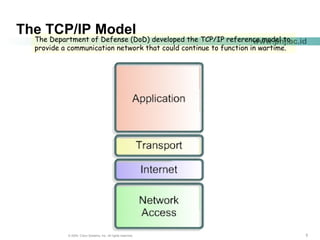
The TCP/IP Model
The Department of Defense (DoD) developed the TCP/IP reference model to
provide a communication network that could continue to function in wartime.
444© 2004, Cisco Systems, Inc. All rights reserved.
www.pnj.ac.id
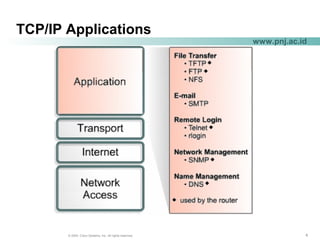
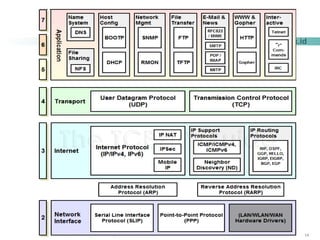
TCP/IP Applications
555© 2004, Cisco Systems, Inc. All rights reserved.
www.pnj.ac.id
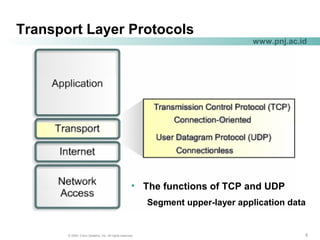
Transport Layer Protocols
• The functions of TCP and UDP
Segment upper-layer application data
666© 2004, Cisco Systems, Inc. All rights reserved.
www.pnj.ac.id
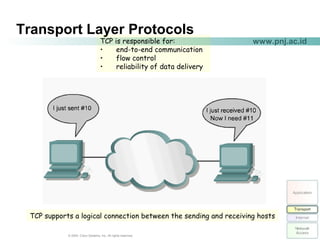
Transport Layer Protocols
TCP is responsible for:
• end-to-end communication
• flow control
• reliability of data delivery
TCP supports a logical connection between the sending and receiving hosts
777© 2004, Cisco Systems, Inc. All rights reserved.
www.pnj.ac.id
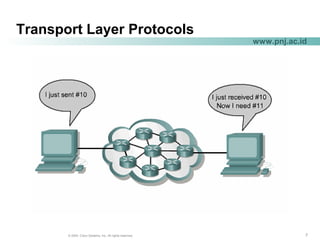
Transport Layer Protocols
888© 2004, Cisco Systems, Inc. All rights reserved.
www.pnj.ac.id
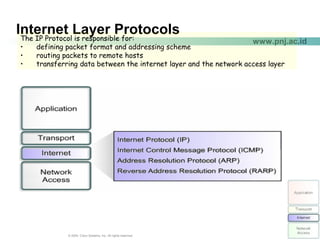
Internet Layer ProtocolsThe IP Protocol is responsible for:
• defining packet format and addressing scheme
• routing packets to remote hosts
• transferring data between the internet layer and the network access layer
999© 2004, Cisco Systems, Inc. All rights reserved.
www.pnj.ac.id
Internet Layer Protocols
• IP - connectionless, best-effort delivery routing of
packets.
• ICMP - control and messaging capabilities.
• ARP - determines the data link layer address for known
IP addresses.
• RARP - determines the IP address for a known MAC
address.
101010© 2004, Cisco Systems, Inc. All rights reserved.
www.pnj.ac.id
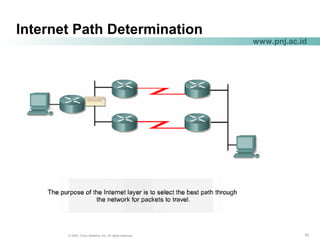
Internet Path Determination
111111© 2004, Cisco Systems, Inc. All rights reserved.
www.pnj.ac.id
Question
• Why is IP sometimes referred as an
unreliable protocol?
• Is it really unreliable?
121212© 2004, Cisco Systems, Inc. All rights reserved.
www.pnj.ac.id
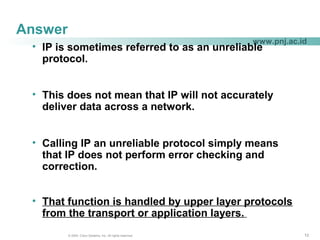
Answer
• IP is sometimes referred to as an unreliable
protocol.
• This does not mean that IP will not accurately
deliver data across a network.
• Calling IP an unreliable protocol simply means
that IP does not perform error checking and
correction.
• That function is handled by upper layer protocols
from the transport or application layers.
131313© 2004, Cisco Systems, Inc. All rights reserved.
www.pnj.ac.id
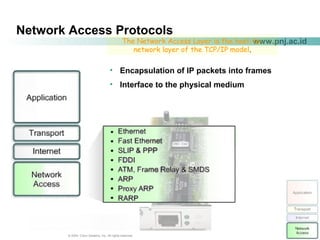
Network Access Protocols
The Network Access Layer is the host-to-
network layer of the TCP/IP model.
• Encapsulation of IP packets into frames
• Interface to the physical medium
141414© 2004, Cisco Systems, Inc. All rights reserved.
www.pnj.ac.id
151515© 2004, Cisco Systems, Inc. All rights reserved.
www.pnj.ac.id
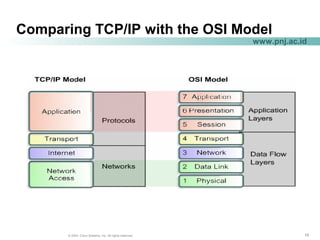
Comparing TCP/IP with the OSI Model
161616© 2004, Cisco Systems, Inc. All rights reserved.
www.pnj.ac.id
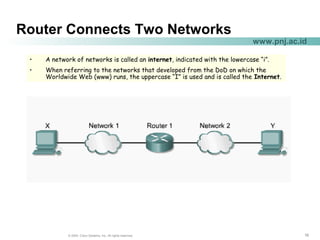
Router Connects Two Networks
• A network of networks is called an internet, indicated with the lowercase “i”.
• When referring to the networks that developed from the DoD on which the
Worldwide Web (www) runs, the uppercase “I” is used and is called the Internet.
171717© 2004, Cisco Systems, Inc. All rights reserved.
www.pnj.ac.id
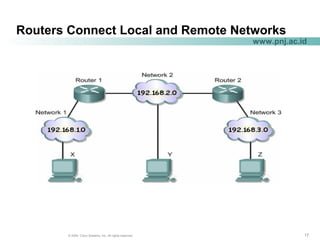
Routers Connect Local and Remote Networks
181818© 2004, Cisco Systems, Inc. All rights reserved.
www.pnj.ac.id
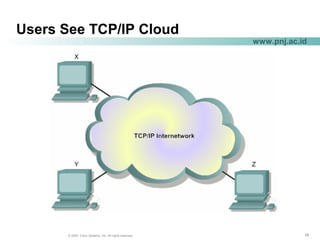
Users See TCP/IP Cloud
191919© 2004, Cisco Systems, Inc. All rights reserved.
www.pnj.ac.id
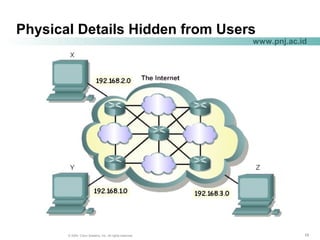
Physical Details Hidden from Users
202020© 2004, Cisco Systems, Inc. All rights reserved.
www.pnj.ac.id
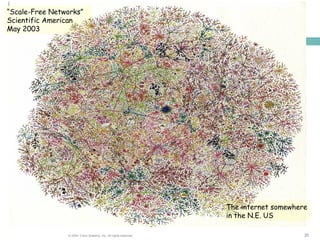
“Scale-Free Networks”
Scientific American
May 2003
The internet somewhere
in the N.E. US
212121© 2004, Cisco Systems, Inc. All rights reserved.
www.pnj.ac.id
Forwarding Packets—IP address
• A router forwards packets from the originating
network to the destination network using the
IP protocol.
• The packets must include an identifier for both
the source and destination networks.
• Accordingly, every IP address has two parts
– One part identifies the network where the
system is connected
– A second part identifies that particular
system on the network
222222© 2004, Cisco Systems, Inc. All rights reserved.
www.pnj.ac.id
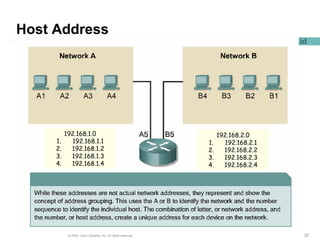
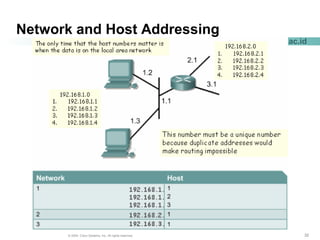
Host Address
192.168.1.0
1. 192.168.1.1
2. 192.168.1.2
3. 192.168.1.3
4. 192.168.1.4
192.168.2.0
1. 192.168.2.1
2. 192.168.2.2
3. 192.168.2.3
4. 192.168.2.4
232323© 2004, Cisco Systems, Inc. All rights reserved.
www.pnj.ac.id
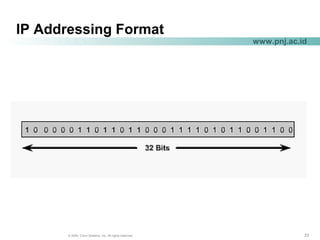
IP Addressing Format
242424© 2004, Cisco Systems, Inc. All rights reserved.
www.pnj.ac.id
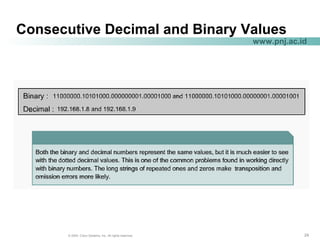
Consecutive Decimal and Binary Values
252525© 2004, Cisco Systems, Inc. All rights reserved.
www.pnj.ac.id
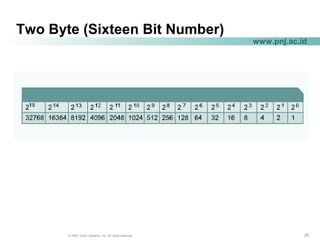
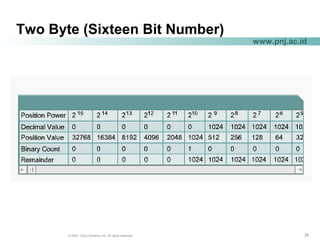
Two Byte (Sixteen Bit Number)
262626© 2004, Cisco Systems, Inc. All rights reserved.
www.pnj.ac.id
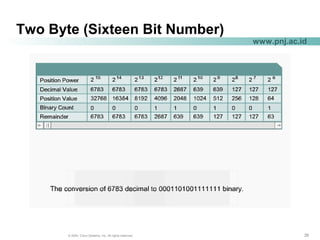
Two Byte (Sixteen Bit Number)
272727© 2004, Cisco Systems, Inc. All rights reserved.
www.pnj.ac.id
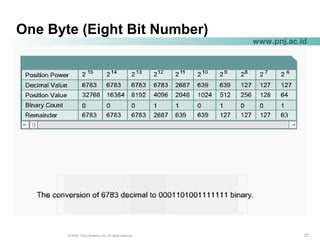
One Byte (Eight Bit Number)
282828© 2004, Cisco Systems, Inc. All rights reserved.
www.pnj.ac.id
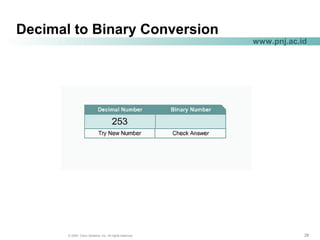
Decimal to Binary Conversion
292929© 2004, Cisco Systems, Inc. All rights reserved.
www.pnj.ac.id
Two Byte (Sixteen Bit Number)
303030© 2004, Cisco Systems, Inc. All rights reserved.
www.pnj.ac.id
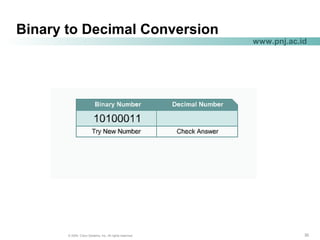
Binary to Decimal Conversion
313131© 2004, Cisco Systems, Inc. All rights reserved.
www.pnj.ac.id
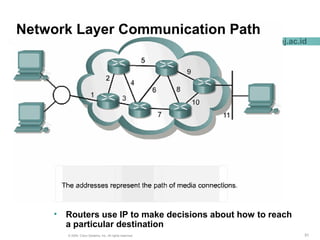
Network Layer Communication Path
• Routers use IP to make decisions about how to reach
a particular destination
323232© 2004, Cisco Systems, Inc. All rights reserved.
www.pnj.ac.id
Network and Host Addressing
333333© 2004, Cisco Systems, Inc. All rights reserved.
www.pnj.ac.id
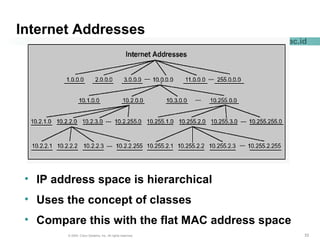
Internet Addresses
• IP address space is hierarchical
• Uses the concept of classes
• Compare this with the flat MAC address space
343434© 2004, Cisco Systems, Inc. All rights reserved.
www.pnj.ac.id
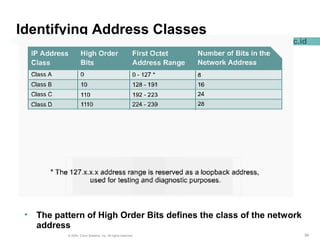
Identifying Address Classes
• The pattern of High Order Bits defines the class of the network
address
353535© 2004, Cisco Systems, Inc. All rights reserved.
www.pnj.ac.id
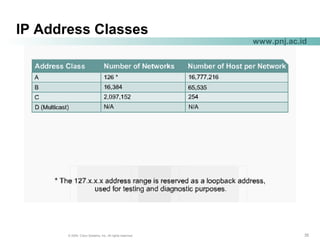
IP Address Classes
363636© 2004, Cisco Systems, Inc. All rights reserved.
www.pnj.ac.id
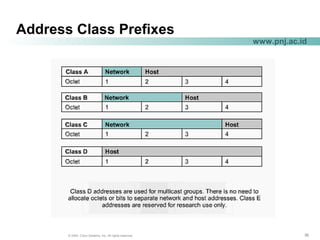
Address Class Prefixes
373737© 2004, Cisco Systems, Inc. All rights reserved.
www.pnj.ac.id
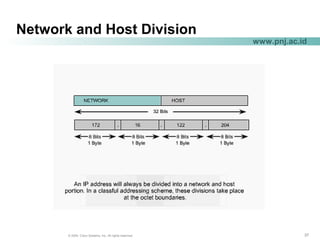
Network and Host Division
383838© 2004, Cisco Systems, Inc. All rights reserved.
www.pnj.ac.id
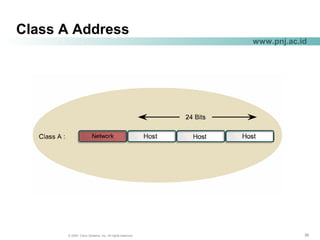
Class A Address
393939© 2004, Cisco Systems, Inc. All rights reserved.
www.pnj.ac.id
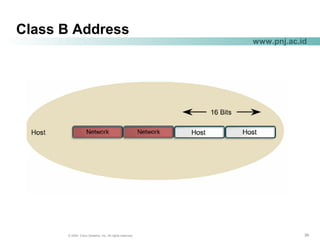
Class B Address
404040© 2004, Cisco Systems, Inc. All rights reserved.
www.pnj.ac.id
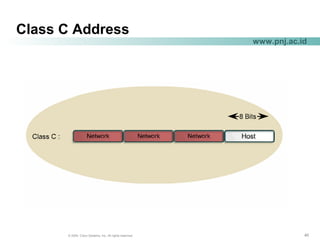
Class C Address
414141© 2004, Cisco Systems, Inc. All rights reserved.
www.pnj.ac.id
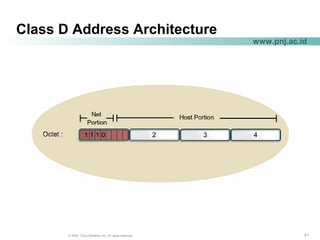
Class D Address Architecture
424242© 2004, Cisco Systems, Inc. All rights reserved.
www.pnj.ac.id
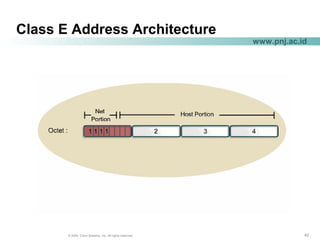
Class E Address Architecture
434343© 2004, Cisco Systems, Inc. All rights reserved.
www.pnj.ac.id
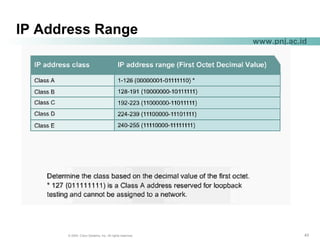
IP Address Range
444444© 2004, Cisco Systems, Inc. All rights reserved.
www.pnj.ac.id
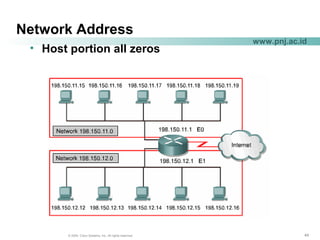
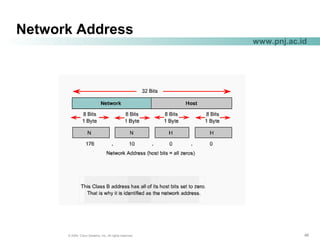
Network Address
• Host portion all zeros
454545© 2004, Cisco Systems, Inc. All rights reserved.
www.pnj.ac.id
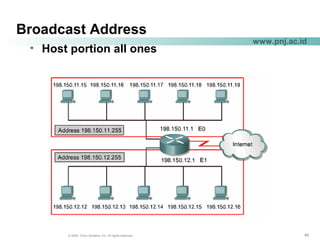
Broadcast Address
• Host portion all ones
464646© 2004, Cisco Systems, Inc. All rights reserved.
www.pnj.ac.id
Network Address
474747© 2004, Cisco Systems, Inc. All rights reserved.
www.pnj.ac.id
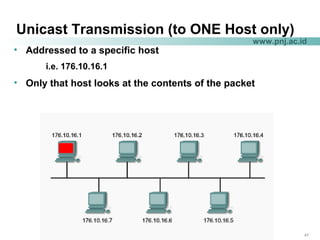
Unicast Transmission (to ONE Host only)
• Addressed to a specific host
i.e. 176.10.16.1
• Only that host looks at the contents of the packet
484848© 2004, Cisco Systems, Inc. All rights reserved.
www.pnj.ac.id
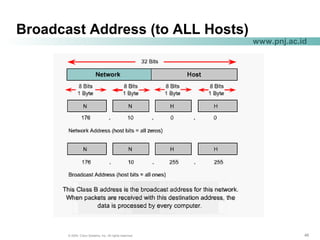
Broadcast Address (to ALL Hosts)
494949© 2004, Cisco Systems, Inc. All rights reserved.
www.pnj.ac.id
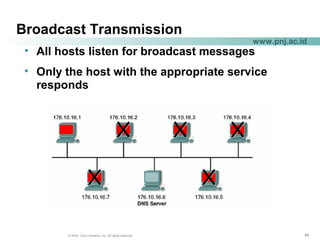
Broadcast Transmission
• All hosts listen for broadcast messages
• Only the host with the appropriate service
responds
505050© 2004, Cisco Systems, Inc. All rights reserved.
www.pnj.ac.id
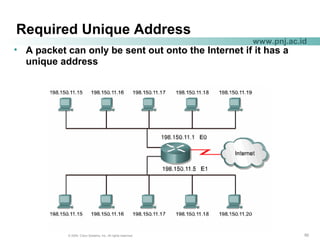
Required Unique Address
• A packet can only be sent out onto the Internet if it has a
unique address
515151© 2004, Cisco Systems, Inc. All rights reserved.
www.pnj.ac.id
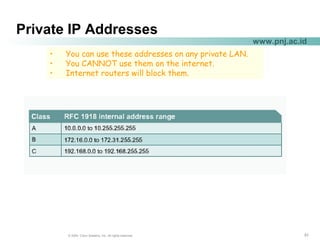
Private IP Addresses
• You can use these addresses on any private LAN.
• You CANNOT use them on the internet.
• Internet routers will block them.
525252© 2004, Cisco Systems, Inc. All rights reserved.
www.pnj.ac.id
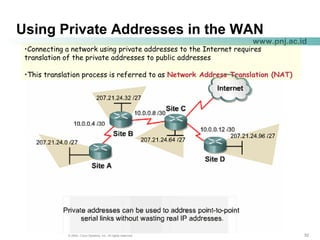
Using Private Addresses in the WAN
•Connecting a network using private addresses to the Internet requires
translation of the private addresses to public addresses
•This translation process is referred to as Network Address Translation (NAT)
535353© 2004, Cisco Systems, Inc. All rights reserved.
www.pnj.ac.id
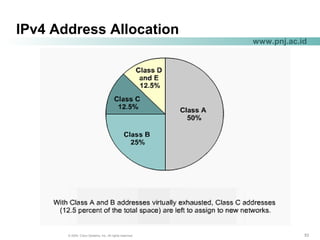
IPv4 Address Allocation
545454© 2004, Cisco Systems, Inc. All rights reserved.
www.pnj.ac.id
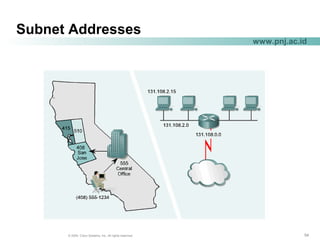
Subnet Addresses
555555© 2004, Cisco Systems, Inc. All rights reserved.
www.pnj.ac.id
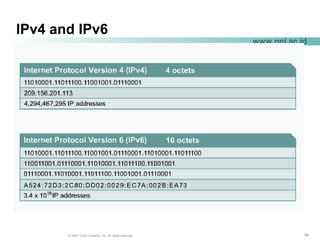
IPv4 and IPv6
565656© 2004, Cisco Systems, Inc. All rights reserved.
www.pnj.ac.id
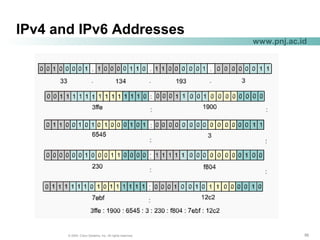
IPv4 and IPv6 Addresses
575757© 2004, Cisco Systems, Inc. All rights reserved.
www.pnj.ac.id
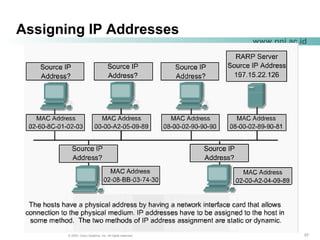
Assigning IP Addresses
585858© 2004, Cisco Systems, Inc. All rights reserved.
www.pnj.ac.id
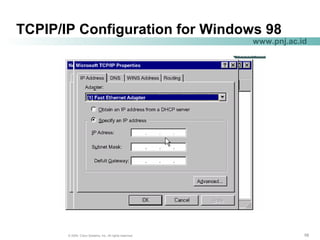
TCPIP/IP Configuration for Windows 98
595959© 2004, Cisco Systems, Inc. All rights reserved.
www.pnj.ac.id
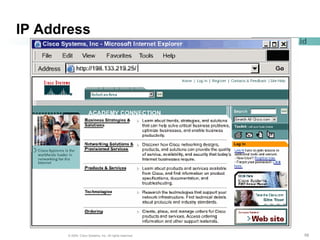
IP Address
606060© 2004, Cisco Systems, Inc. All rights reserved.
www.pnj.ac.id
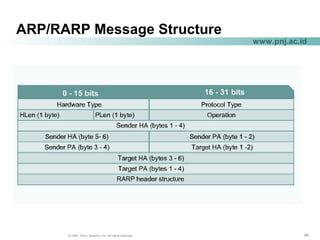
ARP/RARP Message Structure
616161© 2004, Cisco Systems, Inc. All rights reserved.
www.pnj.ac.id
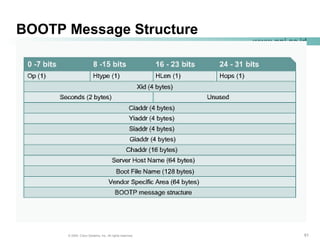
BOOTP Message Structure
626262© 2004, Cisco Systems, Inc. All rights reserved.
www.pnj.ac.id
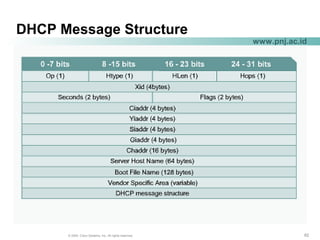
DHCP Message Structure
636363© 2004, Cisco Systems, Inc. All rights reserved.
www.pnj.ac.id
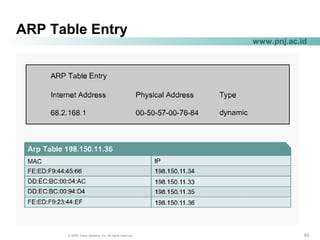
ARP Table Entry
646464© 2004, Cisco Systems, Inc. All rights reserved.
www.pnj.ac.id
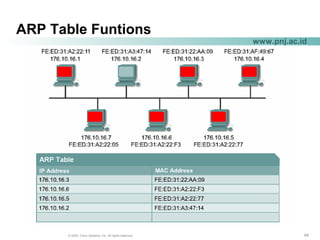
ARP Table Funtions
656565© 2004, Cisco Systems, Inc. All rights reserved.
www.pnj.ac.id
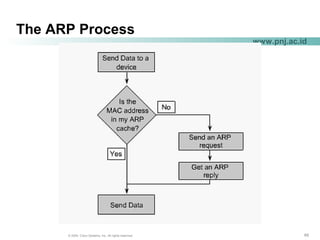
The ARP Process
666666© 2004, Cisco Systems, Inc. All rights reserved.
www.pnj.ac.id
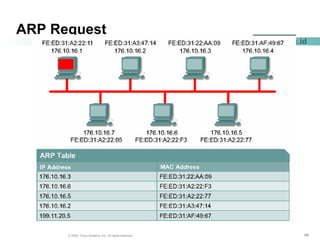
ARP Request
676767© 2004, Cisco Systems, Inc. All rights reserved.
www.pnj.ac.id
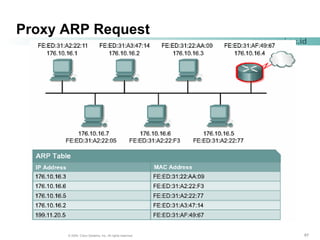
Proxy ARP Request
686868© 2004, Cisco Systems, Inc. All rights reserved.
www.pnj.ac.id
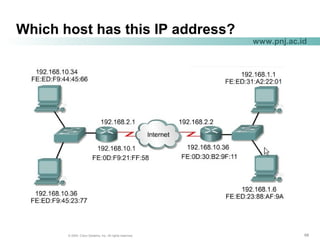
Which host has this IP address?
• ARP
696969© 2004, Cisco Systems, Inc. All rights reserved.
www.pnj.ac.id
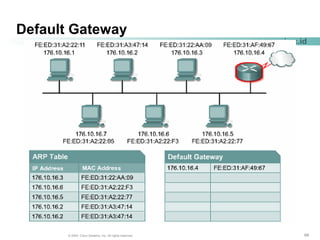
Default Gateway
707070© 2004, Cisco Systems, Inc. All rights reserved.
www.pnj.ac.id
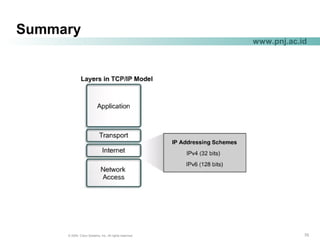
Summary
717171© 2004, Cisco Systems, Inc. All rights reserved.
www.pnj.ac.id
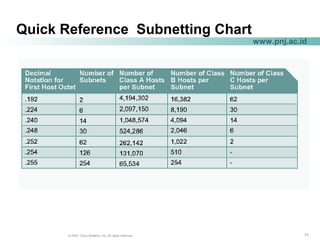
Quick Reference Subnetting Chart

Cisco CCNA module 9

  • 1.
    1© 2004, CiscoSystems, Inc. All rights reserved. Module 9 TCP/IP Protocol Suite and IP Addressing
  • 2.
    222© 2004, CiscoSystems, Inc. All rights reserved. www.pnj.ac.id Objectives
  • 3.
    333© 2004, CiscoSystems, Inc. All rights reserved. www.pnj.ac.id The TCP/IP Model The Department of Defense (DoD) developed the TCP/IP reference model to provide a communication network that could continue to function in wartime.
  • 4.
    444© 2004, CiscoSystems, Inc. All rights reserved. www.pnj.ac.id TCP/IP Applications
  • 5.
    555© 2004, CiscoSystems, Inc. All rights reserved. www.pnj.ac.id Transport Layer Protocols • The functions of TCP and UDP Segment upper-layer application data
  • 6.
    666© 2004, CiscoSystems, Inc. All rights reserved. www.pnj.ac.id Transport Layer Protocols TCP is responsible for: • end-to-end communication • flow control • reliability of data delivery TCP supports a logical connection between the sending and receiving hosts
  • 7.
    777© 2004, CiscoSystems, Inc. All rights reserved. www.pnj.ac.id Transport Layer Protocols
  • 8.
    888© 2004, CiscoSystems, Inc. All rights reserved. www.pnj.ac.id Internet Layer ProtocolsThe IP Protocol is responsible for: • defining packet format and addressing scheme • routing packets to remote hosts • transferring data between the internet layer and the network access layer
  • 9.
    999© 2004, CiscoSystems, Inc. All rights reserved. www.pnj.ac.id Internet Layer Protocols • IP - connectionless, best-effort delivery routing of packets. • ICMP - control and messaging capabilities. • ARP - determines the data link layer address for known IP addresses. • RARP - determines the IP address for a known MAC address.
  • 10.
    101010© 2004, CiscoSystems, Inc. All rights reserved. www.pnj.ac.id Internet Path Determination
  • 11.
    111111© 2004, CiscoSystems, Inc. All rights reserved. www.pnj.ac.id Question • Why is IP sometimes referred as an unreliable protocol? • Is it really unreliable?
  • 12.
    121212© 2004, CiscoSystems, Inc. All rights reserved. www.pnj.ac.id Answer • IP is sometimes referred to as an unreliable protocol. • This does not mean that IP will not accurately deliver data across a network. • Calling IP an unreliable protocol simply means that IP does not perform error checking and correction. • That function is handled by upper layer protocols from the transport or application layers.
  • 13.
    131313© 2004, CiscoSystems, Inc. All rights reserved. www.pnj.ac.id Network Access Protocols The Network Access Layer is the host-to- network layer of the TCP/IP model. • Encapsulation of IP packets into frames • Interface to the physical medium
  • 14.
    141414© 2004, CiscoSystems, Inc. All rights reserved. www.pnj.ac.id
  • 15.
    151515© 2004, CiscoSystems, Inc. All rights reserved. www.pnj.ac.id Comparing TCP/IP with the OSI Model
  • 16.
    161616© 2004, CiscoSystems, Inc. All rights reserved. www.pnj.ac.id Router Connects Two Networks • A network of networks is called an internet, indicated with the lowercase “i”. • When referring to the networks that developed from the DoD on which the Worldwide Web (www) runs, the uppercase “I” is used and is called the Internet.
  • 17.
    171717© 2004, CiscoSystems, Inc. All rights reserved. www.pnj.ac.id Routers Connect Local and Remote Networks
  • 18.
    181818© 2004, CiscoSystems, Inc. All rights reserved. www.pnj.ac.id Users See TCP/IP Cloud
  • 19.
    191919© 2004, CiscoSystems, Inc. All rights reserved. www.pnj.ac.id Physical Details Hidden from Users
  • 20.
    202020© 2004, CiscoSystems, Inc. All rights reserved. www.pnj.ac.id “Scale-Free Networks” Scientific American May 2003 The internet somewhere in the N.E. US
  • 21.
    212121© 2004, CiscoSystems, Inc. All rights reserved. www.pnj.ac.id Forwarding Packets—IP address • A router forwards packets from the originating network to the destination network using the IP protocol. • The packets must include an identifier for both the source and destination networks. • Accordingly, every IP address has two parts – One part identifies the network where the system is connected – A second part identifies that particular system on the network
  • 22.
    222222© 2004, CiscoSystems, Inc. All rights reserved. www.pnj.ac.id Host Address 192.168.1.0 1. 192.168.1.1 2. 192.168.1.2 3. 192.168.1.3 4. 192.168.1.4 192.168.2.0 1. 192.168.2.1 2. 192.168.2.2 3. 192.168.2.3 4. 192.168.2.4
  • 23.
    232323© 2004, CiscoSystems, Inc. All rights reserved. www.pnj.ac.id IP Addressing Format
  • 24.
    242424© 2004, CiscoSystems, Inc. All rights reserved. www.pnj.ac.id Consecutive Decimal and Binary Values
  • 25.
    252525© 2004, CiscoSystems, Inc. All rights reserved. www.pnj.ac.id Two Byte (Sixteen Bit Number)
  • 26.
    262626© 2004, CiscoSystems, Inc. All rights reserved. www.pnj.ac.id Two Byte (Sixteen Bit Number)
  • 27.
    272727© 2004, CiscoSystems, Inc. All rights reserved. www.pnj.ac.id One Byte (Eight Bit Number)
  • 28.
    282828© 2004, CiscoSystems, Inc. All rights reserved. www.pnj.ac.id Decimal to Binary Conversion
  • 29.
    292929© 2004, CiscoSystems, Inc. All rights reserved. www.pnj.ac.id Two Byte (Sixteen Bit Number)
  • 30.
    303030© 2004, CiscoSystems, Inc. All rights reserved. www.pnj.ac.id Binary to Decimal Conversion
  • 31.
    313131© 2004, CiscoSystems, Inc. All rights reserved. www.pnj.ac.id Network Layer Communication Path • Routers use IP to make decisions about how to reach a particular destination
  • 32.
    323232© 2004, CiscoSystems, Inc. All rights reserved. www.pnj.ac.id Network and Host Addressing
  • 33.
    333333© 2004, CiscoSystems, Inc. All rights reserved. www.pnj.ac.id Internet Addresses • IP address space is hierarchical • Uses the concept of classes • Compare this with the flat MAC address space
  • 34.
    343434© 2004, CiscoSystems, Inc. All rights reserved. www.pnj.ac.id Identifying Address Classes • The pattern of High Order Bits defines the class of the network address
  • 35.
    353535© 2004, CiscoSystems, Inc. All rights reserved. www.pnj.ac.id IP Address Classes
  • 36.
    363636© 2004, CiscoSystems, Inc. All rights reserved. www.pnj.ac.id Address Class Prefixes
  • 37.
    373737© 2004, CiscoSystems, Inc. All rights reserved. www.pnj.ac.id Network and Host Division
  • 38.
    383838© 2004, CiscoSystems, Inc. All rights reserved. www.pnj.ac.id Class A Address
  • 39.
    393939© 2004, CiscoSystems, Inc. All rights reserved. www.pnj.ac.id Class B Address
  • 40.
    404040© 2004, CiscoSystems, Inc. All rights reserved. www.pnj.ac.id Class C Address
  • 41.
    414141© 2004, CiscoSystems, Inc. All rights reserved. www.pnj.ac.id Class D Address Architecture
  • 42.
    424242© 2004, CiscoSystems, Inc. All rights reserved. www.pnj.ac.id Class E Address Architecture
  • 43.
    434343© 2004, CiscoSystems, Inc. All rights reserved. www.pnj.ac.id IP Address Range
  • 44.
    444444© 2004, CiscoSystems, Inc. All rights reserved. www.pnj.ac.id Network Address • Host portion all zeros
  • 45.
    454545© 2004, CiscoSystems, Inc. All rights reserved. www.pnj.ac.id Broadcast Address • Host portion all ones
  • 46.
    464646© 2004, CiscoSystems, Inc. All rights reserved. www.pnj.ac.id Network Address
  • 47.
    474747© 2004, CiscoSystems, Inc. All rights reserved. www.pnj.ac.id Unicast Transmission (to ONE Host only) • Addressed to a specific host i.e. 176.10.16.1 • Only that host looks at the contents of the packet
  • 48.
    484848© 2004, CiscoSystems, Inc. All rights reserved. www.pnj.ac.id Broadcast Address (to ALL Hosts)
  • 49.
    494949© 2004, CiscoSystems, Inc. All rights reserved. www.pnj.ac.id Broadcast Transmission • All hosts listen for broadcast messages • Only the host with the appropriate service responds
  • 50.
    505050© 2004, CiscoSystems, Inc. All rights reserved. www.pnj.ac.id Required Unique Address • A packet can only be sent out onto the Internet if it has a unique address
  • 51.
    515151© 2004, CiscoSystems, Inc. All rights reserved. www.pnj.ac.id Private IP Addresses • You can use these addresses on any private LAN. • You CANNOT use them on the internet. • Internet routers will block them.
  • 52.
    525252© 2004, CiscoSystems, Inc. All rights reserved. www.pnj.ac.id Using Private Addresses in the WAN •Connecting a network using private addresses to the Internet requires translation of the private addresses to public addresses •This translation process is referred to as Network Address Translation (NAT)
  • 53.
    535353© 2004, CiscoSystems, Inc. All rights reserved. www.pnj.ac.id IPv4 Address Allocation
  • 54.
    545454© 2004, CiscoSystems, Inc. All rights reserved. www.pnj.ac.id Subnet Addresses
  • 55.
    555555© 2004, CiscoSystems, Inc. All rights reserved. www.pnj.ac.id IPv4 and IPv6
  • 56.
    565656© 2004, CiscoSystems, Inc. All rights reserved. www.pnj.ac.id IPv4 and IPv6 Addresses
  • 57.
    575757© 2004, CiscoSystems, Inc. All rights reserved. www.pnj.ac.id Assigning IP Addresses
  • 58.
    585858© 2004, CiscoSystems, Inc. All rights reserved. www.pnj.ac.id TCPIP/IP Configuration for Windows 98
  • 59.
    595959© 2004, CiscoSystems, Inc. All rights reserved. www.pnj.ac.id IP Address
  • 60.
    606060© 2004, CiscoSystems, Inc. All rights reserved. www.pnj.ac.id ARP/RARP Message Structure
  • 61.
    616161© 2004, CiscoSystems, Inc. All rights reserved. www.pnj.ac.id BOOTP Message Structure
  • 62.
    626262© 2004, CiscoSystems, Inc. All rights reserved. www.pnj.ac.id DHCP Message Structure
  • 63.
    636363© 2004, CiscoSystems, Inc. All rights reserved. www.pnj.ac.id ARP Table Entry
  • 64.
    646464© 2004, CiscoSystems, Inc. All rights reserved. www.pnj.ac.id ARP Table Funtions
  • 65.
    656565© 2004, CiscoSystems, Inc. All rights reserved. www.pnj.ac.id The ARP Process
  • 66.
    666666© 2004, CiscoSystems, Inc. All rights reserved. www.pnj.ac.id ARP Request
  • 67.
    676767© 2004, CiscoSystems, Inc. All rights reserved. www.pnj.ac.id Proxy ARP Request
  • 68.
    686868© 2004, CiscoSystems, Inc. All rights reserved. www.pnj.ac.id Which host has this IP address? • ARP
  • 69.
    696969© 2004, CiscoSystems, Inc. All rights reserved. www.pnj.ac.id Default Gateway
  • 70.
    707070© 2004, CiscoSystems, Inc. All rights reserved. www.pnj.ac.id Summary
  • 71.
    717171© 2004, CiscoSystems, Inc. All rights reserved. www.pnj.ac.id Quick Reference Subnetting Chart