PUMBA
 Business Communication
Nonverbal Activity ConsideringKinesics
and Eye Movement
What Is Kinesics ?
• Kinesics Is The Name Given To
Study Of body's Physical
Movements.
• Kinesics Is Considered To Be an
intelligent way of Communication’.
• The study of The way in Which
certain body movements and
gestures serve as a form of non
verbal communication.
• Body movements and Gestures
regarded as a form of non-
verbal communication.
Kinesics includes the following things
• Personal appearance
• Posture
• Eye Contact
• Facial expression
• Chronemics
• Paralinguistics
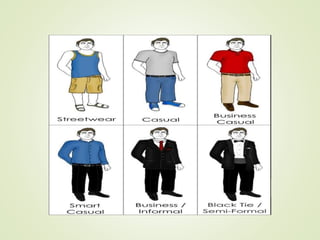
Personal Appearance
• The Imp area of Kinesics is appearance.
• Appearance includes clothes, hair, jewelry, cosmetics and such.it
accents our body movements and how we are perceived.
• Appearance tells others how we want to be seen. How we practice
the rules of the game in an organization.
• If you changed your appearance drastically-from formal to informal ,
for example-how would others respond?
• When do you give your appearance special attention ? These
occasions tell you about the importance of appearance.
• Most people indicate they are not influenced by another's physical
appearance , but apparently they are.
• Expect your appearance to a part of the messages you communicate,
and should plan your appearance so that it will effectively
communicate to others.
Posture
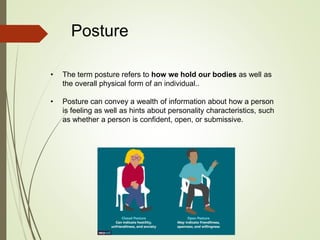
• The term posture refers to how we hold our bodies as well as
the overall physical form of an individual..
• Posture can convey a wealth of information about how a person
is feeling as well as hints about personality characteristics, such
as whether a person is confident, open, or submissive.
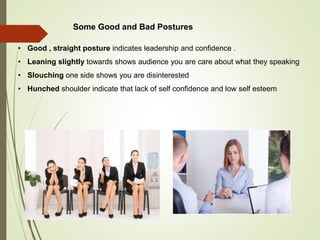
• Good , straight posture indicates leadership and confidence .
• Leaning slightly towards shows audience you are care about what they speaking
• Slouching one side shows you are disinterested
• Hunched shoulder indicate that lack of self confidence and low self esteem
Some Good and Bad Postures
Eye Contact
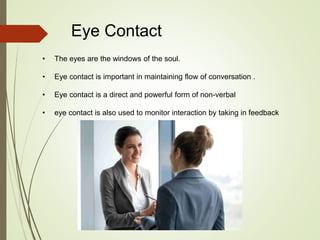
• The eyes are the windows of the soul.
• Eye contact is important in maintaining flow of conversation .
• Eye contact is a direct and powerful form of non-verbal
• eye contact is also used to monitor interaction by taking in feedback
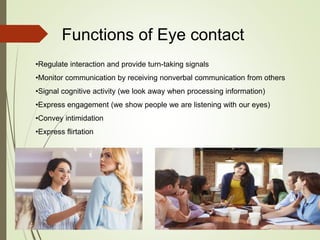
•Regulate interaction and provide turn-taking signals
•Monitor communication by receiving nonverbal communication from others
•Signal cognitive activity (we look away when processing information)
•Express engagement (we show people we are listening with our eyes)
•Convey intimidation
•Express flirtation
Functions of Eye contact
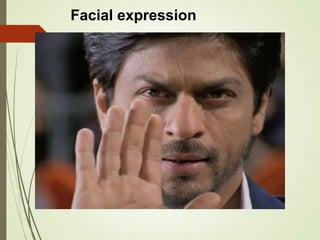
Facial expression
Facial expression
• Facial expression also play an important role
in presentation .
• The face is the most expressive part of our
body.
• Consist of movement of Eyes, eyebrows,
Jawline. Head nodding.
• Convey Intensity of Message & true Feelings
of Situation.
• Representational & Presentational Facial
Expressions
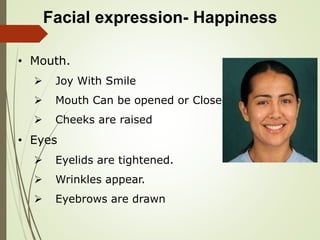
Facial expression- Happiness
• Mouth.
 Joy With Smile
 Mouth Can be opened or Closed
 Cheeks are raised
• Eyes
 Eyelids are tightened.
 Wrinkles appear.
 Eyebrows are drawn
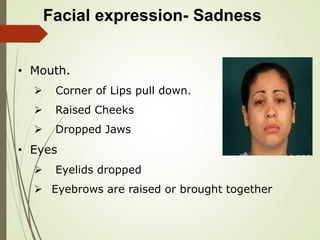
Facial expression- Sadness
• Mouth.
 Corner of Lips pull down.
 Raised Cheeks
 Dropped Jaws
• Eyes
 Eyelids dropped
 Eyebrows are raised or brought together
Facial expression- Fear
• Mouth.
 Lips stretched Horizontally
 Dropped Jaws
• Eyes
 Eyelids raised
 Eyebrows are raised or brought together
 Eyes staring straight ahead.
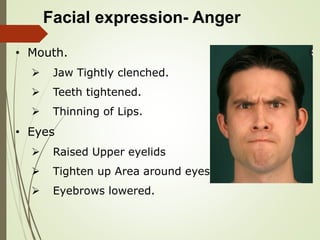
Facial expression- Anger
• Mouth.
 Jaw Tightly clenched.
 Teeth tightened.
 Thinning of Lips.
• Eyes
 Raised Upper eyelids
 Tighten up Area around eyes.
 Eyebrows lowered.
Facial expression
 Interaction is pleasant or unpleasant.
 The degree of involvement.
 Whether responses during are natural or
controlled
 The extent to which messages are
understood and shared
 Micro Momentary Expression.
 Facial expression reveals your personality &
about your situation.
Chronemics
• Ways that we use our time communicate information
about ourselves and our feelings:
 Interest & affection
 Power & status
 Activities
• Can indicate other messages- appropriate
times for phone calls (Call at 2 a.m. usually indicates
emergency)
• Our society values time highly; we have an emphasis
on watching the clock and doing things on time-
varies
from culture to culture
Paralinguistics
• Paralinguistics features are non-verbal
vocal cues that help you to give urgency
to your voice.
• Your voice is your trademark
• it is that part of yourself that adds
human touch to
your words.
Example of Paralinguistics
Below mentioned points can be considered as
characteristics of paralinguistics
Volume:
Volume is the loudness or the softness of the
voice.
Pitch:
Pitch refers to the number of vibrations per
second of your voice.
Thank you…
Contribution

Business Communication PPT.pptx

  • 1.
    PUMBA  Business Communication NonverbalActivity ConsideringKinesics and Eye Movement
  • 2.
    What Is Kinesics? • Kinesics Is The Name Given To Study Of body's Physical Movements. • Kinesics Is Considered To Be an intelligent way of Communication’. • The study of The way in Which certain body movements and gestures serve as a form of non verbal communication. • Body movements and Gestures regarded as a form of non- verbal communication.
  • 3.
    Kinesics includes thefollowing things • Personal appearance • Posture • Eye Contact • Facial expression • Chronemics • Paralinguistics
  • 4.
    Personal Appearance • TheImp area of Kinesics is appearance. • Appearance includes clothes, hair, jewelry, cosmetics and such.it accents our body movements and how we are perceived. • Appearance tells others how we want to be seen. How we practice the rules of the game in an organization. • If you changed your appearance drastically-from formal to informal , for example-how would others respond? • When do you give your appearance special attention ? These occasions tell you about the importance of appearance. • Most people indicate they are not influenced by another's physical appearance , but apparently they are. • Expect your appearance to a part of the messages you communicate, and should plan your appearance so that it will effectively communicate to others.
  • 7.
    Posture • The termposture refers to how we hold our bodies as well as the overall physical form of an individual.. • Posture can convey a wealth of information about how a person is feeling as well as hints about personality characteristics, such as whether a person is confident, open, or submissive.
  • 8.
    • Good ,straight posture indicates leadership and confidence . • Leaning slightly towards shows audience you are care about what they speaking • Slouching one side shows you are disinterested • Hunched shoulder indicate that lack of self confidence and low self esteem Some Good and Bad Postures
  • 9.
    Eye Contact • Theeyes are the windows of the soul. • Eye contact is important in maintaining flow of conversation . • Eye contact is a direct and powerful form of non-verbal • eye contact is also used to monitor interaction by taking in feedback
  • 10.
    •Regulate interaction andprovide turn-taking signals •Monitor communication by receiving nonverbal communication from others •Signal cognitive activity (we look away when processing information) •Express engagement (we show people we are listening with our eyes) •Convey intimidation •Express flirtation Functions of Eye contact
  • 11.
  • 12.
    Facial expression • Facialexpression also play an important role in presentation . • The face is the most expressive part of our body. • Consist of movement of Eyes, eyebrows, Jawline. Head nodding. • Convey Intensity of Message & true Feelings of Situation. • Representational & Presentational Facial Expressions
  • 13.
    Facial expression- Happiness •Mouth.  Joy With Smile  Mouth Can be opened or Closed  Cheeks are raised • Eyes  Eyelids are tightened.  Wrinkles appear.  Eyebrows are drawn
  • 14.
    Facial expression- Sadness •Mouth.  Corner of Lips pull down.  Raised Cheeks  Dropped Jaws • Eyes  Eyelids dropped  Eyebrows are raised or brought together
  • 15.
    Facial expression- Fear •Mouth.  Lips stretched Horizontally  Dropped Jaws • Eyes  Eyelids raised  Eyebrows are raised or brought together  Eyes staring straight ahead.
  • 16.
    Facial expression- Anger •Mouth.  Jaw Tightly clenched.  Teeth tightened.  Thinning of Lips. • Eyes  Raised Upper eyelids  Tighten up Area around eyes.  Eyebrows lowered.
  • 17.
    Facial expression  Interactionis pleasant or unpleasant.  The degree of involvement.  Whether responses during are natural or controlled  The extent to which messages are understood and shared  Micro Momentary Expression.  Facial expression reveals your personality & about your situation.
  • 18.
    Chronemics • Ways thatwe use our time communicate information about ourselves and our feelings:  Interest & affection  Power & status  Activities • Can indicate other messages- appropriate times for phone calls (Call at 2 a.m. usually indicates emergency) • Our society values time highly; we have an emphasis on watching the clock and doing things on time- varies from culture to culture
  • 19.
    Paralinguistics • Paralinguistics featuresare non-verbal vocal cues that help you to give urgency to your voice. • Your voice is your trademark • it is that part of yourself that adds human touch to your words.
  • 20.
    Example of Paralinguistics Belowmentioned points can be considered as characteristics of paralinguistics Volume: Volume is the loudness or the softness of the voice. Pitch: Pitch refers to the number of vibrations per second of your voice.
  • 21.
  • 22.