Conducting
Key
Informant
Interviews
Stella P
.Go
Integrated School
De La Salle
University
1
Not
Qualitative Research and NVIVO Training Workshop,11-13 April 2018, Philippine Social Science Center
for
quotation
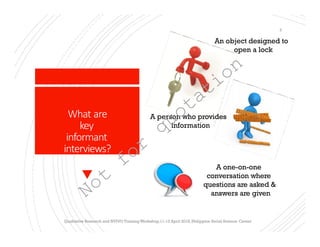
What are
key
informant
interviews?
2
An object designed to
open a lock
Qualitative Research and NVIVO Training Workshop,11-13 April 2018, Philippine Social Science Center
A person who provides
information
A one-on-one
conversation where
questions are asked &
answers are given
Not
for
quotation
3
 an in-depth interview of 15-35 people focusing on a list of issues
regarding a topic which interviewees have first-hand knowledge of
 primary goal is to obtain qualitative description of perceptions or
experiences, rather than measuring aspects of the experience.
 it aims to collect information from a wide range of people—such as
community leaders, professionals, or residents—who have first
hand knowledge about the issue/topic
Qualitative Research and NVIVO Training Workshop,11-13 April 2018, Philippine Social Science Center
Not
for
quotation
What Data Can
KI Interviews
Provide?
Qualitative Research and NVIVO Training Workshop,11-13 April 2018, Philippine Social Science Center
 Qualitative, descriptive information
for decision-making.
 Understanding of motivation,
behavior, and perspectives of
participants.
 Causes of successes and
shortcomings of an activity or
program.
 Recommendations or future
directions.
 Information to support
interpretation of quantitative data
collected through other methods
(triangulate findings).
 Preliminary information needed to
design a comprehensive quantitative
study.
4
Not
for
quotation
Qualitative Research and NVIVO Training Workshop,11-13 April 2018, Philippine Social Science Center
5
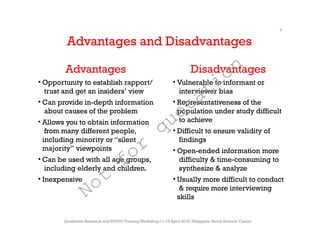
Advantages and Disadvantages
Advantages
• Opportunity to establish rapport/
trust and get an insiders’ view
• Can provide in-depth information
about causes of the problem
• Allows you to obtain information
from many different people,
including minority or “silent
majority” viewpoints
• Can be used with all age groups,
including elderly and children.
• Inexpensive
Disadvantages
• Vulnerable to informant or
interviewer bias
• Representativeness of the
population under study difficult
to achieve
• Difficult to ensure validity of
findings
• Open-ended information more
difficulty & time-consuming to
synthesize & analyze
• Usually more difficult to conduct
& require more interviewing
skills
Not
for
quotation
6
Ethical Considerations in Conducting Key
Informant Interviews
In 1974, the National Commission for the Protection of Human
Subjects in the U.S. produced a framework with three ethical principles to
guide human research (called the Belmont Report).
Respect for persons
• Respect people’s autonomy, particularly their ability to make independent
decisions and act on those decisions.
• Implemented through informed consent (i.e., giving people the information
they need to make an informed and independent decision about whether
to participate in the project/study).
Beneficence
• Projects/studies need to maximize benefits and minimize risks.
• Implemented by a risk/benefit analysis that fully considers the physical,
psychological, emotional, and other risks to participants and weighs these
against the benefits that will accrue to the participants, the population
group, and/or society.
Not
Qualitative Research and NVIVO Training Workshop,11-13 April 2018, Philippine Social Science Center
for
quotation
Qualitative Research and NVIVO Training Workshop,11-13 April 2018, Philippine Social Science Center
7
Ethical Considerations in Conducting Key
Informant Interviews
Justice
• Select participants for the project/study in such a way that there is fair
opportunity for inclusion and vulnerable populations are not exploited.
• Need for studies to include diverse populations (e.g., women, the lgbt,
people of color) so that these groups can benefit from the knowledge
gained.
Not
for
quotation
8
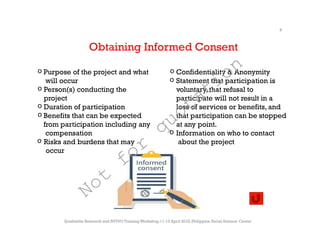
Obtaining Informed Consent
o Purpose of the project and what
will occur
o Person(s) conducting the
project
o Duration of participation
o Benefits that can be expected
from participation including any
compensation
o Risks and burdens that may
occur
o Confidentiality & Anonymity
o Statement that participation is
voluntary,that refusal to
participate will not result in a
loss of services or benefits, and
that participation can be stopped
at any point.
o Information on who to contact
about the project
Not
Qualitative Research and NVIVO Training Workshop,11-13 April 2018, Philippine Social Science Center
for
quotation
Steps in Conducting Key
Informant Interviews
Qualitative Research and NVIVO Training Workshop,11-13 April 2018, Philippine Social Science Center
9
Not
for
quotation
What
Information/Data
Are Needed?
10
Qualitative Research and NVIVO Training Workshop,11-13 April 2018, Philippine Social Science Center
Adequacy of
services
Satisfaction with
service
delivery
Reasons for
poor
patronage
Recommendations
for improvement
Not
for
quotation
Determine target
population and
possible key
informants
11
Qualitative Research and NVIVO Training Workshop,11-13 April 2018, Philippine Social Science Center
Barangay Batong Malaki
Barangay
leaders
OFW
spouses left
behind
Baranga
y Health
Workers
Not
for
quotation
Selecting
Key
Informants
Diversity is Important!
12
Not
Qualitative Research and NVIVO Training Workshop,11-13 April 2018, Philippine Social Science Center
for
quotation
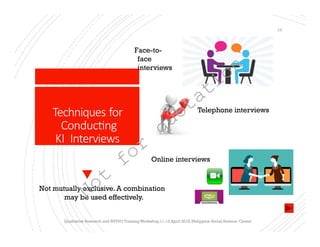
Techniques for
Conducting
KI Interviews
13
Face-to-
face
interviews
Telephone interviews
Online interviews
Not mutually exclusive. A combination
may be used effectively.
Qualitative Research and NVIVO Training Workshop,11-13 April 2018, Philippine Social Science Center
Not
for
quotation
Develop
Interview
Guide
14
Main Components of Interview Guide
• Introduction: Introduce the interviewer
and explain the project.
• Key questions: Draft five to ten questions
important to getting the information you
have set out to collect. Ask questions that
draw upon the informant's expertise and
unique viewpoint.
• Probing questions: Probing questions
encourage participants to reflect more
deeply on the meaning of their
comments.
• Closing question: Provide an
opportunity for the key informant to give
any additional information or comments.
Also ask the key informants for their
recommendations or solutions in
addressing key issues or problems.
Not
Qualitative Research and NVIVO Training Workshop,11-13 April 2018, Philippine Social Science Center
for
quotation
Choose
Documentatio
n Method
15
Note-taking
Digital audio
recording
Not
Qualitative Research and NVIVO Training Workshop,11-13 April 2018, Philippine Social Science Center
for
quotation
Conductin
g
Interviews
Qualitative Research and NVIVO Training Workshop,11-13 April 2018, Philippine Social Science Center
16
Starting the Interview
• Introduce yourself, the project (if
needed) and explain the purpose
of the interview
• Explain why his/her cooperation is
important in collecting the
information you need and what
you intend to do with the
information you will receive from
him/her.
• Emphasize the fact that the
interview results will remain
confidential
Not
for
quotation
Conductin
g
Interviews
Qualitative Research and NVIVO Training Workshop,11-13 April 2018, Philippine Social Science Center
17
Use Interview Guide/Template
to Standardize Administration
To protect validity and
comparability of answers:
• Questions and prompts should be
presented to all respondents in
the same way.
• While you want to maintain an
engaging tone, remain neutral
and avoid giving the impression
of having a strong view on the
topic to avoid bias.
• Clarify meanings of responses
and request detail by using
proper probing techniques
Not
for
quotation
Conductin
g
Interviews
18
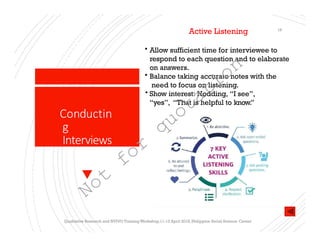
Active Listening
• Allow sufficient time for interviewee to
respond to each question and to elaborate
on answers.
• Balance taking accurate notes with the
need to focus on listening.
• Show interest: Nodding, “I see”,
“yes”, “That is helpful to know.”
Not
Qualitative Research and NVIVO Training Workshop,11-13 April 2018, Philippine Social Science Center
for
quotation
Compile
and
Organize
Interviews
19
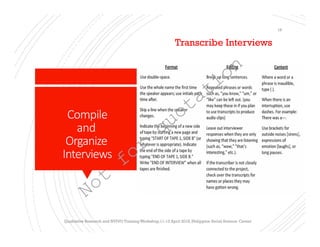
Transcribe Interviews
Not
Qualitative Research and NVIVO Training Workshop,11-13 April 2018, Philippine Social Science Center
for
quotation
Compile
and
Organize
Interviews
Qualitative Research and NVIVO Training Workshop,11-13 April 2018, Philippine Social Science Center
20
Create a Codebook
1. Prepare the texts
 Assign an ID # for each transcript
In each transcript, break & number the
paragraphs
2. Identify themes in the transcript
Read a few transcripts and start pulling
out themes that emerge and assign
codes to them. By the end of this
process you will have a set of codes that
you can apply to the rest of the
transcripts. Organize your codes with
common themes into categories.
3. Create a codebook that contains the
following:
 Name of code
 Description of code
 Example of code
Not
for
quotation
Analyze &
Interpret the
Interview
Data
Qualitative Research and NVIVO Training Workshop,11-13 April 2018, Philippine Social Science Center
21
1. Go through all the transcripts & apply the
codes
If you find that you need to create a new
code because none of the existing ones in
the codebook apply,do so & update your
codebook accordingly.
2.Using Excel, create a worksheet for each
code.
3.Go through all your transcripts. Cut and
paste the texts under the appropriate
codes in your Excel file. If a text has
multiple codes, cut and paste it under the
applicable codes.
4.Start looking for common threads and
themes
 Pull out common threads, themes &
differences
 Pull out powerful quotes that exemplify the
themes
5. Summarize the analysis & interpret the
data.
Not
for
quotation
Intercode
r
Reliability
22
 the extent to which 2 or more independent
coders evaluate a characteristic of a
message or artifact and reach the same
conclusion. (Also known as intercoder
agreement, according to Tinsley and Weiss
(2000).
 measures "the extent to which the different
judges tend to assign exactly the same
rating to each object" (Tinsley & Weiss,
2000, p. 98);
Not
Qualitative Research and NVIVO Training Workshop,11-13 April 2018, Philippine Social Science Center
for
quotation
Acceptanc
e
Standard
for Intercoder
Reliability
Qualitative Research and NVIVO Training Workshop,11-13 April 2018, Philippine Social Science Center
23
No coherent standard.
Some rules of thumb
(Neuendorf, 2002):
• Coefficients of .90 or greater
would be acceptable to all,
• .80 or greater would be
acceptable in most situations,
• Below .80, there exists great
disagreement” (p. 145).
Not
for
quotation
Using
Computer
Programs for
Data Analysis
24
 Computer programs, such as NVIVO,
can help with the analysis of interview
transcripts.
 They can perform many tasks, such as
coding, writing personal comments on
the interviews, doing word counts,
and searching for key words.
 Are much faster than manually coding
data and can save hours of work.
While these programs can
help you organize the data
more efficiently, they are not
substitutes for your analysis of
the data.
Not
Qualitative Research and NVIVO Training Workshop,11-13 April 2018, Philippine Social Science Center
for
quotation
Write the
Research
Report
25
Not
Qualitative Research and NVIVO Training Workshop,11-13 April 2018, Philippine Social Science Center
for
quotation
Steps in Conducting
Informant
Interviews
Qualitative Research and NVIVO Training Workshop,11-13 April 2018, Philippine Social Science Center
 Determine what information is needed
 Determine target population and
brainstorm about possible key
informants
 Choose key informants
 Choose type of interview
 Develop an interview guide
 Determine documentation
method
 Select designated interviewer(s)
 Conduct key informant
interviews
 Compile and organize key informant
interview
 Analyze & interpret interview data
 Write report
26
Not
for
quotation
Maraming Salamat!
Qualitative Research and NVIVO Training Workshop,11-13 April 2018, Philippine Social Science Center
27
Not
for
quotation
28
References
Gelfand, R. and Godefroy, R, 2010. Participatory Research Kit:
Conducting Interviews. Oakland, California: Data Center.
Mack, N; Woodsong, C.; Macqueen, K.; Guest, G.; and Namey, E. 2005.
Module 3: In-depth interviews. In Mack N., et al., Qualitative Research
Methods: A Data Collector’s Field Guide. Pp. 29-50. Research Triangle
Park, North Carolina: Family Health International.
Neuendorf, K. (2002). The Content Analysis Guidebook. Thousand Oaks,
CA: Sage Publications.
UCLA Center for Health Policy Research. Section 4: Key informant interviews.
Retrieved 15 January 2018 from
http://healthpolicy.ucla.edu/programs/healthdata/trainings/Documents/t
w_cba23.pdf
Washington University.Key Informant Interview Handbook. Retrieved 15
January 2018 from
http://courses.washington.edu/nutr531/HEBD/KIInterviews/KeyInformant
I
n
t
e
r
v
i
eQ
uwa
l
iHt
a
ti
av
enRde
sbe
aor
c
hoakn
d.
pN
VdI
VfO TrainingWorkshop,11-13 April 2018, Philippine Social Science Center
Not
for
quotation

Key-Informant-Interview-Research and Development

  • 1.
    Conducting Key Informant Interviews Stella P .Go Integrated School DeLa Salle University 1 Not Qualitative Research and NVIVO Training Workshop,11-13 April 2018, Philippine Social Science Center for quotation
  • 2.
    What are key informant interviews? 2 An objectdesigned to open a lock Qualitative Research and NVIVO Training Workshop,11-13 April 2018, Philippine Social Science Center A person who provides information A one-on-one conversation where questions are asked & answers are given Not for quotation
  • 3.
    3  an in-depthinterview of 15-35 people focusing on a list of issues regarding a topic which interviewees have first-hand knowledge of  primary goal is to obtain qualitative description of perceptions or experiences, rather than measuring aspects of the experience.  it aims to collect information from a wide range of people—such as community leaders, professionals, or residents—who have first hand knowledge about the issue/topic Qualitative Research and NVIVO Training Workshop,11-13 April 2018, Philippine Social Science Center Not for quotation
  • 4.
    What Data Can KIInterviews Provide? Qualitative Research and NVIVO Training Workshop,11-13 April 2018, Philippine Social Science Center  Qualitative, descriptive information for decision-making.  Understanding of motivation, behavior, and perspectives of participants.  Causes of successes and shortcomings of an activity or program.  Recommendations or future directions.  Information to support interpretation of quantitative data collected through other methods (triangulate findings).  Preliminary information needed to design a comprehensive quantitative study. 4 Not for quotation
  • 5.
    Qualitative Research andNVIVO Training Workshop,11-13 April 2018, Philippine Social Science Center 5 Advantages and Disadvantages Advantages • Opportunity to establish rapport/ trust and get an insiders’ view • Can provide in-depth information about causes of the problem • Allows you to obtain information from many different people, including minority or “silent majority” viewpoints • Can be used with all age groups, including elderly and children. • Inexpensive Disadvantages • Vulnerable to informant or interviewer bias • Representativeness of the population under study difficult to achieve • Difficult to ensure validity of findings • Open-ended information more difficulty & time-consuming to synthesize & analyze • Usually more difficult to conduct & require more interviewing skills Not for quotation
  • 6.
    6 Ethical Considerations inConducting Key Informant Interviews In 1974, the National Commission for the Protection of Human Subjects in the U.S. produced a framework with three ethical principles to guide human research (called the Belmont Report). Respect for persons • Respect people’s autonomy, particularly their ability to make independent decisions and act on those decisions. • Implemented through informed consent (i.e., giving people the information they need to make an informed and independent decision about whether to participate in the project/study). Beneficence • Projects/studies need to maximize benefits and minimize risks. • Implemented by a risk/benefit analysis that fully considers the physical, psychological, emotional, and other risks to participants and weighs these against the benefits that will accrue to the participants, the population group, and/or society. Not Qualitative Research and NVIVO Training Workshop,11-13 April 2018, Philippine Social Science Center for quotation
  • 7.
    Qualitative Research andNVIVO Training Workshop,11-13 April 2018, Philippine Social Science Center 7 Ethical Considerations in Conducting Key Informant Interviews Justice • Select participants for the project/study in such a way that there is fair opportunity for inclusion and vulnerable populations are not exploited. • Need for studies to include diverse populations (e.g., women, the lgbt, people of color) so that these groups can benefit from the knowledge gained. Not for quotation
  • 8.
    8 Obtaining Informed Consent oPurpose of the project and what will occur o Person(s) conducting the project o Duration of participation o Benefits that can be expected from participation including any compensation o Risks and burdens that may occur o Confidentiality & Anonymity o Statement that participation is voluntary,that refusal to participate will not result in a loss of services or benefits, and that participation can be stopped at any point. o Information on who to contact about the project Not Qualitative Research and NVIVO Training Workshop,11-13 April 2018, Philippine Social Science Center for quotation
  • 9.
    Steps in ConductingKey Informant Interviews Qualitative Research and NVIVO Training Workshop,11-13 April 2018, Philippine Social Science Center 9 Not for quotation
  • 10.
    What Information/Data Are Needed? 10 Qualitative Researchand NVIVO Training Workshop,11-13 April 2018, Philippine Social Science Center Adequacy of services Satisfaction with service delivery Reasons for poor patronage Recommendations for improvement Not for quotation
  • 11.
    Determine target population and possiblekey informants 11 Qualitative Research and NVIVO Training Workshop,11-13 April 2018, Philippine Social Science Center Barangay Batong Malaki Barangay leaders OFW spouses left behind Baranga y Health Workers Not for quotation
  • 12.
    Selecting Key Informants Diversity is Important! 12 Not QualitativeResearch and NVIVO Training Workshop,11-13 April 2018, Philippine Social Science Center for quotation
  • 13.
    Techniques for Conducting KI Interviews 13 Face-to- face interviews Telephoneinterviews Online interviews Not mutually exclusive. A combination may be used effectively. Qualitative Research and NVIVO Training Workshop,11-13 April 2018, Philippine Social Science Center Not for quotation
  • 14.
    Develop Interview Guide 14 Main Components ofInterview Guide • Introduction: Introduce the interviewer and explain the project. • Key questions: Draft five to ten questions important to getting the information you have set out to collect. Ask questions that draw upon the informant's expertise and unique viewpoint. • Probing questions: Probing questions encourage participants to reflect more deeply on the meaning of their comments. • Closing question: Provide an opportunity for the key informant to give any additional information or comments. Also ask the key informants for their recommendations or solutions in addressing key issues or problems. Not Qualitative Research and NVIVO Training Workshop,11-13 April 2018, Philippine Social Science Center for quotation
  • 15.
    Choose Documentatio n Method 15 Note-taking Digital audio recording Not QualitativeResearch and NVIVO Training Workshop,11-13 April 2018, Philippine Social Science Center for quotation
  • 16.
    Conductin g Interviews Qualitative Research andNVIVO Training Workshop,11-13 April 2018, Philippine Social Science Center 16 Starting the Interview • Introduce yourself, the project (if needed) and explain the purpose of the interview • Explain why his/her cooperation is important in collecting the information you need and what you intend to do with the information you will receive from him/her. • Emphasize the fact that the interview results will remain confidential Not for quotation
  • 17.
    Conductin g Interviews Qualitative Research andNVIVO Training Workshop,11-13 April 2018, Philippine Social Science Center 17 Use Interview Guide/Template to Standardize Administration To protect validity and comparability of answers: • Questions and prompts should be presented to all respondents in the same way. • While you want to maintain an engaging tone, remain neutral and avoid giving the impression of having a strong view on the topic to avoid bias. • Clarify meanings of responses and request detail by using proper probing techniques Not for quotation
  • 18.
    Conductin g Interviews 18 Active Listening • Allowsufficient time for interviewee to respond to each question and to elaborate on answers. • Balance taking accurate notes with the need to focus on listening. • Show interest: Nodding, “I see”, “yes”, “That is helpful to know.” Not Qualitative Research and NVIVO Training Workshop,11-13 April 2018, Philippine Social Science Center for quotation
  • 19.
    Compile and Organize Interviews 19 Transcribe Interviews Not Qualitative Researchand NVIVO Training Workshop,11-13 April 2018, Philippine Social Science Center for quotation
  • 20.
    Compile and Organize Interviews Qualitative Research andNVIVO Training Workshop,11-13 April 2018, Philippine Social Science Center 20 Create a Codebook 1. Prepare the texts  Assign an ID # for each transcript In each transcript, break & number the paragraphs 2. Identify themes in the transcript Read a few transcripts and start pulling out themes that emerge and assign codes to them. By the end of this process you will have a set of codes that you can apply to the rest of the transcripts. Organize your codes with common themes into categories. 3. Create a codebook that contains the following:  Name of code  Description of code  Example of code Not for quotation
  • 21.
    Analyze & Interpret the Interview Data QualitativeResearch and NVIVO Training Workshop,11-13 April 2018, Philippine Social Science Center 21 1. Go through all the transcripts & apply the codes If you find that you need to create a new code because none of the existing ones in the codebook apply,do so & update your codebook accordingly. 2.Using Excel, create a worksheet for each code. 3.Go through all your transcripts. Cut and paste the texts under the appropriate codes in your Excel file. If a text has multiple codes, cut and paste it under the applicable codes. 4.Start looking for common threads and themes  Pull out common threads, themes & differences  Pull out powerful quotes that exemplify the themes 5. Summarize the analysis & interpret the data. Not for quotation
  • 22.
    Intercode r Reliability 22  the extentto which 2 or more independent coders evaluate a characteristic of a message or artifact and reach the same conclusion. (Also known as intercoder agreement, according to Tinsley and Weiss (2000).  measures "the extent to which the different judges tend to assign exactly the same rating to each object" (Tinsley & Weiss, 2000, p. 98); Not Qualitative Research and NVIVO Training Workshop,11-13 April 2018, Philippine Social Science Center for quotation
  • 23.
    Acceptanc e Standard for Intercoder Reliability Qualitative Researchand NVIVO Training Workshop,11-13 April 2018, Philippine Social Science Center 23 No coherent standard. Some rules of thumb (Neuendorf, 2002): • Coefficients of .90 or greater would be acceptable to all, • .80 or greater would be acceptable in most situations, • Below .80, there exists great disagreement” (p. 145). Not for quotation
  • 24.
    Using Computer Programs for Data Analysis 24 Computer programs, such as NVIVO, can help with the analysis of interview transcripts.  They can perform many tasks, such as coding, writing personal comments on the interviews, doing word counts, and searching for key words.  Are much faster than manually coding data and can save hours of work. While these programs can help you organize the data more efficiently, they are not substitutes for your analysis of the data. Not Qualitative Research and NVIVO Training Workshop,11-13 April 2018, Philippine Social Science Center for quotation
  • 25.
    Write the Research Report 25 Not Qualitative Researchand NVIVO Training Workshop,11-13 April 2018, Philippine Social Science Center for quotation
  • 26.
    Steps in Conducting Informant Interviews QualitativeResearch and NVIVO Training Workshop,11-13 April 2018, Philippine Social Science Center  Determine what information is needed  Determine target population and brainstorm about possible key informants  Choose key informants  Choose type of interview  Develop an interview guide  Determine documentation method  Select designated interviewer(s)  Conduct key informant interviews  Compile and organize key informant interview  Analyze & interpret interview data  Write report 26 Not for quotation
  • 27.
    Maraming Salamat! Qualitative Researchand NVIVO Training Workshop,11-13 April 2018, Philippine Social Science Center 27 Not for quotation
  • 28.
    28 References Gelfand, R. andGodefroy, R, 2010. Participatory Research Kit: Conducting Interviews. Oakland, California: Data Center. Mack, N; Woodsong, C.; Macqueen, K.; Guest, G.; and Namey, E. 2005. Module 3: In-depth interviews. In Mack N., et al., Qualitative Research Methods: A Data Collector’s Field Guide. Pp. 29-50. Research Triangle Park, North Carolina: Family Health International. Neuendorf, K. (2002). The Content Analysis Guidebook. Thousand Oaks, CA: Sage Publications. UCLA Center for Health Policy Research. Section 4: Key informant interviews. Retrieved 15 January 2018 from http://healthpolicy.ucla.edu/programs/healthdata/trainings/Documents/t w_cba23.pdf Washington University.Key Informant Interview Handbook. Retrieved 15 January 2018 from http://courses.washington.edu/nutr531/HEBD/KIInterviews/KeyInformant I n t e r v i eQ uwa l iHt a ti av enRde sbe aor c hoakn d. pN VdI VfO TrainingWorkshop,11-13 April 2018, Philippine Social Science Center Not for quotation