Welcome
Key Considerations for Pediatric Clinical Trials:
Ethical and Regulatory Aspects
Athiya Begum
Pharm.D Intern
147/072024
28/9/2024
www.clinosol.com | follow us on social media
@clinosolresearch
1
Index
• Introduction
• Ethical Considerations
• Ethical Process in Pediatric Clinical Trials
• Regulatory Framework
• Conclusion
• References
28/9/2024 www.clinosol.com | follow us on social media
@clinosolresearch
2
Introduction
Pediatric clinical trials are research studies conducted with children to evaluate the safety and
efficacy of medical treatments or interventions.
Children are a vulnerable population with distinct physical, emotional, and psychological
differences compared to adults, making ethical and regulatory considerations critical.
28/9/2024
www.clinosol.com | follow us on social media
@clinosolresearch
3
Ethical considerations
Vulnerability of pediatric population
Vulnerability of children based on :
• Their decision- making capacity may be immature,
• Their lives are still subject to the authority of others,
• Their underlying dissent may be asked for fear of upsetting authority figures, and
their rights and interests may be undervalued by society.
28/9/2042
www.clinosol.com | follow us on social media
@clinosolresearch
4
Ethical considerations
• Informed Consent: Children are often unable to give legal consent, and parental consent is
required. And Requires explanation in understandable language for both parents and children.
• Assent: Where possible, researchers should seek assent (agreement) from the child,
especially for older children and adolescents. Children over a certain age (typically 7+)
should provide their agreement after an age-appropriate explanation.
• Minimization of Risk: Ethical principles require minimizing risks to children participating
in trials.
28/9/2024
www.clinosol.com | follow us on social media
@clinosolresearch
5
Ethical principles that serve as a framework for human subject’s research:
www.clinosol.com | follow us on social media
@clinosolresearch
6
Beneficence Applying evidence- based care generated from research specific
to children
Non-maleficence Avoiding harmful therapies extrapolated from adult patient data
or experience. Prevent or remove possible harm
Distributive justice Allowing research benefits to be available to all populations
Respect for
informed consent
Supporting developing autonomy in children considering
research participation
Respect for
privacy and
confidentiality
Providing confidentiality within the limits of legal requirements
Scientific necessity Children should not be enrolled in a clinical investigation unless
necessary to achieve an important scientific and/or public health
objective concerning the health and welfare of children
28/9/2024
Ethical considerations:
1. Balancing Risk and Benefit
• Low-Risk vs High-Risk Trials: Research with children should be classified into minimal
risk and higher-risk categories.
• Direct Benefit: Trials should provide direct benefit to the pediatric participant, or minimal
risk if no direct benefit is likely.
28/9/2024
www.clinosol.com | follow us on social media
@clinosolresearch
7
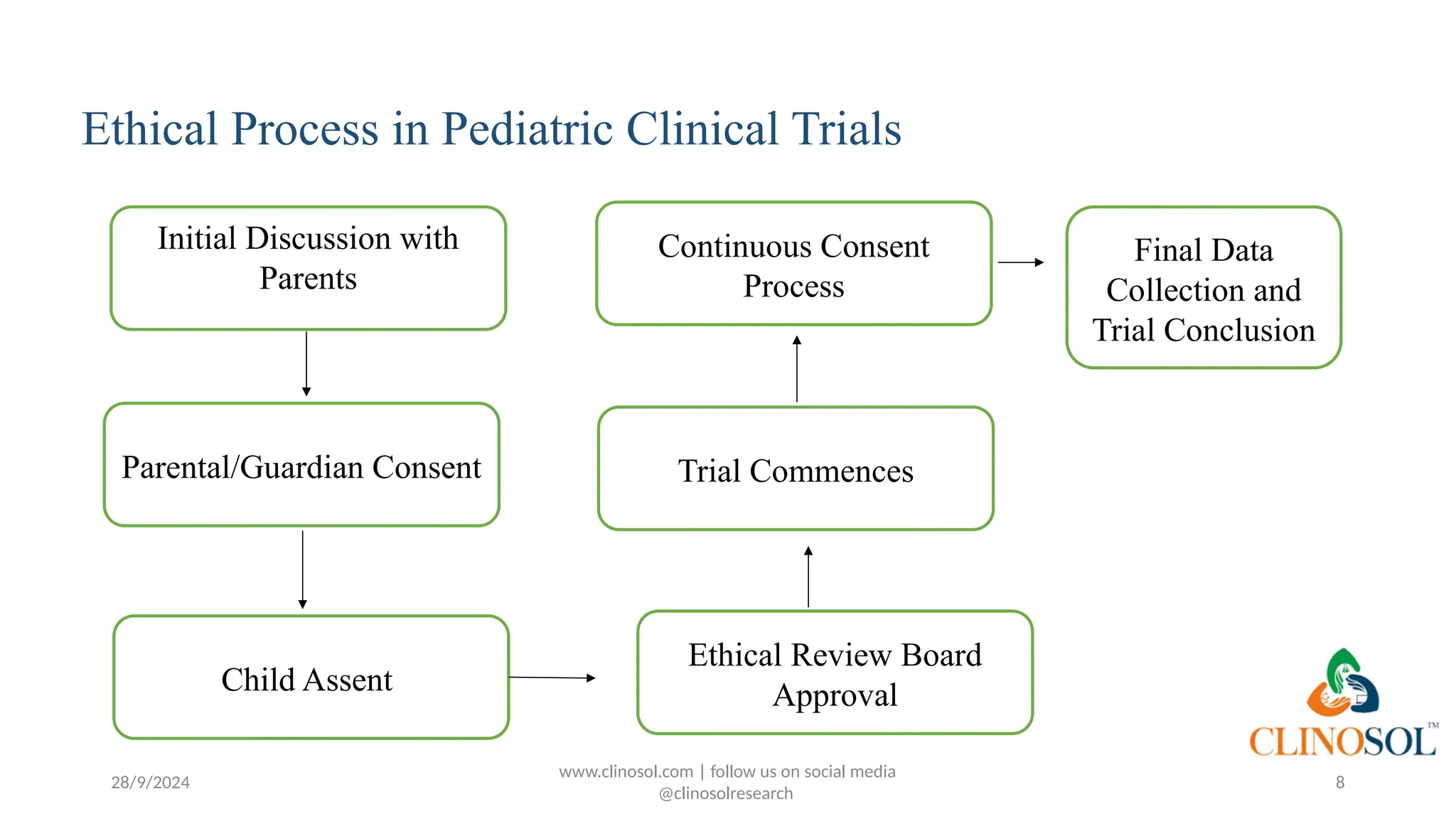
Ethical Process in Pediatric Clinical Trials
8
28/9/2024
www.clinosol.com | follow us on social media
@clinosolresearch
Initial Discussion with
Parents
Parental/Guardian Consent
Ethical Review Board
Approval
Trial Commences
Child Assent
Final Data
Collection and
Trial Conclusion
Continuous Consent
Process
Regulatory framework: Global Overview
U.S. Regulations: Pediatric trials are governed by FDA, with the Pediatric Research Equity Act
(PREA) and Best Pharmaceuticals for Children Act (BPCA) guiding pediatric drug development.
EU Regulations: The European Medicines Agency (EMA) has pediatric research guidelines,
requiring Pediatric Investigation Plans (PIPs) for new drug applications.
Table : Key Regulations in Different Regions
28/9/2024
www.clinosol.com | follow us on social media
@clinosolresearch
9
Region Regulation/Guideline Agency
USA PREA, BPCA FDA
EU Pediatric Investigation plan
(PIP)
EMA
WHO Ethical Considerations in
clinical trials
WHO
Regulatory framework: Ethical Guidelines
Ethical guidelines like ICH E11 and the declaration of Helsinki
• ICH E11: Clinical Trials in Pediatric Population
E11 shows that, clinical investigation of medicinal products in the pediatric population
• Declaration of Helsinki: Provides ethical principles for medical research involving
human subjects, including children
28/9/2042
www.clinosol.com | follow us on social media
@clinosolresearch
10
Conclusion
Pediatric clinical trials are essential for ensuring treatments are safe and effective for children.
ethical and regulatory frameworks play a crucial role for safeguarding children rights and well-
being.
28/9/2024
www.clinosol.com | follow us on social media
@clinosolresearch
11
References
• Anthony T. Podany, Ethical Considerations in Pediatric Research. PedSAP 2017 Book 1.
• Roth-Cline M, Gerson J, Bright P, Lee CS, Nelson RM, Ethical considerations in conducting pediatric
research, Handb Exp Pharmacol. 2011;205:219-44. doi: 10.1007/978-3-642-20195-0_11. PMID:21882114
• Caldwell PH, Murphy SB, Butow PN, et al. Clinical trials in children. Lancet 2004;364:803-11
• Allmark P, Manson S, Gill B, Megone C. Obtaining consent for neonatal research. Arch Dis
Child Fetal Neonatal Ed 2003; 88 F166-F167.
• Include major ethical guidelines, such as Decleration of Helsinki and Belmont report.
• Regulatory agency guidance (FDA, EMA, ICH E11).
28/9/2024
www.clinosol.com | follow us on social media
@clinosolresearch
12
ThankYou!
www.clinosol.com
(India | Canada)
9121151622/623/624
info@clinosol.com
28/9/2024
www.clinosol.com | follow us on social media
@clinosolresearch
13

Key Considerations for Pediatric Clinical Trials: Ethical and Regulatory Aspects

  • 1.
    Welcome Key Considerations forPediatric Clinical Trials: Ethical and Regulatory Aspects Athiya Begum Pharm.D Intern 147/072024 28/9/2024 www.clinosol.com | follow us on social media @clinosolresearch 1
  • 2.
    Index • Introduction • EthicalConsiderations • Ethical Process in Pediatric Clinical Trials • Regulatory Framework • Conclusion • References 28/9/2024 www.clinosol.com | follow us on social media @clinosolresearch 2
  • 3.
    Introduction Pediatric clinical trialsare research studies conducted with children to evaluate the safety and efficacy of medical treatments or interventions. Children are a vulnerable population with distinct physical, emotional, and psychological differences compared to adults, making ethical and regulatory considerations critical. 28/9/2024 www.clinosol.com | follow us on social media @clinosolresearch 3
  • 4.
    Ethical considerations Vulnerability ofpediatric population Vulnerability of children based on : • Their decision- making capacity may be immature, • Their lives are still subject to the authority of others, • Their underlying dissent may be asked for fear of upsetting authority figures, and their rights and interests may be undervalued by society. 28/9/2042 www.clinosol.com | follow us on social media @clinosolresearch 4
  • 5.
    Ethical considerations • InformedConsent: Children are often unable to give legal consent, and parental consent is required. And Requires explanation in understandable language for both parents and children. • Assent: Where possible, researchers should seek assent (agreement) from the child, especially for older children and adolescents. Children over a certain age (typically 7+) should provide their agreement after an age-appropriate explanation. • Minimization of Risk: Ethical principles require minimizing risks to children participating in trials. 28/9/2024 www.clinosol.com | follow us on social media @clinosolresearch 5
  • 6.
    Ethical principles thatserve as a framework for human subject’s research: www.clinosol.com | follow us on social media @clinosolresearch 6 Beneficence Applying evidence- based care generated from research specific to children Non-maleficence Avoiding harmful therapies extrapolated from adult patient data or experience. Prevent or remove possible harm Distributive justice Allowing research benefits to be available to all populations Respect for informed consent Supporting developing autonomy in children considering research participation Respect for privacy and confidentiality Providing confidentiality within the limits of legal requirements Scientific necessity Children should not be enrolled in a clinical investigation unless necessary to achieve an important scientific and/or public health objective concerning the health and welfare of children 28/9/2024
  • 7.
    Ethical considerations: 1. BalancingRisk and Benefit • Low-Risk vs High-Risk Trials: Research with children should be classified into minimal risk and higher-risk categories. • Direct Benefit: Trials should provide direct benefit to the pediatric participant, or minimal risk if no direct benefit is likely. 28/9/2024 www.clinosol.com | follow us on social media @clinosolresearch 7
  • 8.
    Ethical Process inPediatric Clinical Trials 8 28/9/2024 www.clinosol.com | follow us on social media @clinosolresearch Initial Discussion with Parents Parental/Guardian Consent Ethical Review Board Approval Trial Commences Child Assent Final Data Collection and Trial Conclusion Continuous Consent Process
  • 9.
    Regulatory framework: GlobalOverview U.S. Regulations: Pediatric trials are governed by FDA, with the Pediatric Research Equity Act (PREA) and Best Pharmaceuticals for Children Act (BPCA) guiding pediatric drug development. EU Regulations: The European Medicines Agency (EMA) has pediatric research guidelines, requiring Pediatric Investigation Plans (PIPs) for new drug applications. Table : Key Regulations in Different Regions 28/9/2024 www.clinosol.com | follow us on social media @clinosolresearch 9 Region Regulation/Guideline Agency USA PREA, BPCA FDA EU Pediatric Investigation plan (PIP) EMA WHO Ethical Considerations in clinical trials WHO
  • 10.
    Regulatory framework: EthicalGuidelines Ethical guidelines like ICH E11 and the declaration of Helsinki • ICH E11: Clinical Trials in Pediatric Population E11 shows that, clinical investigation of medicinal products in the pediatric population • Declaration of Helsinki: Provides ethical principles for medical research involving human subjects, including children 28/9/2042 www.clinosol.com | follow us on social media @clinosolresearch 10
  • 11.
    Conclusion Pediatric clinical trialsare essential for ensuring treatments are safe and effective for children. ethical and regulatory frameworks play a crucial role for safeguarding children rights and well- being. 28/9/2024 www.clinosol.com | follow us on social media @clinosolresearch 11
  • 12.
    References • Anthony T.Podany, Ethical Considerations in Pediatric Research. PedSAP 2017 Book 1. • Roth-Cline M, Gerson J, Bright P, Lee CS, Nelson RM, Ethical considerations in conducting pediatric research, Handb Exp Pharmacol. 2011;205:219-44. doi: 10.1007/978-3-642-20195-0_11. PMID:21882114 • Caldwell PH, Murphy SB, Butow PN, et al. Clinical trials in children. Lancet 2004;364:803-11 • Allmark P, Manson S, Gill B, Megone C. Obtaining consent for neonatal research. Arch Dis Child Fetal Neonatal Ed 2003; 88 F166-F167. • Include major ethical guidelines, such as Decleration of Helsinki and Belmont report. • Regulatory agency guidance (FDA, EMA, ICH E11). 28/9/2024 www.clinosol.com | follow us on social media @clinosolresearch 12
  • 13.