Understanding Organizational
Style and Its Impact on
Information Systems
Systems Analysis and Design, 7e
Kendall & Kendall
2
©2008 Pearson Prentice Hall
Kendall & Kendall 2-2
Learning Objectives
• Understand that organizations and their
members are systems and that analysts need
to take a systems perspective
• Depict systems graphically using context-level
data flow diagrams, and entity-relationship
models, use cases and use case scenarios
• Recognize that different levels of
management require different systems
• Comprehend that organizational culture
impacts the design of information systems
Kendall & Kendall 2-3
Three Main Forces Interacting to
Shape Organizations
• Levels of management
• Design of organizations
• Organizational cultures
Kendall & Kendall 2-4
Organizations Are Composed of
Interrelated Subsystems
• Influenced by levels of management
decision makers that cut horizontally
across the organizational system
• Operations
• Middle management
• Strategic management
• Influenced by organizational cultures
and subcultures
Kendall & Kendall 2-5
Major Topics
• Organizations as systems
• Depicting systems graphically
• Data flow diagram
• Entity-relationship model
• Use case modeling
• Levels of management
• Organizational culture
Kendall & Kendall 2-6
Organizations As Systems
• Conceptualized as systems designed to
accomplish predetermined goals and
objectives
• Composed of smaller, interrelated
systems serving specialized functions
• Specialized functions are reintegrated to
form an effective organizational whole
Kendall & Kendall 2-7
Interrelatedness and
Independence of Systems
• All systems and subsystems are interrelated
and interdependent
• All systems process inputs from their
environments
• All systems are contained by boundaries
separating them from their environments
• System feedback for planning and control
• An ideal system self-corrects or self-regulates
itself
Kendall & Kendall 2-8
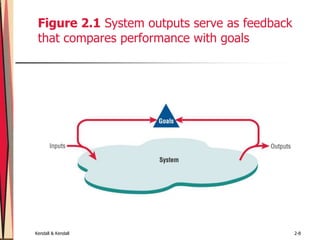
Figure 2.1 System outputs serve as feedback
that compares performance with goals
Kendall & Kendall 2-9
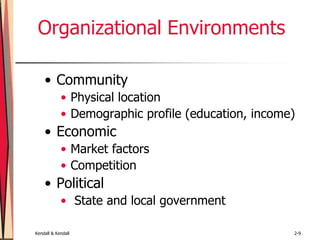
Organizational Environments
• Community
• Physical location
• Demographic profile (education, income)
• Economic
• Market factors
• Competition
• Political
• State and local government
Kendall & Kendall 2-10
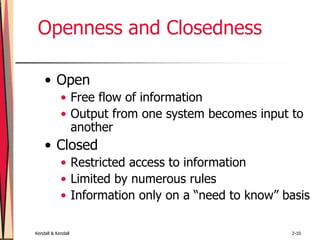
Openness and Closedness
• Open
• Free flow of information
• Output from one system becomes input to
another
• Closed
• Restricted access to information
• Limited by numerous rules
• Information only on a “need to know” basis
Kendall & Kendall 2-11
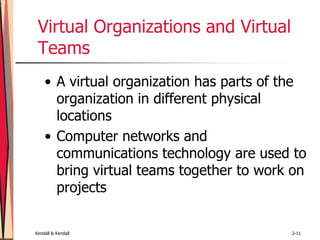
Virtual Organizations and Virtual
Teams
• A virtual organization has parts of the
organization in different physical
locations
• Computer networks and
communications technology are used to
bring virtual teams together to work on
projects
Kendall & Kendall 2-12
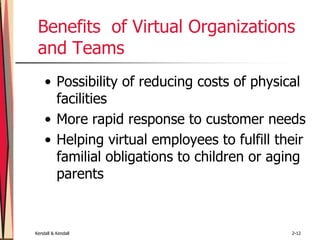
Benefits of Virtual Organizations
and Teams
• Possibility of reducing costs of physical
facilities
• More rapid response to customer needs
• Helping virtual employees to fulfill their
familial obligations to children or aging
parents
Kendall & Kendall 2-13
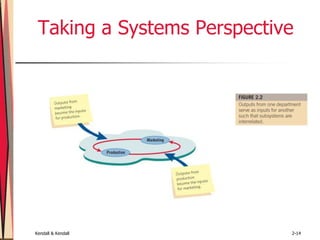
Taking a Systems Perspective
• Allows system analyst to understand
businesses before they begin their tasks
• It is important that members of subsystems
realize that they are interrelated with other
subsystems
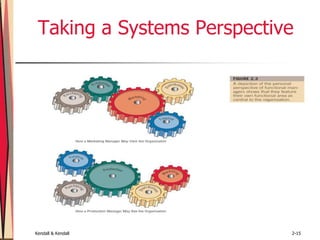
• Problems occur when each manager thinks
that his/her department is the most important
• Bigger problems may occur when that
manager rises through the ranks
Kendall & Kendall 2-14
Taking a Systems Perspective
Kendall & Kendall 2-15
Taking a Systems Perspective
Kendall & Kendall 2-16
Enterprise Resource Planning
• Enterprise Resource Planning (ERP)
describes an integrated organizational
information system
• Software that helps the flow of
information between the functional
areas within the organization
Kendall & Kendall 2-17
Depicting Systems Graphically
• Context-level data flow diagrams
• Entity-relationship model
• Use Case Modeling
Kendall & Kendall 2-18
Context-Level Data Flow
Diagrams
• Focus is on the data flowing into and
out of the system and the processing of
the data
Kendall & Kendall 2-19
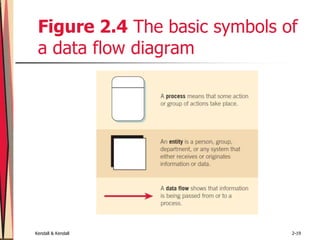
Figure 2.4 The basic symbols of
a data flow diagram
Kendall & Kendall 2-20
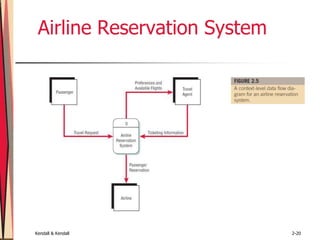
Airline Reservation System
Kendall & Kendall 2-21
Entity-Relationship Model
• Focus is on the entities and their
relationships within the organizational
system
Kendall & Kendall 2-22
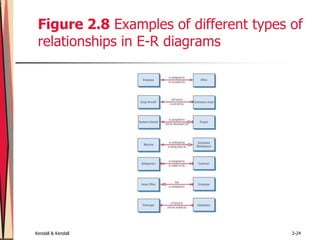
Relationships
• Relationships show how the entities are
connected
• Three types of relationships
• One-to-one
• One-to-many
• Many-to-many
Kendall & Kendall 2-23
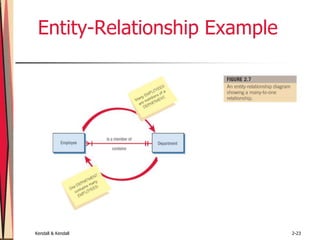
Entity-Relationship Example
Kendall & Kendall 2-24
Figure 2.8 Examples of different types of
relationships in E-R diagrams
Kendall & Kendall 2-25
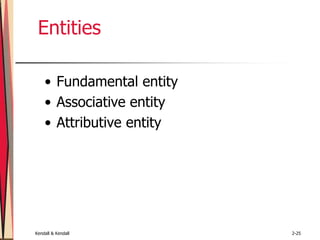
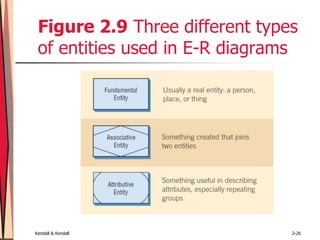
Entities
• Fundamental entity
• Associative entity
• Attributive entity
Kendall & Kendall 2-26
Figure 2.9 Three different types
of entities used in E-R diagrams
Kendall & Kendall 2-27
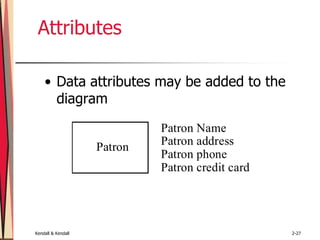
Attributes
• Data attributes may be added to the
diagram
Patron
Patron Name
Patron address
Patron phone
Patron credit card
Kendall & Kendall 2-28
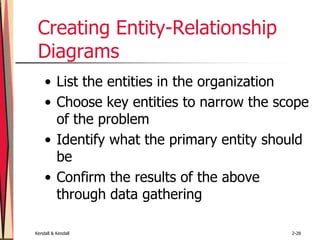
Creating Entity-Relationship
Diagrams
• List the entities in the organization
• Choose key entities to narrow the scope
of the problem
• Identify what the primary entity should
be
• Confirm the results of the above
through data gathering
Kendall & Kendall 2-29
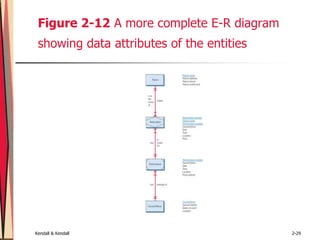
Figure 2-12 A more complete E-R diagram
showing data attributes of the entities
Kendall & Kendall 2-30
Use Case Modeling
• Describes what a system does without
describing how the system does it; that
is, it is a logical model of the system
Kendall & Kendall 2-31
Use Case Diagram
• Actor
• Refers to a particular role of a user of the system
• Similar to external entities; they exist outside of
the system
• Use case symbols
• An oval indicating the task of the use case
• Connecting lines
• Arrows and lines used to diagram behavioral
relationships
Kendall & Kendall 2-32
Actor
• Divided into two groups
• Primary actors
• Supply data or receive information from the
system
• Provide details on what the use case should do
• Supporting actors
• Help to keep the system running or provide
help
• The people who run the help desk, the
analysts, programmers, and so on
Kendall & Kendall 2-33
A Use Case Always Provides
Three Things
• An actor that initiates an event
• The event that triggers a use case
• The use case that performs the actions
triggered by the event
Kendall & Kendall 2-34
Use Case Relations
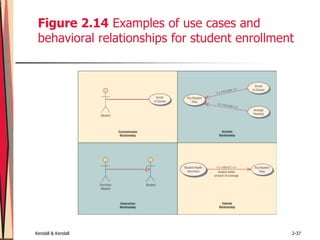
• Behavioral relationships
• Communicates
• Used to connect an actor to a use case
• Includes
• Describes the situation in which a use
case contains behavior that is common
to more than one use case
Kendall & Kendall 2-35
Use Case Relations
• Behavioral relationships (Continued)
• Extends
• Describes the situation in which one use
case possesses the behavior that allows
the new case to handle a variation or
exception from the basic use case
• Generalizes
• Implies that one thing is more typical
than the other thing
Kendall & Kendall 2-36
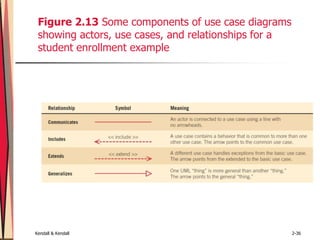
Figure 2.13 Some components of use case diagrams
showing actors, use cases, and relationships for a
student enrollment example
Kendall & Kendall 2-37
Figure 2.14 Examples of use cases and
behavioral relationships for student enrollment
Kendall & Kendall 2-38
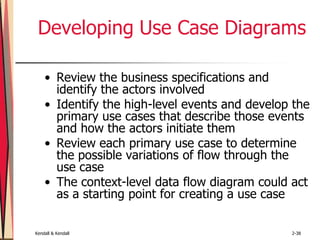
Developing Use Case Diagrams
• Review the business specifications and
identify the actors involved
• Identify the high-level events and develop the
primary use cases that describe those events
and how the actors initiate them
• Review each primary use case to determine
the possible variations of flow through the
use case
• The context-level data flow diagram could act
as a starting point for creating a use case
Kendall & Kendall 2-39
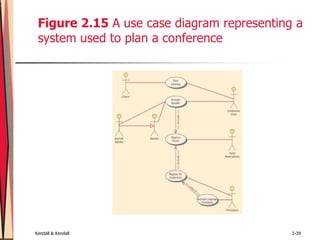
Figure 2.15 A use case diagram representing a
system used to plan a conference
Kendall & Kendall 2-40
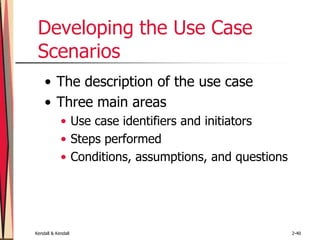
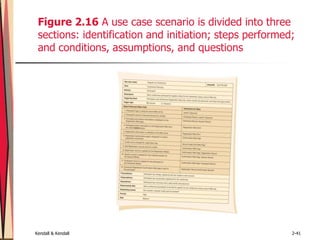
Developing the Use Case
Scenarios
• The description of the use case
• Three main areas
• Use case identifiers and initiators
• Steps performed
• Conditions, assumptions, and questions
Kendall & Kendall 2-41
Figure 2.16 A use case scenario is divided into three
sections: identification and initiation; steps performed;
and conditions, assumptions, and questions
Kendall & Kendall 2-42
Why Use Case Diagrams Are
Helpful
• Identify all the actors in the problem
domain
• Actions that need to be completed are
also clearly shown on the use case
diagram
• The use case scenario is also
worthwhile
• Simplicity and lack of technical detail
Kendall & Kendall 2-43
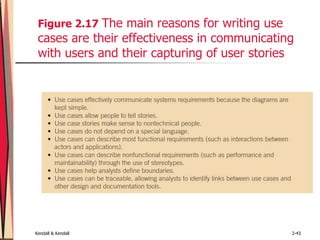
Figure 2.17 The main reasons for writing use
cases are their effectiveness in communicating
with users and their capturing of user stories
Kendall & Kendall 2-44
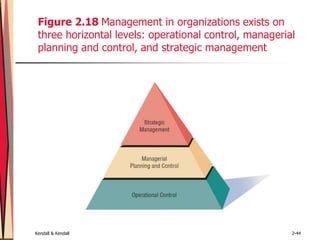
Figure 2.18 Management in organizations exists on
three horizontal levels: operational control, managerial
planning and control, and strategic management
Kendall & Kendall 2-45
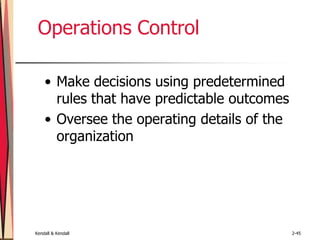
Operations Control
• Make decisions using predetermined
rules that have predictable outcomes
• Oversee the operating details of the
organization
Kendall & Kendall 2-46
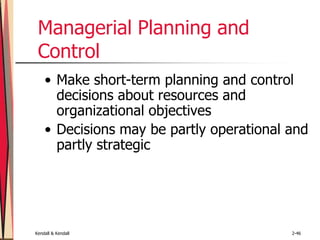
Managerial Planning and
Control
• Make short-term planning and control
decisions about resources and
organizational objectives
• Decisions may be partly operational and
partly strategic
Kendall & Kendall 2-47
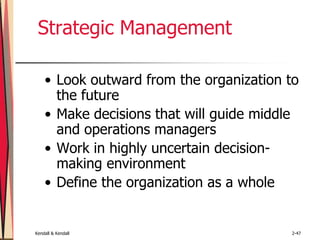
Strategic Management
• Look outward from the organization to
the future
• Make decisions that will guide middle
and operations managers
• Work in highly uncertain decision-
making environment
• Define the organization as a whole
Kendall & Kendall 2-48
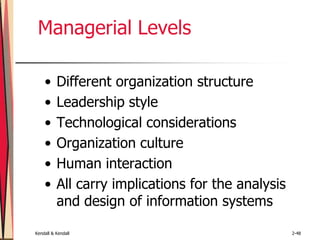
Managerial Levels
• Different organization structure
• Leadership style
• Technological considerations
• Organization culture
• Human interaction
• All carry implications for the analysis
and design of information systems
Kendall & Kendall 2-49
Organizational Culture
• Organizations have cultures and
subcultures
• Learn from verbal and nonverbal
symbolism
Kendall & Kendall 2-50
Verbal Symbolism
• Myths
• Metaphors
• Visions
• Humor
Kendall & Kendall 2-51
Nonverbal Symbolism
• Shared artifacts
• Trophies, etc.
• Rites and rituals
• Promotions
• Birthdays, etc.
• Clothing worn
• Office placement and decorations
Kendall & Kendall 2-52
Summary
• Organizational fundamentals
• Organizations as systems
• Levels of management
• Organizational culture
• Graphical representation of systems
• DFD
• ERD
• Use case diagrams and scenarios
Kendall & Kendall 2-53
Summary (Continued)
• Levels of managerial control
• Operational
• Middle management
• Strategic
• Organizational culture

Kendall7e ch02

  • 1.
    Understanding Organizational Style andIts Impact on Information Systems Systems Analysis and Design, 7e Kendall & Kendall 2 ©2008 Pearson Prentice Hall
  • 2.
    Kendall & Kendall2-2 Learning Objectives • Understand that organizations and their members are systems and that analysts need to take a systems perspective • Depict systems graphically using context-level data flow diagrams, and entity-relationship models, use cases and use case scenarios • Recognize that different levels of management require different systems • Comprehend that organizational culture impacts the design of information systems
  • 3.
    Kendall & Kendall2-3 Three Main Forces Interacting to Shape Organizations • Levels of management • Design of organizations • Organizational cultures
  • 4.
    Kendall & Kendall2-4 Organizations Are Composed of Interrelated Subsystems • Influenced by levels of management decision makers that cut horizontally across the organizational system • Operations • Middle management • Strategic management • Influenced by organizational cultures and subcultures
  • 5.
    Kendall & Kendall2-5 Major Topics • Organizations as systems • Depicting systems graphically • Data flow diagram • Entity-relationship model • Use case modeling • Levels of management • Organizational culture
  • 6.
    Kendall & Kendall2-6 Organizations As Systems • Conceptualized as systems designed to accomplish predetermined goals and objectives • Composed of smaller, interrelated systems serving specialized functions • Specialized functions are reintegrated to form an effective organizational whole
  • 7.
    Kendall & Kendall2-7 Interrelatedness and Independence of Systems • All systems and subsystems are interrelated and interdependent • All systems process inputs from their environments • All systems are contained by boundaries separating them from their environments • System feedback for planning and control • An ideal system self-corrects or self-regulates itself
  • 8.
    Kendall & Kendall2-8 Figure 2.1 System outputs serve as feedback that compares performance with goals
  • 9.
    Kendall & Kendall2-9 Organizational Environments • Community • Physical location • Demographic profile (education, income) • Economic • Market factors • Competition • Political • State and local government
  • 10.
    Kendall & Kendall2-10 Openness and Closedness • Open • Free flow of information • Output from one system becomes input to another • Closed • Restricted access to information • Limited by numerous rules • Information only on a “need to know” basis
  • 11.
    Kendall & Kendall2-11 Virtual Organizations and Virtual Teams • A virtual organization has parts of the organization in different physical locations • Computer networks and communications technology are used to bring virtual teams together to work on projects
  • 12.
    Kendall & Kendall2-12 Benefits of Virtual Organizations and Teams • Possibility of reducing costs of physical facilities • More rapid response to customer needs • Helping virtual employees to fulfill their familial obligations to children or aging parents
  • 13.
    Kendall & Kendall2-13 Taking a Systems Perspective • Allows system analyst to understand businesses before they begin their tasks • It is important that members of subsystems realize that they are interrelated with other subsystems • Problems occur when each manager thinks that his/her department is the most important • Bigger problems may occur when that manager rises through the ranks
  • 14.
    Kendall & Kendall2-14 Taking a Systems Perspective
  • 15.
    Kendall & Kendall2-15 Taking a Systems Perspective
  • 16.
    Kendall & Kendall2-16 Enterprise Resource Planning • Enterprise Resource Planning (ERP) describes an integrated organizational information system • Software that helps the flow of information between the functional areas within the organization
  • 17.
    Kendall & Kendall2-17 Depicting Systems Graphically • Context-level data flow diagrams • Entity-relationship model • Use Case Modeling
  • 18.
    Kendall & Kendall2-18 Context-Level Data Flow Diagrams • Focus is on the data flowing into and out of the system and the processing of the data
  • 19.
    Kendall & Kendall2-19 Figure 2.4 The basic symbols of a data flow diagram
  • 20.
    Kendall & Kendall2-20 Airline Reservation System
  • 21.
    Kendall & Kendall2-21 Entity-Relationship Model • Focus is on the entities and their relationships within the organizational system
  • 22.
    Kendall & Kendall2-22 Relationships • Relationships show how the entities are connected • Three types of relationships • One-to-one • One-to-many • Many-to-many
  • 23.
    Kendall & Kendall2-23 Entity-Relationship Example
  • 24.
    Kendall & Kendall2-24 Figure 2.8 Examples of different types of relationships in E-R diagrams
  • 25.
    Kendall & Kendall2-25 Entities • Fundamental entity • Associative entity • Attributive entity
  • 26.
    Kendall & Kendall2-26 Figure 2.9 Three different types of entities used in E-R diagrams
  • 27.
    Kendall & Kendall2-27 Attributes • Data attributes may be added to the diagram Patron Patron Name Patron address Patron phone Patron credit card
  • 28.
    Kendall & Kendall2-28 Creating Entity-Relationship Diagrams • List the entities in the organization • Choose key entities to narrow the scope of the problem • Identify what the primary entity should be • Confirm the results of the above through data gathering
  • 29.
    Kendall & Kendall2-29 Figure 2-12 A more complete E-R diagram showing data attributes of the entities
  • 30.
    Kendall & Kendall2-30 Use Case Modeling • Describes what a system does without describing how the system does it; that is, it is a logical model of the system
  • 31.
    Kendall & Kendall2-31 Use Case Diagram • Actor • Refers to a particular role of a user of the system • Similar to external entities; they exist outside of the system • Use case symbols • An oval indicating the task of the use case • Connecting lines • Arrows and lines used to diagram behavioral relationships
  • 32.
    Kendall & Kendall2-32 Actor • Divided into two groups • Primary actors • Supply data or receive information from the system • Provide details on what the use case should do • Supporting actors • Help to keep the system running or provide help • The people who run the help desk, the analysts, programmers, and so on
  • 33.
    Kendall & Kendall2-33 A Use Case Always Provides Three Things • An actor that initiates an event • The event that triggers a use case • The use case that performs the actions triggered by the event
  • 34.
    Kendall & Kendall2-34 Use Case Relations • Behavioral relationships • Communicates • Used to connect an actor to a use case • Includes • Describes the situation in which a use case contains behavior that is common to more than one use case
  • 35.
    Kendall & Kendall2-35 Use Case Relations • Behavioral relationships (Continued) • Extends • Describes the situation in which one use case possesses the behavior that allows the new case to handle a variation or exception from the basic use case • Generalizes • Implies that one thing is more typical than the other thing
  • 36.
    Kendall & Kendall2-36 Figure 2.13 Some components of use case diagrams showing actors, use cases, and relationships for a student enrollment example
  • 37.
    Kendall & Kendall2-37 Figure 2.14 Examples of use cases and behavioral relationships for student enrollment
  • 38.
    Kendall & Kendall2-38 Developing Use Case Diagrams • Review the business specifications and identify the actors involved • Identify the high-level events and develop the primary use cases that describe those events and how the actors initiate them • Review each primary use case to determine the possible variations of flow through the use case • The context-level data flow diagram could act as a starting point for creating a use case
  • 39.
    Kendall & Kendall2-39 Figure 2.15 A use case diagram representing a system used to plan a conference
  • 40.
    Kendall & Kendall2-40 Developing the Use Case Scenarios • The description of the use case • Three main areas • Use case identifiers and initiators • Steps performed • Conditions, assumptions, and questions
  • 41.
    Kendall & Kendall2-41 Figure 2.16 A use case scenario is divided into three sections: identification and initiation; steps performed; and conditions, assumptions, and questions
  • 42.
    Kendall & Kendall2-42 Why Use Case Diagrams Are Helpful • Identify all the actors in the problem domain • Actions that need to be completed are also clearly shown on the use case diagram • The use case scenario is also worthwhile • Simplicity and lack of technical detail
  • 43.
    Kendall & Kendall2-43 Figure 2.17 The main reasons for writing use cases are their effectiveness in communicating with users and their capturing of user stories
  • 44.
    Kendall & Kendall2-44 Figure 2.18 Management in organizations exists on three horizontal levels: operational control, managerial planning and control, and strategic management
  • 45.
    Kendall & Kendall2-45 Operations Control • Make decisions using predetermined rules that have predictable outcomes • Oversee the operating details of the organization
  • 46.
    Kendall & Kendall2-46 Managerial Planning and Control • Make short-term planning and control decisions about resources and organizational objectives • Decisions may be partly operational and partly strategic
  • 47.
    Kendall & Kendall2-47 Strategic Management • Look outward from the organization to the future • Make decisions that will guide middle and operations managers • Work in highly uncertain decision- making environment • Define the organization as a whole
  • 48.
    Kendall & Kendall2-48 Managerial Levels • Different organization structure • Leadership style • Technological considerations • Organization culture • Human interaction • All carry implications for the analysis and design of information systems
  • 49.
    Kendall & Kendall2-49 Organizational Culture • Organizations have cultures and subcultures • Learn from verbal and nonverbal symbolism
  • 50.
    Kendall & Kendall2-50 Verbal Symbolism • Myths • Metaphors • Visions • Humor
  • 51.
    Kendall & Kendall2-51 Nonverbal Symbolism • Shared artifacts • Trophies, etc. • Rites and rituals • Promotions • Birthdays, etc. • Clothing worn • Office placement and decorations
  • 52.
    Kendall & Kendall2-52 Summary • Organizational fundamentals • Organizations as systems • Levels of management • Organizational culture • Graphical representation of systems • DFD • ERD • Use case diagrams and scenarios
  • 53.
    Kendall & Kendall2-53 Summary (Continued) • Levels of managerial control • Operational • Middle management • Strategic • Organizational culture