










THE BRAND SEEMS
FAMILIAR ??
OFCOURSE IT DOES…
DOES THIS PRODUCT
SEEM FAMILIAR ??
OFCOURSE IT DOESN’T…
BUT IN ‘UK’ IT DOES…
LET ME TELL YOU
WHY ??
BUT FIRST BEFORE THAT …

SOMETHING ABOUT

KELLOGG’S
 Kellogg is one of the world’s leading Producers
of cereals. It has manufacturing facilities in
more than 18 countries and sells its products
in over 180 countries.
 Kellogg’s offer a range of healthy and nutritious
food Items. It aims to achieve sustainable
growth by focusing on meeting the customer
requirements.
 This can be done by including more products in
the portfolio of the company.
THE CASE
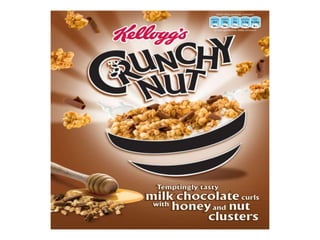
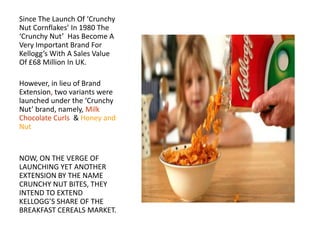
Since The Launch Of ‘Crunchy
Nut Cornflakes’ In 1980 The
‘Crunchy Nut’ Has Become A
Very Important Brand For
Kellogg’s With A Sales Value
Of £68 Million In UK.

However, in lieu of Brand
Extension, two variants were
launched under the ‘Crunchy
Nut’ brand, namely, Milk
Chocolate Curls & Honey and
Nut

NOW, ON THE VERGE OF
LAUNCHING YET ANOTHER
EXTENSION BY THE NAME
CRUNCHY NUT BITES, THEY
INTEND TO EXTEND
KELLOGG’S SHARE OF THE
BREAKFAST CEREALS MARKET.
WHAT DO THEY NEED
TO ACCOMPLISH THAT??
MARKET RESEARCH
Informs businesses about the things consumers need.
 Finds out what consumers are thinking today.

 Can identify what consumers might want in the future.
 Reduces the risks for any NEW PRODUCT DEVELOPMENT (NPD)
 Increases the likelihood that products will be well received by
consumers when they are launched.
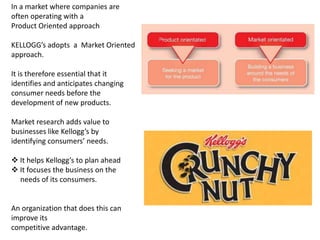
In a market where companies are
often operating with a
Product Oriented approach
KELLOGG’s adopts a Market Oriented
approach.
It is therefore essential that it
identifies and anticipates changing
consumer needs before the
development of new products.
Market research adds value to
businesses like Kellogg’s by
identifying consumers’ needs.
 It helps Kellogg’s to plan ahead
 It focuses the business on the
needs of its consumers.

An organization that does this can
improve its
competitive advantage.
METHODOLOGY
PRIMARY RESEARCH-

• Includes the data collected by interview with customer.
• It prompt consumer reaction to, a new product idea and help
research understand what they think of it, how it makes them feel,
why they find it interesting or not.
• Research use questionnaires administered a large number of

respondents.
SECONDARY RESERCH-

Sources of secondary data includes books, journals, and the internet
and government statistics.
METHODOLOGY
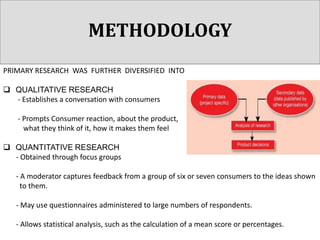
PRIMARY RESEARCH WAS FURTHER DIVERSIFIED INTO
 QUALITATIVE RESEARCH
- Establishes a conversation with consumers
- Prompts Consumer reaction, about the product,
what they think of it, how it makes them feel
 QUANTITATIVE RESEARCH
- Obtained through focus groups
- A moderator captures feedback from a group of six or seven consumers to the ideas shown
to them.
- May use questionnaires administered to large numbers of respondents.
- Allows statistical analysis, such as the calculation of a mean score or percentages.
THE EXECUTION
OF PLAN
STAGE 1 : DISCOVERY
 Aimed at identifying a set of new food ideas suitable for
developing new product.
 Secondary research from Mintel and Datamonitor was used
 Focus groups were used to provide new food ideas in the form
of a number of different (real) food prototypes.
The results allowed Kellogg’s to discard some ideas.
 At the end of this stage, Kellogg’s had a number of new food
ideas that all seemed to appeal to consumers.
STAGE 2
SELECTING THE BEST IDEA
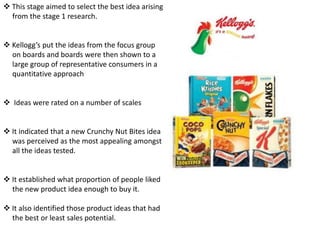
 This stage aimed to select the best idea arising
from the stage 1 research.
 Kellogg’s put the ideas from the focus group
on boards and boards were then shown to a
large group of representative consumers in a
quantitative approach
 Ideas were rated on a number of scales
 It indicated that a new Crunchy Nut Bites idea
was perceived as the most appealing amongst
all the ideas tested.
 It established what proportion of people liked
the new product idea enough to buy it.
 It also identified those product ideas that had
the best or least sales potential.
STAGE 3
CRAFTING IDEA INTO PRODUCT
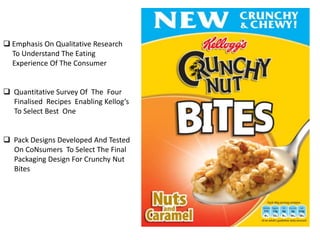
 Emphasis On Qualitative Research
To Understand The Eating
Experience Of The Consumer
 Quantitative Survey Of The Four
Finalised Recipes Enabling Kellog’s
To Select Best One
 Pack Designs Developed And Tested
On CoNsumers To Select The Final
Packaging Design For Crunchy Nut
Bites
STAGE 4
FORCASTING SALES
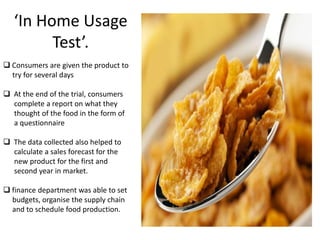
‘In Home Usage
Test’.
 Consumers are given the product to
try for several days
 At the end of the trial, consumers
complete a report on what they
thought of the food in the form of
a questionnaire
 The data collected also helped to
calculate a sales forecast for the
new product for the first and
second year in market.

 finance department was able to set
budgets, organise the supply chain
and to schedule food production.
CONCLUSION
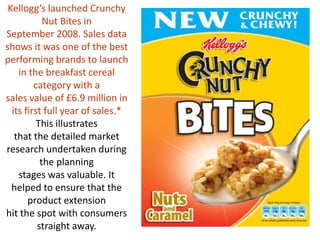
Kellogg’s launched Crunchy
Nut Bites in
September 2008. Sales data
shows it was one of the best
performing brands to launch
in the breakfast cereal
category with a
sales value of £6.9 million in
its first full year of sales.*
This illustrates
that the detailed market
research undertaken during
the planning
stages was valuable. It
helped to ensure that the
product extension
hit the spot with consumers
straight away.
Kellogg's Business Research

Kellogg's Business Research

  • 2.
    THE BRAND SEEMS FAMILIAR?? OFCOURSE IT DOES…
  • 4.
    DOES THIS PRODUCT SEEMFAMILIAR ?? OFCOURSE IT DOESN’T…
  • 5.
    BUT IN ‘UK’IT DOES…
  • 6.
    LET ME TELLYOU WHY ?? BUT FIRST BEFORE THAT … SOMETHING ABOUT KELLOGG’S
  • 7.
     Kellogg isone of the world’s leading Producers of cereals. It has manufacturing facilities in more than 18 countries and sells its products in over 180 countries.  Kellogg’s offer a range of healthy and nutritious food Items. It aims to achieve sustainable growth by focusing on meeting the customer requirements.  This can be done by including more products in the portfolio of the company.
  • 8.
  • 9.
    Since The LaunchOf ‘Crunchy Nut Cornflakes’ In 1980 The ‘Crunchy Nut’ Has Become A Very Important Brand For Kellogg’s With A Sales Value Of £68 Million In UK. However, in lieu of Brand Extension, two variants were launched under the ‘Crunchy Nut’ brand, namely, Milk Chocolate Curls & Honey and Nut NOW, ON THE VERGE OF LAUNCHING YET ANOTHER EXTENSION BY THE NAME CRUNCHY NUT BITES, THEY INTEND TO EXTEND KELLOGG’S SHARE OF THE BREAKFAST CEREALS MARKET.
  • 10.
    WHAT DO THEYNEED TO ACCOMPLISH THAT??
  • 11.
    MARKET RESEARCH Informs businessesabout the things consumers need.  Finds out what consumers are thinking today.  Can identify what consumers might want in the future.  Reduces the risks for any NEW PRODUCT DEVELOPMENT (NPD)  Increases the likelihood that products will be well received by consumers when they are launched.
  • 13.
    In a marketwhere companies are often operating with a Product Oriented approach KELLOGG’s adopts a Market Oriented approach. It is therefore essential that it identifies and anticipates changing consumer needs before the development of new products. Market research adds value to businesses like Kellogg’s by identifying consumers’ needs.  It helps Kellogg’s to plan ahead  It focuses the business on the needs of its consumers. An organization that does this can improve its competitive advantage.
  • 14.
    METHODOLOGY PRIMARY RESEARCH- • Includesthe data collected by interview with customer. • It prompt consumer reaction to, a new product idea and help research understand what they think of it, how it makes them feel, why they find it interesting or not. • Research use questionnaires administered a large number of respondents. SECONDARY RESERCH- Sources of secondary data includes books, journals, and the internet and government statistics.
  • 15.
    METHODOLOGY PRIMARY RESEARCH WASFURTHER DIVERSIFIED INTO  QUALITATIVE RESEARCH - Establishes a conversation with consumers - Prompts Consumer reaction, about the product, what they think of it, how it makes them feel  QUANTITATIVE RESEARCH - Obtained through focus groups - A moderator captures feedback from a group of six or seven consumers to the ideas shown to them. - May use questionnaires administered to large numbers of respondents. - Allows statistical analysis, such as the calculation of a mean score or percentages.
  • 16.
  • 17.
    STAGE 1 :DISCOVERY
  • 18.
     Aimed atidentifying a set of new food ideas suitable for developing new product.  Secondary research from Mintel and Datamonitor was used  Focus groups were used to provide new food ideas in the form of a number of different (real) food prototypes. The results allowed Kellogg’s to discard some ideas.  At the end of this stage, Kellogg’s had a number of new food ideas that all seemed to appeal to consumers.
  • 19.
  • 20.
     This stageaimed to select the best idea arising from the stage 1 research.  Kellogg’s put the ideas from the focus group on boards and boards were then shown to a large group of representative consumers in a quantitative approach  Ideas were rated on a number of scales  It indicated that a new Crunchy Nut Bites idea was perceived as the most appealing amongst all the ideas tested.  It established what proportion of people liked the new product idea enough to buy it.  It also identified those product ideas that had the best or least sales potential.
  • 21.
  • 22.
     Emphasis OnQualitative Research To Understand The Eating Experience Of The Consumer  Quantitative Survey Of The Four Finalised Recipes Enabling Kellog’s To Select Best One  Pack Designs Developed And Tested On CoNsumers To Select The Final Packaging Design For Crunchy Nut Bites
  • 23.
  • 24.
    ‘In Home Usage Test’. Consumers are given the product to try for several days  At the end of the trial, consumers complete a report on what they thought of the food in the form of a questionnaire  The data collected also helped to calculate a sales forecast for the new product for the first and second year in market.  finance department was able to set budgets, organise the supply chain and to schedule food production.
  • 25.
  • 26.
    Kellogg’s launched Crunchy NutBites in September 2008. Sales data shows it was one of the best performing brands to launch in the breakfast cereal category with a sales value of £6.9 million in its first full year of sales.* This illustrates that the detailed market research undertaken during the planning stages was valuable. It helped to ensure that the product extension hit the spot with consumers straight away.