Keeping Them in Stitches
Teaching Stitchery in Elementary Art
Sarah Brooks

Image via flickr user TschiAe
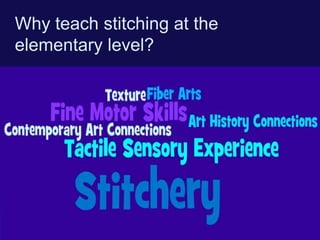
Why teach stitching at the
elementary level?
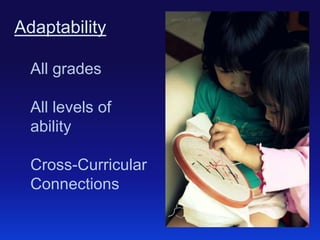
Adaptability
All grades
All levels of
ability
Cross-Curricular
Connections
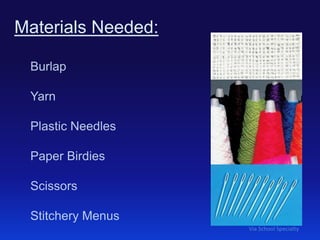
Materials Needed:
Burlap
Yarn
Plastic Needles
Paper Birdies
Scissors
Stitchery Menus
Via School Specialty
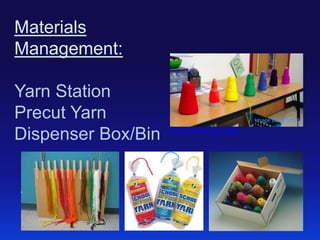
Materials
Management:
Yarn Station
Precut Yarn
Dispenser Box/Bin

Image via ArtofEd

Art of Ed yarn cart video
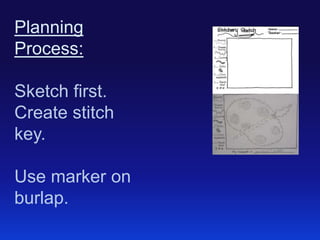
Planning
Process:
Sketch first.
Create stitch
key.
Use marker on
burlap.
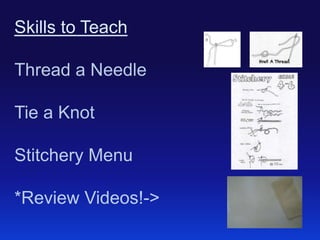
Skills to Teach
Thread a Needle
Tie a Knot
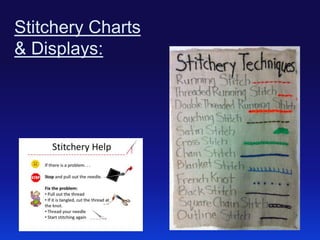
Stitchery Menu

*Review Videos!->
Stitchery Charts
& Displays:
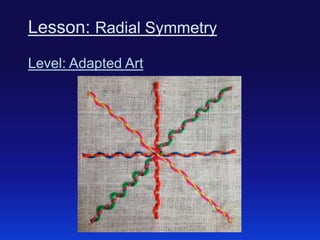
Lesson: Radial Symmetry
Level: Adapted Art
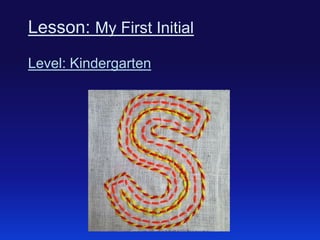
Lesson: My First Initial
Level: Kindergarten
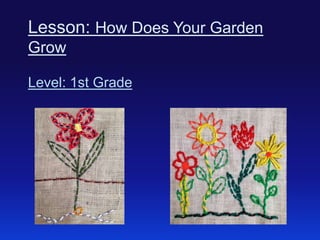
Lesson: How Does Your Garden
Grow
Level: 1st Grade
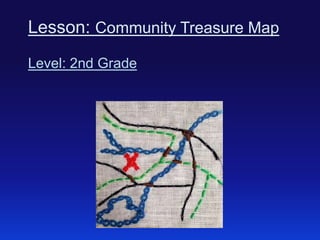
Lesson: Community Treasure Map
Level: 2nd Grade
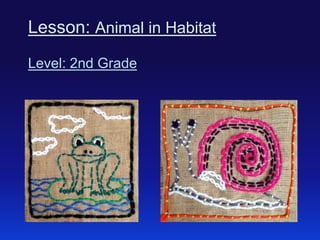
Lesson: Animal in Habitat
Level: 2nd Grade
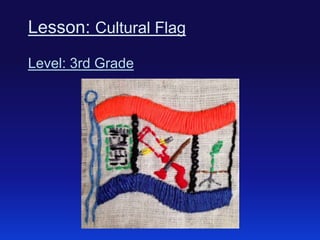
Lesson: Cultural Flag
Level: 3rd Grade
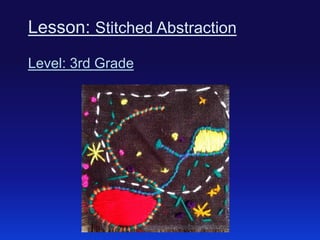
Lesson: Stitched Abstraction
Level: 3rd Grade
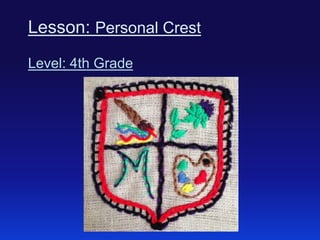
Lesson: Personal Crest
Level: 4th Grade
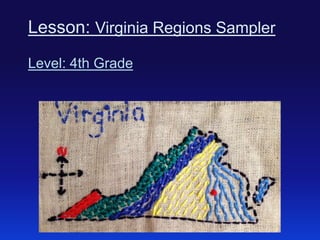
Lesson: Virginia Regions Sampler
Level: 4th Grade
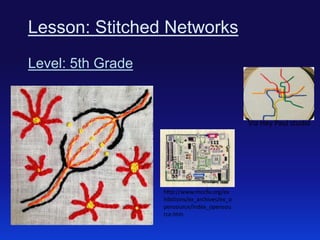
Lesson: Stitched Networks
Level: 5th Grade

Via Hey Paul studio

http://www.mocfa.org/ex
hibitions/ex_archives/ex_o
pensource/index_opensou
rce.htm
Tips & Tricks
Make it fun.
Find a rhythm or pattern.

Use a document camera.
Use class experts/Buddy System.
Ask for help from parent volunteers.
For More Info:
Email:
sdewittbrooks@gmail.com
Blog:
http://wonderbrooks.wordpress.com
Twitter:
@wonderbrooks

Keeping Them in Stitches: Stitchery in Elementary Art

Editor's Notes

  • #3 Fiber Arts-relavant to art history and contemporary craft traditionsExcellent fine motor skill development- students not getting as much fine motor practice- many kinders cant button, or tie shoes- threading, tying knots, and stitching are excellent practice.Two handed activity- coordination requiredVery different sensory experience from painting or clay.
  • #4 Highly adaptable- I teach stitchery to my entire school at the same time. Each year students learn new stitches to add to their repetoire. They are required to learn at least one new grade level stitch, but after that they select which stitches they want to use from past years. Students can continue adding more layers of stitches if they are skilled stitchers,OR they can stick with the basics if necessary.Students can stitch images of anything they are learning about- we make connections to big idea from our art curriculum, but in the past we made connections to science and social studies.
  • #5 Alternate materials can be used- could use canvas, or plastic canvas for students with burlap fiber allergies, Can even stitch on paper with older students- give them watercolor paper with craft foam underneath to pre punch holes for stitching embellishments onto 2d work with a sharper needle.Can stitch using embroider hoop if necessary- but I don’t.
  • #6 Consider how you will disperse materials. It helps to have precut arm-lengths for younger children to cut down one snipping tiny snips and running out frequently, or to avoid tangles. ArtofEd has a great video about using a rubbermaid yarn barn bin- yarn dispenses from the side of the bin. Can set up cones in yarn station, or buy the pricey traitex dispenser boxes once and just order refills each year.
  • #7 Encourage planning process. Create meaningful, individual stitchery design, use a stitch key while sketching, use marker to plan on burlap.Can also paint with tempera paint onto burlap and stitch for embellishment.
  • #10 Stitched with adapted art small group class. Draw one straight line. Choose a color, teachers threaded needles and tied knots. Pinch push pull method worked for them. Stuck with running stitch and threaded. Double threaded and additional lines with those moving faster. Simple symmetrical design, drawn and stitched one line at a time.
  • #11 Prepped burlpa with first initial of each kindergarten child, plus masking tape name and class code on back. Started by teaching threading, tying. See-Say-Do- I show them how first on document camera step by step- just threading. Then I tell them my song-”The bird bites the worm, the worm goes in the ground, the bird flies away-to Hi, Ho, the Dairy-Oh” Then I let them choose a color and try. Work the room checking in until everyone is threaded- encourage buddy helpers!Come back to carpet for next step- tying a not. Worm over snake, worm under snake, hi-ho-the-dairy-oh, we have to pull the pretzel- kids think its ridiculous, but they remember itCheck in around room.Back to carpet for running stitch demo- Pinch-Push-Pull. Stitching on the initial line.Continue by tracing bubble letter around the first letter, and continue stitching. Demonstrate threaded stitches on last day for those that are ready.
  • #12 Science connections- originally stitching seed-roots-stem-leaves-petals at same time as flowering plants science unit.Rewritten to fit with Big Idea-Family. Discuss stitched textiles in our homes, why choose flowers as a design- connections to seasonal changes and enjoying gardens with family year round.Since I teach stitchery to kindergarten, they are ready for the whole garden in first grade. Adapt it- could start with one flower, then add as time allows. Everyone starts with running stitches for all the flowers, continue with threaded stitches as time allows.
  • #13 Discussed art history- stitched map samplers. Encourage students to draw a map of a favorite community location. Use stitch key- different stitches represent different map items.For example: Couching stitch is roads, Double Threaded Running Stitch is rivers or bodies of water, brown satin stitch is bridges, etcConnections between Stitchery, Communtiy, and Social Studies/Geography
  • #14 Stitch animals in habitats- make art historical connections to folk art- Kuna Molas from Panama and Colombia. Could also discuss economic value of molas and stitchery and a wearable art form.
  • #15 Discuss art and americanhistorica connections- flag design, symbolism with color and simple imagery. Design a flag for your own imaginary country- what would be important to you? What would your country value- design and stitch an original flag design using symbolic image and colors.
  • #16 Miro Stitchery- connections to art history and abstraction.
  • #17 Stitch a personal crest- discuss tabards and heraldry- what do the symbols on a coat of arms mean? How can we se stitched symbols to represent our past present and future.
  • #18 Stitched map connections- stitched regions of virginia using stitch key- different stitch for each region.
  • #19 Contemporary art connections- Stitch a network- viewed and discussed contemporary stitchery exemplars and students had to stitch a network that affects us globally (big idea) Stitched maps, digital networks, television, radio, internet, biological networks.