New Zealand food 
Karmel Kull, Isabel Ala-Jyrä
New Zealand cuisine 
The Cuisine of New Zealands is a British-based cuisine, with 
Mediterranean and Pacific Rim influences as the country 
becomes more cosmopolitan. 
Historical influences came from Māori culture. 
New American cuisine, Southeast Asian, East Asian, and South 
Asian culinary traditions have become popular since the 1970s. 
In New Zealand households, dinner (also known as "tea") is the 
main meal of the day, when families gather and share their 
evening together.
Māori cuisine - 1 
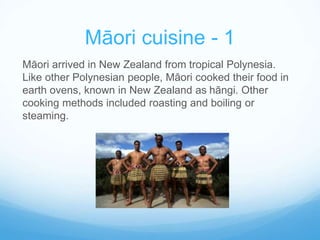
Māori arrived in New Zealand from tropical Polynesia. 
Like other Polynesian people, Māori cooked their food in 
earth ovens, known in New Zealand as hāngi. Other 
cooking methods included roasting and boiling or 
steaming.
Māori cuisine - 2 
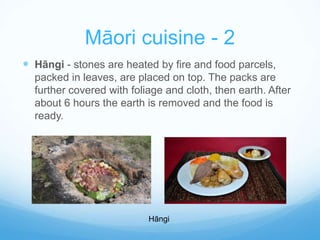
 Hāngi - stones are heated by fire and food parcels, 
packed in leaves, are placed on top. The packs are 
further covered with foliage and cloth, then earth. After 
about 6 hours the earth is removed and the food is 
ready. 
Hāngi
Māori cuisine - 3 
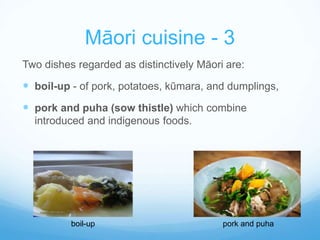
Two dishes regarded as distinctively Māori are: 
 boil-up - of pork, potatoes, kūmara, and dumplings, 
 pork and puha (sow thistle) which combine 
introduced and indigenous foods. 
boil-up pork and puha
Contemporary cuisine- 1 
Contemporary New Zealand food combines its British 
heritages with European, Asian and Pacific influences. 
Most of the home cooking prepared at households is now 
a mix of traditional dishes modified by Mediterranean and 
Asian techniques and ingredients. 
As surrounded by the sea there is fresh seafood year-round 
– mussels, scallops, oysters, whitebait. 
Farming provides – lamb, beef and diary products.
Contemporary cuisine- 2 
 Fish and chips 
 Meat pies 
 Custard Squares 
 Roast lamb with rosemary and seasonal vegetables 
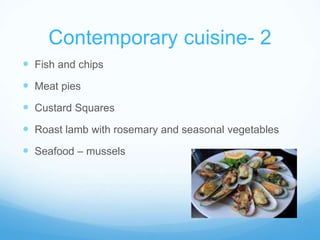
 Seafood – mussels
Contemporary cuisine- 3 
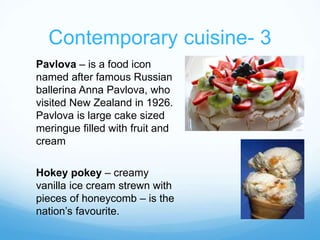
Pavlova – is a food icon 
named after famous Russian 
ballerina Anna Pavlova, who 
visited New Zealand in 1926. 
Pavlova is large cake sized 
meringue filled with fruit and 
cream 
Hokey pokey – creamy 
vanilla ice cream strewn with 
pieces of honeycomb – is the 
nation’s favourite.
Patterns of eating - 1 
 Most New Zealanders eat their main meal – known as 
dinner, or sometimes tea – in the evening. 
 In the summer, the barbecue is common, generally as a 
social event. Guests will usually be invited to bring beer (or 
wine), and on occasion meat, which the host will cook. 
Sometimes guests contribute a salad to the gathering 
instead. It is traditional for the men to cook the meat, and for 
the women to do everything else. 
 Many New Zealand gatherings feature a custom known as 
'bring a plate' or 'potluck' in which each guest will bring a 
plate of food to share.
Patterns of eating - 2 
 Eating out - it is common for people to visit cafes 
regularly for lunch or morning or afternoon snacks. On 
the other hand, visits to restaurants are still regarded 
as special occasion treats for most of the population. 
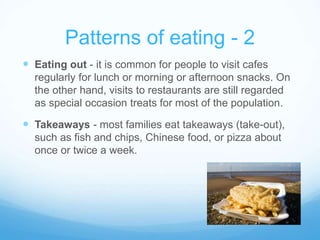
 Takeaways - most families eat takeaways (take-out), 
such as fish and chips, Chinese food, or pizza about 
once or twice a week.
Patterns of eating - 3 
 Fast food - there is a 'fast food' culture similar to that in 
the United States, Australia and Britain. Many American 
fast food chains have a presence in New Zealand. 
 The pie is possibly the nearest thing New Zealand has 
to street food, though its popularity has waned. Pies 
are actually still the most common take away lunch and 
is sold everywhere, dairies, bakeries, supermarkets, 
petrol stations, school lunch tuck-shops. Pies can be 
made with beef, lamb, chicken, pork, apple or custard.

Karmel ja isabel

  • 1.
    New Zealand food Karmel Kull, Isabel Ala-Jyrä
  • 2.
    New Zealand cuisine The Cuisine of New Zealands is a British-based cuisine, with Mediterranean and Pacific Rim influences as the country becomes more cosmopolitan. Historical influences came from Māori culture. New American cuisine, Southeast Asian, East Asian, and South Asian culinary traditions have become popular since the 1970s. In New Zealand households, dinner (also known as "tea") is the main meal of the day, when families gather and share their evening together.
  • 3.
    Māori cuisine -1 Māori arrived in New Zealand from tropical Polynesia. Like other Polynesian people, Māori cooked their food in earth ovens, known in New Zealand as hāngi. Other cooking methods included roasting and boiling or steaming.
  • 4.
    Māori cuisine -2  Hāngi - stones are heated by fire and food parcels, packed in leaves, are placed on top. The packs are further covered with foliage and cloth, then earth. After about 6 hours the earth is removed and the food is ready. Hāngi
  • 5.
    Māori cuisine -3 Two dishes regarded as distinctively Māori are:  boil-up - of pork, potatoes, kūmara, and dumplings,  pork and puha (sow thistle) which combine introduced and indigenous foods. boil-up pork and puha
  • 6.
    Contemporary cuisine- 1 Contemporary New Zealand food combines its British heritages with European, Asian and Pacific influences. Most of the home cooking prepared at households is now a mix of traditional dishes modified by Mediterranean and Asian techniques and ingredients. As surrounded by the sea there is fresh seafood year-round – mussels, scallops, oysters, whitebait. Farming provides – lamb, beef and diary products.
  • 7.
    Contemporary cuisine- 2  Fish and chips  Meat pies  Custard Squares  Roast lamb with rosemary and seasonal vegetables  Seafood – mussels
  • 8.
    Contemporary cuisine- 3 Pavlova – is a food icon named after famous Russian ballerina Anna Pavlova, who visited New Zealand in 1926. Pavlova is large cake sized meringue filled with fruit and cream Hokey pokey – creamy vanilla ice cream strewn with pieces of honeycomb – is the nation’s favourite.
  • 9.
    Patterns of eating- 1  Most New Zealanders eat their main meal – known as dinner, or sometimes tea – in the evening.  In the summer, the barbecue is common, generally as a social event. Guests will usually be invited to bring beer (or wine), and on occasion meat, which the host will cook. Sometimes guests contribute a salad to the gathering instead. It is traditional for the men to cook the meat, and for the women to do everything else.  Many New Zealand gatherings feature a custom known as 'bring a plate' or 'potluck' in which each guest will bring a plate of food to share.
  • 10.
    Patterns of eating- 2  Eating out - it is common for people to visit cafes regularly for lunch or morning or afternoon snacks. On the other hand, visits to restaurants are still regarded as special occasion treats for most of the population.  Takeaways - most families eat takeaways (take-out), such as fish and chips, Chinese food, or pizza about once or twice a week.
  • 11.
    Patterns of eating- 3  Fast food - there is a 'fast food' culture similar to that in the United States, Australia and Britain. Many American fast food chains have a presence in New Zealand.  The pie is possibly the nearest thing New Zealand has to street food, though its popularity has waned. Pies are actually still the most common take away lunch and is sold everywhere, dairies, bakeries, supermarkets, petrol stations, school lunch tuck-shops. Pies can be made with beef, lamb, chicken, pork, apple or custard.