March 21, 2011Copyright 2011: Team TriangleKinect Abnormal Movement Assessment System (KAMAS)Team TriangleClaus C Becker, MSc, PhD, MBA Greg Borenstein, MPS (candidate) Johnny Hujol, MSCS Daniel Karlin, MD, MA Greg Kust, MPH, MBA
March 21, 2011Copyright 2011: Team TriangleExecutive SummaryConceived and developed in 8 hours at Boston Code-a-Thon Symptomatic diseases with excess of movementMicrosoft Kinect-based application to automate assessment Home-grown and integrated open-source codeMultiple stakeholder perspectives (clinicians, payers, patients)Framework for future development
March 21, 2011Copyright 2011: Team TriangleOverview of Movement DisordersFocused on hyperkinetic movement disordersDyskinesias, Choreas, AkathesiasNeurological conditions affecting speed, fluency, and ease of movement; and the ability to stop movementKAMAS matches & complements existing clinical practices for the diagnosis & assessment of movement disorders
March 21, 2011Chorea van Sydenhamhttp://www.youtube.com/watch?v=RsIQFeYOkAg
March 21, 2011Copyright 2011: Team TrianglePrevalence and Severity
March 21, 2011Copyright 2011: Team TriangleProblem in Current PracticeInadequate assessment of movement disorders (AIMS test)StandardizationFrequencyInter-rater reliability poor, masking progression Disease progression, on a more granular & temporal basisCurrent assessment every 3-6 months, at bestGaps between assessments allow development of severe disease Response to therapy (e.g. efficacy, dosing, adverse events)Adherence to therapyRemote monitoring
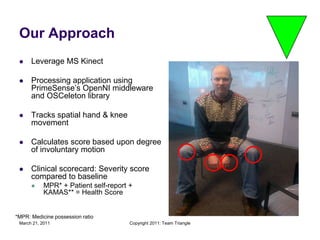
March 21, 2011Copyright 2011: Team TriangleOur ApproachLeverage MS KinectProcessing application using PrimeSense’s OpenNI middleware and OSCeleton library Tracks spatial hand & knee movement Calculates score based upon degree of involuntary motionClinical scorecard: Severity score compared to baselineMPR* + Patient self-report + KAMAS** = Health Score  *MPR: Medicine possession ratio
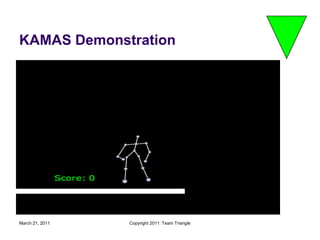
March 21, 2011Copyright 2011: Team TriangleKAMAS Demonstration
March 21, 2011Copyright 2011: Team TriangleClinical Benefits PatientLess disruptive / more convenientEngaged participation and self careImproved careClosed feedback loopsEarlier detection of non-response and disease progressionProviderClinical effectiveness & dose modificationAdherence measures (prescription status)Time efficientReliable, quantifiable scoringEMR integration (video & data)At home or in clinic
March 21, 2011Copyright 2011: Team TrianglePayer BenefitsLess $ waste (quick detection of ineffective therapy) Avoid a lifetime of advanced disease costsReduce risk of expensive side effects and irreversible diseaseReduce hospitalizations and all cause total costs (1)Clinical assessment without an office visitTelemedicine compatibleLow cost, transparent, reproducible, auditableStart-up costs not capital intensive“Efforts to promote medication adherence…may lead to cost savings for managed care systems”31) Delea et al. CNS Drugs. 2011 Jan 1;25(1):53-66,  2) Wei et al. Amer J Ger Pharm.  2010 Aug;8(4):384-394, 3) Davis KL et al. Prevalence and cost of medication nonadherence in Parkinson's disease: evidence from administrative claims data. Mov Disord. 2010 Mar 15;25(4):474-80.
March 21, 2011Copyright 2011: Team TriangleIssues we wrestled withShort timeline (ad hoc project)Kinect development environment rapidly changingInvestment needed to further validate and develop for clinical use
March 21, 2011Copyright 2011: Team TriangleNext StepsWith interest from investors, refine software to include directions, progression measures, and increased range of movementsData archiving and security complianceImprove statistical treatment of dataClinical validation possible at Tufts Medical Center
March 21, 2011Copyright 2011: Team TriangleReferenceshttp://www.neurologychannel.com/movementdisorders/overview-of-movement-disorders.shtmlhttp://www.nlm.nih.gov/medlineplus/movementdisorders.htmlhttp://www.atlantapsychiatry.com/forms/AIMS.pdfhttp://www.webmd.comDelea et al. CNS Drugs. 2011 Jan 1;25(1):53-66,  Wei et al. Amer J Ger Pharm.  2010 Aug;8(4):384-394Davis KL et al. Prevalence and cost of medication nonadherence in Parkinson's disease: evidence from administrative claims data. Mov Disord. 2010 Mar 15;25(4):474-80.Rosenheck, RA.  Evaluating the cost-effectiveness of reduced tardive dyskinesia with secong-generation antipsychotics. B J Psychiatry.  2007 (191): 238-245.

KAMAS Health 2.0 Presentation

  • 1.
    March 21, 2011Copyright2011: Team TriangleKinect Abnormal Movement Assessment System (KAMAS)Team TriangleClaus C Becker, MSc, PhD, MBA Greg Borenstein, MPS (candidate) Johnny Hujol, MSCS Daniel Karlin, MD, MA Greg Kust, MPH, MBA
  • 2.
    March 21, 2011Copyright2011: Team TriangleExecutive SummaryConceived and developed in 8 hours at Boston Code-a-Thon Symptomatic diseases with excess of movementMicrosoft Kinect-based application to automate assessment Home-grown and integrated open-source codeMultiple stakeholder perspectives (clinicians, payers, patients)Framework for future development
  • 3.
    March 21, 2011Copyright2011: Team TriangleOverview of Movement DisordersFocused on hyperkinetic movement disordersDyskinesias, Choreas, AkathesiasNeurological conditions affecting speed, fluency, and ease of movement; and the ability to stop movementKAMAS matches & complements existing clinical practices for the diagnosis & assessment of movement disorders
  • 4.
    March 21, 2011Choreavan Sydenhamhttp://www.youtube.com/watch?v=RsIQFeYOkAg
  • 5.
    March 21, 2011Copyright2011: Team TrianglePrevalence and Severity
  • 6.
    March 21, 2011Copyright2011: Team TriangleProblem in Current PracticeInadequate assessment of movement disorders (AIMS test)StandardizationFrequencyInter-rater reliability poor, masking progression Disease progression, on a more granular & temporal basisCurrent assessment every 3-6 months, at bestGaps between assessments allow development of severe disease Response to therapy (e.g. efficacy, dosing, adverse events)Adherence to therapyRemote monitoring
  • 7.
    March 21, 2011Copyright2011: Team TriangleOur ApproachLeverage MS KinectProcessing application using PrimeSense’s OpenNI middleware and OSCeleton library Tracks spatial hand & knee movement Calculates score based upon degree of involuntary motionClinical scorecard: Severity score compared to baselineMPR* + Patient self-report + KAMAS** = Health Score *MPR: Medicine possession ratio
  • 8.
    March 21, 2011Copyright2011: Team TriangleKAMAS Demonstration
  • 9.
    March 21, 2011Copyright2011: Team TriangleClinical Benefits PatientLess disruptive / more convenientEngaged participation and self careImproved careClosed feedback loopsEarlier detection of non-response and disease progressionProviderClinical effectiveness & dose modificationAdherence measures (prescription status)Time efficientReliable, quantifiable scoringEMR integration (video & data)At home or in clinic
  • 10.
    March 21, 2011Copyright2011: Team TrianglePayer BenefitsLess $ waste (quick detection of ineffective therapy) Avoid a lifetime of advanced disease costsReduce risk of expensive side effects and irreversible diseaseReduce hospitalizations and all cause total costs (1)Clinical assessment without an office visitTelemedicine compatibleLow cost, transparent, reproducible, auditableStart-up costs not capital intensive“Efforts to promote medication adherence…may lead to cost savings for managed care systems”31) Delea et al. CNS Drugs. 2011 Jan 1;25(1):53-66, 2) Wei et al. Amer J Ger Pharm. 2010 Aug;8(4):384-394, 3) Davis KL et al. Prevalence and cost of medication nonadherence in Parkinson's disease: evidence from administrative claims data. Mov Disord. 2010 Mar 15;25(4):474-80.
  • 11.
    March 21, 2011Copyright2011: Team TriangleIssues we wrestled withShort timeline (ad hoc project)Kinect development environment rapidly changingInvestment needed to further validate and develop for clinical use
  • 12.
    March 21, 2011Copyright2011: Team TriangleNext StepsWith interest from investors, refine software to include directions, progression measures, and increased range of movementsData archiving and security complianceImprove statistical treatment of dataClinical validation possible at Tufts Medical Center
  • 13.
    March 21, 2011Copyright2011: Team TriangleReferenceshttp://www.neurologychannel.com/movementdisorders/overview-of-movement-disorders.shtmlhttp://www.nlm.nih.gov/medlineplus/movementdisorders.htmlhttp://www.atlantapsychiatry.com/forms/AIMS.pdfhttp://www.webmd.comDelea et al. CNS Drugs. 2011 Jan 1;25(1):53-66, Wei et al. Amer J Ger Pharm. 2010 Aug;8(4):384-394Davis KL et al. Prevalence and cost of medication nonadherence in Parkinson's disease: evidence from administrative claims data. Mov Disord. 2010 Mar 15;25(4):474-80.Rosenheck, RA. Evaluating the cost-effectiveness of reduced tardive dyskinesia with secong-generation antipsychotics. B J Psychiatry. 2007 (191): 238-245.