Kalihi Neighborhood
Transit-Oriented Development Plan


Community Survey
EXECUTIVE SUMMARY
October 2011


      Department of
      Planning & Permitting
City and County of Honolulu       Kalihi Community Survey – Executive Summary


Survey Background 
Survey Purpose
The Department of Planning and Permitting (DPP) of the City and County of Honolulu sought to capture
the perspectives of residents living near the three planned Kalihi rail transit stations. National Research
Center, Inc. (NRC) assisted the City in conducting a survey to assess residents’ perceptions about their
neighborhood and opinions about potential transit-oriented development opportunities in these areas.
The results of the survey, combined with other sources of community input, will help the DPP make
plans to guide future public investment and development around the rail stations.

Survey Methods                                    

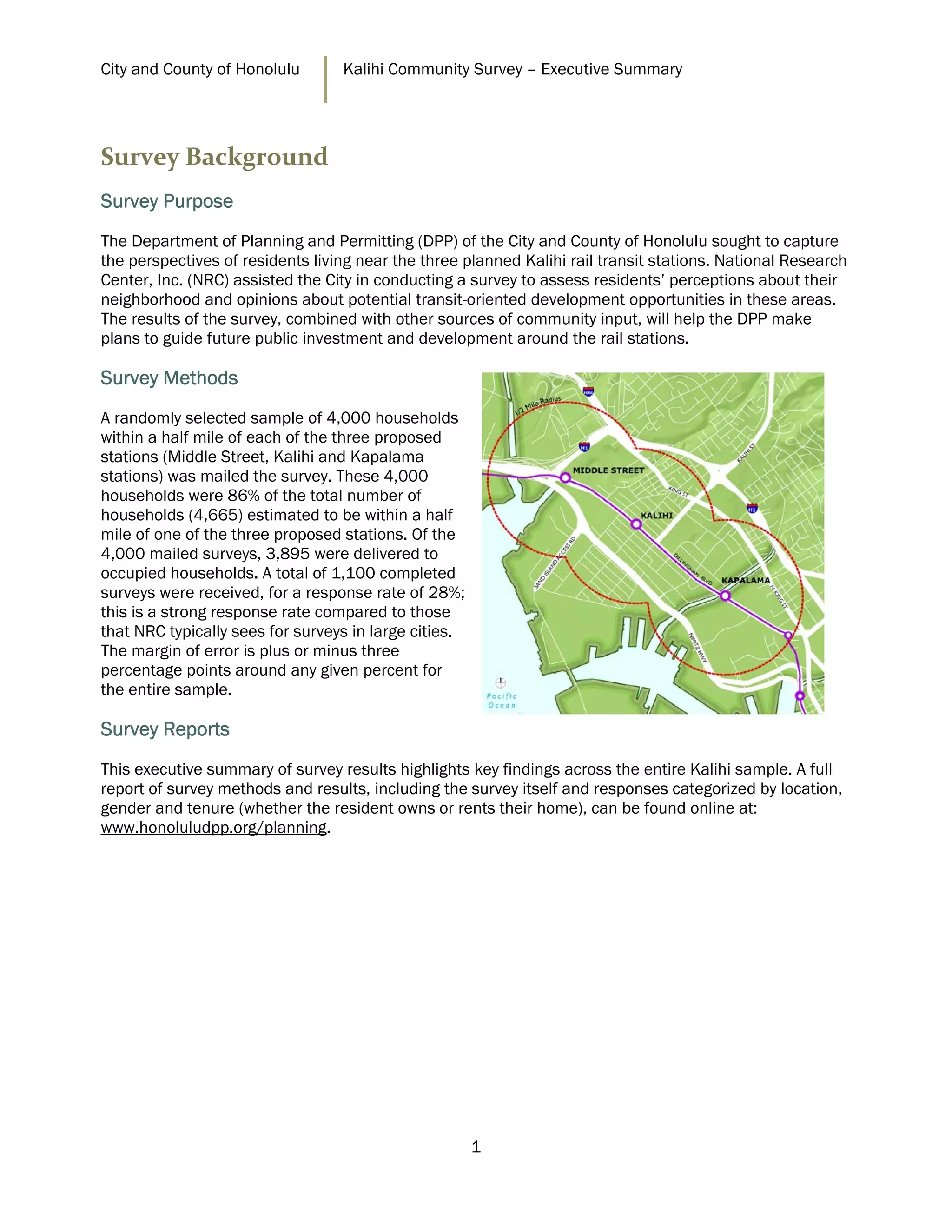
A randomly selected sample of 4,000 households
within a half mile of each of the three proposed
stations (Middle Street, Kalihi and Kapalama
stations) was mailed the survey. These 4,000
households were 86% of the total number of
households (4,665) estimated to be within a half
mile of one of the three proposed stations. Of the
4,000 mailed surveys, 3,895 were delivered to
occupied households. A total of 1,100 completed
surveys were received, for a response rate of 28%;
this is a strong response rate compared to those
that NRC typically sees for surveys in large cities.
The margin of error is plus or minus three
percentage points around any given percent for
the entire sample.

Survey Reports
This executive summary of survey results highlights key findings across the entire Kalihi sample. A full
report of survey methods and results, including the survey itself and responses categorized by location,
gender and tenure (whether the resident owns or rents their home), can be found online at:
www.honoluludpp.org/planning.


                                                       1
City and County of Honolulu             Kalihi Community Survey – Executive Summary


Survey Findings 
 
Neighborhood Values

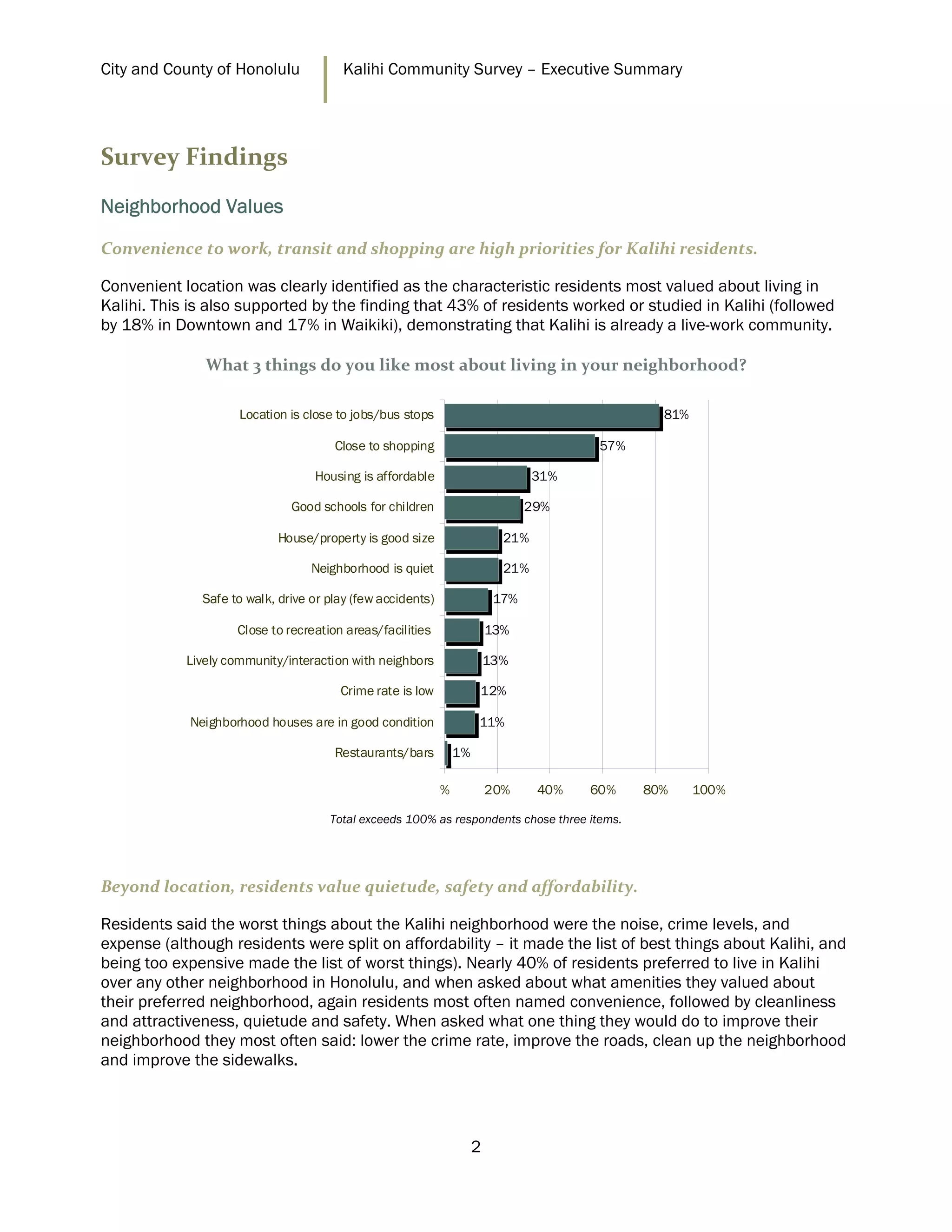
Convenience to work, transit and shopping are high priorities for Kalihi residents. 

Convenient location was clearly identified as the characteristic residents most valued about living in
Kalihi. This is also supported by the finding that 43% of residents worked or studied in Kalihi (followed
by 18% in Downtown and 17% in Waikiki), demonstrating that Kalihi is already a live-work community.

               What 3 things do you like most about living in your neighborhood? 

                     Location is close to jobs/bus stops                                        81%

                                      Close to shopping                                 57%

                                  Housing is affordable                          31%

                              Good schools for children                         29%

                            House/property is good size                    21%

                                  Neighborhood is quiet                    21%

              Safe to walk, drive or play (few accidents)                 17%

                    Close to recreation areas/facilities                 13%

            Lively community/interaction with neighbors                  13%

                                       Crime rate is low             12%

            Neighborhood houses are in good condition                11%

                                      Restaurants/bars          1%

                                                            %            20%     40%   60%    80%     100%

                                     Total exceeds 100% as respondents chose three items.


Beyond location, residents value quietude, safety and affordability. 

Residents said the worst things about the Kalihi neighborhood were the noise, crime levels, and
expense (although residents were split on affordability – it made the list of best things about Kalihi, and
being too expensive made the list of worst things). Nearly 40% of residents preferred to live in Kalihi
over any other neighborhood in Honolulu, and when asked about what amenities they valued about
their preferred neighborhood, again residents most often named convenience, followed by cleanliness
and attractiveness, quietude and safety. When asked what one thing they would do to improve their
neighborhood they most often said: lower the crime rate, improve the roads, clean up the neighborhood
and improve the sidewalks.


                                                                     2
City and County of Honolulu       Kalihi Community Survey – Executive Summary


Resident Mobility

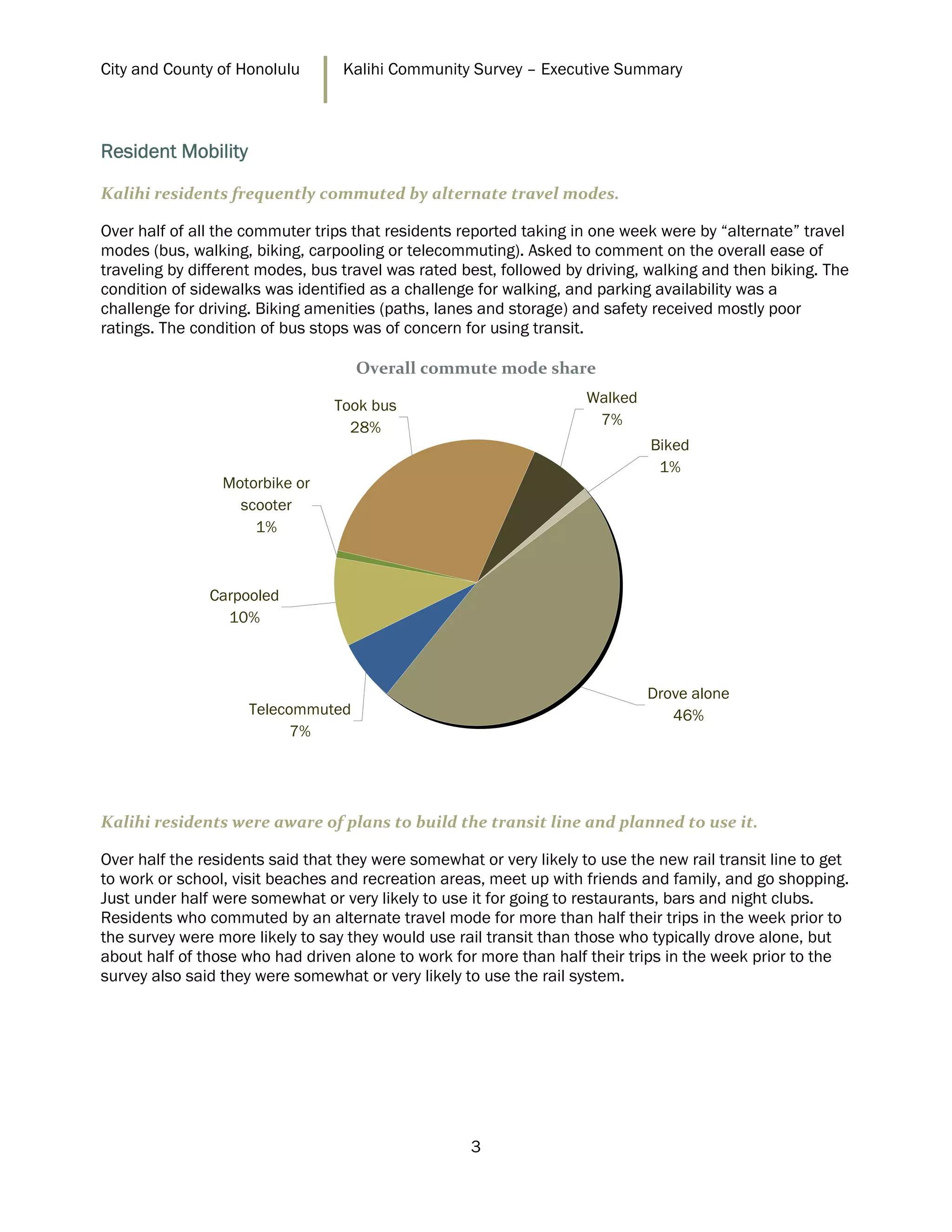
Kalihi residents frequently commuted by alternate travel modes. 

Over half of all the commuter trips that residents reported taking in one week were by “alternate” travel
modes (bus, walking, biking, carpooling or telecommuting). Asked to comment on the overall ease of
traveling by different modes, bus travel was rated best, followed by driving, walking and then biking. The
condition of sidewalks was identified as a challenge for walking, and parking availability was a
challenge for driving. Biking amenities (paths, lanes and storage) and safety received mostly poor
ratings. The condition of bus stops was of concern for using transit.

                                    Overall commute mode share  

                                 Took bus                            Walked
                                   28%                                7%
                                                                              Biked
                                                                               1%
                 Motorbike or
                   scooter
                     1%


               Carpooled
                 10%


                                                                              Drove alone
                     Telecommuted                                                46%
                           7%


Kalihi residents were aware of plans to build the transit line and planned to use it. 

Over half the residents said that they were somewhat or very likely to use the new rail transit line to get
to work or school, visit beaches and recreation areas, meet up with friends and family, and go shopping.
Just under half were somewhat or very likely to use it for going to restaurants, bars and night clubs.
Residents who commuted by an alternate travel mode for more than half their trips in the week prior to
the survey were more likely to say they would use rail transit than those who typically drove alone, but
about half of those who had driven alone to work for more than half their trips in the week prior to the
survey also said they were somewhat or very likely to use the rail system.


                                                    3
City and County of Honolulu          Kalihi Community Survey – Executive Summary


Community Amenities

Recreational amenities are valued but could use improvement. 

Just under half of residents in the Kalihi neighborhood used parks a few times a month or more
frequently. While most residents said they felt safe in parks during the day, few felt safe at night or
when homeless people were present. And despite that the majority rated their quality as fair or poor,
parks and landscapes were identified as the most important neighborhood landmarks to preserve—
followed by schools, local retail and markets, and the Bishop Museum.

Family entertainment businesses were the most lacking in the Kalihi neighborhood. 

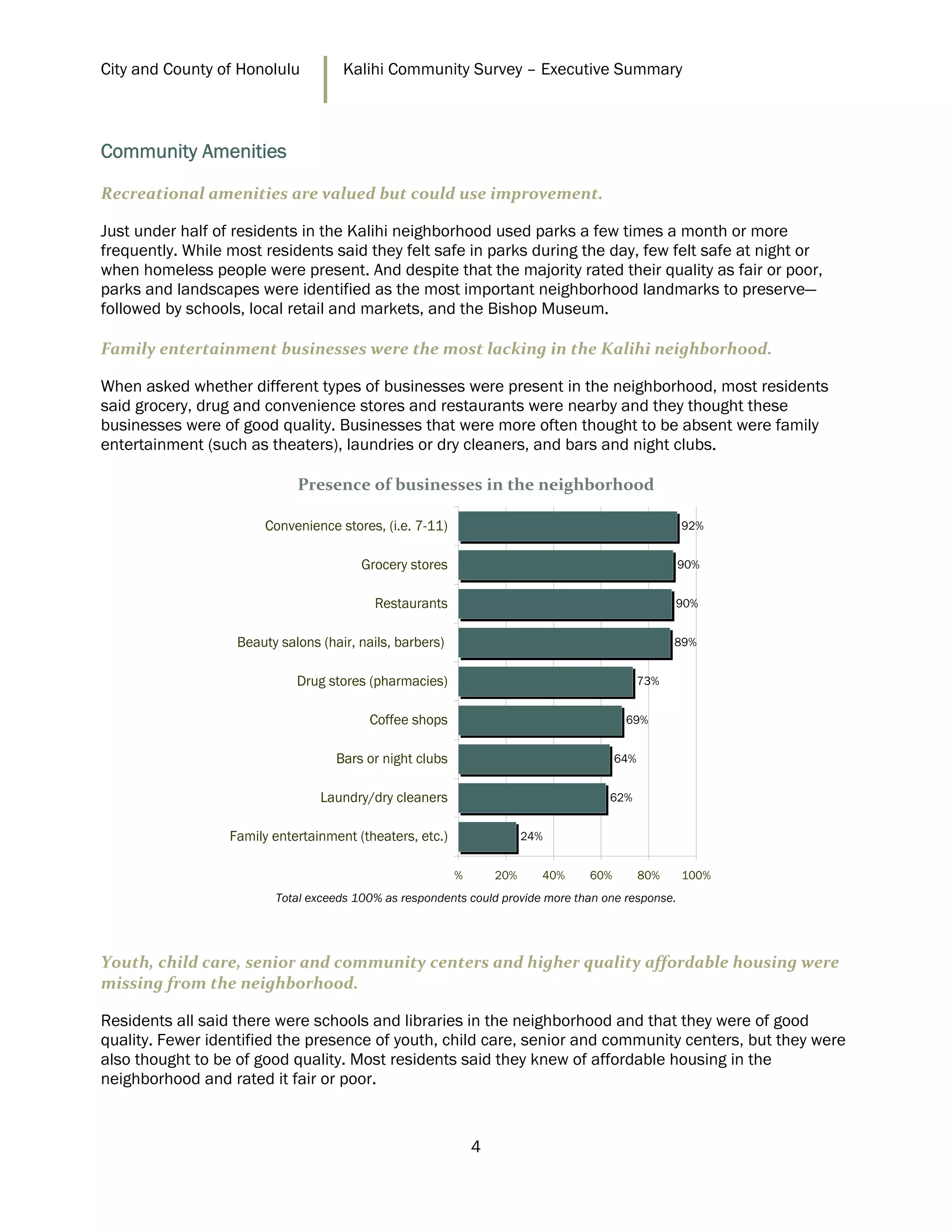
When asked whether different types of businesses were present in the neighborhood, most residents
said grocery, drug and convenience stores and restaurants were nearby and they thought these
businesses were of good quality. Businesses that were more often thought to be absent were family
entertainment (such as theaters), laundries or dry cleaners, and bars and night clubs.

                             Presence of businesses in the neighborhood 

                        Convenience stores, (i.e. 7-11)                                            92%


                                        Grocery stores                                             90%


                                          Restaurants                                             90%


                   Beauty salons (hair, nails, barbers)                                           89%


                             Drug stores (pharmacies)                                       73%


                                          Coffee shops                                 69%


                                    Bars or night clubs                               64%


                                 Laundry/dry cleaners                               62%


                  Family entertainment (theaters, etc.)                 24%


                                                          %       20%     40%   60%         80%    100%
                         Total exceeds 100% as respondents could provide more than one response.


Youth, child care, senior and community centers and higher quality affordable housing were 
missing from the neighborhood.  

Residents all said there were schools and libraries in the neighborhood and that they were of good
quality. Fewer identified the presence of youth, child care, senior and community centers, but they were
also thought to be of good quality. Most residents said they knew of affordable housing in the
neighborhood and rated it fair or poor.


                                                              4
City and County of Honolulu        Kalihi Community Survey – Executive Summary


Development Opportunities

Sidewalks and streetscapes were a top priority for transit‐oriented development. 

While there was relatively strong support for most development possibilities near the proposed rail
stations and along major streets in Kalihi (for new retail, residences and services), improving the
streetscape (e.g. adding places to sit, landscaping, and bus shelters) received the strongest support.
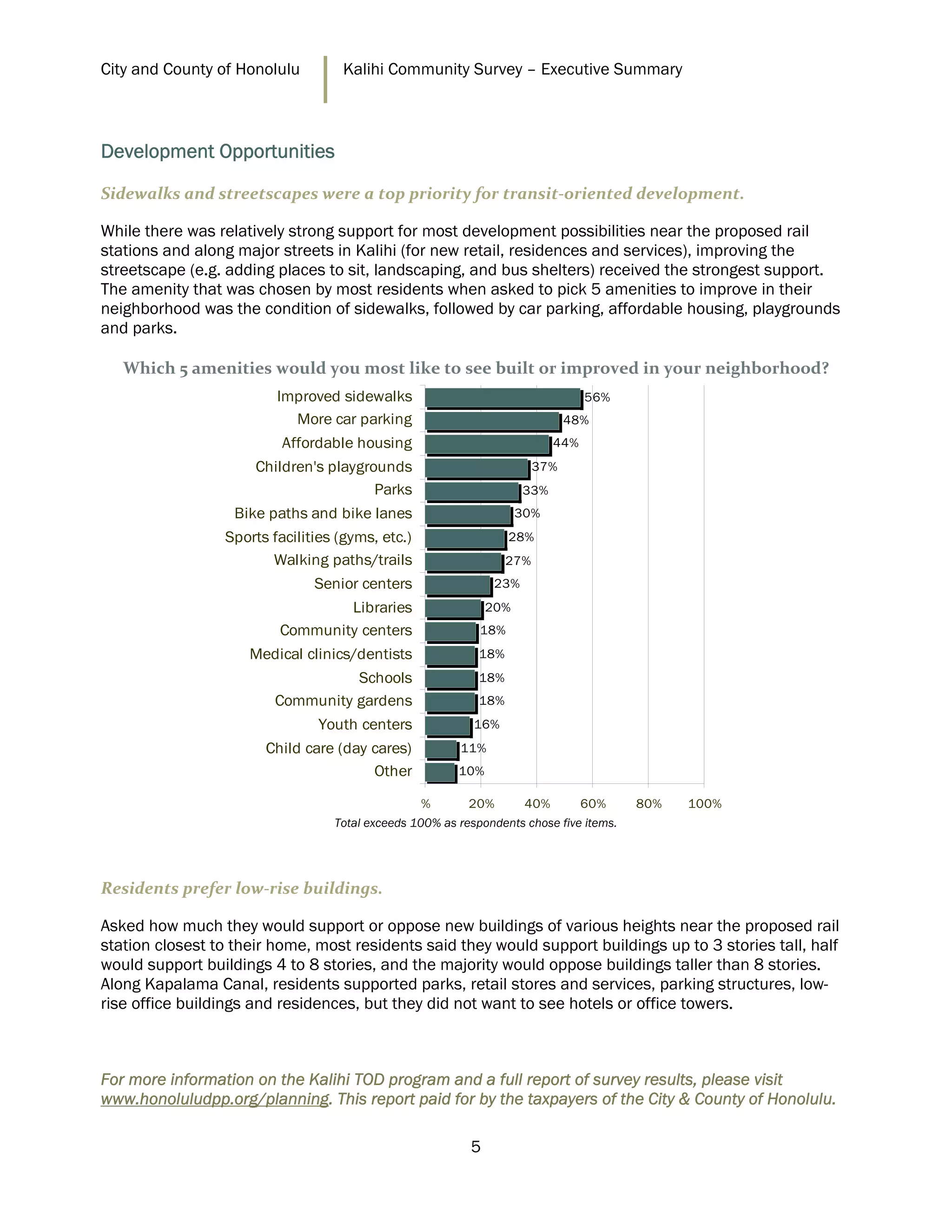
The amenity that was chosen by most residents when asked to pick 5 amenities to improve in their
neighborhood was the condition of sidewalks, followed by car parking, affordable housing, playgrounds
and parks.

    Which 5 amenities would you most like to see built or improved in your neighborhood? 
                         Improved sidewalks                                      56%
                           More car parking                                   48%
                          Affordable housing                               44%
                      Children's playgrounds                            37%
                                        Parks                        33%
                   Bike paths and bike lanes                        30%
                 Sports facilities (gyms, etc.)                   28%
                        Walking paths/trails                      27%
                               Senior centers                  23%
                                 Libraries                    20%
                         Community centers                  18%
                     Medical clinics/dentists               18%
                                  Schools                   18%
                        Community gardens                   18%
                               Youth centers               16%
                       Child care (day cares)           11%
                                       Other            10%

                                                  %       20%        40%         60%    80%   100%
                                  Total exceeds 100% as respondents chose five items.


Residents prefer low‐rise buildings.  

Asked how much they would support or oppose new buildings of various heights near the proposed rail
station closest to their home, most residents said they would support buildings up to 3 stories tall, half
would support buildings 4 to 8 stories, and the majority would oppose buildings taller than 8 stories.
Along Kapalama Canal, residents supported parks, retail stores and services, parking structures, low-
rise office buildings and residences, but they did not want to see hotels or office towers.


For more information on the Kalihi TOD program and a full report of survey results, please visit
www.honoluludpp.org/planning. This report paid for by the taxpayers of the City & County of Honolulu.

                                                          5

Kalihi exec summary

  • 1.
    Kalihi Neighborhood Transit-Oriented DevelopmentPlan Community Survey EXECUTIVE SUMMARY October 2011 Department of Planning & Permitting
  • 2.
    City and Countyof Honolulu Kalihi Community Survey – Executive Summary Survey Background  Survey Purpose The Department of Planning and Permitting (DPP) of the City and County of Honolulu sought to capture the perspectives of residents living near the three planned Kalihi rail transit stations. National Research Center, Inc. (NRC) assisted the City in conducting a survey to assess residents’ perceptions about their neighborhood and opinions about potential transit-oriented development opportunities in these areas. The results of the survey, combined with other sources of community input, will help the DPP make plans to guide future public investment and development around the rail stations. Survey Methods   A randomly selected sample of 4,000 households within a half mile of each of the three proposed stations (Middle Street, Kalihi and Kapalama stations) was mailed the survey. These 4,000 households were 86% of the total number of households (4,665) estimated to be within a half mile of one of the three proposed stations. Of the 4,000 mailed surveys, 3,895 were delivered to occupied households. A total of 1,100 completed surveys were received, for a response rate of 28%; this is a strong response rate compared to those that NRC typically sees for surveys in large cities. The margin of error is plus or minus three percentage points around any given percent for the entire sample. Survey Reports This executive summary of survey results highlights key findings across the entire Kalihi sample. A full report of survey methods and results, including the survey itself and responses categorized by location, gender and tenure (whether the resident owns or rents their home), can be found online at: www.honoluludpp.org/planning. 1
  • 3.
    City and Countyof Honolulu Kalihi Community Survey – Executive Summary Survey Findings    Neighborhood Values Convenience to work, transit and shopping are high priorities for Kalihi residents.  Convenient location was clearly identified as the characteristic residents most valued about living in Kalihi. This is also supported by the finding that 43% of residents worked or studied in Kalihi (followed by 18% in Downtown and 17% in Waikiki), demonstrating that Kalihi is already a live-work community. What 3 things do you like most about living in your neighborhood?  Location is close to jobs/bus stops 81% Close to shopping 57% Housing is affordable 31% Good schools for children 29% House/property is good size 21% Neighborhood is quiet 21% Safe to walk, drive or play (few accidents) 17% Close to recreation areas/facilities 13% Lively community/interaction with neighbors 13% Crime rate is low 12% Neighborhood houses are in good condition 11% Restaurants/bars 1% % 20% 40% 60% 80% 100% Total exceeds 100% as respondents chose three items.   Beyond location, residents value quietude, safety and affordability.  Residents said the worst things about the Kalihi neighborhood were the noise, crime levels, and expense (although residents were split on affordability – it made the list of best things about Kalihi, and being too expensive made the list of worst things). Nearly 40% of residents preferred to live in Kalihi over any other neighborhood in Honolulu, and when asked about what amenities they valued about their preferred neighborhood, again residents most often named convenience, followed by cleanliness and attractiveness, quietude and safety. When asked what one thing they would do to improve their neighborhood they most often said: lower the crime rate, improve the roads, clean up the neighborhood and improve the sidewalks. 2
  • 4.
    City and Countyof Honolulu Kalihi Community Survey – Executive Summary Resident Mobility Kalihi residents frequently commuted by alternate travel modes.  Over half of all the commuter trips that residents reported taking in one week were by “alternate” travel modes (bus, walking, biking, carpooling or telecommuting). Asked to comment on the overall ease of traveling by different modes, bus travel was rated best, followed by driving, walking and then biking. The condition of sidewalks was identified as a challenge for walking, and parking availability was a challenge for driving. Biking amenities (paths, lanes and storage) and safety received mostly poor ratings. The condition of bus stops was of concern for using transit. Overall commute mode share   Took bus Walked 28% 7% Biked 1% Motorbike or scooter 1% Carpooled 10% Drove alone Telecommuted 46% 7% Kalihi residents were aware of plans to build the transit line and planned to use it.  Over half the residents said that they were somewhat or very likely to use the new rail transit line to get to work or school, visit beaches and recreation areas, meet up with friends and family, and go shopping. Just under half were somewhat or very likely to use it for going to restaurants, bars and night clubs. Residents who commuted by an alternate travel mode for more than half their trips in the week prior to the survey were more likely to say they would use rail transit than those who typically drove alone, but about half of those who had driven alone to work for more than half their trips in the week prior to the survey also said they were somewhat or very likely to use the rail system. 3
  • 5.
    City and Countyof Honolulu Kalihi Community Survey – Executive Summary Community Amenities Recreational amenities are valued but could use improvement.  Just under half of residents in the Kalihi neighborhood used parks a few times a month or more frequently. While most residents said they felt safe in parks during the day, few felt safe at night or when homeless people were present. And despite that the majority rated their quality as fair or poor, parks and landscapes were identified as the most important neighborhood landmarks to preserve— followed by schools, local retail and markets, and the Bishop Museum. Family entertainment businesses were the most lacking in the Kalihi neighborhood.  When asked whether different types of businesses were present in the neighborhood, most residents said grocery, drug and convenience stores and restaurants were nearby and they thought these businesses were of good quality. Businesses that were more often thought to be absent were family entertainment (such as theaters), laundries or dry cleaners, and bars and night clubs. Presence of businesses in the neighborhood  Convenience stores, (i.e. 7-11) 92% Grocery stores 90% Restaurants 90% Beauty salons (hair, nails, barbers) 89% Drug stores (pharmacies) 73% Coffee shops 69% Bars or night clubs 64% Laundry/dry cleaners 62% Family entertainment (theaters, etc.) 24% % 20% 40% 60% 80% 100% Total exceeds 100% as respondents could provide more than one response.   Youth, child care, senior and community centers and higher quality affordable housing were  missing from the neighborhood.   Residents all said there were schools and libraries in the neighborhood and that they were of good quality. Fewer identified the presence of youth, child care, senior and community centers, but they were also thought to be of good quality. Most residents said they knew of affordable housing in the neighborhood and rated it fair or poor. 4
  • 6.
    City and Countyof Honolulu Kalihi Community Survey – Executive Summary Development Opportunities Sidewalks and streetscapes were a top priority for transit‐oriented development.  While there was relatively strong support for most development possibilities near the proposed rail stations and along major streets in Kalihi (for new retail, residences and services), improving the streetscape (e.g. adding places to sit, landscaping, and bus shelters) received the strongest support. The amenity that was chosen by most residents when asked to pick 5 amenities to improve in their neighborhood was the condition of sidewalks, followed by car parking, affordable housing, playgrounds and parks. Which 5 amenities would you most like to see built or improved in your neighborhood?  Improved sidewalks 56% More car parking 48% Affordable housing 44% Children's playgrounds 37% Parks 33% Bike paths and bike lanes 30% Sports facilities (gyms, etc.) 28% Walking paths/trails 27% Senior centers 23% Libraries 20% Community centers 18% Medical clinics/dentists 18% Schools 18% Community gardens 18% Youth centers 16% Child care (day cares) 11% Other 10% % 20% 40% 60% 80% 100% Total exceeds 100% as respondents chose five items.   Residents prefer low‐rise buildings.   Asked how much they would support or oppose new buildings of various heights near the proposed rail station closest to their home, most residents said they would support buildings up to 3 stories tall, half would support buildings 4 to 8 stories, and the majority would oppose buildings taller than 8 stories. Along Kapalama Canal, residents supported parks, retail stores and services, parking structures, low- rise office buildings and residences, but they did not want to see hotels or office towers. For more information on the Kalihi TOD program and a full report of survey results, please visit www.honoluludpp.org/planning. This report paid for by the taxpayers of the City & County of Honolulu. 5