ST. CATHERINE'S
DAY OR
KADRIPÄEV

Kohtla-Järve Järve Vene Gümnasium
2014
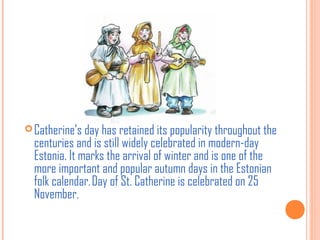
 Catherine’s day has retained its popularity throughout the

centuries and is still widely celebrated in modern-day
Estonia. It marks the arrival of winter and is one of the
more important and popular autumn days in the Estonian
folk calendar. Day of St. Catherine is celebrated on 25
November.
HISTORICAL MEANING OF KADRIPÄEV 
 St. Catherine’s Day commemorates the martyrdom of

St. Catherine. In Lutheran countries, including Estonia,
this day has also been associated with Catherine, the
wife of Martin Luther. In Estonia, five parish churches
and at least as many chapels have been dedicated to
St. Catherine.
 Similar to St. Martin's day on November 10, St. Catherine’s

day also marks the arrival of winter. Generally, St. Martin’s
day and St. Catherine’s day are described by their
differences: St. Martin’s day is primarily a holiday associated
with men and St. Catherine’s day is associated with women.
CUSTOM


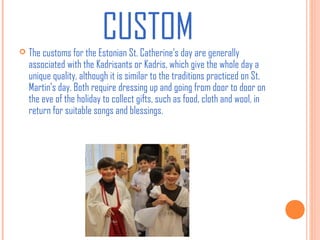
The customs for the Estonian St. Catherine’s day are generally
associated with the Kadrisants or Kadris, which give the whole day a
unique quality, although it is similar to the traditions practiced on St.
Martin’s day. Both require dressing up and going from door to door on
the eve of the holiday to collect gifts, such as food, cloth and wool, in
return for suitable songs and blessings.
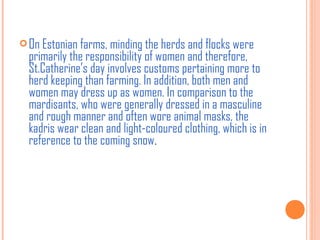
 On Estonian farms, minding the herds and flocks were

primarily the responsibility of women and therefore,
St.Catherine’s day involves customs pertaining more to
herd keeping than farming. In addition, both men and
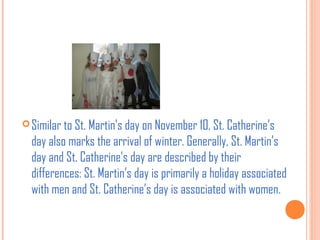
women may dress up as women. In comparison to the
mardisants, who were generally dressed in a masculine
and rough manner and often wore animal masks, the
kadris wear clean and light-coloured clothing, which is in
reference to the coming snow. 
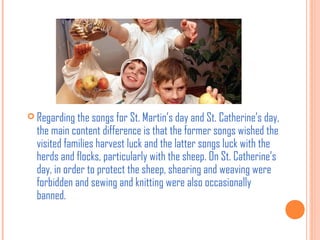
 Regarding the songs for St. Martin’s day and St. Catherine’s day,

the main content difference is that the former songs wished the
visited families harvest luck and the latter songs luck with the
herds and flocks, particularly with the sheep. On St. Catherine’s
day, in order to protect the sheep, shearing and weaving were
forbidden and sewing and knitting were also occasionally
banned.
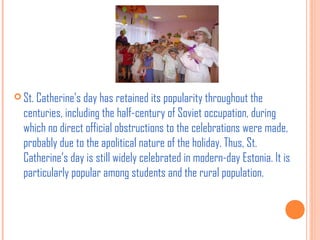
 St. Catherine’s day has retained its popularity throughout the

centuries, including the half-century of Soviet occupation, during
which no direct official obstructions to the celebrations were made,
probably due to the apolitical nature of the holiday. Thus, St.
Catherine’s day is still widely celebrated in modern-day Estonia. It is
particularly popular among students and the rural population.
SOURCE


http://www.vm.ee/?q=node/8449/4281
THANKS FOR
ATTENTION!

KADRIPÄEV

  • 1.
  • 2.
     Catherine’s dayhas retained its popularity throughout the centuries and is still widely celebrated in modern-day Estonia. It marks the arrival of winter and is one of the more important and popular autumn days in the Estonian folk calendar. Day of St. Catherine is celebrated on 25 November.
  • 3.
    HISTORICAL MEANING OF KADRIPÄEV  St. Catherine’s Day commemorates the martyrdom of St. Catherine. In Lutheran countries, including Estonia, this day has also been associated with Catherine, the wife of Martin Luther. In Estonia, five parish churches and at least as many chapels have been dedicated to St. Catherine.
  • 4.
     Similar toSt. Martin's day on November 10, St. Catherine’s day also marks the arrival of winter. Generally, St. Martin’s day and St. Catherine’s day are described by their differences: St. Martin’s day is primarily a holiday associated with men and St. Catherine’s day is associated with women.
  • 5.
    CUSTOM  The customs forthe Estonian St. Catherine’s day are generally associated with the Kadrisants or Kadris, which give the whole day a unique quality, although it is similar to the traditions practiced on St. Martin’s day. Both require dressing up and going from door to door on the eve of the holiday to collect gifts, such as food, cloth and wool, in return for suitable songs and blessings.
  • 6.
     On Estonianfarms, minding the herds and flocks were primarily the responsibility of women and therefore, St.Catherine’s day involves customs pertaining more to herd keeping than farming. In addition, both men and women may dress up as women. In comparison to the mardisants, who were generally dressed in a masculine and rough manner and often wore animal masks, the kadris wear clean and light-coloured clothing, which is in reference to the coming snow. 
  • 7.
     Regarding thesongs for St. Martin’s day and St. Catherine’s day, the main content difference is that the former songs wished the visited families harvest luck and the latter songs luck with the herds and flocks, particularly with the sheep. On St. Catherine’s day, in order to protect the sheep, shearing and weaving were forbidden and sewing and knitting were also occasionally banned.
  • 8.
     St. Catherine’sday has retained its popularity throughout the centuries, including the half-century of Soviet occupation, during which no direct official obstructions to the celebrations were made, probably due to the apolitical nature of the holiday. Thus, St. Catherine’s day is still widely celebrated in modern-day Estonia. It is particularly popular among students and the rural population.
  • 9.
  • 10.