St. Mark Upper Stained
Glass Windows
Photos and Lives of the Holy
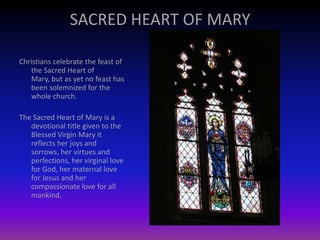
SACRED HEART OF MARY
Christians celebrate the feast of
the Sacred Heart of
Mary, but as yet no feast has
been solemnized for the
whole church.
The Sacred Heart of Mary is a
devotional title given to the
Blessed Virgin Mary it
reflects her joys and
sorrows, her virtues and
perfections, her virginal love
for God, her maternal love
for Jesus and her
compassionate love for all
mankind.
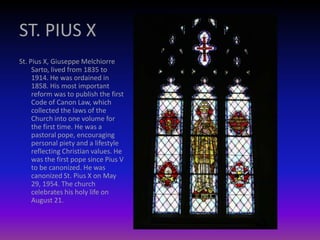
ST. PIUS X
St. Pius X, Giuseppe Melchiorre
Sarto, lived from 1835 to
1914. He was ordained in
1858. His most important
reform was to publish the first
Code of Canon Law, which
collected the laws of the
Church into one volume for
the first time. He was a
pastoral pope, encouraging
personal piety and a lifestyle
reflecting Christian values. He
was the first pope since Pius V
to be canonized. He was
canonized St. Pius X on May
29, 1954. The church
celebrates his holy life on
August 21.
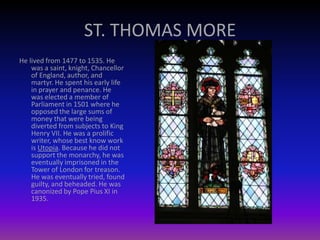
ST. THOMAS MORE
He lived from 1477 to 1535. He
was a saint, knight, Chancellor
of England, author, and
martyr. He spent his early life
in prayer and penance. He
was elected a member of
Parliament in 1501 where he
opposed the large sums of
money that were being
diverted from subjects to King
Henry VII. He was a prolific
writer, whose best know work
is Utopia. Because he did not
support the monarchy, he was
eventually imprisoned in the
Tower of London for treason.
He was eventually tried, found
guilty, and beheaded. He was
canonized by Pope Pius XI in
1935.
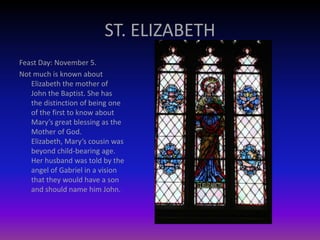
ST. ELIZABETH
Feast Day: November 5.
Not much is known about
Elizabeth the mother of
John the Baptist. She has
the distinction of being one
of the first to know about
Mary’s great blessing as the
Mother of God.
Elizabeth, Mary’s cousin was
beyond child-bearing age.
Her husband was told by the
angel of Gabriel in a vision
that they would have a son
and should name him John.
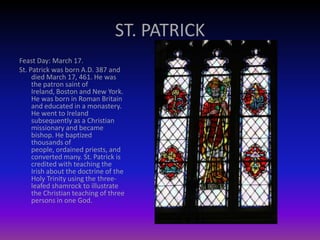
ST. PATRICK
Feast Day: March 17.
St. Patrick was born A.D. 387 and
died March 17, 461. He was
the patron saint of
Ireland, Boston and New York.
He was born in Roman Britain
and educated in a monastery.
He went to Ireland
subsequently as a Christian
missionary and became
bishop. He baptized
thousands of
people, ordained priests, and
converted many. St. Patrick is
credited with teaching the
Irish about the doctrine of the
Holy Trinity using the three-
leafed shamrock to illustrate
the Christian teaching of three
persons in one God.
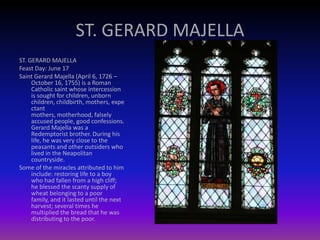
ST. GERARD MAJELLA
ST. GERARD MAJELLA
Feast Day: June 17
Saint Gerard Majella (April 6, 1726 –
October 16, 1755) is a Roman
Catholic saint whose intercession
is sought for children, unborn
children, childbirth, mothers, expe
ctant
mothers, motherhood, falsely
accused people, good confessions.
Gerard Majella was a
Redemptorist brother. During his
life, he was very close to the
peasants and other outsiders who
lived in the Neapolitan
countryside.
Some of the miracles attributed to him
include: restoring life to a boy
who had fallen from a high cliff;
he blessed the scanty supply of
wheat belonging to a poor
family, and it lasted until the next
harvest; several times he
multiplied the bread that he was
distributing to the poor.
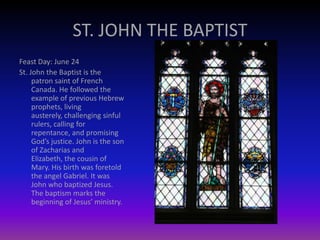
ST. JOHN THE BAPTIST
Feast Day: June 24
St. John the Baptist is the
patron saint of French
Canada. He followed the
example of previous Hebrew
prophets, living
austerely, challenging sinful
rulers, calling for
repentance, and promising
God’s justice. John is the son
of Zacharias and
Elizabeth, the cousin of
Mary. His birth was foretold
the angel Gabriel. It was
John who baptized Jesus.
The baptism marks the
beginning of Jesus’ ministry.
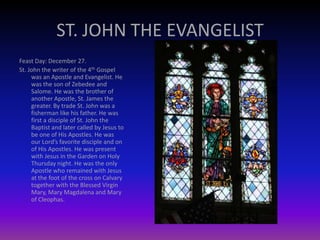
ST. JOHN THE EVANGELIST
Feast Day: December 27.
St. John the writer of the 4th Gospel
was an Apostle and Evangelist. He
was the son of Zebedee and
Salome. He was the brother of
another Apostle, St. James the
greater. By trade St. John was a
fisherman like his father. He was
first a disciple of St. John the
Baptist and later called by Jesus to
be one of His Apostles. He was
our Lord’s favorite disciple and on
of His Apostles. He was present
with Jesus in the Garden on Holy
Thursday night. He was the only
Apostle who remained with Jesus
at the foot of the cross on Calvary
together with the Blessed Virgin
Mary, Mary Magdalena and Mary
of Cleophas.
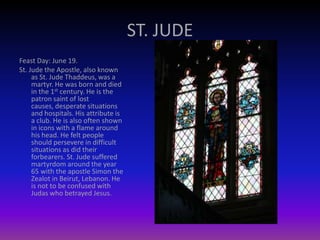
ST. JUDE
Feast Day: June 19.
St. Jude the Apostle, also known
as St. Jude Thaddeus, was a
martyr. He was born and died
in the 1st century. He is the
patron saint of lost
causes, desperate situations
and hospitals. His attribute is
a club. He is also often shown
in icons with a flame around
his head. He felt people
should persevere in difficult
situations as did their
forbearers. St. Jude suffered
martyrdom around the year
65 with the apostle Simon the
Zealot in Beirut, Lebanon. He
is not to be confused with
Judas who betrayed Jesus.
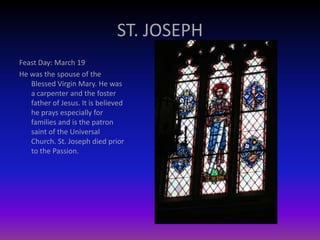
ST. JOSEPH
Feast Day: March 19
He was the spouse of the
Blessed Virgin Mary. He was
a carpenter and the foster
father of Jesus. It is believed
he prays especially for
families and is the patron
saint of the Universal
Church. St. Joseph died prior
to the Passion.
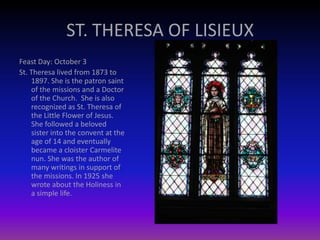
ST. THERESA OF LISIEUX
Feast Day: October 3
St. Theresa lived from 1873 to
1897. She is the patron saint
of the missions and a Doctor
of the Church. She is also
recognized as St. Theresa of
the Little Flower of Jesus.
She followed a beloved
sister into the convent at the
age of 14 and eventually
became a cloister Carmelite
nun. She was the author of
many writings in support of
the missions. In 1925 she
wrote about the Holiness in
a simple life.
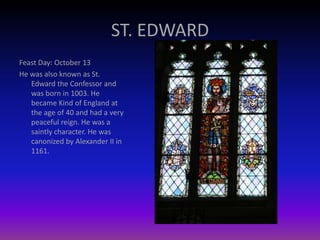
ST. EDWARD
Feast Day: October 13
He was also known as St.
Edward the Confessor and
was born in 1003. He
became Kind of England at
the age of 40 and had a very
peaceful reign. He was a
saintly character. He was
canonized by Alexander II in
1161.
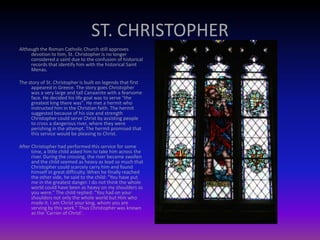
ST. CHRISTOPHER
Although the Roman Catholic Church still approves
devotion to him, St. Christopher is no longer
considered a saint due to the confusion of historical
records that identify him with the historical Saint
Menas.
The story of St. Christopher is built on legends that first
appeared in Greece. The story goes Christopher
was a very large and tall Canaanite with a fearsome
face. He decided his life goal was to serve "the
greatest king there was". He met a hermit who
instructed him in the Christian faith. The hermit
suggested because of his size and strength
Christopher could serve Christ by assisting people
to cross a dangerous river, where they were
perishing in the attempt. The hermit promised that
this service would be pleasing to Christ.
After Christopher had performed this service for some
time, a little child asked him to take him across the
river. During the crossing, the river became swollen
and the child seemed as heavy as lead so much that
Christopher could scarcely carry him and found
himself in great difficulty. When he finally reached
the other side, he said to the child: "You have put
me in the greatest danger. I do not think the whole
world could have been as heavy on my shoulders as
you were." The child replied: "You had on your
shoulders not only the whole world but Him who
made it. I am Christ your king, whom you are
serving by this work." Thus Christopher was known
as the 'Carrier of Christ'.
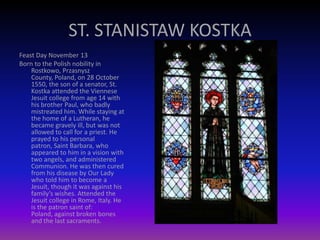
ST. STANISTAW KOSTKA
Feast Day November 13
Born to the Polish nobility in
Rostkowo, Przasnysz
County, Poland, on 28 October
1550, the son of a senator, St.
Kostka attended the Viennese
Jesuit college from age 14 with
his brother Paul, who badly
mistreated him. While staying at
the home of a Lutheran, he
became gravely ill, but was not
allowed to call for a priest. He
prayed to his personal
patron, Saint Barbara, who
appeared to him in a vision with
two angels, and administered
Communion. He was then cured
from his disease by Our Lady
who told him to become a
Jesuit, though it was against his
family’s wishes. Attended the
Jesuit college in Rome, Italy. He
is the patron saint of:
Poland, against broken bones
and the last sacraments.
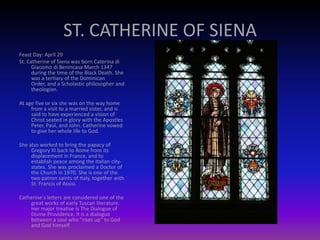
ST. CATHERINE OF SIENA
Feast Day: April 29
St. Catherine of Siena was born Caterina di
Giacomo di Benincasa March 1347
during the time of the Black Death. She
was a tertiary of the Dominican
Order, and a Scholastic philosopher and
theologian.
At age five or six she was on the way home
from a visit to a married sister, and is
said to have experienced a vision of
Christ seated in glory with the Apostles
Peter, Paul, and John. Catherine vowed
to give her whole life to God.
She also worked to bring the papacy of
Gregory XI back to Rome from its
displacement in France, and to
establish peace among the Italian city-
states. She was proclaimed a Doctor of
the Church in 1970. She is one of the
two patron saints of Italy, together with
St. Francis of Assisi.
Catherine's letters are considered one of the
great works of early Tuscan literature.
Her major treatise is The Dialogue of
Divine Providence. It is a dialogue
between a soul who "rises up" to God
and God himself.
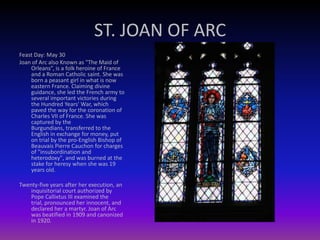
ST. JOAN OF ARC
Feast Day: May 30
Joan of Arc also Known as "The Maid of
Orleans”, is a folk heroine of France
and a Roman Catholic saint. She was
born a peasant girl in what is now
eastern France. Claiming divine
guidance, she led the French army to
several important victories during
the Hundred Years' War, which
paved the way for the coronation of
Charles VII of France. She was
captured by the
Burgundians, transferred to the
English in exchange for money, put
on trial by the pro-English Bishop of
Beauvais Pierre Cauchon for charges
of "insubordination and
heterodoxy", and was burned at the
stake for heresy when she was 19
years old.
Twenty-five years after her execution, an
inquisitorial court authorized by
Pope Callixtus III examined the
trial, pronounced her innocent, and
declared her a martyr. Joan of Arc
was beatified in 1909 and canonized
in 1920.
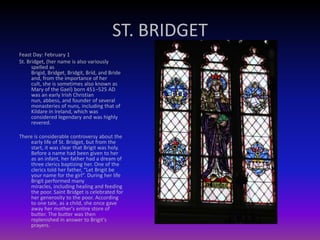
ST. BRIDGET
Feast Day: February 1
St. Bridget, (her name is also variously
spelled as
Brigid, Bridget, Bridgit, Bríd, and Bride
and, from the importance of her
cult, she is sometimes also known as
Mary of the Gael) born 451–525 AD
was an early Irish Christian
nun, abbess, and founder of several
monasteries of nuns, including that of
Kildare in Ireland, which was
considered legendary and was highly
revered.
There is considerable controversy about the
early life of St. Bridget, but from the
start, it was clear that Brigit was holy.
Before a name had been given to her
as an infant, her father had a dream of
three clerics baptizing her. One of the
clerics told her father, “Let Brigit be
your name for the girl”. During her life
Brigit performed many
miracles, including healing and feeding
the poor. Saint Bridget is celebrated for
her generosity to the poor. According
to one tale, as a child, she once gave
away her mother's entire store of
butter. The butter was then
replenished in answer to Brigit's
prayers.
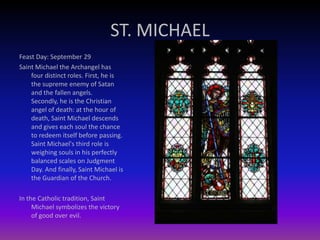
ST. MICHAEL
Feast Day: September 29
Saint Michael the Archangel has
four distinct roles. First, he is
the supreme enemy of Satan
and the fallen angels.
Secondly, he is the Christian
angel of death: at the hour of
death, Saint Michael descends
and gives each soul the chance
to redeem itself before passing.
Saint Michael's third role is
weighing souls in his perfectly
balanced scales on Judgment
Day. And finally, Saint Michael is
the Guardian of the Church.
In the Catholic tradition, Saint
Michael symbolizes the victory
of good over evil.

Upper stained glass windows

  • 1.
    St. Mark UpperStained Glass Windows Photos and Lives of the Holy
  • 2.
    SACRED HEART OFMARY Christians celebrate the feast of the Sacred Heart of Mary, but as yet no feast has been solemnized for the whole church. The Sacred Heart of Mary is a devotional title given to the Blessed Virgin Mary it reflects her joys and sorrows, her virtues and perfections, her virginal love for God, her maternal love for Jesus and her compassionate love for all mankind.
  • 3.
    ST. PIUS X St.Pius X, Giuseppe Melchiorre Sarto, lived from 1835 to 1914. He was ordained in 1858. His most important reform was to publish the first Code of Canon Law, which collected the laws of the Church into one volume for the first time. He was a pastoral pope, encouraging personal piety and a lifestyle reflecting Christian values. He was the first pope since Pius V to be canonized. He was canonized St. Pius X on May 29, 1954. The church celebrates his holy life on August 21.
  • 4.
    ST. THOMAS MORE Helived from 1477 to 1535. He was a saint, knight, Chancellor of England, author, and martyr. He spent his early life in prayer and penance. He was elected a member of Parliament in 1501 where he opposed the large sums of money that were being diverted from subjects to King Henry VII. He was a prolific writer, whose best know work is Utopia. Because he did not support the monarchy, he was eventually imprisoned in the Tower of London for treason. He was eventually tried, found guilty, and beheaded. He was canonized by Pope Pius XI in 1935.
  • 5.
    ST. ELIZABETH Feast Day:November 5. Not much is known about Elizabeth the mother of John the Baptist. She has the distinction of being one of the first to know about Mary’s great blessing as the Mother of God. Elizabeth, Mary’s cousin was beyond child-bearing age. Her husband was told by the angel of Gabriel in a vision that they would have a son and should name him John.
  • 6.
    ST. PATRICK Feast Day:March 17. St. Patrick was born A.D. 387 and died March 17, 461. He was the patron saint of Ireland, Boston and New York. He was born in Roman Britain and educated in a monastery. He went to Ireland subsequently as a Christian missionary and became bishop. He baptized thousands of people, ordained priests, and converted many. St. Patrick is credited with teaching the Irish about the doctrine of the Holy Trinity using the three- leafed shamrock to illustrate the Christian teaching of three persons in one God.
  • 7.
    ST. GERARD MAJELLA ST.GERARD MAJELLA Feast Day: June 17 Saint Gerard Majella (April 6, 1726 – October 16, 1755) is a Roman Catholic saint whose intercession is sought for children, unborn children, childbirth, mothers, expe ctant mothers, motherhood, falsely accused people, good confessions. Gerard Majella was a Redemptorist brother. During his life, he was very close to the peasants and other outsiders who lived in the Neapolitan countryside. Some of the miracles attributed to him include: restoring life to a boy who had fallen from a high cliff; he blessed the scanty supply of wheat belonging to a poor family, and it lasted until the next harvest; several times he multiplied the bread that he was distributing to the poor.
  • 8.
    ST. JOHN THEBAPTIST Feast Day: June 24 St. John the Baptist is the patron saint of French Canada. He followed the example of previous Hebrew prophets, living austerely, challenging sinful rulers, calling for repentance, and promising God’s justice. John is the son of Zacharias and Elizabeth, the cousin of Mary. His birth was foretold the angel Gabriel. It was John who baptized Jesus. The baptism marks the beginning of Jesus’ ministry.
  • 9.
    ST. JOHN THEEVANGELIST Feast Day: December 27. St. John the writer of the 4th Gospel was an Apostle and Evangelist. He was the son of Zebedee and Salome. He was the brother of another Apostle, St. James the greater. By trade St. John was a fisherman like his father. He was first a disciple of St. John the Baptist and later called by Jesus to be one of His Apostles. He was our Lord’s favorite disciple and on of His Apostles. He was present with Jesus in the Garden on Holy Thursday night. He was the only Apostle who remained with Jesus at the foot of the cross on Calvary together with the Blessed Virgin Mary, Mary Magdalena and Mary of Cleophas.
  • 10.
    ST. JUDE Feast Day:June 19. St. Jude the Apostle, also known as St. Jude Thaddeus, was a martyr. He was born and died in the 1st century. He is the patron saint of lost causes, desperate situations and hospitals. His attribute is a club. He is also often shown in icons with a flame around his head. He felt people should persevere in difficult situations as did their forbearers. St. Jude suffered martyrdom around the year 65 with the apostle Simon the Zealot in Beirut, Lebanon. He is not to be confused with Judas who betrayed Jesus.
  • 11.
    ST. JOSEPH Feast Day:March 19 He was the spouse of the Blessed Virgin Mary. He was a carpenter and the foster father of Jesus. It is believed he prays especially for families and is the patron saint of the Universal Church. St. Joseph died prior to the Passion.
  • 12.
    ST. THERESA OFLISIEUX Feast Day: October 3 St. Theresa lived from 1873 to 1897. She is the patron saint of the missions and a Doctor of the Church. She is also recognized as St. Theresa of the Little Flower of Jesus. She followed a beloved sister into the convent at the age of 14 and eventually became a cloister Carmelite nun. She was the author of many writings in support of the missions. In 1925 she wrote about the Holiness in a simple life.
  • 13.
    ST. EDWARD Feast Day:October 13 He was also known as St. Edward the Confessor and was born in 1003. He became Kind of England at the age of 40 and had a very peaceful reign. He was a saintly character. He was canonized by Alexander II in 1161.
  • 14.
    ST. CHRISTOPHER Although theRoman Catholic Church still approves devotion to him, St. Christopher is no longer considered a saint due to the confusion of historical records that identify him with the historical Saint Menas. The story of St. Christopher is built on legends that first appeared in Greece. The story goes Christopher was a very large and tall Canaanite with a fearsome face. He decided his life goal was to serve "the greatest king there was". He met a hermit who instructed him in the Christian faith. The hermit suggested because of his size and strength Christopher could serve Christ by assisting people to cross a dangerous river, where they were perishing in the attempt. The hermit promised that this service would be pleasing to Christ. After Christopher had performed this service for some time, a little child asked him to take him across the river. During the crossing, the river became swollen and the child seemed as heavy as lead so much that Christopher could scarcely carry him and found himself in great difficulty. When he finally reached the other side, he said to the child: "You have put me in the greatest danger. I do not think the whole world could have been as heavy on my shoulders as you were." The child replied: "You had on your shoulders not only the whole world but Him who made it. I am Christ your king, whom you are serving by this work." Thus Christopher was known as the 'Carrier of Christ'.
  • 15.
    ST. STANISTAW KOSTKA FeastDay November 13 Born to the Polish nobility in Rostkowo, Przasnysz County, Poland, on 28 October 1550, the son of a senator, St. Kostka attended the Viennese Jesuit college from age 14 with his brother Paul, who badly mistreated him. While staying at the home of a Lutheran, he became gravely ill, but was not allowed to call for a priest. He prayed to his personal patron, Saint Barbara, who appeared to him in a vision with two angels, and administered Communion. He was then cured from his disease by Our Lady who told him to become a Jesuit, though it was against his family’s wishes. Attended the Jesuit college in Rome, Italy. He is the patron saint of: Poland, against broken bones and the last sacraments.
  • 16.
    ST. CATHERINE OFSIENA Feast Day: April 29 St. Catherine of Siena was born Caterina di Giacomo di Benincasa March 1347 during the time of the Black Death. She was a tertiary of the Dominican Order, and a Scholastic philosopher and theologian. At age five or six she was on the way home from a visit to a married sister, and is said to have experienced a vision of Christ seated in glory with the Apostles Peter, Paul, and John. Catherine vowed to give her whole life to God. She also worked to bring the papacy of Gregory XI back to Rome from its displacement in France, and to establish peace among the Italian city- states. She was proclaimed a Doctor of the Church in 1970. She is one of the two patron saints of Italy, together with St. Francis of Assisi. Catherine's letters are considered one of the great works of early Tuscan literature. Her major treatise is The Dialogue of Divine Providence. It is a dialogue between a soul who "rises up" to God and God himself.
  • 17.
    ST. JOAN OFARC Feast Day: May 30 Joan of Arc also Known as "The Maid of Orleans”, is a folk heroine of France and a Roman Catholic saint. She was born a peasant girl in what is now eastern France. Claiming divine guidance, she led the French army to several important victories during the Hundred Years' War, which paved the way for the coronation of Charles VII of France. She was captured by the Burgundians, transferred to the English in exchange for money, put on trial by the pro-English Bishop of Beauvais Pierre Cauchon for charges of "insubordination and heterodoxy", and was burned at the stake for heresy when she was 19 years old. Twenty-five years after her execution, an inquisitorial court authorized by Pope Callixtus III examined the trial, pronounced her innocent, and declared her a martyr. Joan of Arc was beatified in 1909 and canonized in 1920.
  • 18.
    ST. BRIDGET Feast Day:February 1 St. Bridget, (her name is also variously spelled as Brigid, Bridget, Bridgit, Bríd, and Bride and, from the importance of her cult, she is sometimes also known as Mary of the Gael) born 451–525 AD was an early Irish Christian nun, abbess, and founder of several monasteries of nuns, including that of Kildare in Ireland, which was considered legendary and was highly revered. There is considerable controversy about the early life of St. Bridget, but from the start, it was clear that Brigit was holy. Before a name had been given to her as an infant, her father had a dream of three clerics baptizing her. One of the clerics told her father, “Let Brigit be your name for the girl”. During her life Brigit performed many miracles, including healing and feeding the poor. Saint Bridget is celebrated for her generosity to the poor. According to one tale, as a child, she once gave away her mother's entire store of butter. The butter was then replenished in answer to Brigit's prayers.
  • 19.
    ST. MICHAEL Feast Day:September 29 Saint Michael the Archangel has four distinct roles. First, he is the supreme enemy of Satan and the fallen angels. Secondly, he is the Christian angel of death: at the hour of death, Saint Michael descends and gives each soul the chance to redeem itself before passing. Saint Michael's third role is weighing souls in his perfectly balanced scales on Judgment Day. And finally, Saint Michael is the Guardian of the Church. In the Catholic tradition, Saint Michael symbolizes the victory of good over evil.