Jomare
Presentation
EducationAbout Transportation
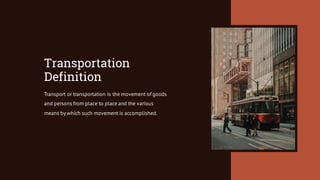
Transport or transportation is the movement of goods
and persons from place to place and the various
means by which such movement is accomplished.
Transportation
Definition
International trade was the driving motivator behind
advancements in global transportation in the Pre Modern world.
There was a single global world economy with a worldwide
division of labor and multilateral trade from 1500 onward.
History Of
Transportation
Support Transportation
The infrastructure is the network where things are carried. Infrastructure
includes roads, railways, airports, canals and pipelines. Infrastructure also
includes airports, railway stations, bus stations and seaports.
Vehicles include cars, trucks, trains and airplanes. Vehicles are usually
designed by mechanical engineers. Vessels include boats, ferries, and
barges which travel on canals and use docks and seaports
Operations include traffic signals, railway signals and air traffic control.
Operations also include the government policies and regulations used to
control the system,such as tolls, fuel taxes, and traffic laws.
Infrastructure
Vehicles
Operations Control System
03
02
01
Operations Control
The System
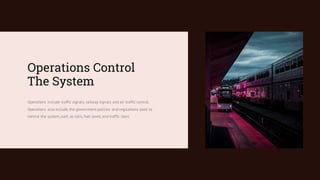
Operations include traffic signals, railway signals and air traffic control.
Operations also include the government policies and regulations used to
control the system,such as tolls, fuel taxes, and traffic laws.
Public
Transportation
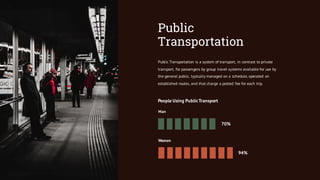
Public Transportation is a system of transport, in contrast to private
transport, for passengers by group travel systems available for use by
the general public, typically managed on a schedule, operated on
established routes, and that charge a posted fee for each trip.
People Using PublicTransport
Man
Women
70%
94%
Transport And
Communications
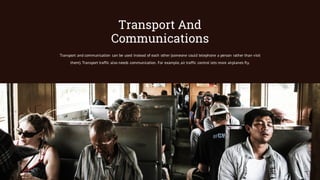
Transport and communication can be used instead of each other (someone could telephone a person rather than visit
them). Transport traffic also needs communication. For example, air traffic control lets more airplanes fly.
Transport, Energy,
And The Environment
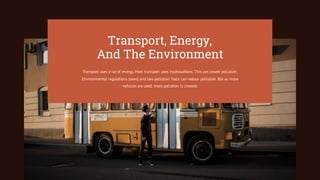
Transport uses a lot of energy. Most transport uses hydrocarbons. This can create pollution.
Environmental regulations (laws) and low-pollution fuels can reduce pollution. But as more
vehicles are used, more pollution is created.
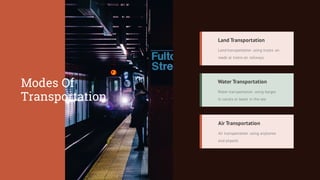
Air transportation using airplanes
and airports
Air Transportation
Water transportation using barges
in canals or boats in the sea
Water Transportation
Land transportation using trucks on
roads or trains on railways
Land Transportation
Modes Of
Transportation
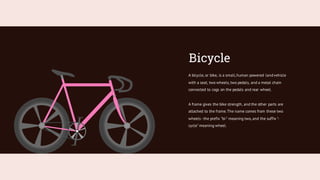
Bicycle
A bicycle, or bike, is a small,human powered landvehicle
with a seat, two wheels, two pedals, and a metal chain
connected to cogs on the pedals and rear wheel.
A frame gives the bike strength, and the other parts are
attached to the frame.The name comes from these two
wheels -the prefix "bi-" meaning two, and the suffix "-
cycle" meaning wheel.
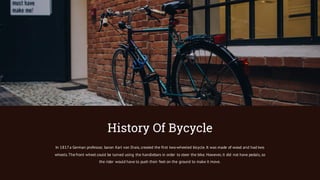
In 1817a German professor, baron Karl von Drais, created the first two-wheeled bicycle. It was made of wood and had two
wheels.The front wheel could be turned using the handlebars in order to steer the bike. However, it did not have pedals, so
the rider would have to push their feet on the ground to make it move.
History Of Bycycle
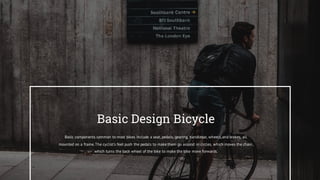
Basic Design Bicycle
Basic components common to most bikes include a seat, pedals, gearing, handlebar, wheels,and brakes, all
mounted on a frame.The cyclist's feet push the pedals to make them go around in circles, which moves the chain,
which turns the back wheel of the bike to make the bike move forwards.
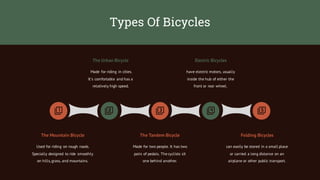
Types Of Bicycles
Made for riding in cities.
It`s comfortable and has a
relatively high speed.
The Urban Bicycle
have electric motors, usually
inside the hub of either the
front or rear wheel.
Electric Bicycles
Used for riding on rough roads.
Specially designed to ride smoothly
on hills,grass, and mountains.
Made for two people. It has two
pairs of pedals. The cyclists sit
one behind another.
can easily be stored in a small place
or carried a long distance on an
airplane or other public transport.
The Mountain Bicycle The Tandem Bicycle Folding Bicycles
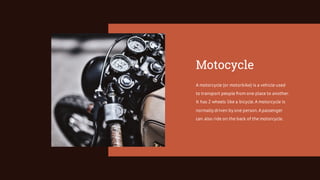
Motocycle
A motorcycle (or motorbike) is a vehicle used
to transport people from one place to another.
It has 2 wheels like a bicycle.A motorcycle is
normally driven by one person.Apassenger
can also ride on the back of the motorcycle.
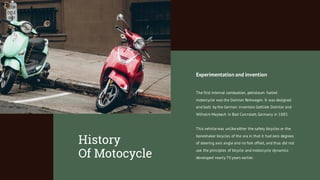
Experimentation and invention
The first internal combustion, petroleum fueled
motorcycle was the Daimler Reitwagen. It was designed
and built by the German inventors Gottlieb Daimler and
Wilhelm Maybach in Bad Cannstatt,Germany in 1885.
This vehicle was unlike either the safety bicycles or the
boneshaker bicycles of the era in that it had zero degrees
of steering axis angle and no fork offset, and thus did not
use the principles of bicycle and motorcycle dynamics
developed nearly 70 years earlier.
History
Of Motocycle
This Is
Break
Section
What
Is Automobile?
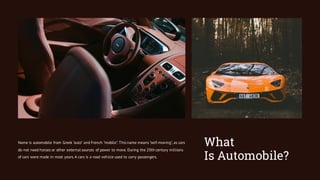
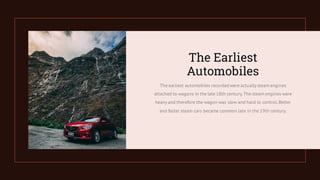
Name is automobile from Greek "auto" and French "mobile". This name means "self-moving", as cars
do not need horses or other external sources of power to move. During the 20th century millions
of cars were made in most years.A cars is a road vehicle used to carry passengers.
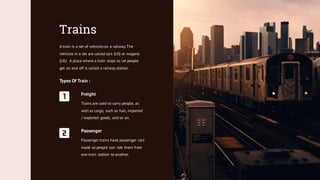
The earliest automobiles recorded were actually steam engines
attached to wagons in the late 18th century.The steam engines were
heavy and therefore the wagon was slow and hard to control.Better
and faster steam cars became common late in the 19th century.
The Earliest
Automobiles
Trains
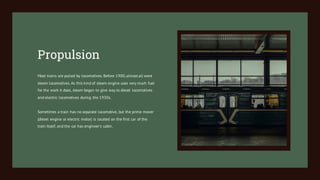
A train is a set of vehicles on a railway.The
vehicles in a set are called cars (US) or wagons
(UK). A place where a train stops to let people
get on and off is called a railway station.
Types Of Train :
Passenger
Passenger trains have passenger cars
made so people can ride them from
one train station to another.
Freight
Trains are used to carry people, as
well as cargo, such as fuel, imported
/ exported goods, and so on.
Most trains are pulled by locomotives. Before 1900,almost all were
steam locomotives. As this kind of steam engine uses very much fuel
for the work it does, steam began to give way to diesel locomotives
and electric locomotives during the 1930s.
Sometimes a train has no separate locomotive, but the prime mover
(diesel engine or electric motor) is located on the first car of the
train itself, and the car has engineer's cabin.
Propulsion
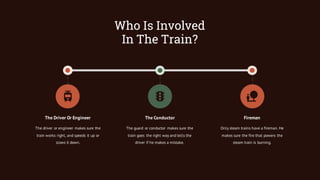
Who Is Involved
In The Train?
The driver or engineer makes sure the
train works right, and speeds it up or
slows it down.
The Driver Or Engineer
The guard or conductor makes sure the
train goes the right way and tells the
driver if he makes a mistake.
The Conductor
Only steam trains have a fireman. He
makes sure the fire that powers the
steam train is burning.
Fireman
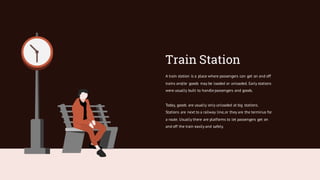
Train Station
A train station is a place where passengers can get on and off
trains and/or goods may be loaded or unloaded. Early stations
were usually built to handle passengers and goods.
Today, goods are usually only unloaded at big stations.
Stations are next to a railway line,or they are the terminus for
a route. Usually there are platforms to let passengers get on
and off the train easily and safely.
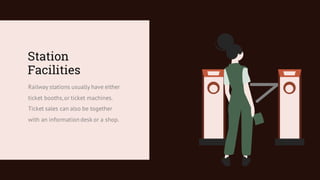
Station
Facilities
Railway stations usually have either
ticket booths,or ticket machines.
Ticket sales can also be together
with an information desk or a shop.
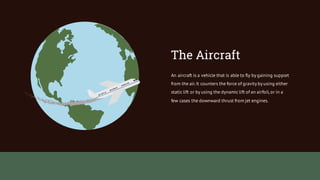
An aircraft is a vehicle that is able to fly by gaining support
from the air.It counters the force of gravity by using either
static lift or by using the dynamic lift of an airfoil,or in a
few cases the downward thrust from jet engines.
The Aircraft
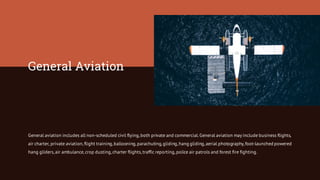
General Aviation
General aviation includes all non-scheduled civil flying,both private and commercial.General aviation may include business flights,
air charter, private aviation,flight training,ballooning,parachuting,gliding,hang gliding,aerial photography,foot-launched powered
hang gliders,air ambulance,crop dusting,charter flights,traffic reporting,police air patrols and forest fire fighting.
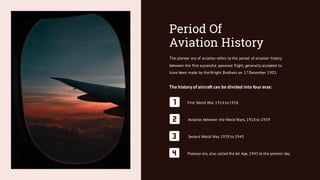
Period Of
Aviation History
The pioneer era of aviation refers to the period of aviation history
between the first successful powered flight, generally accepted to
have been made by the Wright Brothers on 17December 1903.
The history of aircraft can be divided into four eras:
First World War, 1914 to1918
Aviation between the World Wars, 1918 to 1939
Second World War, 1939 to 1945
Postwar era, also called the Jet Age, 1945 to the present day
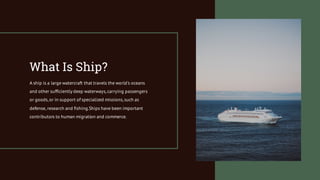
What Is Ship?
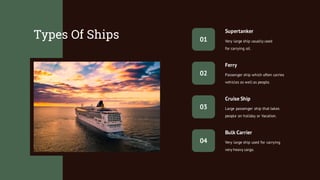
A ship is a large watercraft that travels the world's oceans
and other sufficiently deep waterways,carrying passengers
or goods,or in support of specialized missions,such as
defense, research and fishing.Ships have been important
contributors to human migration and commerce.
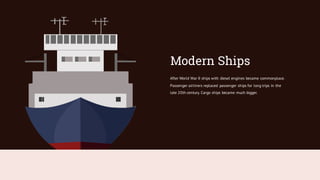
After World War II ships with diesel engines became commonplace.
Passenger airliners replaced passenger ships for long trips in the
late 20th century. Cargo ships became much bigger.
Modern Ships
Types Of Ships
Very large ship used for carrying
very heavy cargo.
Bulk Carrier
Cruise Ship
Large passenger ship that takes
people on holiday or Vacation.
Supertanker
Very large ship usually used
for carrying oil.
Ferry
Passenger ship which often carries
vehicles as well as people.
01
02
03
04
Thanks
For Watching
Collaboratively administrate empowered with markets via plug and play
networks. Dynamicwith procrastinate B2C user installed base
interactively coordinate proactive via process.
Kabuki Presentation : Dark Color Version

Kabuki Presentation : Dark Color Version

  • 1.
  • 2.
    Transport or transportationis the movement of goods and persons from place to place and the various means by which such movement is accomplished. Transportation Definition
  • 3.
    International trade wasthe driving motivator behind advancements in global transportation in the Pre Modern world. There was a single global world economy with a worldwide division of labor and multilateral trade from 1500 onward. History Of Transportation
  • 4.
    Support Transportation The infrastructureis the network where things are carried. Infrastructure includes roads, railways, airports, canals and pipelines. Infrastructure also includes airports, railway stations, bus stations and seaports. Vehicles include cars, trucks, trains and airplanes. Vehicles are usually designed by mechanical engineers. Vessels include boats, ferries, and barges which travel on canals and use docks and seaports Operations include traffic signals, railway signals and air traffic control. Operations also include the government policies and regulations used to control the system,such as tolls, fuel taxes, and traffic laws. Infrastructure Vehicles Operations Control System 03 02 01
  • 5.
    Operations Control The System Operationsinclude traffic signals, railway signals and air traffic control. Operations also include the government policies and regulations used to control the system,such as tolls, fuel taxes, and traffic laws.
  • 6.
    Public Transportation Public Transportation isa system of transport, in contrast to private transport, for passengers by group travel systems available for use by the general public, typically managed on a schedule, operated on established routes, and that charge a posted fee for each trip. People Using PublicTransport Man Women 70% 94%
  • 7.
    Transport And Communications Transport andcommunication can be used instead of each other (someone could telephone a person rather than visit them). Transport traffic also needs communication. For example, air traffic control lets more airplanes fly.
  • 8.
    Transport, Energy, And TheEnvironment Transport uses a lot of energy. Most transport uses hydrocarbons. This can create pollution. Environmental regulations (laws) and low-pollution fuels can reduce pollution. But as more vehicles are used, more pollution is created.
  • 9.
    Air transportation usingairplanes and airports Air Transportation Water transportation using barges in canals or boats in the sea Water Transportation Land transportation using trucks on roads or trains on railways Land Transportation Modes Of Transportation
  • 10.
    Bicycle A bicycle, orbike, is a small,human powered landvehicle with a seat, two wheels, two pedals, and a metal chain connected to cogs on the pedals and rear wheel. A frame gives the bike strength, and the other parts are attached to the frame.The name comes from these two wheels -the prefix "bi-" meaning two, and the suffix "- cycle" meaning wheel.
  • 11.
    In 1817a Germanprofessor, baron Karl von Drais, created the first two-wheeled bicycle. It was made of wood and had two wheels.The front wheel could be turned using the handlebars in order to steer the bike. However, it did not have pedals, so the rider would have to push their feet on the ground to make it move. History Of Bycycle
  • 12.
    Basic Design Bicycle Basiccomponents common to most bikes include a seat, pedals, gearing, handlebar, wheels,and brakes, all mounted on a frame.The cyclist's feet push the pedals to make them go around in circles, which moves the chain, which turns the back wheel of the bike to make the bike move forwards.
  • 13.
    Types Of Bicycles Madefor riding in cities. It`s comfortable and has a relatively high speed. The Urban Bicycle have electric motors, usually inside the hub of either the front or rear wheel. Electric Bicycles Used for riding on rough roads. Specially designed to ride smoothly on hills,grass, and mountains. Made for two people. It has two pairs of pedals. The cyclists sit one behind another. can easily be stored in a small place or carried a long distance on an airplane or other public transport. The Mountain Bicycle The Tandem Bicycle Folding Bicycles
  • 14.
    Motocycle A motorcycle (ormotorbike) is a vehicle used to transport people from one place to another. It has 2 wheels like a bicycle.A motorcycle is normally driven by one person.Apassenger can also ride on the back of the motorcycle.
  • 15.
    Experimentation and invention Thefirst internal combustion, petroleum fueled motorcycle was the Daimler Reitwagen. It was designed and built by the German inventors Gottlieb Daimler and Wilhelm Maybach in Bad Cannstatt,Germany in 1885. This vehicle was unlike either the safety bicycles or the boneshaker bicycles of the era in that it had zero degrees of steering axis angle and no fork offset, and thus did not use the principles of bicycle and motorcycle dynamics developed nearly 70 years earlier. History Of Motocycle
  • 16.
  • 17.
    What Is Automobile? Name isautomobile from Greek "auto" and French "mobile". This name means "self-moving", as cars do not need horses or other external sources of power to move. During the 20th century millions of cars were made in most years.A cars is a road vehicle used to carry passengers.
  • 18.
    The earliest automobilesrecorded were actually steam engines attached to wagons in the late 18th century.The steam engines were heavy and therefore the wagon was slow and hard to control.Better and faster steam cars became common late in the 19th century. The Earliest Automobiles
  • 19.
    Trains A train isa set of vehicles on a railway.The vehicles in a set are called cars (US) or wagons (UK). A place where a train stops to let people get on and off is called a railway station. Types Of Train : Passenger Passenger trains have passenger cars made so people can ride them from one train station to another. Freight Trains are used to carry people, as well as cargo, such as fuel, imported / exported goods, and so on.
  • 20.
    Most trains arepulled by locomotives. Before 1900,almost all were steam locomotives. As this kind of steam engine uses very much fuel for the work it does, steam began to give way to diesel locomotives and electric locomotives during the 1930s. Sometimes a train has no separate locomotive, but the prime mover (diesel engine or electric motor) is located on the first car of the train itself, and the car has engineer's cabin. Propulsion
  • 21.
    Who Is Involved InThe Train? The driver or engineer makes sure the train works right, and speeds it up or slows it down. The Driver Or Engineer The guard or conductor makes sure the train goes the right way and tells the driver if he makes a mistake. The Conductor Only steam trains have a fireman. He makes sure the fire that powers the steam train is burning. Fireman
  • 22.
    Train Station A trainstation is a place where passengers can get on and off trains and/or goods may be loaded or unloaded. Early stations were usually built to handle passengers and goods. Today, goods are usually only unloaded at big stations. Stations are next to a railway line,or they are the terminus for a route. Usually there are platforms to let passengers get on and off the train easily and safely.
  • 23.
    Station Facilities Railway stations usuallyhave either ticket booths,or ticket machines. Ticket sales can also be together with an information desk or a shop.
  • 24.
    An aircraft isa vehicle that is able to fly by gaining support from the air.It counters the force of gravity by using either static lift or by using the dynamic lift of an airfoil,or in a few cases the downward thrust from jet engines. The Aircraft
  • 25.
    General Aviation General aviationincludes all non-scheduled civil flying,both private and commercial.General aviation may include business flights, air charter, private aviation,flight training,ballooning,parachuting,gliding,hang gliding,aerial photography,foot-launched powered hang gliders,air ambulance,crop dusting,charter flights,traffic reporting,police air patrols and forest fire fighting.
  • 26.
    Period Of Aviation History Thepioneer era of aviation refers to the period of aviation history between the first successful powered flight, generally accepted to have been made by the Wright Brothers on 17December 1903. The history of aircraft can be divided into four eras: First World War, 1914 to1918 Aviation between the World Wars, 1918 to 1939 Second World War, 1939 to 1945 Postwar era, also called the Jet Age, 1945 to the present day
  • 27.
    What Is Ship? Aship is a large watercraft that travels the world's oceans and other sufficiently deep waterways,carrying passengers or goods,or in support of specialized missions,such as defense, research and fishing.Ships have been important contributors to human migration and commerce.
  • 28.
    After World WarII ships with diesel engines became commonplace. Passenger airliners replaced passenger ships for long trips in the late 20th century. Cargo ships became much bigger. Modern Ships
  • 29.
    Types Of Ships Verylarge ship used for carrying very heavy cargo. Bulk Carrier Cruise Ship Large passenger ship that takes people on holiday or Vacation. Supertanker Very large ship usually used for carrying oil. Ferry Passenger ship which often carries vehicles as well as people. 01 02 03 04
  • 30.
    Thanks For Watching Collaboratively administrateempowered with markets via plug and play networks. Dynamicwith procrastinate B2C user installed base interactively coordinate proactive via process.