Repository management: an emerging profession in the information sectorOnline Information 2010Jackie WickhamProject CoordinatorCentre for Research CommunicationsUniversity of Nottingham
Presentation OutlineContextUK landscape – growth in repositoriesThe UK workforceNew skills and rolesSupport for staff - Repositories Support Project and the United Kingdom Council of Research Repositories
ContextOpen Access to ResearchUK Higher EducationInstitutional repository
What is Open Access“Open Access (OA) means that scholarly literature is made freely available on the internet, so that it can be read, downloaded, copied, distributed, printed, searched, text mined, or used for any other lawful purpose, without financial, legal or technical barriers, subject to proper attribution of authorship.”Research Information Network, June 2010
Routes to OA - GoldImage by Warren Pilkington, zawtowers, Flickr
Routes to OA - GreenSome textdetails of thatSome more textAnother ideaMore stuffdetail 1detail 2Image by Rojabro, Flickr
Why it’s importantAccess in the developing worldInstitutional showcase for researchIncreased readership and citationQuicker disseminationSecure storageBetter discoverability (indexed by Google)Encourages collaborationEconomic impact Houghton et al (2009) Economic implications of alternative scholarly publishing models: exploring the costs and benefits  http://www.jisc.ac.uk/media/documents/publications/rpteconomicoapublishing.pdf
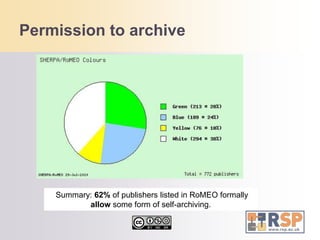
Permission to archive
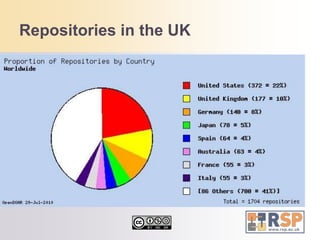
Repositories in the UKSome textdetails of thatSome more textAnother ideaMore stuffdetail 1detail 2
Why have universities invested in repositories?http://www.youtube.com/watch?v=2plF9io3vQEhttp://www.nottingham.ac.uk/toolkits/play_3159
Survey of UK Repository staff29th July to 5th September SurveyMonkeyDistributed via UKCoRR list 215 members (August 2010) and there were 84 respondents. Interviews with a couple of respondents
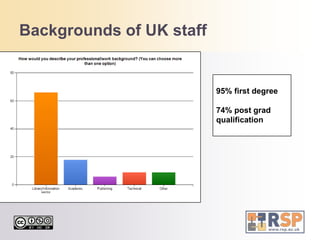
Backgrounds of UK staff95% first degree74% post grad qualification
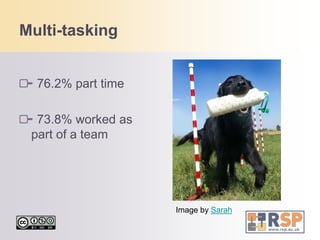
Multi-tasking76.2% part time73.8% worked as part of a teamImage by Sarah
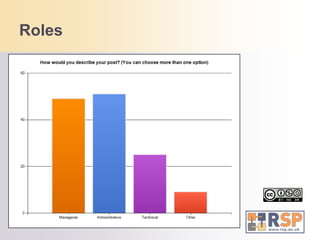
Roles
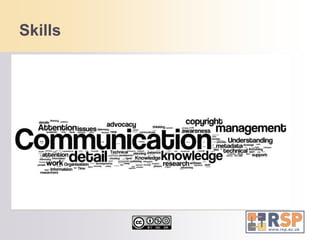
Skills
Job satisfactionhttp://www.youtube.com/watch?v=gVhSqlhNwcIhttp://www.youtube.com/watch?v=4ih4aAKuRSkhttp://www.nottingham.ac.uk/toolkits/play_3159
Support in the UKRepositories Support Project (RSP)Welsh Repositories Network (WRN)Enhancing Repository Infrastructure in Scotland (ERIS)
Repositories Support Project - Objectivesmore repositories in higher education institutions in England, Wales and Northern Irelandmore content in existing repositoriesmore types of content in existing repositoriescloser integration of repositories into institutional information systemspromotion of best practice and standardsinvestigation of the new role of institutions in research output curation and access
Repositories Support Project – who we are- Initially a 2.5 year JISC funded project
September 2006 – March 2009
Lead Institution – University of Nottingham
Partner Institutions – University of Southampton, Aberystwyth University, Digital Curation Centre (University of Edinburgh), UKOLN (University of Bath).
- Second phase April 2009 – March 2012
University of Nottingham
Team of four – Project Director, Project Coordinator, Open Access Adviser, Technical Officer.The RSP Offers…On site supportInstitutional visits – free, impartial consultancy from a team of expertsEnquiry service - support@rsp.ac.uk - 0845 257 6860Website ResourcesReusable advocacy materialsBriefing papers (technical & procedural)RSP Wiki pagesResource bank of links and references (publications etc)Buddy Scheme
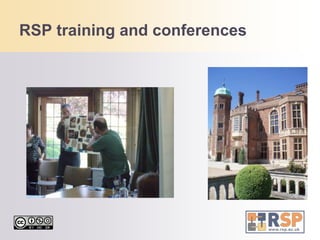
RSP training and conferences
Recent Events…RSP Summer SchoolThree-day residential training event covering most of the aspects of repository management (technical, preservation, metadata, advocacy etc)Research in the Open: How mandates work in practicePreservation training events RSP Software DayCommunicating for effective advocacy http://www.rsp.ac.uk/events/
UKCoRRUK Council of Research Repositories - www.ukcorr.orgA group for repository managers by repository managersAn independent professional body to allow repository     managers to share experiences and discuss issues of     common concernTo give repository managers a group voice in national       discussions and policy development  independent of      projects or temporary initiativesTo grow together as a community and learn from each     other’s experiencesMailing list.  215 members (August 2010)

Jw online2010

  • 1.
    Repository management: anemerging profession in the information sectorOnline Information 2010Jackie WickhamProject CoordinatorCentre for Research CommunicationsUniversity of Nottingham
  • 2.
    Presentation OutlineContextUK landscape– growth in repositoriesThe UK workforceNew skills and rolesSupport for staff - Repositories Support Project and the United Kingdom Council of Research Repositories
  • 3.
    ContextOpen Access toResearchUK Higher EducationInstitutional repository
  • 4.
    What is OpenAccess“Open Access (OA) means that scholarly literature is made freely available on the internet, so that it can be read, downloaded, copied, distributed, printed, searched, text mined, or used for any other lawful purpose, without financial, legal or technical barriers, subject to proper attribution of authorship.”Research Information Network, June 2010
  • 5.
    Routes to OA- GoldImage by Warren Pilkington, zawtowers, Flickr
  • 6.
    Routes to OA- GreenSome textdetails of thatSome more textAnother ideaMore stuffdetail 1detail 2Image by Rojabro, Flickr
  • 8.
    Why it’s importantAccessin the developing worldInstitutional showcase for researchIncreased readership and citationQuicker disseminationSecure storageBetter discoverability (indexed by Google)Encourages collaborationEconomic impact Houghton et al (2009) Economic implications of alternative scholarly publishing models: exploring the costs and benefits http://www.jisc.ac.uk/media/documents/publications/rpteconomicoapublishing.pdf
  • 9.
  • 10.
    Repositories in theUKSome textdetails of thatSome more textAnother ideaMore stuffdetail 1detail 2
  • 11.
    Why have universitiesinvested in repositories?http://www.youtube.com/watch?v=2plF9io3vQEhttp://www.nottingham.ac.uk/toolkits/play_3159
  • 12.
    Survey of UKRepository staff29th July to 5th September SurveyMonkeyDistributed via UKCoRR list 215 members (August 2010) and there were 84 respondents. Interviews with a couple of respondents
  • 13.
    Backgrounds of UKstaff95% first degree74% post grad qualification
  • 14.
    Multi-tasking76.2% part time73.8%worked as part of a teamImage by Sarah
  • 15.
  • 16.
  • 17.
  • 18.
    Support in theUKRepositories Support Project (RSP)Welsh Repositories Network (WRN)Enhancing Repository Infrastructure in Scotland (ERIS)
  • 19.
    Repositories Support Project- Objectivesmore repositories in higher education institutions in England, Wales and Northern Irelandmore content in existing repositoriesmore types of content in existing repositoriescloser integration of repositories into institutional information systemspromotion of best practice and standardsinvestigation of the new role of institutions in research output curation and access
  • 20.
    Repositories Support Project– who we are- Initially a 2.5 year JISC funded project
  • 21.
  • 22.
    Lead Institution –University of Nottingham
  • 23.
    Partner Institutions –University of Southampton, Aberystwyth University, Digital Curation Centre (University of Edinburgh), UKOLN (University of Bath).
  • 24.
    - Second phaseApril 2009 – March 2012
  • 25.
  • 26.
    Team of four– Project Director, Project Coordinator, Open Access Adviser, Technical Officer.The RSP Offers…On site supportInstitutional visits – free, impartial consultancy from a team of expertsEnquiry service - support@rsp.ac.uk - 0845 257 6860Website ResourcesReusable advocacy materialsBriefing papers (technical & procedural)RSP Wiki pagesResource bank of links and references (publications etc)Buddy Scheme
  • 27.
    RSP training andconferences
  • 28.
    Recent Events…RSP SummerSchoolThree-day residential training event covering most of the aspects of repository management (technical, preservation, metadata, advocacy etc)Research in the Open: How mandates work in practicePreservation training events RSP Software DayCommunicating for effective advocacy http://www.rsp.ac.uk/events/
  • 29.
    UKCoRRUK Council ofResearch Repositories - www.ukcorr.orgA group for repository managers by repository managersAn independent professional body to allow repository managers to share experiences and discuss issues of common concernTo give repository managers a group voice in national discussions and policy development independent of projects or temporary initiativesTo grow together as a community and learn from each other’s experiencesMailing list. 215 members (August 2010)

Editor's Notes

  • #3 And there are other people in this presentation – really getting your moneys worth here! I think that
  • #5 Key goals have been defined:Declaration of the Budapest Open Access Initiative in 2002Bethesda Statement on Open Access PublishingBerlin Declaration on Open Access to Knowledge in 2003
  • #6 Two routes to OA – forgive me if I’m teaching grandma to suck eggs!Publishing articles in open access journals, ‘author pays’. Usually paid for by institution or included in research grant. Increasingly, UK Universities have established publication funds e.g. Nottingham and Birmingham.Two types:Open Access publishers (PLOS, BioMedCentral, Hindari)Traditional publishers with OA option (Nature, Elsevier, Springer) – Hybrid.
  • #7 Self archiving in a repository of published research (plus others conference papers etc)– Subject e.g Organic E-Prints, PubMedCentral, arXiv, RepecOr Institutional – a way for universities to showcase their research and to preserve it.Usually (if not completely) in addition to publishing in a journal – OA, hybrid, subscription only.Publisher could impose embargo.
  • #8 How many people publish research papers, conference papers?How many people make their research open access – paper on their website, in an open access repository, publish in an open access journal?How many people have ever searched on Google and found some really useful references and then found that they don’t have access to them?
  • #9 You’ll probably be aware of the well rehearsed benefits of OA:Access in the developing worldIncreased readership and citation – research evidence is conclusive. See Willow’s statementsQuicker disseminationSecure storage etcSavings for HE – £115 million per yearIncreased returns on investment in R & D up to £170 million
  • #10 It’s getting increasingly possible to make things open access, and free via self-archiving.
  • #11 UK has 177 repositories in total. Most UK HE institutions and research centres have one.But the issue is getting content – not yet part of researchers workflows. Estimates of the proportion of full text records (as proportion of total university output) vary from 15%-30%. (Harnad, 2009). Many metadata only records.Drivers such as Research Excellence Framework are changing this. Universities have to collect and demonstrate their research output. OA can be built into this easily.Internationally – new repositories have been established at a rate of more than one per working day over the last 3 years. (A.Swan Ch8 Institutional repositories – now and next.
  • #14 78.6% library background
  • #17 Libraries have taken on repositories because of traditional role of cataloguing and information management. And whilst these are important, they are not top of the list of skills identified by staff. In the survey.Communication is the most dominant term – not surprising given that main role of repository staff is to radically alter the process of scholarly communication, with their own interpersonal skills being the key weapon in their armoury. Many of the other skills listed such as the delivery of training and presentations and liaison with other departments in the university are linked to this. Strategic planning, project management and prioritisation were also common themes as well as accuracy and attention to detail. Many people highlighted the need for perseverance also using terms such as determination, patience and persistence. One respondent summed it up as “aka bloody minded obsession”!.
  • #19 Funded by JISC in England and Wales and Scottish Funding Council in Scotland.WRN – established repositories in all Welsh institutionsERIS – motivating researchers to deposit their work in repositories.
  • #23 Events - As the repository scene matures in the UK, the focus for events has correspondingly changed. Originally, it was very much about technical set up and establishing a presence in the institution. Now issues such as increasing content and forging integration with other institutional initiatives and systems are more prevalent. Increasing content in repositories is one of the major challenges facing managers – Advocacy, preservation, copyright and dealing with publishers, metadata standards. For UK HE.
  • #26 How many include repositories specifically in the curriculum? Something for the community to pursue.2008 study by Zuccala, Oppenheim and Dhiensa that most library schools include basics of digital library management, none specifically focused on respoitory management. More recently, university of Sheffield has included this in their ‘Academic and Research Libraries’ module. And data management is a whole new area. Comments at recent RIN meeting re ned for skilled professionals to manage and curate data.
  • #27 Info staff are engaging with university agendas regarding showcasing research, systems for reporting on research e.g. REFCommunication, influencing. Also new technical skills such as data management.Decribed role of RSP. Future looks good – UKC0RR very lively and healthy