Justin Cole
Student # 557426
Masters of Literacy: Literacy Leadership Research Project


Comparison	
  of	
  teacher	
  
and	
  student	
  personal	
  
literacy	
  practices	
  and	
  
the	
  effect	
  these	
  have	
  on	
  
student	
  engagement.	


Mr.	
  Justin	
  Cole	
  &	
  Dr.	
  Pam	
  Macintyre
Justin Cole
Student # 557426
Masters of Literacy: Literacy Leadership Research Project


   2	


Table of Contents
	
  
Page Number
Abstract 3
Introduction and background 4
Literature review 9
Methodology 19
Results, Analysis & Discussion 26
Findings & recommendations 49
References 56
Appendix 59


Justin Cole
Student # 557426
Masters of Literacy: Literacy Leadership Research Project


   3	


Abstract	


This	
  research	
  project	
  inquires	
  into	
  the	
  text	
  based	
  practices	
  of	
  teachers	
  and	
  
students	
  outside	
  of	
  school	
  hours.	
  The	
  research	
  exposed	
  a	
  fundamental	
  difference	
  
between	
  the	
  text	
  based	
  practices	
  of	
  the	
  two	
  participant	
  groups	
  and	
  inquired	
  into	
  
the	
  effects	
  this	
  has	
  on	
  the	
  motivation	
  of	
  students.	
  This	
  study	
  presents	
  a	
  small	
  
scale,	
  qualitative	
  research	
  methodology	
  involving	
  both	
  teacher	
  and	
  student	
  
participants	
  from	
  an	
  inner	
  city,	
  government	
  primary	
  school.	


This	
  paper	
  reports	
  and	
  analyses	
  interview	
  and	
  survey	
  data,	
  finding	
  that	
  while	
  
students	
  are	
  daily	
  producers	
  of	
  visual	
  text,	
  teachers’	
  text	
  production	
  is	
  limited	
  to	
  
written	
  text.	
  The	
  research	
  also	
  shows	
  that	
  in	
  spite	
  of	
  their	
  knowledge	
  of	
  what	
  
engages	
  students,	
  teachers	
  feel	
  more	
  confident	
  teaching	
  the	
  texts	
  they	
  are	
  most	
  
familiar	
  with.	


The	
  findings	
  of	
  this	
  report	
  include	
  three	
  recommendations	
  to	
  improve	
  the	
  
development	
  of	
  teacher	
  capacity	
  to	
  engage	
  with	
  and	
  use	
  a	
  critical	
  literacy	
  
approach	
  to	
  teaching	
  using	
  multiliteracies.	
  
Justin Cole
Student # 557426
Masters of Literacy: Literacy Leadership Research Project


   4	


Introduction	


The	
  creation	
  of	
  the	
  Koenig	
  steam	
  powered	
  printing	
  press	
  in	
  1814	
  revolutionised	
  
the	
  way	
  that	
  people	
  accessed	
  and	
  communicated	
  ideas.	
  It	
  was	
  the	
  beginning	
  of	
  
the	
  mass-­‐production	
  of	
  print	
  based	
  text	
  and	
  the	
  invention	
  that	
  allowed	
  for	
  the	
  
rapid	
  spread	
  of	
  information	
  among	
  the	
  masses.	
  It	
  changed	
  the	
  ease	
  and	
  modes	
  of	
  
communication.	


We	
  are	
  currently	
  in	
  the	
  midst	
  of	
  our	
  own	
  literacy	
  revolution;	
  not	
  the	
  invention	
  of	
  
a	
   machine	
   but	
   the	
   technical	
   changes	
   to	
   the	
   Internet	
   that	
   allowed	
   for	
   web	
   2.0	
  
applications	
  and	
  sites	
  to	
  flourish.	
  Web2.0	
  meant	
  a	
  change	
  from	
  passive	
  viewing	
  
of	
   content	
   online	
   to	
   the	
   collaborative,	
   virtual	
   communities	
   that	
   web2.0	
  
applications	
  allowed.	
  It	
  gave	
  rise	
  to	
  social	
  media	
  such	
  as	
  Facebook	
  and	
  platforms	
  
such	
  as	
  Wikipedia	
  for	
  developing	
  crowd	
  sourced	
  knowledge.	
  For	
  the	
  everyday	
  
person	
  it	
  has	
  revolutionised	
  the	
  way	
  we	
  communicate	
  and	
  the	
  ease	
  at	
  which	
  we	
  
can	
  produce	
  multimedia	
  content	
  and	
  communicate	
  to	
  a	
  worldwide	
  audience.	


The	
  ease	
  of	
  multimedia	
  production	
  has	
  magnified	
  the	
  volume	
  and	
  importance	
  of	
  
visual	
   communication	
   to	
   this	
   new	
   society.	
   Applications	
   like	
   Instagram	
   and	
  
Pinterest	
  trade	
  purely	
  on	
  the	
  visual.	
  So	
  in	
  this	
  era	
  of	
  change,	
  I	
  wonder	
  whether	
  
schooling	
  was	
  changing	
  too?	


As	
  a	
  teacher,	
  my	
  greatest	
  pleasures	
  come	
  from	
  the	
  times	
  when	
  I	
  am	
  able	
  to	
  read	
  
with	
   the	
   students	
   and	
   to	
   scaffold	
   the	
   blossoming	
   of	
   their	
   burgeoning	
  
Justin Cole
Student # 557426
Masters of Literacy: Literacy Leadership Research Project


   5	


understanding	
  of	
  how	
  multimodal	
  texts	
  work.	
  	
  I	
  was	
  always	
  keen	
  to	
  draw	
  on	
  my	
  
previous	
  photography	
  qualification	
  and	
  begin	
  critical	
  analysis	
  of	
  media	
  imagery	
  
as	
  well	
  as	
  the	
  visual	
  within	
  print	
  based	
  text.	


Like	
  all	
  reflective	
  practitioners	
  I	
  also	
  enjoyed	
  discussions	
  with	
  colleagues	
  about	
  
the	
  successes	
  I	
  was	
  having	
  and	
  the	
  areas	
  for	
  improvement	
  I	
  felt	
  were	
  needed	
  in	
  
my	
  practice.	
  Yet	
  when	
  I	
  engaged	
  in	
  professional	
  discourse	
  with	
  my	
  peers	
  I	
  was	
  
always	
   struck	
   by	
   how	
   few	
   teachers	
   were	
   able	
   to	
   engage	
   in	
   productive	
  
conversation	
  around	
  multimodal	
  text	
  for	
  children.	
  When	
  I	
  did	
  find	
  a	
  colleague	
  
that	
   showed	
   a	
   willingness	
   to	
   engage	
   in	
   children’s	
   text	
   based	
   practices	
   I	
   was	
  
further	
   stung	
   by	
   the	
   narrow	
   definition	
   of	
   what	
   a	
   text	
   can	
   constitute	
   and	
   the	
  
critical	
  way	
  text	
  practices	
  can	
  be	
  taught.	


And	
   so	
   the	
   “seed”	
   for	
   my	
   research	
   was	
   planted.	
   I	
   was	
   driven	
   by	
   the	
   positive	
  
experiences	
   I	
   was	
   having	
   using	
   critical	
   literacy	
   theories	
   to	
   inform	
   my	
  
pedagogical	
   practice	
   and	
   through	
   embedding	
   web	
   2.0	
   tools	
   such	
   as	
   blogs	
   and	
  
wikis	
   into	
   my	
   class	
   literacy	
   planning.	
   Conversely,	
   I	
   was	
   driven	
   by	
   the	
  
frustratingly	
  negative	
  experiences	
  my	
  peers	
  were	
  having	
  attempting	
  to	
  engage	
  
with	
  and	
  embed	
  contemporary	
  multimodal	
  texts	
  into	
  their	
  classroom.	
  
(Lankshear	
  &	
  Knobel,	
  2004)	


Justin Cole
Student # 557426
Masters of Literacy: Literacy Leadership Research Project


   6	


However	
   it	
   was	
   not	
   just	
   personal	
   motivation	
   that	
   drove	
   my	
   questioning;	
   our	
  
school	
   level	
   data	
   was	
   demonstrating	
   negative	
   trends	
   on	
   measures	
   of	
   student	
  
engagement	
  as	
  well	
  as	
  measures	
  around	
  various	
  English	
  achievement	
  standards.	
  
I	
  felt	
  that	
  the	
  problems	
  I	
  was	
  experiencing	
  with	
  my	
  colleagues	
  was	
  in	
  some	
  way	
  
responsible	
  for	
  these	
  results	
  and	
  I	
  was	
  hoping	
  to	
  find	
  out	
  how?	


These	
   experiences	
   and	
   thoughts	
   led	
   me	
   to	
   ask	
   these	
   questions	
   for	
   inquiry,	
  
questions	
  that	
  would	
  guide	
  the	
  research	
  contained	
  in	
  this	
  paper.	


• What	
  text	
  types	
  do	
  teachers	
  and	
  students	
  frequently	
  engage	
  in	
  outside	
  of	
  
the	
  school	
  environment?	
  
• Is	
  there	
  room	
  for	
  private	
  literacy	
  practices	
  in	
  the	
  school	
  setting?	
  
• Do	
  teachers	
  utilise	
  their	
  own	
  text	
  practices	
  to	
  support	
  student	
  learning	
  
and	
  engagement?	
  	
  
• What	
   assumptions	
   do	
   teachers	
   make	
   about	
   the	
   Literacy	
   practices	
   of	
  
students?	
  
• How	
  do	
  teachers	
  define	
  ‘text’	
  for	
  use	
  in	
  their	
  classrooms?	
  
• How	
  frequently	
  are	
  non-­‐traditional	
  text	
  types	
  brought	
  into	
  classrooms?	
  
• What	
  are	
  student’s	
  attitudes	
  to	
  traditional	
  literacy	
  education?	


This	
  research	
  paper	
  will	
  begin	
  with	
  a	
  literature	
  review	
  of	
  the	
  current	
  research	
  
that	
   already	
   exists	
   around	
   the	
   key	
   themes	
   of	
   student	
   engagement	
   and	
   critical	
  
Justin Cole
Student # 557426
Masters of Literacy: Literacy Leadership Research Project


   7	


literacy.	
  Following	
  the	
  Literature	
  Review	
  will	
  be	
  a	
  presentation	
  of	
  the	
  research	
  
methodology	
   that	
   will	
   provide	
   a	
   framework	
   to	
   support	
   the	
   strong	
   qualitative	
  
research	
  required	
  to	
  answer	
  these	
  questions.	


The	
  collected	
  data	
  will	
  be	
  presented,	
  analysed	
  and	
  discussed	
  using	
  a	
  Narrative	
  
Analysis	
  (Merriam,	
  2009)	
  framework	
  that	
  will	
  afford	
  reference	
  to	
  the	
  research	
  
questions	
  outlined	
  in	
  this	
  introduction.	
  Finally	
  the	
  discussion	
  will	
  present	
  four	
  
key	
  findings	
  that	
  have	
  emerged	
  from	
  the	
  research	
  project	
  that	
  will	
  help	
  improve	
  
teacher	
  capacity	
  and	
  inform	
  stronger	
  levels	
  of	
  student	
  engagement	
  and	
  social,	
  
personal	
  and	
  academic	
  growth.	


Justin Cole
Student # 557426
Masters of Literacy: Literacy Leadership Research Project


   8	


Definitions.	
  
For	
  the	
  purpose	
  of	
  this	
  research	
  it	
  is	
  important	
  to	
  declare	
  what	
  definition	
  of	
  ‘text’	
  
will	
   be	
   used	
   for	
   the	
   purpose	
   of	
   analysis.	
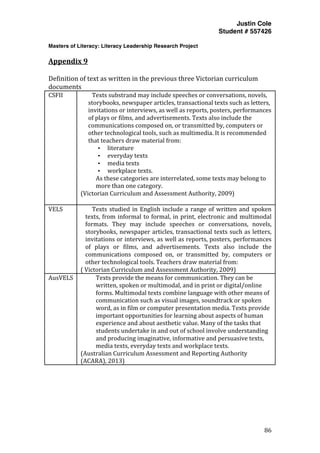
   This	
   research	
   follows	
   the	
   definition	
  
presented	
  in	
  the	
  AusVELS	
  curriculum	
  documentation.	
  	
  
They	
  define	
  text	
  as,	


“Texts	
   provide	
   the	
   means	
   for	
   communication.	
   They	
   can	
   be	
  
written,	
   spoken	
   or	
   multimodal,	
   and	
   in	
   print	
   or	
   digital/online	
  
forms.	
   Multimodal	
   texts	
   combine	
   language	
   with	
   other	
   means	
   of	
  
communication	
   such	
   as	
   visual	
   images,	
   soundtrack	
   or	
   spoken	
  
word,	
   as	
   in	
   film	
   or	
   computer	
   presentation	
   media.	
   Texts	
   provide	
  
important	
   opportunities	
   for	
   learning	
   about	
   aspects	
   of	
   human	
  
experience	
  and	
  about	
  aesthetic	
  value.”	
  
(Australian	
  Curriculum	
  Assessment	
  and	
  Reporting	
  Authority	
  (ACARA),	
  2013)	


Justin Cole
Student # 557426
Masters of Literacy: Literacy Leadership Research Project


   9	


Literature	
  Review	


This	
  chapter	
  presents	
  a	
  synthesis	
  of	
  the	
  current	
  research	
  into	
  the	
  key	
  areas	
  of	
  
inquiry	
  for	
  this	
  research	
  project.	
  The	
  Literature	
  Review	
  recognises	
  what	
  areas	
  of	
  
research	
  have	
  already	
  been	
  investigated	
  and	
  what	
  this	
  research	
  project	
  adds	
  to	
  
the	
   body	
   of	
   knowledge	
   around	
   the	
   topic	
   of	
   student	
   motivation,	
   multiliteracies	
  
and	
   educational	
   leadership	
   that	
   supports	
   teachers	
   with	
   curriculum	
  
implementation.	


Multiliteracies	
  &	
  Critical	
  literacy	
  
Developing	
   skills	
   in	
   critical	
   analysis	
   of	
   text	
   and	
   supporting	
   critical	
   thought	
   in	
  
students	
   is	
   the	
   objective	
   of	
   a	
   critical	
   literacy	
   based	
   approach	
   to	
   literacy	
  
education.	
  Gainer	
  (Gainer,	
  2010)	
  (Sharp,	
  2012)supports	
  the	
  notion	
  that	
  critical	
  
thought	
  has	
  an	
  impact	
  not	
  only	
  on	
  the	
  individual	
  but	
  it	
  is	
  also	
  the	
  foundation	
  of	
  a	
  
healthy	
  democratic	
  society.	


Gainer	
  also	
  makes	
  strong	
  connections	
  between	
  a	
  critical	
  literacy	
  approach	
  and	
  a	
  
student’s	
   engagement	
   and	
   motivation,	
   claiming	
   that	
   a	
   literacy	
   pedagogy	
   that	
  
connects	
   with	
   the	
   cultural	
   and	
   linguistic	
   variations	
   present	
   in	
   any	
   classroom	
  
provide	
  affirmation	
  for	
  students	
  and	
  an	
  increase	
  in	
  connectedness.	


Justin Cole
Student # 557426
Masters of Literacy: Literacy Leadership Research Project


   10	


The	
  use	
  of	
  multimodal,	
  web	
  2.0	
  tools	
  such	
  as	
  blogs	
  and	
  wikis	
  has	
  allowed	
  often	
  
marginalised	
  member	
  of	
  society	
  to	
  become	
  creators	
  of	
  popular	
  culture.	
  This	
  has	
  
supported	
  a	
  broader	
  representation	
  of	
  the	
  world	
  today.	


Embedding	
  a	
  critical	
  literacy	
  curriculum	
  takes	
  time	
  as	
  it	
  encourages	
  the	
  teachers	
  
to	
   remove	
   themselves	
   from	
   the	
   tag	
   of	
   ‘expert’	
   instead	
   collaborating	
   in	
   and	
  
supporting	
  students’	
  development.	
  This	
  fundamental	
  shift	
  supports	
  ownership	
  
over	
  learning	
  and	
  provides	
  opportunities	
  to	
  learn	
  from	
  students	
  and	
  honour	
  the	
  
out	
  of	
  school	
  literacies	
  students	
  engage	
  in.	


In	
   her	
   journal	
   article,	
   Breaking	
   Down	
   the	
   Barriers:	
   Using	
   Critical	
   Literacy	
   to	
  
Improve	
   Educational	
   Outcomes	
   for	
   Students	
   in	
   21st-­‐century	
   Australian	
  
Classrooms,	
  Kelly	
  Sharp(Sharp,	
  2012)	
  describes	
  critical	
  literacy	
  as	
  a	
  pedagogical	
  
approach	
   that	
   recognises	
   the	
   connection	
   between	
   literacy	
   practices	
   are	
  
ingrained	
  in	
  culture	
  and	
  that	
  they	
  reinforce	
  power	
  and	
  privilege	
  within	
  society. 	


Critical	
  literacy	
  attempts	
  to	
  expose	
  the	
  hidden	
  curriculum	
  present	
  in	
  texts.	
  Sharp	
  
argues	
  that	
  education	
  instead	
  focuses	
  on	
  discreet	
  learning	
  of	
  technical	
  skills	
  and	
  
practices	
  that	
  are	
  often	
  imagined	
  hierarchically.	
  This	
  ignores	
  the	
  inherent	
  skills	
  
and	
  practices	
  that	
  are	
  not	
  considered	
  as	
  functional	
  literacy	
  and	
  are	
  therefore	
  not	
  
explicitly	
  taught.	


Justin Cole
Student # 557426
Masters of Literacy: Literacy Leadership Research Project


   11	


Sharp	
  recognises	
  the	
  importance	
  of	
  embedding	
  multiliteracies	
  into	
  the	
  teaching	
  
of	
  critical	
  literacy.	
  She	
  believes	
  that	
  we	
  must	
  teach	
  the	
  comprehension	
  of	
  these	
  
texts	
  so	
  that	
  students	
  can	
  identify	
  and	
  gain	
  control	
  of	
  the	
  hidden	
  curriculum	
  in	
  
these	
  texts	
  and	
  in	
  turn,	
  acquire	
  social	
  status	
  and	
  currency.	


The	
   concept	
   of	
   multiliteries	
   is	
   described	
   best	
   by	
   the	
   New	
   London	
   Group	
   who	
  
refer	
  to	
  it	
  as	
  a	
  change	
  in	
  mindset	
  from	
  a	
  traditional	
  definition	
  of	
  being	
  literate	
  to	
  
one	
   more	
   suited	
   to	
   a	
   modern,	
   multi-­‐modal	
   society.	
   (The	
   New	
   London	
   Group,	
  
1996)	
  Traditionally,	
  the	
  notion	
  of	
  a	
  literate	
  individual	
  represented	
  a	
  competency	
  
in	
  one	
  language	
  and	
  in	
  one	
  text	
  mode.	
  The	
  New	
  London	
  Group	
  recognised	
  the	
  
huge	
  societal	
  shift	
  that	
  requires	
  individuals	
  to	
  develop	
  a	
  broader	
  range	
  of	
  skills	
  
to	
  flourish	
  in	
  a	
  culturally	
  and	
  linguistically	
  diverse	
  society.	


The	
   notion	
   of	
   cultural	
   capital	
   was	
   coined	
   by	
   Pierre	
   Bordieu	
   and	
   refers	
   to	
   the	
  
assets	
  that	
  an	
  individual	
  has	
  or	
  can	
  acquire	
  that	
  allow	
  them	
  to	
  become	
  socially	
  
mobile.	
  Sharp	
  recognises	
  that	
  literacy	
  is	
  a	
  powerful	
  form	
  of	
  cultural	
  capital	
  that	
  
dictates	
   the	
   distribution	
   of	
   power	
   within	
   any	
   given	
   context.	
   A	
   student	
   with	
   a	
  
developed	
  knowledge	
  and	
  understanding	
  of	
  the	
  dominant	
  discourse	
  poses	
  more	
  
capital	
   in	
   this	
   context.	
   When	
   looking	
   at	
   the	
   Australian	
   educational	
   setting	
  
through	
   this	
   lens,	
   this	
   means	
   capabilities	
   in	
   standardised	
   testing	
   and	
   white	
  
middleclass	
  Anglo-­‐Saxon	
  representations.	


Justin Cole
Student # 557426
Masters of Literacy: Literacy Leadership Research Project


   12	


Sharp	
  identifies	
  that	
  definitions	
  of	
  literacy	
  revolve	
  around	
  traditional	
  modes	
  of	
  
meaning	
  making	
  such	
  as	
  print	
  based	
  text,	
  while	
  a	
  shift	
  towards	
  defining	
  literacy	
  
as	
   embedding	
   traditional	
   concepts	
   into	
   the	
   cultural	
   and	
   social	
   contexts	
   they	
  
belong	
  to.	


To	
   teach	
   critical	
   literacy	
   Sharp	
   recommends	
   a	
   clear	
   framework	
   for	
   thinking,	
  
analysing	
  and	
  applying	
  knowledge	
  such	
  as	
  Bloom’s	
  taxonomy	
  of	
  Freebody’s	
  Four	
  
Resources	
  Model.	
  Sharp	
  also	
  recognises	
  the	
  importance	
  of	
  classroom	
  texts	
  from	
  
a	
  varied	
  range	
  of	
  perspectives	
  as	
  well	
  as	
  engaging	
  in	
  multiliteracies,	
  especially	
  
visual	
  literacies.	


Effective	
  teaching	
  is	
  about	
  knowing	
  our	
  students	
  and	
  their	
  needs,	
  and	
  with	
  the	
  
emergence	
   of	
   each	
   new	
   generation,	
   the	
   possibility	
   of	
   genuinely	
   knowing	
   our	
  
students	
  becomes	
  more	
  difficult.	


Kalantzis	
   and	
   Cope	
   theorise	
   critical	
   literacy	
   and	
   the	
   cultural	
   shift	
   from	
  
consumers	
  of	
  narrative	
  and	
  content	
  to	
  creators.	
  They	
  site	
  the	
  example	
  of	
  video	
  
game	
  players	
  and	
  the	
  evolution	
  of	
  the	
  games	
  narrative	
  as	
  they	
  interact	
  with	
  the	
  
game.	
   	
   The	
   creation	
   of	
   narrative	
   extends	
   to	
   creating	
   and	
   sharing	
   playlists	
   on	
  
iTunes	
  to	
  the	
  opportunity	
  to	
  select	
  viewing	
  angles	
  when	
  watching	
  sport.	


Justin Cole
Student # 557426
Masters of Literacy: Literacy Leadership Research Project


   13	


In	
   their	
   book,	
   ‘New	
   learning:	
   elements	
   of	
   a	
   science	
   of	
   education’(Kalantzis	
   &	
  
Cope,	
   2008),	
   Kalantzis	
   and	
   Cope	
   wrote	
   that	
   traditional	
   schooling	
   falls	
   short,	
  
disappointing	
   young	
   people	
   who	
   expect	
   higher	
   levels	
   of	
   engagement	
   but	
   also	
  
failing	
  to	
  direct	
  their	
  energies	
  into	
  developing	
  new	
  skills	
  and	
  strategies.	


Like	
  Sharp,	
  Kalantzis	
  and	
  Cope	
  recommend	
  the	
  introduction	
  of	
  higher	
  level	
  of	
  
digital	
  media	
  being	
  analysed	
  in	
  schools	
  to	
  create	
  conditions	
  that	
  are	
  conducive	
  to	
  
creating	
  an	
  individual	
  with	
  all	
  the	
  skills	
  and	
  traits	
  to	
  comprehend	
  contemporary	
  
text	
  types.	
  They	
  argue	
  that	
  digital	
  media	
  allows	
  students	
  to	
  work	
  at	
  their	
  own	
  
pace,	
  students	
  can	
  be	
  doing	
  what	
  is	
  best	
  for	
  them.	
  Digital	
  media	
  allows	
  students	
  
to	
  work	
  together	
  freely	
  and	
  supports	
  all	
  students	
  contributions	
  to	
  be	
  visible	
  and	
  
for	
  all	
  perspectives	
  to	
  be	
  heard.	


Kalantzis	
   and	
   Cope	
   write	
   about	
   the	
   concept	
   of	
   belonging	
   and	
   transformation	
  
within	
  a	
  school	
  setting.	
  They	
  state	
  that	
  belonging	
  occurs	
  in	
  an	
  educational	
  setting	
  
when	
   formal	
   learning	
   engages	
   with	
   a	
   learners	
   life	
   experiences.	
   Belonging	
   to	
  
learning	
  is	
  founded	
  upon	
  the	
  learning	
  ways,	
  the	
  learning	
  point	
  of	
  view	
  and	
  the	
  
learning	
  community.	


Kalantzis	
  and	
  Cope	
  believe	
  that	
  education	
  must	
  be	
  learner	
  transformative	
  and	
  
world	
  transformative	
  as	
  we	
  inquire	
  into	
  the	
  human	
  nature	
  of	
  learning	
  and	
  the	
  
role	
   it	
   plays	
   in	
   imagining	
   and	
   enacting	
   new	
   ways	
   of	
   being	
   human	
   and	
   living	
  
socially.	
  
Justin Cole
Student # 557426
Masters of Literacy: Literacy Leadership Research Project


   14	


Ray	
  Misson	
  and	
  Wendy	
  Morgan	
  believe	
  that	
  critical	
  literacy	
  is	
  about	
  the	
  hidden,	
  
unspoken	
  world	
  in	
  each	
  text	
  and	
  for	
  this	
  can	
  often	
  be	
  viewed	
  as	
  being	
  cold	
  and	
  
clinical,	
  Misson	
  and	
  Morgan	
  argue	
  for	
  a	
  balance	
  between	
  critique	
  of	
  a	
  text	
  and	
  
deriving	
  pleasure	
  from	
  the	
  purely	
  aesthetic.	


They	
  wrote	
  in	
  their	
  journal	
  article	
  ‘Beyond	
  the	
  Pleasure	
  Principle?	
  Confessions	
  of	
  
a	
  Critical	
  Literacy	
  Teacher’	
  (Misson	
  &	
  Morgan,	
  2005)	
  that	
  critical	
  literacy	
  shies	
  
away	
   from	
   text	
   interaction	
   for	
   pleasure	
   as	
   this	
   often	
   ignores	
   the	
   ideological	
  
message	
   underlying	
   each	
   text.	
   It	
   implies	
   a	
   relationship	
   between	
   critique	
   and	
  
pleasure	
  is	
  impossible.	
  	
  
Misson	
   and	
   Morgan	
   prefer	
   to	
   use	
   the	
   title	
   ‘Aesthetic	
   Texts’	
   as	
   it	
   removes	
   the	
  
pretence	
  that	
  ‘literature’	
  often	
  evokes.	
  It	
  also	
  allows	
  for	
  a	
  justifiable,	
  emotional	
  
response	
  that	
  is	
  as	
  valuable	
  as	
  critique.	


Their	
  rejection	
  of	
  the	
  impossible	
  relationship	
  between	
  critique	
  and	
  pleasure	
  is	
  
that	
  critical	
  literacy	
  provokes	
  the	
  identification	
  of	
  a	
  ‘difficulty’	
  with	
  the	
  dominant	
  
reading	
  of	
  a	
  text.	
  Misson	
  and	
  Morgan	
  argue	
  that	
  the	
  answers	
  that	
  Critical	
  literacy	
  
seeks	
  to	
  find	
  are	
  not	
  satisfactory	
  enough	
  to	
  comprehend	
  the	
  experience	
  a	
  text	
  is	
  
offering.	


They	
  write	
  that	
  no	
  one	
  reading	
  can	
  substitute	
  all	
  that	
  an	
  aesthetic	
  text	
  has	
  to	
  
offer,	
   “Aesthetic	
   texts	
   afford	
   an	
   inexhaustible	
   potential	
   that	
   can	
   delight	
  
readers”.(Misson	
  &	
  Morgan,	
  2005)	
  
Justin Cole
Student # 557426
Masters of Literacy: Literacy Leadership Research Project


   15	


LaMarca	
   &	
   Macintyre	
   also	
   contribute	
   to	
   the	
   argument	
   for	
   a	
   multiliteracies	
  
approach,	
   writing	
   about	
   the	
   changing	
   nature	
   of	
   communication	
   in	
   the	
   21st	
  
century.	
  In	
  their	
  book	
  ‘Knowing	
  Readers:	
  Unlocking	
  the	
  Pleasures	
  of	
  Reading’	
  (La	
  
Marca	
  &	
  Macintyre,	
  2006),	
  they	
  comment	
  that	
  a	
  larger	
  percentage	
  of	
  information	
  
is	
  being	
  contributed	
  visually	
  to	
  students,	
  either	
  through	
  the	
  internet,	
  television,	
  
computer	
  games	
  or	
  advertising	
  to	
  name	
  a	
  few.	


Because	
  of	
  this	
  they	
  argue	
  that	
  analysis	
  of	
  visual	
  literacy	
  is	
  an	
  essential	
  part	
  of	
  
contemporary	
  literacy	
  practice	
  and	
  one	
  best	
  learned	
  through	
  picture	
  storybooks.	
  
LaMarca	
  &	
  Macintyre	
  believe	
  that	
  not	
  only	
  must	
  students	
  learn	
  to	
  interpret	
  these	
  
texts	
  but	
  students	
  must	
  also	
  learn	
  how	
  they	
  work,	
  referencing	
  Anstey	
  &	
  Bulls	
  
(2009)	
  framework	
  of	
  metalanguage	
  as	
  a	
  guide.	
  	
  Anstey	
  &	
  Bull	
  identify	
  in	
  their	
  
framework	
   colour,	
   line,	
   texture,	
   shape,	
   form,	
   balance,	
   layout	
   and	
   tone	
   as	
   the	
  
grammar	
  of	
  visual	
  texts	
  that	
  will	
  support	
  an	
  understanding	
  of	
  how	
  visual	
  texts	
  
work.	


Justin Cole
Student # 557426
Masters of Literacy: Literacy Leadership Research Project


   16	


Student	
  Engagement	
  
Zammit	
  is	
  interested	
  in	
  the	
  relationship	
  between	
  levels	
  of	
  students’	
  engagement	
  
and	
   their	
   Socio-­‐economic	
   status.	
   She	
   writes	
   that	
   current	
   literacy	
   practices	
  
reinforce	
  the	
  sense	
  of	
  alienation	
  and	
  failure	
  for	
  low	
  SES	
  students,	
  highlighting	
  a	
  
failure	
  in	
  traditional	
  classrooms.	
  Zammit	
  implies	
  that	
  without	
  a	
  representation	
  of	
  
themselves	
  and	
  their	
  experiences	
  being	
  presented	
  in	
  pedagogy	
  and	
  curriculum,	
  
students	
  will	
  become	
  increasingly	
  disengaged.	
  (Zammit,	
  2011)	


While	
   Zammit	
   acknowledges	
   that	
   the	
   advances	
   in	
   technology	
   and	
   technology	
  
based	
   communication	
   is	
   an	
   important	
   reason	
   for	
   introducing	
   a	
   multiliteracies	
  
based	
  approach,	
  she	
  clearly	
  recognizes	
  there	
  is	
  an	
  important	
  difference	
  between	
  
multiliteracies	
  and	
  digital	
  literacies.	
  Multiliteracies	
  serve	
  to	
  define	
  the	
  teaching	
  
and	
  learning	
  of	
  the	
  process	
  and	
  practices	
  required	
  to	
  create	
  multimodal	
  texts,	
  
even	
  in	
  an	
  electronic	
  environment.	


Zammit	
  makes	
  a	
  strong	
  connection	
  between	
  students’	
  levels	
  of	
  engagement	
  and	
  
their	
   relationship	
   to	
   the	
   dominant	
   pedagogical	
   discourse,	
   arguing	
   that	
   who	
   is	
  
seen	
   to	
   be	
   literate	
   and	
   what	
   counts	
   as	
   knowledge	
   depends	
   very	
   much	
   on	
   the	
  
teachers	
  interpretations	
  and	
  values	
  of	
  literacy.	


Justin Cole
Student # 557426
Masters of Literacy: Literacy Leadership Research Project


   17	


The	
   importance	
   of	
   students’	
   engagement	
   has	
   been	
   written	
   about	
   both	
   by	
  
Guthrie(2008)	
   and	
   La	
   Marca	
   &	
   Macintyre(2006),	
   both	
   recognising	
   that	
  
engagement	
   was	
   a	
   stronger	
   indicator	
   of	
   achievement	
   than	
   a	
   students	
   home	
  
environment.	


La	
  Marca	
  &	
  Macintyre	
  take	
  this	
  notion	
  further	
  by	
  identifying	
  the	
  significant	
  role	
  
that	
   teachers	
   play	
   in	
   supporting	
   engagement	
   in	
   students.	
   They	
   write	
   of	
   the	
  
responsibility	
   teachers	
   have	
   to	
   promote	
   reading	
   and	
   the	
   act	
   of	
   reading	
   as	
   a	
  
wholly	
  pleasurable	
  experiences.	
  	
  La	
  Marca	
  &	
  Macintyre	
  refer	
  to	
  this	
  role	
  as	
  that	
  
of	
  an	
  ‘enabling	
  adult’,	
  an	
  advocate	
  who	
  can	
  support	
  students	
  selection	
  of	
  texts	
  as	
  
well	
   as	
   scaffolding	
   discussions	
   about	
   and	
   modeling/sharing	
   reading	
   with	
  
students.	
  (La	
  Marca	
  &	
  Macintyre,	
  2006)	


Jane	
  Lave	
  expanded	
  on	
  this	
  notion	
  of	
  the	
  Enabling	
  Adult	
  through	
  while	
  writing	
  
on	
  the	
  notion	
  of	
  teaching	
  as	
  learning.	
  She	
  writes,	


“Why	
  pursue	
  a	
  social	
  rather	
  than	
  a	
  more	
  familiar	
  psychological	
  theory	
  of	
  
learning?	
   To	
   the	
   extent	
   that	
   being	
   human	
   is	
   a	
   relational	
   matter,	
  
generated	
   in	
   social	
   living,	
   historically,	
   in	
   social	
   formations	
   whose	
  
participants	
  engage	
  with	
  each	
  other	
  as	
  a	
  condition	
  and	
  precondition	
  for	
  
their	
  existence”(Lave,	
  1996)	


Justin Cole
Student # 557426
Masters of Literacy: Literacy Leadership Research Project


   18	


CONCLUSION	
  
While	
  this	
  research	
  project	
  aims	
  to	
  inquire	
  into	
  the	
  specific	
  area	
  of	
  teacher	
  and	
  
student	
   personal	
   literacy	
   practices	
   and	
   the	
   effect	
   that	
   these	
   have	
   on	
   student	
  
engagement,	
  it	
  was	
  important	
  to	
  read	
  broadly	
  about	
  other	
  research	
  areas	
  that	
  
have	
  an	
  effect	
  on	
  students’	
  engagement.	


Research	
  done	
  around	
  critical	
  literacy	
  and	
  student	
  engagement	
  makes	
  clear	
  the	
  
strong	
   connection	
   between	
   the	
   use	
   of	
   multimodal	
   text	
   in	
   the	
   classroom	
   and	
  
student	
  engagement	
  and	
  the	
  teacher	
  competencies	
  required	
  to	
  support	
  students	
  
to	
  critically	
  analyse	
  multiliteracies	
  that	
  they	
  will	
  encounter	
  in	
  their	
  increasingly	
  
complex	
  lives.	
  The	
  important	
  role	
  that	
  educators’	
  play	
  is	
  made	
  clear	
  in	
  the	
  role	
  
that	
   La	
   Marca	
   and	
   Macintyre	
   (La	
   Marca	
   &	
   Macintyre,	
   2006)	
   dub	
   the	
   ‘enabling	
  
adult’.	


It	
   is	
   clear	
   that	
   the	
   coming	
   together	
   of	
   the	
   New	
   London	
   Group	
   was	
   a	
   seminal	
  
occasion	
   for	
   literacy	
   educators,	
   an	
   event	
   that	
   has	
   provoked	
   further	
   research.	
  	
  
However,	
  there	
  has	
  been	
  little	
  research	
  that	
  has	
  assessed	
  the	
  shift	
  in	
  classroom	
  
practice	
  and	
  the	
  support	
  needed	
  for	
  the	
  ongoing	
  implementation	
  of	
  their	
  initial	
  
research	
  on	
  student	
  learning.	


Justin Cole
Student # 557426
Masters of Literacy: Literacy Leadership Research Project


   19	


Methodology	
  
This	
   research	
   methodology	
   was	
   informed	
   by	
   existing	
   questions	
   around	
   the	
  
literary	
   practices	
   of	
   teachers	
   and	
   students	
   and	
   whether	
   these	
   would	
   have	
   a	
  
subconscious	
  effect	
  on	
  student	
  engagement.	


The	
  previous	
  chapter	
  explored	
  and	
  examined	
  the	
  existing	
  literature	
  and	
  research	
  
theories	
  relevant	
  to	
  student	
  engagement	
  and	
  the	
  role	
  a	
  multiliteracy	
  approach	
  to	
  
literacy	
  education	
  plays.	
  Research	
  conducted	
  by	
  the	
  Organisation	
  for	
  Economic	
  
Co-­‐Operation	
   and	
   Development	
   (OECD)(Organisation	
   For	
   Economic	
   Co-­‐
Operation	
   and	
   Development	
   (OECD),	
   2000)	
   showed	
   that	
   student	
   engagement	
  
levels	
   are	
   a	
   stronger	
   indicator	
   of	
   student	
   academic	
   achievement	
   than	
   other	
  
socioeconomic	
  measures.	
  It	
  also	
  illustrated	
  that	
  embedding	
  multiliteracies	
  and	
  
multimodal	
  text	
  types	
  into	
  classroom	
  practice	
  was	
  necessary	
  to	
  support	
  a	
  critical	
  
literacy	
  approach	
  and	
  in	
  turn	
  reflect	
  students’	
  home	
  experiences,	
  another	
  key	
  
factor	
  in	
  raising	
  student	
  engagement.	


This	
   chapter	
   aims	
   to	
   outline	
   the	
   procedural	
   approach	
   for	
   conducting	
   this	
  
research	
  and	
  the	
  philosophical	
  foundations	
  upon	
  which	
  this	
  research	
  sits.	
  	
  This	
  
section	
  opens	
  up	
  with	
  a	
  background	
  behind	
  the	
  theoretical	
  design	
  that	
  has	
  been	
  
chosen	
   and	
   is	
   followed	
   by	
   a	
   discussion	
   of	
   the	
   context,	
   participants	
   and	
   data	
  
sources	
   that	
   will	
   inform	
   this	
   research.	
   Finally	
   the	
   process	
   behind	
   the	
   data	
  
collection	
  will	
  be	
  explained.	
  
Justin Cole
Student # 557426
Masters of Literacy: Literacy Leadership Research Project


   20	


At	
  the	
  conclusion	
  of	
  this	
  research,	
  the	
  hope	
  is	
  that	
  the	
  findings	
  will	
  further	
  the	
  
knowledge	
  of	
  the	
  role	
  of	
  teachers	
  and	
  students	
  home	
  literacy	
  practices	
  play	
  on	
  
student’s	
  levels	
  of	
  engagement	
  and	
  in	
  turn	
  overall	
  academic	
  and	
  social	
  growth.	


As	
   (Lankshear	
   &	
   Knobel,	
   2004)	
   recognise,	
   the	
   purpose	
   of	
   practitioner	
   lead	
  
research	
  is	
  to	
  improve	
  practice.	
  Therefore,	
  it	
  is	
  hoped	
  that	
  the	
  findings	
  of	
  this	
  
research	
  will	
  add	
  to	
  the	
  body	
  of	
  knowledge	
  around	
  the	
  factors	
  that	
  effect	
  student	
  
engagement	
  as	
  well	
  as	
  the	
  influence	
  that	
  a	
  teachers	
  personal	
  literacy	
  practices	
  
play	
  on	
  student	
  achievement.	
  It	
  is	
  hoped	
  that	
  it	
  will	
  affirm	
  to	
  school	
  leaders	
  the	
  
importance	
   of	
   a	
   multiliteracies	
   approach	
   to	
   education	
   as	
   well	
   as	
   providing	
   an	
  
initial	
  framework	
  for	
  developing	
  teacher’s	
  capacity	
  in	
  this	
  area.	
  These	
  ideas	
  and	
  
philosophies	
  will	
  be	
  supported	
  by	
  qualitative	
  data	
  around	
  student	
  engagement	
  
and	
  motivation.	


Research	
  design	
  
This	
  research	
  project	
  collected	
  data	
  using	
  methods	
  that	
  supported	
  the	
  analysis	
  
of	
   the	
   resulting	
   data	
   using	
   a	
   qualitative	
   frame,	
   one	
   that	
   recognises	
   the	
  
importance	
  of	
  context.	
  (Lankshear	
  &	
  Knobel,	
  2004)	


The	
  methodology	
  for	
  this	
  research	
  involves	
  interviews	
  with	
  participants	
  about	
  
their	
  current	
  levels	
  of	
  engagement	
  with	
  a	
  range	
  of	
  multiliteracies	
  as	
  well	
  as	
  their	
  
attitudes	
  to	
  school	
  based	
  literacy	
  lessons.	
  	
  All	
  participants	
  completed	
  a	
  survey	
  
about	
  their	
  attitudes	
  to	
  literacy	
  lessons	
  in	
  school	
  and	
  questions	
  about	
  their	
  daily	
  
text	
  practices.	
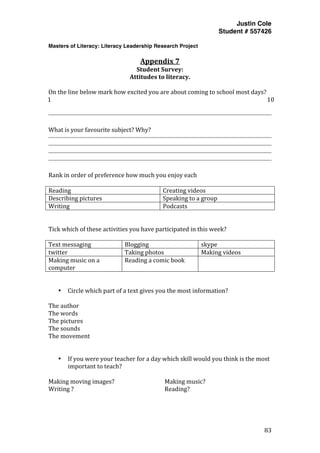
  (Appendix	
  7)	
  
Justin Cole
Student # 557426
Masters of Literacy: Literacy Leadership Research Project


   21	


Direct	
   observations	
   of	
   literacy	
   lessons	
   and	
   classroom	
   environments	
   occurred	
  
over	
   a	
   one-­‐week	
   period.	
   This	
   anecdotal	
   data	
   allowed	
   me	
   to	
   take	
   an	
   in-­‐situ	
  
snapshot	
  of	
  the	
  literacy	
  practices	
  in	
  these	
  classrooms.	


This	
   research	
   draws	
   on	
   qualitative	
   methods	
   including	
   teacher	
   and	
   student	
  
interviews	
  and	
  a	
  teacher	
  reflective	
  journal.	
  	
  The	
  student	
  interviews	
  and	
  survey	
  
will	
  gather	
  data	
  about	
  the	
  student’s	
  attitudes	
  towards	
  literacy	
  lessons	
  before	
  and	
  
after	
  teacher	
  intervention.	
  The	
  teacher	
  reflective	
  journal	
  will	
  provide	
  anecdotal	
  
data	
  about	
  the	
  effectiveness	
  of	
  explicit	
  intervention	
  on	
  teacher	
  capabilities	
  and	
  
confidence	
   when	
   using	
   contemporary	
   text	
   types	
   in	
   their	
   classroom.	
   Particular	
  
thought	
  will	
  be	
  given	
  to	
  the	
  effect	
  of	
  instructional	
  leadership	
  in	
  the	
  delivery	
  of	
  
school	
  based	
  teacher	
  intervention.	


Questions	
  that	
  will	
  guide	
  the	
  research	
  are;	


• What	
  text	
  types	
  do	
  teachers	
  and	
  students	
  frequently	
  engage	
  in	
  outside	
  of	
  
the	
  school	
  environment?	
  
• Is	
  there	
  room	
  for	
  private	
  literacy	
  practices	
  in	
  the	
  school	
  setting?	
  
• Do	
  teachers	
  utilise	
  their	
  own	
  text	
  practices	
  to	
  support	
  student	
  learning	
  
and	
  engagement?	
  	
  
• What	
   assumptions	
   do	
   teachers	
   make	
   about	
   the	
   Literacy	
   practices	
   of	
  
students?	
  
• How	
  do	
  teachers	
  define	
  ‘text’	
  for	
  use	
  in	
  their	
  classrooms?	
  
Justin Cole
Student # 557426
Masters of Literacy: Literacy Leadership Research Project


   22	


• How	
  frequently	
  are	
  non-­‐traditional	
  text	
  types	
  brought	
  into	
  classrooms?	
  
• What	
  are	
  student’s	
  attitudes	
  to	
  traditional	
  literacy	
  education?	


Setting	
  
This	
   study	
   took	
   place	
   in	
   a	
   government	
   primary	
   school	
   located	
   in	
   the	
   South-­‐
Eastern	
  Victorian	
  Region.	
  With	
  an	
  enrolment	
  of	
  487	
  and	
  a	
  population	
  with	
  a	
  high	
  
socio-­‐economic	
   background	
   it	
   enjoys	
   a	
   high	
   level	
   of	
   community	
   involvement	
  
with	
   parents	
   placing	
   a	
   high	
   level	
   of	
   importance	
   on	
   academic	
   success.	
   Our	
  
students	
  come	
  from	
  highly	
  educated	
  families	
  with	
  over	
  60%	
  of	
  year	
  6	
  students	
  
attending	
  private	
  secondary	
  schools.	
  Our	
  school	
  has	
  been	
  refining	
  and	
  delivering	
  
the	
   International	
   Baccalaureate	
   Primary	
   Years	
   Programme	
   for	
   the	
   last	
   three	
  
years,	
  and	
  we	
  will	
  be	
  fully	
  accredited	
  as	
  of	
  2013.	
  	
  Regardless	
  of	
  the	
  high	
  Student	
  
Family	
   occupation	
   (SFO)	
   index	
   rating	
   of	
   this	
   school,	
   the	
   research	
   participants	
  
were	
  selected	
  from	
  a	
  broad	
  SFO	
  profile.	


Participants	
  
Participants	
   in	
   this	
   research	
   were	
   selected	
   using	
   a	
   stratified	
   approach.	
   (Opie,	
  
2004)	
   The	
   sample	
   of	
   participants	
   will	
   consist	
   of	
   four	
   teachers	
   from	
   a	
  
government	
   primary	
   school	
   in	
   Victoria	
   and	
   two	
   students	
   from	
   each	
   of	
   their	
  
classes,	
  making	
  a	
  total	
  of	
  twelve	
  participants.	
  The	
  four	
  teachers	
  will	
  be	
  selected	
  
from	
  that	
  schools	
  English	
  Professional	
  Learning	
  Action	
  Team	
  (PLAT).	
  	
  
The	
  PLAT	
  teams	
  at	
  this	
  school	
  are	
  designed	
  with	
  representatives	
  from	
  each	
  year	
  
level	
  to	
  allow	
  dissemination	
  of	
  curriculum	
  and	
  pedagogical	
  support.	
  Therefore	
  
Choosing	
   PLAT	
   members	
   was	
   strategic	
   as	
   it	
   allowed	
   me	
   the	
   opportunity	
   for	
  
Justin Cole
Student # 557426
Masters of Literacy: Literacy Leadership Research Project


   23	


these	
   four	
   teachers	
   to	
   begin	
   to	
   reflect	
   on	
   their	
   practice	
   and	
   to	
   pass	
   on	
   their	
  
thoughts	
  and	
  experiences	
  to	
  their	
  colleagues.	


The	
  eight	
  students	
  were	
  aged	
  between	
  7	
  to	
  12years	
  old	
  and	
  all	
  were	
  invited	
  to	
  
participate	
   in	
   interviews	
   and	
   classroom	
   observations.	
   The	
   proposed	
   research	
  
relates	
  directly	
  to	
  the	
  approved	
  program	
  in	
  which	
  permission	
  has	
  been	
  granted	
  
for	
  projects	
  involving	
  the	
  evaluation	
  of	
  teaching	
  programs	
  within	
  an	
  educational	
  
setting.	
  All	
  teachers,	
  students,	
  students	
  parents	
  and	
  the	
  principal	
  of	
  the	
  school	
  
gave	
   their	
   consent	
   to	
   be	
   part	
   of	
   this	
   research	
   by	
   signing	
   and	
   returning	
   the	
  
appropriate	
  permission	
  forms.	
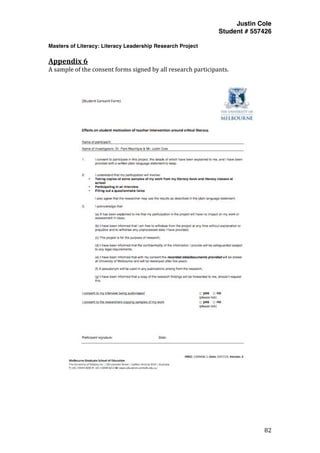
  (Appendix	
  6)	


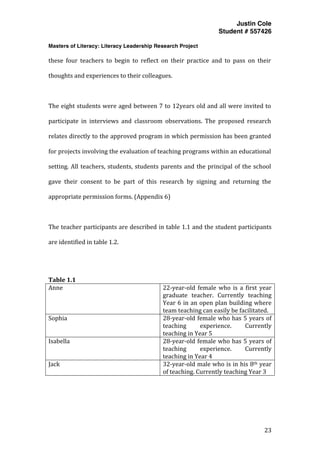
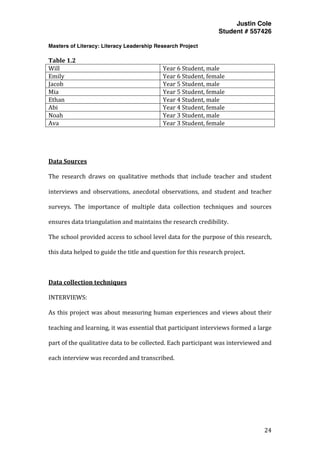
The	
  teacher	
  participants	
  are	
  described	
  in	
  table	
  1.1	
  and	
  the	
  student	
  participants	
  
are	
  identified	
  in	
  table	
  1.2.	


Table	
  1.1	
  
Anne	
   22-­‐year-­‐old	
   female	
   who	
   is	
   a	
   first	
   year	
  
graduate	
   teacher.	
   Currently	
   teaching	
  
Year	
  6	
  in	
  an	
  open	
  plan	
  building	
  where	
  
team	
  teaching	
  can	
  easily	
  be	
  facilitated.	
  
Sophia	
   28-­‐year-­‐old	
  female	
  who	
  has	
  5	
  years	
  of	
  
teaching	
   experience.	
   Currently	
  
teaching	
  in	
  Year	
  5	
  
Isabella	
  	
   28-­‐year-­‐old	
  female	
  who	
  has	
  5	
  years	
  of	
  
teaching	
   experience.	
   Currently	
  
teaching	
  in	
  Year	
  4	
  
Jack	
   32-­‐year-­‐old	
  male	
  who	
  is	
  in	
  his	
  8th	
  year	
  
of	
  teaching.	
  Currently	
  teaching	
  Year	
  3	


Justin Cole
Student # 557426
Masters of Literacy: Literacy Leadership Research Project


   24	


Table	
  1.2	
  
Will	
   Year	
  6	
  Student,	
  male	
  
Emily	
   Year	
  6	
  Student,	
  female	
  
Jacob	
   Year	
  5	
  Student,	
  male	
  
Mia	
   Year	
  5	
  Student,	
  female	
  
Ethan	
   Year	
  4	
  Student,	
  male	
  
Abi	
   Year	
  4	
  Student,	
  female	
  
Noah	
   Year	
  3	
  Student,	
  male	
  
Ava	
   Year	
  3	
  Student,	
  female	


Data	
  Sources	
  
The	
   research	
   draws	
   on	
   qualitative	
   methods	
   that	
   include	
   teacher	
   and	
   student	
  
interviews	
   and	
   observations,	
   anecdotal	
   observations,	
   and	
   student	
   and	
   teacher	
  
surveys.	
   The	
   importance	
   of	
   multiple	
   data	
   collection	
   techniques	
   and	
   sources	
  
ensures	
  data	
  triangulation	
  and	
  maintains	
  the	
  research	
  credibility.	
  
The	
  school	
  provided	
  access	
  to	
  school	
  level	
  data	
  for	
  the	
  purpose	
  of	
  this	
  research,	
  
this	
  data	
  helped	
  to	
  guide	
  the	
  title	
  and	
  question	
  for	
  this	
  research	
  project.	


Data	
  collection	
  techniques	
  
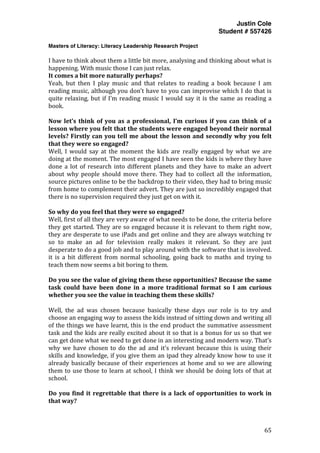
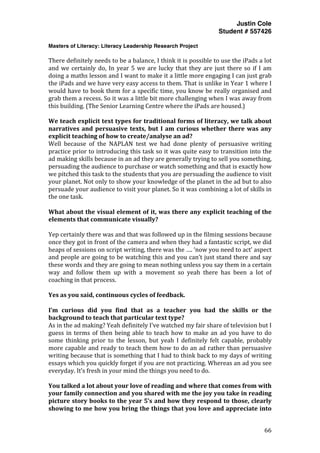
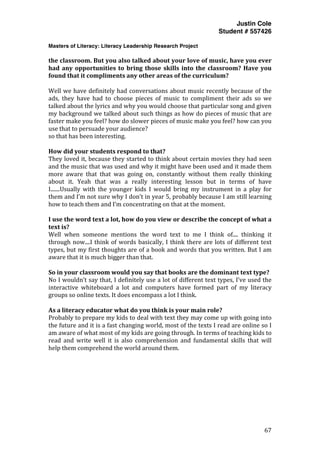
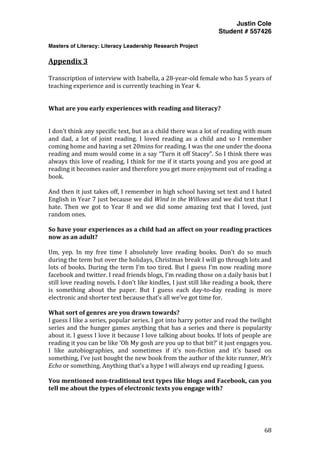
INTERVIEWS:	
  
As	
  this	
  project	
  was	
  about	
  measuring	
  human	
  experiences	
  and	
  views	
  about	
  their	
  
teaching	
  and	
  learning,	
  it	
  was	
  essential	
  that	
  participant	
  interviews	
  formed	
  a	
  large	
  
part	
  of	
  the	
  qualitative	
  data	
  to	
  be	
  collected.	
  Each	
  participant	
  was	
  interviewed	
  and	
  
each	
  interview	
  was	
  recorded	
  and	
  transcribed.	


Justin Cole
Student # 557426
Masters of Literacy: Literacy Leadership Research Project


   25	


Open-­‐ended	
  questioning	
  (Appendix	
  7)	
  was	
  used	
  to	
  guide	
  participant	
  views	
  and	
  
contributions	
  yet	
  maintain	
  individual	
  perspectives	
  and	
  beliefs.	


Due	
  to	
  the	
  considerable	
  weight	
  placed	
  on	
  participant	
  responses	
  it	
  was	
  extremely	
  
important	
   to	
   conduct	
   the	
   interviews	
   in	
   a	
   setting	
   and	
   time	
   that	
   allowed	
   the	
  
subject	
  comfort	
  and	
  time	
  to	
  contribute	
  full	
  and	
  thoughtful	
  responses.	


The	
  time	
  and	
  location	
  of	
  interviews	
  was	
  individualized	
  and	
  negotiated	
  with	
  each	
  
participant.	
  I	
  made	
  sure	
  to	
  provide	
  tea	
  and	
  coffee	
  to	
  relax	
  the	
  participant	
  and	
  
even	
  though	
  I	
  was	
  recording	
  the	
  conversation	
  I	
  was	
  conscious	
  of	
  removing	
  any	
  
recording	
  devices	
  from	
  the	
  table	
  or	
  line	
  of	
  sight	
  that	
  could	
  inhibit	
  responses.	


As	
   interviewer	
   I	
   assumed	
   a	
   very	
   relaxed	
   persona	
   and	
   sat	
   casually	
   with	
   open	
  
body	
  language	
  to	
  create	
  an	
  open	
  and	
  honest	
  environment.	


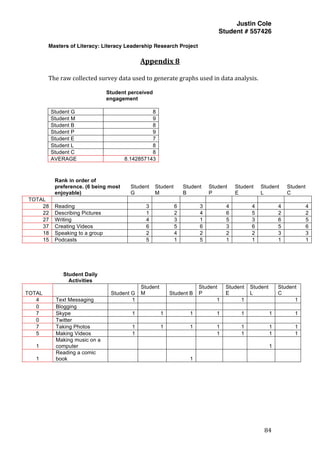
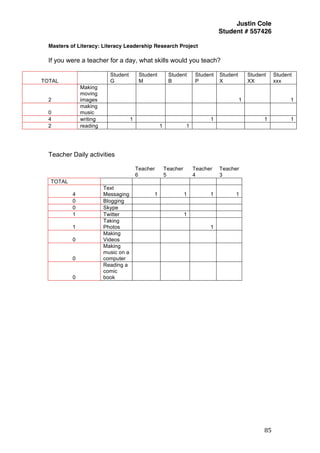
SURVEYS:	
  
Upon	
   completion	
   of	
   the	
   interviews,	
   all	
   participants	
   completed	
   a	
   survey	
   about	
  
their	
  daily	
  literacy	
  practices	
  and	
  attitudes	
  to	
  literacy	
  education.	
  
The	
   survey	
   provided	
   a	
   quantitative	
   measure	
   that	
   supported	
   the	
   qualitative	
  
observations.	


Justin Cole
Student # 557426
Masters of Literacy: Literacy Leadership Research Project


   26	


Results	
  and	
  Analysis	


The	
  previous	
  chapter	
  outlined	
  the	
  methodological	
  approach	
  to	
  the	
  collection	
  of	
  
research	
   data	
   that	
   supports	
   a	
   qualitative	
   research	
   framework.	
   The	
   qualitative	
  
data	
   includes	
   a	
   large	
   amount	
   of	
   verbatim	
   conversation	
   to	
   present	
   the	
  
respondents	
   thoughts	
   and	
   ideas	
   without	
   any	
   colouring.	
   As	
   Cohen	
   et	
   al	
   (2007)	
  
recognise,	
  this	
  is	
  a	
  method	
  of	
  that	
  keeps	
  the	
  flavour	
  of	
  the	
  original	
  data	
  and	
  in	
  
many	
  cases,	
  allows	
  it	
  to	
  speak	
  for	
  itself.	


Qualitative	
  data	
  analysis,	
  relies	
  on	
  the	
  organisation	
  and	
  explanation	
  of	
  the	
  data	
  
which	
   is	
   both	
   large	
   in	
   number	
   and	
   heavy	
   in	
   detail.	
   	
   Raw	
   data	
   on	
   its	
   own	
  
represents	
  little	
  more	
  than	
  the	
  basic	
  ingredients,	
  it	
  is	
  the	
  frame	
  through	
  which	
  
you	
  view	
  this	
  data	
  that	
  will	
  colour	
  its	
  reading.	
  The	
  analysis	
  and	
  discussion	
  will	
  
use	
  the	
  ‘Narrative	
  Analysis’	
  framework	
  Sharan	
  B.	
  Merriam	
  outlined	
  in	
  her	
  book	
  
‘Qualitative	
  Research:	
  A	
  Guide	
  to	
  Design	
  and	
  Implementation’	
  (2009).	


She	
  describes	
  Narrative	
  analysis	
  as,	
  
“the	
  study	
  of	
  experience	
  through	
  stories”	
  (Merriam	
  S.	
  B.,	
  2009)	


Teacher	
  Interviews:	
  
Full	
  transcripts	
  of	
  all	
  teacher	
  interviews	
  and	
  a	
  sample	
  of	
  the	
  student	
  interviews	
  
are	
  attached	
  as	
  appendix	
  1	
  through	
  5	
  of	
  this	
  thesis.	


Justin Cole
Student # 557426
Masters of Literacy: Literacy Leadership Research Project


   27	


Table	
  2.1	
  teacher	
  responses	
  to	
  the	
  question,	
  	
  ‘Do	
  you	
  have	
  any	
  fond	
  memories	
  with	
  
reading	
  and	
  literacy?’	
  
Year	
  6	
  
Teacher	
  
Anne	
  	
  
In	
  about	
  grade	
  two	
  I	
  started	
  reading	
  to	
  my	
  dad	
  every	
  night	
  in	
  bed,	
  So	
  I	
  
would	
  jump	
  into	
  their	
  bed	
  and	
  just	
  start	
  reading	
  to	
  them	
  for	
  about	
  30	
  
min.	
  He	
  would	
  just	
  lie	
  there	
  and	
  listen	
  and	
  every	
  time	
  I	
  mispronounced	
  
a	
  word	
  or	
  mumbled	
  he	
  would	
  help	
  me	
  out	
  by	
  saying,	
  ‘read	
  that	
  page	
  
again’	
  or	
  ‘read	
  faster’	
  so	
  he	
  would	
  spend	
  about	
  an	
  hour	
  and	
  a	
  half	
  each	
  
night	
  just	
  listening	
  to	
  me	
  and	
  my	
  brothers	
  read.	


So	
  why	
  does	
  that	
  memory	
  stick	
  out?	


I	
   don’t	
   know	
   I	
   just	
   really	
   enjoyed	
   going	
   into	
   his	
   room	
   and	
   if	
   I	
   was	
  
enjoying	
   a	
   book	
   to	
   be	
   able	
   to	
   share	
   it	
   with	
   him	
   and	
   for	
   him	
   to	
   be	
  
actually	
   engaged.	
   He	
   wasn't	
   just	
   lying	
   there	
   he	
   was	
   actually	
   really	
  
interested	
  in	
  what	
  we	
  were	
  doing.	


Year	
   5	
  
Teacher	
  
Sophia	
  
From	
  when	
  I	
  was	
  a	
  kid	
  I	
  do	
  remember	
  having	
  a	
  love	
  of	
  books,	
  picture	
  
storybooks,	
  mainly	
  due	
  to	
  my	
  grandma	
  who	
  was	
  an	
  author.	
  She	
  wrote	
  a	
  
lot	
   of	
   rhyming	
   text	
   and	
   she	
   had	
   a	
   group	
   of	
   ladies	
   who	
   put	
   books	
  
together	
   called	
   the	
   ‘Big	
   Dipper’	
   series,	
   so	
   she	
   contributed	
   to	
   a	
   few	
  
different	
  books	
  that	
  were	
  published	
  so	
  she	
  tried	
  to	
  read	
  to	
  us	
  as	
  much	
  
as	
  possible	
  and	
  listen	
  to	
  us	
  read	
  as	
  kids.	
  She	
  was	
  amazing,	
  she	
  used	
  to	
  
write	
  rhymes	
  for	
  us,	
  if	
  we	
  were	
  doing	
  an	
  Easter	
  egg	
  hunt	
  she	
  used	
  to	
  
write	
   clues	
   that	
   would	
   rhyme.	
   So	
   if	
   anyone	
   influenced	
   my	
   childhood	
  
literacy	
  it	
  was	
  her	
  and	
  mum	
  who	
  would	
  often	
  read	
  to	
  me.	
  But	
  as	
  I	
  got	
  
older	
  and	
  started	
  to	
  read	
  longer	
  books,	
  it	
  was	
  really	
  important	
  to	
  find	
  a	
  
book	
   that	
   I	
   loved	
   and	
   enjoyed	
   from	
   the	
   beginning	
   because	
   often	
   at	
  
school	
  I	
  would	
  be	
  thrown	
  a	
  book	
  and	
  not	
  enjoy	
  it	
  and	
  it	
  would	
  take	
  me	
  
ages	
   to	
   finish.	
   But	
   really	
   I	
   did	
   love	
   books	
   from	
   the	
   beginning	
   mainly	
  
because	
  of	
  my	
  grandma.	


Year	
   4	
  
teacher	
  
Isabella	
  
I	
  guess	
  I	
  like	
  a	
  series,	
  popular	
  series.	
  I	
  got	
  into	
  harry	
  potter	
  and	
  read	
  the	
  
twilight	
   series	
   and	
   the	
   hunger	
   games	
   anything	
   that	
   has	
   a	
   series	
   and	
  
there	
  is	
  popularity	
  about	
  it.	
  I	
  guess	
  I	
  love	
  it	
  because	
  I	
  love	
  talking	
  about	
  
books.	
  If	
  lots	
  of	
  people	
  are	
  reading	
  it	
  you	
  can	
  be	
  like	
  ‘Oh	
  My	
  gosh	
  are	
  
you	
   up	
   to	
   that	
   bit?’	
   it	
   just	
   engages	
   you.	
   I	
   like	
   autobiographies,	
   and	
  
sometimes	
   if	
   it’s	
   non	
   fiction	
   and	
   it’s	
   based	
   on	
   something,	
   I’ve	
   just	
  
bought	
  the	
  new	
  book	
  from	
  the	
  author	
  of	
  the	
  kite	
  runner,	
  Mt’s	
  Echo	
  or	
  
Justin Cole
Student # 557426
Masters of Literacy: Literacy Leadership Research Project


   28	


something.	
  Anything	
  that’s	
  a	
  hype	
  I	
  will	
  always	
  end	
  up	
  reading	
  I	
  guess.	


Year	
   3	
  
Teacher	
  
Jack	
  
Absolutely,	
  my	
  Year	
  9	
  English	
  teacher	
  teaching	
  us	
  our	
  first	
  Shakespeare	
  
text,	
   the	
   passion	
   that	
   he	
   showed	
   for	
   the	
   text	
   and	
   the	
   way	
   that	
   that	
  
enthusiasm	
  for	
  the	
  text	
  influenced	
  the	
  classes	
  reaction	
  to	
  King	
  Henry	
  V,	
  
and	
   actually	
   the	
   same	
   teacher	
   the	
   following	
   year	
   showing	
   us	
   Jane	
  
Austen	
  for	
  the	
  first	
  time.	
  Two	
  very	
  strong	
  memories	
  of	
  learning	
  English	
  
at	
  school.	


They	
  are	
  considered	
  very	
  canonical	
  text,	
  was	
  that	
  part	
  of	
  the	
  allure	
  
of	
   the	
   experience	
   because	
   they	
   were	
   different	
   or	
   outside	
   the	
  
realms	
  of	
  your	
  previous	
  experiences?	
  
Perhaps	
  it	
  was,	
  I	
  think	
  that	
  looking	
  back	
  on	
  it	
  that	
  it	
  is	
  not	
  the	
  easiest	
  
thing	
  in	
  the	
  world	
  to	
  make	
  a	
  14	
  year	
  old	
  boy	
  interested	
  in	
  Shakespeare	
  
or	
   more	
   particularly	
   Jane	
   Austen,	
   but	
   just	
   the	
   way	
   that	
   the	
   teaching	
  
style	
  of	
  this	
  particular	
  man	
  and	
  the	
  enthusiasm	
  that	
  he	
  showed	
  and	
  the	
  
way	
  that	
  he	
  taught	
  us	
  to	
  love	
  it	
  through	
  his	
  love	
  of	
  it	
  was	
  just	
  a	
  really	
  
powerful	
  moment	
  for	
  me.	


These	
   responses	
   illustrate	
   the	
   joy	
   and	
   passion	
   that	
   can	
   be	
   generated	
   through	
  
shared	
  moments	
  of	
  connection	
  around	
  a	
  text.	
  Their	
  formative	
  experiences	
  have	
  
all	
  shaped	
  their	
  reading	
  patterns	
  as	
  adults.	


This	
  is	
  best	
  illustrated	
  in	
  Isabella’s	
  response	
  where	
  she	
  raves	
  about	
  reading,	


“anything	
  that	
  has	
  a	
  series	
  and	
  there	
  is	
  popularity	
  about	
  it.	
  I	
  guess	
  I	
  
love	
   it	
   because	
   I	
   love	
   talking	
   about	
   books.	
   If	
   lots	
   of	
   people	
   are	
  
reading	
  it	
  you	
  can	
  be	
  like	
  ‘Oh	
  My	
  gosh	
  are	
  you	
  up	
  to	
  that	
  bit?’	
  it	
  just	
  
engages	
  you.”	
  
Justin Cole
Student # 557426
Masters of Literacy: Literacy Leadership Research Project


   29	


What	
  she	
  is	
  describing	
  is	
  the	
  concept	
  of	
  belonging	
  and	
  transformation	
  within	
  a	
  
setting.	
  Kalantzis	
  and	
  Cope	
  state	
  that	
  belonging	
  occurs	
  in	
  an	
  educational	
  setting	
  
when	
  formal	
  learning	
  engages	
  with	
  a	
  learners’	
  life	
  experiences.	


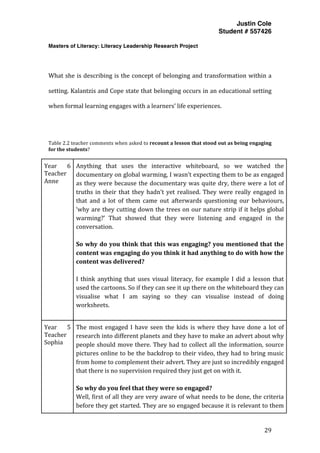
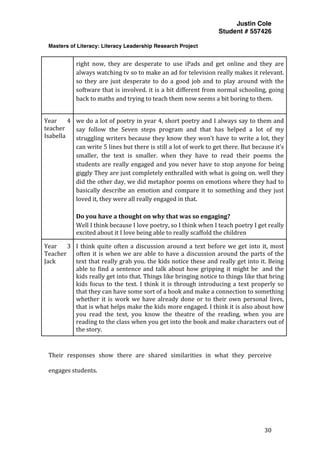
Table	
  2.2	
  teacher	
  comments	
  when	
  asked	
  to	
  recount	
  a	
  lesson	
  that	
  stood	
  out	
  as	
  being	
  engaging	
  
for	
  the	
  students?	


Year	
   6	
  
Teacher	
  
Anne	
  
Anything	
   that	
   uses	
   the	
   interactive	
   whiteboard,	
   so	
   we	
   watched	
   the	
  
documentary	
  on	
  global	
  warming,	
  I	
  wasn’t	
  expecting	
  them	
  to	
  be	
  as	
  engaged	
  
as	
  they	
  were	
  because	
  the	
  documentary	
  was	
  quite	
  dry,	
  there	
  were	
  a	
  lot	
  of	
  
truths	
  in	
  their	
  that	
  they	
  hadn’t	
  yet	
  realised.	
  They	
  were	
  really	
  engaged	
  in	
  
that	
   and	
   a	
   lot	
   of	
   them	
   came	
   out	
   afterwards	
   questioning	
   our	
   behaviours,	
  
‘why	
  are	
  they	
  cutting	
  down	
  the	
  trees	
  on	
  our	
  nature	
  strip	
  if	
  it	
  helps	
  global	
  
warming?’	
   That	
   showed	
   that	
   they	
   were	
   listening	
   and	
   engaged	
   in	
   the	
  
conversation.	


So	
  why	
  do	
  you	
  think	
  that	
  this	
  was	
  engaging?	
  you	
  mentioned	
  that	
  the	
  
content	
  was	
  engaging	
  do	
  you	
  think	
  it	
  had	
  anything	
  to	
  do	
  with	
  how	
  the	
  
content	
  was	
  delivered?	


I	
   think	
   anything	
   that	
   uses	
   visual	
   literacy,	
   for	
   example	
   I	
   did	
   a	
   lesson	
   that	
  
used	
  the	
  cartoons.	
  So	
  if	
  they	
  can	
  see	
  it	
  up	
  there	
  on	
  the	
  whiteboard	
  they	
  can	
  
visualise	
   what	
   I	
   am	
   saying	
   so	
   they	
   can	
   visualise	
   instead	
   of	
   doing	
  
worksheets.	


Year	
   5	
  
Teacher	
  
Sophia	
  
The	
  most	
  engaged	
  I	
  have	
  seen	
  the	
  kids	
  is	
  where	
  they	
  have	
  done	
  a	
  lot	
  of	
  
research	
  into	
  different	
  planets	
  and	
  they	
  have	
  to	
  make	
  an	
  advert	
  about	
  why	
  
people	
  should	
  move	
  there.	
  They	
  had	
  to	
  collect	
  all	
  the	
  information,	
  source	
  
pictures	
  online	
  to	
  be	
  the	
  backdrop	
  to	
  their	
  video,	
  they	
  had	
  to	
  bring	
  music	
  
from	
  home	
  to	
  complement	
  their	
  advert.	
  They	
  are	
  just	
  so	
  incredibly	
  engaged	
  
that	
  there	
  is	
  no	
  supervision	
  required	
  they	
  just	
  get	
  on	
  with	
  it.	


So	
  why	
  do	
  you	
  feel	
  that	
  they	
  were	
  so	
  engaged?	
  
Well,	
  first	
  of	
  all	
  they	
  are	
  very	
  aware	
  of	
  what	
  needs	
  to	
  be	
  done,	
  the	
  criteria	
  
before	
  they	
  get	
  started.	
  They	
  are	
  so	
  engaged	
  because	
  it	
  is	
  relevant	
  to	
  them	
  
Justin Cole
Student # 557426
Masters of Literacy: Literacy Leadership Research Project


   30	


right	
   now,	
   they	
   are	
   desperate	
   to	
   use	
   iPads	
   and	
   get	
   online	
   and	
   they	
   are	
  
always	
  watching	
  tv	
  so	
  to	
  make	
  an	
  ad	
  for	
  television	
  really	
  makes	
  it	
  relevant.	
  
so	
  they	
  are	
  just	
  desperate	
  to	
  do	
  a	
  good	
  job	
  and	
  to	
  play	
  around	
  with	
  the	
  
software	
  that	
  is	
  involved.	
  it	
  is	
  a	
  bit	
  different	
  from	
  normal	
  schooling,	
  going	
  
back	
  to	
  maths	
  and	
  trying	
  to	
  teach	
  them	
  now	
  seems	
  a	
  bit	
  boring	
  to	
  them.	


Year	
   4	
  
teacher	
  
Isabella	
  
we	
  do	
  a	
  lot	
  of	
  poetry	
  in	
  year	
  4,	
  short	
  poetry	
  and	
  I	
  always	
  say	
  to	
  them	
  and	
  
say	
   follow	
   the	
   Seven	
   steps	
   program	
   and	
   that	
   has	
   helped	
   a	
   lot	
   of	
   my	
  
struggling	
  writers	
  because	
  they	
  know	
  they	
  won’t	
  have	
  to	
  write	
  a	
  lot,	
  they	
  
can	
  write	
  5	
  lines	
  but	
  there	
  is	
  still	
  a	
  lot	
  of	
  work	
  to	
  get	
  there.	
  But	
  because	
  it’s	
  
smaller,	
   the	
   text	
   is	
   smaller.	
   when	
   they	
   have	
   to	
   read	
   their	
   poems	
   the	
  
students	
  are	
  really	
  engaged	
  and	
  you	
  never	
  have	
  to	
  stop	
  anyone	
  for	
  being	
  
giggly	
  They	
  are	
  just	
  completely	
  enthralled	
  with	
  what	
  is	
  going	
  on.	
  well	
  they	
  
did	
  the	
  other	
  day,	
  we	
  did	
  metaphor	
  poems	
  on	
  emotions	
  where	
  they	
  had	
  to	
  
basically	
  describe	
  an	
  emotion	
  and	
  compare	
  it	
  to	
  something	
  and	
  they	
  just	
  
loved	
  it,	
  they	
  were	
  all	
  really	
  engaged	
  in	
  that.	


Do	
  you	
  have	
  a	
  thought	
  on	
  why	
  that	
  was	
  so	
  engaging?	
  
Well	
  I	
  think	
  because	
  I	
  love	
  poetry,	
  so	
  I	
  think	
  when	
  I	
  teach	
  poetry	
  I	
  get	
  really	
  
excited	
  about	
  it	
  I	
  love	
  being	
  able	
  to	
  really	
  scaffold	
  the	
  children	
  
Year	
   3	
  
Teacher	
  
Jack	
  
I	
  think	
  quite	
  often	
  a	
  discussion	
  around	
  a	
  text	
  before	
  we	
  get	
  into	
  it,	
  most	
  
often	
  it	
  is	
  when	
  we	
  are	
  able	
  to	
  have	
  a	
  discussion	
  around	
  the	
  parts	
  of	
  the	
  
text	
  that	
  really	
  grab	
  you.	
  the	
  kids	
  notice	
  these	
  and	
  really	
  get	
  into	
  it.	
  Being	
  
able	
  to	
  find	
  a	
  sentence	
  and	
  talk	
  about	
  how	
  gripping	
  it	
  might	
  be	
  	
  and	
  the	
  
kids	
  really	
  get	
  into	
  that.	
  Things	
  like	
  bringing	
  notice	
  to	
  things	
  like	
  that	
  bring	
  
kids	
  focus	
  to	
  the	
  text.	
  I	
  think	
  it	
  is	
  through	
  introducing	
  a	
  text	
  properly	
  so	
  
that	
  they	
  can	
  have	
  some	
  sort	
  of	
  a	
  hook	
  and	
  make	
  a	
  connection	
  to	
  something	
  
whether	
  it	
  is	
  work	
  we	
  have	
  already	
  done	
  or	
  to	
  their	
  own	
  personal	
  lives,	
  
that	
  is	
  what	
  helps	
  make	
  the	
  kids	
  more	
  engaged.	
  I	
  think	
  it	
  is	
  also	
  about	
  how	
  
you	
   read	
   the	
   text,	
   you	
   know	
   the	
   theatre	
   of	
   the	
   reading,	
   when	
   you	
   are	
  
reading	
  to	
  the	
  class	
  when	
  you	
  get	
  into	
  the	
  book	
  and	
  make	
  characters	
  out	
  of	
  
the	
  story.	


Their	
   responses	
   show	
   there	
   are	
   shared	
   similarities	
   in	
   what	
   they	
   perceive	
  
engages	
  students.	


Justin Cole
Student # 557426
Masters of Literacy: Literacy Leadership Research Project


   31	


Firstly,	
   three	
   of	
   the	
   four	
   teachers	
   reported	
   that	
   the	
   engaging	
   lessons	
   utilised	
  
multiliteracies	
   in	
   some	
   way.	
   	
   Whether	
   it	
   is	
   a	
   visual	
   text	
   presented	
   on	
   the	
  
interactive	
   white	
   board	
   or	
   the	
   production	
   of	
   video	
   advertisements	
   for	
   the	
  
habitation	
   of	
   a	
   new	
   planet,	
   students	
   were	
   engaged	
   through	
   the	
   use	
   of	
  
communicating	
  using	
  multiple	
  modes	
  of	
  meaning	
  making.	


Secondly,	
  collaboration	
  was	
  identified	
  as	
  a	
  key	
  aspect	
  to	
  enhancing	
  engagement	
  
in	
  all	
  lessons.	
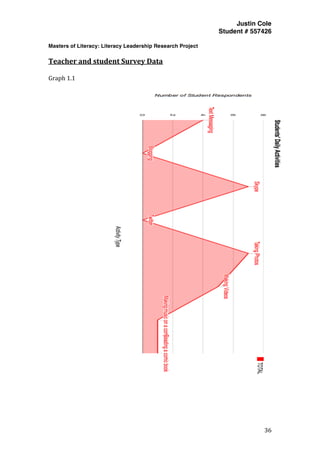
  The	
  ability	
  to	
  work	
  collaboratively	
  with	
  their	
  peers	
  was	
  engaging	
  
for	
  the	
  students.	
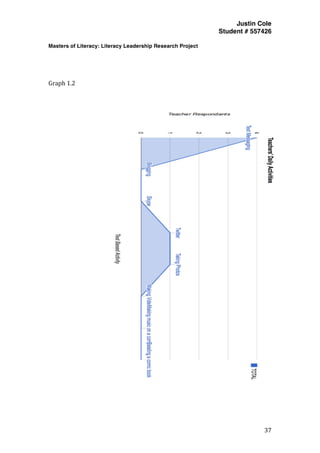
  This	
  element	
  supports	
  the	
  notion	
  of	
  literacy	
  as	
  a	
  social	
  practice	
  
and	
  mirrors	
  the	
  formative	
  experiences	
  that	
  the	
  teachers	
  had.	


Lastly,	
   whether	
   it	
   was	
   overtly	
   acknowledged	
   or	
   subconsciously	
   reported,	
   the	
  
involvement	
  and	
  motivation	
  of	
  the	
  teacher	
  led	
  to	
  higher	
  levels	
  of	
  engagement	
  in	
  
the	
  students.	


This	
  is	
  clear	
  in	
  Jack’s	
  response	
  where	
  he	
  cites	
  the	
  most	
  engaging	
  lessons	
  occur	
  
when	
  there	
  are	
  strong	
  analytical	
  discussions	
  around	
  world	
  level	
  features.	
  	
  This	
  is	
  
a	
   mirroring	
   of	
   his	
   favourite	
   memories	
   from	
   school	
   (table	
   2.1),	
   where	
   his	
  
strongest,	
  most	
  enjoyable	
  memories	
  come	
  from	
  discovering	
  classical	
  text.	


“I	
   love	
   Charles	
   Dickens	
   and	
   that’s	
   where	
   it	
   began,	
   they	
   way	
   you	
  
can	
   just	
   use	
   words	
   to	
   create	
   a	
   totally	
   beautiful	
   sentence	
   and	
  
memorable	
  text.”	
  (Appendix	
  4)	


Justin Cole
Student # 557426
Masters of Literacy: Literacy Leadership Research Project


   32	


Jack	
   is	
   clearly	
   mimicking	
   the	
   role	
   of	
   his	
   previous	
   teacher	
   in	
   an	
   attempt	
   to	
  
develop	
  that	
  same	
  love	
  of	
  reading	
  in	
  his	
  students.	
  He	
  is	
  assuming	
  the	
  role	
  of	
  the	
  
enabling	
   adult	
   with	
   the	
   purpose	
   of	
   supporting	
   his	
   students’	
   acquisition	
   of	
  
cultural	
  capital.	


Anne’s	
   comments	
   in	
   table	
   2.2	
   show	
   confusion	
   about	
   where	
   the	
   level	
   of	
  
engagement	
  is	
  coming	
  from.	
  She	
  believed	
  that	
  her	
  lesson	
  was	
  engaging	
  because	
  
it	
   was	
   on	
   the	
   interactive	
   whiteboard,	
   however	
   I	
   believe	
   it	
   is	
   because	
   of	
   the	
  
selection	
  of	
  text	
  she	
  chose.	


Using	
  a	
  multimodal	
  text	
  such	
  as	
  a	
  movie	
  made	
  the	
  content	
  more	
  relevant	
  and	
  
engaging	
  for	
  students.	
  Its	
  multimodality	
  allowed	
  for	
  access	
  to	
  the	
  content	
  in	
  a	
  
number	
  of	
  ways	
  and	
  was	
  congruent	
  with	
  how	
  students	
  communicate	
  on	
  a	
  daily	
  
basis.	
  	
  The	
  interactive	
  whiteboard	
  is	
  merely	
  a	
  tool	
  that	
  delivered	
  the	
  chosen	
  text.	


This	
  Misconception	
  can	
  also	
  be	
  seen	
  in	
  Sophia’s	
  comments	
  about	
  iPad	
  usage	
  in	
  
Year	
  5.	


“In	
  year	
  5	
  we	
  are	
  lucky	
  that	
  they	
  (the	
  iPads)	
  are	
  just	
  there	
  so	
  if	
  I	
  
am	
   doing	
   a	
   maths	
   lesson	
   and	
   I	
   want	
   to	
   make	
   it	
   a	
   little	
   more	
  
engaging	
  I	
  can	
  just	
  grab	
  the	
  iPads	
  and	
  we	
  have	
  very	
  easy	
  access	
  to	
  
them”	
  (Appendix	
  2)	


Justin Cole
Student # 557426
Masters of Literacy: Literacy Leadership Research Project


   33	


The	
   comments	
   from	
   teachers	
   indicate	
   that	
   there	
   is	
   no	
   explicit	
   teaching	
   of	
   the	
  
semiotics	
  of	
  multimodality.	
  This	
  is	
  in	
  contrast	
  to	
  the	
  suggestions	
  that	
  La	
  Marca	
  
and	
  Macintyre	
  make	
  about	
  effective	
  teaching	
  of	
  multiliteracies.	
  	
  They	
  believe	
  that	
  
not	
  only	
  must	
  students	
  learn	
  to	
  interpret	
  these	
  texts	
  but	
  students	
  must	
  also	
  learn	
  
how	
  they	
  work,	
  citing	
  Anstey	
  &	
  Bulls	
  (2009)	
  framework	
  of	
  metalanguage	
  as	
  a	
  
guide.	


Sophia	
  spoke	
  in	
  her	
  interview	
  about	
  an	
  engaging	
  lesson	
  where	
  the	
  students	
  were	
  
producing	
   advertisements	
   to	
   sell	
   the	
   planet	
   they	
   were	
   studying	
   to	
   potential	
  
inhabitants.	
  When	
  Sophia	
  was	
  asked	
  whether	
  she	
  felt	
  competent	
  and	
  capable	
  of	
  
teaching	
   the	
   semiotic	
   process	
   behind	
   meaning	
   making	
   in	
   audiovisual	
   text	
   she	
  
replied	
   in	
   the	
   positive,	
   not	
   because	
   of	
   a	
   level	
   of	
   competency	
   or	
   because	
   of	
   a	
  
framework	
  of	
  support,	
  simply	
  due	
  to	
  an	
  innate	
  level	
  of	
  knowledge	
  due	
  to	
  relative	
  
experiences	
  in	
  her	
  day	
  to	
  day	
  life.	


“I	
   definitely	
   felt	
   capable,	
   probably	
   more	
   capable	
   and	
   ready	
   to	
  
teach	
   them	
   how	
   to	
   do	
   an	
   ad	
   rather	
   than	
   persuasive	
   writing	
  
because	
  that	
  is	
  something	
  that	
  I	
  had	
  to	
  think	
  back	
  to	
  my	
  days	
  of	
  
writing	
  essays	
  which	
  you	
  quickly	
  forget	
  if	
  you	
  are	
  not	
  practicing.	
  
Whereas	
   an	
   ad	
   you	
   see	
   everyday.	
   It’s	
   fresh	
   in	
   your	
   mind	
   the	
  
things	
  you	
  need	
  to	
  do.”(Appendix	
  2)	


Justin Cole
Student # 557426
Masters of Literacy: Literacy Leadership Research Project


   34	


Assuming	
  that	
  you	
  know	
  how	
  something	
  works	
  simply	
  by	
  prolonged	
  exposure	
  to	
  
its	
  effects,	
  is	
  a	
  condescending	
  view	
  of	
  the	
  sophisticated	
  methods	
  advertising	
  uses	
  
to	
  persuade	
  its	
  audience.	
  	
  
This	
  assumption	
  of	
  knowledge	
  was	
  simply	
  extended	
  to	
  her	
  students,	
  a	
  common	
  
practice	
  especially	
  when	
  using	
  ICT	
  with	
  students.	
  The	
  assumption	
  that	
  they	
  just	
  
know	
  how	
  to	
  navigate	
  or	
  read	
  multimodal	
  texts	
  robs	
  the	
  students	
  a	
  consistent	
  
analytical	
  framework	
  that	
  supports	
  their	
  critical	
  analysis.	
  
“In	
  discussions	
  about	
  the	
  multimodal	
  literacy	
  practices	
  of	
  youth,	
  
what	
   is	
   being	
   missed	
   is	
   that	
   many	
   adolescents,	
   particularly	
  
those	
  who	
  are	
  not	
  of	
  the	
  dominant,	
  middle	
  class	
  culture,	
  are	
  still	
  
novices.	
  “(Mills,	
  2010)	


Table	
  2.3	
  contains	
  teacher	
  responses	
  to	
  the	
  question,	
  ‘How	
  do	
  you	
  define	
  text	
  for	
  the	
  purpose	
  
of	
  your	
  role	
  as	
  a	
  teacher?’	


Year	
   4	
  
teacher	
  
Isabella	


I	
  believe	
  a	
  text	
  is	
  anything	
  that	
  you	
  read.	
  So	
  it	
  can	
  go	
  from	
  a	
  comic	
  
strip	
  to	
  those	
  captions	
  of	
  animals	
  with	
  one	
  quote	
  on	
  it	
  to	
  an	
  essay.	
  I	
  
would	
   say	
   that	
   there	
   are	
   more	
   formal	
   texts	
   that	
   we	
   teach	
   like	
  
exposition	
  and	
  narratives	
  and	
  persuasive	
  text.	
  
Year	
   3	
  
Teacher	
  
Jack	
  
So	
   in	
   terms	
   of	
   what	
   I	
   would	
   think	
   of	
   as	
   a	
   text,	
   I	
   mean	
   it	
   is	
   a	
   very	
  
varied	
  thing	
  but	
  I	
  wouldn’t	
  consider	
  it	
  a	
  text	
  unless	
  it	
  was	
  of	
  a	
  certain	
  
length,	
  whereas	
  short	
  instructions	
  or	
  things	
  I	
  am	
  expecting	
  students	
  
to	
  read	
  through	
  I	
  wouldn’t	
  classify	
  as	
  a	
  text.	
  
Year	
   5	
  
Teacher	
  
Sophia	
  
Well	
   when	
   someone	
   mentions	
   the	
   word	
   text	
   to	
   me	
   I	
   think	
   of....	
  
thinking	
  it	
  through	
  now....I	
  think	
  of	
  words	
  basically,	
  I	
  think	
  there	
  are	
  
lots	
  of	
  different	
  text	
  types,	
  but	
  my	
  first	
  thoughts	
  are	
  of	
  a	
  book	
  and	
  
words	
  that	
  you	
  written.	
  But	
  I	
  am	
  aware	
  that	
  it	
  is	
  much	
  bigger	
  than	
  
that.	
  
Justin Cole
Student # 557426
Masters of Literacy: Literacy Leadership Research Project


   35	


Year	
   6	
  
Teacher	
  
Anne	
  
When	
   I	
   think	
   of	
   text	
   I	
   immediately	
   think	
   of	
   books,	
   but	
   that	
   is	
   just	
  
because	
  of	
  when	
  I	
  was	
  at	
  school	
  we	
  didn’t	
  use	
  multimodal	
  text.	
  We	
  
were	
  discussing	
  in	
  one	
  of	
  the	
  classes	
  that	
  text	
  can	
  refer	
  to	
  any	
  online,	
  
newspaper,	
  any	
  form	
  of	
  writing.	
  So	
  in	
  the	
  class	
  I	
  use	
  a	
  lot	
  of	
  online	
  
text,	
  such	
  as	
  in	
  Maths,	
  I	
  use	
  multimedia	
  text	
  to	
  illustrate	
  concepts.	


The	
  teacher	
  definitions	
  of	
  text	
  illustrate	
  a	
  traditional	
  view,	
  one	
  that	
  is	
  at	
  odds	
  
with	
  the	
  current	
  curriculum	
  documentation.	


While	
   the	
   current	
   definition	
   of	
   ‘text’	
   as	
   found	
   in	
   the	
   AusVELS	
   curriculum	
  
includes	
   reference	
   to	
   digital	
   and	
   online	
   text,	
   multimodal	
   text,	
   visual	
   text,	
  
soundtracks	
  and	
  any	
  other	
  form	
  of	
  communication.	
  The	
  teachers	
  have	
  a	
  static	
  
view	
   that	
   a	
   ‘text’	
   it	
   is	
   referring	
   to	
   books	
   and	
   the	
   written	
   word.	
   	
   (Australian	
  
Curriculum	
  Assessment	
  and	
  Reporting	
  Authority	
  (ACARA),	
  2013)	


There	
   were	
   some	
   slight	
   references	
   to	
   cartoons	
   (graphic	
   and	
   visual	
   text)	
   and	
  
multimedia	
   from	
   two	
   respondents,	
   however	
   they	
   are	
   mentioned	
   as	
   an	
  
afterthought	
   to	
   written	
   text	
   illustrating	
   their	
   position	
   in	
   the	
   hierarchy	
   of	
  
importance	
  for	
  the	
  teacher.	


No	
  matter	
  how	
  well	
  researched	
  or	
  progressive	
  a	
  curriculum	
  is,	
  if	
  the	
  classroom	
  
practice	
  or	
  philosophical	
  approach	
  of	
  the	
  teacher	
  is	
  not	
  in	
  alignment,	
  it	
  becomes	
  
redundant.
Justin Cole
Student # 557426
Masters of Literacy: Literacy Leadership Research Project


   36	


Teacher	
  and	
  student	
  Survey	
  Data	
  
Graph	
  1.1	


Justin Cole
Student # 557426
Masters of Literacy: Literacy Leadership Research Project


   37	


Graph	
  1.2	


Justin Cole
Student # 557426
Masters of Literacy: Literacy Leadership Research Project


   38	


The	
   previous	
   two	
   graphs	
   illustrate	
   a	
   clear	
   difference	
   between	
   the	
   text	
   based	
  
practices	
   of	
   the	
   two	
   participant	
   groups.	
   Graph	
   1.1	
   shows	
   that	
   teachers	
  
participate	
  in	
  traditional,	
  text	
  based	
  activities	
  such	
  as	
  text	
  messaging.	
  Whereas	
  
graph	
   1.2	
   indicates	
   that	
   students’	
   are	
   engaging	
   more	
   frequently	
   in	
   the	
  
production	
  of	
  multimodal	
  texts	
  on	
  a	
  daily	
  basis.	
  The	
  top	
  three	
  student	
  activities	
  
are	
  heavily	
  reliant	
  on	
  an	
  understanding	
  of	
  reading	
  and	
  producing	
  visual	
  text.	


Not	
   only	
   was	
   there	
   a	
   difference	
   between	
   the	
   teachers	
   and	
   students	
   daily	
   text	
  
based	
  activities,	
  there	
  was	
  also	
  a	
  fundamental	
  difference	
  that	
  emerged	
  from	
  the	
  
participant	
   interviews,	
   a	
   difference	
   that	
   revolves	
   around	
   the	
   purpose	
   of	
   their	
  
activities.	


Year	
   6	
   student	
   Emily	
   recounted	
   in	
   her	
   interview	
   about	
   the	
   ongoing	
  
communication	
  she	
  engages	
  in	
  with	
  her	
  friends.	


“So	
  is	
  it	
  (Social	
  media)	
  mainly	
  for	
  organisation?	
  
Yeah,	
   like	
   um	
   a	
   lot	
   of	
   the	
   time	
   I	
   have	
   to	
   organise	
   things	
   very	
  
quickly	
   on	
   the	
   weekend	
   so	
   usually	
   my	
   friends	
   and	
   I	
   invite	
   one	
  
another	
  out.	
  For	
  example	
  I	
  was	
  invited	
  to	
  the	
  park	
  and	
  I	
  Facetimed	
  
another	
  friend	
  and	
  invited	
  them	
  too.	
  I	
  was	
  also	
  invited	
  to	
  a	
  party	
  
on	
  Facetime	
  then	
  I	
  invited	
  someone	
  else	
  on	
  Facetime.”	
  (Appendix	
  
5)	
  
Justin Cole
Student # 557426
Masters of Literacy: Literacy Leadership Research Project


   39	


In	
  the	
  interview	
  with	
  Year	
  3	
  teacher	
  Jack,	
  he	
  talked	
  about	
  his	
  usage	
  of	
  online	
  text	
  
and	
  why	
  he	
  engages	
  with	
  them.	


“I’m	
  much	
  more	
  involved	
  in	
  digital	
  text,	
  If	
  I	
  think	
  about	
  it	
  in	
  
terms	
  of	
  what	
  I’m	
  reading,	
  I	
  do	
  far	
  more	
  reading	
  in	
  a	
  digital	
  
format.	
   I	
   read	
   a	
   lot	
   of	
   online	
   recipes	
   and	
   most	
   blogs	
   that	
   I	
  
would	
  visit	
  would	
  be	
  about	
  cooking.	
  Wikipedia	
  too	
  I	
  suppose,	
  
at	
  least	
  three	
  to	
  four	
  times	
  a	
  week	
  I	
  would	
  be	
  reading	
  that	
  sort	
  
of	
  thing.	
  I	
  think	
  I	
  probably	
  read	
  a	
  lot	
  more	
  on	
  my	
  phone	
  screen	
  
than	
  I	
  would	
  do	
  in	
  a	
  traditional	
  book	
  format.”	
  (Appendix	
  4)	


This	
   data	
   highlights	
   that	
   the	
   teachers’	
   online	
   practices	
   are	
   centered	
   around	
  
sourcing	
   information	
   and	
   resources,	
   whereas	
   students’	
   practices	
   were	
   about	
  
organising	
  and	
  communicating	
  with	
  peers.	
  Students	
  are	
  daily	
  producers	
  of	
  visual	
  
text	
  while	
  teachers’	
  text	
  production	
  is	
  limited	
  to	
  written	
  text.	


When	
   viewing	
   these	
   results	
   in	
   relation	
   to	
   Zammit’s	
   (2011)	
   views	
   on	
  
engagement,	
  if	
  there	
  is	
  a	
  gap	
  between	
  students	
  and	
  teachers’	
  text	
  practices	
  and	
  
ideologies,	
  this	
  must	
  surely	
  lead	
  to	
  a	
  stronger	
  level	
  of	
  disengagement	
  in	
  students	


Justin Cole
Student # 557426
Masters of Literacy: Literacy Leadership Research Project


   40	


Graph	
  1.3	


Graph	
   1.3	
   gives	
   a	
   clear	
   indication	
   that	
   the	
   production	
   of	
   videos	
   is	
   their	
   most	
  
enjoyable	
  form	
  of	
  text	
  production.	
  Writing	
  and	
  reading	
  are	
  equal	
  second	
  in	
  terms	
  of	
  
students	
  enjoyment.	
  
Justin Cole
Student # 557426
Masters of Literacy: Literacy Leadership Research Project


   41	


This	
   data	
   supports	
   the	
   view	
   of	
   Kalantzis	
   and	
   Cope	
   who	
   argue	
   that	
   digital	
   media	
  
allows	
  students	
  to	
  work	
  at	
  their	
  own	
  pace,	
  students	
  can	
  be	
  doing	
  what	
  is	
  best	
  for	
  
them.	
   Digital	
   media	
   allows	
   students	
   to	
   work	
   together	
   freely	
   and	
   supports	
   all	
  
students	
  contributions	
  to	
  be	
  visible	
  and	
  for	
  all	
  perspectives	
  to	
  be	
  heard.	


This	
  graph	
  is	
  also	
  validates	
  the	
  teachers’	
  reflections	
  on	
  what	
  text	
  based	
  elements	
  in	
  
lessons	
   engage	
   students.	
   This	
   is	
   important	
   because	
   it	
   affirms	
   the	
   teachers’	
  
assumptions	
  about	
  what	
  engages	
  students.	


Discussion	


When	
   analyzing	
   the	
   results	
   of	
   this	
   research,	
   it	
   is	
   important	
   to	
   return	
   to	
   the	
   initial	
  
questions	
  that	
  were	
  being	
  asked.	


What	
  text	
  types	
  do	
  teachers	
  and	
  students	
  frequently	
  engage	
  in?	
  
Unfortunately	
  teachers	
  are	
  very	
  rarely	
  engaging	
  in	
  new	
  texts	
  or	
  anything	
  outside	
  of	
  
their	
   already	
   established	
   practices.	
   Their	
   interviews	
   reveal	
   that	
   a	
   lack	
   of	
   time	
   and	
  
energy	
  is	
  a	
  limiting	
  factor	
  to	
  them	
  engaging	
  in	
  new	
  text.	


Justin Cole
Student # 557426
Masters of Literacy: Literacy Leadership Research Project


   42	


The	
  responses	
  below	
  reveal	
  that	
  due	
  to	
  the	
  grueling	
  nature	
  of	
  teaching,	
  there	
  is	
  simply	
  
no	
  more	
  energy	
  left	
  to	
  explore	
  and	
  therefore	
  teachers	
  fall	
  back	
  on	
  reliable	
  habits	
  and	
  
experiences.	


“I	
  used	
  to	
  read	
  every	
  night,	
  but	
  now	
  with	
  school	
  I’m	
  just	
  too	
  tired”	


   Year	
  6	
  teacher	
  Anne.	


“the	
  last	
  book	
  I	
  read	
  was	
  the	
  J.K	
  Rowling	
  book,	
  the	
  adult	
  fiction	
  ‘A	
  Casual	
  Vacancy’.	
  I	
  
don’t	
  get	
  as	
  much	
  time	
  anymore	
  since	
  I’ve	
  become	
  a	
  teacher”	
  
Year	
  5	
  teacher	
  Sophia.	


“During	
   the	
   term	
   I’m	
   too	
   tired.	
   But	
   I	
   guess	
   I’m	
   now	
   reading	
   more	
   facebook	
   and	
  
twitter.”	
  
Year	
  4	
  teacher	
  Isabella.	


Mills	
  wrote	
  of	
  the	
  importance	
  of	
  teachers’	
  engagement	
  with	
  students	
  home	
  literacies	
  noting,	
  
“Teachers	
  are	
  being	
  urged	
  to	
  include	
  new	
  literacies	
  using	
  digital	
  media	
  to	
  make	
  connections	
  
between	
  the	
  learning	
  spaces	
  of	
  home	
  and	
  school.	
  “(Mills,	
  2010)	


Yet	
  where	
  is	
  the	
  support	
  for	
  teachers	
  to	
  develop	
  their	
  own	
  competencies	
  in	
  these	
  new	
  
literacies,	
  further	
  allowing	
  them	
  to	
  become	
  engaged	
  educators	
  for	
  engaged	
  students.	


Justin Cole
Student # 557426
Masters of Literacy: Literacy Leadership Research Project


   43	


Is	
  there	
  room	
  for	
  private	
  literacy	
  practices	
  in	
  the	
  school	
  setting?	


  Teachers	
  reported	
  that	
  their	
  enthusiasm	
  directly	
  influenced	
  student	
  engagement.	
  In	
  
her	
  interview,	
  Year	
  4	
  teacher	
  Isabella	
  recalled	
  an	
  engaging	
  lesson	
  about	
  poetry.	
  During	
  
her	
   recount,	
   she	
   identified	
   her	
   own	
   level	
   of	
   enthusiasm	
   as	
   a	
   major	
   spur	
   for	
   her	
  
students.	


“the	
   other	
   day,	
   we	
   did	
   metaphor	
   poems	
   on	
   emotions	
   where	
   they	
  
had	
  to	
  basically	
  describe	
  an	
  emotion	
  and	
  compare	
  it	
  to	
  something	
  
and	
  they	
  just	
  loved	
  it,	
  they	
  were	
  all	
  really	
  engaged	
  in	
  that.	
  
Do	
  you	
  have	
  a	
  thought	
  on	
  why	
  that	
  was	
  so	
  engaging?	
  
Well	
  I	
  think	
  because	
  I	
  love	
  poetry,	
  so	
  I	
  think	
  when	
  I	
  teach	
  poetry	
  I	
  
get	
   really	
   excited	
   about	
   it	
   I	
   love	
   being	
   able	
   to	
   really	
   scaffold	
   the	
  
children,	
  getting	
  them	
  to	
  imaginatively	
  think	
  in	
  a	
  small	
  amount	
  of	
  
text.”	
  (Appendix	
  3)	


Graph	
  1.3	
  highlighted	
  that	
  teachers	
  were	
  very	
  aware	
  of	
  what	
  engages	
  students,	
  yet	
  the	
  
practices	
  that	
  do	
  engage	
  students	
  were	
  not	
  the	
  regular	
  practices	
  in	
  their	
  classrooms.	


Justin Cole
Student # 557426
Masters of Literacy: Literacy Leadership Research Project


   44	


Do	
   teachers	
   utilise	
   their	
   own	
   text	
   practices	
   to	
   support	
   student	
   learning	
   and	
  
engagement?	


Throughout	
  the	
  interviews	
  with	
  all	
  teacher	
  participants,	
  they	
  all	
  made	
  reference	
  to	
  
their	
  text	
  practices	
  and	
  their	
  enthusiasm	
  for	
  them	
  being	
  a	
  motivating	
  factor	
  for	
  their	
  
students.	
  
However	
  this	
  appears	
  to	
  be	
  a	
  subconscious	
  practice	
  that	
  needs	
  to	
  become	
  an	
  overt	
  
pedagogical	
  tool.	


What	
  assumptions	
  do	
  teachers	
  make	
  about	
  the	
  Literacy	
  practices	
  of	
  students?	
  
On	
  the	
  rare	
  instances	
  that	
  teachers	
  used	
  multiliteracies	
  in	
  their	
  teaching,	
  
they	
  felt	
  competent	
  despite	
  the	
  lack	
  of	
  a	
  knowledge	
  framework	
  or	
  metalanguage.	
  
They	
  held	
  this	
  belief	
  because	
  they	
  experience	
  these	
  text	
  types	
  on	
  a	
  daily	
  basis	
  and	
  
felt	
  an	
  instinctive	
  ability	
  to	
  teach	
  them.	


This	
  is	
  contradictory	
  to	
  the	
  daily	
  activities	
  of	
  the	
  teacher	
  participants	
  and	
  
underlines	
  a	
  misguided	
  belief	
  in	
  their	
  abilities.	
  This	
  assumption	
  that	
  teachers	
  apply	
  
to	
  themselves	
  they	
  also	
  apply	
  to	
  the	
  students.	
  They	
  assume	
  that	
  students	
  have	
  an	
  
innate	
  ability	
  to	
  analyse	
  and	
  compose	
  multimodal	
  text.	


“Teachers	
   have	
   a	
   key	
   responsibility	
   to	
   scaffold	
   multimodal	
  
literacies	
  and	
  model	
  new	
  technical	
  proficiencies.	
  They	
  can	
  lead	
  
students	
   to	
   engage	
   in	
   sophisticated,	
   mature	
   forms	
   of	
  
communication	
  that	
  are	
  unattainable	
  for	
  many	
  students	
  without	
  
Justin Cole
Student # 557426
Masters of Literacy: Literacy Leadership Research Project


   45	


intervention	
   and	
   expert	
   guidance.	
   In	
   discussions	
   about	
   the	
  
multimodal	
  literacy	
  practices	
  of	
  youth,	
  what	
  is	
  being	
  missed	
  is	
  
that	
   many	
   adolescents,	
   particularly	
   those	
   who	
   are	
   not	
   of	
   the	
  
dominant,	
  middle	
  class	
  culture,	
  are	
  still	
  novices.	
  “(Mills,	
  2010)	


How	
  do	
  teachers	
  define	
  ‘text’	
  for	
  use	
  in	
  their	
  classrooms?	
  
How	
  teachers	
  interpret	
  this	
  element	
  of	
  the	
  English	
  curriculum	
  is	
  essential	
  to	
  how	
  
	
  the	
  students	
  learn	
  and	
  for	
  equipping	
  them	
  with	
  the	
  necessary	
  skills	
  for.	
  	
  
Teachers’	
  definition	
  of	
  "text"	
  were	
  traditional	
  and	
  static	
  some	
  noting	
  that,	
  
"A	
  text	
  is	
  anything	
  you	
  read"	
  "It	
  must	
  be	
  of	
  a	
  certain	
  length	
  and	
  quality".	


How	
  frequently	
  are	
  non-­traditional	
  text	
  types	
  brought	
  into	
  classrooms?	
  
Year	
   6	
   student	
   Emily	
   identified	
   the	
   dominance	
   of	
   traditional	
   text	
   types	
   in	
   her	
  
interview	
  when	
  she	
  stated	
  that,	


“Text	
  is	
  more	
  of	
  a	
  thing	
  that	
  is	
  meant	
  for	
  school.	
  Text	
  is	
  more	
  
of	
  a	
  thing	
  that	
  you	
  do	
  everyday	
  whereas	
  film	
  is	
  more	
  of	
  a	
  thing	
  
that	
  you	
  do	
  on	
  a	
  one	
  off	
  basis.	
  You	
  need	
  to	
  learn	
  a	
  lot	
  more	
  
about	
  text	
  and	
  writing	
  because	
  you	
  will	
  do	
  that	
  more	
  in	
  the	
  
future	
  than	
  you	
  will	
  do	
  making	
  videos.”	
  (Emily,	
  Appendix	
  5)	


Justin Cole
Student # 557426
Masters of Literacy: Literacy Leadership Research Project


   46	


In	
   Year	
   5	
   teacher	
   Sophia’s	
   interview	
   she	
   discussed	
   the	
   use	
   of	
   iPads	
   in	
   her	
  
classroom	
  and	
  referred	
  to	
  their	
  inclusion	
  as,	


“we	
  are	
  allowing	
  them	
  to	
  use	
  those	
  to	
  learn	
  at	
  school”.	
  (Appendix	
  2)	


The	
  word	
  ‘allow’	
  is	
  highlight	
  as	
  it	
  provides	
  an	
  interesting	
  concept	
  of	
  ownership	
  
of	
   knowledge	
   and	
   the	
   thought	
   of	
   teachers	
   that	
   using	
   these	
   tools	
   for	
   video	
  
production	
   and	
   multimedia	
   as	
   special	
   lesson.	
   The	
   student	
   data	
   clearly	
   shows	
  
that	
   these	
   multimodal	
   practices	
   are	
   occurring	
   on	
   a	
   daily	
   basis	
   for	
   students	
  
already,	
   so	
   it	
   is	
   misguided	
   of	
   teachers	
   to	
   assume	
   that	
   these	
   are	
   special	
  
experiences	
   for	
   the	
   students.	
   in	
   this	
   instance	
   the	
   teacher	
   has	
   misunderstood	
  
where	
  the	
  engagement	
  is	
  coming	
  from,	
  not	
  from	
  the	
  reward	
  of	
  using	
  the	
  iPads,	
  
but	
  from	
  the	
  relevant	
  context	
  it	
  provides.	


In	
  the	
  Literature	
  Review	
  a	
  common	
  theme	
  was	
  emerging	
  about	
  the	
  importance	
  
of	
  using	
  multiliteracies	
  within	
  the	
  classroom.	
  Sharp(2012),	
  Kalantzis	
  and	
  Cope	
  
(2008)	
   both	
   recommended	
   the	
   introduction	
   of	
   a	
   higher	
   level	
   of	
   digital	
   media	
  
being	
  analysed	
  in	
  schools	
  to	
  create	
  conditions	
  that	
  are	
  conducive	
  to	
  creating	
  an	
  
individual	
  with	
  all	
  the	
  skills	
  and	
  traits	
  to	
  comprehend	
  contemporary	
  text	
  types.	
  
They	
   argued	
   that	
   digital	
   media	
   allows	
   students	
   to	
   work	
   at	
   their	
   own	
   pace,	
  
students	
  can	
  be	
  doing	
  what	
  is	
  best	
  for	
  them.	
  Digital	
  media	
  allows	
  students	
  to	
  
work	
  together	
  freely	
  and	
  supports	
  all	
  students	
  contributions	
  to	
  be	
  visible	
  and	
  for	
  
all	
  perspectives	
  to	
  be	
  heard.	


Justin Cole
Student # 557426
Masters of Literacy: Literacy Leadership Research Project


   47	


What	
  are	
  students’	
  attitudes	
  to	
  traditional	
  literacy	
  education?	


Students	
  were	
  asked	
  to	
  place	
  their	
  perceived	
  level	
  of	
  engagement	
  on	
  a	
  scale	
  from	
  
1	
   to	
   10.	
   This	
   question	
   would	
   allow	
   for	
   a	
   measurable	
   interpretation	
   of	
   how	
  
engaged	
  	
  students	
  currently	
  feel	
  they	
  are.	
  From	
  the	
  8	
  participants,	
  their	
  average	
  
score	
  was	
  a	
  very	
  high	
  8.1.	
  This	
  gives	
  a	
  clear	
  indication	
  that	
  engagement	
  levels	
  
are	
   high	
   amongst	
   the	
   students,	
   yet	
   it	
   gives	
   no	
   indication	
   of	
   why.	
   This	
   high	
  
average	
  is	
  at	
  odds	
  with	
  the	
  Attitudes	
  to	
  school	
  survey	
  that	
  Year	
  5	
  and	
  6	
  students	
  
complete	
   annually.	
   As	
   mentioned	
   in	
   the	
   introduction,	
   school	
   level	
   data	
   is	
   also	
  
showing	
   a	
   negative	
   trend.	
   These	
   results	
   may	
   be	
   contradictory	
   due	
   to	
   the	
  
difference	
  in	
  questioning	
  technique	
  or	
  the	
  more	
  relaxed	
  environment	
  that	
  a	
  one	
  
on	
  one	
  interview	
  allowed.	


“I	
  like	
  english	
  classes	
  a	
  bit	
  better	
  than	
  maths	
  and	
  I	
  think	
  it	
  is	
  going	
  to	
  be	
  really	
  
important	
  because	
  I’m	
  going	
  to	
  have	
  to	
  do	
  a	
  lot	
  of	
  essays	
  in	
  the	
  future	
  and	
  I’ll	
  
have	
  to	
  write	
  a	
  lot	
  of	
  business	
  reports	
  when	
  I	
  grow	
  up,	
  like	
  Dad	
  has	
  to	
  write	
  a	
  
report	
  on	
  business	
  everyday.	
  	
  
So	
  you	
  can	
  see	
  the	
  value	
  in	
  that?	
  
Yeah.”	
  (Appendix	
  5)	


Justin Cole
Student # 557426
Masters of Literacy: Literacy Leadership Research Project


   48	


This	
   passage	
   of	
   dialogue	
   between	
   Year	
   6	
   student	
   Emily	
   and	
   her	
   interviewer	
  
illustrates	
   a	
   common	
   theme	
   about	
   the	
   effectiveness	
   and	
   relevance	
   of	
   current	
  
English	
  classes.	


Comments	
   like	
   these	
   echo	
   the	
   data	
   presented	
   in	
   Graph	
   1.3.	
   This	
   data	
   clearly	
  
shows	
  that	
  students	
  value	
  the	
  traditional	
  modes	
  of	
  meaning	
  making	
  and	
  would	
  
continue	
   to	
   teach	
   these	
   skills.	
   Yet	
   in	
   direct	
   contrast	
   to	
   their	
   daily	
   practices	
   it	
  
raises	
  the	
  question	
  of	
  where	
  does	
  this	
  perception	
  of	
  skill	
  relevance	
  come	
  from?	


These	
  case	
  studies	
  prompt	
  further	
  questioning	
  as	
  to	
  why	
  teachers	
  who	
  recognise	
  
the	
  qualities	
  of	
  engaging	
  lessons,	
  fail	
  to	
  implement	
  this	
  level	
  of	
  teaching	
  with	
  a	
  
greater	
   frequency?	
   Is	
   there	
   a	
   hidden	
   perception	
   of	
   what	
   constitutes	
   quality	
  
teaching?	
   Are	
   there	
   traditional	
   values	
   perpetrated	
   by	
   high	
   stakes	
   testing	
   and	
  
parental	
  involvement	
  that	
  mirrors	
  their	
  own	
  experiences	
  that	
  is	
  subconsciously	
  
guiding	
  schools	
  and	
  teachers?	


In	
  conclusion,	
  the	
  analysis	
  of	
  the	
  qualitative	
  research	
  data	
  shows	
  that	
  teachers	
  
could	
  recognise	
  when	
  students	
  were	
  engaged	
  and	
  their	
  role	
  in	
  the	
  promotion	
  of	
  
student	
  engagement.	
  While	
  all	
  respondents	
  recalled	
  very	
  different	
  examples	
  in	
  
terms	
   of	
   content	
   and	
   structure,	
   there	
   were	
   similarities	
   that	
   were	
   consistent	
  
across	
   all	
   four	
   examples.	
   Lessons	
   that	
   teachers	
   identified	
   as	
   being	
   "engaging",	
  
always	
  involved	
  collaboration	
  and	
  the	
  presence	
  of	
  multiliteracies.	


Justin Cole
Student # 557426
Masters of Literacy: Literacy Leadership Research Project


   49	


Findings	
  and	
  Recommendations	
  
The	
  previous	
  Results,	
  Analysis	
  and	
  Discussion	
  chapter	
  presented	
  the	
  collected	
  
data	
   in	
   a	
   format	
   that	
   allowed	
   for	
   close	
   analysis	
   in	
   relation	
   to	
   the	
   research	
  
questions	
  posed	
  in	
  the	
  introduction.	
  The	
  key	
  results	
  from	
  that	
  chapter	
  include	
  a	
  
comparison	
  of	
  the	
  daily	
  text	
  based	
  practices	
  for	
  teacher	
  and	
  student	
  participant	
  
groups	
  as	
  well	
  as	
  participant	
  ideas	
  about	
  what	
  informs	
  student	
  engagement.	


That	
  data	
  analysis	
  now	
  forms	
  the	
  basis	
  for	
  the	
  following	
  three	
  recommendations	
  
this	
  chapter	
  will	
  present.	
  As	
  was	
  noted	
  in	
  the	
  methodology	
  for	
  this	
  project,	
  the	
  
purpose	
   of	
   practitioner	
   lead	
   research	
   is	
   to	
   improve	
   practice	
   and	
   these	
  
recommendations	
  have	
  been	
  written	
  to	
  support	
  that	
  notion.	
  
(Lankshear	
  &	
  Knobel,	
  2004)	


1)	
   Continued	
   and	
   ongoing	
   support	
   to	
   implement	
   curriculum	
  
documentation.	


Through	
   interviewing	
   teacher	
   participants	
   about	
   their	
   definition	
   of	
   ‘text’	
   it	
   is	
  
clear	
  that	
  the	
  participants	
  have	
  a	
  very	
  traditional	
  and	
  static	
  definition	
  that	
  they	
  
apply	
  to	
  their	
  teaching	
  and	
  classroom	
  context.	
  This	
  is	
  clearly	
  at	
  odds	
  with	
  the	
  
definition	
  of	
  text	
  as	
  written	
  in	
  the	
  AusVELS	
  curriculum	
  document.	


Justin Cole
Student # 557426
Masters of Literacy: Literacy Leadership Research Project


   50	


Looking	
   at	
   the	
   changing	
   nature	
   of	
   ‘text’	
   definition	
   in	
   the	
   previous	
   three	
  
curriculum	
   documents	
   (Appendix	
   9)	
   it	
   must	
   be	
   assumed	
   that	
   the	
   professional	
  
support	
  to	
  develop	
  the	
  inherent	
  skills	
  written	
  into	
  the	
  definitions	
  has	
  not	
  been	
  
provided	
  to	
  cope	
  with	
  the	
  changing	
  definition.	


Anecdotal	
   conversations	
   with	
   the	
   principal	
   of	
   the	
   school	
   show	
   that	
   there	
   is	
   a	
  
feeling	
  of	
  lack	
  of	
  support	
  from	
  the	
  department	
  that	
  “Curriculum	
  changes,	
  yet	
  we	
  
are	
  never	
  given	
  a	
  full	
  level	
  of	
  support	
  to	
  make	
  comprehensive,	
  timely	
  shifts”.	


Not	
   since	
   the	
   introduction	
   of	
   the	
   Early	
   Years	
   framework	
   has	
   there	
   been	
   a	
  
comprehensive	
  and	
  strategic	
  approach	
  to	
  changing	
  a	
  teacher’s	
  pedagogy	
  to	
  align	
  
with	
   the	
   shift	
   in	
   research	
   based	
   knowledge	
   and	
   philosophy	
   behind	
   literacy	
  
education.	


This	
   research	
   clearly	
   shows	
   that	
   further	
   support	
   is	
   needed	
   to	
   implement	
   the	
  
changes	
  that	
  are	
  written	
  into	
  the	
  new	
  AusVELS	
  curriculum.	
  This	
  support	
  needs	
  
to	
   be	
   ongoing	
   as	
   unlike	
   previous	
   curriculum	
   documents	
   that	
   existed	
   as	
   fixed	
  
hard	
  copies,	
  AusVELS	
  is	
  a	
  progressively	
  updated	
  online	
  resource.	
  The	
  results	
  of	
  
this	
   project	
   lead	
   me	
   to	
   teachers	
   may	
   struggle	
   to	
   operate	
   within	
   that	
   flexible	
  
environment.	


Justin Cole
Student # 557426
Masters of Literacy: Literacy Leadership Research Project


   51	


Mills	
   (Mills,	
   2010)Identifies	
   it	
   is	
   the	
   responsibility	
   of	
   educational	
   leaders	
   in	
  
schools	
   to	
   scaffold	
   an	
   engagement	
   in	
   multimodal	
   literacies	
   for	
   their	
   teaching	
  
staff,	
  thus	
  ensuring	
  they	
  can	
  scaffold	
  these	
  same	
  skills	
  for	
  their	
  students.	


2)	
  Teachers	
  need	
  to	
  be	
  supported	
  to	
  act	
  in	
  an	
  empowered	
  manner.	
  	
  
This	
   research	
   has	
   demonstrated	
   that	
   teachers	
   recognise	
   when	
   students	
   are	
  
engaged	
   and	
   that	
   that	
   occurs	
   when	
   students	
   are	
   engaged	
   by	
   using	
   modes	
   of	
  
communication	
  congruent	
  with	
  their	
  own	
  usage.	
  
The	
  question	
  must	
  then	
  be	
  asked,	
  why	
  then	
  do	
  teachers	
  not	
  use	
  this	
  knowledge	
  
to	
   change	
   their	
   pedagogy	
   for	
   the	
   benefit	
   of	
   student	
   learning?	
   The	
   teacher	
  
comments	
   indicate	
   that	
   there	
   are	
   issues	
   of	
   time,	
   either	
   time	
   to	
   teach	
   using	
  
multiliteracies	
  (set	
  up,	
  planning,	
  etc)	
  but	
  more	
  fundamentally,	
  the	
  comment	
  that	
  
there	
  is	
  a	
  lack	
  of	
  time	
  to	
  engage	
  and	
  familiarise	
  themselves	
  in	
  the	
  text	
  types	
  that	
  
the	
  students	
  are	
  using	
  daily.	


Teacher	
   participants	
   have	
   shown	
   through	
   their	
   comments	
   that	
   they	
   feel	
   more	
  
confident	
   teaching	
   the	
   texts	
   they	
   are	
   more	
   familiar	
   with,	
   in	
   spite	
   of	
   their	
  
knowledge	
  of	
  what	
  engages	
  students.	
  If	
  they	
  were	
  afforded	
  time	
  and	
  support	
  to	
  
implement	
  these	
  multiliteracies	
  it	
  would	
  be	
  reasonable	
  to	
  assume	
  that	
  student	
  
motivation	
  and	
  engagement	
  would	
  also	
  improve.	


Justin Cole
Student # 557426
Masters of Literacy: Literacy Leadership Research Project


   52	


Comments	
  arising	
  from	
  the	
  teacher	
  interviews	
  also	
  suggest	
  that	
  there	
  is	
  a	
  hidden	
  
curriculum	
  that	
  is	
  being	
  delivered,	
  one	
  with	
  alternate	
  values	
  and	
  pedagogy.	
  	
  
Teachers	
   are	
   still	
   relying	
   on	
   traditional	
   text	
   types	
   and	
   implied	
   a	
   hidden	
  
expectation	
  that	
  "teaching"	
  meant	
  a	
  reliance	
  on	
  mono	
  or	
  bi-­‐modal	
  text.	


This	
  data	
  also	
  suggests	
  that	
  this	
  view	
  is	
  also	
  one	
  that	
  the	
  students	
  had.	
  When	
  
they	
  were	
  asked	
  the	
  question,	
  	
  
“If	
   you	
   were	
   your	
   teacher	
   for	
   a	
   day	
   which	
   skill	
   would	
   you	
   think	
   is	
   the	
   most	
  
important	
  to	
  teach?”	
  (Appendix	
  7)	


50%	
  of	
  all	
  students	
  selected	
  ‘writing’	
  as	
  the	
  skill	
  they	
  would	
  teach.	
  This	
  is	
  not	
  
suggesting	
   that	
   teaching	
   students	
   to	
   write	
   is	
   not	
   an	
   important	
   skill,	
   rather	
   it	
  
shows	
   that	
   in	
   spite	
   of	
   their	
   daily	
   activities	
   (that	
   suggest	
   a	
   reliance	
   on	
   the	
  
production	
  of	
  visual	
  text),	
  they	
  have	
  a	
  perception	
  of	
  what	
  literacy	
  education	
  is.	


Justin Cole
Student # 557426
Masters of Literacy: Literacy Leadership Research Project


   53	


3)	
  Enhanced	
  funding	
  for	
  human	
  resources.	


The	
  data	
  analysis	
  presented	
  as	
  part	
  of	
  this	
  research	
  makes	
  clear	
  the	
  link	
  between	
  
a	
  teachers’	
  motivation	
  and	
  expertise	
  and	
  the	
  engagement	
  of	
  their	
  students.	
  	
  
The	
   comfort	
   that	
   teachers	
   felt	
   teaching	
   text	
   they	
   engage	
   in	
   and	
   the	
   increased	
  
motivation	
  they	
  demonstrated	
  when	
  they	
  taught	
  using	
  text	
  that	
  created	
  a	
  link	
  to	
  
their	
  private	
  practice,	
  shows	
  the	
  importance	
  of	
  investing	
  in	
  developing	
  teacher	
  
competency.	
  If	
  teachers	
  can	
  be	
  supported	
  to	
  become	
  competent	
  in	
  the	
  text	
  based	
  
practices	
  that	
  students	
  engage	
  in,	
  then	
  student	
  connection	
  and	
  engagement	
  with	
  
learning	
  will	
  increase.	


The	
  literature	
  review	
  clearly	
  illustrates	
  how	
  important	
  the	
  ‘enabling	
  adult’	
  is	
  for	
  
student	
  learning	
  and	
  development.	
  The	
  results	
  of	
  this	
  research	
  suggest	
  that	
  there	
  
is	
  a	
  mandate	
  needed	
  to	
  continue	
  to	
  ensure	
  funding	
  of	
  human	
  resources	
  is	
  always	
  
made	
  a	
  priority	
  over	
  ‘tools’	
  such	
  as	
  the	
  $180million	
  Ultranet.	


While	
  the	
  Ultranet	
  was	
  a	
  fantastic	
  initiative,	
  a	
  learning	
  platform	
  or	
  tool	
  where	
  
the	
  multiliteracies	
  approach	
  this	
  research	
  is	
  championing	
  can	
  be	
  implemented.	
  
This	
   research	
   clearly	
   shows	
   that	
   without	
   the	
   support	
   of	
   the	
   teachers	
   and	
   the	
  
development	
   of	
   their	
   competency,	
   the	
   students	
   will	
   never	
   get	
   the	
   learning	
  
opportunities	
  the	
  Ultranet	
  or	
  other	
  learning	
  tools	
  promise.	


Justin Cole
Student # 557426
Masters of Literacy: Literacy Leadership Research Project


   54	


To	
  conclude	
  this	
  research,	
  the	
  following	
  dot	
  points	
  are	
  a	
  summary	
  of	
  the	
  findings	
  
made	
  from	
  the	
  collected	
  data;	


• Teachers	
   are	
   still	
   confused	
   by	
   the	
   definition	
   of	
   text.	
   Even	
   though	
  
Curriculum	
  documents	
  reflect	
  changes	
  in	
  definition,	
  teachers’	
  definitions	
  
are	
  still	
  narrow.	
  
• There	
   is	
   still	
   a	
   reliance	
   on	
   traditional	
   text	
   types.	
   Teachers	
   implied	
   a	
  
hidden	
  expectation	
  that	
  "teaching"	
  meant	
  a	
  reliance	
  on	
  mono	
  or	
  bi-­‐modal	
  
text.	
  
• Teachers	
   recognise	
   that	
   students	
   are	
   engaged	
   by	
   using	
   modes	
   of	
  
communication	
  congruent	
  with	
  their	
  own	
  usage.	
  
• However	
   teachers	
   feel	
   more	
   confident	
   teaching	
   the	
   text	
   they	
   are	
   more	
  
familiar	
  with,	
  in	
  spite	
  of	
  their	
  knowledge	
  of	
  what	
  engages	
  students.	
  
• Teachers’	
   online	
   practices	
   are	
   around	
   sourcing	
   information	
   whereas	
  
students’	
  practices	
  are	
  to	
  organise	
  and	
  communicate.	
  
• Students	
  are	
  daily	
  producers	
  of	
  visual	
  text	
  while	
  teacher	
  participant	
  text	
  
production	
  is	
  limited	
  to	
  written	
  text.	


Justin Cole
Student # 557426
Masters of Literacy: Literacy Leadership Research Project


   55	


These	
  findings	
  have	
  lead	
  to	
  the	
  following	
  key	
  recommendations;	


• Continued	
   and	
   ongoing	
   support	
   to	
   implement	
   curriculum	
   changes	
   is	
  
required.	
  This	
  includes	
  ensuring	
  a	
  consistency	
  in	
  the	
  understanding	
  of	
  the	
  
content	
  and	
  philosophical	
  approach	
  of	
  the	
  curriculum.	
  
• A	
   priority	
   for	
   school	
   leadership	
   is	
   to	
   develop	
   methods	
   for	
   supporting	
  
teachers	
  to	
  act	
  in	
  an	
  empowered	
  manner.	
  This	
  research	
  has	
  shown	
  that	
  in	
  
spite	
  of	
  their	
  knowledge	
  of	
  what	
  engages	
  students,	
  these	
  lessons	
  are	
  the	
  
exception	
  to	
  their	
  teaching	
  and	
  not	
  the	
  rule.	
  	
  
• Enhanced	
   funding	
   for	
   human	
   resources.	
   The	
   concept	
   of	
   scaffolding	
  
students	
  and	
  acting	
  as	
  an	
  enabling	
  adult	
  is	
  reliant	
  on	
  relationships	
  and	
  
knowing	
  your	
  students.	
  This	
  research	
  has	
  highlighted	
  that	
  no	
  matter	
  what	
  
fancy	
  tool	
  is	
  used,	
  teachers	
  are	
  indispensable	
  in	
  the	
  learning	
  process	
  and	
  
must	
  be	
  supported	
  and	
  funded	
  appropriately.	


This	
   research	
   was	
   conducted	
   in	
   the	
   hope	
   of	
   identifying	
   areas	
   where	
   teacher	
  
capacity	
  can	
  be	
  improved	
  upon	
  and	
  in	
  turn	
  making	
  schooling	
  the	
  most	
  positive	
  
and	
  worthwhile	
  experience	
  for	
  all	
  students.	
   	
  Through	
  the	
  process	
  of	
  research,	
  
data	
  collection	
  and	
  analysis,	
  it	
  is	
  believed	
  that	
  these	
  recommendations	
  combined	
  
with	
  further	
  research	
  can	
  support	
  all	
  teachers	
  to	
  achieve	
  their	
  aims	
  and	
  help	
  our	
  
future	
  generations	
  be	
  active	
  participants	
  in	
  the	
  democratic	
  society	
  we	
  enjoy.	


Justin Cole
Student # 557426
Masters of Literacy: Literacy Leadership Research Project


   56	


References	
  
• Victorian	
  Curriculum	
  and	
  Assessment	
  Authority.	
  (2009,	
  September	
  16).	
  
Glossary	
  |	
  English	
  |	
  Domains	
  |	
  Victorian	
  Essential	
  Learning	
  Standards:.	
  
Retrieved	
  April	
  3,	
  2013,	
  from	
  Pandora	
  Archive	
  -­‐	
  Preserving	
  and	
  Accessing	
  
Networked	
  DOcumentary	
  Resources	
  of	
  Australia::	
  
http://pandora.nla.gov.au/pan/129125/20121206-­‐
0015/vels.vcaa.vic.edu.au/english/glossary.html	


• Australian	
  Bureau	
  of	
  Statistics.	
  (2013	
  йил	
  4-­‐February).	
  4901.0	
  Children's	
  
Participation	
  in	
  Cultural	
  and	
  leisure	
  Activities,	
  Australia,	
  Apr,	
  2012.	
  
Retrieved	
  2013	
  йил	
  14-­‐April	
  from	
  Australian	
  Bureau	
  of	
  Statistics:	
  
http://www.abs.gov.au/ausstats/abs@.nsf/Products/4901.0~Apr+2012
~Main+Features~Internet+and+mobile+phones?OpenDocument	


• Australian	
  Curriculum	
  Assessment	
  and	
  Reporting	
  Authority	
  (ACARA).	
  
(2013	
  йил	
  28-­‐January).	
  AusVELS	
  -­	
  English	
  -­	
  Content	
  structure,	
  3.2.	
  
Retrieved	
  2013	
  йил	
  15-­‐April	
  from	
  AusVELS	
  -­‐	
  Home:	
  
http://ausvels.vcaa.vic.edu.au/English/Overview/Content-­‐structure	


• Cohen,	
  L.,	
  Manion,	
  L.,	
  &	
  Morrison,	
  K.	
  (2007).	
  Research	
  Methods	
  in	
  
Education.	
  New	
  York:	
  Routledge.	


• Gainer,	
  J.	
  (2010).	
  Critical	
  Media	
  Literacy	
  in	
  Middle	
  School:	
  Exploring	
  the	
  
Politics	
  of	
  Representation.	
  Journal	
  of	
  Adolescent	
  &	
  Adult	
  Literacy	
  ,	
  364-­‐
373.	


• Guthrie,	
  J.	
  T.	
  (2008).	
  Reading	
  Motivation	
  and	
  Engagement	
  in	
  Middle	
  and	
  
High	
  School.	
  In	
  J.	
  T.	
  Guthrie,	
  Engaging	
  adolescents	
  in	
  reading	
  (pp.	
  1-­‐16).	
  
Tousand	
  Oaks,	
  CA:	
  Corwin	
  Press.	


• Kalantzis,	
  M.,	
  &	
  Cope,	
  B.	
  (2008).	
  New	
  learning	
  :	
  elements	
  of	
  a	
  science	
  of	
  
education.	
  New	
  York:	
  Cambridge	
  University	
  Press.	


• La	
  Marca,	
  S.,	
  &	
  Macintyre,	
  P.	
  (2006).	
  Knowing	
  Readers:	
  Unlocking	
  the	
  
pleasures	
  of	
  reading.	
  Carlton,	
  Victoria,	
  Australia:	
  School	
  Library	
  
Association	
  of	
  Victoria	
  Inc.	


• Lankshear,	
  C.,	
  &	
  Knobel,	
  M.	
  (2004).	
  A	
  handbook	
  for	
  teacher	
  research	
  :	
  from	
  
design	
  to	
  implementation.	
  London:	
  Open	
  University	
  Press.	


• Latz,	
  A.	
  O.,	
  Speirs	
  Neumeister,	
  K.	
  L.,	
  Adams,	
  C.	
  M.,	
  &	
  Pierce,	
  R.	
  L.	
  (2009).	
  
Peer	
  Coaching	
  to	
  Improve	
  Classroom	
  Differentiation:	
  Perspectives	
  from	
  
Project	
  CLUE.	
  Roeper	
  Review	
  ,	
  31,	
  27-­‐39.	
  
Justin Cole
Student # 557426
Masters of Literacy: Literacy Leadership Research Project


   57	


• Lave,	
  J.	
  (1996).	
  Teaching,	
  as	
  Learning,	
  in	
  Practice.	
  Mind,	
  Culture	
  and	
  
Activity	
  ,	
  3	
  (3),	
  149-­‐163.	


• Merriam,	
  S.	
  B.	
  (2009).	
  Qualitative	
  Research:	
  A	
  Guide	
  to	
  Design	
  and	
  
Implementation.	
  San	
  Francisco:	
  Jossey	
  Bass.	


• Mills,	
  K.	
  A.	
  (2010).	
  Shrek	
  Meets	
  Vygotsky:	
  Rethinking	
  Adolescents’	
  
Multimodal	
  Literacy	
  Practices	
  in	
  Schools	
  .	
  Journal	
  of	
  Adolescent	
  &	
  Adult	
  
Literacy	
  ,	
  54	
  (1),	
  35	
  -­‐	
  45.	


• Misson,	
  R.,	
  &	
  Morgan,	
  W.	
  (2005).	
  Beyond	
  the	
  Pleasure	
  Principle?	
  
Confessions	
  of	
  a	
  Critical	
  Literacy	
  Teacher.	
  English	
  in	
  Australia	
  ,	
  17-­‐25.	


• Opie,	
  C.	
  (2004).	
  Doing	
  educational	
  research:	
  A	
  guide	
  for	
  first	
  time	
  
researchers.	
  London:	
  Sage	
  Publications.	


• Organisation	
  For	
  Economic	
  Co-­‐Operation	
  and	
  Development	
  (OECD).	
  
(2000).	
  Reading	
  for	
  Change:	
  Performance	
  and	
  Engagment	
  Across	
  Countries	
  
Results	
  from	
  PISA	
  2000.	
  OECD.	


• Sharp,	
  K.	
  (2012).	
  Breaking	
  Down	
  the	
  Barriers:	
  Using	
  Critical	
  Literacy	
  to	
  
Improve	
  Educational	
  Outcomes	
  for	
  Students	
  in	
  21st-­‐century	
  Australian	
  
Classrooms.	
  Literacy	
  Learning:	
  The	
  Middle	
  Years	
  ,	
  9-­‐15.	


• The	
  New	
  London	
  Group.	
  (1996).	
  A	
  pedagogy	
  of	
  multiliteracies:	
  Designing	
  
social	
  futures.	
  Harvard	
  Educational	
  Review	
  ,	
  66	
  (6),	
  60-­‐92.	


• Unsworth,	
  L.,	
  &	
  Chan,	
  E.	
  (2009).	
  Bridging	
  multimodal	
  literacies	
  and	
  
national	
  assessment	
  programs	
  in	
  literacy.	
  Australian	
  Journal	
  of	
  Language	
  
and	
  Literacy	
  ,	
  32	
  (3),	
  245-­‐257.	


• Valiande,	
  S.,	
  &	
  Tarman,	
  B.	
  (2011).	
  Differentlated	
  Teaching	
  and	
  
Constructive	
  Learning	
  Approach	
  by	
  The	
  Implementation	
  of	
  ICT	
  in	
  Mixed	
  
Ability	
  Classrooms.	
  Kırşehir	
  Eğitim	
  Fakültesi	
  Dergisi	
  (KEFAD)	
  ,	
  12	
  (1),	
  169-­‐
184.	


• Victorian	
  Curriculum	
  and	
  Assessment	
  Authority.	
  (2009,	
  May	
  6).	
  English:	
  
Structure.	
  Retrieved	
  April	
  3,	
  2013,	
  from	
  Pandora	
  Archive	
  -­‐	
  Preserving	
  and	
  
Accessing	
  Networked	
  DOcumentary	
  Resources	
  of	
  Australia::	
  
http://pandora.nla.gov.au/pan/99103/20090505-­‐
1614/csf.vcaa.vic.edu.au/en/koen-­‐k.html	
  
• Walsh,	
  M.	
  (2010).	
  Multimodal	
  literacy:	
  What	
  does	
  it	
  mean	
  for	
  classroom	
  
practice?	
  Australian	
  Journal	
  of	
  Language	
  and	
  Literacy	
  ,	
  33	
  (3),	
  211-­‐239.	


• Zammit,	
  K.	
  P.	
  (2011).	
  Connecting	
  multiliteracies	
  and	
  engagement	
  of	
  
students	
  from	
  low	
  socio-­‐economic	
  backgrounds:	
  using	
  Bernstein’s	
  
Justin Cole
Student # 557426
Masters of Literacy: Literacy Leadership Research Project


   58	


pedagogic	
  discourse	
  as	
  a	
  bridge	
  .	
  Language	
  and	
  Education	
  ,	
  25	
  (3),	
  203-­‐
220.	


Justin Cole
Student # 557426
Masters of Literacy: Literacy Leadership Research Project


   59	


Apendix	
  1	
  
Transcription	
  of	
  an	
  interview	
  with	
  Anne,	
  a	
  22-­‐year-­‐old	
  female	
  who	
  is	
  a	
  first	
  year	
  
graduate	
  teacher	
  who	
  is	
  currently	
  teaching	
  Year	
  6.	


Do	
  you	
  have	
  any	
  fond	
  memories	
  with	
  reading	
  and	
  literacy?	


In	
  about	
  grade	
  two	
  I	
  started	
  reading	
  to	
  my	
  dad	
  every	
  night	
  in	
  bed,	
  So	
  I	
  would	
  
jump	
  into	
  their	
  bed	
  and	
  just	
  start	
  reading	
  to	
  them	
  for	
  about	
  30	
  min.	
  He	
  would	
  
just	
  lie	
  there	
  and	
  listen	
  and	
  every	
  time	
  I	
  mispronounced	
  a	
  word	
  or	
  mumbled	
  he	
  
would	
  help	
  me	
  out	
  by	
  saying,	
  ‘read	
  that	
  page	
  again’	
  or	
  ‘read	
  faster’	
  so	
  he	
  would	
  
spend	
  about	
  an	
  hour	
  and	
  a	
  half	
  each	
  night	
  just	
  listening	
  to	
  me	
  and	
  my	
  brothers	
  
read.	


So	
  why	
  does	
  that	
  memory	
  stick	
  out?	


I	
  don’t	
  know	
  I	
  just	
  really	
  enjoyed	
  going	
  into	
  his	
  room	
  and	
  if	
  i	
  was	
  enjoying	
  a	
  book	
  
to	
  be	
  able	
  to	
  share	
  it	
  with	
  him	
  and	
  for	
  him	
  to	
  be	
  actually	
  engaged.	
  He	
  wasn't	
  just	
  
lying	
  there	
  he	
  was	
  actually	
  really	
  interested	
  in	
  what	
  we	
  were	
  doing.	


DO	
  you	
  remember	
  any	
  of	
  the	
  books	
  that	
  you	
  read?	


I	
  read	
  ‘good	
  night	
  Mr.	
  Tom’	
  in	
  year	
  7	
  and	
  I	
  read	
  that	
  to	
  him	
  and	
  in	
  primary	
  school	
  
it	
  was	
  Roald	
  Dahl	
  and	
  Paul	
  Jennings.	


What	
  sort	
  of	
  text	
  do	
  you	
  engage	
  in	
  now?	


At	
  the	
  moment	
  I	
  have	
  read	
  all	
  the	
  twilight	
  and	
  hunger	
  game	
  series.	
  I	
  tend	
  to	
  get	
  
bored	
   of	
   books	
   quite	
   quickly	
   if	
   it	
   doesn’t	
   interest	
   me	
   by	
   about	
   half	
   way	
   I	
   just	
  
stop,	
  I’m	
  not	
  one	
  to	
  just	
  continue	
  if	
  it’s	
  boring.	


Do	
  you	
  read	
  frequently?	


I	
  used	
  to	
  read	
  every	
  night,	
  but	
  now	
  with	
  school	
  I’m	
  just	
  too	
  tired.	
  Before	
  at	
  Uni	
  I	
  
used	
  to	
  read	
  every	
  night	
  and	
  it	
  would	
  help	
  me	
  get	
  to	
  sleep.	


What	
  Genres	
  do	
  you	
  enjoy	
  reading?	
  
I	
  enjoy	
  the	
  Jodi	
  Picoult	
  books,	
  I	
  was	
  reading	
  one	
  in	
  Bali	
  but	
  I	
  didn’t	
  get	
  a	
  chance	
  
to	
  finish	
  it.	
  I	
  liked	
  her	
  books,	
  but	
  sometimes	
  they	
  are	
  a	
  bit	
  sad.	
  I	
  like	
  Crime	
  and	
  
war	
  books	
  too.	


Do	
  you	
  like	
  any	
  non-­fiction	
  texts?	
  
No,	
  not	
  really	


What	
  about	
  digital	
  texts?	
  any	
  social	
  media	
  or	
  online	
  content?	
  
Justin Cole
Student # 557426
Masters of Literacy: Literacy Leadership Research Project


   60	


I	
  read	
  the	
  newspaper	
  online	
  sometimes	
  and	
  facebook,	
  that’s	
  about	
  it.	
  I	
  don’t	
  read	
  
books	
  online.	


Do	
  you	
  think	
  you	
  interact	
  with	
  text	
  more	
  frequently	
  than	
  you	
  do	
  say	
  as	
  a	
  
book?	
  
Um,	
  if	
  it’s	
  in	
  terms	
  of	
  social	
  media,	
  but	
  if	
  it	
  was	
  a	
  narrative	
  I	
  would	
  go	
  to	
  a	
  book	
  to	
  
read	
  it.	


What	
  about	
  you	
  as	
  a	
  producer	
  of	
  text,	
  do	
  you	
  produce	
  text	
  regularly?	
  
I	
   have	
   conversations	
   with	
   friends,	
   group	
   conversations.	
   I’m	
   not	
   that	
   active	
   on	
  
social	
  media,	
  it’s	
  just	
  a	
  way	
  for	
  me	
  to	
  see	
  what	
  friends	
  are	
  doing.	


Can	
  I	
  ask	
  why?	
  
Just	
  because	
  everyone	
  has	
  it	
  and	
  so	
  much	
  these	
  days	
  like	
  invites	
  is	
  sent	
  through	
  
facebook.	
  So	
  even	
  though	
  you	
  haven’t	
  seen	
  them	
  for	
  about	
  a	
  year	
  you	
  still	
  feel	
  
connected.	


So	
  you	
  would	
  say	
  that	
  you	
  prefer	
  to	
  just	
  receive	
  information	
  online	
  rather	
  
than	
  produce	
  it?	
  
Yeah	


Did	
  you	
  say	
  that	
  you	
  had	
  friends	
  with	
  Blogs?	


Umm,	
  friends	
  do	
  use	
  blogs,	
  a	
  few	
  use	
  fashion	
  blogs.	


I	
  want	
  to	
  think	
  of	
  you	
  as	
  a	
  teacher	
  now,	
  in	
  your	
  experience	
  has	
  there	
  been	
  
any	
  moments	
  or	
  lessons	
  where	
  the	
  students	
  have	
  been	
  incredibly	
  engaged?	


Anything	
  that	
  uses	
  the	
  interactive	
  whiteboard,	
  so	
  we	
  watched	
  the	
  documentary	
  
on	
   global	
   warming,	
   I	
   wasn’t	
   expecting	
   them	
   to	
   be	
   as	
   engaged	
   as	
   they	
   were	
  
because	
  the	
  documentary	
  was	
  quite	
  dry,	
  there	
  were	
  a	
  lot	
  of	
  truths	
  in	
  their	
  that	
  
they	
  hadn’t	
  yet	
  realised.	
  They	
  were	
  really	
  engaged	
  in	
  that	
  and	
  a	
  lot	
  of	
  them	
  came	
  
out	
  afterwards	
  questioning	
  our	
  behaviours,	
  ‘why	
  are	
  they	
  cutting	
  down	
  the	
  trees	
  
on	
   our	
   nature	
   strip	
   if	
   it	
   helps	
   global	
   warming?’	
   That	
   showed	
   that	
   they	
   were	
  
listening	
  and	
  engaged	
  in	
  the	
  conversation.	


So	
   why	
   do	
   you	
   think	
   that	
   this	
   was	
   engaging?	
   You	
   mentioned	
   that	
   the	
  
content	
   was	
   engaging	
   do	
   you	
   think	
   it	
   had	
   anything	
   to	
   do	
   with	
   how	
   the	
  
content	
  was	
  delivered?	


I	
  think	
  anything	
  that	
  uses	
  visual	
  literacy,	
  for	
  example	
  I	
  did	
  a	
  lesson	
  that	
  used	
  the	
  
cartoons.	
  So	
  if	
  they	
  can	
  see	
  it	
  up	
  there	
  on	
  the	
  whiteboard	
  they	
  can	
  visualise	
  what	
  
I	
  am	
  saying	
  so	
  they	
  can	
  visualise	
  instead	
  of	
  doing	
  worksheets.	


Justin Cole
Student # 557426
Masters of Literacy: Literacy Leadership Research Project


   61	


You	
  mentioned	
  cartoons,	
  can	
  you	
  explain	
  what	
  you	
  were	
  trying	
  to	
  achieve	
  
in	
  that	
  lesson	
  and	
  how	
  the	
  students	
  responded?	
  
What	
  we	
  were	
  trying	
  to	
  do	
  was	
  unpack	
  cartoons	
  about	
  global	
  warming	
  that	
  had	
  
been	
  published	
  in	
  the	
  political	
  section	
  of	
  the	
  newspaper.	
  So	
  we	
  started	
  to	
  look	
  at	
  
things	
  such	
  as	
  the	
  audience,	
  who	
  the	
  cartoon	
  was	
  intended	
  for.	
  the	
  details	
  such	
  
as	
   the	
   body	
   language	
   and	
   speech	
   that	
   was	
   used	
   and	
   all	
   those	
   sorts	
   of	
   things,	
  
colours.	


So	
  given	
  that	
  framework,	
  how	
  did	
  the	
  students	
  react	
  to	
  the	
  imagery?	
  
A	
  lot	
  of	
  them	
  at	
  the	
  start	
  were	
  quite	
  confused	
  with	
  the	
  concept	
  of	
  ‘dissecting	
  the	
  
cartoon’,	
  they	
  didn’t	
  quite	
  understood	
  what	
  we	
  were	
  trying	
  to	
  do,	
  they	
  knew	
  that	
  
cartoons	
  of	
  Julia	
  Gillard	
  they	
  draw	
  her	
  with	
  a	
  big	
  nose	
  and	
  Tony	
  Abbott	
  with	
  big	
  
ears,	
  but	
  they	
  couldn’t	
  understand	
  why?	
  So	
  I	
  was	
  trying	
  to	
  get	
  the	
  point	
  across	
  
that	
  everything	
  drawn	
  is	
  done	
  for	
  a	
  reason,	
  so	
  we	
  looked	
  at	
  each	
  element	
  and	
  by	
  
the	
   end	
   of	
   the	
   lesson	
   they	
   started	
   to	
   realise	
   that	
   there	
   was	
   a	
   message	
   in	
   the	
  
cartoon.	
  But	
  it	
  took	
  a	
  while.	


Were	
  they	
  able	
  to	
  use	
  that	
  framework	
  to	
  infer	
  some	
  meanings?	
  
Definitely,	
  they	
  were	
  able	
  to	
  infer	
  what	
  the	
  cartoon	
  meant	
  to	
  them	
  and	
  they	
  were	
  
able	
  to	
  give	
  reasons	
  why	
  from	
  the	
  elements	
  of	
  the	
  cartoon.	
  So	
  rather	
  than	
  just	
  
saying	
  it	
  means	
  this,	
  they	
  could	
  say	
  it	
  means	
  this	
  because	
  of	
  what	
  the	
  cartoonist	
  
had	
  done	
  with	
  the	
  line,	
  shape,	
  colour,	
  caricatured.	


So	
  if	
  we	
  look	
  at	
  it	
  in	
  terms	
  of	
  the	
  students’	
  levels	
  of	
  engagement,	
  would	
  you	
  
say	
  that	
  this	
  was	
  a	
  particularly	
  engaging	
  lesson?	


That	
  was	
  really	
  engaging,	
  but	
  a	
  few	
  students	
  did	
  struggle.	
  They	
  could	
  describe	
  
what	
  they	
  were	
  seeing	
  but	
  they	
  couldn’t	
  apply	
  any	
  critical	
  analysis	
  of	
  why	
  it	
  was	
  
saying	
  this.	


I’m	
  curious	
  from	
  your	
  perspective,	
  how	
  do	
  you	
  define	
  text?	
  And	
  what	
  text	
  
you	
  might	
  be	
  using	
  in	
  your	
  classroom?	
  
When	
   I	
   think	
   of	
   text	
   I	
   immediately	
   think	
   of	
   books,	
   but	
   that	
   is	
   just	
   because	
   of	
  
when	
  I	
  was	
  at	
  school	
  we	
  didn’t	
  use	
  multimodal	
  text.	
  We	
  were	
  discussing	
  in	
  one	
  of	
  
the	
  classes	
  that	
  text	
  can	
  refer	
  to	
  any	
  online,	
  newspaper,	
  any	
  form	
  of	
  writing.	
  So	
  in	
  
the	
   class	
   I	
   use	
   a	
   lot	
   of	
   online	
   text,	
   such	
   as	
   in	
   Maths,	
   I	
   use	
   multimedia	
   text	
   to	
  
illustrate	
  concepts.	


So	
  who	
  selects	
  text	
  that	
  go	
  into	
  your	
  classroom?	
  
I	
  select	
  the	
  text.	
  
Do	
  the	
  students	
  have	
  an	
  input?	
  
Not	
  so	
  much	
  in	
  maths,	
  but	
  if	
  we	
  are	
  looking	
  at	
  documentaries	
  or	
  videos	
  online	
  
they	
  have	
  a	
  say	
  in	
  what	
  videos	
  they	
  may	
  be	
  interested	
  in	
  watching.	


Do	
  you	
  think	
  that	
  is	
  a	
  valuable	
  thing?	
  
Justin Cole
Student # 557426
Masters of Literacy: Literacy Leadership Research Project


   62	


Yes	
  the	
  videos	
  are	
  really	
  engaging	
  and	
  they	
  provoke	
  a	
  lot	
  of	
  discussion	
  among	
  
the	
   students.	
   We	
   watched	
   a	
   video	
   that	
   had	
   multiple	
   perspectives	
   of	
   a	
   racist	
  
incident	
   on	
   a	
   tram.	
   Seeing	
   it	
   from	
   all	
   different	
   viewpoints	
   provoked	
   a	
   deeper	
  
level	
  of	
  understanding	
  from	
  the	
  students.	


Justin Cole
Student # 557426
Masters of Literacy: Literacy Leadership Research Project


   63	


Appendix	
  2	
  
Transcription	
  of	
  an	
  interview	
  with	
  Sophia,	
  a	
  28-­‐year-­‐old	
  female	
  who	
  has	
  5	
  years	
  
of	
  teaching	
  experience	
  and	
  is	
  currently	
  teaching	
  in	
  Year	
  5	


Can	
   you	
   recount	
   a	
   story	
   from	
   your	
   past,	
   memory	
   of	
   growing	
   up	
   around	
  
literacy?	


From	
  when	
  I	
  was	
  a	
  kid	
  I	
  do	
  remember	
  having	
  a	
  love	
  of	
  books,	
  picture	
  storybooks,	
  
mainly	
  due	
  to	
  my	
  grandma	
  who	
  was	
  an	
  author.	
  She	
  wrote	
  a	
  lot	
  of	
  rhyming	
  text	
  
and	
   she	
   had	
   a	
   group	
   of	
   ladies	
   who	
   put	
   books	
   together	
   called	
   the	
   ‘Big	
   Dipper’	
  
series,	
  so	
  she	
  contributed	
  to	
  a	
  few	
  different	
  books	
  that	
  were	
  published	
  so	
  she	
  
tried	
  to	
  read	
  to	
  us	
  as	
  much	
  as	
  possible	
  and	
  listen	
  to	
  us	
  read	
  as	
  kids.	
  She	
  was	
  
amazing,	
  she	
  used	
  to	
  write	
  rhymes	
  for	
  us,	
  if	
  we	
  were	
  doing	
  an	
  Easter	
  egg	
  hunt	
  
she	
  used	
  to	
  write	
  clues	
  that	
  would	
  rhyme.	
  So	
  if	
  anyone	
  influenced	
  my	
  childhood	
  
literacy	
  it	
  was	
  her	
  and	
  mum	
  who	
  would	
  often	
  read	
  to	
  me.	
  But	
  as	
  I	
  got	
  older	
  and	
  
started	
  to	
  read	
  longer	
  books,	
  it	
  was	
  really	
  important	
  to	
  find	
  a	
  book	
  that	
  I	
  loved	
  
and	
   enjoyed	
   from	
   the	
   beginning	
   because	
   often	
   at	
   school	
   I	
   would	
   be	
   thrown	
   a	
  
book	
  and	
  not	
  enjoy	
  it	
  and	
  it	
  would	
  take	
  me	
  ages	
  to	
  finish.	
  But	
  really	
  I	
  did	
  love	
  
books	
  from	
  the	
  beginning	
  mainly	
  because	
  of	
  my	
  grandma.	


Thinking	
   about	
   you	
   as	
   an	
   adult	
   now,	
   did	
   those	
   experiences	
   guide	
   your	
  
reading	
  experiences	
  as	
  an	
  adult?	


Well	
  it	
  has	
  definitely	
  made	
  me	
  want	
  to	
  make	
  kids	
  enthusiastic	
  about	
  reading	
  and	
  
to	
   make	
   them	
   connect	
   with	
   a	
   text	
   because	
   it	
   can	
   really	
   make	
   a	
   difference	
  
between	
   finishing	
   a	
   book	
   and	
   being	
   turned	
   off	
   reading.	
   Yeah	
   my	
   earlier	
  
experiences	
  have	
  affected	
  me	
  mainly	
  childrens	
  poems	
  and	
  things,	
  I	
  just	
  find	
  them	
  
gorgeous.	


Do	
  you	
  enjoy	
  them	
  now?	


Yeah,	
  I	
  also	
  worked	
  in	
  a	
  library	
  and	
  did	
  things	
  like	
  story	
  time	
  and	
  things	
  like	
  that	
  
so	
  I	
  used	
  to	
  go	
  through	
  all	
  the	
  storybooks	
  and	
  find	
  things	
  like	
  poems	
  to	
  read.	
  
That	
  is	
  also	
  one	
  of	
  the	
  reasons	
  that	
  I	
  became	
  a	
  teacher.	
  Through	
  doing	
  story	
  time	
  
I	
  love	
  the	
  kids	
  books,	
  even	
  in	
  year	
  5,	
  I	
  know	
  that	
  they	
  still	
  get	
  a	
  lot	
  of	
  enjoyment	
  
from	
  reading	
  picture	
  story	
  books.	
  
I	
  know	
  my	
  class	
  they	
  need	
  to	
  choose	
  something	
  they	
  can	
  relate	
  to	
  and	
  context	
  to	
  
keep	
  them	
  engaged.	


What	
  about	
  you	
  as	
  an	
  adult	
  now,	
  what	
  sort	
  of	
  text	
  do	
  you	
  engage	
  in	
  now?	
  
Well,	
  I	
  probably..	
  the	
  last	
  book	
  I	
  read	
  was	
  the	
  J.K	
  Rowling	
  book,	
  the	
  adult	
  fiction	
  
‘A	
  Casual	
  Vacancy’.	
  I	
  don’t	
  get	
  as	
  much	
  time	
  anymore	
  since	
  I’ve	
  become	
  a	
  teacher,	
  
but	
  during	
  the	
  holidays	
  is	
  a	
  good	
  opportunity.	
  But	
  during	
  the	
  term	
  I	
  find	
  it	
  really	
  
difficult	
  to	
  sit	
  down	
  with	
  a	
  book	
  because	
  I	
  am	
  just	
  so	
  exhausted.	
  	
  I	
  enjoy	
  reading	
  
fiction	
  and	
  series	
  novels,	
  I	
  have	
  to	
  admit	
  that	
  	
  like	
  the	
  Twighlight	
  	
  series	
  and	
  girly	
  
Justin Cole
Student # 557426
Masters of Literacy: Literacy Leadership Research Project


   64	


types	
  like	
  Paulina	
  Simons	
  and	
  those	
  sort	
  of	
  authors,	
  they	
  are	
  really	
  just	
  an	
  escape	
  
and	
  relaxing	
  to	
  read	
  those	
  sorts	
  of	
  novels.	
  
Are	
  they	
  more	
  fantasy	
  genre	
  novels?	
  
Not	
  so	
  much,	
  it	
  is	
  not	
  so	
  much	
  fantasy	
  just	
  general.....	
  escapism.	


You	
  spoke	
  about	
  your	
  enjoyment	
  and	
  connection	
  with	
  kids	
  books	
  and	
  you	
  
spoke	
   about	
   how	
   the	
   year	
   5	
   students	
   enjoyed	
   those	
   too,	
   do	
   you	
   ever	
   get	
  
time	
   to	
   in	
   your	
   private	
   life	
   to	
   enjoy	
   kids	
   books?	
   either	
   personally	
   or	
  
professionally?	
  Even	
  just	
  to	
  explore	
  what	
  is	
  there?	
  
I	
  mean	
  it	
  is	
  difficult	
  to	
  find	
  time	
  to	
  do	
  that,	
  but	
  I	
  do	
  enjoy	
  wandering	
  around	
  and	
  
recognising	
  what	
  the	
  kids	
  are	
  borrowing	
  from	
  our	
  library	
  and	
  I	
  find	
  it	
  interesting	
  
to	
  look	
  at,	
  I	
  don’t	
  pick	
  them	
  up	
  and	
  read	
  them	
  for	
  fun.	
  I	
  don’t	
  go	
  out	
  and	
  research.	


We	
  have	
  talked	
  about	
  fairly	
  traditional	
  text	
  types,	
  if	
  we	
  broaden	
  our	
  views	
  
are	
  there	
  other	
  text	
  types	
  that	
  you	
  engage	
  in	
  on	
  a	
  frequent	
  basis?	
  
Ahh	
  yeah,	
  I	
  read	
  ‘The	
  Age’	
  online	
  everyday	
  and	
  I	
  visit	
  particular	
  blogs	
  and	
  things	
  
daily.	
  So	
  before	
  I	
  sit	
  down	
  and	
  turn	
  on	
  the	
  tv	
  I	
  check	
  in	
  and	
  see	
  what	
  is	
  going	
  on	
  
online.	
  
So	
  do	
  you	
  have	
  any	
  social	
  media	
  accounts?	
  
Yeah,	
  I	
  have	
  Facebook	
  and	
  Instagram.	


You	
  talked	
  about	
  blogs	
  there,	
  do	
  you	
  find	
  that	
  you	
  go	
  to	
  blogs	
  for	
  a	
  different	
  
purpose?	
  Is	
  there	
  a	
  particular	
  need	
  that	
  a	
  blog	
  is	
  fulfilling?	
  
Probably	
  a	
  little	
  bit	
  of	
  both,	
  I	
  don’t	
  know	
  if	
  you	
  are	
  familiar	
  with	
  ‘MamaMia.com’,	
  
its	
  a	
  little	
  bit	
  of	
  an	
  online	
  magazine	
  and	
  there	
  are	
  a	
  lot	
  of	
  different	
  contributors	
  to	
  
that	
  site,	
  so	
  I	
  would	
  probably	
  check	
  The	
  Age	
  and	
  then	
  check	
  Mamamia.	
  It	
  is	
  also	
  
very	
  topical	
  about	
  what	
  is	
  going	
  on	
  and	
  opinions	
  pieces.	
  So	
  that’s	
  my	
  order	
  the,	
  
Mamamia	
  would	
  be	
  for	
  enjoyment	
  and	
  information.	


Do	
   you	
   ever	
   find	
   yourself	
   producing	
   text	
   to	
   go	
   in	
   these	
   blogs	
   or	
   make	
  
comments	
  online?	
  
With	
  the	
  blogs	
  it	
  is	
  just	
  reading	
  rather	
  than	
  contributing	
  but	
  with	
  social	
  media	
  it	
  
is	
  reading	
  and	
  contributing	
  on	
  a	
  daily	
  basis.	


We’ve	
  been	
  talking	
  about	
  fairly	
  traditional	
  texts,	
  I	
  know	
  you	
  are	
  a	
  musician	
  
do	
  you	
  ever	
  use	
  music	
  or	
  other	
  modes	
  of	
  meaning	
  that	
  you	
  enjoy	
  engaging	
  
with?	
  
Yep,	
  I	
  definitely	
  listen	
  to	
  music	
  daily	
  and	
  tv	
  too.	


I’m	
  interested	
  in	
  what	
  you	
  get	
  from	
  music	
  that	
  you	
  don't	
  get	
  from	
  other	
  text	
  
types?	
  
Music	
  definitely	
  if	
  you	
  are	
  in	
  a	
  particular	
  mood	
  you	
  are	
  drawn	
  to	
  different	
  styles	
  
of	
  music.	
  I	
  guess	
  it	
  can	
  be	
  comforting	
  to	
  listen	
  to	
  some	
  styles	
  of	
  music.	


Do	
  you	
  find	
  that	
  books	
  draw	
  you	
  in	
  the	
  same	
  way?	
  
umm	
  yeah,	
  books	
  are	
  definitely	
  quite	
  relaxing	
  in	
  the	
  same	
  way	
  that	
  music	
  is,	
  but	
  
I	
  find	
  listening	
  to	
  music	
  you	
  can	
  just	
  completely	
  relax,	
  whereas	
  with	
  books	
  I	
  find	
  
Justin Cole
Student # 557426
Masters of Literacy: Literacy Leadership Research Project


   65	


I	
  have	
  to	
  think	
  about	
  them	
  a	
  little	
  bit	
  more,	
  analysing	
  and	
  thinking	
  about	
  what	
  is	
  
happening.	
  With	
  music	
  those	
  I	
  can	
  just	
  relax.	
  
It	
  comes	
  a	
  bit	
  more	
  naturally	
  perhaps?	
  
Yeah,	
   but	
   then	
   I	
   play	
   music	
   and	
   that	
   relates	
   to	
   reading	
   a	
   book	
   because	
   I	
   am	
  
reading	
  music,	
  although	
  you	
  don’t	
  have	
  to	
  you	
  can	
  improvise	
  which	
  I	
  do	
  that	
  is	
  
quite	
  relaxing,	
  but	
  if	
  I’m	
  reading	
  music	
  I	
  would	
  say	
  it	
  is	
  the	
  same	
  as	
  reading	
  a	
  
book.	


Now	
  let’s	
  think	
  of	
  you	
  as	
  a	
  professional,	
  I’m	
  curious	
  if	
  you	
  can	
  think	
  of	
  a	
  
lesson	
  where	
  you	
  felt	
  that	
  the	
  students	
  were	
  engaged	
  beyond	
  their	
  normal	
  
levels?	
  Firstly	
  can	
  you	
  tell	
  me	
  about	
  the	
  lesson	
  and	
  secondly	
  why	
  you	
  felt	
  
that	
  they	
  were	
  so	
  engaged?	
  
Well,	
   I	
   would	
   say	
   at	
   the	
   moment	
   the	
   kids	
   are	
   really	
   engaged	
   by	
   what	
   we	
   are	
  
doing	
  at	
  the	
  moment.	
  The	
  most	
  engaged	
  I	
  have	
  seen	
  the	
  kids	
  is	
  where	
  they	
  have	
  
done	
  a	
  lot	
  of	
  research	
  into	
  different	
  planets	
  and	
  they	
  have	
  to	
  make	
  an	
  advert	
  
about	
   why	
   people	
   should	
   move	
   there.	
   They	
   had	
   to	
   collect	
   all	
   the	
   information,	
  
source	
  pictures	
  online	
  to	
  be	
  the	
  backdrop	
  to	
  their	
  video,	
  they	
  had	
  to	
  bring	
  music	
  
from	
  home	
  to	
  complement	
  their	
  advert.	
  They	
  are	
  just	
  so	
  incredibly	
  engaged	
  that	
  
there	
  is	
  no	
  supervision	
  required	
  they	
  just	
  get	
  on	
  with	
  it.	


So	
  why	
  do	
  you	
  feel	
  that	
  they	
  were	
  so	
  engaged?	
  
Well,	
  first	
  of	
  all	
  they	
  are	
  very	
  aware	
  of	
  what	
  needs	
  to	
  be	
  done,	
  the	
  criteria	
  before	
  
they	
  get	
  started.	
  They	
  are	
  so	
  engaged	
  because	
  it	
  is	
  relevant	
  to	
  them	
  right	
  now,	
  
they	
  are	
  desperate	
  to	
  use	
  iPads	
  and	
  get	
  online	
  and	
  they	
  are	
  always	
  watching	
  tv	
  
so	
   to	
   make	
   an	
   ad	
   for	
   television	
   really	
   makes	
   it	
   relevant.	
   So	
   they	
   are	
   just	
  
desperate	
  to	
  do	
  a	
  good	
  job	
  and	
  to	
  play	
  around	
  with	
  the	
  software	
  that	
  is	
  involved.	
  
it	
   is	
   a	
   bit	
   different	
   from	
   normal	
   schooling,	
   going	
   back	
   to	
   maths	
   and	
   trying	
   to	
  
teach	
  them	
  now	
  seems	
  a	
  bit	
  boring	
  to	
  them.	


Do	
  you	
  see	
  the	
  value	
  of	
  giving	
  them	
  these	
  opportunities?	
  Because	
  the	
  same	
  
task	
   could	
   have	
   been	
   done	
   in	
   a	
   more	
   traditional	
   format	
   so	
   I	
   am	
   curious	
  
whether	
  you	
  see	
  the	
  value	
  in	
  teaching	
  them	
  these	
  skills?	


Well,	
   the	
   ad	
   was	
   chosen	
   because	
   basically	
   these	
   days	
   our	
   role	
   is	
   to	
   try	
   and	
  
choose	
  an	
  engaging	
  way	
  to	
  assess	
  the	
  kids	
  instead	
  of	
  sitting	
  down	
  and	
  writing	
  all	
  
of	
  the	
  things	
  we	
  have	
  learnt,	
  this	
  is	
  the	
  end	
  product	
  the	
  summative	
  assessment	
  
task	
  and	
  the	
  kids	
  are	
  really	
  excited	
  about	
  it	
  so	
  that	
  is	
  a	
  bonus	
  for	
  us	
  so	
  that	
  we	
  
can	
  get	
  done	
  what	
  we	
  need	
  to	
  get	
  done	
  in	
  an	
  interesting	
  and	
  modern	
  way.	
  That’s	
  
why	
  we	
  have	
  chosen	
  to	
  do	
  the	
  ad	
  and	
  it’s	
  relevant	
  because	
  this	
  is	
  using	
  their	
  
skills	
  and	
  knowledge,	
  if	
  you	
  give	
  them	
  an	
  ipad	
  they	
  already	
  know	
  how	
  to	
  use	
  it	
  
already	
  basically	
  because	
  of	
  their	
  experiences	
  at	
  home	
  and	
  so	
  we	
  are	
  allowing	
  
them	
  to	
  use	
  those	
  to	
  learn	
  at	
  school,	
  I	
  think	
  we	
  should	
  be	
  doing	
  lots	
  of	
  that	
  at	
  
school.	


Do	
  you	
  find	
  it	
  regrettable	
  that	
  there	
  is	
  a	
  lack	
  of	
  opportunities	
  to	
  work	
  in	
  
that	
  way?	
  
Justin Cole
Student # 557426
Masters of Literacy: Literacy Leadership Research Project


   66	


There	
  definitely	
  needs	
  to	
  be	
  a	
  balance,	
  I	
  think	
  it	
  is	
  possible	
  to	
  use	
  the	
  iPads	
  a	
  lot	
  
and	
  we	
  certainly	
  do,	
  In	
  year	
  5	
  we	
  are	
  lucky	
  that	
  they	
  are	
  just	
  there	
  so	
  if	
  I	
  am	
  
doing	
  a	
  maths	
  lesson	
  and	
  I	
  want	
  to	
  make	
  it	
  a	
  little	
  more	
  engaging	
  I	
  can	
  just	
  grab	
  
the	
  iPads	
  and	
  we	
  have	
  very	
  easy	
  access	
  to	
  them.	
  That	
  is	
  unlike	
  in	
  Year	
  1	
  where	
  I	
  
would	
  have	
  to	
  book	
  them	
  for	
  a	
  specific	
  time,	
  you	
  know	
  be	
  really	
  organised	
  and	
  
grab	
  them	
  a	
  recess.	
  So	
  it	
  was	
  a	
  little	
  bit	
  more	
  challenging	
  when	
  I	
  was	
  away	
  from	
  
this	
  building.	
  (The	
  Senior	
  Learning	
  Centre	
  where	
  the	
  iPads	
  are	
  housed.)	


We	
  teach	
  explicit	
  text	
  types	
  for	
  traditional	
  forms	
  of	
  literacy,	
  we	
  talk	
  about	
  
narratives	
  and	
  persuasive	
  texts,	
  but	
  I	
  am	
  curious	
  whether	
  there	
  was	
  any	
  
explicit	
  teaching	
  of	
  how	
  to	
  create/analyse	
  an	
  ad?	
  
Well	
   because	
   of	
   the	
   NAPLAN	
   test	
   we	
   had	
   done	
   plenty	
   of	
   persuasive	
   writing	
  
practice	
  prior	
  to	
  introducing	
  this	
  task	
  so	
  it	
  was	
  quite	
  easy	
  to	
  transition	
  into	
  the	
  
ad	
  making	
  skills	
  because	
  in	
  an	
  ad	
  they	
  are	
  generally	
  trying	
  to	
  sell	
  you	
  something,	
  
persuading	
  the	
  audience	
  to	
  purchase	
  or	
  watch	
  something	
  and	
  that	
  is	
  exactly	
  how	
  
we	
  pitched	
  this	
  task	
  to	
  the	
  students	
  that	
  you	
  are	
  persuading	
  the	
  audience	
  to	
  visit	
  
your	
  planet.	
  Not	
  only	
  to	
  show	
  your	
  knowledge	
  of	
  the	
  planet	
  in	
  the	
  ad	
  but	
  to	
  also	
  
persuade	
  your	
  audience	
  to	
  visit	
  your	
  planet.	
  So	
  it	
  was	
  combining	
  a	
  lot	
  of	
  skills	
  in	
  
the	
  one	
  task.	


What	
  about	
  the	
  visual	
  element	
  of	
  it,	
  was	
  there	
  any	
  explicit	
  teaching	
  of	
  the	
  
elements	
  that	
  communicate	
  visually?	


Yep	
  certainly	
  there	
  was	
  and	
  that	
  was	
  followed	
  up	
  in	
  the	
  filming	
  sessions	
  because	
  
once	
  they	
  got	
  in	
  front	
  of	
  the	
  camera	
  and	
  when	
  they	
  had	
  a	
  fantastic	
  script,	
  we	
  did	
  
heaps	
  of	
  sessions	
  on	
  script	
  writing,	
  there	
  was	
  the	
  ….	
  ‘now	
  you	
  need	
  to	
  act’	
  aspect	
  
and	
  people	
  are	
  going	
  to	
  be	
  watching	
  this	
  and	
  you	
  can’t	
  just	
  stand	
  there	
  and	
  say	
  
these	
  words	
  and	
  they	
  are	
  going	
  to	
  mean	
  nothing	
  unless	
  you	
  say	
  them	
  in	
  a	
  certain	
  
way	
   and	
   follow	
   them	
   up	
   with	
   a	
   movement	
   so	
   yeah	
   there	
   has	
   been	
   a	
   lot	
   of	
  
coaching	
  in	
  that	
  process.	


Yes	
  as	
  you	
  said,	
  continuous	
  cycles	
  of	
  feedback.	


I’m	
   curious	
   did	
   you	
   find	
   that	
   as	
   a	
   teacher	
   you	
   had	
   the	
   skills	
   or	
   the	
  
background	
  to	
  teach	
  that	
  particular	
  text	
  type?	
  
As	
  in	
  the	
  ad	
  making?	
  Yeah	
  definitely	
  I’ve	
  watched	
  my	
  fair	
  share	
  of	
  television	
  but	
  I	
  
guess	
  in	
  terms	
  of	
  then	
  being	
  able	
  to	
  teach	
  how	
  to	
  make	
  an	
  ad	
  you	
  have	
  to	
  do	
  
some	
   thinking	
   prior	
   to	
   the	
   lesson,	
   but	
   yeah	
   I	
   definitely	
   felt	
   capable,	
   probably	
  
more	
  capable	
  and	
  ready	
  to	
  teach	
  them	
  how	
  to	
  do	
  an	
  ad	
  rather	
  than	
  persuasive	
  
writing	
  because	
  that	
  is	
  something	
  that	
  I	
  had	
  to	
  think	
  back	
  to	
  my	
  days	
  of	
  writing	
  
essays	
  which	
  you	
  quickly	
  forget	
  if	
  you	
  are	
  not	
  practicing.	
  Whereas	
  an	
  ad	
  you	
  see	
  
everyday.	
  It’s	
  fresh	
  in	
  your	
  mind	
  the	
  things	
  you	
  need	
  to	
  do.	


You	
  talked	
  a	
  lot	
  about	
  your	
  love	
  of	
  reading	
  and	
  where	
  that	
  comes	
  from	
  with	
  
your	
  family	
  connection	
  and	
  you	
  shared	
  with	
  me	
  the	
  joy	
  you	
  take	
  in	
  reading	
  
picture	
  story	
  books	
  to	
  the	
  year	
  5’s	
  and	
  how	
  they	
  respond	
  to	
  those,	
  clearly	
  
showing	
  to	
  me	
  how	
  you	
  bring	
  the	
  things	
  that	
  you	
  love	
  and	
  appreciate	
  into	
  
Justin Cole
Student # 557426
Masters of Literacy: Literacy Leadership Research Project


   67	


the	
  classroom.	
  But	
  you	
  also	
  talked	
  about	
  your	
  love	
  of	
  music,	
  have	
  you	
  ever	
  
had	
  any	
  opportunities	
  to	
  bring	
  those	
  skills	
  into	
  the	
  classroom?	
  Have	
  you	
  
found	
  that	
  it	
  compliments	
  any	
  other	
  areas	
  of	
  the	
  curriculum?	


Well	
  we	
  have	
  definitely	
  had	
  conversations	
  about	
  music	
  recently	
  because	
  of	
  the	
  
ads,	
   they	
   have	
   had	
   to	
   choose	
   pieces	
   of	
   music	
   to	
   compliment	
   their	
   ads	
   so	
   we	
  
talked	
  about	
  the	
  lyrics	
  and	
  why	
  you	
  would	
  choose	
  that	
  particular	
  song	
  and	
  given	
  
my	
  background	
  we	
  talked	
  about	
  such	
  things	
  as	
  how	
  do	
  pieces	
  of	
  music	
  that	
  are	
  
faster	
  make	
  you	
  feel?	
  how	
  do	
  slower	
  pieces	
  of	
  music	
  make	
  you	
  feel?	
  how	
  can	
  you	
  
use	
  that	
  to	
  persuade	
  your	
  audience?	
  
so	
  that	
  has	
  been	
  interesting.	


How	
  did	
  your	
  students	
  respond	
  to	
  that?	
  
They	
  loved	
  it,	
  because	
  they	
  started	
  to	
  think	
  about	
  certain	
  movies	
  they	
  had	
  seen	
  
and	
  the	
  music	
  that	
  was	
  used	
  and	
  why	
  it	
  might	
  have	
  been	
  used	
  and	
  it	
  made	
  them	
  
more	
   aware	
   that	
   that	
   was	
   going	
   on,	
   constantly	
   without	
   them	
   really	
   thinking	
  
about	
   it.	
   Yeah	
   that	
   was	
   a	
   really	
   interesting	
   lesson	
   but	
   in	
   terms	
   of	
   have	
  
I.......Usually	
   with	
   the	
   younger	
   kids	
   I	
   would	
   bring	
   my	
   instrument	
   in	
   a	
   play	
   for	
  
them	
  and	
  I’m	
  not	
  sure	
  why	
  I	
  don’t	
  in	
  year	
  5,	
  probably	
  because	
  I	
  am	
  still	
  learning	
  
how	
  to	
  teach	
  them	
  and	
  I’m	
  concentrating	
  on	
  that	
  at	
  the	
  moment.	


I	
  use	
  the	
  word	
  text	
  a	
  lot,	
  how	
  do	
  you	
  view	
  or	
  describe	
  the	
  concept	
  of	
  what	
  a	
  
text	
  is?	
  
Well	
   when	
   someone	
   mentions	
   the	
   word	
   text	
   to	
   me	
   I	
   think	
   of....	
   thinking	
   it	
  
through	
  now....I	
  think	
  of	
  words	
  basically,	
  I	
  think	
  there	
  are	
  lots	
  of	
  different	
  text	
  
types,	
  but	
  my	
  first	
  thoughts	
  are	
  of	
  a	
  book	
  and	
  words	
  that	
  you	
  written.	
  But	
  I	
  am	
  
aware	
  that	
  it	
  is	
  much	
  bigger	
  than	
  that.	


So	
  in	
  your	
  classroom	
  would	
  you	
  say	
  that	
  books	
  are	
  the	
  dominant	
  text	
  type?	
  
No	
  I	
  wouldn’t	
  say	
  that,	
  I	
  definitely	
  use	
  a	
  lot	
  of	
  different	
  text	
  types,	
  I’ve	
  used	
  the	
  
interactive	
   whiteboard	
   a	
   lot	
   and	
   computers	
   have	
   formed	
   part	
   of	
   my	
   literacy	
  
groups	
  so	
  online	
  texts.	
  It	
  does	
  encompass	
  a	
  lot	
  I	
  think.	


As	
  a	
  literacy	
  educator	
  what	
  do	
  you	
  think	
  is	
  your	
  main	
  role?	
  
Probably	
  to	
  prepare	
  my	
  kids	
  to	
  deal	
  with	
  text	
  they	
  may	
  come	
  up	
  with	
  going	
  into	
  
the	
  future	
  and	
  it	
  is	
  a	
  fast	
  changing	
  world,	
  most	
  of	
  the	
  texts	
  I	
  read	
  are	
  online	
  so	
  I	
  
am	
  aware	
  of	
  what	
  most	
  of	
  my	
  kids	
  are	
  going	
  through.	
  In	
  terms	
  of	
  teaching	
  kids	
  to	
  
read	
   and	
   write	
   well	
   it	
   is	
   also	
   comprehension	
   and	
   fundamental	
   skills	
   that	
   will	
  
help	
  them	
  comprehend	
  the	
  world	
  around	
  them.	


Justin Cole
Student # 557426
Masters of Literacy: Literacy Leadership Research Project


   68	


Appendix	
  3	
  	
  
Transcription	
  of	
  interview	
  with	
  Isabella,	
  a	
  28-­‐year-­‐old	
  female	
  who	
  has	
  5	
  years	
  of	
  
teaching	
  experience	
  and	
  is	
  currently	
  teaching	
  in	
  Year	
  4.	


What	
  are	
  you	
  early	
  experiences	
  with	
  reading	
  and	
  literacy?	


I	
  don’t	
  think	
  any	
  specific	
  text,	
  but	
  as	
  a	
  child	
  there	
  was	
  a	
  lot	
  of	
  reading	
  with	
  mum	
  
and	
   dad,	
   a	
   lot	
   of	
   joint	
   reading.	
   I	
   loved	
   reading	
   as	
   a	
   child	
   and	
   so	
   I	
   remember	
  
coming	
  home	
  and	
  having	
  a	
  set	
  20mins	
  for	
  reading.	
  I	
  was	
  the	
  one	
  under	
  the	
  doona	
  
reading	
  and	
  mum	
  would	
  come	
  in	
  a	
  say	
  “Turn	
  it	
  off	
  Stacey”.	
  So	
  I	
  think	
  there	
  was	
  
always	
  this	
  love	
  of	
  reading,	
  I	
  think	
  for	
  me	
  if	
  it	
  starts	
  young	
  and	
  you	
  are	
  good	
  at	
  
reading	
  it	
  becomes	
  easier	
  and	
  therefore	
  you	
  get	
  more	
  enjoyment	
  out	
  of	
  reading	
  a	
  
book.	


And	
  then	
  it	
  just	
  takes	
  off,	
  I	
  remember	
  in	
  high	
  school	
  having	
  set	
  text	
  and	
  I	
  hated	
  
English	
  in	
  Year	
  7	
  just	
  because	
  we	
  did	
  Wind	
  in	
  the	
  Willows	
  and	
  we	
  did	
  text	
  that	
  I	
  
hate.	
   Then	
   we	
   got	
   to	
   Year	
   8	
   and	
   we	
   did	
   some	
   amazing	
   text	
   that	
   I	
   loved,	
   just	
  
random	
  ones.	


So	
  have	
  your	
  experiences	
  as	
  a	
  child	
  had	
  an	
  affect	
  on	
  your	
  reading	
  practices	
  
now	
  as	
  an	
  adult?	


Um,	
   yep.	
   In	
   my	
   free	
   time	
   I	
   absolutely	
   love	
   reading	
   books.	
   Don’t	
   do	
   so	
   much	
  
during	
  the	
  term	
  but	
  over	
  the	
  holidays,	
  Christmas	
  break	
  I	
  will	
  go	
  through	
  lots	
  and	
  
lots	
  of	
  books.	
  During	
  the	
  term	
  I’m	
  too	
  tired.	
  But	
  I	
  guess	
  I’m	
  now	
  reading	
  more	
  
facebook	
  and	
  twitter.	
  I	
  read	
  friends	
  blogs,	
  I’m	
  reading	
  those	
  on	
  a	
  daily	
  basis	
  but	
  I	
  
still	
  love	
  reading	
  novels.	
  I	
  don’t	
  like	
  kindles,	
  I	
  just	
  still	
  like	
  reading	
  a	
  book,	
  there	
  
is	
   something	
   about	
   the	
   paper.	
   But	
   I	
   guess	
   each	
   day-­‐to-­‐day	
   reading	
   is	
   more	
  
electronic	
  and	
  shorter	
  text	
  because	
  that’s	
  all	
  we’ve	
  got	
  time	
  for.	


What	
  sort	
  of	
  genres	
  are	
  you	
  drawn	
  towards?	
  
I	
  guess	
  I	
  like	
  a	
  series,	
  popular	
  series.	
  I	
  got	
  into	
  harry	
  potter	
  and	
  read	
  the	
  twilight	
  
series	
  and	
  the	
  hunger	
  games	
  anything	
  that	
  has	
  a	
  series	
  and	
  there	
  is	
  popularity	
  
about	
  it.	
  I	
  guess	
  I	
  love	
  it	
  because	
  I	
  love	
  talking	
  about	
  books.	
  If	
  lots	
  of	
  people	
  are	
  
reading	
  it	
  you	
  can	
  be	
  like	
  ‘Oh	
  My	
  gosh	
  are	
  you	
  up	
  to	
  that	
  bit?’	
  it	
  just	
  engages	
  you.	
  
I	
   like	
   autobiographies,	
   and	
   sometimes	
   if	
   it’s	
   non-­‐fiction	
   and	
   it’s	
   based	
   on	
  
something,	
  I’ve	
  just	
  bought	
  the	
  new	
  book	
  from	
  the	
  author	
  of	
  the	
  kite	
  runner,	
  Mt’s	
  
Echo	
  or	
  something.	
  Anything	
  that’s	
  a	
  hype	
  I	
  will	
  always	
  end	
  up	
  reading	
  I	
  guess.	


You	
  mentioned	
  non-­traditional	
  text	
  types	
  like	
  blogs	
  and	
  Facebook,	
  can	
  you	
  
tell	
  me	
  about	
  the	
  types	
  of	
  electronic	
  texts	
  you	
  engage	
  with?	


Justin Cole
Student # 557426
Masters of Literacy: Literacy Leadership Research Project


   69	


Mainly	
  Facebook,	
  instagram	
  although	
  there	
  isn’t	
  much	
  text	
  on	
  it	
  but	
  it’s	
  a	
  way	
  of	
  
communicating.	
  Umm	
  Pinterest,	
  those	
  funny	
  quotes	
  things	
  and	
  pictures.	
  And	
  I	
  
actually	
   downloaded	
   pinterest	
   because	
   they	
   have	
   literacy	
   rotation	
   ideas	
   and	
   I	
  
was	
  going	
  “I	
  need	
  some	
  help”	
  and	
  they	
  had	
  like	
  pictures	
  but	
  it	
  was	
  pictures	
  of	
  
websites	
  and	
  places	
  to	
  go	
  onto.	
  Mainly	
  Facebook	
  and	
  a	
  few	
  of	
  my	
  friends	
  have	
  
blogs.	
  One	
  of	
  my	
  friends	
  is	
  over	
  in	
  India	
  at	
  the	
  moment	
  and	
  she	
  is	
  starting	
  up	
  a	
  
house	
  for	
  sex	
  trafficked	
  women	
  so	
  she	
  is	
  creating	
  like	
  email	
  and	
  then	
  you	
  go	
  to	
  
her	
  blog	
  site.	
  Even	
  my	
  gym	
  guy	
  has	
  a	
  blog.	


So	
  the	
  blogs	
  are	
  more	
  factual	
  and	
  everyday	
  stories?	
  
Yeah	
  well	
  she	
  always	
  does	
  it	
  as	
  plus,	
  minus,	
  interesting,	
  she’s	
  a	
  teacher,	
  LOVE	
  IT.	
  
But	
  she	
  writes	
  paragraphs	
  about	
  what	
  is	
  happening,	
  what	
  has	
  been	
  amazing	
  and	
  
what	
  hasn’t.	


So	
  what	
  draws	
  you	
  to	
  those	
  blogs?	
  
Well	
   I	
   guess	
   you	
   have	
   a	
   connection	
   of	
   it	
   being	
   your	
   friend,	
   but	
   also	
   to	
   my	
  
personal	
  trainer	
  always	
  puts	
  up	
  a	
  blog	
  and	
  it	
  will	
  just	
  be	
  random	
  things	
  like	
  the	
  
last	
  one	
  was	
  looking	
  at	
  different	
  fads	
  and	
  fad	
  diets,	
  just	
  a	
  quick	
  snapshot	
  of	
  each	
  
one.	
  He	
  puts	
  pictures	
  and	
  funny	
  things	
  saying	
  basically	
  none	
  of	
  them	
  work.	


So	
  it’s	
  about	
  communication	
  and	
  information?	
  
Yeah,	
  yeah	
  definitely.	


What	
  about	
  websites?	
  You	
  talked	
  about	
  Facebook	
  but	
  are	
  there	
  any	
  other	
  
websites	
  that	
  you	
  access	
  on	
  a	
  daily	
  basis?	
  
umm,	
  My	
  bank.	
  	
  I	
  don’t	
  know	
  really..	
  If	
  I	
  ever	
  want	
  to	
  find	
  more	
  it	
  is	
  just	
  Googling	
  
really	
  into	
  any	
  random	
  website,	
  but	
  there	
  is	
  no	
  particular	
  website	
  that	
  I	
  go	
  to	
  a	
  
lot.	


What	
  about	
  newspapers?	
  
No,	
   I	
   find	
   them	
   sad.	
   As	
   I’ve	
   said	
   before	
   if	
   I	
   need	
   to	
   know	
   something	
   then	
   the	
  
people	
  talk	
  about	
  it	
  in	
  the	
  staffroom	
  and	
  I	
  find	
  out	
  important	
  information	
  that	
  
way.	


I	
  want	
  you	
  to	
  start	
  thinking	
  now	
  as	
  a	
  professional.	
  I	
  have	
  been	
  using	
  the	
  
word	
  ‘text’	
  a	
  lot,	
  how	
  would	
  you	
  define	
  text?	
  And	
  how	
  would	
  you	
  use	
  them	
  
in	
  the	
  classroom?	
  
I	
  believe	
  a	
  text	
  is	
  anything	
  that	
  you	
  read.	
  So	
  it	
  can	
  go	
  from	
  a	
  comic	
  strip	
  to	
  those	
  
captions	
  of	
  animals	
  with	
  one	
  quote	
  on	
  it	
  to	
  an	
  essay.	
  I	
  would	
  say	
  that	
  there	
  are	
  
more	
  formal	
  texts	
  that	
  we	
  teach	
  like	
  exposition	
  and	
  narratives	
  and	
  persuasive	
  
text.	
  But	
  then	
  there	
  are	
  informal,	
  well	
  I	
  guess	
  they	
  aren’t	
  informal	
  because	
  quite	
  
often	
  more	
  thought	
  goes	
  into	
  one	
  quote	
  in	
  a	
  speech	
  bubble,	
  so,	
  I	
  think	
  a	
  text	
  is	
  
anything	
  that	
  has	
  words.	


So	
  how	
  would	
  you	
  select	
  the	
  text	
  that	
  you	
  use	
  in	
  class?	
  
Justin Cole
Student # 557426
Masters of Literacy: Literacy Leadership Research Project


   70	


Ummm,	
   So	
   independent	
   reading	
   we	
   have	
   a	
   class	
   library	
   where	
   all	
   the	
   kids	
  
brought	
  in	
  their	
  favourite	
  books,	
  put	
  their	
  names	
  in	
  it	
  and	
  people	
  can	
  borrow	
  
them,	
  there	
  was	
  a	
  child	
  in	
  charge	
  and	
  that	
  created	
  them	
  talking	
  about	
  different	
  
books,	
   but	
   that	
   is	
   independent	
   reading.	
   Guided	
   reading	
   is	
   always	
   link	
   to	
   our	
  
inquiry	
  units,	
  so	
  at	
  the	
  moment	
  ‘Sharing	
  the	
  Planet’	
  so	
  all	
  of	
  our	
  texts	
  are	
  non-­‐
fiction.	


So	
  who	
  selects	
  those	
  texts?	
  
Me,	
  well,	
  they	
  were	
  done	
  by	
  grade	
  4	
  teachers.	
  	
  I	
  always	
  read	
  a	
  picture	
  storybook	
  
when	
   we	
   go	
   to	
   library	
   and	
   sometimes	
   we	
   link	
   them	
   but	
   mostly	
   they	
   can	
   be	
  
unconnected	
  because	
  I	
  just	
  feel	
  that	
  picture	
  storey	
  books	
  have	
  so	
  much	
  value	
  to	
  
them.	


I	
  was	
  going	
  to	
  ask,	
  why	
  picture	
  storybooks	
  as	
  opposed	
  to	
  other	
  text?	
  
Well	
  I	
  think	
  because	
  I	
  had	
  so	
  much	
  experience	
  in	
  Prep	
  and	
  you	
  read	
  4	
  or	
  5	
  books	
  
a	
   day	
   and	
   then	
   you	
   come	
   to	
   the	
   big	
   school	
   and	
   everyone	
   reads	
   them	
   novels,	
  
which	
  is	
  beautiful,	
  but	
  you	
  always	
  forget	
  about	
  it	
  and	
  you	
  can	
  miss	
  the	
  story	
  and	
  
I	
  find	
  there	
  is	
  not	
  enough	
  time	
  in	
  the	
  day	
  to	
  keep	
  reading	
  it	
  and	
  I	
  kind	
  of	
  think	
  
that	
  for	
  them,	
  novels	
  should	
  be	
  take	
  home	
  books,	
  I	
  mean	
  it	
  is	
  good	
  to	
  read	
  a	
  short	
  
novel	
  but,	
  picture	
  story	
  books	
  you	
  can	
  just	
  get	
  so	
  much	
  out	
  of	
  them	
  and	
  you	
  can	
  
infer	
  so	
  much	
  meaning	
  from	
  them	
  not	
  just	
  as	
  simple,	
  the	
  grade	
  4’s	
  really	
  take	
  a	
  
lot	
  out	
  of	
  them	
  and	
  you	
  can	
  hear	
  them	
  discussing	
  the	
  book	
  a	
  while	
  later.	


You	
   talked	
   about	
   an	
   extensive	
   love	
   of	
   reading,	
   do	
   you	
   find	
   there	
   are	
   no	
  
opportunities	
  to	
  translate	
  what	
  you	
  do	
  at	
  home	
  into	
  the	
  classroom?	
  
Yeah,	
  I	
  think	
  there	
  is	
  a	
  big	
  block.	
  I	
  think	
  there	
  is	
  a	
  big	
  block	
  between	
  what	
  we	
  do	
  
in	
  our	
  everyday	
  life	
  and	
  what	
  we	
  read	
  and	
  what	
  we	
  do	
  in	
  the	
  classroom.	
  I	
  have	
  a	
  
mixed	
   view	
   because	
   I	
   believe	
   that	
   you	
   have	
   to	
   teach	
   the	
   fundamentals	
   like	
   I	
  
mean	
  in	
  a	
  non-­‐fiction	
  book	
  you	
  have	
  to	
  teach	
  them	
  about	
  the	
  table	
  of	
  contents	
  
and	
  how	
  to	
  find	
  information,	
  all	
  of	
  those	
  skills	
  are	
  really	
  important.	
  Umm,	
  and	
  we	
  
try	
  and	
  do	
  lots	
  of	
  anything	
  that	
  is	
  hype	
  we	
  try	
  to	
  read	
  and	
  I	
  was	
  explaining	
  why	
  
because	
  everyone	
  is	
  talking	
  about	
  it	
  and	
  so	
  you	
  can	
  bring	
  it	
  in	
  and	
  they	
  could	
  do	
  
anything	
  about	
  your	
  favourite	
  book	
  and	
  so	
  some	
  did	
  a	
  PowerPoint	
  or	
  a	
  little	
  skit.	


Was	
  that	
  in	
  your	
  class?	
  
Yeah,	
  but	
  other	
  than	
  that	
  it	
  is	
  not	
  much.	
  I	
  find	
  that	
  in	
  year	
  4	
  there	
  are	
  a	
  few	
  that	
  
are	
   struggling	
   with	
   reading	
   and	
   are	
   turning	
   to	
   hating	
   reading,	
   like	
   they	
   don’t	
  
want	
  to	
  read	
  at	
  home,	
  their	
  parents	
  are	
  finding	
  it	
  really	
  hard.	


Have	
  you	
  developed	
  a	
  theory	
  on	
  why	
  that	
  might	
  be	
  the	
  case?	
  
I	
  believe	
  because	
  if	
  you	
  find	
  reading	
  hard	
  and	
  if	
  you	
  struggle	
  to	
  decode	
  text,	
  then	
  
you	
  are	
  not	
  going	
  to	
  get	
  the	
  love	
  and	
  the	
  passion	
  of	
  what	
  the	
  book	
  is	
  trying	
  to	
  
say.	
  So	
  we	
  have	
  come	
  up	
  with	
  some	
  strategies	
  of	
  talking	
  about	
  different	
  text	
  they	
  
can	
  read,	
  like	
  if	
  they	
  have	
  lots	
  of	
  comic	
  books	
  in	
  their	
  houses	
  and	
  I	
  even	
  said	
  
those	
  kid’s	
  magazines	
  that	
  they	
  have	
  and	
  I	
  have	
  said	
  that	
  those	
  are	
  fine	
  to	
  read	
  at	
  
Justin Cole
Student # 557426
Masters of Literacy: Literacy Leadership Research Project


   71	


home.	
  It’s	
  just	
  trying	
  to	
  get	
  those	
  kids	
  to	
  read.	
  And	
  I	
  did	
  say	
  that	
  at	
  home	
  I	
  read	
  
the	
  text	
  that	
  I	
  love.	
  
And	
  do	
  you	
  think	
  that	
  is	
  having	
  a	
  positive	
  effect?	
  
Um,	
  for	
  some	
  yes,	
  for	
  others...	
  Maybe	
  it	
  is	
  just	
  parenting	
  as	
  well.	


Thinking	
   about	
   the	
   lessons	
   you	
   have	
   taught	
   in	
   year	
   4,	
   Can	
   you	
   recall	
   a	
  
lesson	
  where	
  the	
  students	
  were	
  highly	
  engaged?	
  Can	
  you	
  explain	
  the	
  lesson	
  
and	
  why	
  you	
  think	
  there	
  were	
  such	
  high	
  levels	
  of	
  engagement.	
  
I	
  think	
  that	
  the	
  sharing	
  of	
  the	
  books	
  they	
  loved	
  was	
  amazing	
  because	
  they	
  could	
  
do	
   it	
   on	
   all	
   different	
   platforms	
   and	
   you	
   know	
   it	
   wasn’t	
   listening	
   to	
   24	
  
PowerPoints	
   and	
   they	
   could	
   go	
   in	
   groups	
   and	
   they	
   created	
   it	
   and	
   it	
   was	
   just	
  
talking	
  about	
  the	
  book	
  they	
  love	
  and	
  therefore	
  it	
  wasn’t	
  study	
  notes	
  and	
  they	
  
could	
  confidently	
  speak.	
  It	
  just	
  came	
  from	
  them	
  and	
  so	
  it	
  was	
  easy	
  to	
  talk	
  about.	
  
So	
  I	
  believe	
  that	
  in	
  literacy......	
  we	
  do	
  a	
  lot	
  of	
  poetry	
  in	
  year	
  4,	
  short	
  poetry	
  and	
  I	
  
always	
  say	
  to	
  them	
  and	
  say	
  follow	
  the	
  Seven	
  steps	
  program	
  and	
  that	
  has	
  helped	
  a	
  
lot	
  of	
  my	
  struggling	
  writers	
  because	
  they	
  know	
  they	
  won’t	
  have	
  to	
  write	
  a	
  lot,	
  
they	
  can	
  write	
  5	
  lines	
  but	
  there	
  is	
  still	
  a	
  lot	
  of	
  work	
  to	
  get	
  there.	
  But	
  because	
  it’s	
  
smaller,	
  the	
  text	
  is	
  smaller.	
  When	
  they	
  have	
  to	
  read	
  their	
  poems	
  the	
  students	
  are	
  
really	
  engaged	
  and	
  you	
  never	
  have	
  to	
  stop	
  anyone	
  for	
  being	
  giggly	
  they	
  are	
  just	
  
completely	
  enthralled	
  with	
  what	
  is	
  going	
  on.	
  Well	
  they	
  did	
  the	
  other	
  day,	
  we	
  did	
  
metaphor	
  poems	
  on	
  emotions	
  where	
  they	
  had	
  to	
  basically	
  describe	
  an	
  emotion	
  
and	
  compare	
  it	
  to	
  something	
  and	
  they	
  just	
  loved	
  it,	
  they	
  were	
  all	
  really	
  engaged	
  
in	
  that.	


Do	
  you	
  have	
  a	
  thought	
  on	
  why	
  that	
  was	
  so	
  engaging?	
  
Well	
   I	
   think	
   because	
   I	
   love	
   poetry,	
   so	
   I	
   think	
   when	
   I	
   teach	
   poetry	
   I	
   get	
   really	
  
excited	
  about	
  it	
  I	
  love	
  being	
  able	
  to	
  really	
  scaffold	
  the	
  children,	
  getting	
  them	
  to	
  
imaginatively	
   think	
   in	
   a	
   small	
   amount	
   of	
   text.	
   I	
   think	
   with	
   narrative	
   and	
  
persuasive	
   there	
   is	
   such	
   a	
   large	
   amount	
   of	
   text	
   and	
   working	
   with	
   a	
   smaller	
  
amount	
  to	
  f	
  text	
  where	
  we	
  can	
  perfect	
  this	
  and	
  we	
  can	
  think	
  imaginatively	
  about	
  
this	
  in	
  a	
  different	
  way	
  and	
  we	
  can	
  be	
  really	
  creative	
  it	
  brings	
  it	
  out	
  of	
  them.	


How	
  would	
  you	
  define	
  your	
  role	
  as	
  a	
  literacy	
  teacher?	
  
I	
  think	
  it	
  is	
  always	
  a	
  mix,	
  I	
  think	
  that	
  I	
  would	
  love	
  to	
  get	
  out	
  of	
  them	
  the	
  love	
  of	
  
reading,	
  that	
  reading	
  is	
  fun	
  and	
  that	
  there	
  is	
  always	
  something	
  enjoyable	
  to	
  read.	
  
And	
   of	
   course	
   that	
   corresponds	
   to	
   their	
   writing,	
   the	
   students	
   who	
   are	
   good	
  
readers	
  are	
  also	
  good	
  writers	
  because	
  the	
  vocab	
  comes	
  out,	
  the	
  spelling.....	
  I	
  think	
  
to	
  create	
  a	
  passion	
  and	
  inspire	
  them	
  to	
  read	
  all	
  different	
  things,	
  and	
  to	
  question	
  
to	
  critically	
  analyse	
  what	
  you	
  are	
  reading	
  in	
  a	
  text.	
  I	
  mean	
  a	
  few	
  of	
  mine	
  who	
  are	
  
Justin Cole
Student # 557426
Masters of Literacy: Literacy Leadership Research Project


   72	


really	
  good	
  readers	
  and	
  we	
  do	
  so	
  much	
  word	
  meaning	
  in	
  a	
  text	
  and	
  they	
  are	
  like,	
  
“why	
   are	
   you	
   always	
   stopping	
   the	
   book?”	
   and	
   I’m	
   teaching	
   them	
   the	
   word	
  
meaning.	


It	
   is	
   always	
   about	
   finding	
   a	
   balance.	
   I	
   think	
   it	
   is	
   just	
   the	
   passion	
   though	
   and	
  
realising	
  what	
  everyone	
  is	
  doing	
  in	
  the	
  world,	
  you	
  have	
  go	
  to	
  be	
  literate	
  and	
  if	
  
you	
  are	
  having	
  a	
  good	
  time	
  too	
  it	
  makes	
  it	
  even	
  better.	


Justin Cole
Student # 557426
Masters of Literacy: Literacy Leadership Research Project


   73	


Appendix	
  4
A	
  transcription	
  of	
  the	
  interview	
  with	
  Jack,	
  a	
  32-­‐year-­‐old	
  male	
  who	
  is	
  in	
  his	
  8th	
  
year	
  of	
  teaching.	
  He	
  is	
  currently	
  teaching	
  Year	
  3.	


Do	
  you	
  have	
  any	
  fond	
  memories	
  with	
  reading	
  and	
  literacy?	
  
Absolutely,	
  my	
  Year	
  9	
  English	
  teacher	
  teaching	
  us	
  our	
  first	
  Shakespeare	
  text,	
  the	
  
passion	
  that	
  he	
  showed	
  for	
  the	
  text	
  and	
  the	
  way	
  that	
  that	
  enthusiasm	
  for	
  the	
  text	
  
influenced	
  the	
  classes	
  reaction	
  to	
  King	
  Henry	
  V,	
  and	
  actually	
  the	
  same	
  teacher	
  
the	
  following	
  year	
  showing	
  us	
  Jane	
  Austen	
  for	
  the	
  first	
  time.	
  Two	
  very	
  strong	
  
memories	
  of	
  learning	
  English	
  at	
  school.	


They	
  are	
  considered	
  very	
  canonical	
  text,	
  was	
  that	
  part	
  of	
  the	
  allure	
  of	
  the	
  
experience	
   because	
   they	
   were	
   different	
   or	
   outside	
   the	
   realms	
   of	
   your	
  
previous	
  experiences?	
  
Perhaps	
  it	
  was,	
  I	
  think	
  that	
  looking	
  back	
  on	
  it	
  that	
  it	
  is	
  not	
  the	
  easiest	
  thing	
  in	
  the	
  
world	
  to	
  make	
  a	
  14	
  year	
  old	
  boy	
  interested	
  in	
  Shakespeare	
  or	
  more	
  particularly	
  
Jane	
  Austen,	
  but	
  just	
  the	
  way	
  that	
  the	
  teaching	
  style	
  of	
  this	
  particular	
  man	
  and	
  
the	
  enthusiasm	
  that	
  he	
  showed	
  and	
  the	
  way	
  that	
  he	
  taught	
  us	
  to	
  love	
  it	
  through	
  
his	
  love	
  of	
  it	
  was	
  just	
  a	
  really	
  powerful	
  moment	
  for	
  me.	


Think	
   of	
   you	
   as	
   an	
   adult,	
   did	
   those	
   experiences	
   inform	
   you	
   as	
   a	
   reader	
  
now?	
  
I	
  think	
  that	
  it	
  definitely	
  gave	
  me	
  a	
  love	
  of	
  the	
  classics	
  and	
  just	
  in	
  terms	
  of	
  quality	
  
literature	
   that	
   you	
   come	
   across	
   and	
   I	
   definitely	
   think	
   it	
   broadened	
   my	
   own	
  
personal	
  reading.	
  It	
  got	
  me	
  out	
  of	
  reading	
  John	
  Grisham	
  and	
  what	
  do	
  you	
  call	
  
them,	
  ‘airport	
  novels’.	
  I	
  think	
  it	
  certainly	
  got	
  me	
  reading	
  more	
  broadly	
  and	
  gave	
  
me	
  a	
  love	
  of,	
  I	
  mean	
  I	
  love	
  Charles	
  Dickens	
  and	
  that’s	
  where	
  it	
  began,	
  they	
  way	
  
you	
  can	
  just	
  use	
  words	
  to	
  create	
  a	
  totally	
  beautiful	
  sentence	
  and	
  memorable	
  text.	


What	
  Genre	
  of	
  text	
  do	
  you	
  enjoy	
  engaging	
  in	
  these	
  days?	
  
I	
  went	
  through	
  a	
  big	
  true	
  crime	
  period	
  and	
  I	
  suppose	
  we	
  all	
  enjoy	
  a	
  biography	
  of	
  
a	
  figure	
  that	
  we	
  are	
  interested	
  in	
  and	
  we	
  want	
  to	
  know	
  more	
  about.	
  I’ve	
  taken	
  
recently	
   to	
   reading	
   books	
   like	
   Peter	
   Fitzsimmons’	
   were	
   they	
   take	
   a	
   historical	
  
event	
  and	
  go	
  though	
  it	
  in	
  detail.	


They	
  are	
  very	
  traditional	
  views	
  of	
  text,	
  what	
  about	
  electronic	
  text?	
  What	
  
sort	
  of	
  electronic	
  text	
  do	
  you	
  use	
  frequently?	
  
I	
  read	
  the	
  paper	
  online	
  everyday	
  and	
  throughout	
  the	
  day	
  on	
  my	
  mobile.	


Do	
  you	
  have	
  any	
  social	
  media	
  accounts?	
  
Yeah	
  so	
  Twitter	
  and	
  Facebook	
  through	
  my	
  phone.	
  
Blogs?	
  
Yes,	
  not	
  as	
  regularly.	
  
Justin Cole
Student # 557426
Masters of Literacy: Literacy Leadership Research Project


   74	


If	
  you	
  were	
  to	
  come	
  up	
  with	
  a	
  percentage	
  balance	
  between	
  traditional	
  and	
  
non-­traditional	
  text,	
  how	
  would	
  you	
  score	
  them?	
  
I’m	
  much	
  more	
  involved	
  in	
  digital	
  text,	
  If	
  I	
  think	
  about	
  it	
  in	
  terms	
  of	
  what	
  I’m	
  
reading,	
  I	
  do	
  far	
  more	
  reading	
  in	
  a	
  digital	
  format.	
  I	
  read	
  a	
  lot	
  of	
  online	
  recipes	
  
and	
  most	
  blogs	
  that	
  I	
  would	
  visit	
  would	
  be	
  about	
  cooking.	
  Wikipedia	
  I	
  suppose	
  At	
  
least	
  three	
  to	
  four	
  times	
  a	
  week	
  I	
  would	
  be	
  reading	
  that	
  sort	
  of	
  thing.	
  I	
  think	
  I	
  
probably	
  read	
  a	
  lot	
  more	
  on	
  my	
  phone	
  screen	
  than	
  I	
  would	
  do	
  in	
  a	
  traditional	
  
book	
  format.	


What	
  about	
  producing	
  text?	
  Do	
  you	
  produce	
  any	
  text	
  online?	
  
I	
  mean	
  emailing	
  I	
  suppose,	
  that	
  is	
  where	
  I	
  do	
  most	
  of	
  my	
  writing.	
  I’ve	
  done	
  about	
  
4	
  tweets	
  myself.	


That’s	
   a	
   very	
   active	
   account,	
   but	
   you	
   have	
   done	
   it.	
   What	
   stops	
   you	
   from	
  
doing	
  more?	
  
Well	
  I	
  don’t	
  really	
  have	
  many	
  followers,	
  perhaps	
  two	
  or	
  three	
  so	
  I	
  don’t	
  think	
  
there	
  is	
  any	
  purpose	
  in	
  writing	
  anything,	
  I	
  sort	
  of	
  feel	
  like	
  my	
  involvement	
  with	
  
twitter	
  is	
  more	
  as	
  a	
  consumer	
  than	
  as	
  a	
  producer.	


Do	
  you	
  think	
  the	
  purpose	
  of	
  online	
  text	
  is	
  very	
  different	
  from	
  the	
  purpose	
  
of	
  books	
  for	
  example?	
  
Yes,	
  I	
  think	
  so.	
  I	
  don’t	
  read	
  any	
  fiction	
  online	
  at	
  all	
  so,	
  I	
  was	
  going	
  to	
  say	
  that	
  one	
  
would	
  be	
  for	
  instruction	
  and	
  that	
  sort	
  of	
  thing,	
  but	
  I	
  think	
  I	
  probably	
  use	
  things	
  
like	
  Wikipedia	
  and	
  all	
  those	
  sorts	
  of	
  things	
  that	
  I	
  read	
  they	
  are	
  continuations	
  of	
  
thoughts	
   and	
   conversations.	
   You	
   sort	
   of	
   spend	
   45	
   mins	
   going	
   from	
   person	
   to	
  
person	
  or	
  topic-­‐to-­‐topic,	
  very	
  much	
  following	
  the	
  stream	
  of	
  consciousness	
  you	
  
are	
  having	
  there.	
  It	
  isn’t	
  as	
  much	
  of	
  a	
  leisure	
  activity	
  as	
  reading	
  traditional	
  text,	
  
but	
   generally	
   speaking,	
   things	
   that	
   I	
   am	
   using	
   digitally	
   are	
   generally	
   for	
   work	
  
rather	
  than	
  play.	


I	
   use	
   the	
   word	
   ‘text’	
   a	
   lot,	
   I	
   am	
   interested	
   to	
   hear	
   how	
   you	
   define	
   that	
  
particular	
   concept?	
   And	
   what	
   text	
   types	
   you	
   introduce	
   into	
   your	
  
classroom?	
  
So	
  in	
  terms	
  of	
  what	
  I	
  would	
  think	
  of	
  as	
  a	
  text,	
  I	
  mean	
  it	
  is	
  a	
  very	
  varied	
  thing	
  but	
  I	
  
wouldn’t	
   consider	
   it	
   a	
   text	
   unless	
   it	
   was	
   of	
   a	
   certain	
   length,	
   whereas	
   short	
  
instructions	
  or	
  things	
  I	
  am	
  expecting	
  students	
  to	
  read	
  through	
  I	
  wouldn’t	
  classify	
  
as	
   a	
   text.	
   But	
   having	
   said	
   that	
   I	
   guess	
   that	
   is	
   not	
   to	
   say	
   I	
   am	
   not	
   using	
  
instructional	
  text	
  they	
  just	
  have	
  to	
  be	
  a	
  longer	
  thing.	


Is	
  it	
  to	
  do	
  with	
  the	
  rigour	
  of	
  it?	
  
I	
  guess	
  so,	
  how	
  involved	
  I	
  am	
  expecting	
  students	
  to	
  get.	
  
So	
  what	
  examples	
  are	
  you	
  using	
  in	
  the	
  classroom	
  at	
  the	
  moment?	
  
In	
  reading	
  groups	
  at	
  the	
  moment	
  we	
  have	
  4	
  different	
  novels	
  on	
  the	
  go,	
  we	
  have	
  
been	
  trying	
  to	
  maintain	
  a	
  balance	
  of	
  books	
  that	
  are	
  perhaps	
  topic	
  related	
  to	
  our	
  
Justin Cole
Student # 557426
Masters of Literacy: Literacy Leadership Research Project


   75	


PYP	
  units.	
  At	
  the	
  moment	
  these	
  are	
  more	
  factual	
  and	
  descriptions	
  of	
  concepts	
  
that	
  might	
  be	
  related	
  to	
  the	
  topic.	
  In	
  our	
  food	
  unit	
  last	
  term	
  we	
  had	
  a	
  lot	
  of	
  text	
  
that	
  were	
  explaining	
  food	
  around	
  the	
  world	
  and	
  different	
  sorts	
  of	
  food.	
  Along	
  
with	
  balancing	
  it	
  with	
  novels	
  and	
  fictional	
  text.	


And	
  who	
  chooses	
  these	
  text?	
  
Me,	
  I’m	
  guided	
  by	
  conversations	
  and	
  I	
  would	
  guess	
  that	
  it	
  is	
  about	
  60%	
  me	
  and	
  
about	
  40%	
  student	
  choice.	
  I’m	
  willing	
  to	
  engage	
  with	
  them	
  about	
  text	
  selection.	
  
And	
  help	
  them	
  to	
  guide	
  me.	


Why?	
  Why	
  do	
  you	
  have	
  it	
  set	
  up	
  as	
  this	
  relationship?	
  
I	
  guess	
  if	
  the	
  children	
  in	
  the	
  class	
  show	
  an	
  interest	
  in	
  anything	
  I	
  want	
  to	
  engage	
  
in	
  that	
  with	
  them,	
  but	
  in	
  terms	
  of	
  text	
  selection,	
  I	
  suppose	
  that	
  as	
  a	
  14	
  year	
  old	
  
there	
  was	
  no	
  way	
  that	
  I	
  was	
  going	
  to	
  go	
  and	
  read	
  King	
  Henry	
  V	
  so	
  I	
  suppose	
  that	
  
my	
  role	
  as	
  a	
  teacher	
  is	
  to	
  expose	
  the	
  students	
  to	
  things	
  that	
  will	
  enhance	
  their	
  
reading	
   skills	
   and	
   interests	
   and	
   I	
   think	
   that	
   is	
   definitely	
   behind	
   why	
   I	
   choose	
  
things.	
  It	
  also	
  helps	
  me	
  keep	
  a	
  handle	
  on	
  the	
  correct	
  instructional	
  level.	


You	
  talked	
  a	
  lot	
  about	
  the	
  genres	
  that	
  you	
  enjoy	
  reading,	
  do	
  you	
  ever	
  get	
  an	
  
opportunity	
  to	
  introduce	
  any	
  genres	
  and	
  text	
  types	
  that	
  you	
  use	
  at	
  home	
  
into	
  the	
  classroom?	
  
Most	
  definitely.	
  I	
  think	
  that	
  if	
  have	
  a	
  strong	
  interest	
  or	
  passion	
  in	
  something	
  then	
  
that	
  is	
  certainly	
  a	
  strong	
  teaching	
  tool	
  and	
  so	
  I	
  think	
  that	
  reading	
  that	
  you	
  have	
  
done	
   outside	
   of	
   school	
   in	
   your	
   own	
   life	
   that	
   you	
   have	
   come	
   across	
   and	
  
particularly	
  enjoyed	
  then	
  I	
  think	
  that	
  definitely	
  has	
  a	
  place	
  in	
  the	
  classroom.	
  That	
  
can	
  be	
  done	
  in	
  all	
  sorts	
  of	
  ways	
  I	
  guess.	


You	
  talked	
  about	
  this	
  notion	
  of	
  letting	
  kids	
  have	
  a	
  say,	
  how	
  do	
  you	
  find	
  out	
  
what	
  they	
  are	
  interested	
  in?	


During	
  things	
  like	
  library	
  times	
  or	
  reading	
  groups	
  or	
  after	
  lunch	
  when	
  they	
  have	
  
quiet	
  reading	
  times,	
  then	
  I	
  take	
  an	
  interest	
  in	
  what	
  kids	
  are	
  reading,	
  what	
  books	
  
they	
  are	
  interested	
  in	
  and	
  what	
  series	
  they	
  are	
  enjoying	
  and	
  I	
  talk	
  with	
  them	
  
because	
  some	
  kids	
  demonstrate	
  a	
  preference	
  as	
  towards	
  a	
  particular	
  genre	
  and	
  I	
  
think	
  that	
  is	
  a	
  particularly	
  interesting	
  conversation	
  to	
  have	
  with	
  them	
  and	
  out	
  of	
  
these	
   discussions	
   generally	
   come	
   requests	
   to	
   read	
   particular	
   books	
   during	
  
guided	
  reading	
  or	
  can	
  when	
  I	
  am	
  reading	
  out	
  the	
  front	
  of	
  the	
  class	
  they	
  quite	
  
often	
  request	
  things	
  they	
  would	
  like	
  me	
  to	
  read.	


So	
  in	
  your	
  private	
  time	
  do	
  you	
  ever	
  find	
  time	
  to	
  read	
  children’s	
  books	
  or	
  
picture	
  storybooks?	
  
Yeah	
  I	
  do,	
  more	
  at	
  work	
  than	
  outside	
  of	
  it.	
  I	
  think	
  if	
  the	
  kids	
  are	
  reading	
  then	
  it	
  is	
  
my	
  role	
  to	
  model	
  that	
  and	
  read	
  too	
  and	
  demonstrate	
  my	
  enjoyment	
  of	
  that	
  as	
  a	
  
pastime.	
  So	
  it	
  is	
  during	
  those	
  times	
  that	
  I	
  would	
  be	
  reading	
  those	
  sorts	
  of	
  books.	
  
It	
   is	
   the	
   love	
   of	
   reading	
   that	
   I	
   am	
   trying	
   to	
   model	
   and	
   it	
   definitely	
   gets	
   kids	
  
noticing	
  that	
  he	
  is	
  interested	
  in	
  reading	
  too.	
  
Justin Cole
Student # 557426
Masters of Literacy: Literacy Leadership Research Project


   76	


Thinking	
   about	
   the	
   lessons	
   you	
   have	
   taught	
   in	
   year	
   3,	
   Can	
   you	
   recall	
   a	
  
lesson	
  where	
  the	
  students	
  were	
  highly	
  engaged?	
  Can	
  you	
  explain	
  the	
  lesson	
  
and	
  why	
  you	
  think	
  there	
  was	
  such	
  high	
  levels	
  of	
  engagement.	
  
I	
  think	
  quite	
  often	
  a	
  discussion	
  around	
  a	
  text	
  before	
  we	
  get	
  into	
  it,	
  most	
  often	
  it	
  is	
  
when	
  we	
  are	
  able	
  to	
  have	
  a	
  discussion	
  around	
  the	
  parts	
  of	
  the	
  text	
  that	
  really	
  
grab	
  you.	
  The	
  kids	
  notice	
  these	
  and	
  really	
  get	
  into	
  it.	
  Being	
  able	
  to	
  find	
  a	
  sentence	
  
and	
  talk	
  about	
  how	
  gripping	
  it	
  might	
  be	
  and	
  the	
  kids	
  really	
  get	
  into	
  that.	
  Things	
  
like	
  bringing	
  notice	
  to	
  things	
  like	
  that	
  bring	
  kids	
  focus	
  to	
  the	
  text.	
  I	
  think	
  it	
  is	
  
through	
  introducing	
  a	
  text	
  properly	
  so	
  that	
  they	
  can	
  have	
  some	
  sort	
  of	
  a	
  hook	
  
and	
  make	
  a	
  connection	
  to	
  something	
  whether	
  it	
  is	
  work	
  we	
  have	
  already	
  done	
  or	
  
to	
  their	
  own	
  personal	
  lives,	
  that	
  is	
  what	
  helps	
  make	
  the	
  kids	
  more	
  engaged.	
  I	
  
think	
  it	
  is	
  also	
  about	
  how	
  you	
  read	
  the	
  text,	
  you	
  know	
  the	
  theatre	
  of	
  the	
  reading,	
  
when	
   you	
   are	
   reading	
   to	
   the	
   class	
   when	
   you	
   get	
   into	
   the	
   book	
   and	
   make	
  
characters	
  out	
  of	
  the	
  story.	


Library	
  time	
  is	
  really	
  doing	
  two	
  things	
  at	
  once,	
  the	
  process	
  of	
  the	
  borrowing	
  and	
  
research	
   and	
   the	
   other	
   thing,	
   which	
   is	
   just	
   as	
   important,	
   is	
   being	
   in	
   an	
  
environment	
  with	
  books.	
  Supporting	
  them	
  to	
  select	
  books,	
  that	
  is	
  a	
  particularly	
  
important	
  role	
  that	
  you	
  are	
  doing	
  especially	
  with	
  the	
  younger	
  students.	


Justin Cole
Student # 557426
Masters of Literacy: Literacy Leadership Research Project


   77	


Appendix	
  5	
  
A	
  transcription	
  of	
  the	
  interview	
  with	
  Emily,	
  a	
  12-­‐year-­‐old	
  Year	
  6	
  student.	
  	
  
Due	
  to	
  the	
  volume	
  of	
  data,	
  this	
  transcript	
  is	
  an	
  indicative	
  representation	
  of	
  the	
  
other	
  7	
  interviews.	


I	
   wonder	
   if	
   you	
   could	
   tell	
   me	
   a	
   really	
   fun	
   most	
   memorable	
   day	
   that	
   you	
  
have	
  spent	
  at	
  school?	


Umm,	
  I	
  think	
  it	
  was	
  probably	
  in	
  prep	
  and	
  the	
  art	
  teacher	
  was	
  doing	
  the	
  role	
  and	
  I	
  
just	
   wandered	
   off	
   to	
   another	
   place,	
   and	
   he	
   made	
   an	
   announcement	
   and	
  
everything	
  then	
  he	
  found	
  me	
  in	
  the	
  art	
  storeroom.	


And	
  why	
  was	
  that	
  so	
  memorable?	


Because	
  everyone	
  was	
  laughing	
  and	
  I	
  just	
  enjoyed	
  playing	
  with	
  things.	
  
And	
  did	
  you	
  like	
  being	
  the	
  centre	
  of	
  attention?	
  
Yes	
  (laughs)	


I’m	
  thinking	
  specifically	
  about	
  Literacy	
  classes,	
  your	
  teachers	
  often	
  use	
  the	
  
word	
  ‘text’	
  and	
  I	
  was	
  wondering	
  what	
  that	
  word	
  means	
  to	
  you?	


Well	
  what	
  it	
  means	
  to	
  me	
  is	
  usually	
  a	
  story	
  or	
  a	
  piece	
  of	
  information	
  that	
  is	
  in	
  a	
  
book.	


And	
  what	
  about	
  in	
  your	
  English	
  lessons	
  do	
  you	
  think	
  that	
  the	
  teacher	
  helps	
  
you	
  to	
  understand	
  why	
  the	
  skills	
  you	
  are	
  learning	
  are	
  important?	


Yes	
  because	
  I	
  ask	
  a	
  lot	
  of	
  questions	
  about	
  that	
  and	
  Ms.	
  R	
  gives	
  me	
  answers.	


Can	
  you	
  give	
  me	
  an	
  example?	
  
I	
  was	
  asking	
  her	
  what	
  needs	
  to	
  go	
  in	
  here	
  and	
  she	
  helped	
  me,	
  it	
  was	
  five	
  minutes	
  
ago	
  and	
  we	
  were	
  doing	
  our	
  diary	
  about	
  refugees	
  and	
  I	
  was	
  having	
  trouble	
  about	
  
what	
  I	
  should	
  put	
  in	
  there.	


Have	
  any	
  teachers	
  ever	
  given	
  you	
  advice	
  or	
  helped	
  you	
  understand	
  where	
  
that	
  skill	
  could	
  be	
  helpful	
  when	
  you	
  grow	
  up?	


Umm,	
  I	
  think	
  about	
  it	
  quite	
  a	
  lot	
  because	
  I	
  over	
  think	
  things.	
  I	
  think	
  about	
  high	
  
school	
  a	
  lot	
  because	
  I’m	
  a	
  year	
  older	
  than	
  other	
  kids	
  and	
  I	
  have	
  a	
  lot	
  of	
  friends	
  
that	
  are	
  in	
  high	
  school.	
  They	
  usually	
  come	
  back	
  with	
  a	
  lot	
  of	
  h/w	
  and	
  I	
  think	
  ‘Oh	
  
GOD’	
  I’m	
  going	
  to	
  need	
  primary	
  school.	


So	
  you	
  feel	
  that	
  what	
  we	
  are	
  teaching	
  is	
  valuable	
  for	
  you?	
  
Yeah	
  definitely.	
  	
  
Justin Cole
Student # 557426
Masters of Literacy: Literacy Leadership Research Project


   78	


Do	
  you	
  think	
  that	
  all	
  the	
  learning	
  you	
  do	
  in	
  English	
  classes	
  is	
  important	
  for	
  
you	
  in	
  the	
  future?	
  
Yes,	
  I	
  like	
  English	
  classes	
  a	
  bit	
  better	
  than	
  maths	
  and	
  I	
  think	
  it	
  is	
  going	
  to	
  be	
  
really	
  important	
  because	
  I’m	
  going	
  to	
  have	
  to	
  do	
  a	
  lot	
  of	
  essays	
  in	
  the	
  future	
  and	
  
I’ll	
  have	
  to	
  write	
  a	
  lot	
  of	
  business	
  reports	
  when	
  I	
  grow	
  up,	
  like	
  Dad	
  has	
  to	
  write	
  a	
  
report	
  on	
  business	
  everyday.	


So	
  you	
  can	
  see	
  the	
  value	
  in	
  that?	
  
Yeah	


So	
   is	
   there	
   something,	
   a	
   skill	
   that	
   you	
   think	
   might	
   be	
   important	
   in	
   the	
  
future	
  that	
  you	
  aren’t	
  being	
  taught?	
  Do	
  you	
  think	
  about	
  that?	


Umm,	
  not	
  really,	
  because	
  school	
  is	
  school	
  and	
  it	
  is	
  a	
  lot	
  better	
  now	
  than	
  it	
  was.	
  
And	
  they	
  would	
  probably	
  tell	
  you	
  if	
  there	
  was	
  something	
  that	
  you	
  needed	
  for	
  the	
  
future.	
  
High	
  school	
  mainly	
  covers	
  the	
  things	
  that	
  you	
  don’t	
  cover	
  in	
  primary	
  school.	
  
So	
  you	
  think	
  we	
  are	
  covering	
  everything	
  pretty	
  well?	
  
Yeah.	


You	
  explained	
  to	
  me	
  what	
  you	
  think	
  is	
  a	
  text,	
  what	
  part	
  do	
  you	
  think	
  gives	
  
you	
  the	
  most	
  information?	
  
Umm,	
  That’s	
  a	
  hard	
  question...	


Well,	
  maybe	
  tell	
  me	
  some	
  of	
  the	
  texts	
  that	
  you	
  have	
  been	
  using	
  this	
  week?	
  
Well	
  there	
  is	
  the	
  refugee	
  diary	
  and	
  not	
  necessarily	
  this	
  week	
  but	
  we	
  had	
  to	
  write	
  
that	
  persuasive	
  text,	
  I	
  really	
  liked	
  that	
  and	
  really	
  just	
  the	
  main	
  points	
  and	
  ideas	
  
of	
  the	
  story	
  that	
  help	
  you	
  understand	
  the	
  text.	


So	
  it	
  is	
  probably	
  the	
  handwriting	
  rather	
  than	
  the	
  pictures	
  that	
  help	
  me.	
  Like	
  they	
  
say	
  ‘	
  a	
  picture	
  tells	
  a	
  thousand	
  words’	
  it	
  never	
  tells	
  you	
  what	
  it	
  is	
  straight	
  away,	
  it	
  
makes	
  you	
  have	
  to	
  think	
  about	
  it.	
  Whereas	
  the	
  words	
  are	
  telling	
  you	
  instead	
  of	
  
having	
  to	
  think	
  about	
  it.	


So	
  do	
  you	
  enjoy	
  being	
  told	
  information	
  straight	
  away	
  instead	
  of	
  thinking	
  
about	
  it?	
  
Yes.	


If	
  you	
  were	
  a	
  teacher	
  for	
  a	
  day,	
  what	
  do	
  you	
  think	
  you	
  would	
  teach	
  that	
  isn’t	
  
being	
  taught?	
  
Oh	
  God.....	
  Algebra!	


Why	
  Algebra?	
  
Justin Cole
Student # 557426
Masters of Literacy: Literacy Leadership Research Project


   79	


Haha	
  because	
  it	
  looks	
  cool	
  and	
  lot’s	
  of	
  my	
  friends	
  are	
  showing	
  me	
  algebra	
  and	
  I	
  
find	
  it	
  the	
  most	
  fun	
  part	
  of	
  maths.	


What	
  about	
  literacy?	
  
Probably	
  persuasive	
  text,	
  because	
  I	
  just	
  love	
  them	
  because	
  I	
  like	
  to	
  use	
  a	
  lot	
  of	
  
humour	
  when	
  I	
  am	
  writing	
  them.	


What	
  about	
  advertising?	
  That	
  is	
  a	
  persuasive	
  text	
  would	
  you	
  agree?	
  
Yeah	


So	
  what	
  about	
  things	
  like	
  advertising,	
  movies,	
  podcasts?	
  
Well	
  those	
  are	
  quite	
  fun,	
  yes	
  they	
  are	
  really	
  fun!	
  They	
  are	
  a	
  way	
  of	
  learning	
  that	
  
is	
  really	
  quite	
  fun.	
  They	
  are	
  also	
  a	
  thing	
  that	
  makes	
  you	
  think	
  for	
  yourself,	
  you	
  
are	
   asked	
   to	
   write	
   something	
   for	
   yourself	
   without	
   being	
   told	
   what	
   to	
   do.	
   For	
  
example	
  we	
  had	
  to	
  make	
  an	
  ad	
  about	
  bullying,	
  we	
  just	
  had	
  a	
  topic,	
  you	
  couldn’t	
  
ask	
  the	
  teachers	
  could	
  we	
  do	
  this?	
  you	
  just	
  had	
  to	
  do	
  it.	
  That	
  is	
  a	
  lot	
  of	
  year	
  6	
  this	
  
year,	
  they	
  say	
  you	
  are	
  going	
  to	
  write	
  about	
  this	
  and	
  you	
  just	
  have	
  to	
  do	
  it.	


So	
  do	
  you	
  like	
  it	
  when	
  you	
  have	
  more	
  freedom?	
  
Yeah.	


But	
  did	
  you	
  like	
  working	
  in	
  film	
  or	
  pictures	
  or	
  sound?	
  
Well	
  I	
  love	
  being	
  the	
  centre	
  of	
  attention	
  so	
  I	
  liked	
  film,	
  my	
  camera	
  roll	
  is	
  full	
  of	
  
films	
  instead	
  of	
  pictures.	


Do	
   you	
   think	
   you	
   could	
   do	
   the	
   same	
   persuasive	
   task	
   using	
   words	
   and	
  
pictures?	
  
Yeah,	
  well...Text	
  is	
   more	
  of	
  a	
  thing	
  that	
  is	
  meant	
  for	
  school.	
  Text	
  is	
  more	
  of	
  a	
  
thing	
  that	
  you	
  do	
  everyday	
  whereas	
  film	
  is	
  more	
  of	
  a	
  thing	
  that	
  you	
  do	
  on	
  a	
  one	
  
off	
  basis.	
  You	
  need	
  to	
  learn	
  a	
  lot	
  more	
  about	
  text	
  and	
  writing	
  because	
  you	
  will	
  do	
  
that	
  more	
  in	
  the	
  future	
  than	
  you	
  will	
  do	
  making	
  videos.	


I	
   want	
   to	
   think	
   about	
   what	
   sort	
   of	
   things	
   you	
   enjoy	
   doing	
   when	
   you	
   get	
  
home?	
  
I	
  get	
  home	
  and	
  I’m	
  alone	
  and	
  I	
  collapse	
  on	
  the	
  couch	
  and	
  watch	
  tv	
  and	
  then	
  about	
  
5	
  mins	
  later	
  mum	
  will	
  call	
  and	
  she’ll	
  say	
  “you’re	
  not	
  watching	
  tv	
  are	
  you?”,	
  I	
  kind	
  
of	
  work	
  my	
  way	
  through	
  things,	
  I	
  do	
  my	
  reading	
  then	
  I	
  do	
  my	
  homework	
  and	
  I	
  
have	
  a	
  tutor	
  who	
  is	
  a	
  friend.	


You	
  talked	
  about	
  watching	
  tv,	
  do	
  you	
  watch	
  a	
  lot	
  of	
  films	
  or	
  do	
  you	
  listen	
  to	
  
music?	
  Or	
  do	
  you	
  go	
  online	
  a	
  lot?	
  
Umm,	
  I	
  used	
  to	
  go	
  online	
  A	
  LOT!	
  And	
  I	
  still	
  do	
  on	
  the	
  weekends.	
  For	
  the	
  first	
  
couple	
  of	
  weeks	
  I	
  was	
  allowed	
  to	
  go	
  home	
  on	
  my	
  own	
  I	
  kind	
  of	
  just	
  sat	
  down	
  and	
  
watched	
   tv	
   and	
   was	
   on	
   social	
   networking	
   for	
   hours.	
   But	
   now	
   not	
   so	
   much,	
   I	
  
found	
  that	
  I	
  could	
  use	
  the	
  time	
  to	
  get	
  stuff	
  done.	
  I	
  don’t	
  actually	
  enjoy	
  being	
  at	
  
home	
  alone	
  without	
  any	
  sound	
  or	
  something	
  moving.	
  So	
  I	
  usually	
  put	
  the	
  tv	
  on	
  
and	
  put	
  it	
  on	
  mute	
  and	
  go	
  and	
  do	
  my	
  assignment	
  or	
  something	
  or	
  put	
  on	
  some	
  
Justin Cole
Student # 557426
Masters of Literacy: Literacy Leadership Research Project


   80	


music.	
  Sometimes	
  Rose	
  and	
  I	
  will	
  help	
  each	
  other	
  on	
  Facetime,	
  like	
  I’ll	
  ask	
  her	
  
what	
  are	
  we	
  supposed	
  to	
  do	
  with	
  the	
  inquiry	
  task?	
  Or	
  what’s	
  this	
  and	
  that?	


That’s	
  good.	
  Do	
  you	
  like	
  communicating	
  on	
  Facetime?	
  
YES,	
  Everyone	
  loves	
  it.	
  Some	
  people	
  are	
  on	
  at	
  10pm	
  and	
  they	
  are	
  like	
  “do	
  you	
  
want	
   to	
   Facetime?”	
   and	
   I’ll	
   be	
   like	
   “I’m	
   not	
   allowed	
   to	
   be	
   on	
   Facetime	
   at	
   this	
  
time.”	


Do	
  you	
  do	
  that	
  for	
  enjoyment	
  or	
  to	
  help	
  people	
  out?	
  
A	
  bit	
  of	
  both	
  really,	
  it	
  depends	
  on	
  what	
  situation	
  you	
  are	
  in.	
  Usually	
  Rose	
  and	
  I	
  
walk	
  home	
  and	
  sometimes	
  I’ll	
  say	
  ‘I	
  don’t	
  know	
  what	
  to	
  do	
  for	
  the	
  Inquiry	
  task’	
  
and	
  she’ll	
  say	
  ‘I’ve	
  got	
  to	
  go	
  now	
  but	
  I’ll	
  face	
  time	
  you	
  tonight’.	
  It’s	
  just	
  another	
  
way	
  of	
  working	
  through	
  things.	
  A	
  lot	
  of	
  other	
  people	
  just	
  use	
  it	
  as	
  a	
  social	
  thing	
  
to	
  talk	
  about	
  other	
  stuff.	
  My	
  parents	
  have	
  figured	
  out	
  when	
  I	
  am	
  using	
  wi-­‐fi	
  so	
  
they	
  know	
  if	
  I	
  am	
  using	
  it	
  in	
  bed	
  and	
  they	
  have	
  stopped	
  me,	
  so	
  everyone	
  else	
  is	
  
on	
  it	
  at	
  a	
  very	
  late	
  time	
  and	
  I	
  am	
  just	
  sleeping.	


You	
  said	
  that	
  you	
  used	
  to	
  use	
  a	
  lot	
  of	
  social	
  media,	
  can	
  you	
  tell	
  me	
  what	
  
accounts	
  you	
  had?	
  
Well	
  I	
  used	
  to	
  have	
  something	
  called	
  Touch,	
  which	
  is	
  a	
  text	
  messaging	
  thing,	
  but	
  I	
  
got	
  a	
  lot	
  of	
  people	
  that	
  I	
  didn’t	
  know	
  and	
  some	
  were	
  very	
  rude.	
  And	
  then	
  I	
  had	
  a	
  
few	
   celebrities	
   that	
   weren’t	
   really	
   celebrities	
   and	
   I	
   was	
   getting	
   too	
   many	
  
messages	
  because	
  I	
  was	
  getting	
  added	
  to	
  too	
  many	
  groups	
  I	
  didn’t	
  know.	
  It	
  was	
  
getting	
  out	
  of	
  control	
  so	
  I	
  don’t	
  have	
  that	
  anymore.	


Umm,	
  everyone	
  has	
  a	
  thing	
  called	
  Kick,	
  people	
  you	
  don’t	
  know	
  can	
  still	
  contact	
  
you	
  but	
  you	
  can	
  delete	
  their	
  messages	
  and	
  stuff	
  so	
  it	
  is	
  a	
  little	
  more	
  safe.	
  And	
  
Instagram,	
  I	
  definitely	
  have	
  an	
  account	
  on	
  Instagram.	
  Not	
  many	
  people	
  have	
  a	
  
Skype	
  account	
  but	
  Facetime	
  is	
  the	
  exact	
  same	
  thing.	


So	
  when	
  you	
  are	
  using	
  these	
  accounts,	
  do	
  you	
  do	
  it	
  just	
  for	
  fun?	
  Or	
  do	
  you	
  
just	
  read	
  what	
  other	
  people	
  post?	
  
Well	
  most	
  of	
  the	
  time,	
  lets	
  say	
  my	
  friend	
  is	
  going	
  to	
  come	
  over	
  on	
  Saturday	
  after	
  
netball,	
  we	
  are	
  always	
  organising	
  stuff	
  in	
  the	
  morning	
  while	
  we	
  are	
  watching	
  tv.	
  
We	
  might	
  even	
  leave	
  Facetime	
  on	
  while	
  we	
  are	
  getting	
  ready	
  for	
  netball.	


So	
  is	
  it	
  mainly	
  for	
  organisation?	
  
Yeah,	
   like	
   um	
   a	
   lot	
   of	
   the	
   time	
   I	
   have	
   to	
   organise	
   things	
   very	
   quickly	
   on	
   the	
  
weekend	
  so	
  usually	
  my	
  friends	
  and	
  I	
  invite	
  one	
  another	
  out.	
  For	
  example	
  I	
  was	
  
invited	
  to	
  the	
  park	
  and	
  I	
  Facetimed	
  another	
  friend	
  and	
  invited	
  them	
  too.	
  I	
  was	
  
also	
  invited	
  to	
  a	
  party	
  on	
  Facetime	
  then	
  I	
  invited	
  someone	
  else	
  on	
  Facetime.	


You	
   talked	
   about	
   some	
   issues	
   that	
   you	
   had,	
   Year	
   6’s	
   have	
   a	
   lot	
   of	
   issues	
  
with	
  online	
  content.	
  Do	
  you	
  think	
  that	
  this	
  is	
  something	
  that	
  we	
  should	
  be	
  
teaching	
  at	
  school?	
  
Well,	
   we	
   have	
   kind	
   of	
   actually	
   learnt	
   that	
   so	
   a	
   recap	
   would	
   probably	
   work.	
  
People	
   are	
   starting	
   to	
   get	
   more	
   social	
   media,	
   like	
   you	
   hear	
   about	
   year	
   4’s	
  
Justin Cole
Student # 557426
Masters of Literacy: Literacy Leadership Research Project


   81	


wanting	
  to	
  follow	
  you	
  on	
  Instagram	
  and	
  you	
  think,	
  we	
  had	
  to	
  wait	
  until	
  we	
  were	
  
in	
  Year	
  6,	
  can’t	
  you	
  just	
  wait	
  a	
  few	
  years	
  until	
  you	
  get	
  Instagram,	
  then	
  you	
  can	
  be	
  
more	
  educated.	
  It	
  is	
  happening	
  a	
  lot	
  younger	
  than	
  it	
  should	
  be,	
  even	
  year	
  5	
  is	
  too	
  
young.	
   I	
   don’t	
   talk	
   to	
   people	
   I	
   don’t	
   know	
   like	
   some	
   people	
   do.	
   I	
   talk	
   to	
   my	
  
friends	
  so	
  I	
  can	
  catch	
  up	
  with	
  them	
  or	
  organise	
  things.	


What	
  about	
  Blogs?	
  Do	
  you	
  have	
  a	
  blog?	
  
No,	
  I	
  have	
  a	
  friend	
  who	
  used	
  to	
  have	
  a	
  blog	
  because	
  she	
  is	
  a	
  singer.	
  She	
  used	
  to	
  
have	
  it	
  but	
  she	
  just	
  gave	
  up	
  on	
  it.	
  
Justin Cole
Student # 557426
Masters of Literacy: Literacy Leadership Research Project


   82	


Appendix	
  6	
  
A	
  sample	
  of	
  the	
  consent	
  forms	
  signed	
  by	
  all	
  research	
  participants.	


Justin Cole
Student # 557426
Masters of Literacy: Literacy Leadership Research Project


   83	


Appendix	
  7	
  
Student	
  Survey:	
  
Attitudes	
  to	
  literacy.	


On	
  the	
  line	
  below	
  mark	
  how	
  excited	
  you	
  are	
  about	
  coming	
  to	
  school	
  most	
  days?	
  
1	
   10	


What	
  is	
  your	
  favourite	
  subject?	
  Why?	


Rank	
  in	
  order	
  of	
  preference	
  how	
  much	
  you	
  enjoy	
  each	


Reading	
   Creating	
  videos	
  
Describing	
  pictures	
   Speaking	
  to	
  a	
  group	
  
Writing	
   Podcasts	


Tick	
  which	
  of	
  these	
  activities	
  you	
  have	
  participated	
  in	
  this	
  week?	


Text	
  messaging	
   Blogging	
   skype	
  
twitter	
   Taking	
  photos	
   Making	
  videos	
  
Making	
  music	
  on	
  a	
  
computer	
  
Reading	
  a	
  comic	
  book	


• Circle	
  which	
  part	
  of	
  a	
  text	
  gives	
  you	
  the	
  most	
  information?	


The	
  author	
  
The	
  words	
  
The	
  pictures	
  
The	
  sounds	
  
The	
  movement	


• If	
  you	
  were	
  your	
  teacher	
  for	
  a	
  day	
  which	
  skill	
  would	
  you	
  think	
  is	
  the	
  most	
  
important	
  to	
  teach?	


Making	
  moving	
  images?	
   	
   	
   Making	
  music?	
  
Writing	
  ?	


   Reading?	
  
Justin Cole
Student # 557426
Masters of Literacy: Literacy Leadership Research Project


   84	


Appendix	
  8	
  
The	
  raw	
  collected	
  survey	
  data	
  used	
  to	
  generate	
  graphs	
  used	
  in	
  data	
  analysis.	
  
Student perceived
engagement
Student G 8
Student M 9
Student B 8
Student P 9
Student E 7
Student L 8
Student C 8
AVERAGE 8.142857143
	
  
Rank in order of
preference. (6 being most
enjoyable)
Student
G
Student
M
Student
B
Student
P
Student
E
Student
L
Student
C
TOTAL
28 Reading 3 6 3 4 4 4 4
22 Describing Pictures 1 2 4 6 5 2 2
27 Writing 4 3 1 5 3 6 5
37 Creating Videos 6 5 6 3 6 5 6
18 Speaking to a group 2 4 2 2 2 3 3
15 Podcasts 5 1 5 1 1 1 1
	
  
Student Daily
Activities
TOTAL Student G
Student
M Student B
Student
P
Student
E
Student
L
Student
C
4 Text Messaging 1 1 1 1
0 Blogging
7 Skype 1 1 1 1 1 1 1
0 Twitter
7 Taking Photos 1 1 1 1 1 1 1
5 Making Videos 1 1 1 1 1
1
Making music on a
computer 1
1
Reading a comic
book 1


Justin Cole
Student # 557426
Masters of Literacy: Literacy Leadership Research Project


   85	


If you were a teacher for a day, what skills would you teach?	
  
TOTAL
Student
G
Student
M
Student
B
Student
P
Student
X
Student
XX
Student
xxx
2
Making
moving
images 1 1
0
making
music
4 writing 1 1 1 1
2 reading 1 1
	
  
Teacher Daily activities
Teacher
6
Teacher
5
Teacher
4
Teacher
3
TOTAL
4
Text
Messaging 1 1 1 1
0 Blogging
0 Skype
1 Twitter 1
1
Taking
Photos 1
0
Making
Videos
0
Making
music on a
computer
0
Reading a
comic
book
	
  
Justin Cole
Student # 557426
Masters of Literacy: Literacy Leadership Research Project


   86	


Appendix	
  9	
  
Definition	
  of	
  text	
  as	
  written	
  in	
  the	
  previous	
  three	
  Victorian	
  curriculum	
  
documents
CSFII Texts	
  substrand	
  may	
  include	
  speeches	
  or	
  conversations,	
  novels,	
  
storybooks,	
  newspaper	
  articles,	
  transactional	
  texts	
  such	
  as	
  letters,	
  
invitations	
  or	
  interviews,	
  as	
  well	
  as	
  reports,	
  posters,	
  performances	
  
of	
  plays	
  or	
  films,	
  and	
  advertisements.	
  Texts	
  also	
  include	
  the	
  
communications	
  composed	
  on,	
  or	
  transmitted	
  by,	
  computers	
  or	
  
other	
  technological	
  tools,	
  such	
  as	
  multimedia.	
  It	
  is	
  recommended	
  
that	
  teachers	
  draw	
  material	
  from:
• literature	
  
• everyday	
  texts	
  
• media	
  texts	
  
• workplace	
  texts.	
  
As	
  these	
  categories	
  are	
  interrelated,	
  some	
  texts	
  may	
  belong	
  to	
  
more	
  than	
  one	
  category.
(Victorian	
  Curriculum	
  and	
  Assessment	
  Authority,	
  2009)
VELS Texts	
  studied	
  in	
  English	
  include	
  a	
  range	
  of	
  written	
  and	
  spoken	
  
texts,	
  from	
  informal	
  to	
  formal,	
  in	
  print,	
  electronic	
  and	
  multimodal	
  
formats.	
   They	
   may	
   include	
   speeches	
   or	
   conversations,	
   novels,	
  
storybooks,	
  newspaper	
  articles,	
  transactional	
  texts	
  such	
  as	
  letters,	
  
invitations	
  or	
  interviews,	
  as	
  well	
  as	
  reports,	
  posters,	
  performances	
  
of	
   plays	
   or	
   films,	
   and	
   advertisements.	
   Texts	
   also	
   include	
   the	
  
communications	
   composed	
   on,	
   or	
   transmitted	
   by,	
   computers	
   or	
  
other	
  technological	
  tools.	
  Teachers	
  draw	
  material	
  from:
(	
  Victorian	
  Curriculum	
  and	
  Assessment	
  Authority,	
  2009)	
  
AusVELS Texts	
  provide	
  the	
  means	
  for	
  communication.	
  They	
  can	
  be	
  
written,	
  spoken	
  or	
  multimodal,	
  and	
  in	
  print	
  or	
  digital/online	
  
forms.	
  Multimodal	
  texts	
  combine	
  language	
  with	
  other	
  means	
  of	
  
communication	
  such	
  as	
  visual	
  images,	
  soundtrack	
  or	
  spoken	
  
word,	
  as	
  in	
  film	
  or	
  computer	
  presentation	
  media.	
  Texts	
  provide	
  
important	
  opportunities	
  for	
  learning	
  about	
  aspects	
  of	
  human	
  
experience	
  and	
  about	
  aesthetic	
  value.	
  Many	
  of	
  the	
  tasks	
  that	
  
students	
  undertake	
  in	
  and	
  out	
  of	
  school	
  involve	
  understanding	
  
and	
  producing	
  imaginative,	
  informative	
  and	
  persuasive	
  texts,	
  
media	
  texts,	
  everyday	
  texts	
  and	
  workplace	
  texts.
(Australian	
  Curriculum	
  Assessment	
  and	
  Reporting	
  Authority	
  
(ACARA),	
  2013)	


Justin Cole Research project

  • 1.
    Justin Cole Student #557426 Masters of Literacy: Literacy Leadership Research Project     Comparison  of  teacher   and  student  personal   literacy  practices  and   the  effect  these  have  on   student  engagement.     Mr.  Justin  Cole  &  Dr.  Pam  Macintyre
  • 2.
    Justin Cole Student #557426 Masters of Literacy: Literacy Leadership Research Project     2       Table of Contents   Page Number Abstract 3 Introduction and background 4 Literature review 9 Methodology 19 Results, Analysis & Discussion 26 Findings & recommendations 49 References 56 Appendix 59        
  • 3.
    Justin Cole Student #557426 Masters of Literacy: Literacy Leadership Research Project     3     Abstract     This  research  project  inquires  into  the  text  based  practices  of  teachers  and   students  outside  of  school  hours.  The  research  exposed  a  fundamental  difference   between  the  text  based  practices  of  the  two  participant  groups  and  inquired  into   the  effects  this  has  on  the  motivation  of  students.  This  study  presents  a  small   scale,  qualitative  research  methodology  involving  both  teacher  and  student   participants  from  an  inner  city,  government  primary  school.     This  paper  reports  and  analyses  interview  and  survey  data,  finding  that  while   students  are  daily  producers  of  visual  text,  teachers’  text  production  is  limited  to   written  text.  The  research  also  shows  that  in  spite  of  their  knowledge  of  what   engages  students,  teachers  feel  more  confident  teaching  the  texts  they  are  most   familiar  with.       The  findings  of  this  report  include  three  recommendations  to  improve  the   development  of  teacher  capacity  to  engage  with  and  use  a  critical  literacy   approach  to  teaching  using  multiliteracies.  
  • 4.
    Justin Cole Student #557426 Masters of Literacy: Literacy Leadership Research Project     4     Introduction     The  creation  of  the  Koenig  steam  powered  printing  press  in  1814  revolutionised   the  way  that  people  accessed  and  communicated  ideas.  It  was  the  beginning  of   the  mass-­‐production  of  print  based  text  and  the  invention  that  allowed  for  the   rapid  spread  of  information  among  the  masses.  It  changed  the  ease  and  modes  of   communication.       We  are  currently  in  the  midst  of  our  own  literacy  revolution;  not  the  invention  of   a   machine   but   the   technical   changes   to   the   Internet   that   allowed   for   web   2.0   applications  and  sites  to  flourish.  Web2.0  meant  a  change  from  passive  viewing   of   content   online   to   the   collaborative,   virtual   communities   that   web2.0   applications  allowed.  It  gave  rise  to  social  media  such  as  Facebook  and  platforms   such  as  Wikipedia  for  developing  crowd  sourced  knowledge.  For  the  everyday   person  it  has  revolutionised  the  way  we  communicate  and  the  ease  at  which  we   can  produce  multimedia  content  and  communicate  to  a  worldwide  audience.     The  ease  of  multimedia  production  has  magnified  the  volume  and  importance  of   visual   communication   to   this   new   society.   Applications   like   Instagram   and   Pinterest  trade  purely  on  the  visual.  So  in  this  era  of  change,  I  wonder  whether   schooling  was  changing  too?     As  a  teacher,  my  greatest  pleasures  come  from  the  times  when  I  am  able  to  read   with   the   students   and   to   scaffold   the   blossoming   of   their   burgeoning  
  • 5.
    Justin Cole Student #557426 Masters of Literacy: Literacy Leadership Research Project     5     understanding  of  how  multimodal  texts  work.    I  was  always  keen  to  draw  on  my   previous  photography  qualification  and  begin  critical  analysis  of  media  imagery   as  well  as  the  visual  within  print  based  text.       Like  all  reflective  practitioners  I  also  enjoyed  discussions  with  colleagues  about   the  successes  I  was  having  and  the  areas  for  improvement  I  felt  were  needed  in   my  practice.  Yet  when  I  engaged  in  professional  discourse  with  my  peers  I  was   always   struck   by   how   few   teachers   were   able   to   engage   in   productive   conversation  around  multimodal  text  for  children.  When  I  did  find  a  colleague   that   showed   a   willingness   to   engage   in   children’s   text   based   practices   I   was   further   stung   by   the   narrow   definition   of   what   a   text   can   constitute   and   the   critical  way  text  practices  can  be  taught.         And   so   the   “seed”   for   my   research   was   planted.   I   was   driven   by   the   positive   experiences   I   was   having   using   critical   literacy   theories   to   inform   my   pedagogical   practice   and   through   embedding   web   2.0   tools   such   as   blogs   and   wikis   into   my   class   literacy   planning.   Conversely,   I   was   driven   by   the   frustratingly  negative  experiences  my  peers  were  having  attempting  to  engage   with  and  embed  contemporary  multimodal  texts  into  their  classroom.   (Lankshear  &  Knobel,  2004)      
  • 6.
    Justin Cole Student #557426 Masters of Literacy: Literacy Leadership Research Project     6     However   it   was   not   just   personal   motivation   that   drove   my   questioning;   our   school   level   data   was   demonstrating   negative   trends   on   measures   of   student   engagement  as  well  as  measures  around  various  English  achievement  standards.   I  felt  that  the  problems  I  was  experiencing  with  my  colleagues  was  in  some  way   responsible  for  these  results  and  I  was  hoping  to  find  out  how?       These   experiences   and   thoughts   led   me   to   ask   these   questions   for   inquiry,   questions  that  would  guide  the  research  contained  in  this  paper.     • What  text  types  do  teachers  and  students  frequently  engage  in  outside  of   the  school  environment?   • Is  there  room  for  private  literacy  practices  in  the  school  setting?   • Do  teachers  utilise  their  own  text  practices  to  support  student  learning   and  engagement?     • What   assumptions   do   teachers   make   about   the   Literacy   practices   of   students?   • How  do  teachers  define  ‘text’  for  use  in  their  classrooms?   • How  frequently  are  non-­‐traditional  text  types  brought  into  classrooms?   • What  are  student’s  attitudes  to  traditional  literacy  education?       This  research  paper  will  begin  with  a  literature  review  of  the  current  research   that   already   exists   around   the   key   themes   of   student   engagement   and   critical  
  • 7.
    Justin Cole Student #557426 Masters of Literacy: Literacy Leadership Research Project     7     literacy.  Following  the  Literature  Review  will  be  a  presentation  of  the  research   methodology   that   will   provide   a   framework   to   support   the   strong   qualitative   research  required  to  answer  these  questions.       The  collected  data  will  be  presented,  analysed  and  discussed  using  a  Narrative   Analysis  (Merriam,  2009)  framework  that  will  afford  reference  to  the  research   questions  outlined  in  this  introduction.  Finally  the  discussion  will  present  four   key  findings  that  have  emerged  from  the  research  project  that  will  help  improve   teacher  capacity  and  inform  stronger  levels  of  student  engagement  and  social,   personal  and  academic  growth.                              
  • 8.
    Justin Cole Student #557426 Masters of Literacy: Literacy Leadership Research Project     8     Definitions.   For  the  purpose  of  this  research  it  is  important  to  declare  what  definition  of  ‘text’   will   be   used   for   the   purpose   of   analysis.   This   research   follows   the   definition   presented  in  the  AusVELS  curriculum  documentation.     They  define  text  as,     “Texts   provide   the   means   for   communication.   They   can   be   written,   spoken   or   multimodal,   and   in   print   or   digital/online   forms.   Multimodal   texts   combine   language   with   other   means   of   communication   such   as   visual   images,   soundtrack   or   spoken   word,   as   in   film   or   computer   presentation   media.   Texts   provide   important   opportunities   for   learning   about   aspects   of   human   experience  and  about  aesthetic  value.”   (Australian  Curriculum  Assessment  and  Reporting  Authority  (ACARA),  2013)          
  • 9.
    Justin Cole Student #557426 Masters of Literacy: Literacy Leadership Research Project     9       Literature  Review     This  chapter  presents  a  synthesis  of  the  current  research  into  the  key  areas  of   inquiry  for  this  research  project.  The  Literature  Review  recognises  what  areas  of   research  have  already  been  investigated  and  what  this  research  project  adds  to   the   body   of   knowledge   around   the   topic   of   student   motivation,   multiliteracies   and   educational   leadership   that   supports   teachers   with   curriculum   implementation.       Multiliteracies  &  Critical  literacy   Developing   skills   in   critical   analysis   of   text   and   supporting   critical   thought   in   students   is   the   objective   of   a   critical   literacy   based   approach   to   literacy   education.  Gainer  (Gainer,  2010)  (Sharp,  2012)supports  the  notion  that  critical   thought  has  an  impact  not  only  on  the  individual  but  it  is  also  the  foundation  of  a   healthy  democratic  society.       Gainer  also  makes  strong  connections  between  a  critical  literacy  approach  and  a   student’s   engagement   and   motivation,   claiming   that   a   literacy   pedagogy   that   connects   with   the   cultural   and   linguistic   variations   present   in   any   classroom   provide  affirmation  for  students  and  an  increase  in  connectedness.    
  • 10.
    Justin Cole Student #557426 Masters of Literacy: Literacy Leadership Research Project     10     The  use  of  multimodal,  web  2.0  tools  such  as  blogs  and  wikis  has  allowed  often   marginalised  member  of  society  to  become  creators  of  popular  culture.  This  has   supported  a  broader  representation  of  the  world  today.     Embedding  a  critical  literacy  curriculum  takes  time  as  it  encourages  the  teachers   to   remove   themselves   from   the   tag   of   ‘expert’   instead   collaborating   in   and   supporting  students’  development.  This  fundamental  shift  supports  ownership   over  learning  and  provides  opportunities  to  learn  from  students  and  honour  the   out  of  school  literacies  students  engage  in.       In   her   journal   article,   Breaking   Down   the   Barriers:   Using   Critical   Literacy   to   Improve   Educational   Outcomes   for   Students   in   21st-­‐century   Australian   Classrooms,  Kelly  Sharp(Sharp,  2012)  describes  critical  literacy  as  a  pedagogical   approach   that   recognises   the   connection   between   literacy   practices   are   ingrained  in  culture  and  that  they  reinforce  power  and  privilege  within  society.     Critical  literacy  attempts  to  expose  the  hidden  curriculum  present  in  texts.  Sharp   argues  that  education  instead  focuses  on  discreet  learning  of  technical  skills  and   practices  that  are  often  imagined  hierarchically.  This  ignores  the  inherent  skills   and  practices  that  are  not  considered  as  functional  literacy  and  are  therefore  not   explicitly  taught.    
  • 11.
    Justin Cole Student #557426 Masters of Literacy: Literacy Leadership Research Project     11     Sharp  recognises  the  importance  of  embedding  multiliteracies  into  the  teaching   of  critical  literacy.  She  believes  that  we  must  teach  the  comprehension  of  these   texts  so  that  students  can  identify  and  gain  control  of  the  hidden  curriculum  in   these  texts  and  in  turn,  acquire  social  status  and  currency.     The   concept   of   multiliteries   is   described   best   by   the   New   London   Group   who   refer  to  it  as  a  change  in  mindset  from  a  traditional  definition  of  being  literate  to   one   more   suited   to   a   modern,   multi-­‐modal   society.   (The   New   London   Group,   1996)  Traditionally,  the  notion  of  a  literate  individual  represented  a  competency   in  one  language  and  in  one  text  mode.  The  New  London  Group  recognised  the   huge  societal  shift  that  requires  individuals  to  develop  a  broader  range  of  skills   to  flourish  in  a  culturally  and  linguistically  diverse  society.       The   notion   of   cultural   capital   was   coined   by   Pierre   Bordieu   and   refers   to   the   assets  that  an  individual  has  or  can  acquire  that  allow  them  to  become  socially   mobile.  Sharp  recognises  that  literacy  is  a  powerful  form  of  cultural  capital  that   dictates   the   distribution   of   power   within   any   given   context.   A   student   with   a   developed  knowledge  and  understanding  of  the  dominant  discourse  poses  more   capital   in   this   context.   When   looking   at   the   Australian   educational   setting   through   this   lens,   this   means   capabilities   in   standardised   testing   and   white   middleclass  Anglo-­‐Saxon  representations.        
  • 12.
    Justin Cole Student #557426 Masters of Literacy: Literacy Leadership Research Project     12     Sharp  identifies  that  definitions  of  literacy  revolve  around  traditional  modes  of   meaning  making  such  as  print  based  text,  while  a  shift  towards  defining  literacy   as   embedding   traditional   concepts   into   the   cultural   and   social   contexts   they   belong  to.     To   teach   critical   literacy   Sharp   recommends   a   clear   framework   for   thinking,   analysing  and  applying  knowledge  such  as  Bloom’s  taxonomy  of  Freebody’s  Four   Resources  Model.  Sharp  also  recognises  the  importance  of  classroom  texts  from   a  varied  range  of  perspectives  as  well  as  engaging  in  multiliteracies,  especially   visual  literacies.     Effective  teaching  is  about  knowing  our  students  and  their  needs,  and  with  the   emergence   of   each   new   generation,   the   possibility   of   genuinely   knowing   our   students  becomes  more  difficult.     Kalantzis   and   Cope   theorise   critical   literacy   and   the   cultural   shift   from   consumers  of  narrative  and  content  to  creators.  They  site  the  example  of  video   game  players  and  the  evolution  of  the  games  narrative  as  they  interact  with  the   game.     The   creation   of   narrative   extends   to   creating   and   sharing   playlists   on   iTunes  to  the  opportunity  to  select  viewing  angles  when  watching  sport.          
  • 13.
    Justin Cole Student #557426 Masters of Literacy: Literacy Leadership Research Project     13     In   their   book,   ‘New   learning:   elements   of   a   science   of   education’(Kalantzis   &   Cope,   2008),   Kalantzis   and   Cope   wrote   that   traditional   schooling   falls   short,   disappointing   young   people   who   expect   higher   levels   of   engagement   but   also   failing  to  direct  their  energies  into  developing  new  skills  and  strategies.         Like  Sharp,  Kalantzis  and  Cope  recommend  the  introduction  of  higher  level  of   digital  media  being  analysed  in  schools  to  create  conditions  that  are  conducive  to   creating  an  individual  with  all  the  skills  and  traits  to  comprehend  contemporary   text  types.  They  argue  that  digital  media  allows  students  to  work  at  their  own   pace,  students  can  be  doing  what  is  best  for  them.  Digital  media  allows  students   to  work  together  freely  and  supports  all  students  contributions  to  be  visible  and   for  all  perspectives  to  be  heard.     Kalantzis   and   Cope   write   about   the   concept   of   belonging   and   transformation   within  a  school  setting.  They  state  that  belonging  occurs  in  an  educational  setting   when   formal   learning   engages   with   a   learners   life   experiences.   Belonging   to   learning  is  founded  upon  the  learning  ways,  the  learning  point  of  view  and  the   learning  community.     Kalantzis  and  Cope  believe  that  education  must  be  learner  transformative  and   world  transformative  as  we  inquire  into  the  human  nature  of  learning  and  the   role   it   plays   in   imagining   and   enacting   new   ways   of   being   human   and   living   socially.  
  • 14.
    Justin Cole Student #557426 Masters of Literacy: Literacy Leadership Research Project     14     Ray  Misson  and  Wendy  Morgan  believe  that  critical  literacy  is  about  the  hidden,   unspoken  world  in  each  text  and  for  this  can  often  be  viewed  as  being  cold  and   clinical,  Misson  and  Morgan  argue  for  a  balance  between  critique  of  a  text  and   deriving  pleasure  from  the  purely  aesthetic.     They  wrote  in  their  journal  article  ‘Beyond  the  Pleasure  Principle?  Confessions  of   a  Critical  Literacy  Teacher’  (Misson  &  Morgan,  2005)  that  critical  literacy  shies   away   from   text   interaction   for   pleasure   as   this   often   ignores   the   ideological   message   underlying   each   text.   It   implies   a   relationship   between   critique   and   pleasure  is  impossible.     Misson   and   Morgan   prefer   to   use   the   title   ‘Aesthetic   Texts’   as   it   removes   the   pretence  that  ‘literature’  often  evokes.  It  also  allows  for  a  justifiable,  emotional   response  that  is  as  valuable  as  critique.     Their  rejection  of  the  impossible  relationship  between  critique  and  pleasure  is   that  critical  literacy  provokes  the  identification  of  a  ‘difficulty’  with  the  dominant   reading  of  a  text.  Misson  and  Morgan  argue  that  the  answers  that  Critical  literacy   seeks  to  find  are  not  satisfactory  enough  to  comprehend  the  experience  a  text  is   offering.     They  write  that  no  one  reading  can  substitute  all  that  an  aesthetic  text  has  to   offer,   “Aesthetic   texts   afford   an   inexhaustible   potential   that   can   delight   readers”.(Misson  &  Morgan,  2005)  
  • 15.
    Justin Cole Student #557426 Masters of Literacy: Literacy Leadership Research Project     15     LaMarca   &   Macintyre   also   contribute   to   the   argument   for   a   multiliteracies   approach,   writing   about   the   changing   nature   of   communication   in   the   21st   century.  In  their  book  ‘Knowing  Readers:  Unlocking  the  Pleasures  of  Reading’  (La   Marca  &  Macintyre,  2006),  they  comment  that  a  larger  percentage  of  information   is  being  contributed  visually  to  students,  either  through  the  internet,  television,   computer  games  or  advertising  to  name  a  few.       Because  of  this  they  argue  that  analysis  of  visual  literacy  is  an  essential  part  of   contemporary  literacy  practice  and  one  best  learned  through  picture  storybooks.   LaMarca  &  Macintyre  believe  that  not  only  must  students  learn  to  interpret  these   texts  but  students  must  also  learn  how  they  work,  referencing  Anstey  &  Bulls   (2009)  framework  of  metalanguage  as  a  guide.    Anstey  &  Bull  identify  in  their   framework   colour,   line,   texture,   shape,   form,   balance,   layout   and   tone   as   the   grammar  of  visual  texts  that  will  support  an  understanding  of  how  visual  texts   work.                    
  • 16.
    Justin Cole Student #557426 Masters of Literacy: Literacy Leadership Research Project     16     Student  Engagement   Zammit  is  interested  in  the  relationship  between  levels  of  students’  engagement   and   their   Socio-­‐economic   status.   She   writes   that   current   literacy   practices   reinforce  the  sense  of  alienation  and  failure  for  low  SES  students,  highlighting  a   failure  in  traditional  classrooms.  Zammit  implies  that  without  a  representation  of   themselves  and  their  experiences  being  presented  in  pedagogy  and  curriculum,   students  will  become  increasingly  disengaged.  (Zammit,  2011)       While   Zammit   acknowledges   that   the   advances   in   technology   and   technology   based   communication   is   an   important   reason   for   introducing   a   multiliteracies   based  approach,  she  clearly  recognizes  there  is  an  important  difference  between   multiliteracies  and  digital  literacies.  Multiliteracies  serve  to  define  the  teaching   and  learning  of  the  process  and  practices  required  to  create  multimodal  texts,   even  in  an  electronic  environment.     Zammit  makes  a  strong  connection  between  students’  levels  of  engagement  and   their   relationship   to   the   dominant   pedagogical   discourse,   arguing   that   who   is   seen   to   be   literate   and   what   counts   as   knowledge   depends   very   much   on   the   teachers  interpretations  and  values  of  literacy.          
  • 17.
    Justin Cole Student #557426 Masters of Literacy: Literacy Leadership Research Project     17     The   importance   of   students’   engagement   has   been   written   about   both   by   Guthrie(2008)   and   La   Marca   &   Macintyre(2006),   both   recognising   that   engagement   was   a   stronger   indicator   of   achievement   than   a   students   home   environment.       La  Marca  &  Macintyre  take  this  notion  further  by  identifying  the  significant  role   that   teachers   play   in   supporting   engagement   in   students.   They   write   of   the   responsibility   teachers   have   to   promote   reading   and   the   act   of   reading   as   a   wholly  pleasurable  experiences.    La  Marca  &  Macintyre  refer  to  this  role  as  that   of  an  ‘enabling  adult’,  an  advocate  who  can  support  students  selection  of  texts  as   well   as   scaffolding   discussions   about   and   modeling/sharing   reading   with   students.  (La  Marca  &  Macintyre,  2006)       Jane  Lave  expanded  on  this  notion  of  the  Enabling  Adult  through  while  writing   on  the  notion  of  teaching  as  learning.  She  writes,     “Why  pursue  a  social  rather  than  a  more  familiar  psychological  theory  of   learning?   To   the   extent   that   being   human   is   a   relational   matter,   generated   in   social   living,   historically,   in   social   formations   whose   participants  engage  with  each  other  as  a  condition  and  precondition  for   their  existence”(Lave,  1996)    
  • 18.
    Justin Cole Student #557426 Masters of Literacy: Literacy Leadership Research Project     18     CONCLUSION   While  this  research  project  aims  to  inquire  into  the  specific  area  of  teacher  and   student   personal   literacy   practices   and   the   effect   that   these   have   on   student   engagement,  it  was  important  to  read  broadly  about  other  research  areas  that   have  an  effect  on  students’  engagement.       Research  done  around  critical  literacy  and  student  engagement  makes  clear  the   strong   connection   between   the   use   of   multimodal   text   in   the   classroom   and   student  engagement  and  the  teacher  competencies  required  to  support  students   to  critically  analyse  multiliteracies  that  they  will  encounter  in  their  increasingly   complex  lives.  The  important  role  that  educators’  play  is  made  clear  in  the  role   that   La   Marca   and   Macintyre   (La   Marca   &   Macintyre,   2006)   dub   the   ‘enabling   adult’.         It   is   clear   that   the   coming   together   of   the   New   London   Group   was   a   seminal   occasion   for   literacy   educators,   an   event   that   has   provoked   further   research.     However,  there  has  been  little  research  that  has  assessed  the  shift  in  classroom   practice  and  the  support  needed  for  the  ongoing  implementation  of  their  initial   research  on  student  learning.          
  • 19.
    Justin Cole Student #557426 Masters of Literacy: Literacy Leadership Research Project     19     Methodology   This   research   methodology   was   informed   by   existing   questions   around   the   literary   practices   of   teachers   and   students   and   whether   these   would   have   a   subconscious  effect  on  student  engagement.     The  previous  chapter  explored  and  examined  the  existing  literature  and  research   theories  relevant  to  student  engagement  and  the  role  a  multiliteracy  approach  to   literacy  education  plays.  Research  conducted  by  the  Organisation  for  Economic   Co-­‐Operation   and   Development   (OECD)(Organisation   For   Economic   Co-­‐ Operation   and   Development   (OECD),   2000)   showed   that   student   engagement   levels   are   a   stronger   indicator   of   student   academic   achievement   than   other   socioeconomic  measures.  It  also  illustrated  that  embedding  multiliteracies  and   multimodal  text  types  into  classroom  practice  was  necessary  to  support  a  critical   literacy  approach  and  in  turn  reflect  students’  home  experiences,  another  key   factor  in  raising  student  engagement.     This   chapter   aims   to   outline   the   procedural   approach   for   conducting   this   research  and  the  philosophical  foundations  upon  which  this  research  sits.    This   section  opens  up  with  a  background  behind  the  theoretical  design  that  has  been   chosen   and   is   followed   by   a   discussion   of   the   context,   participants   and   data   sources   that   will   inform   this   research.   Finally   the   process   behind   the   data   collection  will  be  explained.  
  • 20.
    Justin Cole Student #557426 Masters of Literacy: Literacy Leadership Research Project     20     At  the  conclusion  of  this  research,  the  hope  is  that  the  findings  will  further  the   knowledge  of  the  role  of  teachers  and  students  home  literacy  practices  play  on   student’s  levels  of  engagement  and  in  turn  overall  academic  and  social  growth.     As   (Lankshear   &   Knobel,   2004)   recognise,   the   purpose   of   practitioner   lead   research  is  to  improve  practice.  Therefore,  it  is  hoped  that  the  findings  of  this   research  will  add  to  the  body  of  knowledge  around  the  factors  that  effect  student   engagement  as  well  as  the  influence  that  a  teachers  personal  literacy  practices   play  on  student  achievement.  It  is  hoped  that  it  will  affirm  to  school  leaders  the   importance   of   a   multiliteracies   approach   to   education   as   well   as   providing   an   initial  framework  for  developing  teacher’s  capacity  in  this  area.  These  ideas  and   philosophies  will  be  supported  by  qualitative  data  around  student  engagement   and  motivation.     Research  design   This  research  project  collected  data  using  methods  that  supported  the  analysis   of   the   resulting   data   using   a   qualitative   frame,   one   that   recognises   the   importance  of  context.  (Lankshear  &  Knobel,  2004)     The  methodology  for  this  research  involves  interviews  with  participants  about   their  current  levels  of  engagement  with  a  range  of  multiliteracies  as  well  as  their   attitudes  to  school  based  literacy  lessons.    All  participants  completed  a  survey   about  their  attitudes  to  literacy  lessons  in  school  and  questions  about  their  daily   text  practices.  (Appendix  7)  
  • 21.
    Justin Cole Student #557426 Masters of Literacy: Literacy Leadership Research Project     21     Direct   observations   of   literacy   lessons   and   classroom   environments   occurred   over   a   one-­‐week   period.   This   anecdotal   data   allowed   me   to   take   an   in-­‐situ   snapshot  of  the  literacy  practices  in  these  classrooms.       This   research   draws   on   qualitative   methods   including   teacher   and   student   interviews  and  a  teacher  reflective  journal.    The  student  interviews  and  survey   will  gather  data  about  the  student’s  attitudes  towards  literacy  lessons  before  and   after  teacher  intervention.  The  teacher  reflective  journal  will  provide  anecdotal   data  about  the  effectiveness  of  explicit  intervention  on  teacher  capabilities  and   confidence   when   using   contemporary   text   types   in   their   classroom.   Particular   thought  will  be  given  to  the  effect  of  instructional  leadership  in  the  delivery  of   school  based  teacher  intervention.     Questions  that  will  guide  the  research  are;     • What  text  types  do  teachers  and  students  frequently  engage  in  outside  of   the  school  environment?   • Is  there  room  for  private  literacy  practices  in  the  school  setting?   • Do  teachers  utilise  their  own  text  practices  to  support  student  learning   and  engagement?     • What   assumptions   do   teachers   make   about   the   Literacy   practices   of   students?   • How  do  teachers  define  ‘text’  for  use  in  their  classrooms?  
  • 22.
    Justin Cole Student #557426 Masters of Literacy: Literacy Leadership Research Project     22     • How  frequently  are  non-­‐traditional  text  types  brought  into  classrooms?   • What  are  student’s  attitudes  to  traditional  literacy  education?     Setting   This   study   took   place   in   a   government   primary   school   located   in   the   South-­‐ Eastern  Victorian  Region.  With  an  enrolment  of  487  and  a  population  with  a  high   socio-­‐economic   background   it   enjoys   a   high   level   of   community   involvement   with   parents   placing   a   high   level   of   importance   on   academic   success.   Our   students  come  from  highly  educated  families  with  over  60%  of  year  6  students   attending  private  secondary  schools.  Our  school  has  been  refining  and  delivering   the   International   Baccalaureate   Primary   Years   Programme   for   the   last   three   years,  and  we  will  be  fully  accredited  as  of  2013.    Regardless  of  the  high  Student   Family   occupation   (SFO)   index   rating   of   this   school,   the   research   participants   were  selected  from  a  broad  SFO  profile.     Participants   Participants   in   this   research   were   selected   using   a   stratified   approach.   (Opie,   2004)   The   sample   of   participants   will   consist   of   four   teachers   from   a   government   primary   school   in   Victoria   and   two   students   from   each   of   their   classes,  making  a  total  of  twelve  participants.  The  four  teachers  will  be  selected   from  that  schools  English  Professional  Learning  Action  Team  (PLAT).     The  PLAT  teams  at  this  school  are  designed  with  representatives  from  each  year   level  to  allow  dissemination  of  curriculum  and  pedagogical  support.  Therefore   Choosing   PLAT   members   was   strategic   as   it   allowed   me   the   opportunity   for  
  • 23.
    Justin Cole Student #557426 Masters of Literacy: Literacy Leadership Research Project     23     these   four   teachers   to   begin   to   reflect   on   their   practice   and   to   pass   on   their   thoughts  and  experiences  to  their  colleagues.     The  eight  students  were  aged  between  7  to  12years  old  and  all  were  invited  to   participate   in   interviews   and   classroom   observations.   The   proposed   research   relates  directly  to  the  approved  program  in  which  permission  has  been  granted   for  projects  involving  the  evaluation  of  teaching  programs  within  an  educational   setting.  All  teachers,  students,  students  parents  and  the  principal  of  the  school   gave   their   consent   to   be   part   of   this   research   by   signing   and   returning   the   appropriate  permission  forms.  (Appendix  6)     The  teacher  participants  are  described  in  table  1.1  and  the  student  participants   are  identified  in  table  1.2.       Table  1.1   Anne   22-­‐year-­‐old   female   who   is   a   first   year   graduate   teacher.   Currently   teaching   Year  6  in  an  open  plan  building  where   team  teaching  can  easily  be  facilitated.   Sophia   28-­‐year-­‐old  female  who  has  5  years  of   teaching   experience.   Currently   teaching  in  Year  5   Isabella     28-­‐year-­‐old  female  who  has  5  years  of   teaching   experience.   Currently   teaching  in  Year  4   Jack   32-­‐year-­‐old  male  who  is  in  his  8th  year   of  teaching.  Currently  teaching  Year  3            
  • 24.
    Justin Cole Student #557426 Masters of Literacy: Literacy Leadership Research Project     24     Table  1.2   Will   Year  6  Student,  male   Emily   Year  6  Student,  female   Jacob   Year  5  Student,  male   Mia   Year  5  Student,  female   Ethan   Year  4  Student,  male   Abi   Year  4  Student,  female   Noah   Year  3  Student,  male   Ava   Year  3  Student,  female           Data  Sources   The   research   draws   on   qualitative   methods   that   include   teacher   and   student   interviews   and   observations,   anecdotal   observations,   and   student   and   teacher   surveys.   The   importance   of   multiple   data   collection   techniques   and   sources   ensures  data  triangulation  and  maintains  the  research  credibility.   The  school  provided  access  to  school  level  data  for  the  purpose  of  this  research,   this  data  helped  to  guide  the  title  and  question  for  this  research  project.     Data  collection  techniques   INTERVIEWS:   As  this  project  was  about  measuring  human  experiences  and  views  about  their   teaching  and  learning,  it  was  essential  that  participant  interviews  formed  a  large   part  of  the  qualitative  data  to  be  collected.  Each  participant  was  interviewed  and   each  interview  was  recorded  and  transcribed.          
  • 25.
    Justin Cole Student #557426 Masters of Literacy: Literacy Leadership Research Project     25     Open-­‐ended  questioning  (Appendix  7)  was  used  to  guide  participant  views  and   contributions  yet  maintain  individual  perspectives  and  beliefs.     Due  to  the  considerable  weight  placed  on  participant  responses  it  was  extremely   important   to   conduct   the   interviews   in   a   setting   and   time   that   allowed   the   subject  comfort  and  time  to  contribute  full  and  thoughtful  responses.     The  time  and  location  of  interviews  was  individualized  and  negotiated  with  each   participant.  I  made  sure  to  provide  tea  and  coffee  to  relax  the  participant  and   even  though  I  was  recording  the  conversation  I  was  conscious  of  removing  any   recording  devices  from  the  table  or  line  of  sight  that  could  inhibit  responses.     As   interviewer   I   assumed   a   very   relaxed   persona   and   sat   casually   with   open   body  language  to  create  an  open  and  honest  environment.       SURVEYS:   Upon   completion   of   the   interviews,   all   participants   completed   a   survey   about   their  daily  literacy  practices  and  attitudes  to  literacy  education.   The   survey   provided   a   quantitative   measure   that   supported   the   qualitative   observations.          
  • 26.
    Justin Cole Student #557426 Masters of Literacy: Literacy Leadership Research Project     26       Results  and  Analysis     The  previous  chapter  outlined  the  methodological  approach  to  the  collection  of   research   data   that   supports   a   qualitative   research   framework.   The   qualitative   data   includes   a   large   amount   of   verbatim   conversation   to   present   the   respondents   thoughts   and   ideas   without   any   colouring.   As   Cohen   et   al   (2007)   recognise,  this  is  a  method  of  that  keeps  the  flavour  of  the  original  data  and  in   many  cases,  allows  it  to  speak  for  itself.     Qualitative  data  analysis,  relies  on  the  organisation  and  explanation  of  the  data   which   is   both   large   in   number   and   heavy   in   detail.     Raw   data   on   its   own   represents  little  more  than  the  basic  ingredients,  it  is  the  frame  through  which   you  view  this  data  that  will  colour  its  reading.  The  analysis  and  discussion  will   use  the  ‘Narrative  Analysis’  framework  Sharan  B.  Merriam  outlined  in  her  book   ‘Qualitative  Research:  A  Guide  to  Design  and  Implementation’  (2009).       She  describes  Narrative  analysis  as,   “the  study  of  experience  through  stories”  (Merriam  S.  B.,  2009)     Teacher  Interviews:   Full  transcripts  of  all  teacher  interviews  and  a  sample  of  the  student  interviews   are  attached  as  appendix  1  through  5  of  this  thesis.      
  • 27.
    Justin Cole Student #557426 Masters of Literacy: Literacy Leadership Research Project     27     Table  2.1  teacher  responses  to  the  question,    ‘Do  you  have  any  fond  memories  with   reading  and  literacy?’   Year  6   Teacher   Anne     In  about  grade  two  I  started  reading  to  my  dad  every  night  in  bed,  So  I   would  jump  into  their  bed  and  just  start  reading  to  them  for  about  30   min.  He  would  just  lie  there  and  listen  and  every  time  I  mispronounced   a  word  or  mumbled  he  would  help  me  out  by  saying,  ‘read  that  page   again’  or  ‘read  faster’  so  he  would  spend  about  an  hour  and  a  half  each   night  just  listening  to  me  and  my  brothers  read.     So  why  does  that  memory  stick  out?     I   don’t   know   I   just   really   enjoyed   going   into   his   room   and   if   I   was   enjoying   a   book   to   be   able   to   share   it   with   him   and   for   him   to   be   actually   engaged.   He   wasn't   just   lying   there   he   was   actually   really   interested  in  what  we  were  doing.     Year   5   Teacher   Sophia   From  when  I  was  a  kid  I  do  remember  having  a  love  of  books,  picture   storybooks,  mainly  due  to  my  grandma  who  was  an  author.  She  wrote  a   lot   of   rhyming   text   and   she   had   a   group   of   ladies   who   put   books   together   called   the   ‘Big   Dipper’   series,   so   she   contributed   to   a   few   different  books  that  were  published  so  she  tried  to  read  to  us  as  much   as  possible  and  listen  to  us  read  as  kids.  She  was  amazing,  she  used  to   write  rhymes  for  us,  if  we  were  doing  an  Easter  egg  hunt  she  used  to   write   clues   that   would   rhyme.   So   if   anyone   influenced   my   childhood   literacy  it  was  her  and  mum  who  would  often  read  to  me.  But  as  I  got   older  and  started  to  read  longer  books,  it  was  really  important  to  find  a   book   that   I   loved   and   enjoyed   from   the   beginning   because   often   at   school  I  would  be  thrown  a  book  and  not  enjoy  it  and  it  would  take  me   ages   to   finish.   But   really   I   did   love   books   from   the   beginning   mainly   because  of  my  grandma.     Year   4   teacher   Isabella   I  guess  I  like  a  series,  popular  series.  I  got  into  harry  potter  and  read  the   twilight   series   and   the   hunger   games   anything   that   has   a   series   and   there  is  popularity  about  it.  I  guess  I  love  it  because  I  love  talking  about   books.  If  lots  of  people  are  reading  it  you  can  be  like  ‘Oh  My  gosh  are   you   up   to   that   bit?’   it   just   engages   you.   I   like   autobiographies,   and   sometimes   if   it’s   non   fiction   and   it’s   based   on   something,   I’ve   just   bought  the  new  book  from  the  author  of  the  kite  runner,  Mt’s  Echo  or  
  • 28.
    Justin Cole Student #557426 Masters of Literacy: Literacy Leadership Research Project     28     something.  Anything  that’s  a  hype  I  will  always  end  up  reading  I  guess.     Year   3   Teacher   Jack   Absolutely,  my  Year  9  English  teacher  teaching  us  our  first  Shakespeare   text,   the   passion   that   he   showed   for   the   text   and   the   way   that   that   enthusiasm  for  the  text  influenced  the  classes  reaction  to  King  Henry  V,   and   actually   the   same   teacher   the   following   year   showing   us   Jane   Austen  for  the  first  time.  Two  very  strong  memories  of  learning  English   at  school.     They  are  considered  very  canonical  text,  was  that  part  of  the  allure   of   the   experience   because   they   were   different   or   outside   the   realms  of  your  previous  experiences?   Perhaps  it  was,  I  think  that  looking  back  on  it  that  it  is  not  the  easiest   thing  in  the  world  to  make  a  14  year  old  boy  interested  in  Shakespeare   or   more   particularly   Jane   Austen,   but   just   the   way   that   the   teaching   style  of  this  particular  man  and  the  enthusiasm  that  he  showed  and  the   way  that  he  taught  us  to  love  it  through  his  love  of  it  was  just  a  really   powerful  moment  for  me.               These   responses   illustrate   the   joy   and   passion   that   can   be   generated   through   shared  moments  of  connection  around  a  text.  Their  formative  experiences  have   all  shaped  their  reading  patterns  as  adults.     This  is  best  illustrated  in  Isabella’s  response  where  she  raves  about  reading,     “anything  that  has  a  series  and  there  is  popularity  about  it.  I  guess  I   love   it   because   I   love   talking   about   books.   If   lots   of   people   are   reading  it  you  can  be  like  ‘Oh  My  gosh  are  you  up  to  that  bit?’  it  just   engages  you.”  
  • 29.
    Justin Cole Student #557426 Masters of Literacy: Literacy Leadership Research Project     29       What  she  is  describing  is  the  concept  of  belonging  and  transformation  within  a   setting.  Kalantzis  and  Cope  state  that  belonging  occurs  in  an  educational  setting   when  formal  learning  engages  with  a  learners’  life  experiences.         Table  2.2  teacher  comments  when  asked  to  recount  a  lesson  that  stood  out  as  being  engaging   for  the  students?       Year   6   Teacher   Anne   Anything   that   uses   the   interactive   whiteboard,   so   we   watched   the   documentary  on  global  warming,  I  wasn’t  expecting  them  to  be  as  engaged   as  they  were  because  the  documentary  was  quite  dry,  there  were  a  lot  of   truths  in  their  that  they  hadn’t  yet  realised.  They  were  really  engaged  in   that   and   a   lot   of   them   came   out   afterwards   questioning   our   behaviours,   ‘why  are  they  cutting  down  the  trees  on  our  nature  strip  if  it  helps  global   warming?’   That   showed   that   they   were   listening   and   engaged   in   the   conversation.     So  why  do  you  think  that  this  was  engaging?  you  mentioned  that  the   content  was  engaging  do  you  think  it  had  anything  to  do  with  how  the   content  was  delivered?     I   think   anything   that   uses   visual   literacy,   for   example   I   did   a   lesson   that   used  the  cartoons.  So  if  they  can  see  it  up  there  on  the  whiteboard  they  can   visualise   what   I   am   saying   so   they   can   visualise   instead   of   doing   worksheets.     Year   5   Teacher   Sophia   The  most  engaged  I  have  seen  the  kids  is  where  they  have  done  a  lot  of   research  into  different  planets  and  they  have  to  make  an  advert  about  why   people  should  move  there.  They  had  to  collect  all  the  information,  source   pictures  online  to  be  the  backdrop  to  their  video,  they  had  to  bring  music   from  home  to  complement  their  advert.  They  are  just  so  incredibly  engaged   that  there  is  no  supervision  required  they  just  get  on  with  it.     So  why  do  you  feel  that  they  were  so  engaged?   Well,  first  of  all  they  are  very  aware  of  what  needs  to  be  done,  the  criteria   before  they  get  started.  They  are  so  engaged  because  it  is  relevant  to  them  
  • 30.
    Justin Cole Student #557426 Masters of Literacy: Literacy Leadership Research Project     30     right   now,   they   are   desperate   to   use   iPads   and   get   online   and   they   are   always  watching  tv  so  to  make  an  ad  for  television  really  makes  it  relevant.   so  they  are  just  desperate  to  do  a  good  job  and  to  play  around  with  the   software  that  is  involved.  it  is  a  bit  different  from  normal  schooling,  going   back  to  maths  and  trying  to  teach  them  now  seems  a  bit  boring  to  them.     Year   4   teacher   Isabella   we  do  a  lot  of  poetry  in  year  4,  short  poetry  and  I  always  say  to  them  and   say   follow   the   Seven   steps   program   and   that   has   helped   a   lot   of   my   struggling  writers  because  they  know  they  won’t  have  to  write  a  lot,  they   can  write  5  lines  but  there  is  still  a  lot  of  work  to  get  there.  But  because  it’s   smaller,   the   text   is   smaller.   when   they   have   to   read   their   poems   the   students  are  really  engaged  and  you  never  have  to  stop  anyone  for  being   giggly  They  are  just  completely  enthralled  with  what  is  going  on.  well  they   did  the  other  day,  we  did  metaphor  poems  on  emotions  where  they  had  to   basically  describe  an  emotion  and  compare  it  to  something  and  they  just   loved  it,  they  were  all  really  engaged  in  that.     Do  you  have  a  thought  on  why  that  was  so  engaging?   Well  I  think  because  I  love  poetry,  so  I  think  when  I  teach  poetry  I  get  really   excited  about  it  I  love  being  able  to  really  scaffold  the  children   Year   3   Teacher   Jack   I  think  quite  often  a  discussion  around  a  text  before  we  get  into  it,  most   often  it  is  when  we  are  able  to  have  a  discussion  around  the  parts  of  the   text  that  really  grab  you.  the  kids  notice  these  and  really  get  into  it.  Being   able  to  find  a  sentence  and  talk  about  how  gripping  it  might  be    and  the   kids  really  get  into  that.  Things  like  bringing  notice  to  things  like  that  bring   kids  focus  to  the  text.  I  think  it  is  through  introducing  a  text  properly  so   that  they  can  have  some  sort  of  a  hook  and  make  a  connection  to  something   whether  it  is  work  we  have  already  done  or  to  their  own  personal  lives,   that  is  what  helps  make  the  kids  more  engaged.  I  think  it  is  also  about  how   you   read   the   text,   you   know   the   theatre   of   the   reading,   when   you   are   reading  to  the  class  when  you  get  into  the  book  and  make  characters  out  of   the  story.       Their   responses   show   there   are   shared   similarities   in   what   they   perceive   engages  students.    
  • 31.
    Justin Cole Student #557426 Masters of Literacy: Literacy Leadership Research Project     31     Firstly,   three   of   the   four   teachers   reported   that   the   engaging   lessons   utilised   multiliteracies   in   some   way.     Whether   it   is   a   visual   text   presented   on   the   interactive   white   board   or   the   production   of   video   advertisements   for   the   habitation   of   a   new   planet,   students   were   engaged   through   the   use   of   communicating  using  multiple  modes  of  meaning  making.     Secondly,  collaboration  was  identified  as  a  key  aspect  to  enhancing  engagement   in  all  lessons.  The  ability  to  work  collaboratively  with  their  peers  was  engaging   for  the  students.  This  element  supports  the  notion  of  literacy  as  a  social  practice   and  mirrors  the  formative  experiences  that  the  teachers  had.       Lastly,   whether   it   was   overtly   acknowledged   or   subconsciously   reported,   the   involvement  and  motivation  of  the  teacher  led  to  higher  levels  of  engagement  in   the  students.       This  is  clear  in  Jack’s  response  where  he  cites  the  most  engaging  lessons  occur   when  there  are  strong  analytical  discussions  around  world  level  features.    This  is   a   mirroring   of   his   favourite   memories   from   school   (table   2.1),   where   his   strongest,  most  enjoyable  memories  come  from  discovering  classical  text.     “I   love   Charles   Dickens   and   that’s   where   it   began,   they   way   you   can   just   use   words   to   create   a   totally   beautiful   sentence   and   memorable  text.”  (Appendix  4)    
  • 32.
    Justin Cole Student #557426 Masters of Literacy: Literacy Leadership Research Project     32     Jack   is   clearly   mimicking   the   role   of   his   previous   teacher   in   an   attempt   to   develop  that  same  love  of  reading  in  his  students.  He  is  assuming  the  role  of  the   enabling   adult   with   the   purpose   of   supporting   his   students’   acquisition   of   cultural  capital.     Anne’s   comments   in   table   2.2   show   confusion   about   where   the   level   of   engagement  is  coming  from.  She  believed  that  her  lesson  was  engaging  because   it   was   on   the   interactive   whiteboard,   however   I   believe   it   is   because   of   the   selection  of  text  she  chose.       Using  a  multimodal  text  such  as  a  movie  made  the  content  more  relevant  and   engaging  for  students.  Its  multimodality  allowed  for  access  to  the  content  in  a   number  of  ways  and  was  congruent  with  how  students  communicate  on  a  daily   basis.    The  interactive  whiteboard  is  merely  a  tool  that  delivered  the  chosen  text.       This  Misconception  can  also  be  seen  in  Sophia’s  comments  about  iPad  usage  in   Year  5.     “In  year  5  we  are  lucky  that  they  (the  iPads)  are  just  there  so  if  I   am   doing   a   maths   lesson   and   I   want   to   make   it   a   little   more   engaging  I  can  just  grab  the  iPads  and  we  have  very  easy  access  to   them”  (Appendix  2)    
  • 33.
    Justin Cole Student #557426 Masters of Literacy: Literacy Leadership Research Project     33     The   comments   from   teachers   indicate   that   there   is   no   explicit   teaching   of   the   semiotics  of  multimodality.  This  is  in  contrast  to  the  suggestions  that  La  Marca   and  Macintyre  make  about  effective  teaching  of  multiliteracies.    They  believe  that   not  only  must  students  learn  to  interpret  these  texts  but  students  must  also  learn   how  they  work,  citing  Anstey  &  Bulls  (2009)  framework  of  metalanguage  as  a   guide.         Sophia  spoke  in  her  interview  about  an  engaging  lesson  where  the  students  were   producing   advertisements   to   sell   the   planet   they   were   studying   to   potential   inhabitants.  When  Sophia  was  asked  whether  she  felt  competent  and  capable  of   teaching   the   semiotic   process   behind   meaning   making   in   audiovisual   text   she   replied   in   the   positive,   not   because   of   a   level   of   competency   or   because   of   a   framework  of  support,  simply  due  to  an  innate  level  of  knowledge  due  to  relative   experiences  in  her  day  to  day  life.       “I   definitely   felt   capable,   probably   more   capable   and   ready   to   teach   them   how   to   do   an   ad   rather   than   persuasive   writing   because  that  is  something  that  I  had  to  think  back  to  my  days  of   writing  essays  which  you  quickly  forget  if  you  are  not  practicing.   Whereas   an   ad   you   see   everyday.   It’s   fresh   in   your   mind   the   things  you  need  to  do.”(Appendix  2)    
  • 34.
    Justin Cole Student #557426 Masters of Literacy: Literacy Leadership Research Project     34     Assuming  that  you  know  how  something  works  simply  by  prolonged  exposure  to   its  effects,  is  a  condescending  view  of  the  sophisticated  methods  advertising  uses   to  persuade  its  audience.     This  assumption  of  knowledge  was  simply  extended  to  her  students,  a  common   practice  especially  when  using  ICT  with  students.  The  assumption  that  they  just   know  how  to  navigate  or  read  multimodal  texts  robs  the  students  a  consistent   analytical  framework  that  supports  their  critical  analysis.   “In  discussions  about  the  multimodal  literacy  practices  of  youth,   what   is   being   missed   is   that   many   adolescents,   particularly   those  who  are  not  of  the  dominant,  middle  class  culture,  are  still   novices.  “(Mills,  2010)         Table  2.3  contains  teacher  responses  to  the  question,  ‘How  do  you  define  text  for  the  purpose   of  your  role  as  a  teacher?’     Year   4   teacher   Isabella       I  believe  a  text  is  anything  that  you  read.  So  it  can  go  from  a  comic   strip  to  those  captions  of  animals  with  one  quote  on  it  to  an  essay.  I   would   say   that   there   are   more   formal   texts   that   we   teach   like   exposition  and  narratives  and  persuasive  text.   Year   3   Teacher   Jack   So   in   terms   of   what   I   would   think   of   as   a   text,   I   mean   it   is   a   very   varied  thing  but  I  wouldn’t  consider  it  a  text  unless  it  was  of  a  certain   length,  whereas  short  instructions  or  things  I  am  expecting  students   to  read  through  I  wouldn’t  classify  as  a  text.   Year   5   Teacher   Sophia   Well   when   someone   mentions   the   word   text   to   me   I   think   of....   thinking  it  through  now....I  think  of  words  basically,  I  think  there  are   lots  of  different  text  types,  but  my  first  thoughts  are  of  a  book  and   words  that  you  written.  But  I  am  aware  that  it  is  much  bigger  than   that.  
  • 35.
    Justin Cole Student #557426 Masters of Literacy: Literacy Leadership Research Project     35     Year   6   Teacher   Anne   When   I   think   of   text   I   immediately   think   of   books,   but   that   is   just   because  of  when  I  was  at  school  we  didn’t  use  multimodal  text.  We   were  discussing  in  one  of  the  classes  that  text  can  refer  to  any  online,   newspaper,  any  form  of  writing.  So  in  the  class  I  use  a  lot  of  online   text,  such  as  in  Maths,  I  use  multimedia  text  to  illustrate  concepts.           The  teacher  definitions  of  text  illustrate  a  traditional  view,  one  that  is  at  odds   with  the  current  curriculum  documentation.     While   the   current   definition   of   ‘text’   as   found   in   the   AusVELS   curriculum   includes   reference   to   digital   and   online   text,   multimodal   text,   visual   text,   soundtracks  and  any  other  form  of  communication.  The  teachers  have  a  static   view   that   a   ‘text’   it   is   referring   to   books   and   the   written   word.     (Australian   Curriculum  Assessment  and  Reporting  Authority  (ACARA),  2013)     There   were   some   slight   references   to   cartoons   (graphic   and   visual   text)   and   multimedia   from   two   respondents,   however   they   are   mentioned   as   an   afterthought   to   written   text   illustrating   their   position   in   the   hierarchy   of   importance  for  the  teacher.     No  matter  how  well  researched  or  progressive  a  curriculum  is,  if  the  classroom   practice  or  philosophical  approach  of  the  teacher  is  not  in  alignment,  it  becomes   redundant.
  • 36.
    Justin Cole Student #557426 Masters of Literacy: Literacy Leadership Research Project     36     Teacher  and  student  Survey  Data   Graph  1.1        
  • 37.
    Justin Cole Student #557426 Masters of Literacy: Literacy Leadership Research Project     37           Graph  1.2          
  • 38.
    Justin Cole Student #557426 Masters of Literacy: Literacy Leadership Research Project     38         The   previous   two   graphs   illustrate   a   clear   difference   between   the   text   based   practices   of   the   two   participant   groups.   Graph   1.1   shows   that   teachers   participate  in  traditional,  text  based  activities  such  as  text  messaging.  Whereas   graph   1.2   indicates   that   students’   are   engaging   more   frequently   in   the   production  of  multimodal  texts  on  a  daily  basis.  The  top  three  student  activities   are  heavily  reliant  on  an  understanding  of  reading  and  producing  visual  text.     Not   only   was   there   a   difference   between   the   teachers   and   students   daily   text   based  activities,  there  was  also  a  fundamental  difference  that  emerged  from  the   participant   interviews,   a   difference   that   revolves   around   the   purpose   of   their   activities.     Year   6   student   Emily   recounted   in   her   interview   about   the   ongoing   communication  she  engages  in  with  her  friends.     “So  is  it  (Social  media)  mainly  for  organisation?   Yeah,   like   um   a   lot   of   the   time   I   have   to   organise   things   very   quickly   on   the   weekend   so   usually   my   friends   and   I   invite   one   another  out.  For  example  I  was  invited  to  the  park  and  I  Facetimed   another  friend  and  invited  them  too.  I  was  also  invited  to  a  party   on  Facetime  then  I  invited  someone  else  on  Facetime.”  (Appendix   5)  
  • 39.
    Justin Cole Student #557426 Masters of Literacy: Literacy Leadership Research Project     39     In  the  interview  with  Year  3  teacher  Jack,  he  talked  about  his  usage  of  online  text   and  why  he  engages  with  them.     “I’m  much  more  involved  in  digital  text,  If  I  think  about  it  in   terms  of  what  I’m  reading,  I  do  far  more  reading  in  a  digital   format.   I   read   a   lot   of   online   recipes   and   most   blogs   that   I   would  visit  would  be  about  cooking.  Wikipedia  too  I  suppose,   at  least  three  to  four  times  a  week  I  would  be  reading  that  sort   of  thing.  I  think  I  probably  read  a  lot  more  on  my  phone  screen   than  I  would  do  in  a  traditional  book  format.”  (Appendix  4)     This   data   highlights   that   the   teachers’   online   practices   are   centered   around   sourcing   information   and   resources,   whereas   students’   practices   were   about   organising  and  communicating  with  peers.  Students  are  daily  producers  of  visual   text  while  teachers’  text  production  is  limited  to  written  text.     When   viewing   these   results   in   relation   to   Zammit’s   (2011)   views   on   engagement,  if  there  is  a  gap  between  students  and  teachers’  text  practices  and   ideologies,  this  must  surely  lead  to  a  stronger  level  of  disengagement  in  students      
  • 40.
    Justin Cole Student #557426 Masters of Literacy: Literacy Leadership Research Project     40       Graph  1.3         Graph   1.3   gives   a   clear   indication   that   the   production   of   videos   is   their   most   enjoyable  form  of  text  production.  Writing  and  reading  are  equal  second  in  terms  of   students  enjoyment.  
  • 41.
    Justin Cole Student #557426 Masters of Literacy: Literacy Leadership Research Project     41     This   data   supports   the   view   of   Kalantzis   and   Cope   who   argue   that   digital   media   allows  students  to  work  at  their  own  pace,  students  can  be  doing  what  is  best  for   them.   Digital   media   allows   students   to   work   together   freely   and   supports   all   students  contributions  to  be  visible  and  for  all  perspectives  to  be  heard.     This  graph  is  also  validates  the  teachers’  reflections  on  what  text  based  elements  in   lessons   engage   students.   This   is   important   because   it   affirms   the   teachers’   assumptions  about  what  engages  students.     Discussion     When   analyzing   the   results   of   this   research,   it   is   important   to   return   to   the   initial   questions  that  were  being  asked.     What  text  types  do  teachers  and  students  frequently  engage  in?   Unfortunately  teachers  are  very  rarely  engaging  in  new  texts  or  anything  outside  of   their   already   established   practices.   Their   interviews   reveal   that   a   lack   of   time   and   energy  is  a  limiting  factor  to  them  engaging  in  new  text.                
  • 42.
    Justin Cole Student #557426 Masters of Literacy: Literacy Leadership Research Project     42     The  responses  below  reveal  that  due  to  the  grueling  nature  of  teaching,  there  is  simply   no  more  energy  left  to  explore  and  therefore  teachers  fall  back  on  reliable  habits  and   experiences.     “I  used  to  read  every  night,  but  now  with  school  I’m  just  too  tired”                                                                                           Year  6  teacher  Anne.     “the  last  book  I  read  was  the  J.K  Rowling  book,  the  adult  fiction  ‘A  Casual  Vacancy’.  I   don’t  get  as  much  time  anymore  since  I’ve  become  a  teacher”   Year  5  teacher  Sophia.     “During   the   term   I’m   too   tired.   But   I   guess   I’m   now   reading   more   facebook   and   twitter.”   Year  4  teacher  Isabella.     Mills  wrote  of  the  importance  of  teachers’  engagement  with  students  home  literacies  noting,   “Teachers  are  being  urged  to  include  new  literacies  using  digital  media  to  make  connections   between  the  learning  spaces  of  home  and  school.  “(Mills,  2010)     Yet  where  is  the  support  for  teachers  to  develop  their  own  competencies  in  these  new   literacies,  further  allowing  them  to  become  engaged  educators  for  engaged  students.        
  • 43.
    Justin Cole Student #557426 Masters of Literacy: Literacy Leadership Research Project     43       Is  there  room  for  private  literacy  practices  in  the  school  setting?      Teachers  reported  that  their  enthusiasm  directly  influenced  student  engagement.  In   her  interview,  Year  4  teacher  Isabella  recalled  an  engaging  lesson  about  poetry.  During   her   recount,   she   identified   her   own   level   of   enthusiasm   as   a   major   spur   for   her   students.     “the   other   day,   we   did   metaphor   poems   on   emotions   where   they   had  to  basically  describe  an  emotion  and  compare  it  to  something   and  they  just  loved  it,  they  were  all  really  engaged  in  that.   Do  you  have  a  thought  on  why  that  was  so  engaging?   Well  I  think  because  I  love  poetry,  so  I  think  when  I  teach  poetry  I   get   really   excited   about   it   I   love   being   able   to   really   scaffold   the   children,  getting  them  to  imaginatively  think  in  a  small  amount  of   text.”  (Appendix  3)     Graph  1.3  highlighted  that  teachers  were  very  aware  of  what  engages  students,  yet  the   practices  that  do  engage  students  were  not  the  regular  practices  in  their  classrooms.            
  • 44.
    Justin Cole Student #557426 Masters of Literacy: Literacy Leadership Research Project     44     Do   teachers   utilise   their   own   text   practices   to   support   student   learning   and   engagement?     Throughout  the  interviews  with  all  teacher  participants,  they  all  made  reference  to   their  text  practices  and  their  enthusiasm  for  them  being  a  motivating  factor  for  their   students.   However  this  appears  to  be  a  subconscious  practice  that  needs  to  become  an  overt   pedagogical  tool.     What  assumptions  do  teachers  make  about  the  Literacy  practices  of  students?   On  the  rare  instances  that  teachers  used  multiliteracies  in  their  teaching,   they  felt  competent  despite  the  lack  of  a  knowledge  framework  or  metalanguage.   They  held  this  belief  because  they  experience  these  text  types  on  a  daily  basis  and   felt  an  instinctive  ability  to  teach  them.       This  is  contradictory  to  the  daily  activities  of  the  teacher  participants  and   underlines  a  misguided  belief  in  their  abilities.  This  assumption  that  teachers  apply   to  themselves  they  also  apply  to  the  students.  They  assume  that  students  have  an   innate  ability  to  analyse  and  compose  multimodal  text.       “Teachers   have   a   key   responsibility   to   scaffold   multimodal   literacies  and  model  new  technical  proficiencies.  They  can  lead   students   to   engage   in   sophisticated,   mature   forms   of   communication  that  are  unattainable  for  many  students  without  
  • 45.
    Justin Cole Student #557426 Masters of Literacy: Literacy Leadership Research Project     45     intervention   and   expert   guidance.   In   discussions   about   the   multimodal  literacy  practices  of  youth,  what  is  being  missed  is   that   many   adolescents,   particularly   those   who   are   not   of   the   dominant,  middle  class  culture,  are  still  novices.  “(Mills,  2010)       How  do  teachers  define  ‘text’  for  use  in  their  classrooms?   How  teachers  interpret  this  element  of  the  English  curriculum  is  essential  to  how    the  students  learn  and  for  equipping  them  with  the  necessary  skills  for.     Teachers’  definition  of  "text"  were  traditional  and  static  some  noting  that,   "A  text  is  anything  you  read"  "It  must  be  of  a  certain  length  and  quality".     How  frequently  are  non-­traditional  text  types  brought  into  classrooms?   Year   6   student   Emily   identified   the   dominance   of   traditional   text   types   in   her   interview  when  she  stated  that,     “Text  is  more  of  a  thing  that  is  meant  for  school.  Text  is  more   of  a  thing  that  you  do  everyday  whereas  film  is  more  of  a  thing   that  you  do  on  a  one  off  basis.  You  need  to  learn  a  lot  more   about  text  and  writing  because  you  will  do  that  more  in  the   future  than  you  will  do  making  videos.”  (Emily,  Appendix  5)      
  • 46.
    Justin Cole Student #557426 Masters of Literacy: Literacy Leadership Research Project     46     In   Year   5   teacher   Sophia’s   interview   she   discussed   the   use   of   iPads   in   her   classroom  and  referred  to  their  inclusion  as,     “we  are  allowing  them  to  use  those  to  learn  at  school”.  (Appendix  2)     The  word  ‘allow’  is  highlight  as  it  provides  an  interesting  concept  of  ownership   of   knowledge   and   the   thought   of   teachers   that   using   these   tools   for   video   production   and   multimedia   as   special   lesson.   The   student   data   clearly   shows   that   these   multimodal   practices   are   occurring   on   a   daily   basis   for   students   already,   so   it   is   misguided   of   teachers   to   assume   that   these   are   special   experiences   for   the   students.   in   this   instance   the   teacher   has   misunderstood   where  the  engagement  is  coming  from,  not  from  the  reward  of  using  the  iPads,   but  from  the  relevant  context  it  provides.     In  the  Literature  Review  a  common  theme  was  emerging  about  the  importance   of  using  multiliteracies  within  the  classroom.  Sharp(2012),  Kalantzis  and  Cope   (2008)   both   recommended   the   introduction   of   a   higher   level   of   digital   media   being  analysed  in  schools  to  create  conditions  that  are  conducive  to  creating  an   individual  with  all  the  skills  and  traits  to  comprehend  contemporary  text  types.   They   argued   that   digital   media   allows   students   to   work   at   their   own   pace,   students  can  be  doing  what  is  best  for  them.  Digital  media  allows  students  to   work  together  freely  and  supports  all  students  contributions  to  be  visible  and  for   all  perspectives  to  be  heard.    
  • 47.
    Justin Cole Student #557426 Masters of Literacy: Literacy Leadership Research Project     47       What  are  students’  attitudes  to  traditional  literacy  education?     Students  were  asked  to  place  their  perceived  level  of  engagement  on  a  scale  from   1   to   10.   This   question   would   allow   for   a   measurable   interpretation   of   how   engaged    students  currently  feel  they  are.  From  the  8  participants,  their  average   score  was  a  very  high  8.1.  This  gives  a  clear  indication  that  engagement  levels   are   high   amongst   the   students,   yet   it   gives   no   indication   of   why.   This   high   average  is  at  odds  with  the  Attitudes  to  school  survey  that  Year  5  and  6  students   complete   annually.   As   mentioned   in   the   introduction,   school   level   data   is   also   showing   a   negative   trend.   These   results   may   be   contradictory   due   to   the   difference  in  questioning  technique  or  the  more  relaxed  environment  that  a  one   on  one  interview  allowed.     “I  like  english  classes  a  bit  better  than  maths  and  I  think  it  is  going  to  be  really   important  because  I’m  going  to  have  to  do  a  lot  of  essays  in  the  future  and  I’ll   have  to  write  a  lot  of  business  reports  when  I  grow  up,  like  Dad  has  to  write  a   report  on  business  everyday.     So  you  can  see  the  value  in  that?   Yeah.”  (Appendix  5)          
  • 48.
    Justin Cole Student #557426 Masters of Literacy: Literacy Leadership Research Project     48     This   passage   of   dialogue   between   Year   6   student   Emily   and   her   interviewer   illustrates   a   common   theme   about   the   effectiveness   and   relevance   of   current   English  classes.     Comments   like   these   echo   the   data   presented   in   Graph   1.3.   This   data   clearly   shows  that  students  value  the  traditional  modes  of  meaning  making  and  would   continue   to   teach   these   skills.   Yet   in   direct   contrast   to   their   daily   practices   it   raises  the  question  of  where  does  this  perception  of  skill  relevance  come  from?     These  case  studies  prompt  further  questioning  as  to  why  teachers  who  recognise   the  qualities  of  engaging  lessons,  fail  to  implement  this  level  of  teaching  with  a   greater   frequency?   Is   there   a   hidden   perception   of   what   constitutes   quality   teaching?   Are   there   traditional   values   perpetrated   by   high   stakes   testing   and   parental  involvement  that  mirrors  their  own  experiences  that  is  subconsciously   guiding  schools  and  teachers?     In  conclusion,  the  analysis  of  the  qualitative  research  data  shows  that  teachers   could  recognise  when  students  were  engaged  and  their  role  in  the  promotion  of   student  engagement.  While  all  respondents  recalled  very  different  examples  in   terms   of   content   and   structure,   there   were   similarities   that   were   consistent   across   all   four   examples.   Lessons   that   teachers   identified   as   being   "engaging",   always  involved  collaboration  and  the  presence  of  multiliteracies.      
  • 49.
    Justin Cole Student #557426 Masters of Literacy: Literacy Leadership Research Project     49     Findings  and  Recommendations   The  previous  Results,  Analysis  and  Discussion  chapter  presented  the  collected   data   in   a   format   that   allowed   for   close   analysis   in   relation   to   the   research   questions  posed  in  the  introduction.  The  key  results  from  that  chapter  include  a   comparison  of  the  daily  text  based  practices  for  teacher  and  student  participant   groups  as  well  as  participant  ideas  about  what  informs  student  engagement.     That  data  analysis  now  forms  the  basis  for  the  following  three  recommendations   this  chapter  will  present.  As  was  noted  in  the  methodology  for  this  project,  the   purpose   of   practitioner   lead   research   is   to   improve   practice   and   these   recommendations  have  been  written  to  support  that  notion.   (Lankshear  &  Knobel,  2004)     1)   Continued   and   ongoing   support   to   implement   curriculum   documentation.     Through   interviewing   teacher   participants   about   their   definition   of   ‘text’   it   is   clear  that  the  participants  have  a  very  traditional  and  static  definition  that  they   apply  to  their  teaching  and  classroom  context.  This  is  clearly  at  odds  with  the   definition  of  text  as  written  in  the  AusVELS  curriculum  document.        
  • 50.
    Justin Cole Student #557426 Masters of Literacy: Literacy Leadership Research Project     50       Looking   at   the   changing   nature   of   ‘text’   definition   in   the   previous   three   curriculum   documents   (Appendix   9)   it   must   be   assumed   that   the   professional   support  to  develop  the  inherent  skills  written  into  the  definitions  has  not  been   provided  to  cope  with  the  changing  definition.     Anecdotal   conversations   with   the   principal   of   the   school   show   that   there   is   a   feeling  of  lack  of  support  from  the  department  that  “Curriculum  changes,  yet  we   are  never  given  a  full  level  of  support  to  make  comprehensive,  timely  shifts”.       Not   since   the   introduction   of   the   Early   Years   framework   has   there   been   a   comprehensive  and  strategic  approach  to  changing  a  teacher’s  pedagogy  to  align   with   the   shift   in   research   based   knowledge   and   philosophy   behind   literacy   education.     This   research   clearly   shows   that   further   support   is   needed   to   implement   the   changes  that  are  written  into  the  new  AusVELS  curriculum.  This  support  needs   to   be   ongoing   as   unlike   previous   curriculum   documents   that   existed   as   fixed   hard  copies,  AusVELS  is  a  progressively  updated  online  resource.  The  results  of   this   project   lead   me   to   teachers   may   struggle   to   operate   within   that   flexible   environment.      
  • 51.
    Justin Cole Student #557426 Masters of Literacy: Literacy Leadership Research Project     51     Mills   (Mills,   2010)Identifies   it   is   the   responsibility   of   educational   leaders   in   schools   to   scaffold   an   engagement   in   multimodal   literacies   for   their   teaching   staff,  thus  ensuring  they  can  scaffold  these  same  skills  for  their  students.     2)  Teachers  need  to  be  supported  to  act  in  an  empowered  manner.     This   research   has   demonstrated   that   teachers   recognise   when   students   are   engaged   and   that   that   occurs   when   students   are   engaged   by   using   modes   of   communication  congruent  with  their  own  usage.   The  question  must  then  be  asked,  why  then  do  teachers  not  use  this  knowledge   to   change   their   pedagogy   for   the   benefit   of   student   learning?   The   teacher   comments   indicate   that   there   are   issues   of   time,   either   time   to   teach   using   multiliteracies  (set  up,  planning,  etc)  but  more  fundamentally,  the  comment  that   there  is  a  lack  of  time  to  engage  and  familiarise  themselves  in  the  text  types  that   the  students  are  using  daily.     Teacher   participants   have   shown   through   their   comments   that   they   feel   more   confident   teaching   the   texts   they   are   more   familiar   with,   in   spite   of   their   knowledge  of  what  engages  students.  If  they  were  afforded  time  and  support  to   implement  these  multiliteracies  it  would  be  reasonable  to  assume  that  student   motivation  and  engagement  would  also  improve.          
  • 52.
    Justin Cole Student #557426 Masters of Literacy: Literacy Leadership Research Project     52     Comments  arising  from  the  teacher  interviews  also  suggest  that  there  is  a  hidden   curriculum  that  is  being  delivered,  one  with  alternate  values  and  pedagogy.     Teachers   are   still   relying   on   traditional   text   types   and   implied   a   hidden   expectation  that  "teaching"  meant  a  reliance  on  mono  or  bi-­‐modal  text.     This  data  also  suggests  that  this  view  is  also  one  that  the  students  had.  When   they  were  asked  the  question,     “If   you   were   your   teacher   for   a   day   which   skill   would   you   think   is   the   most   important  to  teach?”  (Appendix  7)     50%  of  all  students  selected  ‘writing’  as  the  skill  they  would  teach.  This  is  not   suggesting   that   teaching   students   to   write   is   not   an   important   skill,   rather   it   shows   that   in   spite   of   their   daily   activities   (that   suggest   a   reliance   on   the   production  of  visual  text),  they  have  a  perception  of  what  literacy  education  is.                      
  • 53.
    Justin Cole Student #557426 Masters of Literacy: Literacy Leadership Research Project     53         3)  Enhanced  funding  for  human  resources.     The  data  analysis  presented  as  part  of  this  research  makes  clear  the  link  between   a  teachers’  motivation  and  expertise  and  the  engagement  of  their  students.     The   comfort   that   teachers   felt   teaching   text   they   engage   in   and   the   increased   motivation  they  demonstrated  when  they  taught  using  text  that  created  a  link  to   their  private  practice,  shows  the  importance  of  investing  in  developing  teacher   competency.  If  teachers  can  be  supported  to  become  competent  in  the  text  based   practices  that  students  engage  in,  then  student  connection  and  engagement  with   learning  will  increase.     The  literature  review  clearly  illustrates  how  important  the  ‘enabling  adult’  is  for   student  learning  and  development.  The  results  of  this  research  suggest  that  there   is  a  mandate  needed  to  continue  to  ensure  funding  of  human  resources  is  always   made  a  priority  over  ‘tools’  such  as  the  $180million  Ultranet.     While  the  Ultranet  was  a  fantastic  initiative,  a  learning  platform  or  tool  where   the  multiliteracies  approach  this  research  is  championing  can  be  implemented.   This   research   clearly   shows   that   without   the   support   of   the   teachers   and   the   development   of   their   competency,   the   students   will   never   get   the   learning   opportunities  the  Ultranet  or  other  learning  tools  promise.    
  • 54.
    Justin Cole Student #557426 Masters of Literacy: Literacy Leadership Research Project     54     To  conclude  this  research,  the  following  dot  points  are  a  summary  of  the  findings   made  from  the  collected  data;     • Teachers   are   still   confused   by   the   definition   of   text.   Even   though   Curriculum  documents  reflect  changes  in  definition,  teachers’  definitions   are  still  narrow.   • There   is   still   a   reliance   on   traditional   text   types.   Teachers   implied   a   hidden  expectation  that  "teaching"  meant  a  reliance  on  mono  or  bi-­‐modal   text.   • Teachers   recognise   that   students   are   engaged   by   using   modes   of   communication  congruent  with  their  own  usage.   • However   teachers   feel   more   confident   teaching   the   text   they   are   more   familiar  with,  in  spite  of  their  knowledge  of  what  engages  students.   • Teachers’   online   practices   are   around   sourcing   information   whereas   students’  practices  are  to  organise  and  communicate.   • Students  are  daily  producers  of  visual  text  while  teacher  participant  text   production  is  limited  to  written  text.                
  • 55.
    Justin Cole Student #557426 Masters of Literacy: Literacy Leadership Research Project     55     These  findings  have  lead  to  the  following  key  recommendations;     • Continued   and   ongoing   support   to   implement   curriculum   changes   is   required.  This  includes  ensuring  a  consistency  in  the  understanding  of  the   content  and  philosophical  approach  of  the  curriculum.   • A   priority   for   school   leadership   is   to   develop   methods   for   supporting   teachers  to  act  in  an  empowered  manner.  This  research  has  shown  that  in   spite  of  their  knowledge  of  what  engages  students,  these  lessons  are  the   exception  to  their  teaching  and  not  the  rule.     • Enhanced   funding   for   human   resources.   The   concept   of   scaffolding   students  and  acting  as  an  enabling  adult  is  reliant  on  relationships  and   knowing  your  students.  This  research  has  highlighted  that  no  matter  what   fancy  tool  is  used,  teachers  are  indispensable  in  the  learning  process  and   must  be  supported  and  funded  appropriately.     This   research   was   conducted   in   the   hope   of   identifying   areas   where   teacher   capacity  can  be  improved  upon  and  in  turn  making  schooling  the  most  positive   and  worthwhile  experience  for  all  students.    Through  the  process  of  research,   data  collection  and  analysis,  it  is  believed  that  these  recommendations  combined   with  further  research  can  support  all  teachers  to  achieve  their  aims  and  help  our   future  generations  be  active  participants  in  the  democratic  society  we  enjoy.      
  • 56.
    Justin Cole Student #557426 Masters of Literacy: Literacy Leadership Research Project     56       References   • Victorian  Curriculum  and  Assessment  Authority.  (2009,  September  16).   Glossary  |  English  |  Domains  |  Victorian  Essential  Learning  Standards:.   Retrieved  April  3,  2013,  from  Pandora  Archive  -­‐  Preserving  and  Accessing   Networked  DOcumentary  Resources  of  Australia::   http://pandora.nla.gov.au/pan/129125/20121206-­‐ 0015/vels.vcaa.vic.edu.au/english/glossary.html     • Australian  Bureau  of  Statistics.  (2013  йил  4-­‐February).  4901.0  Children's   Participation  in  Cultural  and  leisure  Activities,  Australia,  Apr,  2012.   Retrieved  2013  йил  14-­‐April  from  Australian  Bureau  of  Statistics:   http://www.abs.gov.au/ausstats/abs@.nsf/Products/4901.0~Apr+2012 ~Main+Features~Internet+and+mobile+phones?OpenDocument     • Australian  Curriculum  Assessment  and  Reporting  Authority  (ACARA).   (2013  йил  28-­‐January).  AusVELS  -­  English  -­  Content  structure,  3.2.   Retrieved  2013  йил  15-­‐April  from  AusVELS  -­‐  Home:   http://ausvels.vcaa.vic.edu.au/English/Overview/Content-­‐structure     • Cohen,  L.,  Manion,  L.,  &  Morrison,  K.  (2007).  Research  Methods  in   Education.  New  York:  Routledge.     • Gainer,  J.  (2010).  Critical  Media  Literacy  in  Middle  School:  Exploring  the   Politics  of  Representation.  Journal  of  Adolescent  &  Adult  Literacy  ,  364-­‐ 373.     • Guthrie,  J.  T.  (2008).  Reading  Motivation  and  Engagement  in  Middle  and   High  School.  In  J.  T.  Guthrie,  Engaging  adolescents  in  reading  (pp.  1-­‐16).   Tousand  Oaks,  CA:  Corwin  Press.     • Kalantzis,  M.,  &  Cope,  B.  (2008).  New  learning  :  elements  of  a  science  of   education.  New  York:  Cambridge  University  Press.     • La  Marca,  S.,  &  Macintyre,  P.  (2006).  Knowing  Readers:  Unlocking  the   pleasures  of  reading.  Carlton,  Victoria,  Australia:  School  Library   Association  of  Victoria  Inc.     • Lankshear,  C.,  &  Knobel,  M.  (2004).  A  handbook  for  teacher  research  :  from   design  to  implementation.  London:  Open  University  Press.     • Latz,  A.  O.,  Speirs  Neumeister,  K.  L.,  Adams,  C.  M.,  &  Pierce,  R.  L.  (2009).   Peer  Coaching  to  Improve  Classroom  Differentiation:  Perspectives  from   Project  CLUE.  Roeper  Review  ,  31,  27-­‐39.  
  • 57.
    Justin Cole Student #557426 Masters of Literacy: Literacy Leadership Research Project     57       • Lave,  J.  (1996).  Teaching,  as  Learning,  in  Practice.  Mind,  Culture  and   Activity  ,  3  (3),  149-­‐163.     • Merriam,  S.  B.  (2009).  Qualitative  Research:  A  Guide  to  Design  and   Implementation.  San  Francisco:  Jossey  Bass.     • Mills,  K.  A.  (2010).  Shrek  Meets  Vygotsky:  Rethinking  Adolescents’   Multimodal  Literacy  Practices  in  Schools  .  Journal  of  Adolescent  &  Adult   Literacy  ,  54  (1),  35  -­‐  45.     • Misson,  R.,  &  Morgan,  W.  (2005).  Beyond  the  Pleasure  Principle?   Confessions  of  a  Critical  Literacy  Teacher.  English  in  Australia  ,  17-­‐25.     • Opie,  C.  (2004).  Doing  educational  research:  A  guide  for  first  time   researchers.  London:  Sage  Publications.     • Organisation  For  Economic  Co-­‐Operation  and  Development  (OECD).   (2000).  Reading  for  Change:  Performance  and  Engagment  Across  Countries   Results  from  PISA  2000.  OECD.     • Sharp,  K.  (2012).  Breaking  Down  the  Barriers:  Using  Critical  Literacy  to   Improve  Educational  Outcomes  for  Students  in  21st-­‐century  Australian   Classrooms.  Literacy  Learning:  The  Middle  Years  ,  9-­‐15.     • The  New  London  Group.  (1996).  A  pedagogy  of  multiliteracies:  Designing   social  futures.  Harvard  Educational  Review  ,  66  (6),  60-­‐92.     • Unsworth,  L.,  &  Chan,  E.  (2009).  Bridging  multimodal  literacies  and   national  assessment  programs  in  literacy.  Australian  Journal  of  Language   and  Literacy  ,  32  (3),  245-­‐257.     • Valiande,  S.,  &  Tarman,  B.  (2011).  Differentlated  Teaching  and   Constructive  Learning  Approach  by  The  Implementation  of  ICT  in  Mixed   Ability  Classrooms.  Kırşehir  Eğitim  Fakültesi  Dergisi  (KEFAD)  ,  12  (1),  169-­‐ 184.     • Victorian  Curriculum  and  Assessment  Authority.  (2009,  May  6).  English:   Structure.  Retrieved  April  3,  2013,  from  Pandora  Archive  -­‐  Preserving  and   Accessing  Networked  DOcumentary  Resources  of  Australia::   http://pandora.nla.gov.au/pan/99103/20090505-­‐ 1614/csf.vcaa.vic.edu.au/en/koen-­‐k.html   • Walsh,  M.  (2010).  Multimodal  literacy:  What  does  it  mean  for  classroom   practice?  Australian  Journal  of  Language  and  Literacy  ,  33  (3),  211-­‐239.     • Zammit,  K.  P.  (2011).  Connecting  multiliteracies  and  engagement  of   students  from  low  socio-­‐economic  backgrounds:  using  Bernstein’s  
  • 58.
    Justin Cole Student #557426 Masters of Literacy: Literacy Leadership Research Project     58     pedagogic  discourse  as  a  bridge  .  Language  and  Education  ,  25  (3),  203-­‐ 220.            
  • 59.
    Justin Cole Student #557426 Masters of Literacy: Literacy Leadership Research Project     59     Apendix  1   Transcription  of  an  interview  with  Anne,  a  22-­‐year-­‐old  female  who  is  a  first  year   graduate  teacher  who  is  currently  teaching  Year  6.     Do  you  have  any  fond  memories  with  reading  and  literacy?     In  about  grade  two  I  started  reading  to  my  dad  every  night  in  bed,  So  I  would   jump  into  their  bed  and  just  start  reading  to  them  for  about  30  min.  He  would   just  lie  there  and  listen  and  every  time  I  mispronounced  a  word  or  mumbled  he   would  help  me  out  by  saying,  ‘read  that  page  again’  or  ‘read  faster’  so  he  would   spend  about  an  hour  and  a  half  each  night  just  listening  to  me  and  my  brothers   read.     So  why  does  that  memory  stick  out?     I  don’t  know  I  just  really  enjoyed  going  into  his  room  and  if  i  was  enjoying  a  book   to  be  able  to  share  it  with  him  and  for  him  to  be  actually  engaged.  He  wasn't  just   lying  there  he  was  actually  really  interested  in  what  we  were  doing.     DO  you  remember  any  of  the  books  that  you  read?     I  read  ‘good  night  Mr.  Tom’  in  year  7  and  I  read  that  to  him  and  in  primary  school   it  was  Roald  Dahl  and  Paul  Jennings.     What  sort  of  text  do  you  engage  in  now?     At  the  moment  I  have  read  all  the  twilight  and  hunger  game  series.  I  tend  to  get   bored   of   books   quite   quickly   if   it   doesn’t   interest   me   by   about   half   way   I   just   stop,  I’m  not  one  to  just  continue  if  it’s  boring.     Do  you  read  frequently?     I  used  to  read  every  night,  but  now  with  school  I’m  just  too  tired.  Before  at  Uni  I   used  to  read  every  night  and  it  would  help  me  get  to  sleep.     What  Genres  do  you  enjoy  reading?   I  enjoy  the  Jodi  Picoult  books,  I  was  reading  one  in  Bali  but  I  didn’t  get  a  chance   to  finish  it.  I  liked  her  books,  but  sometimes  they  are  a  bit  sad.  I  like  Crime  and   war  books  too.     Do  you  like  any  non-­fiction  texts?   No,  not  really     What  about  digital  texts?  any  social  media  or  online  content?  
  • 60.
    Justin Cole Student #557426 Masters of Literacy: Literacy Leadership Research Project     60     I  read  the  newspaper  online  sometimes  and  facebook,  that’s  about  it.  I  don’t  read   books  online.     Do  you  think  you  interact  with  text  more  frequently  than  you  do  say  as  a   book?   Um,  if  it’s  in  terms  of  social  media,  but  if  it  was  a  narrative  I  would  go  to  a  book  to   read  it.     What  about  you  as  a  producer  of  text,  do  you  produce  text  regularly?   I   have   conversations   with   friends,   group   conversations.   I’m   not   that   active   on   social  media,  it’s  just  a  way  for  me  to  see  what  friends  are  doing.     Can  I  ask  why?   Just  because  everyone  has  it  and  so  much  these  days  like  invites  is  sent  through   facebook.  So  even  though  you  haven’t  seen  them  for  about  a  year  you  still  feel   connected.     So  you  would  say  that  you  prefer  to  just  receive  information  online  rather   than  produce  it?   Yeah     Did  you  say  that  you  had  friends  with  Blogs?     Umm,  friends  do  use  blogs,  a  few  use  fashion  blogs.     I  want  to  think  of  you  as  a  teacher  now,  in  your  experience  has  there  been   any  moments  or  lessons  where  the  students  have  been  incredibly  engaged?     Anything  that  uses  the  interactive  whiteboard,  so  we  watched  the  documentary   on   global   warming,   I   wasn’t   expecting   them   to   be   as   engaged   as   they   were   because  the  documentary  was  quite  dry,  there  were  a  lot  of  truths  in  their  that   they  hadn’t  yet  realised.  They  were  really  engaged  in  that  and  a  lot  of  them  came   out  afterwards  questioning  our  behaviours,  ‘why  are  they  cutting  down  the  trees   on   our   nature   strip   if   it   helps   global   warming?’   That   showed   that   they   were   listening  and  engaged  in  the  conversation.       So   why   do   you   think   that   this   was   engaging?   You   mentioned   that   the   content   was   engaging   do   you   think   it   had   anything   to   do   with   how   the   content  was  delivered?     I  think  anything  that  uses  visual  literacy,  for  example  I  did  a  lesson  that  used  the   cartoons.  So  if  they  can  see  it  up  there  on  the  whiteboard  they  can  visualise  what   I  am  saying  so  they  can  visualise  instead  of  doing  worksheets.      
  • 61.
    Justin Cole Student #557426 Masters of Literacy: Literacy Leadership Research Project     61     You  mentioned  cartoons,  can  you  explain  what  you  were  trying  to  achieve   in  that  lesson  and  how  the  students  responded?   What  we  were  trying  to  do  was  unpack  cartoons  about  global  warming  that  had   been  published  in  the  political  section  of  the  newspaper.  So  we  started  to  look  at   things  such  as  the  audience,  who  the  cartoon  was  intended  for.  the  details  such   as   the   body   language   and   speech   that   was   used   and   all   those   sorts   of   things,   colours.     So  given  that  framework,  how  did  the  students  react  to  the  imagery?   A  lot  of  them  at  the  start  were  quite  confused  with  the  concept  of  ‘dissecting  the   cartoon’,  they  didn’t  quite  understood  what  we  were  trying  to  do,  they  knew  that   cartoons  of  Julia  Gillard  they  draw  her  with  a  big  nose  and  Tony  Abbott  with  big   ears,  but  they  couldn’t  understand  why?  So  I  was  trying  to  get  the  point  across   that  everything  drawn  is  done  for  a  reason,  so  we  looked  at  each  element  and  by   the   end   of   the   lesson   they   started   to   realise   that   there   was   a   message   in   the   cartoon.  But  it  took  a  while.     Were  they  able  to  use  that  framework  to  infer  some  meanings?   Definitely,  they  were  able  to  infer  what  the  cartoon  meant  to  them  and  they  were   able  to  give  reasons  why  from  the  elements  of  the  cartoon.  So  rather  than  just   saying  it  means  this,  they  could  say  it  means  this  because  of  what  the  cartoonist   had  done  with  the  line,  shape,  colour,  caricatured.     So  if  we  look  at  it  in  terms  of  the  students’  levels  of  engagement,  would  you   say  that  this  was  a  particularly  engaging  lesson?     That  was  really  engaging,  but  a  few  students  did  struggle.  They  could  describe   what  they  were  seeing  but  they  couldn’t  apply  any  critical  analysis  of  why  it  was   saying  this.     I’m  curious  from  your  perspective,  how  do  you  define  text?  And  what  text   you  might  be  using  in  your  classroom?   When   I   think   of   text   I   immediately   think   of   books,   but   that   is   just   because   of   when  I  was  at  school  we  didn’t  use  multimodal  text.  We  were  discussing  in  one  of   the  classes  that  text  can  refer  to  any  online,  newspaper,  any  form  of  writing.  So  in   the   class   I   use   a   lot   of   online   text,   such   as   in   Maths,   I   use   multimedia   text   to   illustrate  concepts.       So  who  selects  text  that  go  into  your  classroom?   I  select  the  text.   Do  the  students  have  an  input?   Not  so  much  in  maths,  but  if  we  are  looking  at  documentaries  or  videos  online   they  have  a  say  in  what  videos  they  may  be  interested  in  watching.     Do  you  think  that  is  a  valuable  thing?  
  • 62.
    Justin Cole Student #557426 Masters of Literacy: Literacy Leadership Research Project     62     Yes  the  videos  are  really  engaging  and  they  provoke  a  lot  of  discussion  among   the   students.   We   watched   a   video   that   had   multiple   perspectives   of   a   racist   incident   on   a   tram.   Seeing   it   from   all   different   viewpoints   provoked   a   deeper   level  of  understanding  from  the  students.      
  • 63.
    Justin Cole Student #557426 Masters of Literacy: Literacy Leadership Research Project     63     Appendix  2   Transcription  of  an  interview  with  Sophia,  a  28-­‐year-­‐old  female  who  has  5  years   of  teaching  experience  and  is  currently  teaching  in  Year  5     Can   you   recount   a   story   from   your   past,   memory   of   growing   up   around   literacy?     From  when  I  was  a  kid  I  do  remember  having  a  love  of  books,  picture  storybooks,   mainly  due  to  my  grandma  who  was  an  author.  She  wrote  a  lot  of  rhyming  text   and   she   had   a   group   of   ladies   who   put   books   together   called   the   ‘Big   Dipper’   series,  so  she  contributed  to  a  few  different  books  that  were  published  so  she   tried  to  read  to  us  as  much  as  possible  and  listen  to  us  read  as  kids.  She  was   amazing,  she  used  to  write  rhymes  for  us,  if  we  were  doing  an  Easter  egg  hunt   she  used  to  write  clues  that  would  rhyme.  So  if  anyone  influenced  my  childhood   literacy  it  was  her  and  mum  who  would  often  read  to  me.  But  as  I  got  older  and   started  to  read  longer  books,  it  was  really  important  to  find  a  book  that  I  loved   and   enjoyed   from   the   beginning   because   often   at   school   I   would   be   thrown   a   book  and  not  enjoy  it  and  it  would  take  me  ages  to  finish.  But  really  I  did  love   books  from  the  beginning  mainly  because  of  my  grandma.     Thinking   about   you   as   an   adult   now,   did   those   experiences   guide   your   reading  experiences  as  an  adult?     Well  it  has  definitely  made  me  want  to  make  kids  enthusiastic  about  reading  and   to   make   them   connect   with   a   text   because   it   can   really   make   a   difference   between   finishing   a   book   and   being   turned   off   reading.   Yeah   my   earlier   experiences  have  affected  me  mainly  childrens  poems  and  things,  I  just  find  them   gorgeous.     Do  you  enjoy  them  now?     Yeah,  I  also  worked  in  a  library  and  did  things  like  story  time  and  things  like  that   so  I  used  to  go  through  all  the  storybooks  and  find  things  like  poems  to  read.   That  is  also  one  of  the  reasons  that  I  became  a  teacher.  Through  doing  story  time   I  love  the  kids  books,  even  in  year  5,  I  know  that  they  still  get  a  lot  of  enjoyment   from  reading  picture  story  books.   I  know  my  class  they  need  to  choose  something  they  can  relate  to  and  context  to   keep  them  engaged.     What  about  you  as  an  adult  now,  what  sort  of  text  do  you  engage  in  now?   Well,  I  probably..  the  last  book  I  read  was  the  J.K  Rowling  book,  the  adult  fiction   ‘A  Casual  Vacancy’.  I  don’t  get  as  much  time  anymore  since  I’ve  become  a  teacher,   but  during  the  holidays  is  a  good  opportunity.  But  during  the  term  I  find  it  really   difficult  to  sit  down  with  a  book  because  I  am  just  so  exhausted.    I  enjoy  reading   fiction  and  series  novels,  I  have  to  admit  that    like  the  Twighlight    series  and  girly  
  • 64.
    Justin Cole Student #557426 Masters of Literacy: Literacy Leadership Research Project     64     types  like  Paulina  Simons  and  those  sort  of  authors,  they  are  really  just  an  escape   and  relaxing  to  read  those  sorts  of  novels.   Are  they  more  fantasy  genre  novels?   Not  so  much,  it  is  not  so  much  fantasy  just  general.....  escapism.     You  spoke  about  your  enjoyment  and  connection  with  kids  books  and  you   spoke   about   how   the   year   5   students   enjoyed   those   too,   do   you   ever   get   time   to   in   your   private   life   to   enjoy   kids   books?   either   personally   or   professionally?  Even  just  to  explore  what  is  there?   I  mean  it  is  difficult  to  find  time  to  do  that,  but  I  do  enjoy  wandering  around  and   recognising  what  the  kids  are  borrowing  from  our  library  and  I  find  it  interesting   to  look  at,  I  don’t  pick  them  up  and  read  them  for  fun.  I  don’t  go  out  and  research.     We  have  talked  about  fairly  traditional  text  types,  if  we  broaden  our  views   are  there  other  text  types  that  you  engage  in  on  a  frequent  basis?   Ahh  yeah,  I  read  ‘The  Age’  online  everyday  and  I  visit  particular  blogs  and  things   daily.  So  before  I  sit  down  and  turn  on  the  tv  I  check  in  and  see  what  is  going  on   online.   So  do  you  have  any  social  media  accounts?   Yeah,  I  have  Facebook  and  Instagram.     You  talked  about  blogs  there,  do  you  find  that  you  go  to  blogs  for  a  different   purpose?  Is  there  a  particular  need  that  a  blog  is  fulfilling?   Probably  a  little  bit  of  both,  I  don’t  know  if  you  are  familiar  with  ‘MamaMia.com’,   its  a  little  bit  of  an  online  magazine  and  there  are  a  lot  of  different  contributors  to   that  site,  so  I  would  probably  check  The  Age  and  then  check  Mamamia.  It  is  also   very  topical  about  what  is  going  on  and  opinions  pieces.  So  that’s  my  order  the,   Mamamia  would  be  for  enjoyment  and  information.     Do   you   ever   find   yourself   producing   text   to   go   in   these   blogs   or   make   comments  online?   With  the  blogs  it  is  just  reading  rather  than  contributing  but  with  social  media  it   is  reading  and  contributing  on  a  daily  basis.     We’ve  been  talking  about  fairly  traditional  texts,  I  know  you  are  a  musician   do  you  ever  use  music  or  other  modes  of  meaning  that  you  enjoy  engaging   with?   Yep,  I  definitely  listen  to  music  daily  and  tv  too.       I’m  interested  in  what  you  get  from  music  that  you  don't  get  from  other  text   types?   Music  definitely  if  you  are  in  a  particular  mood  you  are  drawn  to  different  styles   of  music.  I  guess  it  can  be  comforting  to  listen  to  some  styles  of  music.     Do  you  find  that  books  draw  you  in  the  same  way?   umm  yeah,  books  are  definitely  quite  relaxing  in  the  same  way  that  music  is,  but   I  find  listening  to  music  you  can  just  completely  relax,  whereas  with  books  I  find  
  • 65.
    Justin Cole Student #557426 Masters of Literacy: Literacy Leadership Research Project     65     I  have  to  think  about  them  a  little  bit  more,  analysing  and  thinking  about  what  is   happening.  With  music  those  I  can  just  relax.   It  comes  a  bit  more  naturally  perhaps?   Yeah,   but   then   I   play   music   and   that   relates   to   reading   a   book   because   I   am   reading  music,  although  you  don’t  have  to  you  can  improvise  which  I  do  that  is   quite  relaxing,  but  if  I’m  reading  music  I  would  say  it  is  the  same  as  reading  a   book.     Now  let’s  think  of  you  as  a  professional,  I’m  curious  if  you  can  think  of  a   lesson  where  you  felt  that  the  students  were  engaged  beyond  their  normal   levels?  Firstly  can  you  tell  me  about  the  lesson  and  secondly  why  you  felt   that  they  were  so  engaged?   Well,   I   would   say   at   the   moment   the   kids   are   really   engaged   by   what   we   are   doing  at  the  moment.  The  most  engaged  I  have  seen  the  kids  is  where  they  have   done  a  lot  of  research  into  different  planets  and  they  have  to  make  an  advert   about   why   people   should   move   there.   They   had   to   collect   all   the   information,   source  pictures  online  to  be  the  backdrop  to  their  video,  they  had  to  bring  music   from  home  to  complement  their  advert.  They  are  just  so  incredibly  engaged  that   there  is  no  supervision  required  they  just  get  on  with  it.     So  why  do  you  feel  that  they  were  so  engaged?   Well,  first  of  all  they  are  very  aware  of  what  needs  to  be  done,  the  criteria  before   they  get  started.  They  are  so  engaged  because  it  is  relevant  to  them  right  now,   they  are  desperate  to  use  iPads  and  get  online  and  they  are  always  watching  tv   so   to   make   an   ad   for   television   really   makes   it   relevant.   So   they   are   just   desperate  to  do  a  good  job  and  to  play  around  with  the  software  that  is  involved.   it   is   a   bit   different   from   normal   schooling,   going   back   to   maths   and   trying   to   teach  them  now  seems  a  bit  boring  to  them.     Do  you  see  the  value  of  giving  them  these  opportunities?  Because  the  same   task   could   have   been   done   in   a   more   traditional   format   so   I   am   curious   whether  you  see  the  value  in  teaching  them  these  skills?     Well,   the   ad   was   chosen   because   basically   these   days   our   role   is   to   try   and   choose  an  engaging  way  to  assess  the  kids  instead  of  sitting  down  and  writing  all   of  the  things  we  have  learnt,  this  is  the  end  product  the  summative  assessment   task  and  the  kids  are  really  excited  about  it  so  that  is  a  bonus  for  us  so  that  we   can  get  done  what  we  need  to  get  done  in  an  interesting  and  modern  way.  That’s   why  we  have  chosen  to  do  the  ad  and  it’s  relevant  because  this  is  using  their   skills  and  knowledge,  if  you  give  them  an  ipad  they  already  know  how  to  use  it   already  basically  because  of  their  experiences  at  home  and  so  we  are  allowing   them  to  use  those  to  learn  at  school,  I  think  we  should  be  doing  lots  of  that  at   school.     Do  you  find  it  regrettable  that  there  is  a  lack  of  opportunities  to  work  in   that  way?  
  • 66.
    Justin Cole Student #557426 Masters of Literacy: Literacy Leadership Research Project     66     There  definitely  needs  to  be  a  balance,  I  think  it  is  possible  to  use  the  iPads  a  lot   and  we  certainly  do,  In  year  5  we  are  lucky  that  they  are  just  there  so  if  I  am   doing  a  maths  lesson  and  I  want  to  make  it  a  little  more  engaging  I  can  just  grab   the  iPads  and  we  have  very  easy  access  to  them.  That  is  unlike  in  Year  1  where  I   would  have  to  book  them  for  a  specific  time,  you  know  be  really  organised  and   grab  them  a  recess.  So  it  was  a  little  bit  more  challenging  when  I  was  away  from   this  building.  (The  Senior  Learning  Centre  where  the  iPads  are  housed.)     We  teach  explicit  text  types  for  traditional  forms  of  literacy,  we  talk  about   narratives  and  persuasive  texts,  but  I  am  curious  whether  there  was  any   explicit  teaching  of  how  to  create/analyse  an  ad?   Well   because   of   the   NAPLAN   test   we   had   done   plenty   of   persuasive   writing   practice  prior  to  introducing  this  task  so  it  was  quite  easy  to  transition  into  the   ad  making  skills  because  in  an  ad  they  are  generally  trying  to  sell  you  something,   persuading  the  audience  to  purchase  or  watch  something  and  that  is  exactly  how   we  pitched  this  task  to  the  students  that  you  are  persuading  the  audience  to  visit   your  planet.  Not  only  to  show  your  knowledge  of  the  planet  in  the  ad  but  to  also   persuade  your  audience  to  visit  your  planet.  So  it  was  combining  a  lot  of  skills  in   the  one  task.     What  about  the  visual  element  of  it,  was  there  any  explicit  teaching  of  the   elements  that  communicate  visually?     Yep  certainly  there  was  and  that  was  followed  up  in  the  filming  sessions  because   once  they  got  in  front  of  the  camera  and  when  they  had  a  fantastic  script,  we  did   heaps  of  sessions  on  script  writing,  there  was  the  ….  ‘now  you  need  to  act’  aspect   and  people  are  going  to  be  watching  this  and  you  can’t  just  stand  there  and  say   these  words  and  they  are  going  to  mean  nothing  unless  you  say  them  in  a  certain   way   and   follow   them   up   with   a   movement   so   yeah   there   has   been   a   lot   of   coaching  in  that  process.     Yes  as  you  said,  continuous  cycles  of  feedback.     I’m   curious   did   you   find   that   as   a   teacher   you   had   the   skills   or   the   background  to  teach  that  particular  text  type?   As  in  the  ad  making?  Yeah  definitely  I’ve  watched  my  fair  share  of  television  but  I   guess  in  terms  of  then  being  able  to  teach  how  to  make  an  ad  you  have  to  do   some   thinking   prior   to   the   lesson,   but   yeah   I   definitely   felt   capable,   probably   more  capable  and  ready  to  teach  them  how  to  do  an  ad  rather  than  persuasive   writing  because  that  is  something  that  I  had  to  think  back  to  my  days  of  writing   essays  which  you  quickly  forget  if  you  are  not  practicing.  Whereas  an  ad  you  see   everyday.  It’s  fresh  in  your  mind  the  things  you  need  to  do.     You  talked  a  lot  about  your  love  of  reading  and  where  that  comes  from  with   your  family  connection  and  you  shared  with  me  the  joy  you  take  in  reading   picture  story  books  to  the  year  5’s  and  how  they  respond  to  those,  clearly   showing  to  me  how  you  bring  the  things  that  you  love  and  appreciate  into  
  • 67.
    Justin Cole Student #557426 Masters of Literacy: Literacy Leadership Research Project     67     the  classroom.  But  you  also  talked  about  your  love  of  music,  have  you  ever   had  any  opportunities  to  bring  those  skills  into  the  classroom?  Have  you   found  that  it  compliments  any  other  areas  of  the  curriculum?     Well  we  have  definitely  had  conversations  about  music  recently  because  of  the   ads,   they   have   had   to   choose   pieces   of   music   to   compliment   their   ads   so   we   talked  about  the  lyrics  and  why  you  would  choose  that  particular  song  and  given   my  background  we  talked  about  such  things  as  how  do  pieces  of  music  that  are   faster  make  you  feel?  how  do  slower  pieces  of  music  make  you  feel?  how  can  you   use  that  to  persuade  your  audience?   so  that  has  been  interesting.     How  did  your  students  respond  to  that?   They  loved  it,  because  they  started  to  think  about  certain  movies  they  had  seen   and  the  music  that  was  used  and  why  it  might  have  been  used  and  it  made  them   more   aware   that   that   was   going   on,   constantly   without   them   really   thinking   about   it.   Yeah   that   was   a   really   interesting   lesson   but   in   terms   of   have   I.......Usually   with   the   younger   kids   I   would   bring   my   instrument   in   a   play   for   them  and  I’m  not  sure  why  I  don’t  in  year  5,  probably  because  I  am  still  learning   how  to  teach  them  and  I’m  concentrating  on  that  at  the  moment.     I  use  the  word  text  a  lot,  how  do  you  view  or  describe  the  concept  of  what  a   text  is?   Well   when   someone   mentions   the   word   text   to   me   I   think   of....   thinking   it   through  now....I  think  of  words  basically,  I  think  there  are  lots  of  different  text   types,  but  my  first  thoughts  are  of  a  book  and  words  that  you  written.  But  I  am   aware  that  it  is  much  bigger  than  that.     So  in  your  classroom  would  you  say  that  books  are  the  dominant  text  type?   No  I  wouldn’t  say  that,  I  definitely  use  a  lot  of  different  text  types,  I’ve  used  the   interactive   whiteboard   a   lot   and   computers   have   formed   part   of   my   literacy   groups  so  online  texts.  It  does  encompass  a  lot  I  think.     As  a  literacy  educator  what  do  you  think  is  your  main  role?   Probably  to  prepare  my  kids  to  deal  with  text  they  may  come  up  with  going  into   the  future  and  it  is  a  fast  changing  world,  most  of  the  texts  I  read  are  online  so  I   am  aware  of  what  most  of  my  kids  are  going  through.  In  terms  of  teaching  kids  to   read   and   write   well   it   is   also   comprehension   and   fundamental   skills   that   will   help  them  comprehend  the  world  around  them.    
  • 68.
    Justin Cole Student #557426 Masters of Literacy: Literacy Leadership Research Project     68     Appendix  3     Transcription  of  interview  with  Isabella,  a  28-­‐year-­‐old  female  who  has  5  years  of   teaching  experience  and  is  currently  teaching  in  Year  4.       What  are  you  early  experiences  with  reading  and  literacy?     I  don’t  think  any  specific  text,  but  as  a  child  there  was  a  lot  of  reading  with  mum   and   dad,   a   lot   of   joint   reading.   I   loved   reading   as   a   child   and   so   I   remember   coming  home  and  having  a  set  20mins  for  reading.  I  was  the  one  under  the  doona   reading  and  mum  would  come  in  a  say  “Turn  it  off  Stacey”.  So  I  think  there  was   always  this  love  of  reading,  I  think  for  me  if  it  starts  young  and  you  are  good  at   reading  it  becomes  easier  and  therefore  you  get  more  enjoyment  out  of  reading  a   book.       And  then  it  just  takes  off,  I  remember  in  high  school  having  set  text  and  I  hated   English  in  Year  7  just  because  we  did  Wind  in  the  Willows  and  we  did  text  that  I   hate.   Then   we   got   to   Year   8   and   we   did   some   amazing   text   that   I   loved,   just   random  ones.     So  have  your  experiences  as  a  child  had  an  affect  on  your  reading  practices   now  as  an  adult?     Um,   yep.   In   my   free   time   I   absolutely   love   reading   books.   Don’t   do   so   much   during  the  term  but  over  the  holidays,  Christmas  break  I  will  go  through  lots  and   lots  of  books.  During  the  term  I’m  too  tired.  But  I  guess  I’m  now  reading  more   facebook  and  twitter.  I  read  friends  blogs,  I’m  reading  those  on  a  daily  basis  but  I   still  love  reading  novels.  I  don’t  like  kindles,  I  just  still  like  reading  a  book,  there   is   something   about   the   paper.   But   I   guess   each   day-­‐to-­‐day   reading   is   more   electronic  and  shorter  text  because  that’s  all  we’ve  got  time  for.     What  sort  of  genres  are  you  drawn  towards?   I  guess  I  like  a  series,  popular  series.  I  got  into  harry  potter  and  read  the  twilight   series  and  the  hunger  games  anything  that  has  a  series  and  there  is  popularity   about  it.  I  guess  I  love  it  because  I  love  talking  about  books.  If  lots  of  people  are   reading  it  you  can  be  like  ‘Oh  My  gosh  are  you  up  to  that  bit?’  it  just  engages  you.   I   like   autobiographies,   and   sometimes   if   it’s   non-­‐fiction   and   it’s   based   on   something,  I’ve  just  bought  the  new  book  from  the  author  of  the  kite  runner,  Mt’s   Echo  or  something.  Anything  that’s  a  hype  I  will  always  end  up  reading  I  guess.     You  mentioned  non-­traditional  text  types  like  blogs  and  Facebook,  can  you   tell  me  about  the  types  of  electronic  texts  you  engage  with?    
  • 69.
    Justin Cole Student #557426 Masters of Literacy: Literacy Leadership Research Project     69     Mainly  Facebook,  instagram  although  there  isn’t  much  text  on  it  but  it’s  a  way  of   communicating.  Umm  Pinterest,  those  funny  quotes  things  and  pictures.  And  I   actually   downloaded   pinterest   because   they   have   literacy   rotation   ideas   and   I   was  going  “I  need  some  help”  and  they  had  like  pictures  but  it  was  pictures  of   websites  and  places  to  go  onto.  Mainly  Facebook  and  a  few  of  my  friends  have   blogs.  One  of  my  friends  is  over  in  India  at  the  moment  and  she  is  starting  up  a   house  for  sex  trafficked  women  so  she  is  creating  like  email  and  then  you  go  to   her  blog  site.  Even  my  gym  guy  has  a  blog.       So  the  blogs  are  more  factual  and  everyday  stories?   Yeah  well  she  always  does  it  as  plus,  minus,  interesting,  she’s  a  teacher,  LOVE  IT.   But  she  writes  paragraphs  about  what  is  happening,  what  has  been  amazing  and   what  hasn’t.     So  what  draws  you  to  those  blogs?   Well   I   guess   you   have   a   connection   of   it   being   your   friend,   but   also   to   my   personal  trainer  always  puts  up  a  blog  and  it  will  just  be  random  things  like  the   last  one  was  looking  at  different  fads  and  fad  diets,  just  a  quick  snapshot  of  each   one.  He  puts  pictures  and  funny  things  saying  basically  none  of  them  work.     So  it’s  about  communication  and  information?   Yeah,  yeah  definitely.       What  about  websites?  You  talked  about  Facebook  but  are  there  any  other   websites  that  you  access  on  a  daily  basis?   umm,  My  bank.    I  don’t  know  really..  If  I  ever  want  to  find  more  it  is  just  Googling   really  into  any  random  website,  but  there  is  no  particular  website  that  I  go  to  a   lot.     What  about  newspapers?   No,   I   find   them   sad.   As   I’ve   said   before   if   I   need   to   know   something   then   the   people  talk  about  it  in  the  staffroom  and  I  find  out  important  information  that   way.     I  want  you  to  start  thinking  now  as  a  professional.  I  have  been  using  the   word  ‘text’  a  lot,  how  would  you  define  text?  And  how  would  you  use  them   in  the  classroom?   I  believe  a  text  is  anything  that  you  read.  So  it  can  go  from  a  comic  strip  to  those   captions  of  animals  with  one  quote  on  it  to  an  essay.  I  would  say  that  there  are   more  formal  texts  that  we  teach  like  exposition  and  narratives  and  persuasive   text.  But  then  there  are  informal,  well  I  guess  they  aren’t  informal  because  quite   often  more  thought  goes  into  one  quote  in  a  speech  bubble,  so,  I  think  a  text  is   anything  that  has  words.     So  how  would  you  select  the  text  that  you  use  in  class?  
  • 70.
    Justin Cole Student #557426 Masters of Literacy: Literacy Leadership Research Project     70     Ummm,   So   independent   reading   we   have   a   class   library   where   all   the   kids   brought  in  their  favourite  books,  put  their  names  in  it  and  people  can  borrow   them,  there  was  a  child  in  charge  and  that  created  them  talking  about  different   books,   but   that   is   independent   reading.   Guided   reading   is   always   link   to   our   inquiry  units,  so  at  the  moment  ‘Sharing  the  Planet’  so  all  of  our  texts  are  non-­‐ fiction.     So  who  selects  those  texts?   Me,  well,  they  were  done  by  grade  4  teachers.    I  always  read  a  picture  storybook   when   we   go   to   library   and   sometimes   we   link   them   but   mostly   they   can   be   unconnected  because  I  just  feel  that  picture  storey  books  have  so  much  value  to   them.     I  was  going  to  ask,  why  picture  storybooks  as  opposed  to  other  text?   Well  I  think  because  I  had  so  much  experience  in  Prep  and  you  read  4  or  5  books   a   day   and   then   you   come   to   the   big   school   and   everyone   reads   them   novels,   which  is  beautiful,  but  you  always  forget  about  it  and  you  can  miss  the  story  and   I  find  there  is  not  enough  time  in  the  day  to  keep  reading  it  and  I  kind  of  think   that  for  them,  novels  should  be  take  home  books,  I  mean  it  is  good  to  read  a  short   novel  but,  picture  story  books  you  can  just  get  so  much  out  of  them  and  you  can   infer  so  much  meaning  from  them  not  just  as  simple,  the  grade  4’s  really  take  a   lot  out  of  them  and  you  can  hear  them  discussing  the  book  a  while  later.     You   talked   about   an   extensive   love   of   reading,   do   you   find   there   are   no   opportunities  to  translate  what  you  do  at  home  into  the  classroom?   Yeah,  I  think  there  is  a  big  block.  I  think  there  is  a  big  block  between  what  we  do   in  our  everyday  life  and  what  we  read  and  what  we  do  in  the  classroom.  I  have  a   mixed   view   because   I   believe   that   you   have   to   teach   the   fundamentals   like   I   mean  in  a  non-­‐fiction  book  you  have  to  teach  them  about  the  table  of  contents   and  how  to  find  information,  all  of  those  skills  are  really  important.  Umm,  and  we   try  and  do  lots  of  anything  that  is  hype  we  try  to  read  and  I  was  explaining  why   because  everyone  is  talking  about  it  and  so  you  can  bring  it  in  and  they  could  do   anything  about  your  favourite  book  and  so  some  did  a  PowerPoint  or  a  little  skit.       Was  that  in  your  class?   Yeah,  but  other  than  that  it  is  not  much.  I  find  that  in  year  4  there  are  a  few  that   are   struggling   with   reading   and   are   turning   to   hating   reading,   like   they   don’t   want  to  read  at  home,  their  parents  are  finding  it  really  hard.       Have  you  developed  a  theory  on  why  that  might  be  the  case?   I  believe  because  if  you  find  reading  hard  and  if  you  struggle  to  decode  text,  then   you  are  not  going  to  get  the  love  and  the  passion  of  what  the  book  is  trying  to   say.  So  we  have  come  up  with  some  strategies  of  talking  about  different  text  they   can  read,  like  if  they  have  lots  of  comic  books  in  their  houses  and  I  even  said   those  kid’s  magazines  that  they  have  and  I  have  said  that  those  are  fine  to  read  at  
  • 71.
    Justin Cole Student #557426 Masters of Literacy: Literacy Leadership Research Project     71     home.  It’s  just  trying  to  get  those  kids  to  read.  And  I  did  say  that  at  home  I  read   the  text  that  I  love.   And  do  you  think  that  is  having  a  positive  effect?   Um,  for  some  yes,  for  others...  Maybe  it  is  just  parenting  as  well.       Thinking   about   the   lessons   you   have   taught   in   year   4,   Can   you   recall   a   lesson  where  the  students  were  highly  engaged?  Can  you  explain  the  lesson   and  why  you  think  there  were  such  high  levels  of  engagement.   I  think  that  the  sharing  of  the  books  they  loved  was  amazing  because  they  could   do   it   on   all   different   platforms   and   you   know   it   wasn’t   listening   to   24   PowerPoints   and   they   could   go   in   groups   and   they   created   it   and   it   was   just   talking  about  the  book  they  love  and  therefore  it  wasn’t  study  notes  and  they   could  confidently  speak.  It  just  came  from  them  and  so  it  was  easy  to  talk  about.   So  I  believe  that  in  literacy......  we  do  a  lot  of  poetry  in  year  4,  short  poetry  and  I   always  say  to  them  and  say  follow  the  Seven  steps  program  and  that  has  helped  a   lot  of  my  struggling  writers  because  they  know  they  won’t  have  to  write  a  lot,   they  can  write  5  lines  but  there  is  still  a  lot  of  work  to  get  there.  But  because  it’s   smaller,  the  text  is  smaller.  When  they  have  to  read  their  poems  the  students  are   really  engaged  and  you  never  have  to  stop  anyone  for  being  giggly  they  are  just   completely  enthralled  with  what  is  going  on.  Well  they  did  the  other  day,  we  did   metaphor  poems  on  emotions  where  they  had  to  basically  describe  an  emotion   and  compare  it  to  something  and  they  just  loved  it,  they  were  all  really  engaged   in  that.     Do  you  have  a  thought  on  why  that  was  so  engaging?   Well   I   think   because   I   love   poetry,   so   I   think   when   I   teach   poetry   I   get   really   excited  about  it  I  love  being  able  to  really  scaffold  the  children,  getting  them  to   imaginatively   think   in   a   small   amount   of   text.   I   think   with   narrative   and   persuasive   there   is   such   a   large   amount   of   text   and   working   with   a   smaller   amount  to  f  text  where  we  can  perfect  this  and  we  can  think  imaginatively  about   this  in  a  different  way  and  we  can  be  really  creative  it  brings  it  out  of  them.                   How  would  you  define  your  role  as  a  literacy  teacher?   I  think  it  is  always  a  mix,  I  think  that  I  would  love  to  get  out  of  them  the  love  of   reading,  that  reading  is  fun  and  that  there  is  always  something  enjoyable  to  read.   And   of   course   that   corresponds   to   their   writing,   the   students   who   are   good   readers  are  also  good  writers  because  the  vocab  comes  out,  the  spelling.....  I  think   to  create  a  passion  and  inspire  them  to  read  all  different  things,  and  to  question   to  critically  analyse  what  you  are  reading  in  a  text.  I  mean  a  few  of  mine  who  are  
  • 72.
    Justin Cole Student #557426 Masters of Literacy: Literacy Leadership Research Project     72     really  good  readers  and  we  do  so  much  word  meaning  in  a  text  and  they  are  like,   “why   are   you   always   stopping   the   book?”   and   I’m   teaching   them   the   word   meaning.       It   is   always   about   finding   a   balance.   I   think   it   is   just   the   passion   though   and   realising  what  everyone  is  doing  in  the  world,  you  have  go  to  be  literate  and  if   you  are  having  a  good  time  too  it  makes  it  even  better.      
  • 73.
    Justin Cole Student #557426 Masters of Literacy: Literacy Leadership Research Project     73     Appendix  4 A  transcription  of  the  interview  with  Jack,  a  32-­‐year-­‐old  male  who  is  in  his  8th   year  of  teaching.  He  is  currently  teaching  Year  3.     Do  you  have  any  fond  memories  with  reading  and  literacy?   Absolutely,  my  Year  9  English  teacher  teaching  us  our  first  Shakespeare  text,  the   passion  that  he  showed  for  the  text  and  the  way  that  that  enthusiasm  for  the  text   influenced  the  classes  reaction  to  King  Henry  V,  and  actually  the  same  teacher   the  following  year  showing  us  Jane  Austen  for  the  first  time.  Two  very  strong   memories  of  learning  English  at  school.     They  are  considered  very  canonical  text,  was  that  part  of  the  allure  of  the   experience   because   they   were   different   or   outside   the   realms   of   your   previous  experiences?   Perhaps  it  was,  I  think  that  looking  back  on  it  that  it  is  not  the  easiest  thing  in  the   world  to  make  a  14  year  old  boy  interested  in  Shakespeare  or  more  particularly   Jane  Austen,  but  just  the  way  that  the  teaching  style  of  this  particular  man  and   the  enthusiasm  that  he  showed  and  the  way  that  he  taught  us  to  love  it  through   his  love  of  it  was  just  a  really  powerful  moment  for  me.     Think   of   you   as   an   adult,   did   those   experiences   inform   you   as   a   reader   now?   I  think  that  it  definitely  gave  me  a  love  of  the  classics  and  just  in  terms  of  quality   literature   that   you   come   across   and   I   definitely   think   it   broadened   my   own   personal  reading.  It  got  me  out  of  reading  John  Grisham  and  what  do  you  call   them,  ‘airport  novels’.  I  think  it  certainly  got  me  reading  more  broadly  and  gave   me  a  love  of,  I  mean  I  love  Charles  Dickens  and  that’s  where  it  began,  they  way   you  can  just  use  words  to  create  a  totally  beautiful  sentence  and  memorable  text.         What  Genre  of  text  do  you  enjoy  engaging  in  these  days?   I  went  through  a  big  true  crime  period  and  I  suppose  we  all  enjoy  a  biography  of   a  figure  that  we  are  interested  in  and  we  want  to  know  more  about.  I’ve  taken   recently   to   reading   books   like   Peter   Fitzsimmons’   were   they   take   a   historical   event  and  go  though  it  in  detail.       They  are  very  traditional  views  of  text,  what  about  electronic  text?  What   sort  of  electronic  text  do  you  use  frequently?   I  read  the  paper  online  everyday  and  throughout  the  day  on  my  mobile.     Do  you  have  any  social  media  accounts?   Yeah  so  Twitter  and  Facebook  through  my  phone.   Blogs?   Yes,  not  as  regularly.  
  • 74.
    Justin Cole Student #557426 Masters of Literacy: Literacy Leadership Research Project     74       If  you  were  to  come  up  with  a  percentage  balance  between  traditional  and   non-­traditional  text,  how  would  you  score  them?   I’m  much  more  involved  in  digital  text,  If  I  think  about  it  in  terms  of  what  I’m   reading,  I  do  far  more  reading  in  a  digital  format.  I  read  a  lot  of  online  recipes   and  most  blogs  that  I  would  visit  would  be  about  cooking.  Wikipedia  I  suppose  At   least  three  to  four  times  a  week  I  would  be  reading  that  sort  of  thing.  I  think  I   probably  read  a  lot  more  on  my  phone  screen  than  I  would  do  in  a  traditional   book  format.     What  about  producing  text?  Do  you  produce  any  text  online?   I  mean  emailing  I  suppose,  that  is  where  I  do  most  of  my  writing.  I’ve  done  about   4  tweets  myself.         That’s   a   very   active   account,   but   you   have   done   it.   What   stops   you   from   doing  more?   Well  I  don’t  really  have  many  followers,  perhaps  two  or  three  so  I  don’t  think   there  is  any  purpose  in  writing  anything,  I  sort  of  feel  like  my  involvement  with   twitter  is  more  as  a  consumer  than  as  a  producer.     Do  you  think  the  purpose  of  online  text  is  very  different  from  the  purpose   of  books  for  example?   Yes,  I  think  so.  I  don’t  read  any  fiction  online  at  all  so,  I  was  going  to  say  that  one   would  be  for  instruction  and  that  sort  of  thing,  but  I  think  I  probably  use  things   like  Wikipedia  and  all  those  sorts  of  things  that  I  read  they  are  continuations  of   thoughts   and   conversations.   You   sort   of   spend   45   mins   going   from   person   to   person  or  topic-­‐to-­‐topic,  very  much  following  the  stream  of  consciousness  you   are  having  there.  It  isn’t  as  much  of  a  leisure  activity  as  reading  traditional  text,   but   generally   speaking,   things   that   I   am   using   digitally   are   generally   for   work   rather  than  play.     I   use   the   word   ‘text’   a   lot,   I   am   interested   to   hear   how   you   define   that   particular   concept?   And   what   text   types   you   introduce   into   your   classroom?   So  in  terms  of  what  I  would  think  of  as  a  text,  I  mean  it  is  a  very  varied  thing  but  I   wouldn’t   consider   it   a   text   unless   it   was   of   a   certain   length,   whereas   short   instructions  or  things  I  am  expecting  students  to  read  through  I  wouldn’t  classify   as   a   text.   But   having   said   that   I   guess   that   is   not   to   say   I   am   not   using   instructional  text  they  just  have  to  be  a  longer  thing.     Is  it  to  do  with  the  rigour  of  it?   I  guess  so,  how  involved  I  am  expecting  students  to  get.   So  what  examples  are  you  using  in  the  classroom  at  the  moment?   In  reading  groups  at  the  moment  we  have  4  different  novels  on  the  go,  we  have   been  trying  to  maintain  a  balance  of  books  that  are  perhaps  topic  related  to  our  
  • 75.
    Justin Cole Student #557426 Masters of Literacy: Literacy Leadership Research Project     75     PYP  units.  At  the  moment  these  are  more  factual  and  descriptions  of  concepts   that  might  be  related  to  the  topic.  In  our  food  unit  last  term  we  had  a  lot  of  text   that  were  explaining  food  around  the  world  and  different  sorts  of  food.  Along   with  balancing  it  with  novels  and  fictional  text.     And  who  chooses  these  text?   Me,  I’m  guided  by  conversations  and  I  would  guess  that  it  is  about  60%  me  and   about  40%  student  choice.  I’m  willing  to  engage  with  them  about  text  selection.   And  help  them  to  guide  me.     Why?  Why  do  you  have  it  set  up  as  this  relationship?   I  guess  if  the  children  in  the  class  show  an  interest  in  anything  I  want  to  engage   in  that  with  them,  but  in  terms  of  text  selection,  I  suppose  that  as  a  14  year  old   there  was  no  way  that  I  was  going  to  go  and  read  King  Henry  V  so  I  suppose  that   my  role  as  a  teacher  is  to  expose  the  students  to  things  that  will  enhance  their   reading   skills   and   interests   and   I   think   that   is   definitely   behind   why   I   choose   things.  It  also  helps  me  keep  a  handle  on  the  correct  instructional  level.     You  talked  a  lot  about  the  genres  that  you  enjoy  reading,  do  you  ever  get  an   opportunity  to  introduce  any  genres  and  text  types  that  you  use  at  home   into  the  classroom?   Most  definitely.  I  think  that  if  have  a  strong  interest  or  passion  in  something  then   that  is  certainly  a  strong  teaching  tool  and  so  I  think  that  reading  that  you  have   done   outside   of   school   in   your   own   life   that   you   have   come   across   and   particularly  enjoyed  then  I  think  that  definitely  has  a  place  in  the  classroom.  That   can  be  done  in  all  sorts  of  ways  I  guess.     You  talked  about  this  notion  of  letting  kids  have  a  say,  how  do  you  find  out   what  they  are  interested  in?     During  things  like  library  times  or  reading  groups  or  after  lunch  when  they  have   quiet  reading  times,  then  I  take  an  interest  in  what  kids  are  reading,  what  books   they  are  interested  in  and  what  series  they  are  enjoying  and  I  talk  with  them   because  some  kids  demonstrate  a  preference  as  towards  a  particular  genre  and  I   think  that  is  a  particularly  interesting  conversation  to  have  with  them  and  out  of   these   discussions   generally   come   requests   to   read   particular   books   during   guided  reading  or  can  when  I  am  reading  out  the  front  of  the  class  they  quite   often  request  things  they  would  like  me  to  read.     So  in  your  private  time  do  you  ever  find  time  to  read  children’s  books  or   picture  storybooks?   Yeah  I  do,  more  at  work  than  outside  of  it.  I  think  if  the  kids  are  reading  then  it  is   my  role  to  model  that  and  read  too  and  demonstrate  my  enjoyment  of  that  as  a   pastime.  So  it  is  during  those  times  that  I  would  be  reading  those  sorts  of  books.   It   is   the   love   of   reading   that   I   am   trying   to   model   and   it   definitely   gets   kids   noticing  that  he  is  interested  in  reading  too.  
  • 76.
    Justin Cole Student #557426 Masters of Literacy: Literacy Leadership Research Project     76       Thinking   about   the   lessons   you   have   taught   in   year   3,   Can   you   recall   a   lesson  where  the  students  were  highly  engaged?  Can  you  explain  the  lesson   and  why  you  think  there  was  such  high  levels  of  engagement.   I  think  quite  often  a  discussion  around  a  text  before  we  get  into  it,  most  often  it  is   when  we  are  able  to  have  a  discussion  around  the  parts  of  the  text  that  really   grab  you.  The  kids  notice  these  and  really  get  into  it.  Being  able  to  find  a  sentence   and  talk  about  how  gripping  it  might  be  and  the  kids  really  get  into  that.  Things   like  bringing  notice  to  things  like  that  bring  kids  focus  to  the  text.  I  think  it  is   through  introducing  a  text  properly  so  that  they  can  have  some  sort  of  a  hook   and  make  a  connection  to  something  whether  it  is  work  we  have  already  done  or   to  their  own  personal  lives,  that  is  what  helps  make  the  kids  more  engaged.  I   think  it  is  also  about  how  you  read  the  text,  you  know  the  theatre  of  the  reading,   when   you   are   reading   to   the   class   when   you   get   into   the   book   and   make   characters  out  of  the  story.     Library  time  is  really  doing  two  things  at  once,  the  process  of  the  borrowing  and   research   and   the   other   thing,   which   is   just   as   important,   is   being   in   an   environment  with  books.  Supporting  them  to  select  books,  that  is  a  particularly   important  role  that  you  are  doing  especially  with  the  younger  students.        
  • 77.
    Justin Cole Student #557426 Masters of Literacy: Literacy Leadership Research Project     77     Appendix  5   A  transcription  of  the  interview  with  Emily,  a  12-­‐year-­‐old  Year  6  student.     Due  to  the  volume  of  data,  this  transcript  is  an  indicative  representation  of  the   other  7  interviews.     I   wonder   if   you   could   tell   me   a   really   fun   most   memorable   day   that   you   have  spent  at  school?     Umm,  I  think  it  was  probably  in  prep  and  the  art  teacher  was  doing  the  role  and  I   just   wandered   off   to   another   place,   and   he   made   an   announcement   and   everything  then  he  found  me  in  the  art  storeroom.     And  why  was  that  so  memorable?     Because  everyone  was  laughing  and  I  just  enjoyed  playing  with  things.   And  did  you  like  being  the  centre  of  attention?   Yes  (laughs)     I’m  thinking  specifically  about  Literacy  classes,  your  teachers  often  use  the   word  ‘text’  and  I  was  wondering  what  that  word  means  to  you?     Well  what  it  means  to  me  is  usually  a  story  or  a  piece  of  information  that  is  in  a   book.     And  what  about  in  your  English  lessons  do  you  think  that  the  teacher  helps   you  to  understand  why  the  skills  you  are  learning  are  important?     Yes  because  I  ask  a  lot  of  questions  about  that  and  Ms.  R  gives  me  answers.     Can  you  give  me  an  example?   I  was  asking  her  what  needs  to  go  in  here  and  she  helped  me,  it  was  five  minutes   ago  and  we  were  doing  our  diary  about  refugees  and  I  was  having  trouble  about   what  I  should  put  in  there.     Have  any  teachers  ever  given  you  advice  or  helped  you  understand  where   that  skill  could  be  helpful  when  you  grow  up?     Umm,  I  think  about  it  quite  a  lot  because  I  over  think  things.  I  think  about  high   school  a  lot  because  I’m  a  year  older  than  other  kids  and  I  have  a  lot  of  friends   that  are  in  high  school.  They  usually  come  back  with  a  lot  of  h/w  and  I  think  ‘Oh   GOD’  I’m  going  to  need  primary  school.     So  you  feel  that  what  we  are  teaching  is  valuable  for  you?   Yeah  definitely.    
  • 78.
    Justin Cole Student #557426 Masters of Literacy: Literacy Leadership Research Project     78       Do  you  think  that  all  the  learning  you  do  in  English  classes  is  important  for   you  in  the  future?   Yes,  I  like  English  classes  a  bit  better  than  maths  and  I  think  it  is  going  to  be   really  important  because  I’m  going  to  have  to  do  a  lot  of  essays  in  the  future  and   I’ll  have  to  write  a  lot  of  business  reports  when  I  grow  up,  like  Dad  has  to  write  a   report  on  business  everyday.     So  you  can  see  the  value  in  that?   Yeah     So   is   there   something,   a   skill   that   you   think   might   be   important   in   the   future  that  you  aren’t  being  taught?  Do  you  think  about  that?     Umm,  not  really,  because  school  is  school  and  it  is  a  lot  better  now  than  it  was.   And  they  would  probably  tell  you  if  there  was  something  that  you  needed  for  the   future.   High  school  mainly  covers  the  things  that  you  don’t  cover  in  primary  school.   So  you  think  we  are  covering  everything  pretty  well?   Yeah.     You  explained  to  me  what  you  think  is  a  text,  what  part  do  you  think  gives   you  the  most  information?   Umm,  That’s  a  hard  question...     Well,  maybe  tell  me  some  of  the  texts  that  you  have  been  using  this  week?   Well  there  is  the  refugee  diary  and  not  necessarily  this  week  but  we  had  to  write   that  persuasive  text,  I  really  liked  that  and  really  just  the  main  points  and  ideas   of  the  story  that  help  you  understand  the  text.       So  it  is  probably  the  handwriting  rather  than  the  pictures  that  help  me.  Like  they   say  ‘  a  picture  tells  a  thousand  words’  it  never  tells  you  what  it  is  straight  away,  it   makes  you  have  to  think  about  it.  Whereas  the  words  are  telling  you  instead  of   having  to  think  about  it.     So  do  you  enjoy  being  told  information  straight  away  instead  of  thinking   about  it?   Yes.     If  you  were  a  teacher  for  a  day,  what  do  you  think  you  would  teach  that  isn’t   being  taught?   Oh  God.....  Algebra!     Why  Algebra?  
  • 79.
    Justin Cole Student #557426 Masters of Literacy: Literacy Leadership Research Project     79     Haha  because  it  looks  cool  and  lot’s  of  my  friends  are  showing  me  algebra  and  I   find  it  the  most  fun  part  of  maths.     What  about  literacy?   Probably  persuasive  text,  because  I  just  love  them  because  I  like  to  use  a  lot  of   humour  when  I  am  writing  them.     What  about  advertising?  That  is  a  persuasive  text  would  you  agree?   Yeah     So  what  about  things  like  advertising,  movies,  podcasts?   Well  those  are  quite  fun,  yes  they  are  really  fun!  They  are  a  way  of  learning  that   is  really  quite  fun.  They  are  also  a  thing  that  makes  you  think  for  yourself,  you   are   asked   to   write   something   for   yourself   without   being   told   what   to   do.   For   example  we  had  to  make  an  ad  about  bullying,  we  just  had  a  topic,  you  couldn’t   ask  the  teachers  could  we  do  this?  you  just  had  to  do  it.  That  is  a  lot  of  year  6  this   year,  they  say  you  are  going  to  write  about  this  and  you  just  have  to  do  it.     So  do  you  like  it  when  you  have  more  freedom?   Yeah.       But  did  you  like  working  in  film  or  pictures  or  sound?   Well  I  love  being  the  centre  of  attention  so  I  liked  film,  my  camera  roll  is  full  of   films  instead  of  pictures.     Do   you   think   you   could   do   the   same   persuasive   task   using   words   and   pictures?   Yeah,  well...Text  is   more  of  a  thing  that  is  meant  for  school.  Text  is  more  of  a   thing  that  you  do  everyday  whereas  film  is  more  of  a  thing  that  you  do  on  a  one   off  basis.  You  need  to  learn  a  lot  more  about  text  and  writing  because  you  will  do   that  more  in  the  future  than  you  will  do  making  videos.     I   want   to   think   about   what   sort   of   things   you   enjoy   doing   when   you   get   home?   I  get  home  and  I’m  alone  and  I  collapse  on  the  couch  and  watch  tv  and  then  about   5  mins  later  mum  will  call  and  she’ll  say  “you’re  not  watching  tv  are  you?”,  I  kind   of  work  my  way  through  things,  I  do  my  reading  then  I  do  my  homework  and  I   have  a  tutor  who  is  a  friend.       You  talked  about  watching  tv,  do  you  watch  a  lot  of  films  or  do  you  listen  to   music?  Or  do  you  go  online  a  lot?   Umm,  I  used  to  go  online  A  LOT!  And  I  still  do  on  the  weekends.  For  the  first   couple  of  weeks  I  was  allowed  to  go  home  on  my  own  I  kind  of  just  sat  down  and   watched   tv   and   was   on   social   networking   for   hours.   But   now   not   so   much,   I   found  that  I  could  use  the  time  to  get  stuff  done.  I  don’t  actually  enjoy  being  at   home  alone  without  any  sound  or  something  moving.  So  I  usually  put  the  tv  on   and  put  it  on  mute  and  go  and  do  my  assignment  or  something  or  put  on  some  
  • 80.
    Justin Cole Student #557426 Masters of Literacy: Literacy Leadership Research Project     80     music.  Sometimes  Rose  and  I  will  help  each  other  on  Facetime,  like  I’ll  ask  her   what  are  we  supposed  to  do  with  the  inquiry  task?  Or  what’s  this  and  that?     That’s  good.  Do  you  like  communicating  on  Facetime?   YES,  Everyone  loves  it.  Some  people  are  on  at  10pm  and  they  are  like  “do  you   want   to   Facetime?”   and   I’ll   be   like   “I’m   not   allowed   to   be   on   Facetime   at   this   time.”     Do  you  do  that  for  enjoyment  or  to  help  people  out?   A  bit  of  both  really,  it  depends  on  what  situation  you  are  in.  Usually  Rose  and  I   walk  home  and  sometimes  I’ll  say  ‘I  don’t  know  what  to  do  for  the  Inquiry  task’   and  she’ll  say  ‘I’ve  got  to  go  now  but  I’ll  face  time  you  tonight’.  It’s  just  another   way  of  working  through  things.  A  lot  of  other  people  just  use  it  as  a  social  thing   to  talk  about  other  stuff.  My  parents  have  figured  out  when  I  am  using  wi-­‐fi  so   they  know  if  I  am  using  it  in  bed  and  they  have  stopped  me,  so  everyone  else  is   on  it  at  a  very  late  time  and  I  am  just  sleeping.     You  said  that  you  used  to  use  a  lot  of  social  media,  can  you  tell  me  what   accounts  you  had?   Well  I  used  to  have  something  called  Touch,  which  is  a  text  messaging  thing,  but  I   got  a  lot  of  people  that  I  didn’t  know  and  some  were  very  rude.  And  then  I  had  a   few   celebrities   that   weren’t   really   celebrities   and   I   was   getting   too   many   messages  because  I  was  getting  added  to  too  many  groups  I  didn’t  know.  It  was   getting  out  of  control  so  I  don’t  have  that  anymore.       Umm,  everyone  has  a  thing  called  Kick,  people  you  don’t  know  can  still  contact   you  but  you  can  delete  their  messages  and  stuff  so  it  is  a  little  more  safe.  And   Instagram,  I  definitely  have  an  account  on  Instagram.  Not  many  people  have  a   Skype  account  but  Facetime  is  the  exact  same  thing.     So  when  you  are  using  these  accounts,  do  you  do  it  just  for  fun?  Or  do  you   just  read  what  other  people  post?   Well  most  of  the  time,  lets  say  my  friend  is  going  to  come  over  on  Saturday  after   netball,  we  are  always  organising  stuff  in  the  morning  while  we  are  watching  tv.   We  might  even  leave  Facetime  on  while  we  are  getting  ready  for  netball.     So  is  it  mainly  for  organisation?   Yeah,   like   um   a   lot   of   the   time   I   have   to   organise   things   very   quickly   on   the   weekend  so  usually  my  friends  and  I  invite  one  another  out.  For  example  I  was   invited  to  the  park  and  I  Facetimed  another  friend  and  invited  them  too.  I  was   also  invited  to  a  party  on  Facetime  then  I  invited  someone  else  on  Facetime.         You   talked   about   some   issues   that   you   had,   Year   6’s   have   a   lot   of   issues   with  online  content.  Do  you  think  that  this  is  something  that  we  should  be   teaching  at  school?   Well,   we   have   kind   of   actually   learnt   that   so   a   recap   would   probably   work.   People   are   starting   to   get   more   social   media,   like   you   hear   about   year   4’s  
  • 81.
    Justin Cole Student #557426 Masters of Literacy: Literacy Leadership Research Project     81     wanting  to  follow  you  on  Instagram  and  you  think,  we  had  to  wait  until  we  were   in  Year  6,  can’t  you  just  wait  a  few  years  until  you  get  Instagram,  then  you  can  be   more  educated.  It  is  happening  a  lot  younger  than  it  should  be,  even  year  5  is  too   young.   I   don’t   talk   to   people   I   don’t   know   like   some   people   do.   I   talk   to   my   friends  so  I  can  catch  up  with  them  or  organise  things.         What  about  Blogs?  Do  you  have  a  blog?   No,  I  have  a  friend  who  used  to  have  a  blog  because  she  is  a  singer.  She  used  to   have  it  but  she  just  gave  up  on  it.  
  • 82.
    Justin Cole Student #557426 Masters of Literacy: Literacy Leadership Research Project     82     Appendix  6   A  sample  of  the  consent  forms  signed  by  all  research  participants.      
  • 83.
    Justin Cole Student #557426 Masters of Literacy: Literacy Leadership Research Project     83     Appendix  7   Student  Survey:   Attitudes  to  literacy.     On  the  line  below  mark  how  excited  you  are  about  coming  to  school  most  days?   1   10       What  is  your  favourite  subject?  Why?             Rank  in  order  of  preference  how  much  you  enjoy  each       Reading   Creating  videos   Describing  pictures   Speaking  to  a  group   Writing   Podcasts       Tick  which  of  these  activities  you  have  participated  in  this  week?     Text  messaging   Blogging   skype   twitter   Taking  photos   Making  videos   Making  music  on  a   computer   Reading  a  comic  book         • Circle  which  part  of  a  text  gives  you  the  most  information?     The  author   The  words   The  pictures   The  sounds   The  movement       • If  you  were  your  teacher  for  a  day  which  skill  would  you  think  is  the  most   important  to  teach?     Making  moving  images?       Making  music?   Writing  ?           Reading?  
  • 84.
    Justin Cole Student #557426 Masters of Literacy: Literacy Leadership Research Project     84     Appendix  8   The  raw  collected  survey  data  used  to  generate  graphs  used  in  data  analysis.   Student perceived engagement Student G 8 Student M 9 Student B 8 Student P 9 Student E 7 Student L 8 Student C 8 AVERAGE 8.142857143   Rank in order of preference. (6 being most enjoyable) Student G Student M Student B Student P Student E Student L Student C TOTAL 28 Reading 3 6 3 4 4 4 4 22 Describing Pictures 1 2 4 6 5 2 2 27 Writing 4 3 1 5 3 6 5 37 Creating Videos 6 5 6 3 6 5 6 18 Speaking to a group 2 4 2 2 2 3 3 15 Podcasts 5 1 5 1 1 1 1   Student Daily Activities TOTAL Student G Student M Student B Student P Student E Student L Student C 4 Text Messaging 1 1 1 1 0 Blogging 7 Skype 1 1 1 1 1 1 1 0 Twitter 7 Taking Photos 1 1 1 1 1 1 1 5 Making Videos 1 1 1 1 1 1 Making music on a computer 1 1 Reading a comic book 1      
  • 85.
    Justin Cole Student #557426 Masters of Literacy: Literacy Leadership Research Project     85     If you were a teacher for a day, what skills would you teach?   TOTAL Student G Student M Student B Student P Student X Student XX Student xxx 2 Making moving images 1 1 0 making music 4 writing 1 1 1 1 2 reading 1 1   Teacher Daily activities Teacher 6 Teacher 5 Teacher 4 Teacher 3 TOTAL 4 Text Messaging 1 1 1 1 0 Blogging 0 Skype 1 Twitter 1 1 Taking Photos 1 0 Making Videos 0 Making music on a computer 0 Reading a comic book  
  • 86.
    Justin Cole Student #557426 Masters of Literacy: Literacy Leadership Research Project     86     Appendix  9   Definition  of  text  as  written  in  the  previous  three  Victorian  curriculum   documents CSFII Texts  substrand  may  include  speeches  or  conversations,  novels,   storybooks,  newspaper  articles,  transactional  texts  such  as  letters,   invitations  or  interviews,  as  well  as  reports,  posters,  performances   of  plays  or  films,  and  advertisements.  Texts  also  include  the   communications  composed  on,  or  transmitted  by,  computers  or   other  technological  tools,  such  as  multimedia.  It  is  recommended   that  teachers  draw  material  from: • literature   • everyday  texts   • media  texts   • workplace  texts.   As  these  categories  are  interrelated,  some  texts  may  belong  to   more  than  one  category. (Victorian  Curriculum  and  Assessment  Authority,  2009) VELS Texts  studied  in  English  include  a  range  of  written  and  spoken   texts,  from  informal  to  formal,  in  print,  electronic  and  multimodal   formats.   They   may   include   speeches   or   conversations,   novels,   storybooks,  newspaper  articles,  transactional  texts  such  as  letters,   invitations  or  interviews,  as  well  as  reports,  posters,  performances   of   plays   or   films,   and   advertisements.   Texts   also   include   the   communications   composed   on,   or   transmitted   by,   computers   or   other  technological  tools.  Teachers  draw  material  from: (  Victorian  Curriculum  and  Assessment  Authority,  2009)   AusVELS Texts  provide  the  means  for  communication.  They  can  be   written,  spoken  or  multimodal,  and  in  print  or  digital/online   forms.  Multimodal  texts  combine  language  with  other  means  of   communication  such  as  visual  images,  soundtrack  or  spoken   word,  as  in  film  or  computer  presentation  media.  Texts  provide   important  opportunities  for  learning  about  aspects  of  human   experience  and  about  aesthetic  value.  Many  of  the  tasks  that   students  undertake  in  and  out  of  school  involve  understanding   and  producing  imaginative,  informative  and  persuasive  texts,   media  texts,  everyday  texts  and  workplace  texts. (Australian  Curriculum  Assessment  and  Reporting  Authority   (ACARA),  2013)