Global Justice Information
Sharing – The Forensic
Perspective
Susan D. Narveson, Chief
Investigative and Forensic Sciences Division
National Institute of Justice
Forensic Science
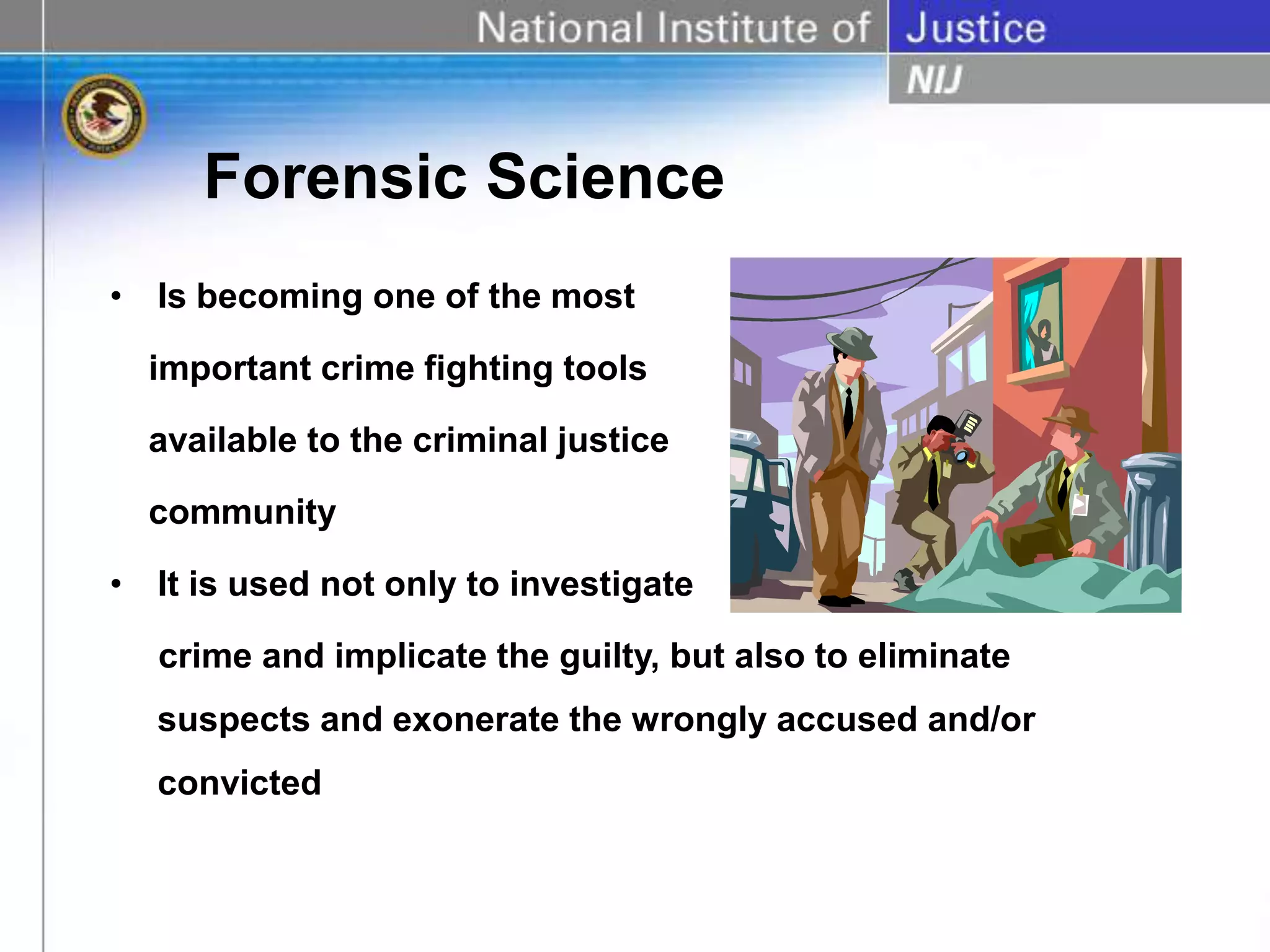
• Is becoming one of the most
important crime fighting tools
available to the criminal justice
community
• It is used not only to investigate
crime and implicate the guilty, but also to eliminate
suspects and exonerate the wrongly accused and/or
convicted
Forensic Science
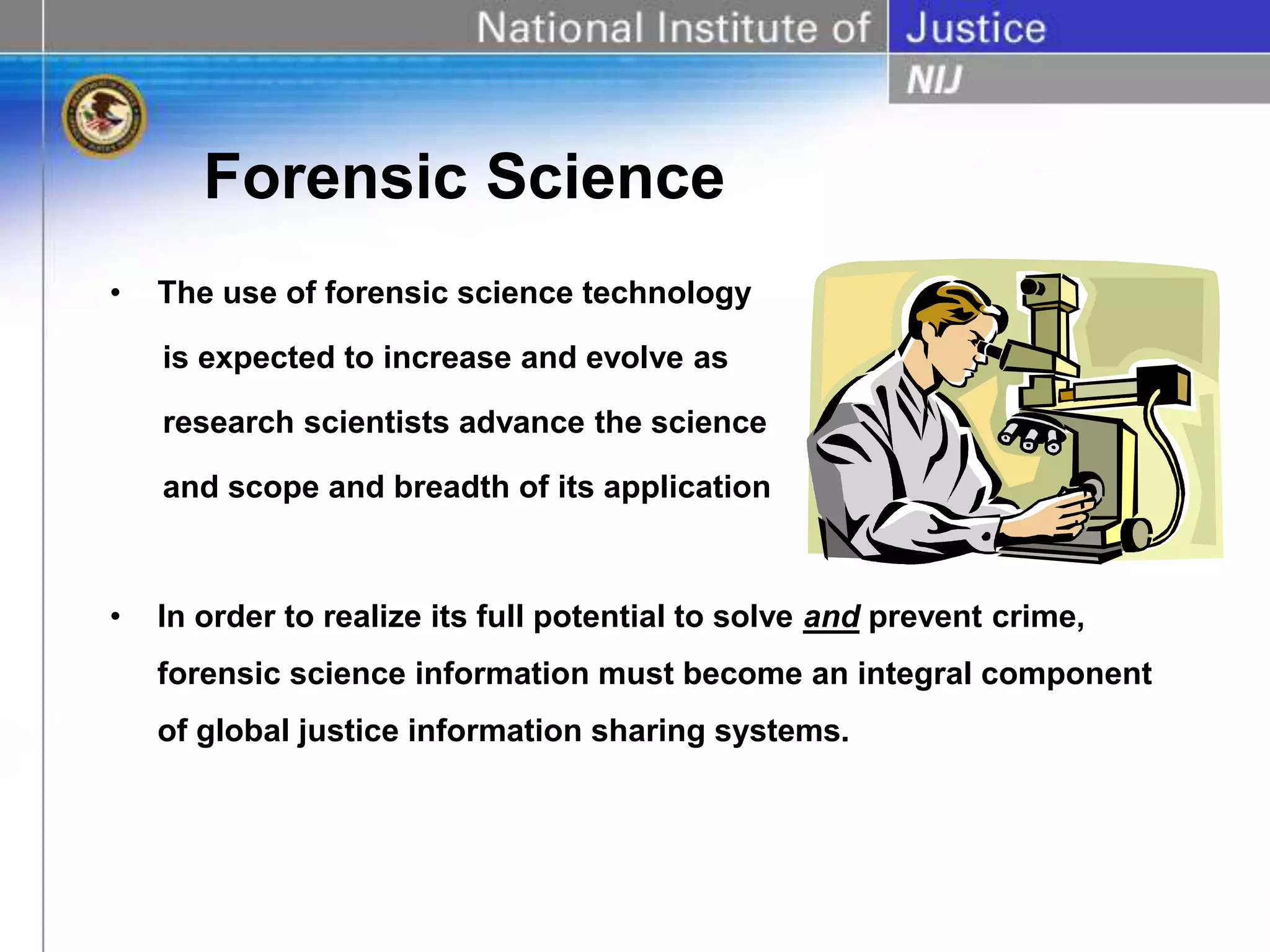
• The use of forensic science technology
is expected to increase and evolve as
research scientists advance the science
and scope and breadth of its application
• In order to realize its full potential to solve and prevent crime,
forensic science information must become an integral component
of global justice information sharing systems.
Information Sharing Challenges
• Specialized Data Bases
– AFIS, NIBIN, CODIS, LIMS
• Lack of Interoperability
• Vendor Driven Specifications
• Restricted Access
• Under Use of Bioinformatics Information
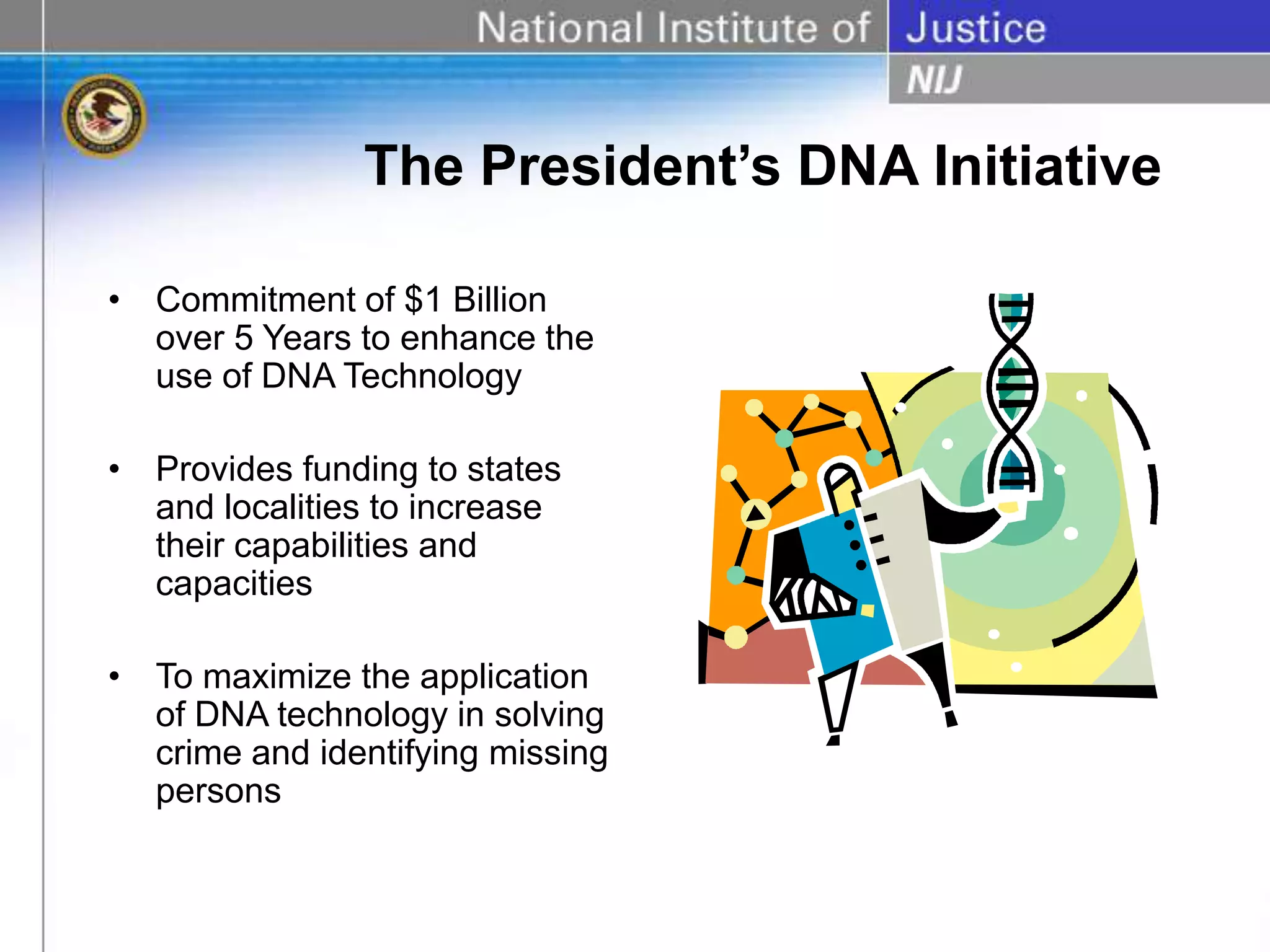
The President’s DNA Initiative
• Commitment of $1 Billion
over 5 Years to enhance the
use of DNA Technology
• Provides funding to states
and localities to increase
their capabilities and
capacities
• To maximize the application
of DNA technology in solving
crime and identifying missing
persons
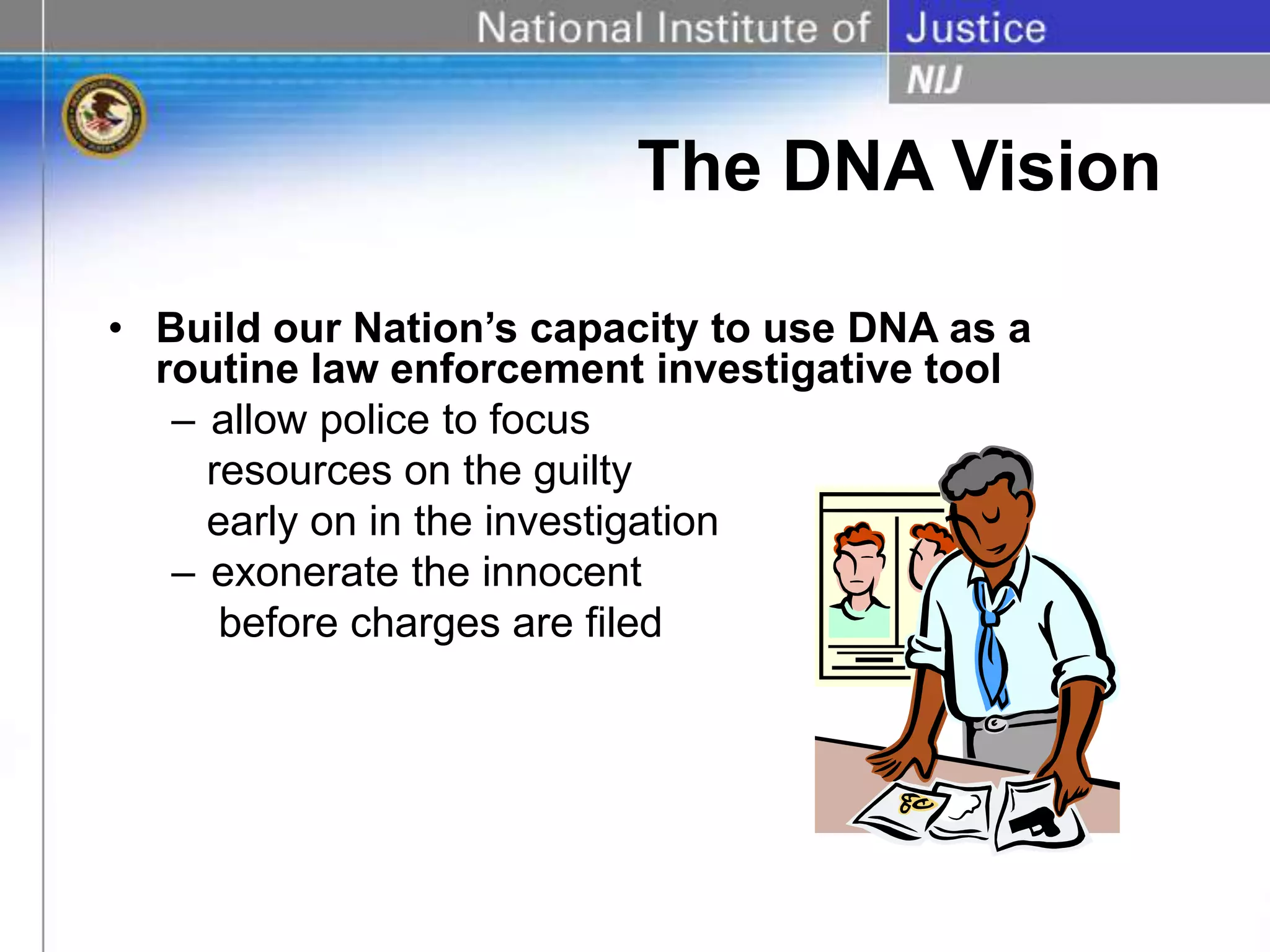
The DNA Vision
• Build our Nation’s capacity to use DNA as a
routine law enforcement investigative tool
– allow police to focus
resources on the guilty
early on in the investigation
– exonerate the innocent
before charges are filed
A Powerful Case for a
Forensic Information
Data Exchange
National initiatives like the National
Information Exchange Model (NIEM), and
the Global Justice XML Data Model
(GJXDM), provide a powerful case for the
development of a Forensic Information Data
Model (FIDM), and a Forensic Information
Data Exchange (FIDEX).
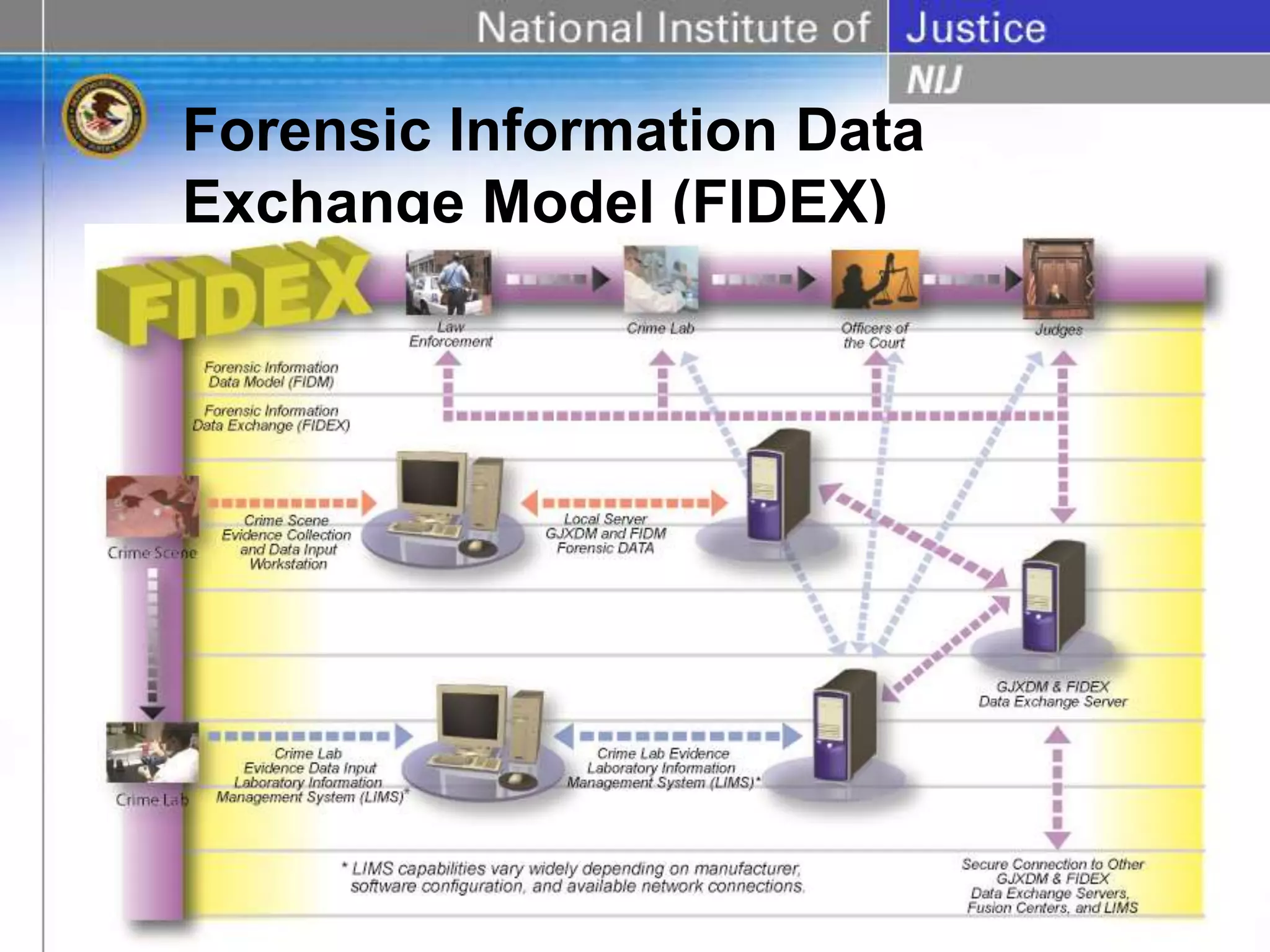
Forensic Information Data
Exchange Model (FIDEX)
FIDEX Overview
What is FIDEX?
– Forensic Information Data Exchange
– Specific Evidence Data will be formatted
using a Forensic Information
Data Model (FIDM)
– Based on the Global
Justice XML Data
Model (GJXDM)
GJXDM & LIMS
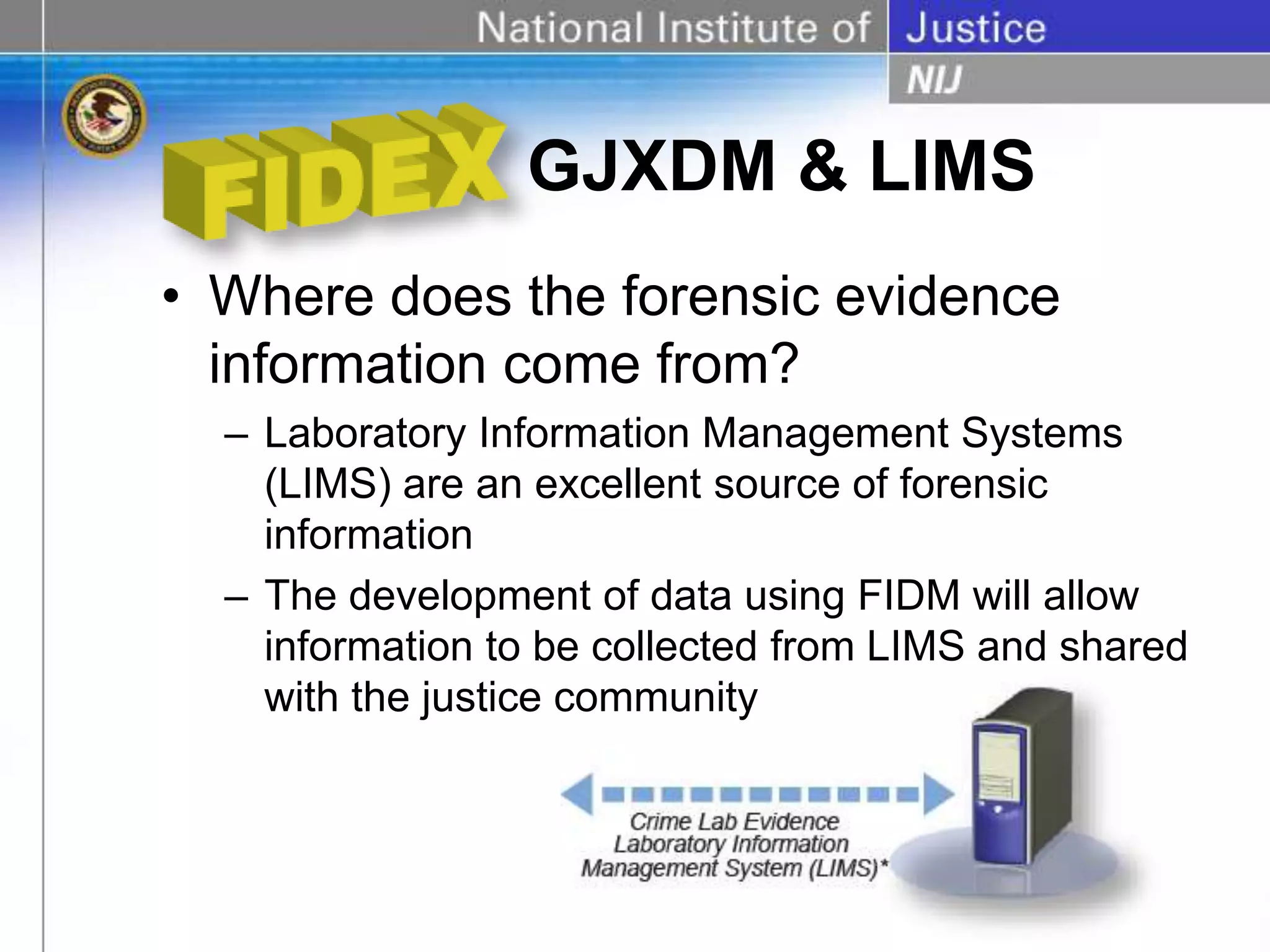
• Where does the forensic evidence
information come from?
– Laboratory Information Management Systems
(LIMS) are an excellent source of forensic
information
– The development of data using FIDM will allow
information to be collected from LIMS and shared
with the justice community
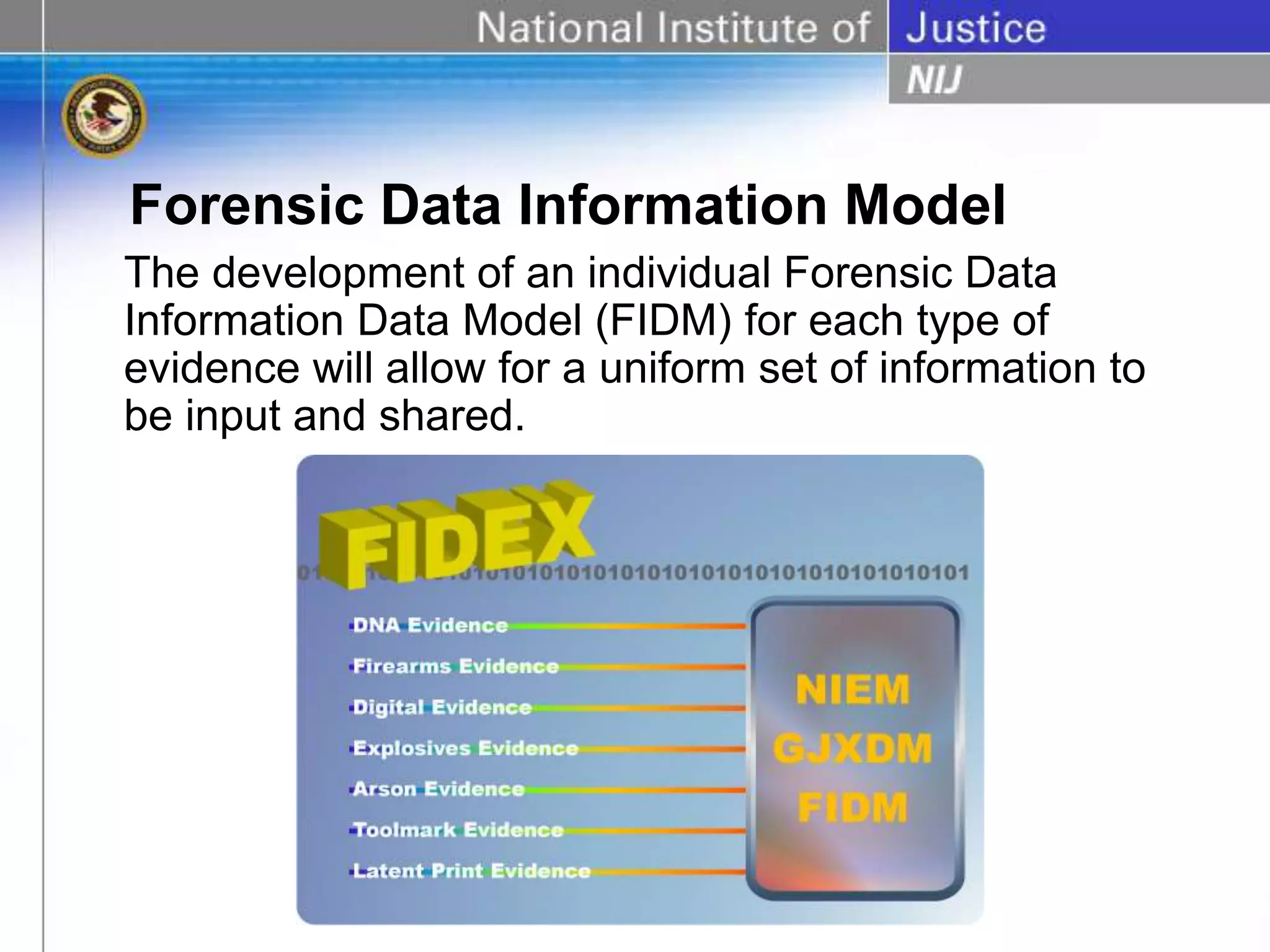
Forensic Data Information Model
The development of an individual Forensic Data
Information Data Model (FIDM) for each type of
evidence will allow for a uniform set of information to
be input and shared.
Forensic Data & Crime Scenes
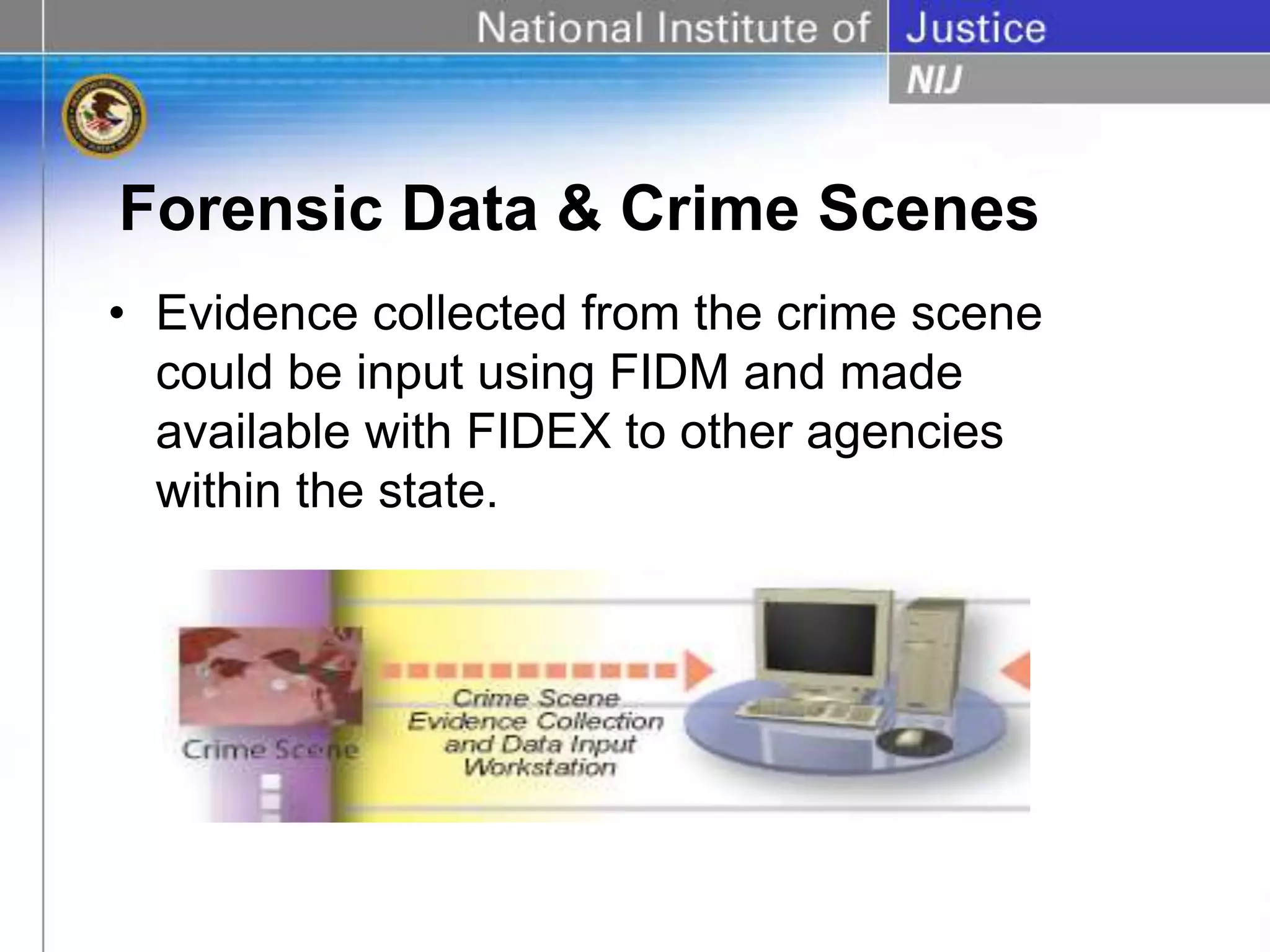
• Evidence collected from the crime scene
could be input using FIDM and made
available with FIDEX to other agencies
within the state.
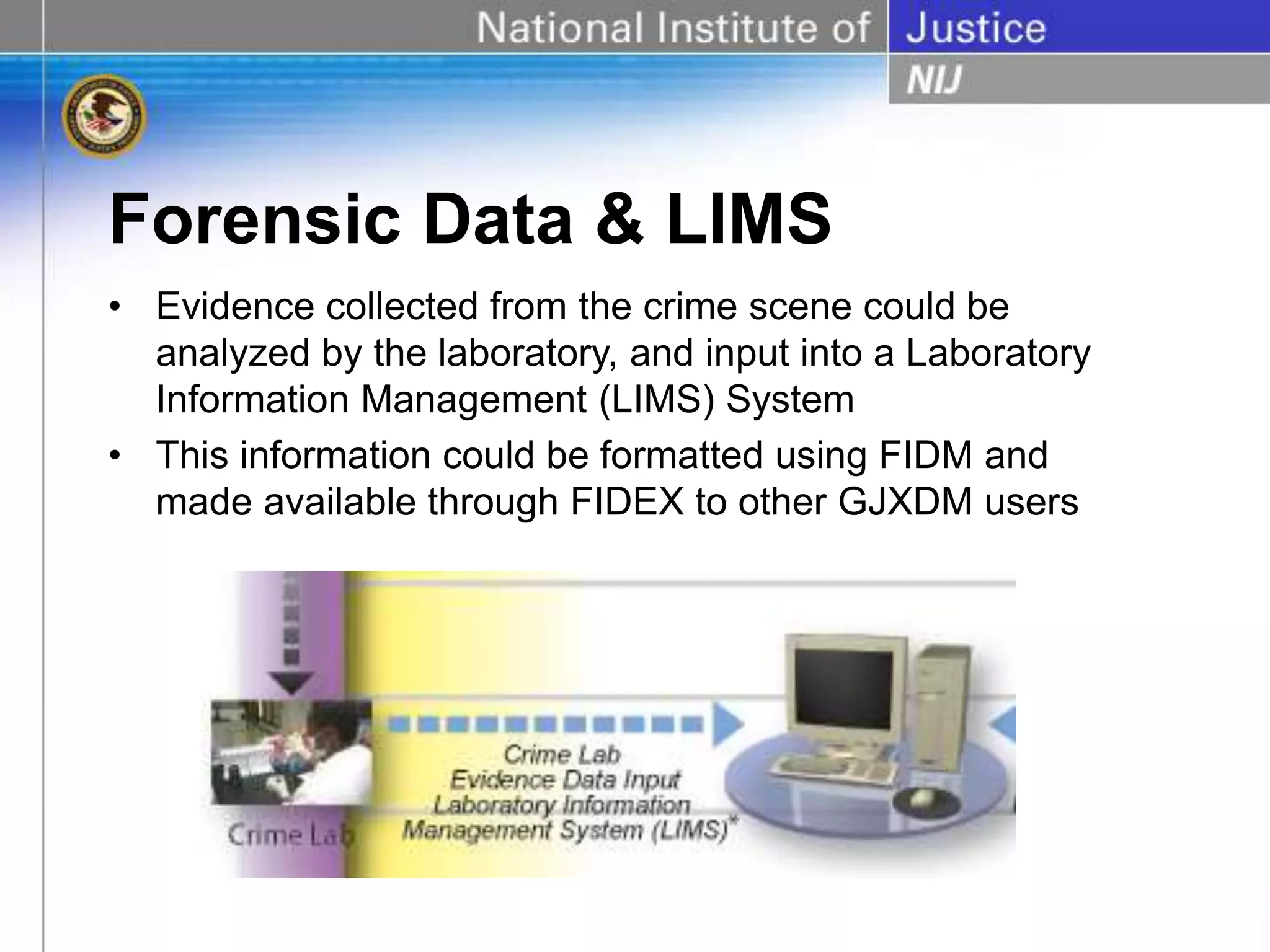
Forensic Data & LIMS
• Evidence collected from the crime scene could be
analyzed by the laboratory, and input into a Laboratory
Information Management (LIMS) System
• This information could be formatted using FIDM and
made available through FIDEX to other GJXDM users
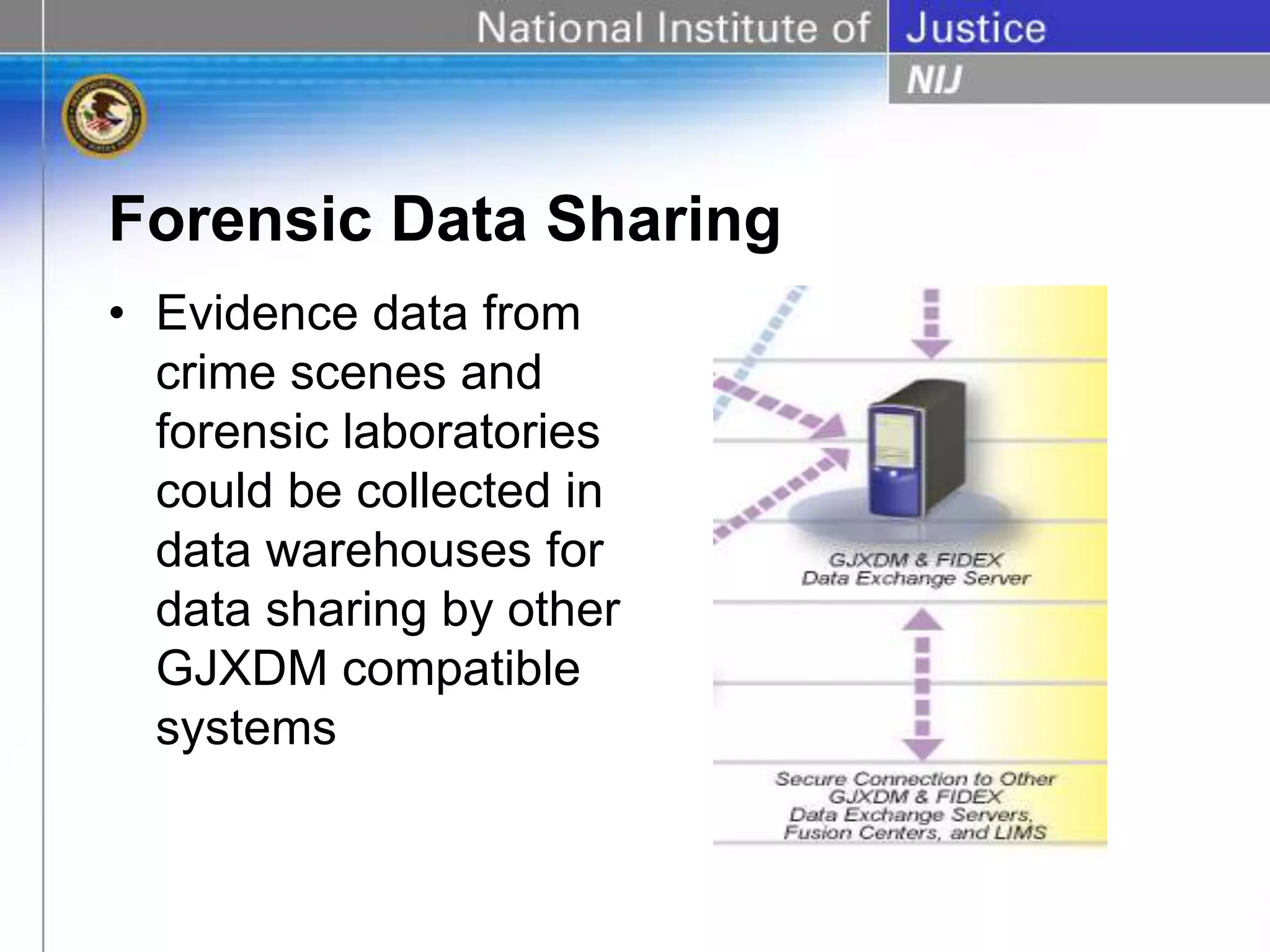
Forensic Data Sharing
• Evidence data from
crime scenes and
forensic laboratories
could be collected in
data warehouses for
data sharing by other
GJXDM compatible
systems
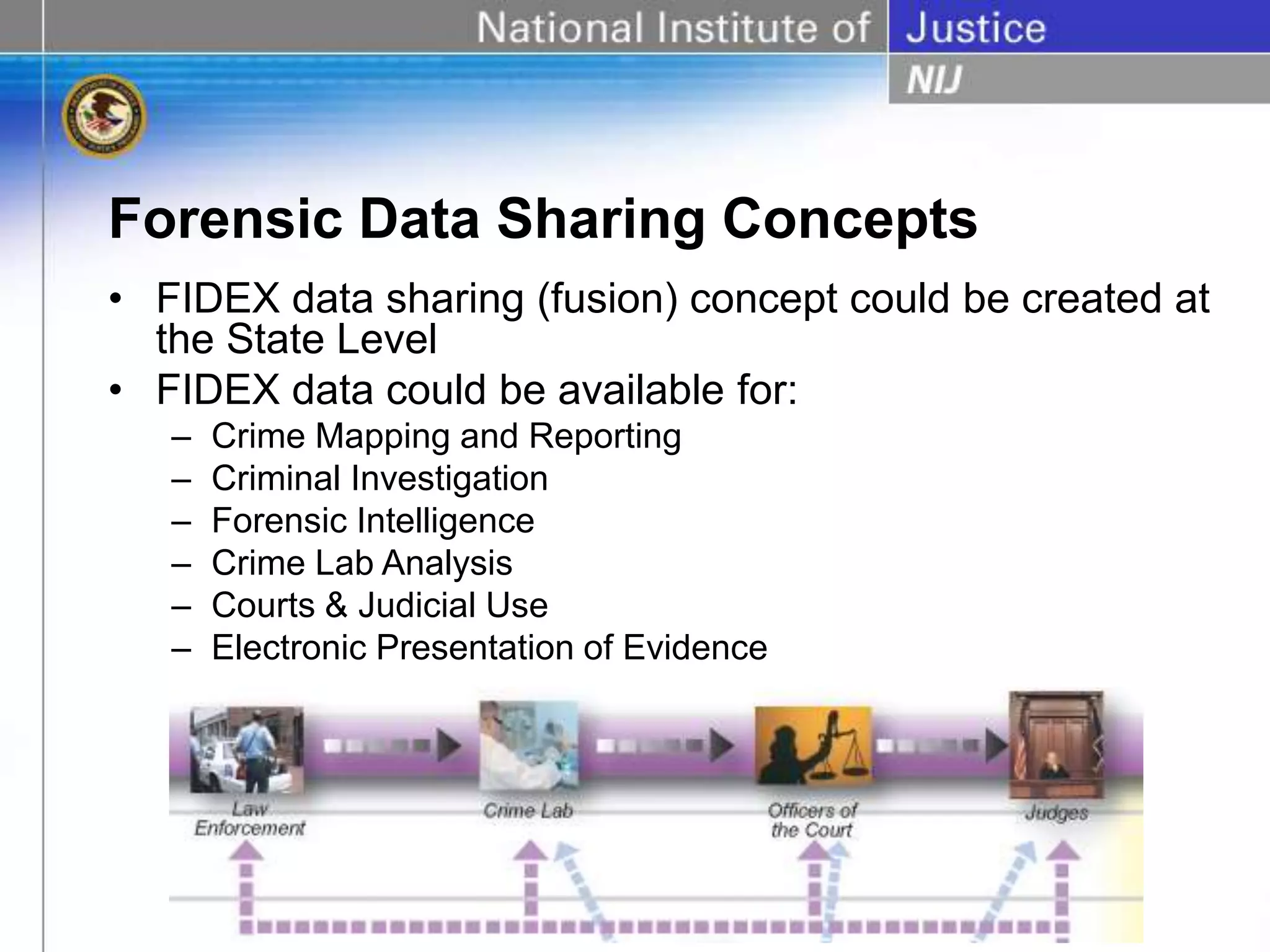
Forensic Data Sharing Concepts
• FIDEX data sharing (fusion) concept could be created at
the State Level
• FIDEX data could be available for:
– Crime Mapping and Reporting
– Criminal Investigation
– Forensic Intelligence
– Crime Lab Analysis
– Courts & Judicial Use
– Electronic Presentation of Evidence
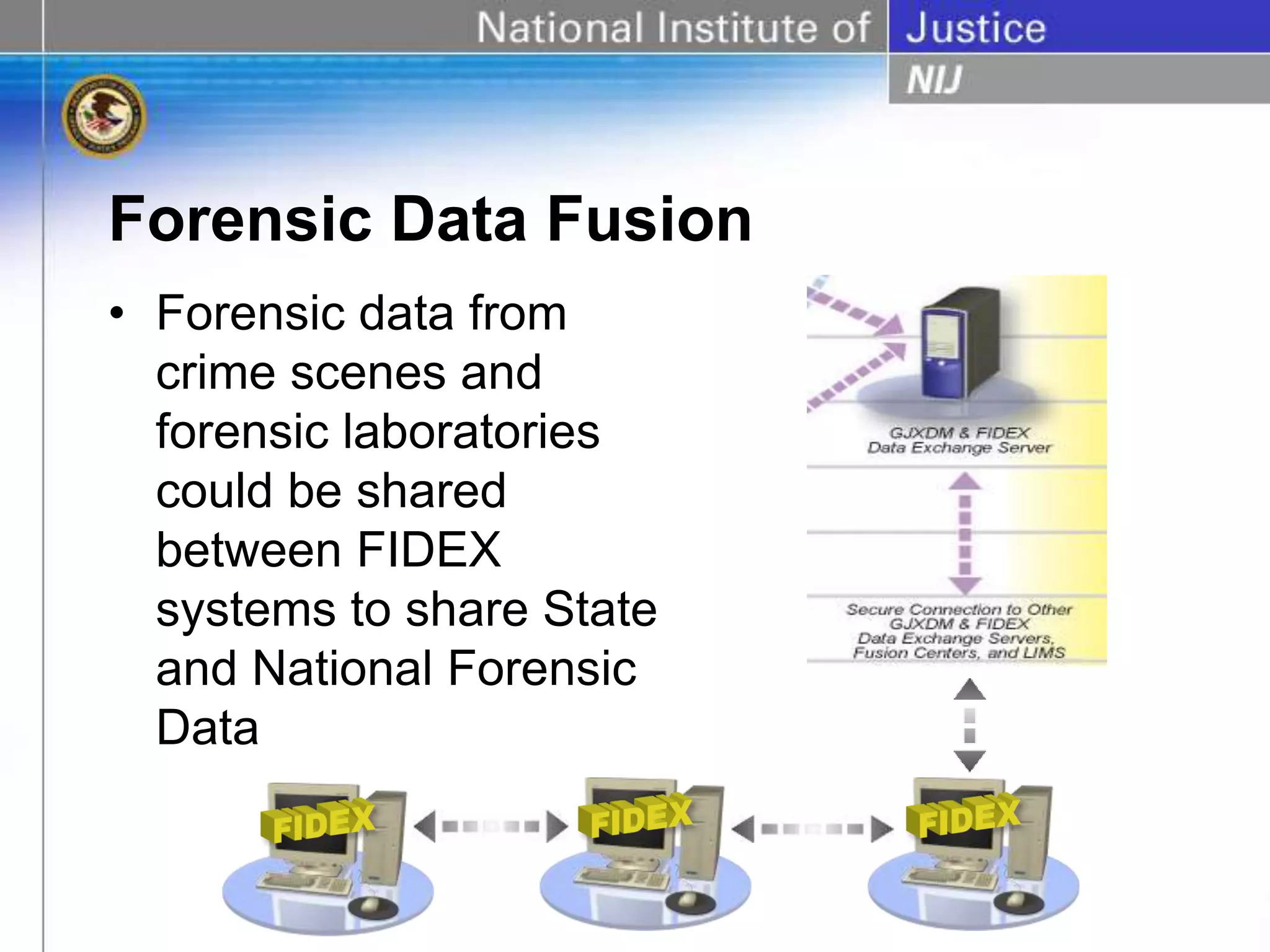
Forensic Data Fusion
• Forensic data from
crime scenes and
forensic laboratories
could be shared
between FIDEX
systems to share State
and National Forensic
Data
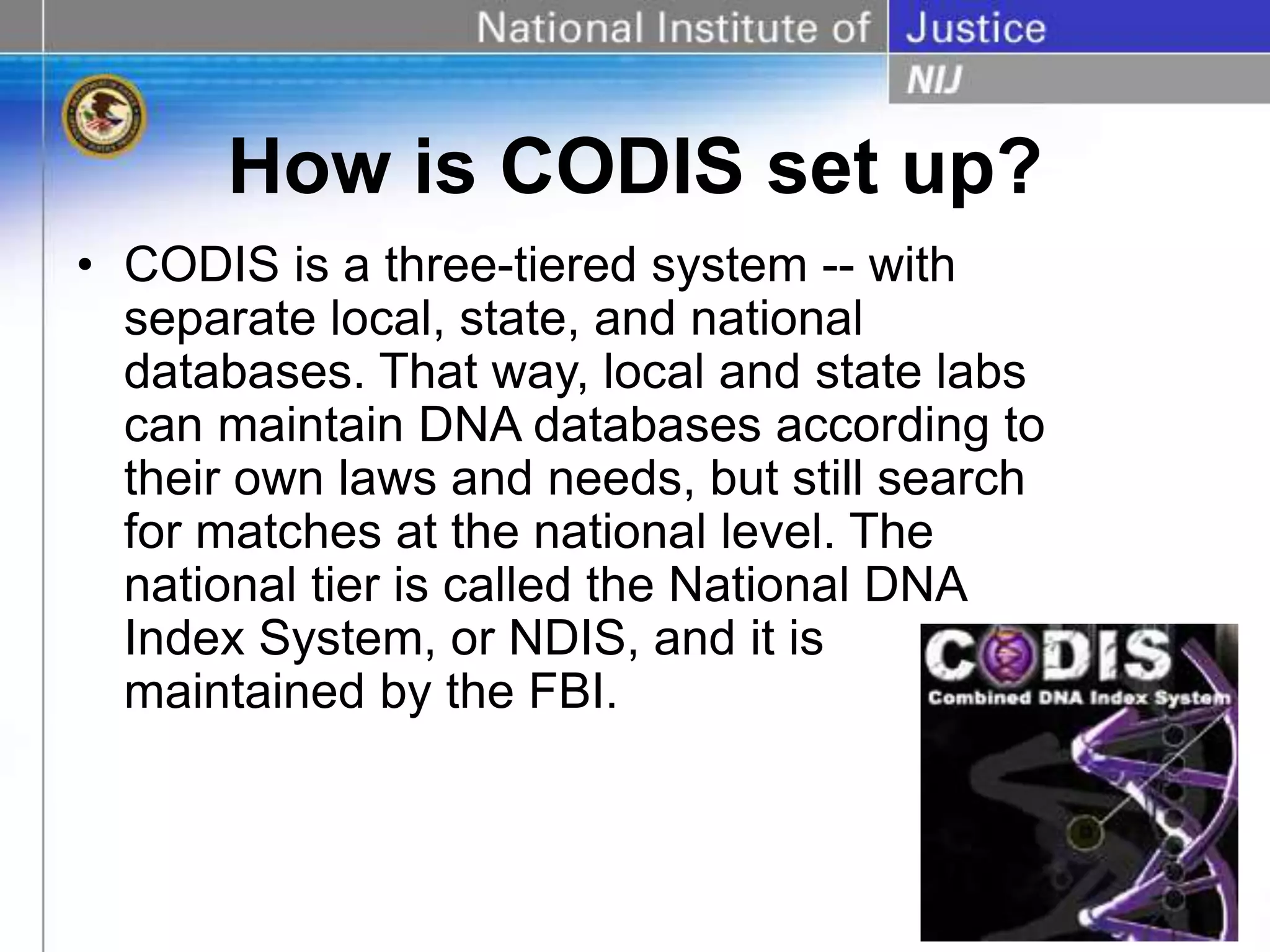
How is CODIS set up?
• CODIS is a three-tiered system -- with
separate local, state, and national
databases. That way, local and state labs
can maintain DNA databases according to
their own laws and needs, but still search
for matches at the national level. The
national tier is called the National DNA
Index System, or NDIS, and it is
maintained by the FBI.
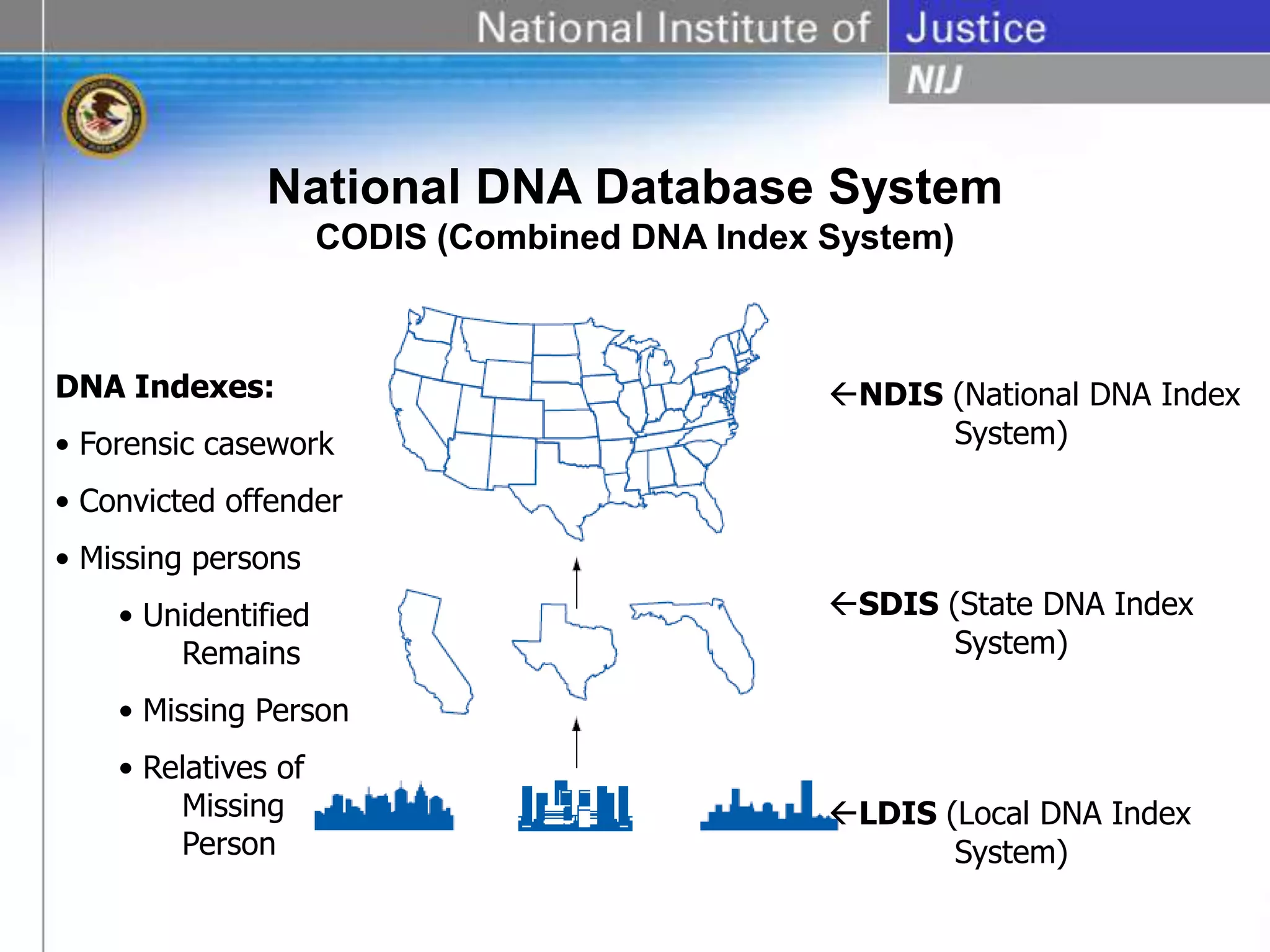
National DNA Database System
CODIS (Combined DNA Index System)
NDIS (National DNA Index
System)
SDIS (State DNA Index
System)
LDIS (Local DNA Index
System)
DNA Indexes:
• Forensic casework
• Convicted offender
• Missing persons
• Unidentified
Remains
• Missing Person
• Relatives of
Missing
Person
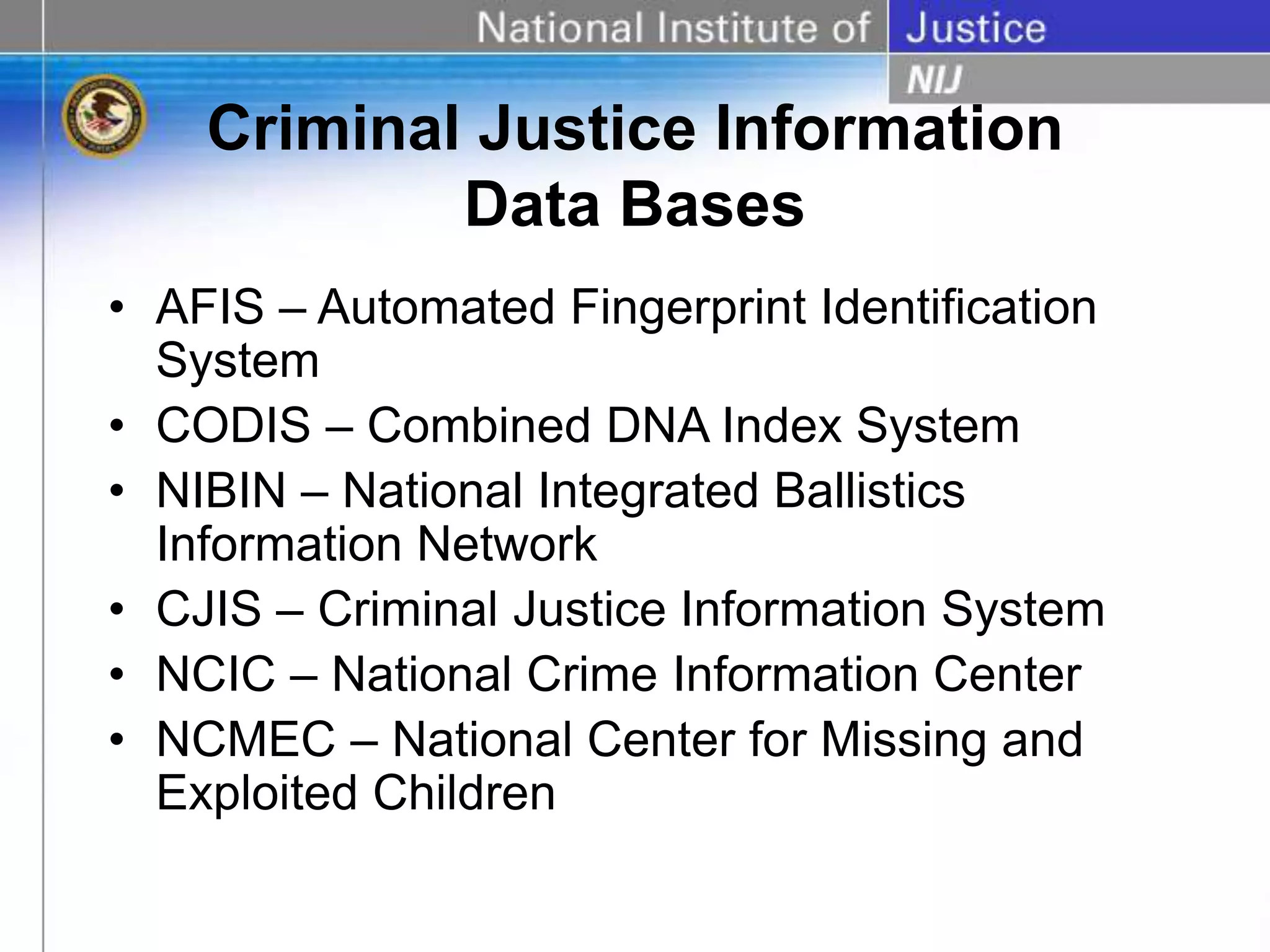
Criminal Justice Information
Data Bases
• AFIS – Automated Fingerprint Identification
System
• CODIS – Combined DNA Index System
• NIBIN – National Integrated Ballistics
Information Network
• CJIS – Criminal Justice Information System
• NCIC – National Crime Information Center
• NCMEC – National Center for Missing and
Exploited Children
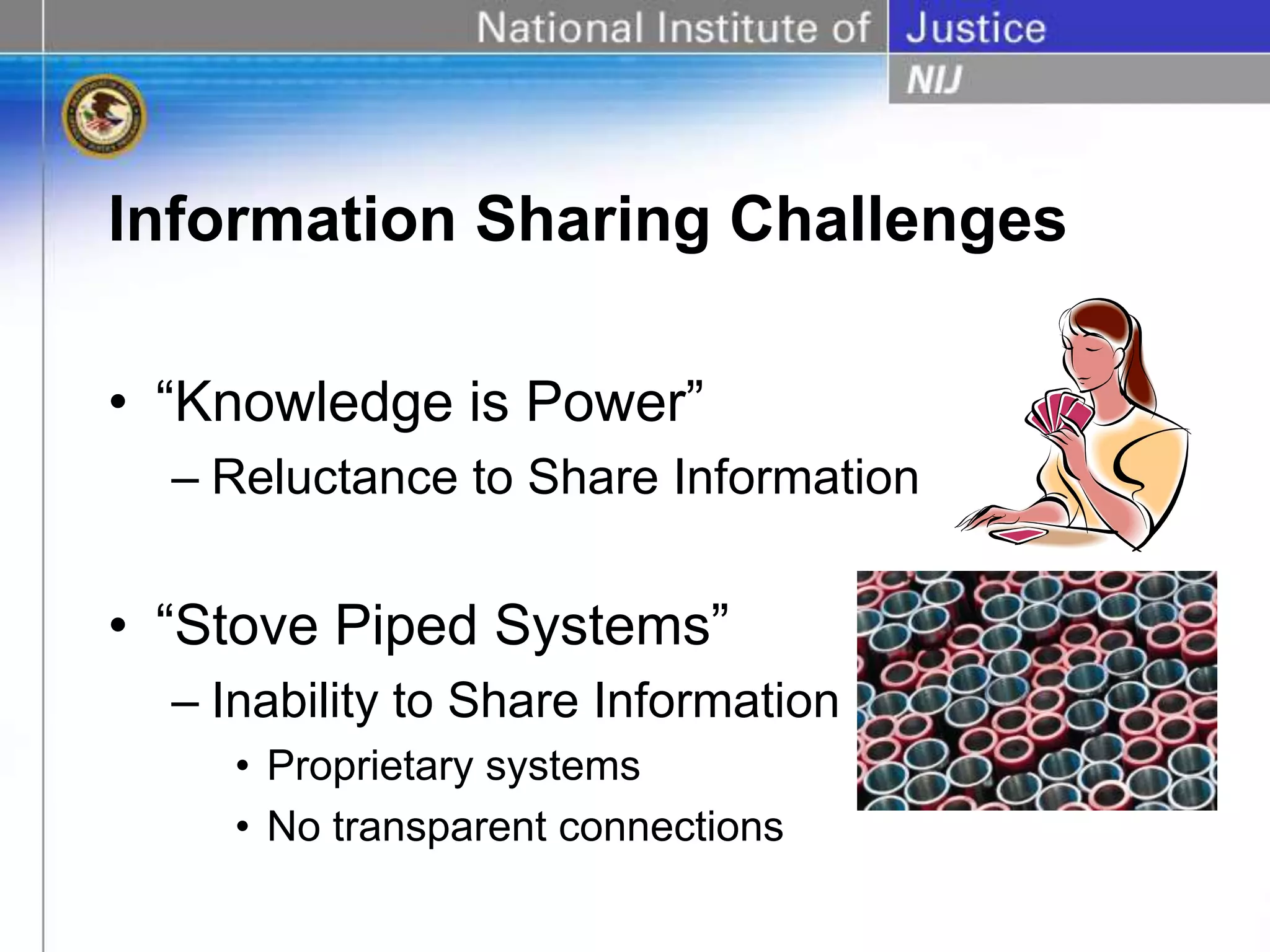
Information Sharing Challenges
• “Knowledge is Power”
– Reluctance to Share Information
• “Stove Piped Systems”
– Inability to Share Information
• Proprietary systems
• No transparent connections
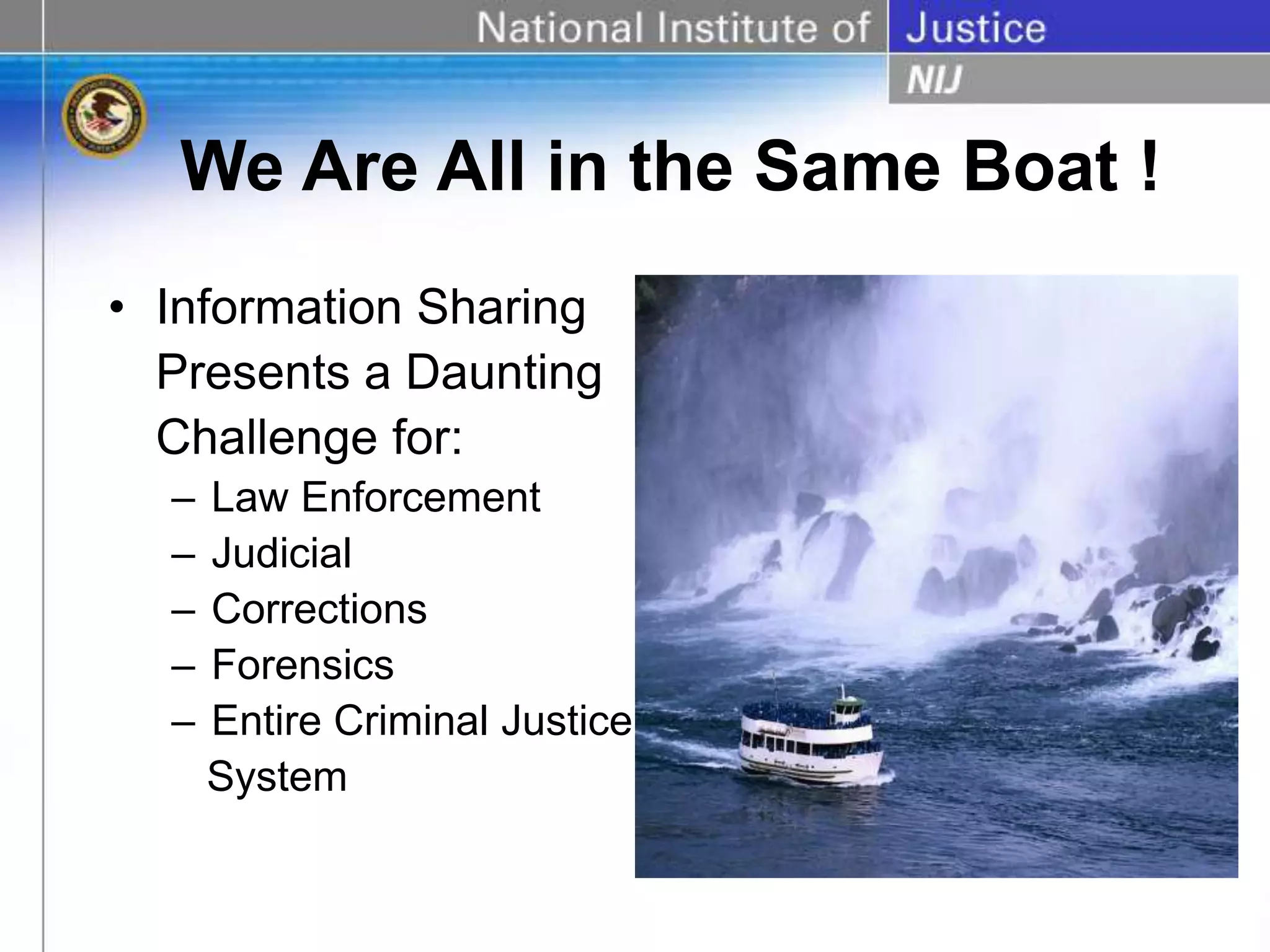
We Are All in the Same Boat !
• Information Sharing
Presents a Daunting
Challenge for:
– Law Enforcement
– Judicial
– Corrections
– Forensics
– Entire Criminal Justice
System
Thank You!

justice_information_sharing-forensics_perspective.ppt

  • 1.
    Global Justice Information Sharing– The Forensic Perspective Susan D. Narveson, Chief Investigative and Forensic Sciences Division National Institute of Justice
  • 2.
    Forensic Science • Isbecoming one of the most important crime fighting tools available to the criminal justice community • It is used not only to investigate crime and implicate the guilty, but also to eliminate suspects and exonerate the wrongly accused and/or convicted
  • 3.
    Forensic Science • Theuse of forensic science technology is expected to increase and evolve as research scientists advance the science and scope and breadth of its application • In order to realize its full potential to solve and prevent crime, forensic science information must become an integral component of global justice information sharing systems.
  • 4.
    Information Sharing Challenges •Specialized Data Bases – AFIS, NIBIN, CODIS, LIMS • Lack of Interoperability • Vendor Driven Specifications • Restricted Access • Under Use of Bioinformatics Information
  • 5.
    The President’s DNAInitiative • Commitment of $1 Billion over 5 Years to enhance the use of DNA Technology • Provides funding to states and localities to increase their capabilities and capacities • To maximize the application of DNA technology in solving crime and identifying missing persons
  • 6.
    The DNA Vision •Build our Nation’s capacity to use DNA as a routine law enforcement investigative tool – allow police to focus resources on the guilty early on in the investigation – exonerate the innocent before charges are filed
  • 7.
    A Powerful Casefor a Forensic Information Data Exchange National initiatives like the National Information Exchange Model (NIEM), and the Global Justice XML Data Model (GJXDM), provide a powerful case for the development of a Forensic Information Data Model (FIDM), and a Forensic Information Data Exchange (FIDEX).
  • 8.
  • 9.
    FIDEX Overview What isFIDEX? – Forensic Information Data Exchange – Specific Evidence Data will be formatted using a Forensic Information Data Model (FIDM) – Based on the Global Justice XML Data Model (GJXDM)
  • 10.
    GJXDM & LIMS •Where does the forensic evidence information come from? – Laboratory Information Management Systems (LIMS) are an excellent source of forensic information – The development of data using FIDM will allow information to be collected from LIMS and shared with the justice community
  • 11.
    Forensic Data InformationModel The development of an individual Forensic Data Information Data Model (FIDM) for each type of evidence will allow for a uniform set of information to be input and shared.
  • 12.
    Forensic Data &Crime Scenes • Evidence collected from the crime scene could be input using FIDM and made available with FIDEX to other agencies within the state.
  • 13.
    Forensic Data &LIMS • Evidence collected from the crime scene could be analyzed by the laboratory, and input into a Laboratory Information Management (LIMS) System • This information could be formatted using FIDM and made available through FIDEX to other GJXDM users
  • 14.
    Forensic Data Sharing •Evidence data from crime scenes and forensic laboratories could be collected in data warehouses for data sharing by other GJXDM compatible systems
  • 15.
    Forensic Data SharingConcepts • FIDEX data sharing (fusion) concept could be created at the State Level • FIDEX data could be available for: – Crime Mapping and Reporting – Criminal Investigation – Forensic Intelligence – Crime Lab Analysis – Courts & Judicial Use – Electronic Presentation of Evidence
  • 16.
    Forensic Data Fusion •Forensic data from crime scenes and forensic laboratories could be shared between FIDEX systems to share State and National Forensic Data
  • 17.
    How is CODISset up? • CODIS is a three-tiered system -- with separate local, state, and national databases. That way, local and state labs can maintain DNA databases according to their own laws and needs, but still search for matches at the national level. The national tier is called the National DNA Index System, or NDIS, and it is maintained by the FBI.
  • 18.
    National DNA DatabaseSystem CODIS (Combined DNA Index System) NDIS (National DNA Index System) SDIS (State DNA Index System) LDIS (Local DNA Index System) DNA Indexes: • Forensic casework • Convicted offender • Missing persons • Unidentified Remains • Missing Person • Relatives of Missing Person
  • 19.
    Criminal Justice Information DataBases • AFIS – Automated Fingerprint Identification System • CODIS – Combined DNA Index System • NIBIN – National Integrated Ballistics Information Network • CJIS – Criminal Justice Information System • NCIC – National Crime Information Center • NCMEC – National Center for Missing and Exploited Children
  • 20.
    Information Sharing Challenges •“Knowledge is Power” – Reluctance to Share Information • “Stove Piped Systems” – Inability to Share Information • Proprietary systems • No transparent connections
  • 21.
    We Are Allin the Same Boat ! • Information Sharing Presents a Daunting Challenge for: – Law Enforcement – Judicial – Corrections – Forensics – Entire Criminal Justice System
  • 22.