AUTOMATED FINGERPRINT
IDENTIFICATION SYSTEMS (AFIS)
RISHAB M NAIR
MSC FORENSIC SCIENCE
WHAT IS AFIS ?
• The Automated Fingerprint Identification System (AFIS) is a biometric technology that digitally
stores representations of friction ridge skin, such as fingerprints, palmprints, and footprints.
It enables rapid database searches to identify connections between different impressions.
• AFIS offers an electronic database that simplifies the maintenance of accurate records and
allows for quick access to relevant information
• AFIS can rapidly search through millions of fingerprints in seconds, facilitating large-scale
searches and the automated identification of potential suspects
• It is primarily utilized for identifying individuals in contexts such as border control and visa
applications, as well as linking an individual to a mark in criminal investigations or public
inquiries.
• The enrollment of individuals can be entirely digital through Live Scan, with biometric feature
extraction and encoding fully automated.
• This system also facilitates the sharing of fingerprint data across different agencies and
jurisdictions, enhancing collaboration and increasing the likelihood of identifying unknown
individuals and solving crimes.
• The National Automated Fingerprint Identification System (NAFIS) is a centralized database
developed by the National Crime Records Bureau (NCRB) in India. It aims to consolidate
fingerprint data from all states and union territories into a single, searchable national database
HISTORY OF AFIS
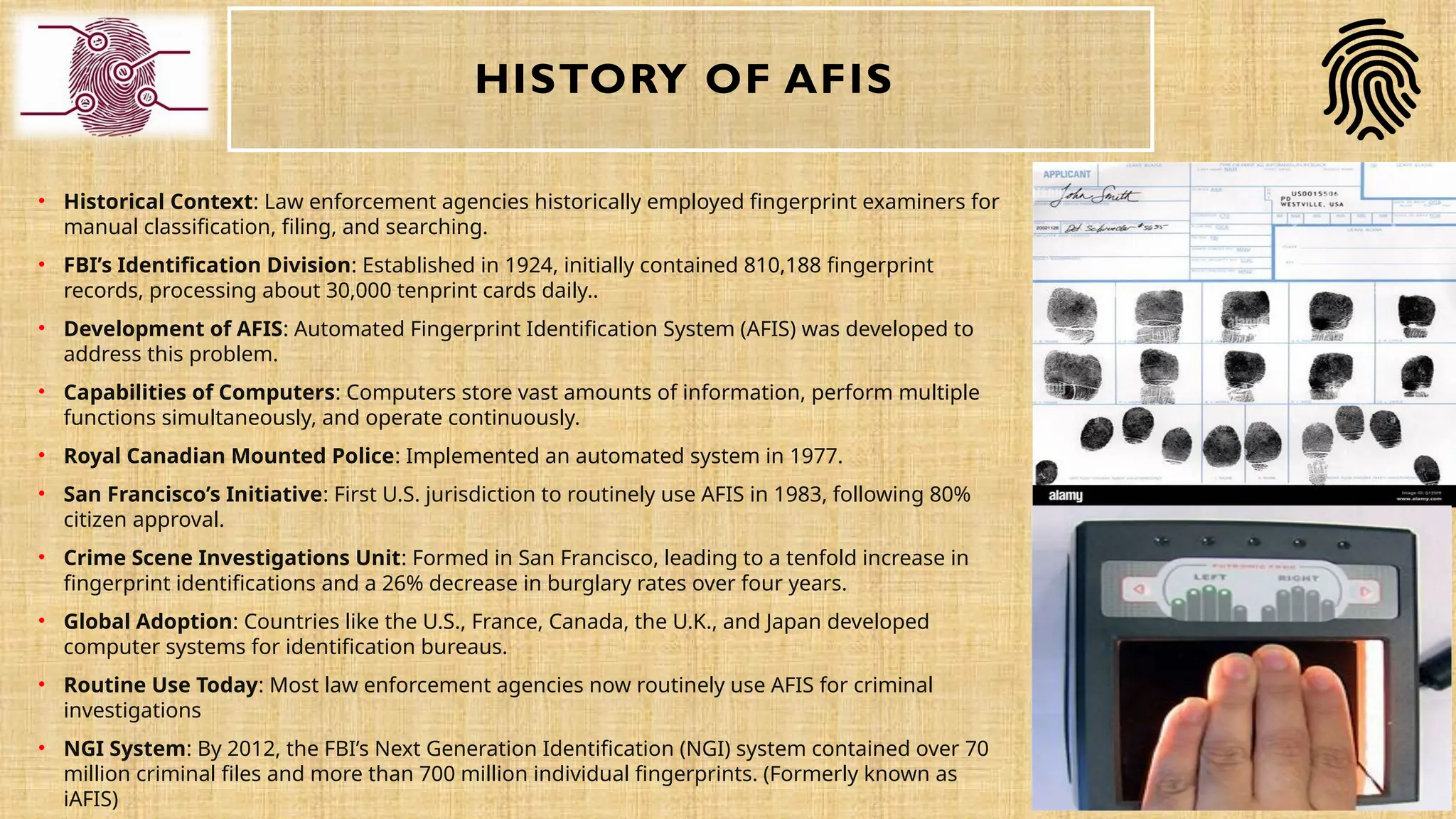
• Historical Context: Law enforcement agencies historically employed fingerprint examiners for
manual classification, filing, and searching.
• FBI’s Identification Division: Established in 1924, initially contained 810,188 fingerprint
records, processing about 30,000 tenprint cards daily..
• Development of AFIS: Automated Fingerprint Identification System (AFIS) was developed to
address this problem.
• Capabilities of Computers: Computers store vast amounts of information, perform multiple
functions simultaneously, and operate continuously.
• Royal Canadian Mounted Police: Implemented an automated system in 1977.
• San Francisco’s Initiative: First U.S. jurisdiction to routinely use AFIS in 1983, following 80%
citizen approval.
• Crime Scene Investigations Unit: Formed in San Francisco, leading to a tenfold increase in
fingerprint identifications and a 26% decrease in burglary rates over four years.
• Global Adoption: Countries like the U.S., France, Canada, the U.K., and Japan developed
computer systems for identification bureaus.
• Routine Use Today: Most law enforcement agencies now routinely use AFIS for criminal
investigations
• NGI System: By 2012, the FBI’s Next Generation Identification (NGI) system contained over 70
million criminal files and more than 700 million individual fingerprints. (Formerly known as
iAFIS)
AFIS DATABASE AND STORAGE
SYSTEM
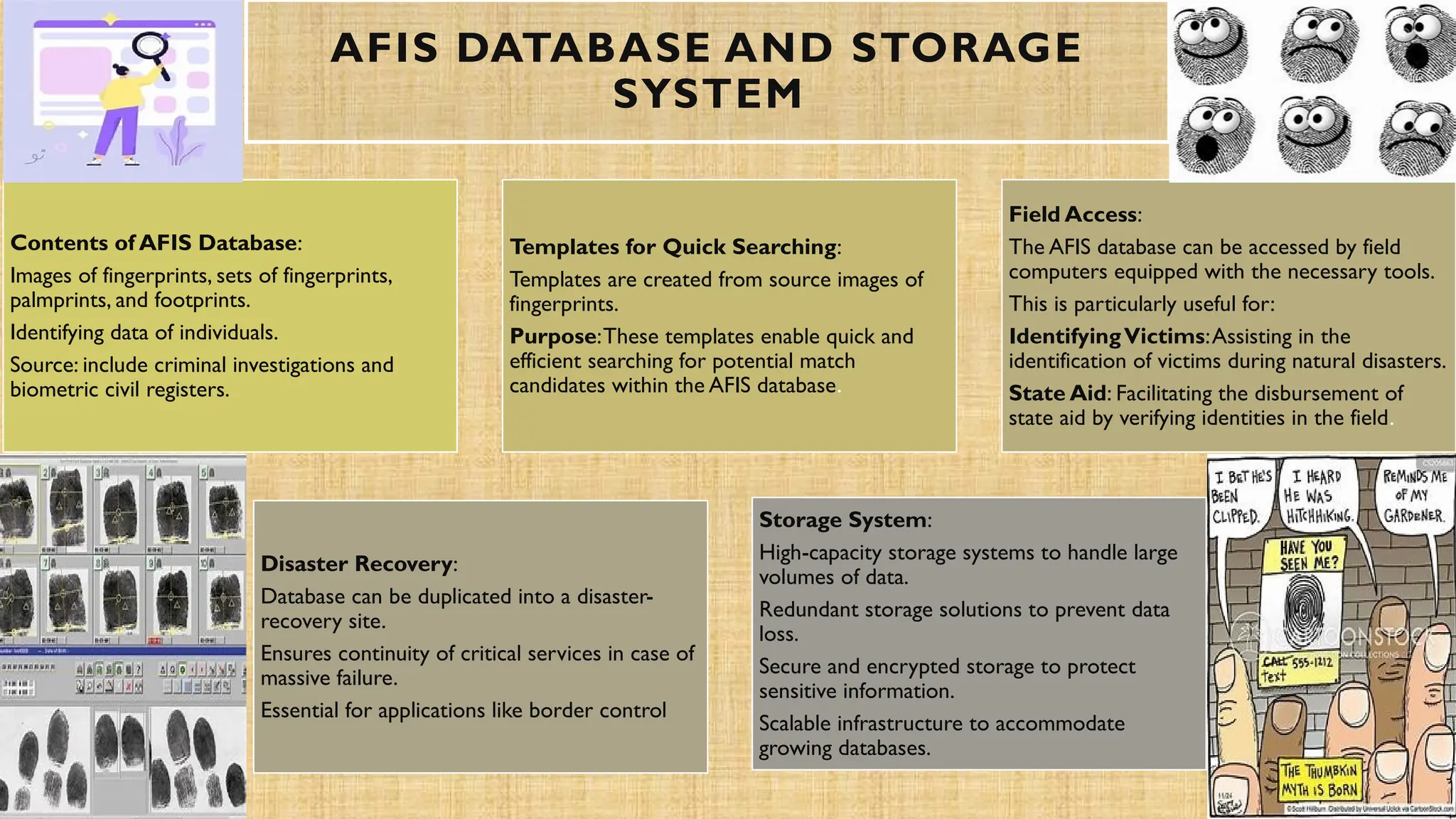
Contents of AFIS Database:
Images of fingerprints, sets of fingerprints,
palmprints, and footprints.
Identifying data of individuals.
Source: include criminal investigations and
biometric civil registers.
Templates for Quick Searching:
Templates are created from source images of
fingerprints.
Purpose:These templates enable quick and
efficient searching for potential match
candidates within the AFIS database.
Field Access:
The AFIS database can be accessed by field
computers equipped with the necessary tools.
This is particularly useful for:
IdentifyingVictims:Assisting in the
identification of victims during natural disasters.
State Aid: Facilitating the disbursement of
state aid by verifying identities in the field.
Disaster Recovery:
Database can be duplicated into a disaster-
recovery site.
Ensures continuity of critical services in case of
massive failure.
Essential for applications like border control
Storage System:
High-capacity storage systems to handle large
volumes of data.
Redundant storage solutions to prevent data
loss.
Secure and encrypted storage to protect
sensitive information.
Scalable infrastructure to accommodate
growing databases.
TYPES OF FINGERPRINTS
PROCESSED BY AFIS
Full
Fingerprints
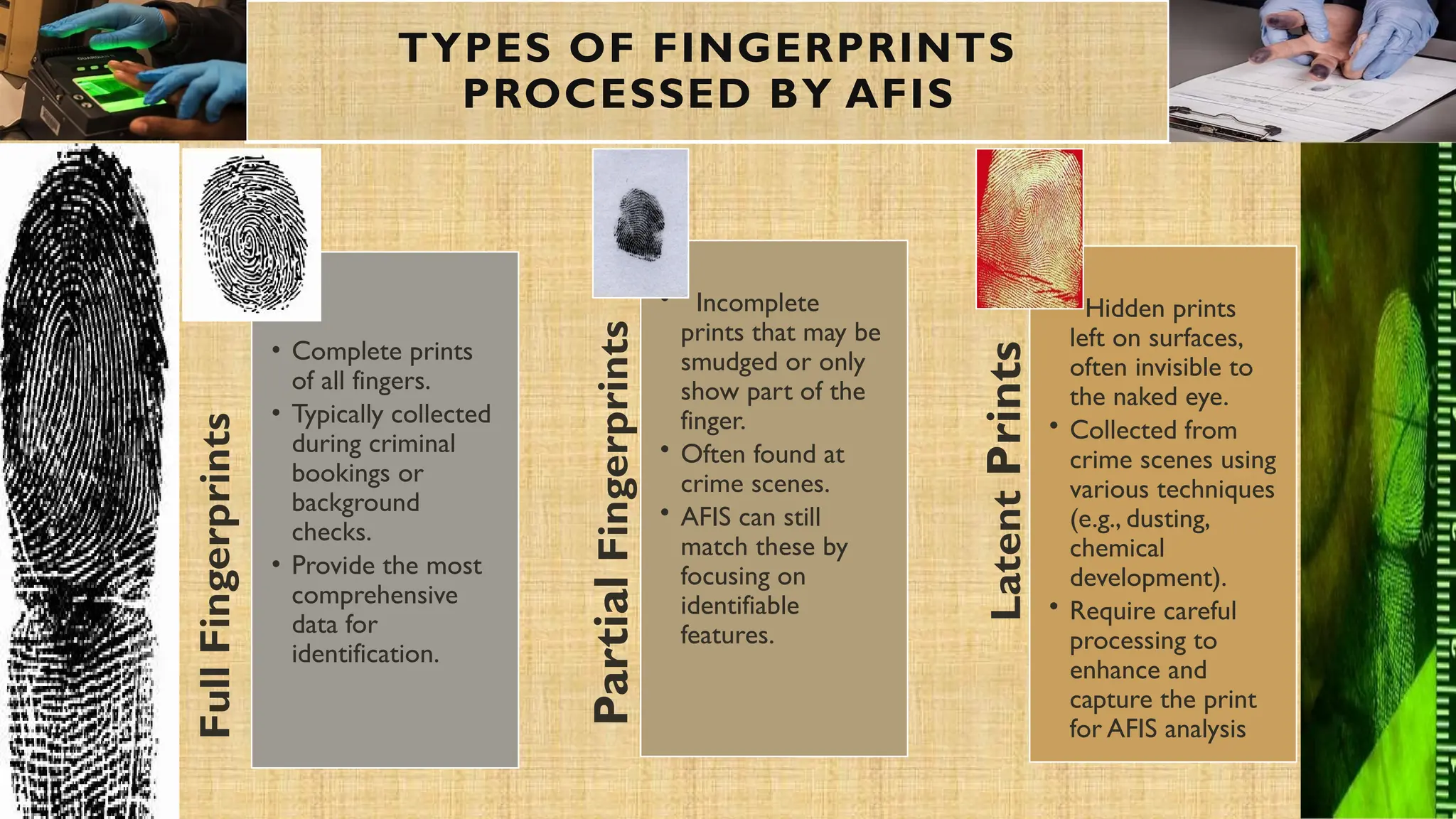
• Complete prints
of all fingers.
• Typically collected
during criminal
bookings or
background
checks.
• Provide the most
comprehensive
data for
identification.
Partial
Fingerprints
• Incomplete
prints that may be
smudged or only
show part of the
finger.
• Often found at
crime scenes.
• AFIS can still
match these by
focusing on
identifiable
features.
Latent
Prints
• Hidden prints
left on surfaces,
often invisible to
the naked eye.
• Collected from
crime scenes using
various techniques
(e.g., dusting,
chemical
development).
• Require careful
processing to
enhance and
capture the print
for AFIS analysis
GENRAL WORKFLOW
OF AFIS
STEPS FOR PROCESSING A
FINGERPRINT SEARCH USING AFIS:
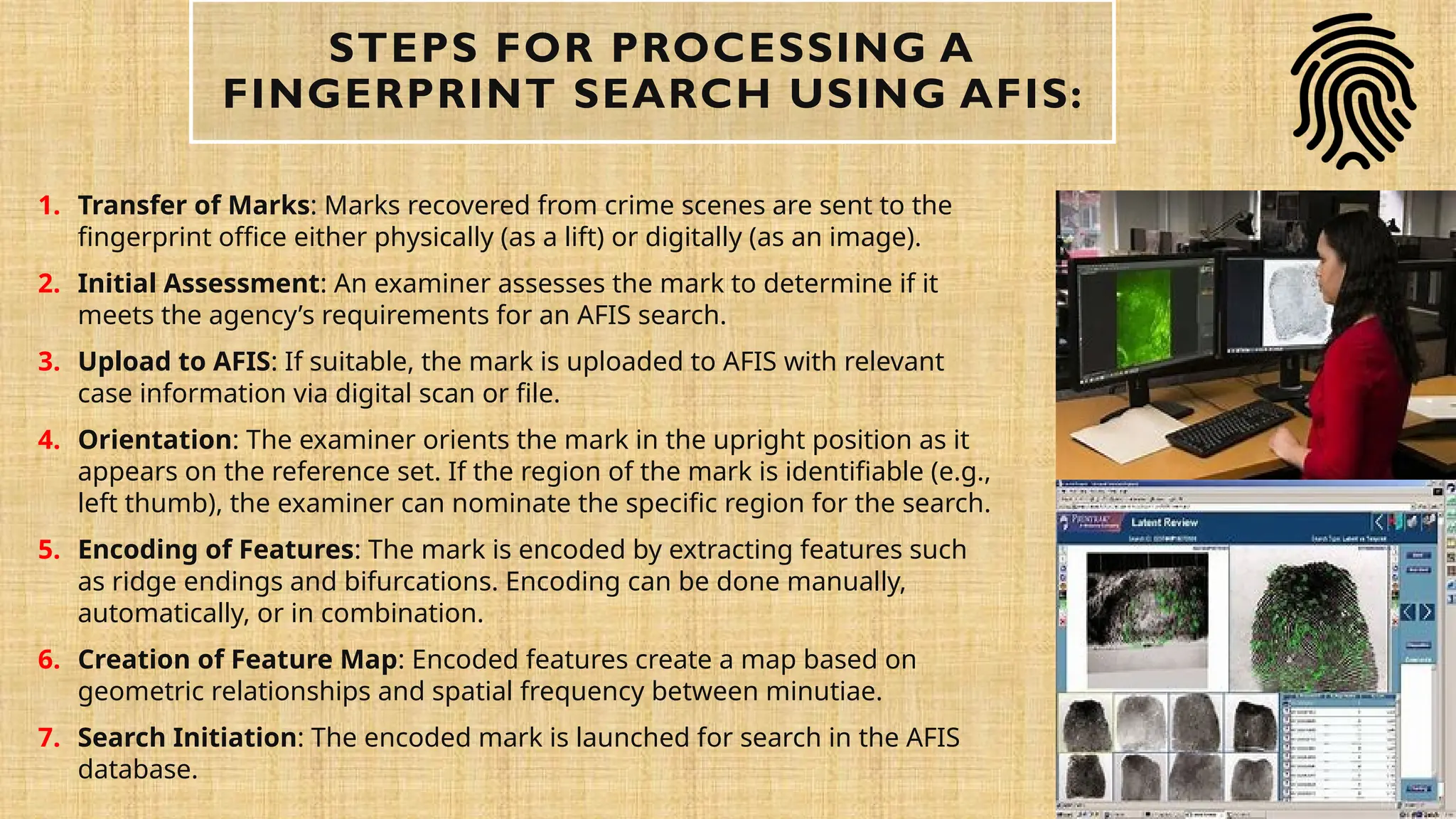
1. Transfer of Marks: Marks recovered from crime scenes are sent to the
fingerprint office either physically (as a lift) or digitally (as an image).
2. Initial Assessment: An examiner assesses the mark to determine if it
meets the agency’s requirements for an AFIS search.
3. Upload to AFIS: If suitable, the mark is uploaded to AFIS with relevant
case information via digital scan or file.
4. Orientation: The examiner orients the mark in the upright position as it
appears on the reference set. If the region of the mark is identifiable (e.g.,
left thumb), the examiner can nominate the specific region for the search.
5. Encoding of Features: The mark is encoded by extracting features such
as ridge endings and bifurcations. Encoding can be done manually,
automatically, or in combination.
6. Creation of Feature Map: Encoded features create a map based on
geometric relationships and spatial frequency between minutiae.
7. Search Initiation: The encoded mark is launched for search in the AFIS
database.
STEPS FOR PROCESSING A
FINGERPRINT SEARCH USING AFIS:
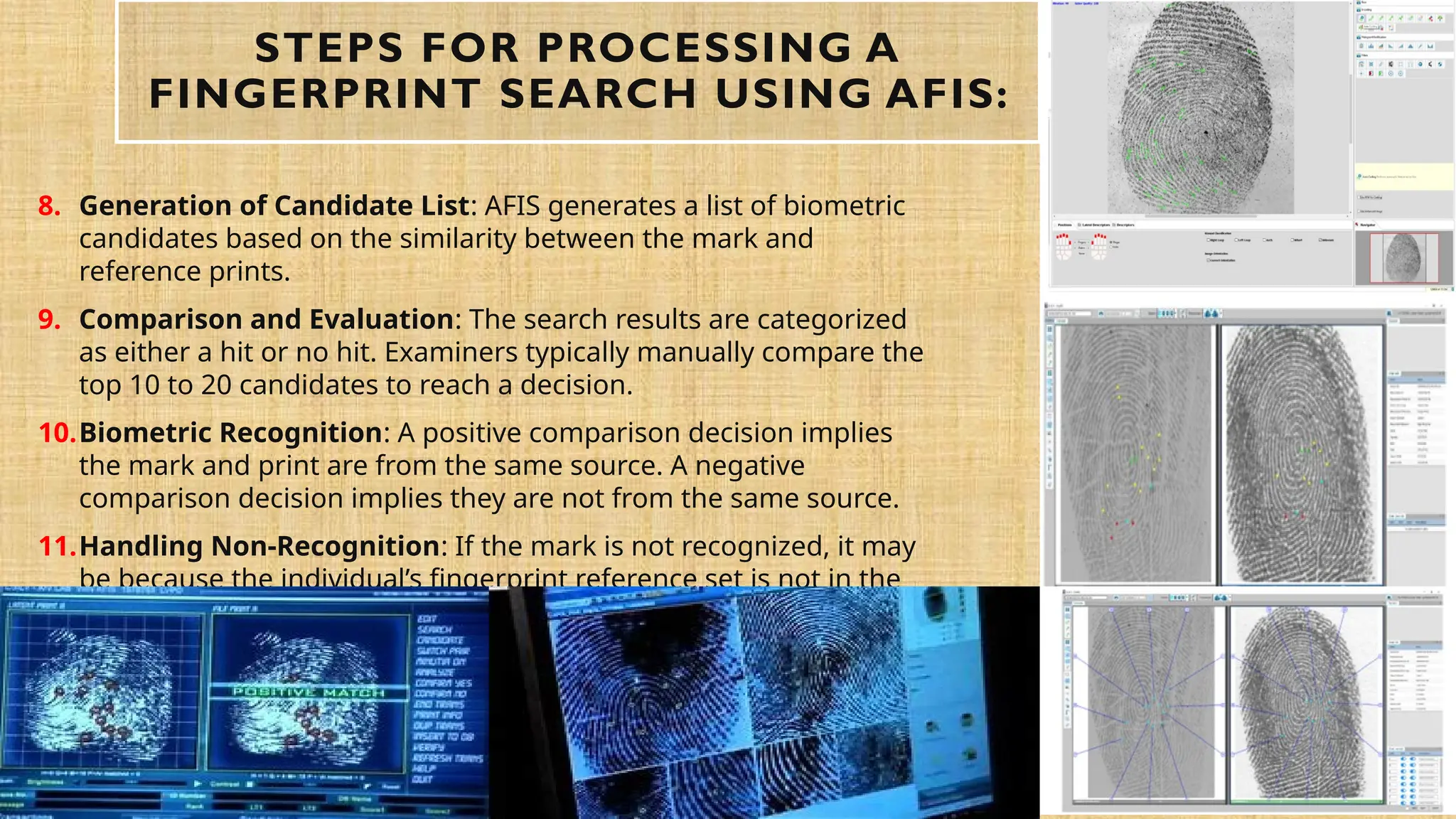
8. Generation of Candidate List: AFIS generates a list of biometric
candidates based on the similarity between the mark and
reference prints.
9. Comparison and Evaluation: The search results are categorized
as either a hit or no hit. Examiners typically manually compare the
top 10 to 20 candidates to reach a decision.
10.Biometric Recognition: A positive comparison decision implies
the mark and print are from the same source. A negative
comparison decision implies they are not from the same source.
11.Handling Non-Recognition: If the mark is not recognized, it may
be because the individual’s fingerprint reference set is not in the
database.
AUTO-ENCONDING MANUAL-ENCODING
• Automated extraction and annotation of fingerprint features.
• Typically involves minimal to no human intervention.
• Often referred to as “lights-out” processing.
• Human examiners manually extract and annotate fingerprint
features.
• Involves detailed analysis and interpretation by trained
professionals.
• Very fast, capable of processing a single fully rolled fingerprint
containing between 40 and 100 minutiae quickly.
• Supports faster turnaround times (TATs) for high-clarity
marks.
• Time-consuming, especially for complete reference sets.
• Slower compared to auto-encoding due to the manual effort
involved.
• Requires fewer human resources, making it cost-effective.
• Ideal for processing large volumes of fingerprints
• More costly due to the need for skilled examiners.
• Labor-intensive, requiring significant human resources.
• Provides consistent results as it eliminates human error and
variability.
• Standardized processing across all fingerprints.
• Allows for expert judgment and handling of complex or low-
quality prints.
• Can adapt to unique or challenging fingerprint patterns.
• Commonly used during the enrollment of biometric
reference sets.
• Suitable for high-clarity marks that require minimal human
intervention.
• Often used for low-quality or smudged prints where
automated systems may struggle
• Essential for detailed forensic analysis and verification.
FORENSIC SCIENCE IN AFIS:
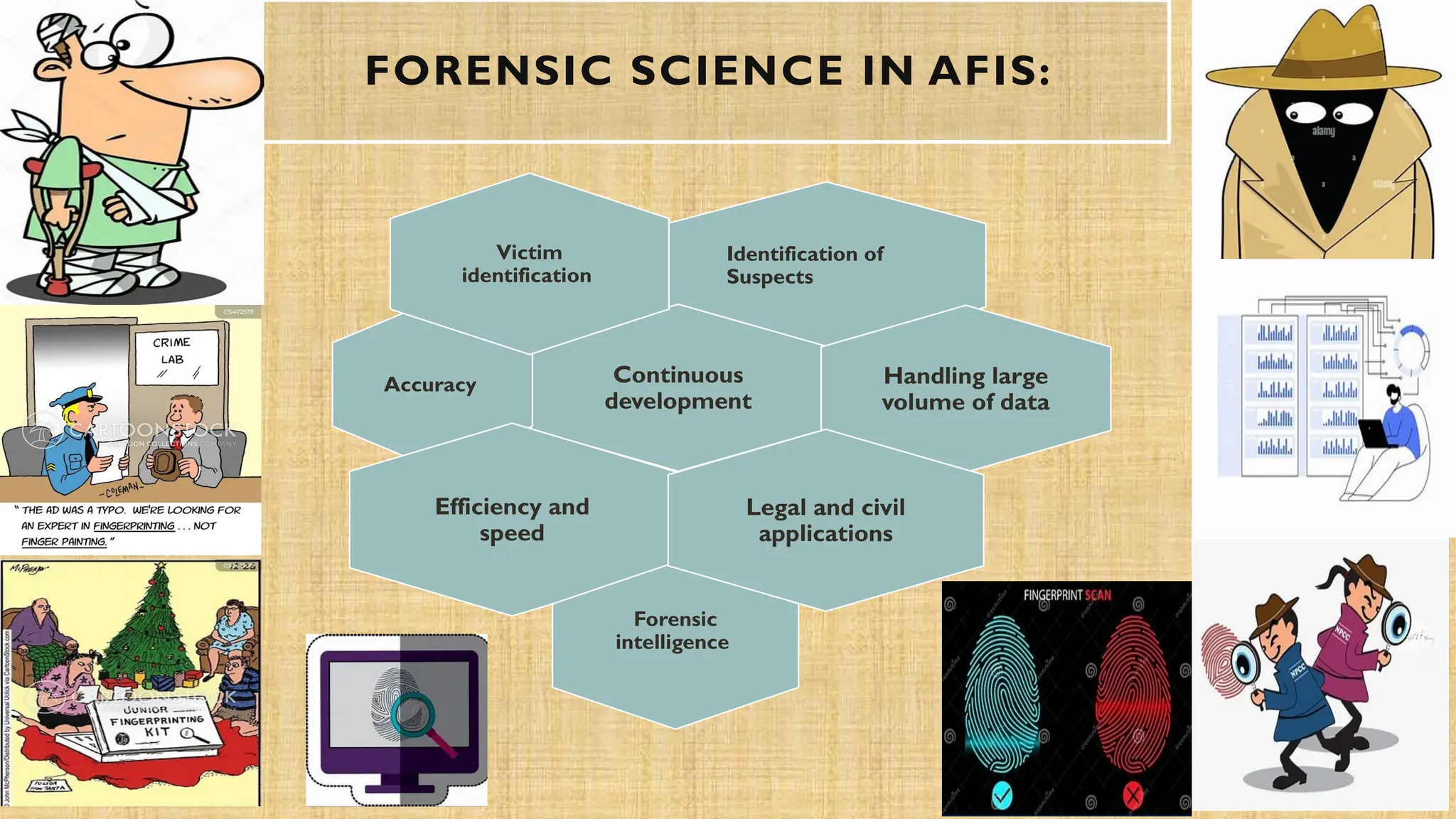
Identification of
Suspects
Continuous
development
Accuracy Handling large
volume of data
Efficiency and
speed
Victim
identification
Forensic
intelligence
Legal and civil
applications
CHALLENGES AND LIMITATIONS OF
AFIS
1. Quality of Fingerprints:
• Low-Quality Prints: Smudged, partial, or low-quality prints can reduce the accuracy of matches
• Environmental Factors: Conditions under which fingerprints are collected (e.g., weather, surface type) can affect
quality
2. Cost:
• High Implementation Costs: Setting up and maintaining AFIS can be expensive, limiting its adoption to well-funded
agencies
• Operational Costs: Ongoing costs for updates, maintenance, and training can be substantial
3. Human Factors:
• Expertise Required: Skilled examiners are needed to handle complex cases and verify matches
• Human Errors: Human errors can affect the accuracy of manual reviews
4. Technological Limitations:
• Algorithm Limitations: Even advanced algorithms may struggle with highly distorted or incomplete prints
• Hardware Dependence: The performance of AFIS is dependent on the quality and capability of the hardware used
5. Legal and Policy Issues:
• Regulatory Compliance: Ensuring compliance with various national and international regulations can be challenging
• Retention Policies: Policies regarding the retention and use of fingerprint data can vary, affecting how long data is
stored and used
CHALLENGES AND LIMITATIONS OF
AFIS
6. Data Privacy and Security:
• Sensitive Information: Handling and storing biometric data raises privacy concerns
• Security Risks: Protecting the database from cyber-attacks and unauthorized access is critical
7. Motivational Bias:
• Close Connectivity with Investigators: Examiners may be influenced by their relationship with
investigators.
• Desire for Positive Outcomes: Examiners may feel pressured to reach positive comparison decisions
to gain recognition or assist police informants.
8. Task-Irrelevant Information:
• Dual Functions: Examiners who both process crime scenes and search for marks may be exposed to
task-irrelevant information.
• Influence on Judgment: Knowledge of a suspect’s criminal history or alibi can unconsciously influence
examiners’ decisions.
9. Legal and Ethical Standards:
• Compliance with Laws: Ensuring that the use of AFIS complies with national and international laws
and regulations is crucial. This includes data protection laws and human rights standards.
• Ethical Guidelines: Developing and adhering to ethical guidelines for the use of biometric data can
help address concerns and build public trust.
ADVANCEMENT OF AFIS
1.Advanced Image Processing:
• Image Enhancement: New image processing techniques enhance the quality
of fingerprint images, making it easier to extract and analyze features
• 3D Fingerprint Scanning: Emerging technologies like 3D fingerprint scanning
provide more detailed and accurate representations of fingerprints, improving
the reliability of matches
2.Cloud-Based Solutions:
• Scalability: Cloud-based AFIS solutions offer scalable storage and processing
capabilities, allowing agencies to handle larger databases without significant
infrastructure investments
• Accessibility: Cloud solutions enable remote access to AFIS databases,
facilitating real-time data sharing and collaboration across different locations
3.Multimodal Biometric Identification Systems (MBIS):
• Combining Modalities: MBIS integrates multiple biometric modalities, such as
fingerprints, iris scans, and facial recognition, to provide a more comprehensive
identification system
• Enhanced Accuracy: By combining different biometric data points, MBIS improves
the accuracy and reliability of identifications
ADVANCEMENT OF AFIS
4. Mobile AFIS:
• Field Access: Mobile AFIS solutions allow law enforcement officers to
capture and search fingerprints in the field using portable devicesThis
capability is particularly useful for rapid identification during
investigations and at border control points.
• Real-Time Results: Mobile AFIS provides real-time results, enabling
officers to make quick decisions based on accurate biometric data
5.Artificial Intelligence and Machine Learning:
• Predictive Analytics: AI and machine learning algorithms can predict
and identify patterns in fingerprint data, improving the accuracy and
efficiency of searches.
• Continuous Learning: These technologies enable AFIS systems to
continuously learn and adapt, enhancing their performance over time
6. Applications Beyond Law Enforcement:
• Civil Applications: Integrated biometric systems are used in various
civil applications, such as border control, visa applications, and national
ID programs
• Public Safety and Security: These systems enhance public safety and
security by providing accurate and reliable identification methods
CASE STUDY
• Case Background
• In 2006, a brutal dacoity and murder occurred in a residential area of Delhi. Despite extensive investigations, the case went cold due to a
lack of concrete evidence and leads. The crime scene had several fingerprints, but without a centralized database, matching them to
potential suspects was challenging.
• Breakthrough with NAFIS
• In 2023, the Delhi Police revisited the case using the National Automated Fingerprint Identification System (NAFIS). Here’s how NAFIS
played a crucial role:
1. Digitization of Fingerprints: The fingerprints collected from the crime scene in 2006 were digitized and uploaded into the NAFIS
database.
2. Automated Matching: NAFIS used advanced algorithms to compare the uploaded fingerprints with millions of records in the database.
This process, which would have taken months manually, was completed in a matter of hours.
3. Identification: The system identified a match with a known criminal who had been arrested for a minor offense in another state. His
fingerprints were in the database due to prior arrests.
4. Verification and Validation: The match was verified by forensic experts to ensure accuracy. The suspect’s background was checked,
revealing a history of similar crimes.
• Arrest and Conviction
• With the suspect identified, the police tracked him down and arrested him. During interrogation, he confessed to the crime, providing
details that matched the evidence collected in 2006. The case was finally solved, bringing closure to the victims’ families.
• Impact of NAFIS
• This case highlights the transformative impact of NAFIS on forensic investigations in India. By centralizing and automating fingerprint
data, NAFIS has made it possible to solve cold cases and bring criminals to justice more efficiently.
REFERENCE
1. AFIS: History of biometrics & forensics (June 2023) (thalesgroup.com)
2. AFIS (Automated Fingerprint Identification System) - FAQs (innovatrics.com)
3. Toward better AFIS practice and process in the forensic fingerprint environment-
Toward better AFIS practice and process in the forensic fingerprint environment - ScienceDirect
4. https://darpg-innovation.nic.in/uploads/5wuevudtOKNAFIS.pdf
5. Moses Daluz, H. (2018). Fundamentals of Fingerprint Analysis, Second Edition (2nd ed.). CRC Press.
https://doi.org/10.4324/9781351043205

Automated Fingerprint Identification Systems (AFIS).pptx

  • 1.
    AUTOMATED FINGERPRINT IDENTIFICATION SYSTEMS(AFIS) RISHAB M NAIR MSC FORENSIC SCIENCE
  • 2.
    WHAT IS AFIS? • The Automated Fingerprint Identification System (AFIS) is a biometric technology that digitally stores representations of friction ridge skin, such as fingerprints, palmprints, and footprints. It enables rapid database searches to identify connections between different impressions. • AFIS offers an electronic database that simplifies the maintenance of accurate records and allows for quick access to relevant information • AFIS can rapidly search through millions of fingerprints in seconds, facilitating large-scale searches and the automated identification of potential suspects • It is primarily utilized for identifying individuals in contexts such as border control and visa applications, as well as linking an individual to a mark in criminal investigations or public inquiries. • The enrollment of individuals can be entirely digital through Live Scan, with biometric feature extraction and encoding fully automated. • This system also facilitates the sharing of fingerprint data across different agencies and jurisdictions, enhancing collaboration and increasing the likelihood of identifying unknown individuals and solving crimes. • The National Automated Fingerprint Identification System (NAFIS) is a centralized database developed by the National Crime Records Bureau (NCRB) in India. It aims to consolidate fingerprint data from all states and union territories into a single, searchable national database
  • 3.
    HISTORY OF AFIS •Historical Context: Law enforcement agencies historically employed fingerprint examiners for manual classification, filing, and searching. • FBI’s Identification Division: Established in 1924, initially contained 810,188 fingerprint records, processing about 30,000 tenprint cards daily.. • Development of AFIS: Automated Fingerprint Identification System (AFIS) was developed to address this problem. • Capabilities of Computers: Computers store vast amounts of information, perform multiple functions simultaneously, and operate continuously. • Royal Canadian Mounted Police: Implemented an automated system in 1977. • San Francisco’s Initiative: First U.S. jurisdiction to routinely use AFIS in 1983, following 80% citizen approval. • Crime Scene Investigations Unit: Formed in San Francisco, leading to a tenfold increase in fingerprint identifications and a 26% decrease in burglary rates over four years. • Global Adoption: Countries like the U.S., France, Canada, the U.K., and Japan developed computer systems for identification bureaus. • Routine Use Today: Most law enforcement agencies now routinely use AFIS for criminal investigations • NGI System: By 2012, the FBI’s Next Generation Identification (NGI) system contained over 70 million criminal files and more than 700 million individual fingerprints. (Formerly known as iAFIS)
  • 4.
    AFIS DATABASE ANDSTORAGE SYSTEM Contents of AFIS Database: Images of fingerprints, sets of fingerprints, palmprints, and footprints. Identifying data of individuals. Source: include criminal investigations and biometric civil registers. Templates for Quick Searching: Templates are created from source images of fingerprints. Purpose:These templates enable quick and efficient searching for potential match candidates within the AFIS database. Field Access: The AFIS database can be accessed by field computers equipped with the necessary tools. This is particularly useful for: IdentifyingVictims:Assisting in the identification of victims during natural disasters. State Aid: Facilitating the disbursement of state aid by verifying identities in the field. Disaster Recovery: Database can be duplicated into a disaster- recovery site. Ensures continuity of critical services in case of massive failure. Essential for applications like border control Storage System: High-capacity storage systems to handle large volumes of data. Redundant storage solutions to prevent data loss. Secure and encrypted storage to protect sensitive information. Scalable infrastructure to accommodate growing databases.
  • 5.
    TYPES OF FINGERPRINTS PROCESSEDBY AFIS Full Fingerprints • Complete prints of all fingers. • Typically collected during criminal bookings or background checks. • Provide the most comprehensive data for identification. Partial Fingerprints • Incomplete prints that may be smudged or only show part of the finger. • Often found at crime scenes. • AFIS can still match these by focusing on identifiable features. Latent Prints • Hidden prints left on surfaces, often invisible to the naked eye. • Collected from crime scenes using various techniques (e.g., dusting, chemical development). • Require careful processing to enhance and capture the print for AFIS analysis
  • 6.
  • 7.
    STEPS FOR PROCESSINGA FINGERPRINT SEARCH USING AFIS: 1. Transfer of Marks: Marks recovered from crime scenes are sent to the fingerprint office either physically (as a lift) or digitally (as an image). 2. Initial Assessment: An examiner assesses the mark to determine if it meets the agency’s requirements for an AFIS search. 3. Upload to AFIS: If suitable, the mark is uploaded to AFIS with relevant case information via digital scan or file. 4. Orientation: The examiner orients the mark in the upright position as it appears on the reference set. If the region of the mark is identifiable (e.g., left thumb), the examiner can nominate the specific region for the search. 5. Encoding of Features: The mark is encoded by extracting features such as ridge endings and bifurcations. Encoding can be done manually, automatically, or in combination. 6. Creation of Feature Map: Encoded features create a map based on geometric relationships and spatial frequency between minutiae. 7. Search Initiation: The encoded mark is launched for search in the AFIS database.
  • 8.
    STEPS FOR PROCESSINGA FINGERPRINT SEARCH USING AFIS: 8. Generation of Candidate List: AFIS generates a list of biometric candidates based on the similarity between the mark and reference prints. 9. Comparison and Evaluation: The search results are categorized as either a hit or no hit. Examiners typically manually compare the top 10 to 20 candidates to reach a decision. 10.Biometric Recognition: A positive comparison decision implies the mark and print are from the same source. A negative comparison decision implies they are not from the same source. 11.Handling Non-Recognition: If the mark is not recognized, it may be because the individual’s fingerprint reference set is not in the database.
  • 9.
    AUTO-ENCONDING MANUAL-ENCODING • Automatedextraction and annotation of fingerprint features. • Typically involves minimal to no human intervention. • Often referred to as “lights-out” processing. • Human examiners manually extract and annotate fingerprint features. • Involves detailed analysis and interpretation by trained professionals. • Very fast, capable of processing a single fully rolled fingerprint containing between 40 and 100 minutiae quickly. • Supports faster turnaround times (TATs) for high-clarity marks. • Time-consuming, especially for complete reference sets. • Slower compared to auto-encoding due to the manual effort involved. • Requires fewer human resources, making it cost-effective. • Ideal for processing large volumes of fingerprints • More costly due to the need for skilled examiners. • Labor-intensive, requiring significant human resources. • Provides consistent results as it eliminates human error and variability. • Standardized processing across all fingerprints. • Allows for expert judgment and handling of complex or low- quality prints. • Can adapt to unique or challenging fingerprint patterns. • Commonly used during the enrollment of biometric reference sets. • Suitable for high-clarity marks that require minimal human intervention. • Often used for low-quality or smudged prints where automated systems may struggle • Essential for detailed forensic analysis and verification.
  • 10.
    FORENSIC SCIENCE INAFIS: Identification of Suspects Continuous development Accuracy Handling large volume of data Efficiency and speed Victim identification Forensic intelligence Legal and civil applications
  • 11.
    CHALLENGES AND LIMITATIONSOF AFIS 1. Quality of Fingerprints: • Low-Quality Prints: Smudged, partial, or low-quality prints can reduce the accuracy of matches • Environmental Factors: Conditions under which fingerprints are collected (e.g., weather, surface type) can affect quality 2. Cost: • High Implementation Costs: Setting up and maintaining AFIS can be expensive, limiting its adoption to well-funded agencies • Operational Costs: Ongoing costs for updates, maintenance, and training can be substantial 3. Human Factors: • Expertise Required: Skilled examiners are needed to handle complex cases and verify matches • Human Errors: Human errors can affect the accuracy of manual reviews 4. Technological Limitations: • Algorithm Limitations: Even advanced algorithms may struggle with highly distorted or incomplete prints • Hardware Dependence: The performance of AFIS is dependent on the quality and capability of the hardware used 5. Legal and Policy Issues: • Regulatory Compliance: Ensuring compliance with various national and international regulations can be challenging • Retention Policies: Policies regarding the retention and use of fingerprint data can vary, affecting how long data is stored and used
  • 12.
    CHALLENGES AND LIMITATIONSOF AFIS 6. Data Privacy and Security: • Sensitive Information: Handling and storing biometric data raises privacy concerns • Security Risks: Protecting the database from cyber-attacks and unauthorized access is critical 7. Motivational Bias: • Close Connectivity with Investigators: Examiners may be influenced by their relationship with investigators. • Desire for Positive Outcomes: Examiners may feel pressured to reach positive comparison decisions to gain recognition or assist police informants. 8. Task-Irrelevant Information: • Dual Functions: Examiners who both process crime scenes and search for marks may be exposed to task-irrelevant information. • Influence on Judgment: Knowledge of a suspect’s criminal history or alibi can unconsciously influence examiners’ decisions. 9. Legal and Ethical Standards: • Compliance with Laws: Ensuring that the use of AFIS complies with national and international laws and regulations is crucial. This includes data protection laws and human rights standards. • Ethical Guidelines: Developing and adhering to ethical guidelines for the use of biometric data can help address concerns and build public trust.
  • 13.
    ADVANCEMENT OF AFIS 1.AdvancedImage Processing: • Image Enhancement: New image processing techniques enhance the quality of fingerprint images, making it easier to extract and analyze features • 3D Fingerprint Scanning: Emerging technologies like 3D fingerprint scanning provide more detailed and accurate representations of fingerprints, improving the reliability of matches 2.Cloud-Based Solutions: • Scalability: Cloud-based AFIS solutions offer scalable storage and processing capabilities, allowing agencies to handle larger databases without significant infrastructure investments • Accessibility: Cloud solutions enable remote access to AFIS databases, facilitating real-time data sharing and collaboration across different locations 3.Multimodal Biometric Identification Systems (MBIS): • Combining Modalities: MBIS integrates multiple biometric modalities, such as fingerprints, iris scans, and facial recognition, to provide a more comprehensive identification system • Enhanced Accuracy: By combining different biometric data points, MBIS improves the accuracy and reliability of identifications
  • 14.
    ADVANCEMENT OF AFIS 4.Mobile AFIS: • Field Access: Mobile AFIS solutions allow law enforcement officers to capture and search fingerprints in the field using portable devicesThis capability is particularly useful for rapid identification during investigations and at border control points. • Real-Time Results: Mobile AFIS provides real-time results, enabling officers to make quick decisions based on accurate biometric data 5.Artificial Intelligence and Machine Learning: • Predictive Analytics: AI and machine learning algorithms can predict and identify patterns in fingerprint data, improving the accuracy and efficiency of searches. • Continuous Learning: These technologies enable AFIS systems to continuously learn and adapt, enhancing their performance over time 6. Applications Beyond Law Enforcement: • Civil Applications: Integrated biometric systems are used in various civil applications, such as border control, visa applications, and national ID programs • Public Safety and Security: These systems enhance public safety and security by providing accurate and reliable identification methods
  • 15.
    CASE STUDY • CaseBackground • In 2006, a brutal dacoity and murder occurred in a residential area of Delhi. Despite extensive investigations, the case went cold due to a lack of concrete evidence and leads. The crime scene had several fingerprints, but without a centralized database, matching them to potential suspects was challenging. • Breakthrough with NAFIS • In 2023, the Delhi Police revisited the case using the National Automated Fingerprint Identification System (NAFIS). Here’s how NAFIS played a crucial role: 1. Digitization of Fingerprints: The fingerprints collected from the crime scene in 2006 were digitized and uploaded into the NAFIS database. 2. Automated Matching: NAFIS used advanced algorithms to compare the uploaded fingerprints with millions of records in the database. This process, which would have taken months manually, was completed in a matter of hours. 3. Identification: The system identified a match with a known criminal who had been arrested for a minor offense in another state. His fingerprints were in the database due to prior arrests. 4. Verification and Validation: The match was verified by forensic experts to ensure accuracy. The suspect’s background was checked, revealing a history of similar crimes. • Arrest and Conviction • With the suspect identified, the police tracked him down and arrested him. During interrogation, he confessed to the crime, providing details that matched the evidence collected in 2006. The case was finally solved, bringing closure to the victims’ families. • Impact of NAFIS • This case highlights the transformative impact of NAFIS on forensic investigations in India. By centralizing and automating fingerprint data, NAFIS has made it possible to solve cold cases and bring criminals to justice more efficiently.
  • 16.
    REFERENCE 1. AFIS: Historyof biometrics & forensics (June 2023) (thalesgroup.com) 2. AFIS (Automated Fingerprint Identification System) - FAQs (innovatrics.com) 3. Toward better AFIS practice and process in the forensic fingerprint environment- Toward better AFIS practice and process in the forensic fingerprint environment - ScienceDirect 4. https://darpg-innovation.nic.in/uploads/5wuevudtOKNAFIS.pdf 5. Moses Daluz, H. (2018). Fundamentals of Fingerprint Analysis, Second Edition (2nd ed.). CRC Press. https://doi.org/10.4324/9781351043205