Faster legal solutions
jdpconsulting.ph
jdpconsulting
www.jdpconsulting.ph
Just Causes
Valid Grounds for Dismissing
an Employee
Serious Misconduct
Standards to be a valid ground for termination:
- There must be misconduct;
- The misconduct must be of such grave and aggravated character;
- It must relate to the performance of the employee’s duties; and
- There must be showing that the employee becomes unfit to
continue working for the employer.
DOLE D.O.
147-15
Imasen Philippine Manufacturing Corporation v. Alcon (2014)
The employer (manufacturer) dismissed employees (welders)
who were caught in the act having sexual intercourse by a secu-
rity guard who submitted a handwritten report of the incident.
HELD: The employees were validly dismissed.
The employees infraction amounts to serious misconduct.
“To constitute a valid cause for the dismissal within the text and
meaning of... the Labor Code, the employee’s misconduct must
be serious, i.e., of such grave and aggravated character and
not merely trivial or unimportant.”
Case Law
Imasen Philip-
pine Manufac-
turing Corpora-
tion v. Alcon,
G.R. No.
194884, 22
October 2014
Standards to be a valid ground for termination:
- There must be disobedience or insubordination;
- The disobedience or insubordination must be willful or inten-
tional characterized by a wrongful and perverse attitude;
- The order violated must be reasonable, lawful, and made
known to the employee; and
- The order must pertain to the duties which he has been en-
gaged to discharge.
Willful Disobedience (Insubordination)
DOLE D.O.
147-15
Nuez v. PHILCOMSAT (1994)
The employer (telecommunication) dismissed the employee (driver) who refused
twice on the same day to drive senior officers of the company. He said: "Ayaw
kong magmaneho dahil may bibilhin ako sa Lagundi. Kung gusto mo yong 'loyal-
ist' ang magmaneho."
HELD: The employee was validly dismissed.
“The existence of an emergency situation is irrelevant to the charge of willful dis-
obedience; an opposite principle would allow a worker to shield himself under his
self-designed concept of "non-emergency situation" to deliberately defy the direc-
tive of the employer. Neither is the resulting damage vital. The heart of the charge
is the crooked and anarchic attitude of the employee towards his employer.
Damage aggravates the charge but its absence does not mitigate nor negate the
employee's liability. The fact that a replacement driver was able to perform the
task could neither alter the gravity of the charge, this responsibility being personal
to the perpetrator...”
Case Law
Nuez v. Philip-
pine Overseas
Telecommunica-
tions Corpora-
tion (PHILCOM-
SAT), G.R. No.
107574, 28
December
1994
Standards to be a valid ground for termination:
1) There must be neglect of duty; and
2) The negligence must be both gross and habitual in character.
Gross & Habitual Neglect of Duties
DOLE D.O.
147-15
Cavite Apparel, Incorporated v. Marquez (2013)
The employer (manufacturer) dismissed the employee for gross and habitual ne-
glect after the latter incurred 4 unauthorized absences.
HELD: The employer was liable for illegal dismissal.
“Cavite Apparel’s position fails to convince us [the Supreme Court]. Based on
what we see in the records, there simply cannot be a case of gross and habitual
neglect of duty against Michelle. Even assuming that she failed to present a medi-
cal certificate for her sick leave on May 8, 2000, the records are bereft of any in-
dication that apart from the four occasions when she did not report for work, Mi-
chelle had been cited for any infraction since she started her employment with the
company in 1994. Four absences in her six years of service, to our mind, cannot
be considered gross and habitual neglect of duty, especially so since the absences
were spread out over a six-month period.”
Case Law
Cavite Apparel,
Incorporated v.
Marquez, G.R.
No. 172044,
06 February
2013
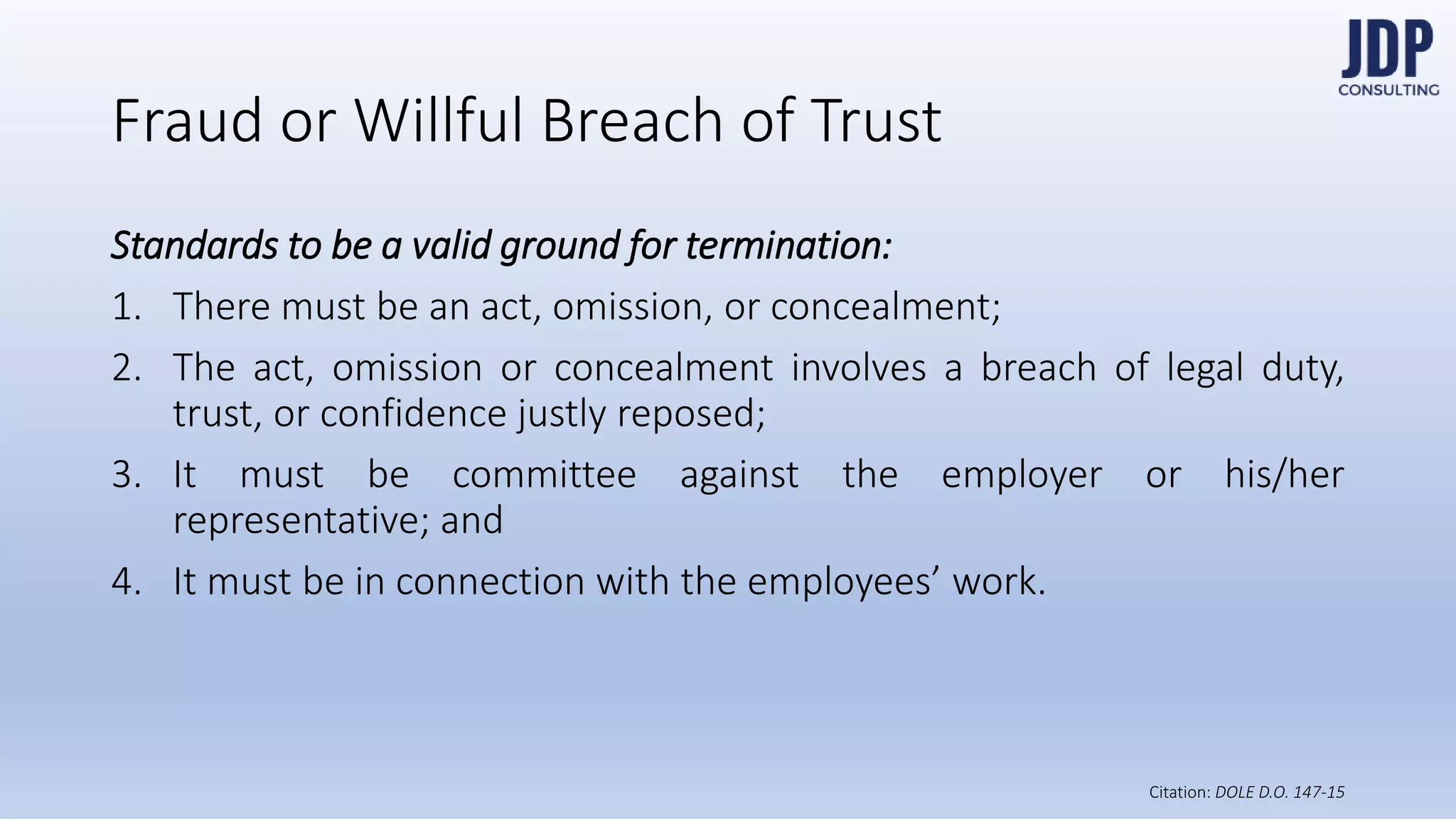
Standards to be a valid ground for termination:
1) There must be an act, omission, or concealment;
2) The act, omission or concealment involves a breach of legal
duty, trust, or confidence justly reposed;
3) It must be committee against the employer or his/her repre-
sentative; and
4) It must be in connection with the employees’ work.
Fraud or Willful Breach of Trust
DOLE D.O.
147-15
P.J. Lhuillier, Inc. v. Velayo (2014)
The employer (pawnshop) dismissed the employee (cashier) for breach of
trust after the latter failed to record a P540.00 pera padala transaction,
which was discovered via a branch audit.
HELD: The employee was validly dismissed.
“A cashier’s inability to safeguard and account for missing cash is sufficient
cause to dismiss her.”
“It would be most unfair to require an employer to continue employing as
its cashiera person whom it reasonably believes is no longer capable of
giving full and whole hearted trustworthiness in the stewardship of compa-
ny funds.”
Case Law
Cavite Apparel,
Incorporated v.
Marquez, G.R.
No. 172044,
06 February
2013
Standards to be a valid ground for termination:
1) There must be an act, omission, or concealment;
2) The act, omission or concealment justifies the loss of trust and confidence
of the employer to the employee;
3) The employee concerned must be holding a position of trust and confi-
dence;
4) The loss of trust and confidence should not be simulated;
5) It should not be used as a subterfuge for causes which are improper, ille-
gal, or unjustified and
6) It must be genuine and not a mere afterthought to justify an earlier action
taken in bad faith.
Loss of Confidence
DOLE D.O.
147-15
Alps Transportation v. Rodriguez (2013)
- The employer (bus company) refused to readmit the employee (bus conductor)
due to loss of trust and confidence after an irregularity report showed that bus
fares were collected from passengers without him issuing tickets.
- While the employee was hired by a third-party, it was found out that such was a
labor-contractor and hence the bus company was considered the employer.
HELD: The employer was liable for illegal dismissal.
- The irregularity report contained accusations without additional proof. “An accu-
sation that is not substantiated will not ripen into a holding that there is just cause
for dismissal.”
- Thus, termination due to just cause was not proven.
Case Law
ALPS Transpor-
tation v. Rodri-
guez, G.R. No.
186732, 13
June 2013
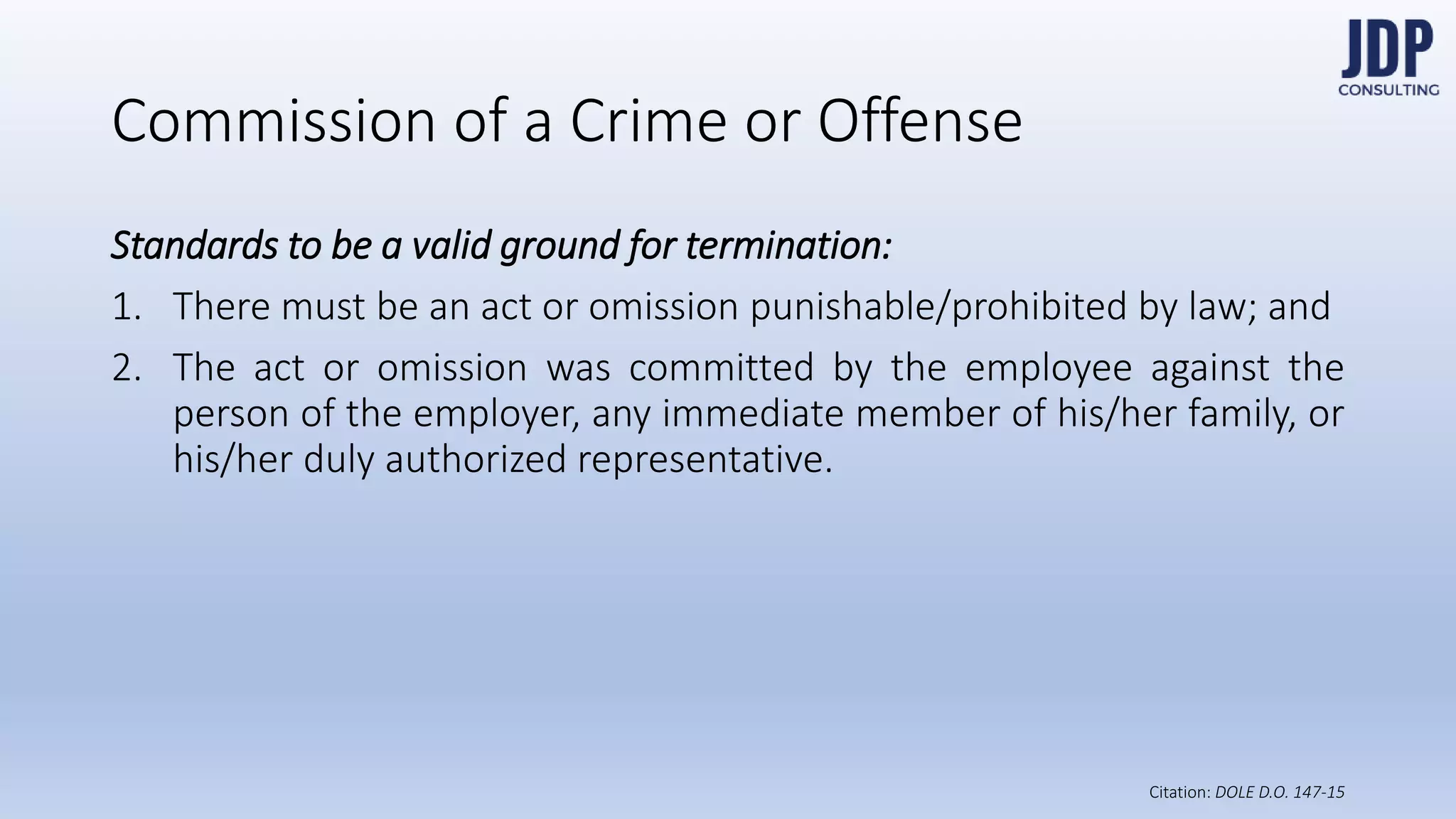
Standards to be a valid ground for termination:
1) There must be an act or omission punishable/prohibited by
law; and
2) The act or omission was committed by the employee against
the person of the employer, any immediate member of his/her
family, or his/her duly authorized representative.
Commission of a Crime or Offense
DOLE D.O.
147-15
International Rice Research Institute v. Micosa (1993)
- The employer (international organization) dismissed an employee (laborer) who
was found guilty for homicide after stabbing to death another at a beer house.
HELD: The employer was liable for illegal dismissal.
- “… the commission of a crime by the employee under Article 282 (d) refer to an
offense against the person of his employer or any immediate member of his family
or his duly authorized representative.”
- “In the case at bar, the commission of the crime of homicide was outside the pe-
rimeter of the IRRI complex, having been committed in a restaurant after office
hours and against a non-IRRI employee. Thus, the conviction of Micosa for homi-
cide was not work-related, his misdeed having no relation to his position as labor-
er and was not directed or committed against IRRI or its authorized agent.”
Case Law
International
Rice Research
Institute v.
Micosa, G.R.
No. 97239, 12
May 1993
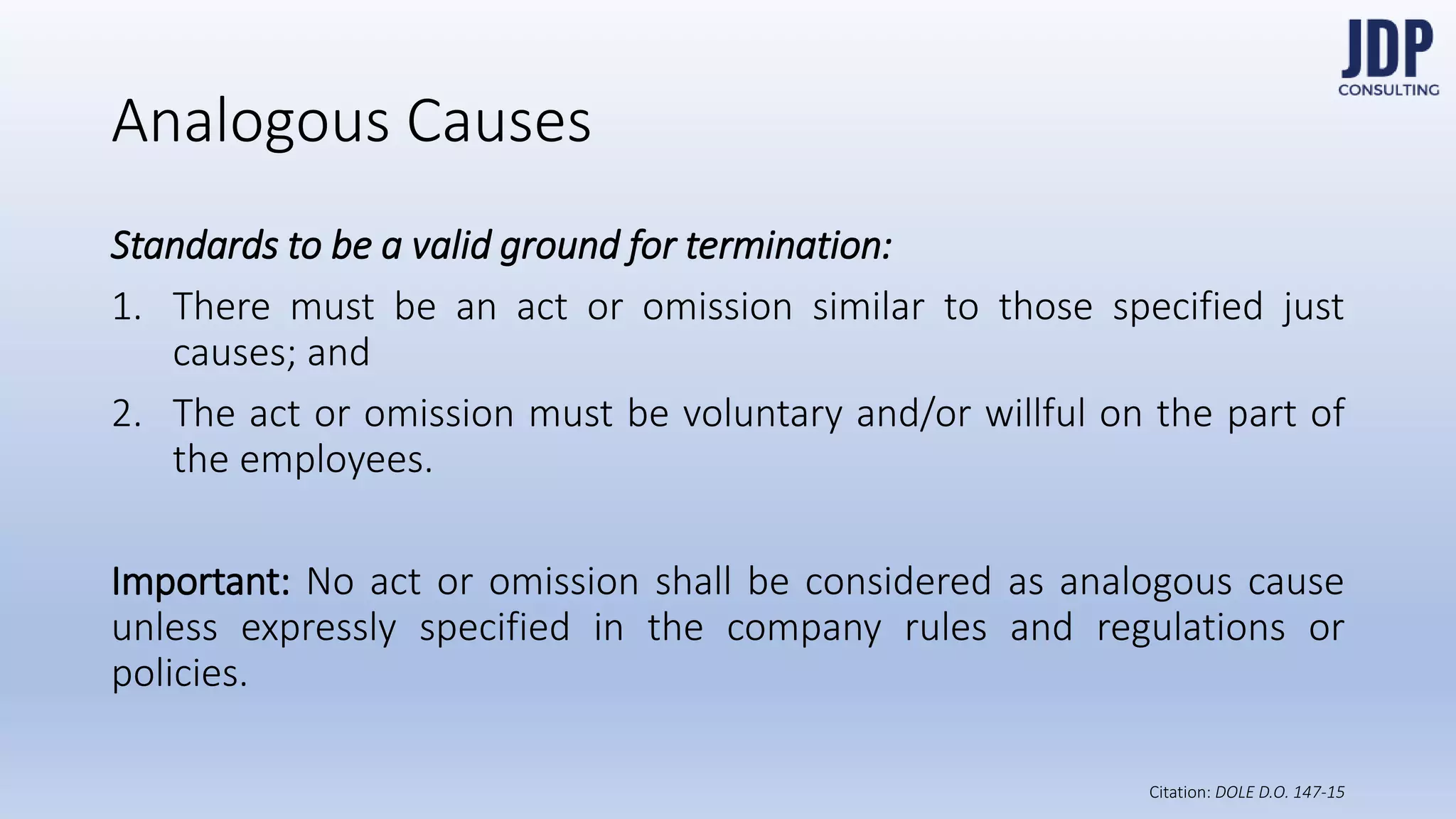
Standards to be a valid ground for termination:
1) There must be an act or omission similar to those specified just
causes; and
2) The act or omission must be voluntary and/or willful on the
part of the employees.
Important: No act or omission shall be considered as analogous
cause unless expressly specified in the company rules and regula-
tions or policies.
Analogous Causes
DOLE D.O.
147-15
International School Manila v. ISAE (2014)
- The employer (international school) dismissed an employee (Spanish language
teacher) for gross and habitual neglect after failing on her evaluations, which the
latter contested claiming she had been doing her work.
HELD: The employee was validly dismissed.
- “’Gross inefficiency’ is closely related to ‘gross neglect,’ for both involve specific
acts of omission on the part of the employee resulting in damage to the employer
or to his business.
- The employer “sufficiently proved the charge of gross inefficiency, which warrant-
ed the dismissal of [the employee] from the School.”
Case Law
International
School Manila
v. International
School Alliance
of Educators,
G.R. No.
167286, 05
February 2014
For more information, please visit
www.laborlaw.ph
We value feedback. �
For comments or permission to use slides,
send us an email: info@jdpconsulting.ph.
LABORLAW
www.jdpconsulting.ph
Brought to you by
Faster legal solutions
In-House Training
Join us for learning sessions on
these Human Resource topics:
HR Legal Compliance
Labor Unions
Company Policies
Labor Complaints
Outsourcing Manpower
Disciplinary Actions
We also offer coaching & mentoring.
Visit www.cpdc.ph for more details.PROFESSIONAL
DEVELOPMENT
CENTER
ONTINUING

Just Causes

  • 1.
  • 2.
    Serious Misconduct Standards tobe a valid ground for termination: - There must be misconduct; - The misconduct must be of such grave and aggravated character; - It must relate to the performance of the employee’s duties; and - There must be showing that the employee becomes unfit to continue working for the employer. DOLE D.O. 147-15
  • 3.
    Imasen Philippine ManufacturingCorporation v. Alcon (2014) The employer (manufacturer) dismissed employees (welders) who were caught in the act having sexual intercourse by a secu- rity guard who submitted a handwritten report of the incident. HELD: The employees were validly dismissed. The employees infraction amounts to serious misconduct. “To constitute a valid cause for the dismissal within the text and meaning of... the Labor Code, the employee’s misconduct must be serious, i.e., of such grave and aggravated character and not merely trivial or unimportant.” Case Law Imasen Philip- pine Manufac- turing Corpora- tion v. Alcon, G.R. No. 194884, 22 October 2014
  • 4.
    Standards to bea valid ground for termination: - There must be disobedience or insubordination; - The disobedience or insubordination must be willful or inten- tional characterized by a wrongful and perverse attitude; - The order violated must be reasonable, lawful, and made known to the employee; and - The order must pertain to the duties which he has been en- gaged to discharge. Willful Disobedience (Insubordination) DOLE D.O. 147-15
  • 5.
    Nuez v. PHILCOMSAT(1994) The employer (telecommunication) dismissed the employee (driver) who refused twice on the same day to drive senior officers of the company. He said: "Ayaw kong magmaneho dahil may bibilhin ako sa Lagundi. Kung gusto mo yong 'loyal- ist' ang magmaneho." HELD: The employee was validly dismissed. “The existence of an emergency situation is irrelevant to the charge of willful dis- obedience; an opposite principle would allow a worker to shield himself under his self-designed concept of "non-emergency situation" to deliberately defy the direc- tive of the employer. Neither is the resulting damage vital. The heart of the charge is the crooked and anarchic attitude of the employee towards his employer. Damage aggravates the charge but its absence does not mitigate nor negate the employee's liability. The fact that a replacement driver was able to perform the task could neither alter the gravity of the charge, this responsibility being personal to the perpetrator...” Case Law Nuez v. Philip- pine Overseas Telecommunica- tions Corpora- tion (PHILCOM- SAT), G.R. No. 107574, 28 December 1994
  • 6.
    Standards to bea valid ground for termination: 1) There must be neglect of duty; and 2) The negligence must be both gross and habitual in character. Gross & Habitual Neglect of Duties DOLE D.O. 147-15
  • 7.
    Cavite Apparel, Incorporatedv. Marquez (2013) The employer (manufacturer) dismissed the employee for gross and habitual ne- glect after the latter incurred 4 unauthorized absences. HELD: The employer was liable for illegal dismissal. “Cavite Apparel’s position fails to convince us [the Supreme Court]. Based on what we see in the records, there simply cannot be a case of gross and habitual neglect of duty against Michelle. Even assuming that she failed to present a medi- cal certificate for her sick leave on May 8, 2000, the records are bereft of any in- dication that apart from the four occasions when she did not report for work, Mi- chelle had been cited for any infraction since she started her employment with the company in 1994. Four absences in her six years of service, to our mind, cannot be considered gross and habitual neglect of duty, especially so since the absences were spread out over a six-month period.” Case Law Cavite Apparel, Incorporated v. Marquez, G.R. No. 172044, 06 February 2013
  • 8.
    Standards to bea valid ground for termination: 1) There must be an act, omission, or concealment; 2) The act, omission or concealment involves a breach of legal duty, trust, or confidence justly reposed; 3) It must be committee against the employer or his/her repre- sentative; and 4) It must be in connection with the employees’ work. Fraud or Willful Breach of Trust DOLE D.O. 147-15
  • 9.
    P.J. Lhuillier, Inc.v. Velayo (2014) The employer (pawnshop) dismissed the employee (cashier) for breach of trust after the latter failed to record a P540.00 pera padala transaction, which was discovered via a branch audit. HELD: The employee was validly dismissed. “A cashier’s inability to safeguard and account for missing cash is sufficient cause to dismiss her.” “It would be most unfair to require an employer to continue employing as its cashiera person whom it reasonably believes is no longer capable of giving full and whole hearted trustworthiness in the stewardship of compa- ny funds.” Case Law Cavite Apparel, Incorporated v. Marquez, G.R. No. 172044, 06 February 2013
  • 10.
    Standards to bea valid ground for termination: 1) There must be an act, omission, or concealment; 2) The act, omission or concealment justifies the loss of trust and confidence of the employer to the employee; 3) The employee concerned must be holding a position of trust and confi- dence; 4) The loss of trust and confidence should not be simulated; 5) It should not be used as a subterfuge for causes which are improper, ille- gal, or unjustified and 6) It must be genuine and not a mere afterthought to justify an earlier action taken in bad faith. Loss of Confidence DOLE D.O. 147-15
  • 11.
    Alps Transportation v.Rodriguez (2013) - The employer (bus company) refused to readmit the employee (bus conductor) due to loss of trust and confidence after an irregularity report showed that bus fares were collected from passengers without him issuing tickets. - While the employee was hired by a third-party, it was found out that such was a labor-contractor and hence the bus company was considered the employer. HELD: The employer was liable for illegal dismissal. - The irregularity report contained accusations without additional proof. “An accu- sation that is not substantiated will not ripen into a holding that there is just cause for dismissal.” - Thus, termination due to just cause was not proven. Case Law ALPS Transpor- tation v. Rodri- guez, G.R. No. 186732, 13 June 2013
  • 12.
    Standards to bea valid ground for termination: 1) There must be an act or omission punishable/prohibited by law; and 2) The act or omission was committed by the employee against the person of the employer, any immediate member of his/her family, or his/her duly authorized representative. Commission of a Crime or Offense DOLE D.O. 147-15
  • 13.
    International Rice ResearchInstitute v. Micosa (1993) - The employer (international organization) dismissed an employee (laborer) who was found guilty for homicide after stabbing to death another at a beer house. HELD: The employer was liable for illegal dismissal. - “… the commission of a crime by the employee under Article 282 (d) refer to an offense against the person of his employer or any immediate member of his family or his duly authorized representative.” - “In the case at bar, the commission of the crime of homicide was outside the pe- rimeter of the IRRI complex, having been committed in a restaurant after office hours and against a non-IRRI employee. Thus, the conviction of Micosa for homi- cide was not work-related, his misdeed having no relation to his position as labor- er and was not directed or committed against IRRI or its authorized agent.” Case Law International Rice Research Institute v. Micosa, G.R. No. 97239, 12 May 1993
  • 14.
    Standards to bea valid ground for termination: 1) There must be an act or omission similar to those specified just causes; and 2) The act or omission must be voluntary and/or willful on the part of the employees. Important: No act or omission shall be considered as analogous cause unless expressly specified in the company rules and regula- tions or policies. Analogous Causes DOLE D.O. 147-15
  • 15.
    International School Manilav. ISAE (2014) - The employer (international school) dismissed an employee (Spanish language teacher) for gross and habitual neglect after failing on her evaluations, which the latter contested claiming she had been doing her work. HELD: The employee was validly dismissed. - “’Gross inefficiency’ is closely related to ‘gross neglect,’ for both involve specific acts of omission on the part of the employee resulting in damage to the employer or to his business. - The employer “sufficiently proved the charge of gross inefficiency, which warrant- ed the dismissal of [the employee] from the School.” Case Law International School Manila v. International School Alliance of Educators, G.R. No. 167286, 05 February 2014
  • 16.
    For more information,please visit www.laborlaw.ph We value feedback. � For comments or permission to use slides, send us an email: info@jdpconsulting.ph. LABORLAW
  • 17.
    www.jdpconsulting.ph Brought to youby Faster legal solutions
  • 18.
    In-House Training Join usfor learning sessions on these Human Resource topics: HR Legal Compliance Labor Unions Company Policies Labor Complaints Outsourcing Manpower Disciplinary Actions We also offer coaching & mentoring. Visit www.cpdc.ph for more details.PROFESSIONAL DEVELOPMENT CENTER ONTINUING