Faster legal solutions
jdpconsulting.ph
jdpconsulting
www.jdpconsulting.ph
Minimum Wage
Lowest Prescribed Pay
Concept of Minimum Wage
Statutory Monetary Benefits are employee benefits required by
law to be given to the employees.
The ones giving the benefits are:
The Employer; or
The Government.
Citation: 2016 Handbook on Statutory Monetary Benefits by DOLE-BWC
RTWPB
Minimum wage is prescribed by the respective Regional Tripartite Wages
and Productivity Boards (RTWPBs) in various regions:
National Capital Region (NCR; Metro Manila)
Cordillera Autonomous Region (CAR)
Region I, II, III, IV-A, IV-B, V, VI, VII, VIII, IX, X, XI, XII, XIII
Autonomous Region in Muslim Mindanao (ARMM)
Citation: 2016 Handbook on Statutory Monetary Benefits by DOLE-BWC
Regional Wage Orders
The Regional Wage Orders “prescribe the daily minimum wage rates per in-
dustry per locality within the region and in some instances depending on the
number of workers and the capitalization of enterprises. The Wage Orders
likewise provide the basis and procedure for application for exemption from
compliance therefrom. Some Wage Orders grant allowances instead of wage
increases.”
Citation: 2016 Handbook on Statutory Monetary Benefits by DOLE-BWC, citing R.A. 6727 (Wage Rationalization Act)
“The wage increases prescribed under Wage Orders apply to all private
sector workers and employees receiving the daily minimum wage rates or
those receiving up to a certain daily wage ceiling, where applicable, re-
gardless of their position, designation, or status of employment, and irre-
spective of the method by which their wages are paid, except workers of
duly registered Barangay Micro Business Enterprises (BMBEs) with Certifi-
cate of Authority issued by the Office of the Municipal or City Treasurer.”
Coverage
Citation: 2016 Handbook on Statutory Monetary Benefits by DOLE-BWC, citing R.A. 6727 (Wage Rationalization Act)
“Upon application with and as determined by an RTWPB, based on docu-
mentation and other requirements in accordance with applicable rules and
regulations issued by the National Wages and Productivity Commission
(NWPC), a company/establishment may be exempted from compliance
with a Wage Order for a period not to exceed one (1) year.”
Coverage
Citation: 2016 Handbook on Statutory Monetary Benefits by DOLE-BWC, citing R.A. 6727 (Wage Rationalization Act)
Service Establishment is “one principally engaged in the sale of service to in-
dividuals for their own or household use and is generally recognized as
such.”
Service Establishments
Citation: 2016 Handbook on Statutory Monetary Benefits by DOLE-BWC, citing R.A. 6727 (Wage Rationalization Act)
The basis of the minimum wage rates prescribed by law shall be “the normal
working hours of eight (8) hours a day.”
Basis
Citation: 2016 Handbook on Statutory Monetary Benefits by DOLE-BWC, citing R.A. 6727 (Wage Rationalization Act)
Monthly-paid employees are “those who are paid every day of the month,
including unworked rest days, special days, and regular holidays. Factor
365 days in a year is used in determining the equivalent monthly salary of
monthly-paid employees.”
Daily-paid employees are “those who are paid on the days they actually
worked and on unworked regular holidays.”
Monthly Paid vs Daily Paid
Citation: 2016 Handbook on Statutory Monetary Benefits by DOLE-BWC, citing R.A. 6727 (Wage Rationalization Act)
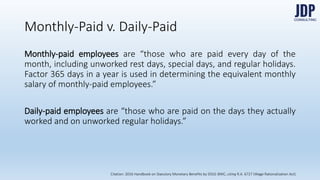
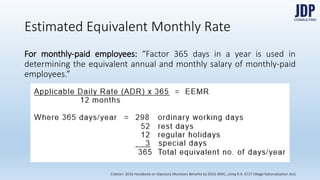
For monthly-paid employees: “Factor 365 days in a year is used in determin-
ing the equivalent annual and monthly salary of monthly-paid employees.”
Estimated Equivalent Monthly Rate
Citation: 2016 Handbook on Statutory Monetary Benefits by DOLE-BWC, citing R.A. 6727 (Wage Rationalization Act)
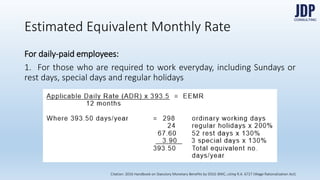
For daily-paid employees:
1. For those who are required to work everyday, including Sundays or rest
days, special days and regular holidays
Estimated Equivalent Monthly Rate
Citation: 2016 Handbook on Statutory Monetary Benefits by DOLE-BWC, citing R.A. 6727 (Wage Rationalization Act)
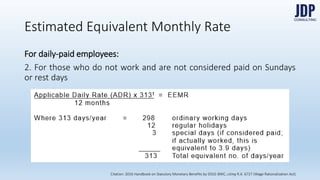
For daily-paid employees:
2. For those who do not work and are not considered paid on Sundays or
rest days
Estimated Equivalent Monthly Rate
Citation: 2016 Handbook on Statutory Monetary Benefits by DOLE-BWC, citing R.A. 6727 (Wage Rationalization Act)
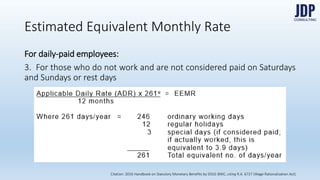
For daily-paid employees:
3. For those who do not work and are not considered paid on Saturdays
and Sundays or rest days
Estimated Equivalent Monthly Rate
Citation: 2016 Handbook on Statutory Monetary Benefits by DOLE-BWC, citing R.A. 6727 (Wage Rationalization Act)
Minimum Wage Earners are exempt from income tax:
1. Statutory Minimum Wage (SMW) inclusive of COLA;
2. Holiday Pay;
3. Overtime Pay;
4. Night Shift Differential Pay; and
5. Hazard Pay.
Exempt from Income Tax
Citation: 2016 Handbook on Statutory Monetary Benefits by DOLE-BWC, citing R.A. 6727 (Wage Rationalization Act)
For more information, please visit
www.laborlaw.ph
We value feedback. �
For comments or permission to use slides,
send us an email: info@jdpconsulting.ph.
LABORLAW
www.jdpconsulting.ph
Brought to you by
Faster legal solutions
In-House Training
Join us for learning sessions on
these Human Resource topics:
HR Legal Compliance
Labor Unions
Company Policies
Labor Complaints
Outsourcing Manpower
Disciplinary Actions
We also offer coaching & mentoring.
Visit www.cpdc.ph for more details.PROFESSIONAL
DEVELOPMENT
CENTER
ONTINUING

Minimum Wage

  • 1.
  • 2.
    Concept of MinimumWage Statutory Monetary Benefits are employee benefits required by law to be given to the employees. The ones giving the benefits are: The Employer; or The Government. Citation: 2016 Handbook on Statutory Monetary Benefits by DOLE-BWC
  • 3.
    RTWPB Minimum wage isprescribed by the respective Regional Tripartite Wages and Productivity Boards (RTWPBs) in various regions: National Capital Region (NCR; Metro Manila) Cordillera Autonomous Region (CAR) Region I, II, III, IV-A, IV-B, V, VI, VII, VIII, IX, X, XI, XII, XIII Autonomous Region in Muslim Mindanao (ARMM) Citation: 2016 Handbook on Statutory Monetary Benefits by DOLE-BWC
  • 4.
    Regional Wage Orders TheRegional Wage Orders “prescribe the daily minimum wage rates per in- dustry per locality within the region and in some instances depending on the number of workers and the capitalization of enterprises. The Wage Orders likewise provide the basis and procedure for application for exemption from compliance therefrom. Some Wage Orders grant allowances instead of wage increases.” Citation: 2016 Handbook on Statutory Monetary Benefits by DOLE-BWC, citing R.A. 6727 (Wage Rationalization Act)
  • 5.
    “The wage increasesprescribed under Wage Orders apply to all private sector workers and employees receiving the daily minimum wage rates or those receiving up to a certain daily wage ceiling, where applicable, re- gardless of their position, designation, or status of employment, and irre- spective of the method by which their wages are paid, except workers of duly registered Barangay Micro Business Enterprises (BMBEs) with Certifi- cate of Authority issued by the Office of the Municipal or City Treasurer.” Coverage Citation: 2016 Handbook on Statutory Monetary Benefits by DOLE-BWC, citing R.A. 6727 (Wage Rationalization Act)
  • 6.
    “Upon application withand as determined by an RTWPB, based on docu- mentation and other requirements in accordance with applicable rules and regulations issued by the National Wages and Productivity Commission (NWPC), a company/establishment may be exempted from compliance with a Wage Order for a period not to exceed one (1) year.” Coverage Citation: 2016 Handbook on Statutory Monetary Benefits by DOLE-BWC, citing R.A. 6727 (Wage Rationalization Act)
  • 7.
    Service Establishment is“one principally engaged in the sale of service to in- dividuals for their own or household use and is generally recognized as such.” Service Establishments Citation: 2016 Handbook on Statutory Monetary Benefits by DOLE-BWC, citing R.A. 6727 (Wage Rationalization Act)
  • 8.
    The basis ofthe minimum wage rates prescribed by law shall be “the normal working hours of eight (8) hours a day.” Basis Citation: 2016 Handbook on Statutory Monetary Benefits by DOLE-BWC, citing R.A. 6727 (Wage Rationalization Act)
  • 9.
    Monthly-paid employees are“those who are paid every day of the month, including unworked rest days, special days, and regular holidays. Factor 365 days in a year is used in determining the equivalent monthly salary of monthly-paid employees.” Daily-paid employees are “those who are paid on the days they actually worked and on unworked regular holidays.” Monthly Paid vs Daily Paid Citation: 2016 Handbook on Statutory Monetary Benefits by DOLE-BWC, citing R.A. 6727 (Wage Rationalization Act)
  • 10.
    For monthly-paid employees:“Factor 365 days in a year is used in determin- ing the equivalent annual and monthly salary of monthly-paid employees.” Estimated Equivalent Monthly Rate Citation: 2016 Handbook on Statutory Monetary Benefits by DOLE-BWC, citing R.A. 6727 (Wage Rationalization Act)
  • 11.
    For daily-paid employees: 1.For those who are required to work everyday, including Sundays or rest days, special days and regular holidays Estimated Equivalent Monthly Rate Citation: 2016 Handbook on Statutory Monetary Benefits by DOLE-BWC, citing R.A. 6727 (Wage Rationalization Act)
  • 12.
    For daily-paid employees: 2.For those who do not work and are not considered paid on Sundays or rest days Estimated Equivalent Monthly Rate Citation: 2016 Handbook on Statutory Monetary Benefits by DOLE-BWC, citing R.A. 6727 (Wage Rationalization Act)
  • 13.
    For daily-paid employees: 3.For those who do not work and are not considered paid on Saturdays and Sundays or rest days Estimated Equivalent Monthly Rate Citation: 2016 Handbook on Statutory Monetary Benefits by DOLE-BWC, citing R.A. 6727 (Wage Rationalization Act)
  • 14.
    Minimum Wage Earnersare exempt from income tax: 1. Statutory Minimum Wage (SMW) inclusive of COLA; 2. Holiday Pay; 3. Overtime Pay; 4. Night Shift Differential Pay; and 5. Hazard Pay. Exempt from Income Tax Citation: 2016 Handbook on Statutory Monetary Benefits by DOLE-BWC, citing R.A. 6727 (Wage Rationalization Act)
  • 15.
    For more information,please visit www.laborlaw.ph We value feedback. � For comments or permission to use slides, send us an email: info@jdpconsulting.ph. LABORLAW
  • 16.
    www.jdpconsulting.ph Brought to youby Faster legal solutions
  • 17.
    In-House Training Join usfor learning sessions on these Human Resource topics: HR Legal Compliance Labor Unions Company Policies Labor Complaints Outsourcing Manpower Disciplinary Actions We also offer coaching & mentoring. Visit www.cpdc.ph for more details.PROFESSIONAL DEVELOPMENT CENTER ONTINUING