IAPA QLD Chapter Event 26 November - An
Australian Analytics Story
Founded in 2001, Halfbrick has developed a range of hugely successful,
independently released games on multiple platforms. Our main base is here in
Brisbane, but we are a global company
One of my jobs is as the analyst on Fruit Ninja. We’ve had Just over 1 billion
downloads across all platforms for Fruit Ninja
Celebrated the 5th anniversary of Fruit Ninja mid this year. We released a huge
update for the game adding 7 new game modes to the existing 3. It was a new
direction for the game whilst staying true to it’s roots
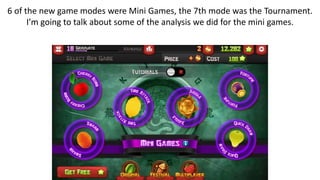
6 of the new game modes were Mini Games, the 7th mode was the Tournament.
I’m going to talk about some of the analysis we did for the mini games.
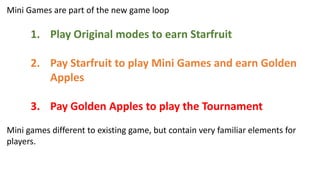
Mini Games are part of the new game loop
1. Play Original modes to earn Starfruit
2. Pay Starfruit to play Mini Games and earn Golden
Apples
3. Pay Golden Apples to play the Tournament
Mini games different to existing game, but contain very familiar elements for
players.
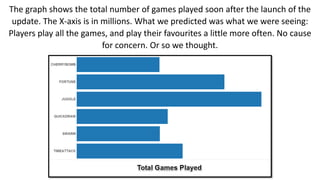
The graph shows the total number of games played soon after the launch of the
update. The X-axis is in millions. What we predicted was what we were seeing:
Players play all the games, and play their favourites a little more often. No cause
for concern. Or so we thought.
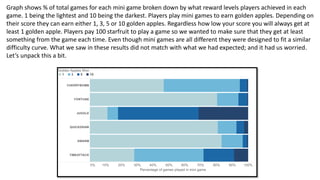
Graph shows % of total games for each mini game broken down by what reward levels players achieved in each
game. 1 being the lightest and 10 being the darkest. Players play mini games to earn golden apples. Depending on
their score they can earn either 1, 3, 5 or 10 golden apples. Regardless how low your score you will always get at
least 1 golden apple. Players pay 100 starfruit to play a game so we wanted to make sure that they get at least
something from the game each time. Even though mini games are all different they were designed to fit a similar
difficulty curve. What we saw in these results did not match with what we had expected; and it had us worried.
Let’s unpack this a bit.
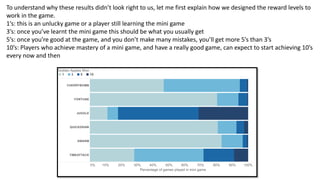
To understand why these results didn’t look right to us, let me first explain how we designed the reward levels to
work in the game.
1’s: this is an unlucky game or a player still learning the mini game
3’s: once you’ve learnt the mini game this should be what you usually get
5’s: once you’re good at the game, and you don’t make many mistakes, you’ll get more 5’s than 3’s
10’s: Players who achieve mastery of a mini game, and have a really good game, can expect to start achieving 10’s
every now and then
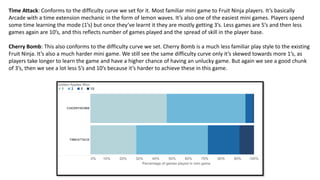
Time Attack: Conforms to the difficulty curve we set for it. Most familiar mini game to Fruit Ninja players. It’s basically
Arcade with a time extension mechanic in the form of lemon waves. It’s also one of the easiest mini games. Players spend
some time learning the mode (1’s) but once they’ve learnt it they are mostly getting 3’s. Less games are 5’s and then less
games again are 10’s, and this reflects number of games played and the spread of skill in the player base.
Cherry Bomb: This also conforms to the difficulty curve we set. Cherry Bomb is a much less familiar play style to the existing
Fruit Ninja. It’s also a much harder mini game. We still see the same difficulty curve only it’s skewed towards more 1’s, as
players take longer to learn the game and have a higher chance of having an unlucky game. But again we see a good chunk
of 3’s, then we see a lot less 5’s and 10’s because it’s harder to achieve these in this game.
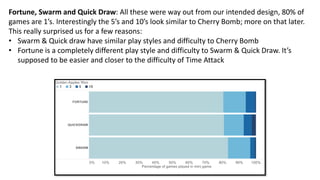
Fortune, Swarm and Quick Draw: All these were way out from our intended design, 80% of
games are 1’s. Interestingly the 5’s and 10’s look similar to Cherry Bomb; more on that later.
This really surprised us for a few reasons:
• Swarm & Quick draw have similar play styles and difficulty to Cherry Bomb
• Fortune is a completely different play style and difficulty to Swarm & Quick Draw. It’s
supposed to be easier and closer to the difficulty of Time Attack
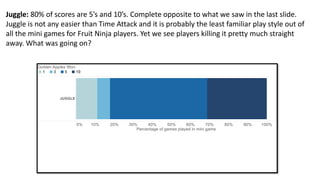
Juggle: 80% of scores are 5’s and 10’s. Complete opposite to what we saw in the last slide.
Juggle is not any easier than Time Attack and it is probably the least familiar play style out of
all the mini games for Fruit Ninja players. Yet we see players killing it pretty much straight
away. What was going on?
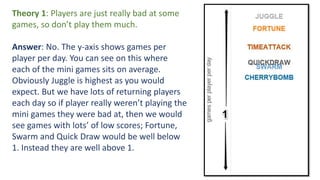
Theory 1: Players are just really bad at some
games, so don’t play them much.
Answer: No. The y-axis shows games per
player per day. You can see on this where
each of the mini games sits on average.
Obviously Juggle is highest as you would
expect. But we have lots of returning players
each day so if player really weren’t playing the
mini games they were bad at, then we would
see games with lots’ of low scores; Fortune,
Swarm and Quick Draw would be well below
1. Instead they are well above 1.
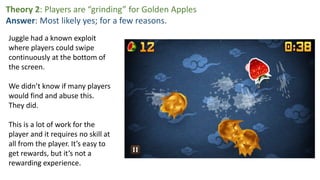
Theory 2: Players are “grinding” for Golden Apples
Answer: Most likely yes; for a few reasons.
Juggle had a known exploit
where players could swipe
continuously at the bottom of
the screen.
We didn’t know if many players
would find and abuse this.
They did.
This is a lot of work for the
player and it requires no skill at
all from the player. It’s easy to
get rewards, but it’s not a
rewarding experience.
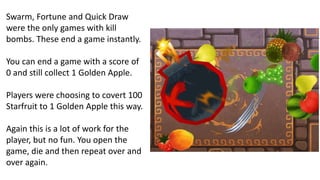
Swarm, Fortune and Quick Draw
were the only games with kill
bombs. These end a game instantly.
You can end a game with a score of
0 and still collect 1 Golden Apple.
Players were choosing to covert 100
Starfruit to 1 Golden Apple this way.
Again this is a lot of work for the
player, but no fun. You open the
game, die and then repeat over and
over again.
Players were working (i.e.
grinding) for golden
apples.
Grinding is acceptable in
games ONLY when it’s
designed to be fun.
Our players had found
ways to grind that weren’t
fun.
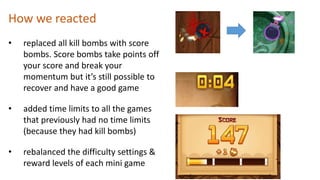
How we reacted
• replaced all kill bombs with score
bombs. Score bombs take points off
your score and break your
momentum but it’s still possible to
recover and have a good game
• added time limits to all the games
that previously had no time limits
(because they had kill bombs)
• rebalanced the difficulty settings &
reward levels of each mini game
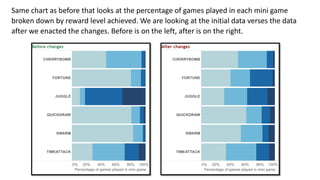
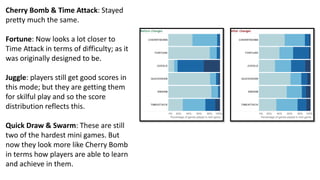
Same chart as before that looks at the percentage of games played in each mini game
broken down by reward level achieved. We are looking at the initial data verses the data
after we enacted the changes. Before is on the left, after is on the right.
Cherry Bomb & Time Attack: Stayed
pretty much the same.
Fortune: Now looks a lot closer to
Time Attack in terms of difficulty; as it
was originally designed to be.
Juggle: players still get good scores in
this mode; but they are getting them
for skilful play and so the score
distribution reflects this.
Quick Draw & Swarm: These are still
two of the hardest mini games. But
now they look more like Cherry Bomb
in terms how players are able to learn
and achieve in them.
Result = More happy, skilful Ninjas
Balancing Fruit - IAPA presentation 26/11/15

Balancing Fruit - IAPA presentation 26/11/15

  • 1.
    IAPA QLD ChapterEvent 26 November - An Australian Analytics Story
  • 2.
    Founded in 2001,Halfbrick has developed a range of hugely successful, independently released games on multiple platforms. Our main base is here in Brisbane, but we are a global company
  • 3.
    One of myjobs is as the analyst on Fruit Ninja. We’ve had Just over 1 billion downloads across all platforms for Fruit Ninja
  • 4.
    Celebrated the 5thanniversary of Fruit Ninja mid this year. We released a huge update for the game adding 7 new game modes to the existing 3. It was a new direction for the game whilst staying true to it’s roots
  • 5.
    6 of thenew game modes were Mini Games, the 7th mode was the Tournament. I’m going to talk about some of the analysis we did for the mini games.
  • 6.
    Mini Games arepart of the new game loop 1. Play Original modes to earn Starfruit 2. Pay Starfruit to play Mini Games and earn Golden Apples 3. Pay Golden Apples to play the Tournament Mini games different to existing game, but contain very familiar elements for players.
  • 7.
    The graph showsthe total number of games played soon after the launch of the update. The X-axis is in millions. What we predicted was what we were seeing: Players play all the games, and play their favourites a little more often. No cause for concern. Or so we thought.
  • 8.
    Graph shows %of total games for each mini game broken down by what reward levels players achieved in each game. 1 being the lightest and 10 being the darkest. Players play mini games to earn golden apples. Depending on their score they can earn either 1, 3, 5 or 10 golden apples. Regardless how low your score you will always get at least 1 golden apple. Players pay 100 starfruit to play a game so we wanted to make sure that they get at least something from the game each time. Even though mini games are all different they were designed to fit a similar difficulty curve. What we saw in these results did not match with what we had expected; and it had us worried. Let’s unpack this a bit.
  • 9.
    To understand whythese results didn’t look right to us, let me first explain how we designed the reward levels to work in the game. 1’s: this is an unlucky game or a player still learning the mini game 3’s: once you’ve learnt the mini game this should be what you usually get 5’s: once you’re good at the game, and you don’t make many mistakes, you’ll get more 5’s than 3’s 10’s: Players who achieve mastery of a mini game, and have a really good game, can expect to start achieving 10’s every now and then
  • 10.
    Time Attack: Conformsto the difficulty curve we set for it. Most familiar mini game to Fruit Ninja players. It’s basically Arcade with a time extension mechanic in the form of lemon waves. It’s also one of the easiest mini games. Players spend some time learning the mode (1’s) but once they’ve learnt it they are mostly getting 3’s. Less games are 5’s and then less games again are 10’s, and this reflects number of games played and the spread of skill in the player base. Cherry Bomb: This also conforms to the difficulty curve we set. Cherry Bomb is a much less familiar play style to the existing Fruit Ninja. It’s also a much harder mini game. We still see the same difficulty curve only it’s skewed towards more 1’s, as players take longer to learn the game and have a higher chance of having an unlucky game. But again we see a good chunk of 3’s, then we see a lot less 5’s and 10’s because it’s harder to achieve these in this game.
  • 11.
    Fortune, Swarm andQuick Draw: All these were way out from our intended design, 80% of games are 1’s. Interestingly the 5’s and 10’s look similar to Cherry Bomb; more on that later. This really surprised us for a few reasons: • Swarm & Quick draw have similar play styles and difficulty to Cherry Bomb • Fortune is a completely different play style and difficulty to Swarm & Quick Draw. It’s supposed to be easier and closer to the difficulty of Time Attack
  • 12.
    Juggle: 80% ofscores are 5’s and 10’s. Complete opposite to what we saw in the last slide. Juggle is not any easier than Time Attack and it is probably the least familiar play style out of all the mini games for Fruit Ninja players. Yet we see players killing it pretty much straight away. What was going on?
  • 13.
    Theory 1: Playersare just really bad at some games, so don’t play them much. Answer: No. The y-axis shows games per player per day. You can see on this where each of the mini games sits on average. Obviously Juggle is highest as you would expect. But we have lots of returning players each day so if player really weren’t playing the mini games they were bad at, then we would see games with lots’ of low scores; Fortune, Swarm and Quick Draw would be well below 1. Instead they are well above 1.
  • 14.
    Theory 2: Playersare “grinding” for Golden Apples Answer: Most likely yes; for a few reasons. Juggle had a known exploit where players could swipe continuously at the bottom of the screen. We didn’t know if many players would find and abuse this. They did. This is a lot of work for the player and it requires no skill at all from the player. It’s easy to get rewards, but it’s not a rewarding experience.
  • 15.
    Swarm, Fortune andQuick Draw were the only games with kill bombs. These end a game instantly. You can end a game with a score of 0 and still collect 1 Golden Apple. Players were choosing to covert 100 Starfruit to 1 Golden Apple this way. Again this is a lot of work for the player, but no fun. You open the game, die and then repeat over and over again.
  • 16.
    Players were working(i.e. grinding) for golden apples. Grinding is acceptable in games ONLY when it’s designed to be fun. Our players had found ways to grind that weren’t fun.
  • 17.
    How we reacted •replaced all kill bombs with score bombs. Score bombs take points off your score and break your momentum but it’s still possible to recover and have a good game • added time limits to all the games that previously had no time limits (because they had kill bombs) • rebalanced the difficulty settings & reward levels of each mini game
  • 18.
    Same chart asbefore that looks at the percentage of games played in each mini game broken down by reward level achieved. We are looking at the initial data verses the data after we enacted the changes. Before is on the left, after is on the right.
  • 19.
    Cherry Bomb &Time Attack: Stayed pretty much the same. Fortune: Now looks a lot closer to Time Attack in terms of difficulty; as it was originally designed to be. Juggle: players still get good scores in this mode; but they are getting them for skilful play and so the score distribution reflects this. Quick Draw & Swarm: These are still two of the hardest mini games. But now they look more like Cherry Bomb in terms how players are able to learn and achieve in them.
  • 20.
    Result = Morehappy, skilful Ninjas

Editor's Notes

  • #2 Roughly 100 million total monthly active users across all Halfbrick games.
  • #3 Roughly 100 million total monthly active users across all Halfbrick games.