June 11, 2017marketing.scienceconsulting group, inc.
linkedin.com/in/augustinefou
June 2017 Ad Blocking Update
Marketing Science analyzed 1.5 billion pageviews and 3 billion ad impressions from
303 websites of mainstream publishers in the U.S. and Canada in June 2017. The
data was directly measured with an embed code installed by publishers on their
websites (on-page and in-ad). Mobile means mobile web; no in-app. The
methodology includes the following:
• On-page measurement – measured the users arriving on the page that had ad blocking
turned on. This is done by attempting to call an asset – ad.gif – and see if it completes or fails.
• In-ad measurement – measured in the ad iframe – these would never be called if ad blocking
were active; our data confirms good publishers do not call ads when ad blockers are on.
KEY FINDINGS – UPDATED
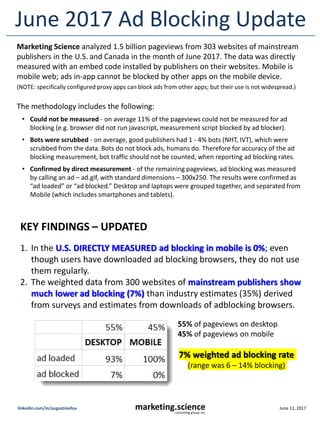
1. DIRECTLY MEASURED ad blocking in MOBILE is 0% in the U.S.
2. Mainstream publishers show much lower ad blocking (7%)
than industry estimates of 35%
3. IN-AD measurement confirmed 0% ad blocking; our ad tag
should only be called when the ad is called; so ad blocking
should be zero, and is thus corroborated.
(range was 6 – 14% blocking)
Ad blocking rates reported by the industry are estimated from the number of ad blocking
plugins (desktop) or ad blocking browsers (mobile) downloaded. This overstates the
problem because users may have downloaded ad blockers, but they don’t use them
regularly. This is especially true in mobile, where most people use their default browser –
Safari (iPhones) and Chrome (Android devices). Directly measured ad blocking rates are a
more accurate reflection of the rate of ad blocking. Also, advertisers are not exposed to
ad blocking anyway, because the ads are not supposed to be called when ad blocking is
on. On-page and in-ad measurement is also different, and must be specified for accuracy.

June 2017 - Ad Blocking Update

  • 1.
    June 11, 2017marketing.scienceconsultinggroup, inc. linkedin.com/in/augustinefou June 2017 Ad Blocking Update Marketing Science analyzed 1.5 billion pageviews and 3 billion ad impressions from 303 websites of mainstream publishers in the U.S. and Canada in June 2017. The data was directly measured with an embed code installed by publishers on their websites (on-page and in-ad). Mobile means mobile web; no in-app. The methodology includes the following: • On-page measurement – measured the users arriving on the page that had ad blocking turned on. This is done by attempting to call an asset – ad.gif – and see if it completes or fails. • In-ad measurement – measured in the ad iframe – these would never be called if ad blocking were active; our data confirms good publishers do not call ads when ad blockers are on. KEY FINDINGS – UPDATED 1. DIRECTLY MEASURED ad blocking in MOBILE is 0% in the U.S. 2. Mainstream publishers show much lower ad blocking (7%) than industry estimates of 35% 3. IN-AD measurement confirmed 0% ad blocking; our ad tag should only be called when the ad is called; so ad blocking should be zero, and is thus corroborated. (range was 6 – 14% blocking) Ad blocking rates reported by the industry are estimated from the number of ad blocking plugins (desktop) or ad blocking browsers (mobile) downloaded. This overstates the problem because users may have downloaded ad blockers, but they don’t use them regularly. This is especially true in mobile, where most people use their default browser – Safari (iPhones) and Chrome (Android devices). Directly measured ad blocking rates are a more accurate reflection of the rate of ad blocking. Also, advertisers are not exposed to ad blocking anyway, because the ads are not supposed to be called when ad blocking is on. On-page and in-ad measurement is also different, and must be specified for accuracy.